Chapter 7 – Cost-Volume-Profit Analysis
83. Which of the following underlying assumptions form(s) the basis for cost-volume-profit
analysis?
84. Cost-volume-profit analysis is based on certain general assumptions. Which of the
following is not one of these assumptions?
85. The assumptions on which cost-volume-profit analysis is based appear to be most valid
for businesses:
86. The contribution income statement differs from the traditional income statement in which
of the following ways?
87. Which of the following does not typically appear on a contribution income statement?
88. Which of the following does not typically appear on an income statement prepared by
using a traditional format?
89. The extent to which an organization uses fixed costs in its cost structure is measured by:
90. A manager who wants to determine the percentage impact on income of a given
percentage change in sales would multiply the percentage increase/decrease in sales revenue
by the:
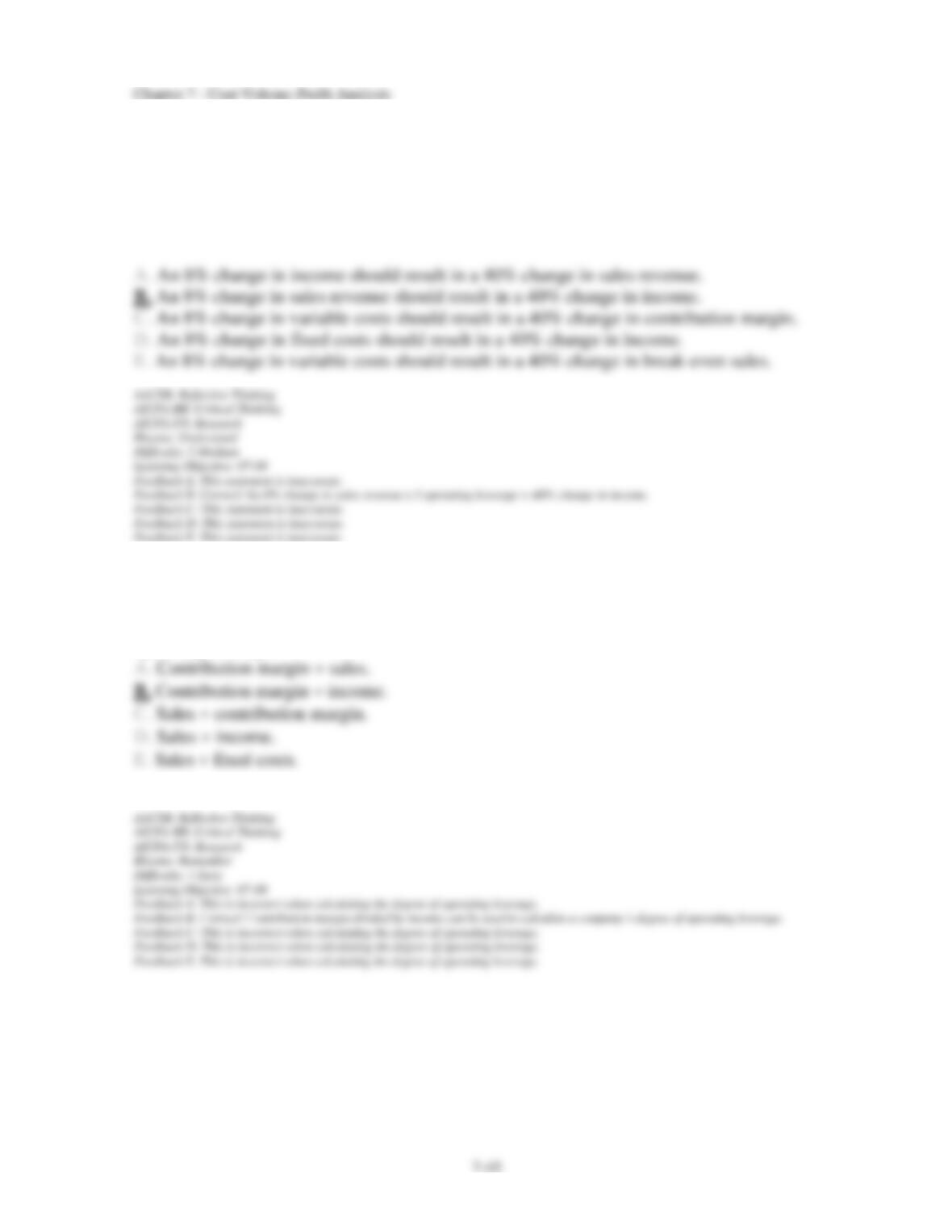
91. Gandee Company has an operating leverage factor of 5. Which of the following
statements is true?
Thus, an 8% change in ______ should result in a 40% change in ______. The respective
amounts that change are:
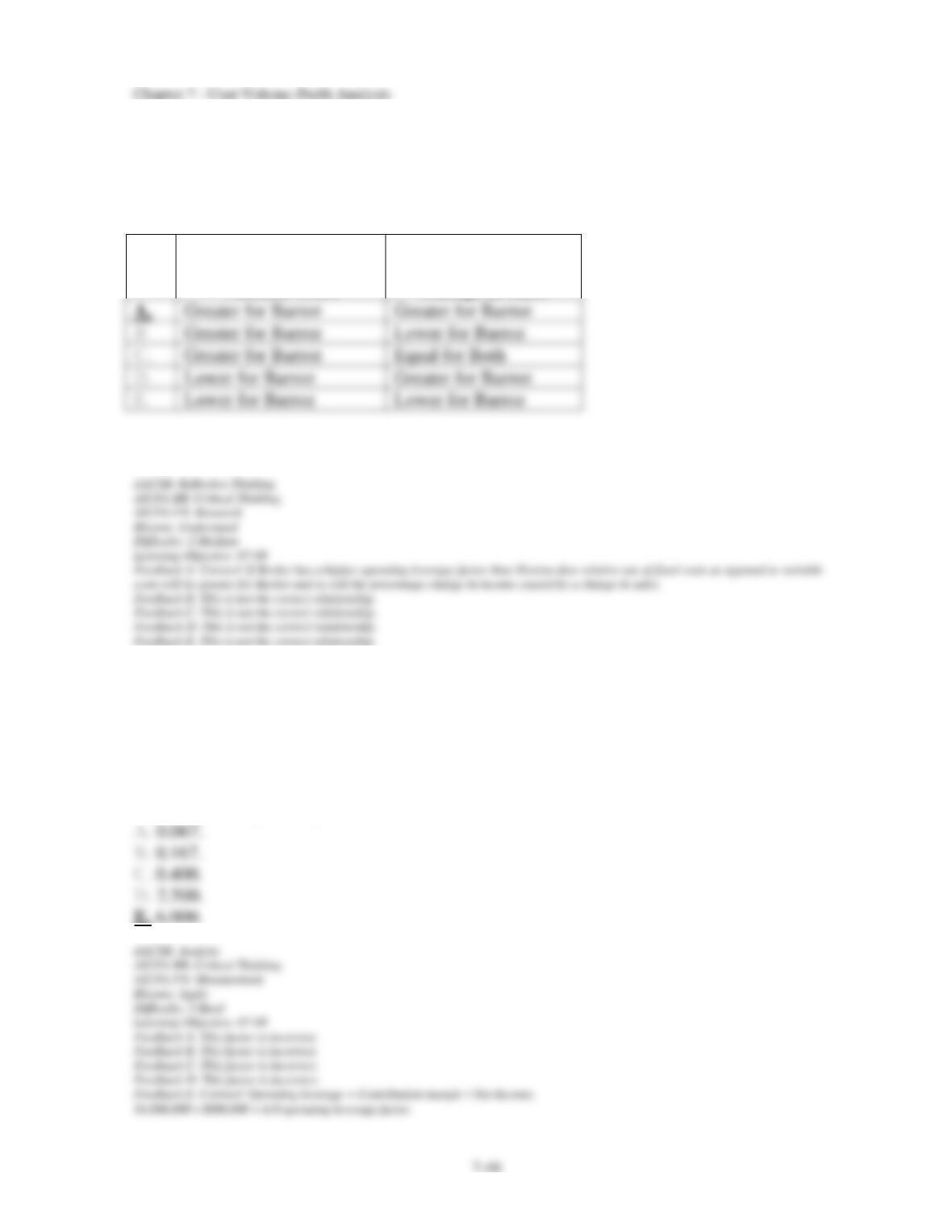
92. Which of the following calculations can be used to measure a company’s degree of
operating leverage?
93. You are analyzing Barroz Corporation and Newton Corporation and have concluded that
Barroz has a higher operating leverage factor than Newton. Which one of the following
choices correctly depicts (1) the relative use of fixed costs (as opposed to variable costs) for
the two companies and (2) the percentage change in income caused by a change in sales?
Relative Use of Fixed
Costs as Opposed to
Variable Costs
Percentage Change in
Income Caused by a
Change in Sales
94. The following information relates to Dazie Company:
Sales revenue $12,000,000
Contribution margin 4,800,000
Net Income 800,000
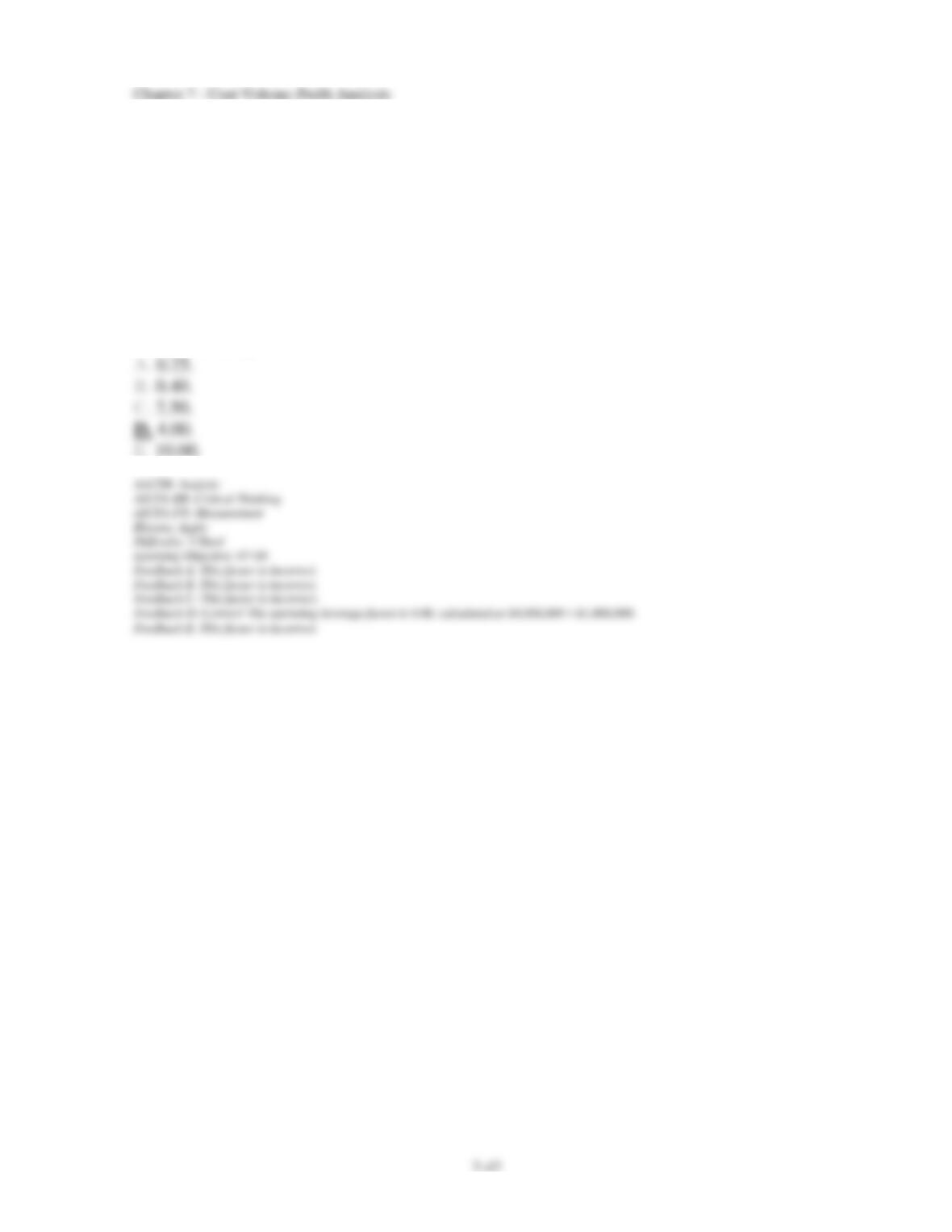
Dazie’s operating leverage factor is closest to:
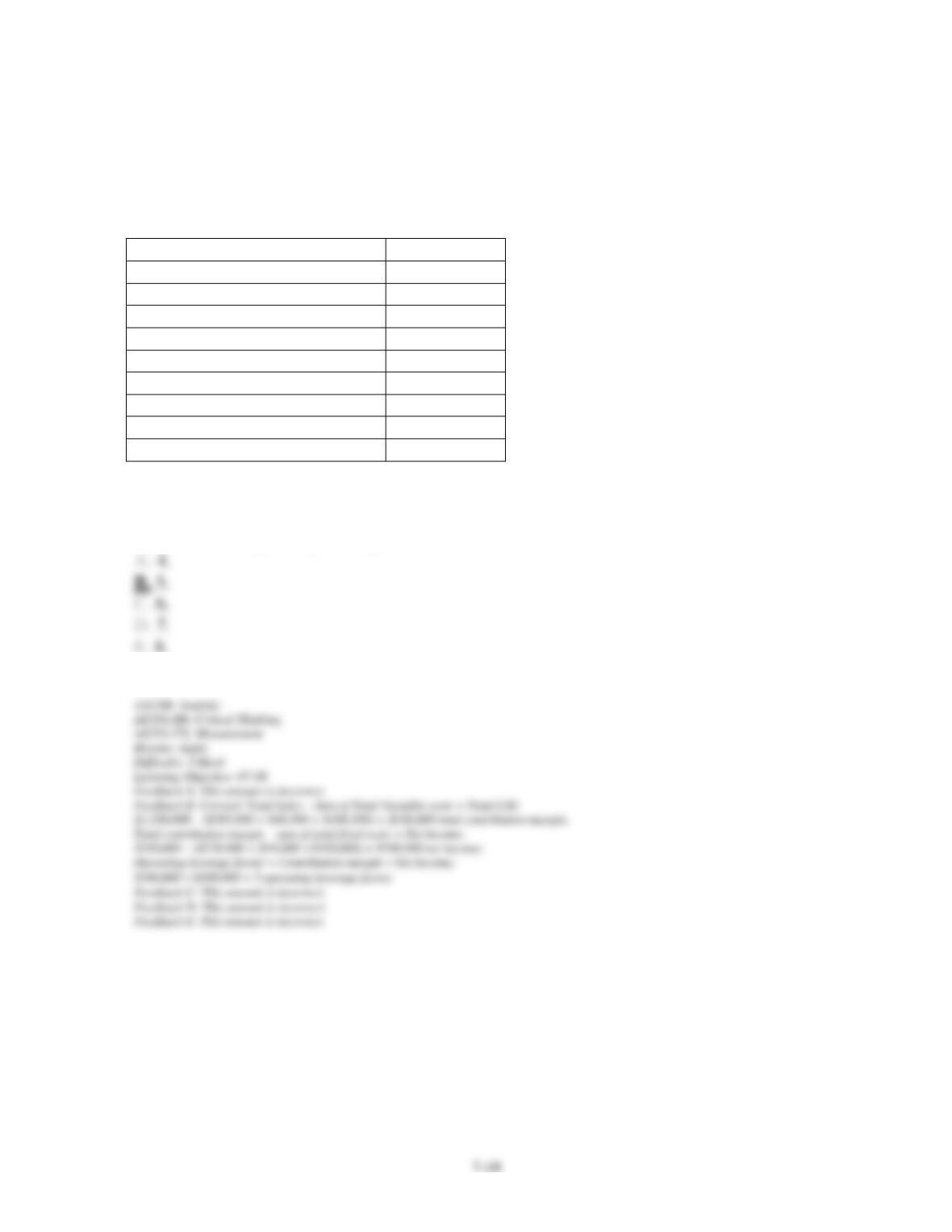
95. The following information relates to Paternus Company:
Sales revenue $10,000,000
Contribution margin 4,000,000
Net Income 1,000,000
If a manager at Paternus desired to determine the percentage impact on income of a given
percentage change in sales, the manager would multiply the percentage increase/decrease in
sales revenue by:
Chapter 7 – Cost-Volume-Profit Analysis
Use the following information to answer Questions 96-97.
Edmonco Company produced and sold 45,000 units of a single product last year, with the
following results:
Sales Revenue
$1,350,000
Manufacturing costs:
Variable
585,000
Fixed
270,000
Selling costs:
Variable
40,500
Fixed
54,000
Administrative costs:
Variable
184,500
Fixed
108,000
96. Edmonco’s operating leverage factor was:
97. If Edmonco’s sales revenues increase 15%, what will be the percentage increase in income
before income taxes?
98. When advanced manufacturing systems are installed, what effect does such installation
usually have on fixed costs and the break-even point?
Fixed Costs
Break-even Point
Increase
Increase
Increase
Decrease
Decrease
Increase
Decrease
Decrease
Do not change
Does not change
99. Which of the following statements is (are) true regarding a company that has implemented
flexible manufacturing systems and activity-based costing?
I. The company has erred, as these two practices used in conjunction with one another will
severely limit the firm’s ability to analyze costs over the relevant range.
II. Costs formerly viewed as fixed under traditional-costing systems may now be considered
variable with respect to changes in cost drivers such as number of setups, number of material
moves, and so forth.
III. As compared with the results obtained under a traditional-costing system, the concept of
break-even analysis loses meaning.
100. A company, subject to a 40% tax rate, desires to earn $500,000 of after-tax income. How
much should the firm add to fixed costs when figuring the sales revenues necessary to
produce this income level?
101. Samuels, Inc. is subject to a 40% income tax rate. The following data pertain to the
period just ended when the company produced and sold 45,000 units:
Sales revenue
$1,350,000
Variable costs
810,000
Fixed costs
432,000
How many units must Samuels sell to earn an after-tax profit of $180,000?
102. Samuels, Inc. is subject to a 40% income tax rate. The following data pertain to the
period just ended when the company produced and sold 45,000 units:
Sales revenue
$1,350,000
Variable costs
810,000
Fixed costs
432,000
How many units must Samuels sell to earn an after-tax profit of $225,000?
Chapter 7 – Cost-Volume-Profit Analysis
Essay Questions
103. Vogt Corporation’s product no. H647 has a negative contribution margin. How can such
a situation arise? Should the company continue to stock and sell product no. H647? Explain.
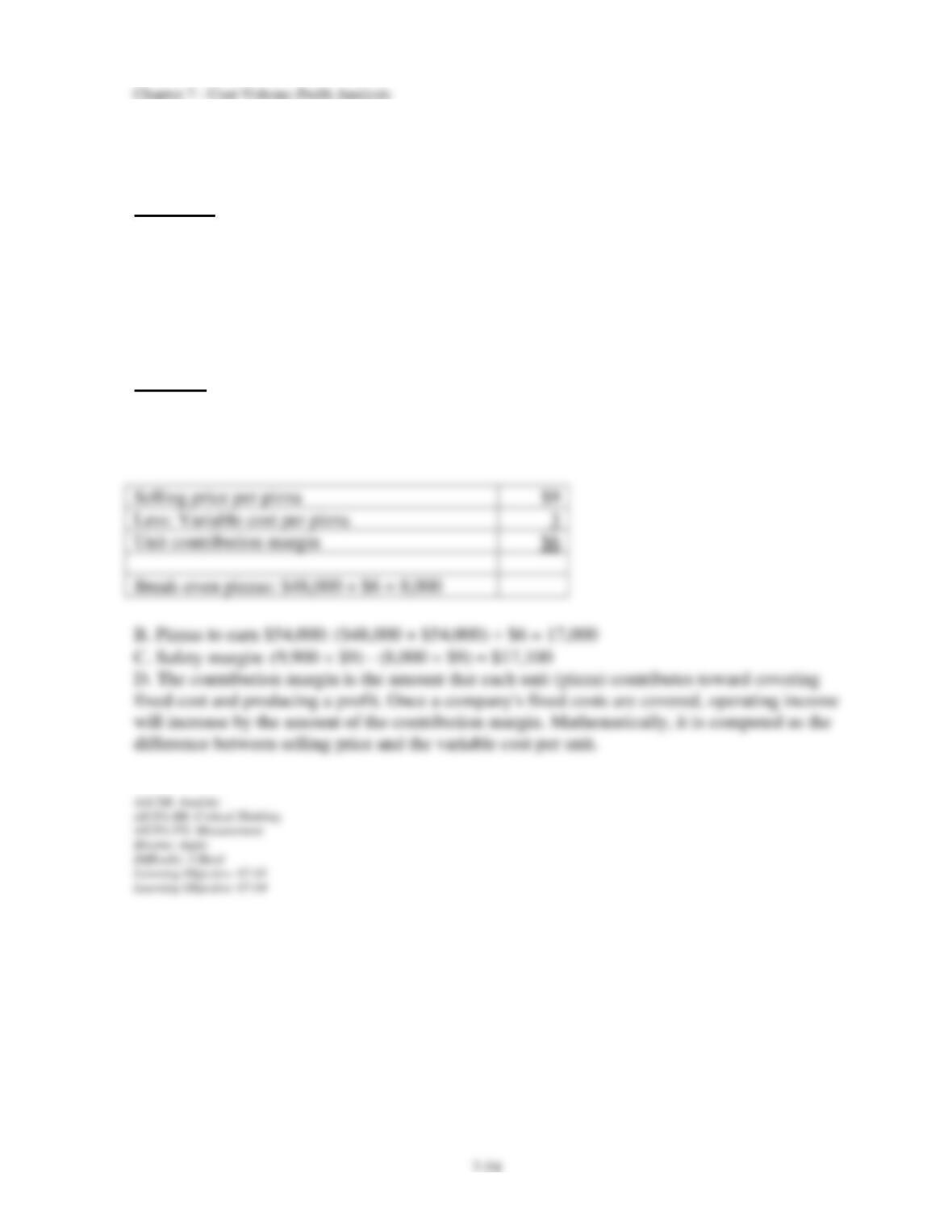
104. Randy’s Pizza delivers pizzas to dormitories and apartments near a major state
university. The company’s annual fixed costs are $48,000. The sales price averages $9, and it
costs the firm $3 to make and deliver each pizza.
Required:
A. How many pizzas must Randy’s sell to break even?
B. How many pizzas must the company sell to earn a target profit of $54,000?
C. If budgeted sales total 9,900 pizzas, how much is the company’s safety margin in dollars?
D. Tony’s assistant manager, an accounting major, has suggested that the firm should try to
increase the contribution margin per pizza. Explain the meaning of “contribution margin” in
layman’s terms.
Solution:
A.
7-55
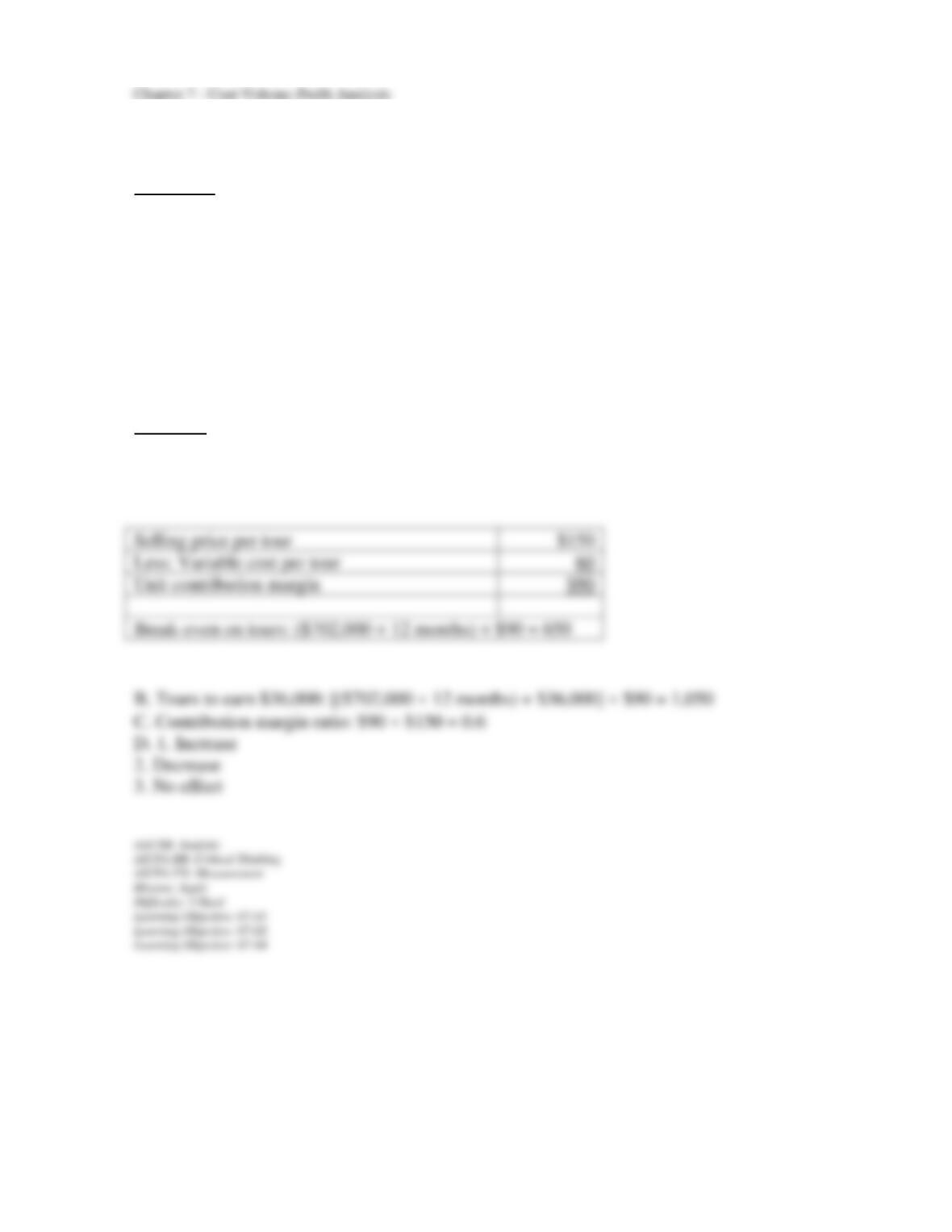
105. High Flying takes tourists on helicopter tours of Hawaii. Each tourist buys a $150 ticket;
the variable costs average $60 per person. High Flying has annual fixed costs of $702,000.
Required:
A. Compute the average number of tours the company must conduct per month to break even.
B. Compute the average sales revenue needed per month to produce a target average profit of
$36,000 per month. See below (answer to “B”).
C. Calculate the contribution margin ratio.
D. Determine whether the actions that follow will increase, decrease, or not affect the
company’s break-even point.
1. A decrease in tour prices.
2. The termination of a salaried clerk (no replacement is planned).
3. A decrease in the number of tours sold.
Solution:
A.
7-56
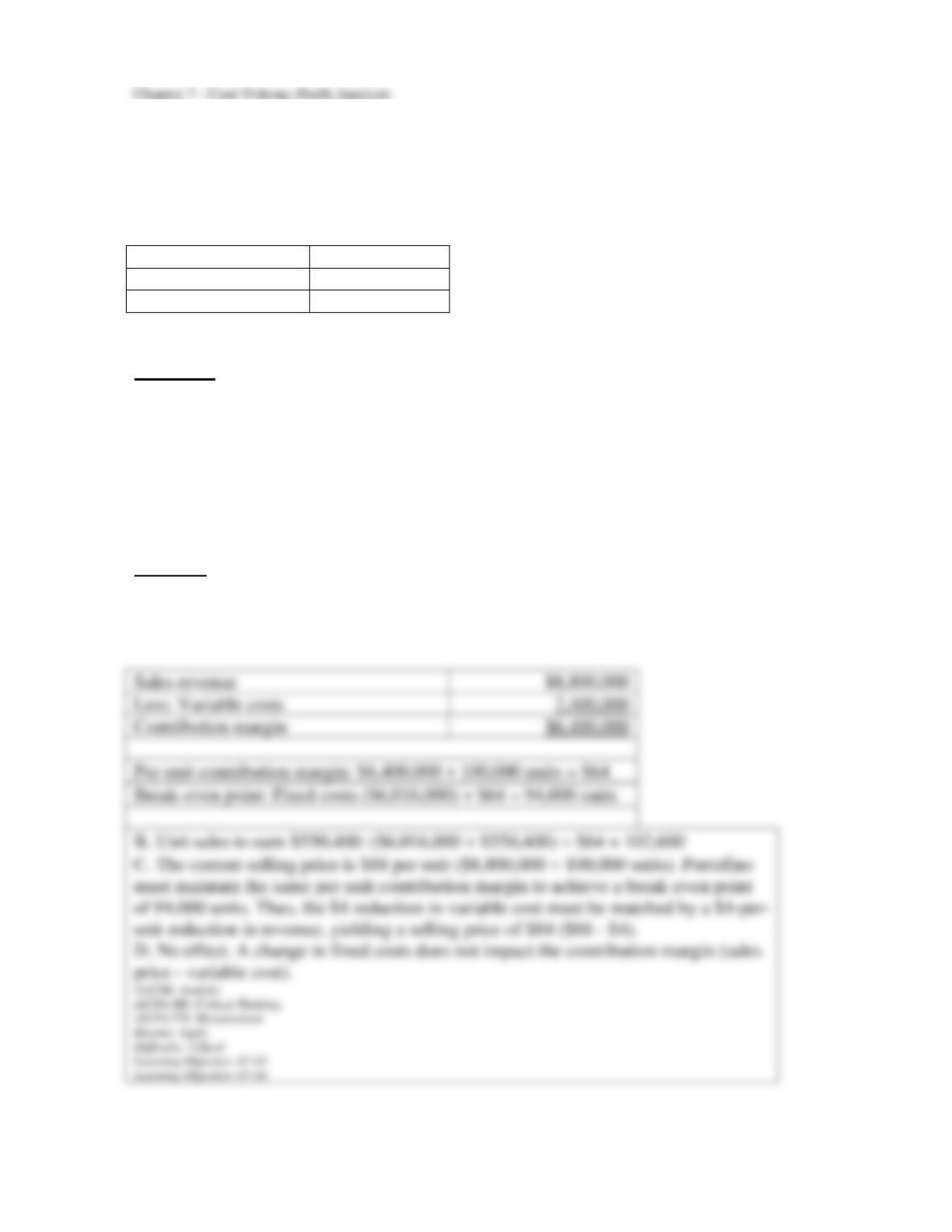
106. The information that follows was obtained from the accounting records of Portofino
Manufacturing during a period when the company sold 100,000 units.
Sales revenue
$8,800,000
Variable costs
2,400,000
Fixed costs
6,016,000
Required:
A. Compute the company’s per-unit contribution margin and break-even point in units.
B. How many units must Portofino sell to produce a target profit of $550,400?
C. Assume that Portofino was able to reduce the variable cost per unit by $4. What selling
price could management charge if it desired to maintain the current break-even point?
D. Depreciation charges of $640,000 are included in the firm’s fixed costs of $6,016,000. If
these charges were to increase by 10%, what effect, if any, would this cost increase have on
the company’s contribution margin?
Solution:
A.
Sales revenue
Less: Variable costs
Contribution margin