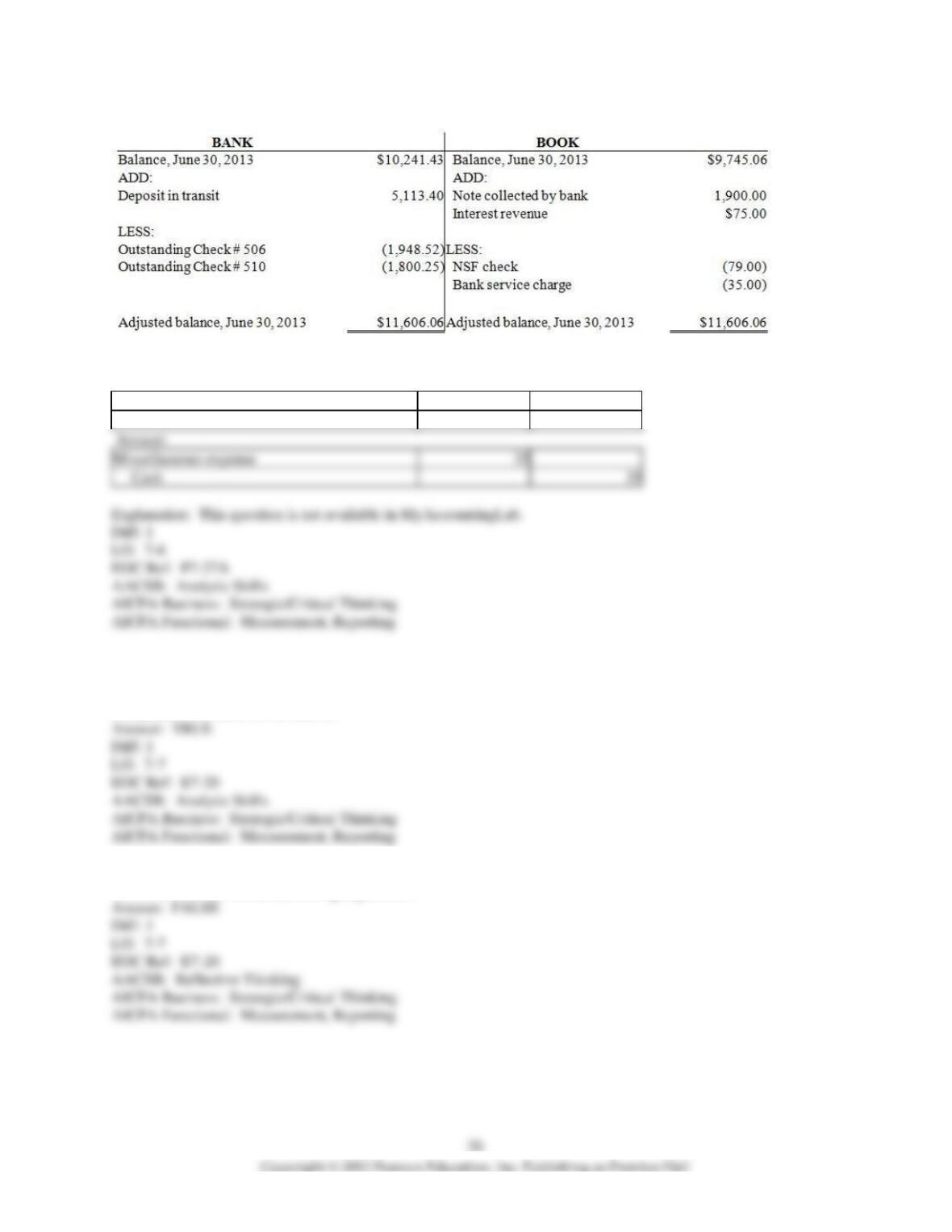
53) Please refer to the following bank reconciliation:
Please prepare the adjusting entry for the fourth reconciling item (bank service charge.)
Miscellaneous expense
Learning Objective 7-7
1) A point-of-sale terminal (cash register) provides control over cash in the form of a tape record of sales which is
compared to the count of the drawer.
2) As part of the internal control over cash receipts by mail, the mailroom sends both the customer checks and the
remittance advices to the accounting department.
3) Regarding controls over cash receipts by mail, the bank deposit slip should be compared to the remittance
advices by the accounting department.
4) For strong controls over cash receipts, the checks to be deposited should be sent to the treasurer and the
remittance advices should be sent to the accounting department.
5) As long as the same person deposits customer checks and records the deposits into the ledger, there will be good
internal control over cash receipts.
6) A basic principle of internal control over cash receipts is that the deposit of the cash and the recording of the
receipts into the ledger should be separated.
7) Which of the following is used by many companies to separate cash duties and establish stronger control over
cash receipts?
A) An encryption system
B) An imprest system
C) A lock-box system
D) A firewall system
8) Which of the following is the last step in the daily control over cash receipts by mail?
A) A mailroom employee sends all customer checks to the treasurer who has the cashier make the bank deposit.
B) A mailroom clerk opens the mail and sends the remittance advices to the accounting department.
C) The controller compares the records of the day’s bank deposit amount from the treasurer and the debit to cash
from the accounting department.
D) The accounting department prepares journal entries to cash and the customers’ accounts.
9) A system where customers send their checks directly to the company’s bank account is described as which of the
following?
A) An encryption system
B) An imprest system
C) A lock-box system
D) A firewall system
Learning Objective 7-8
1) Before signing a check, the controller or the treasurer should examine the purchase order, the invoice, and the
receiving report to determine that the company received the goods and that the company is paying only for the goods
received.
2) A receiving report should be matched with the supplier invoice before a payment to the supplier is approved.
3) For good controls over cash payments, the company officer approving a payment voucher should be the same as
the person who ordered the goods, to ensure that the correct amount of cash is paid.
4) For good controls over cash payments, the person who orders goods from a supplier should always be different
from the person who approves the payment.
5) Which of the following is the first step in the purchasing and payment process?
A) The supplier ships the goods and sends an invoice to the purchaser.
B) The purchaser sends a check to the supplier.
C) The purchaser sends a purchase order to the supplier.
D) The purchase receives the inventory and prepares a receiving report.
6) Which of the following is NOT included in a voucher?
A) An approval signature
B) A check
C) The invoice number
D) A description of the goods or services being purchased
7) Which of the following items is NOT required to be examined by the controller or treasurer before signing a
check?
A) The invoice
B) The purchase order
C) The receiving report
D) The journal entry
8) A company check for payment must be signed by:
A) any employee of the company.
B) a bank employee.
C) a person specifically authorized by the company.
D) the external auditor.
9) Which of the following should the purchasing agent NOT be able to do?
A) Prepare the purchase order.
B) Receive the goods.
C) Contact the supplier of the goods.
D) Negotiate prices with suppliers.
10) Which of the following should the purchasing agent NOT be able to do?
A) Prepare the purchase order.
B) Approve the payment.
C) Contact the supplier of the goods.
D) Negotiate prices with suppliers.
11) Which of the following statements describes a voucher?
A) It is an order to purchase goods from a supplier.
B) It is a statement from the supplier showing the goods purchased and the amount due.
C) It is a report showing that the goods have been received in good condition, as ordered.
D) It is a document authorizing a payment to a supplier.
12) Which of the following statements describes a purchase order?
A) It is an order to purchase goods from a supplier.
B) It is a statement from the supplier showing the goods purchased and the amount due.
C) It is a report showing that the goods have been received in good condition, as ordered.
D) It is a document authorizing a payment to a supplier.
13) Which of the following statements describes an invoice from a supplier?
A) It is an order to purchase goods from a supplier.
B) It is a statement from the supplier showing the goods purchased and the amount due.
C) It is a report showing that the goods have been received in good condition, as ordered.
D) It is a document authorizing a payment to a supplier.
14) Which of the following statements describes a receiving report?
A) It is an order to purchase goods from a supplier.
B) It is a statement from the supplier showing the goods purchased and the amount due.
C) It is a report showing that the goods have been received in good condition, as ordered.
D) It is a document authorizing a payment to a supplier.
15) In a system of good internal control, a payment to a supplier requires which documents for proper approval?
A) A journal entry, a supplier invoice, and a description of the goods being purchased
B) A receiving report, an invoice, and a purchase order
C) A purchase order, a journal entry, and a price catalog
D) A supplier invoice, a bill of lading, and the supplier’s financial statements
16) A document authorizing a cash payment is a(n):
A) check.
B) invoice.
C) voucher.
D) bill of lading.
17) If a single person is authorized to both order goods and approve payments, the company may be defrauded in
several ways. Which of the following scenarios would NOT be a possible consequence of this control weakness?
A) The company may order goods priced above the current market price.
B) The goods received may be damaged in shipment.
C) The company may purchase more goods or higher quality goods than it needs.
D) The company may purchase goods from a “related party” in order to enrich a relative of the company employee.
Learning Objective 7-9
1) Cash in the bank is more liquid than a petty cash fund.
2) Petty cash is a fund containing a small amount of cash that is used to pay for minor expenditures.
3) The journal entry to replenish a petty cash fund includes a debit to the petty cash account and a credit to the
expense account.
4) The journal entry to open a new petty cash fund includes a debit to the petty cash account and a credit to cash in
bank.
5) A key to strong control over petty cash is to ensure that several persons serve as custodian at one time.
6) An imprest system is a way to account for petty cash by maintaining a constant balance in the petty cash account,
supported by the fund (cash plus payment tickets) totaling the same amount.
7) Which is the MOST liquid of assets?
A) Cash
B) Accounts receivable
C) Inventory
D) Supplies
8) A company has a petty cash fund amount of $200. When replenished, it has petty cash receipts of $15 for gas
expense, $23 for postage expense, $18 for supplies expense and $12 for miscellaneous expenses. In the journal
entry, Cash would be credited for:
A) $68.
B) $132.
C) $200.
D) $42
9) A fund for petty cash of $200 has $17 remaining in cash, $3 in miscellaneous cash receipts and additional $180
specific cash receipts. The debit to Cash short & over would be:
A) $0.
B) $17.
C) $180.
D) $183.
10) Which of the following would be included in the entry to record the replenishment of a petty cash fund?
A) A credit to Petty cash
B) A debit to Cash in bank
C) A credit to Cash in bank
D) A credit to various expenses and assets
11) A petty cash fund was established with a $250 balance. It currently has cash of $31 and petty cash tickets
totaling $219. Which of the following would be included in the entry to replenish the fund?
A) A credit to Petty cash for $219
B) A debit to Petty cash for $31
C) A credit to Cash in bank for $31
D) Debits to various expenses for $219
12) A petty cash fund was established with a $250 balance. It currently has cash of $31 and petty cash tickets
totaling $219. Which of the following would be included in the entry to replenish the fund?
A) A credit to Petty cash for $219
B) A debit to Petty cash for $31
C) A credit to Cash in bank for $31
D) A credit to Cash in bank for $219
13) Petty cash is accounted for by maintaining a constant balance in the petty cash account, supported by the fund
(cash plus payment tickets) totaling the same amount. What is this system called?
A) A control system
B) A voucher system
C) A balanced system
D) An imprest system
14) A petty cash fund was established with a $400 balance. It currently has cash of $10 and petty cash tickets as
shown below.
Travel expense
$120
Office supplies
$200
Equipment rental expense
$70
The journal entry to replenish the account would be which of the following:
A) Debit various expenses $390, credit Cash $390
B) Debit various expenses $390, credit Petty cash fund $390
C) Debit Cash $10, credit various expenses $10
D) Credit Petty cash fund $390, debit Cash $390
15) A petty cash fund was established with a $400 balance. It currently has cash of $9 and petty cash tickets as
shown below.
Travel expense
$120
Office supplies
$200
Equipment rental expense
$70
The journal entry to replenish the account would be which of the following:
A) Debit to Cash short & over for $1
B) Credit Cash short & over for $1
C) Debit Petty cash fund $1
D) Credit Petty cash fund $1
16) A petty cash fund was established with a $400 balance. It currently has cash of $15 and petty cash tickets as
shown below.
Travel expense
$120
Office supplies
$200
Equipment rental expense
$70
The journal entry to replenish the account would be which of the following:
A) Debit to Cash short & over for $5
B) Credit Cash short & over for $5
C) Debit Petty cash fund $5
D) Credit Petty cash fund $5
17) A petty cash fund was established with a $300 balance. It currently has cash of $78 and petty cash tickets
totaling $222 for travel expense. Please provide the journal entry to record the replenishment of the account.
Travel expense
Cash
18) A petty cash fund was established with a $300 balance. It currently has cash of $77 and petty cash tickets
totaling $222 for travel expense. Please provide the journal entry to record the replenishment of the account.
Travel expense
Cash short & over
Learning Objective 7-10
1) An accountant is under pressure to maximize the company’s net income at year-end. He is told to delay orders of
important services until the following year. This action would be considered unethical because it is a
misrepresentation of actual transactions.
2) An accountant is under pressure to maximize the company’s net income at year-end. He is told to record expense
payments made in December as if they were actually made the following January. This action would be considered
unethical because it is a misrepresentation of actual transactions.
3) A company makes a legitimate, properly authorized payment to a supplier. The accountant changes the date of
the transaction to shift it to a later time period. Because the transaction is legitimate, this action would not be
considered unethical.
4) A company urgently needs to repair its fire alarm system, which will cost $6,000. The two senior managers who
are authorized to approve payments over $5,000 are both on holiday and cannot be reached. The office manager is
only authorized to approve payments up to $5,000, but is concerned about the risks and safety factors involved, and
wants to have the repair work done immediately. She asks if the contractor could split up the repair bill into two
separate invoices, one for parts, and one for labor, so that she could approve both of them separately, and get the
work done right away. This action would not be considered unethical, as long as the office manager does not violate
specific company rules, or deliberately misrepresent the facts of the situation.
5) Around the end of the year, an accountant orders a shipment of inventory earlier than normally scheduled because
she knows that it will result in lower cost of goods sold, and thus a higher net income. This action would be
considered unethical because it is not a legitimate business transaction.
6) Which of the following statements describes the decision guidelines for an ethical decision?
A) Identify the ethical issue, specify alternatives, calculate the gain or loss on each alternative solution, and choose
the solution with the smallest gain or highest loss.
B) Identify the ethical issue, specify alternatives, consult the Code of Professional Conduct, and choose the solution
which has the greatest benefit to the largest number of people.
C) Identify the ethical issue, specify alternatives, assess the possible outcomes, and make the decision.
D) Identify the ethical issue, consult an external auditor, and make the decision.
7) If an accountant takes an action that is deliberately designed to improve the company’s financial results, it would
be considered unethical if:
A) it deliberately misrepresents facts.
B) the action was taken specifically for the purpose of showing higher income.
C) the action will require a special journal entry.
D) the action is not in the best interests of the business owners.