6) In respect to accounting for depreciation, IFRS uses a components approach for assets such as
buildings, aircraft, and manufactured equipment.
7) A company purchased a machine for $100,000. The accumulated depreciation on the machine is now
$100,000. Which of the following statements is TRUE regarding the disposal of the machine for no cash
proceeds?
A) The cost of the asset, but not its accumulated depreciation, must be removed from the books.
B) A gain or loss on the disposal can occur.
C) The journal entry to record the disposal will decrease net assets.
D) There will be no gain or loss on the disposal.
8) A company purchased a machine for $200,000. The accumulated depreciation on the machine is now
$130,000. The machine is junked. Which journal entry is prepared to record the disposal?
A) debit Loss on Disposal of Machine for $70,000, debit Accumulated Depreciation – Machine $70,000
and credit Machine for $140,000
B) debit Accumulated Depreciation – Machine for $130,000 and credit Machine for $130,000
C) debit Accumulated Depreciation – Machine for $200,000, credit Machine for $130,000 and credit Gain
on Disposal of Machine for $70,000
D) debit Loss on Disposal of Machine for $70,000, debit Accumulated Depreciation – Machine for
$130,000 and credit Machine for $200,000
9) When plant assets are exchanged, the gain or loss on the exchange equals:
A) the difference between the fair value and the book value of the asset received.
B) the difference between the fair value and the book value of the asset given up.
C) the fair value of the asset received plus the cash paid.
D) the fair value of the asset given up plus the cash paid.
10) U.S. Generally Accepted Accounting Principles require the reporting of plant assets at ________ on
the balance sheet. International Financial Reporting Standards allow the reporting of plant assets at
________ on the balance sheet.
A) current replacement cost; fair market value
B) fair market value; fair market value
C) historical cost; fair market value
D) historical cost; net realizable value
11) Franco Company sold office furniture for $2400 cash. The furniture cost $70,000 and had
accumulated depreciation through the date of sale totaling $32,000. The company will recognize:
A) a gain of $35,600.
B) a loss of $35,600.
C) a gain of $38,000.
D) a loss of $38,000.
12) Smiley Corporation sold equipment costing $72,000 with $66,000 of accumulated depreciation for
$10,000 cash. Which of the following journal entries should be prepared?
A) debit Cash for $10,000 and credit Gain on Sale of Equipment for $10,000
B) debit Accumulated Depreciation – Equipment for $66,000 and credit Equipment for $66,000
C) debit Cash for $10,000, credit Equipment for $6000 and credit Gain on Sale of Equipment for $4000
D) debit Cash for $10,000, debit Accumulated Depreciation – Equipment for $66,000, credit Equipment
for $72,000and credit Gain on Sale of Equipment for $4000
13) Equipment costing $50,000 with a book value of $16,000 is sold for $21,000. Which journal entry is
used to record the sale?
A) debit Cash for $21,000 and credit Equipment for $21,000
B) debit Cash for $16,000, debit Accumulated Depreciation – Equipment for $34,000 and credit
Equipment for $50,000
C) debit Cash for $21,000, debit Accumulated Depreciation – Equipment for $34,000, credit Equipment
for $50,000 and credit Gain on Sale of Equipment for $5000
D) debit Cash for $16,000, debit Loss on Sale of Equipment for $5000 and credit Equipment for $21,000
14) Equipment purchased for $80,000 on January 1, 2015, was sold on July 1, 2018. The company uses
the straight-line method of computing depreciation and recognizes $15,000 of depreciation expense
annually. When recording the sale, the company should record a debit to Accumulated Depreciation
for:
A) $0.
B) $45,000.
C) $52,500.
D) $60,000.
15) Equipment acquired on January 1, 2014, is sold on June 30, 2018, for $11,200. The equipment cost
$46,500, had an estimated residual value of $6400, and an estimated useful life of 5 years. The company
prepares financial statements on December 31, and the equipment has been depreciated using the
straight-line method. On June 30, 2018, the company should record Depreciation Expense of:
A) $0.
B) $2005.
C) $4650.
D) $8020.
16) Kolonas, Inc., sold equipment for $5400 cash. The equipment cost $73,400 and had accumulated
depreciation through the date of sale of $72,000. At the date of sale, the journal entry to record the sale
will have:
A) a Gain on Sale of Equipment for $1400.
B) a Loss on Sale of Equipment for $1400.
C) a Loss on Sale of Equipment for $4000.
D) a Gain on Sale of Equipment for $4000.
17) Willis Company trades in a printing press for a newer model. The cost of the old printing press was
$61,000, and accumulated depreciation up to the date of the trade–in is $44,000. The company also pays
$42,000 cash for the newer printing press. The fair market value of the newer printing press is $72,000.
The journal entry to acquire the new printing press will require a debit to Printing Press for:
A) $42,000.
B) $61,000.
C) $72,000.
D) $105,000.
18) Tom’s Roadside Burger Stand has a beginning balance in the Accumulated Depreciation—
Equipment account of $260,000. The depreciation expense on the equipment for the year was $60,000. At
the end of the year, the balance in the Accumulated Depreciation—Equipment account was $150,000.
What was the accumulated depreciation on the equipment sold during the year?
A) $110,000
B) $90,000
C) $170,000
D) $200,000
19) Equipment with a historical cost of $70,000 and Accumulated Depreciation of $70,000 is junked.
Which journal entry is necessary?
A) debit Equipment for $70,000 and credit Accumulated Depreciation – Equipment for $70,000
B) debit Cash for $70,000 and credit Equipment for $70,000
C) debit Equipment for $70,000 and credit Cash for $70,000
D) debit Accumulated Depreciation – Equipment for $70,000 and credit Equipment for $70,000
20) Equipment with a historical cost of $105,000 and Accumulated Depreciation of $20,000 is junked. No
cash is received upon disposal. Which journal entry is necessary?
A) debit Accumulated Depreciation – Equipment for $105,000 and credit Equipment for $105,000
B) debit Accumulated Depreciation – Equipment for $20,000, debit Gain on Disposal of Equipment for
$85,000 and credit Equipment for $105,000
C) debit Accumulated Depreciation – Equipment for $20,000, debit Loss on Disposal of Equipment for
$85,000 and credit Equipment for $105,000
D) debit Accumulated Depreciation – Equipment for $20,000 and credit Equipment for $20,000
21) Excalibur Company sells equipment for $20,000 cash. The gain or loss on the sale of equipment
equals:
A) the cash received upon the sale.
B) the book value of the equipment.
C) the accumulated depreciation of the equipment plus the cash received from the sale.
D) the difference between the cash received on sale and the book value of the equipment.
22) Tony Company sells equipment for $20,000 cash. The equipment has a historical cost of $60,000 and
accumulated depreciation of $54,000. What is the gain or loss on sale of the equipment?
A) $14,000 loss
B) $14,000 gain
C) $20,000 loss
D) $20,000 gain
23) Remini Company sells equipment for $20,000 cash. The equipment has a historical cost of $87,000
and accumulated depreciation of $55,000. What is the journal entry to record the sale of the equipment?
A) debit Cash for $20,000 and credit Gain on Sale of Equipment for $20,000
B) debit Cash for $20,000, debit Accumulated Depreciation – Equipment for $55,000 and credit
Equipment for $75,000
C) debit Loss on Sale of Equipment for $12,000, debit Cash for $20,000, debit Accumulated Depreciation
– Equipment for $55,000 and credit Equipment for $87,000
D) debit Cash for $20,000, debit Accumulated Depreciation – Equipment for $55,000, debit Gain on Sale
of Equipment $12,000 and credit Equipment for $87,000
24) The Pizza Store trades in a delivery car for a newer model. The old delivery car has a cost of $9000
and accumulated depreciation of $8000. The Pizza Store pays cash of $5000. The fair value of the newer
car is $20,000. What is the gain or loss for the Pizza Store on the exchange of vehicles?
A) $14,000 loss
B) $1000 gain
C) $14,000 gain
D) $15,000 gain
25) Beck Company trades in old equipment for new equipment. The old equipment has a cost of $10,000
and accumulated depreciation of $8000. Beck Company pays cash of $24,000. The fair value of the new
equipment is $25,000. What is the gain or loss for Beck Company on the exchange of equipment?
A) -$1000 loss
B) -$1000 gain
C) $1000 loss
D) $1000 gain
26) A company exchanges an old machine for a new machine and cash is paid for the new machine.
Assume there is a Gain on Exchange of Machine. In the journal entry to record the exchange by the
owner of the old machine, which accounts will be debited?
A) Machine and Accumulated Depreciation – Machine
B) Cash and Machine
C) Accumulated Depreciation – Machine, Cash and Machine
D) Accumulated Depreciation – Machine, Cash, Machine and Gain on Exchange of Machine
27) When recording a nonmonetary exchange of two plant assets, what information is NOT needed?
A) book value of the asset given up
B) book value of the asset received
C) fair value of asset given up
D) fair value of the asset received.
28) At the beginning of the year, the balance in the Buildings account was $1,200,000. At the end of the
year, the balance in the Buildings account was $2,100,000. During the year, a building was purchased for
$1,400,000. This was the only purchase of buildings during the year. What was the cost of the building or
buildings sold during the year?
A) $0
B) $500,000
C) $1,200,000
D) $1,400,000
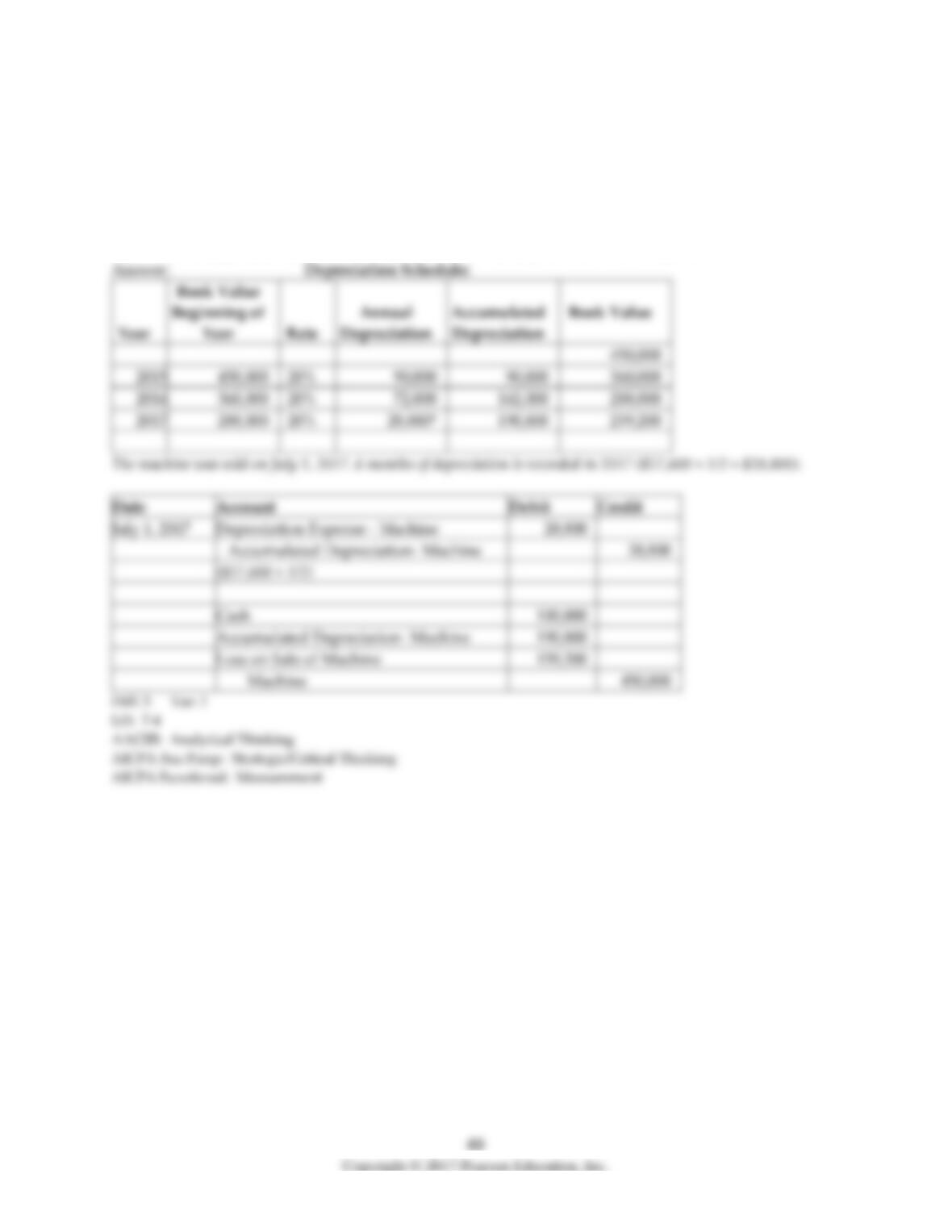
29) Sullivan Sales purchased a machine on January 1, 2015 which cost $450,000. The machine had a
residual value of $50,000 and a useful life of 10 years. Sullivan Sales can replace this machine with one
that is more efficient and decides to sell the old machine for $100,000 on July 1, 2017.
Required:
Prepare the appropriate journal entry to record the sale of this machine, assuming the company uses the
double-declining-balance method of depreciation. The fiscal year ends on December 31.
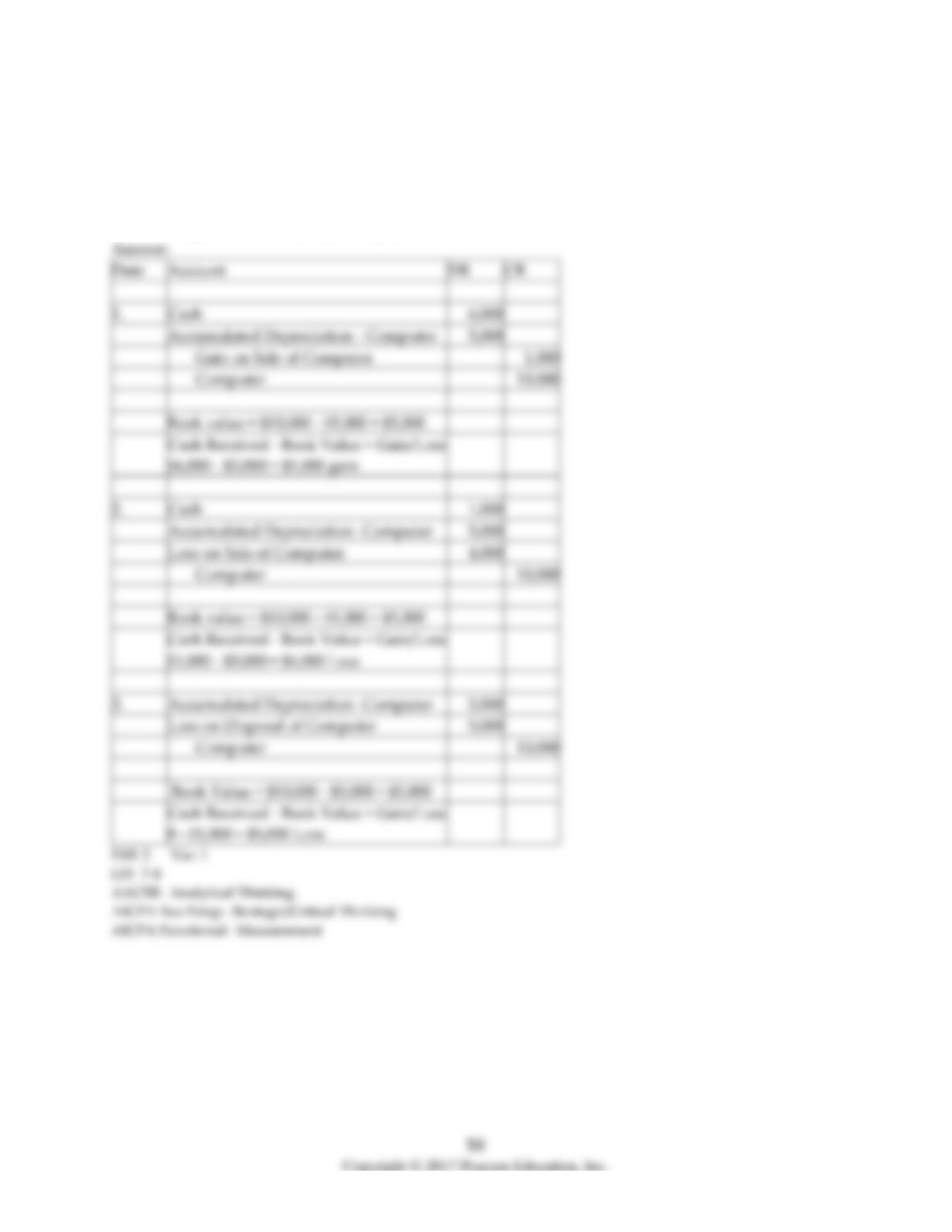
30) A computer, with a cost of $10,000 is sold on July 1. Accumulated depreciation up to the date of sale
is $5,000. Journalize the entries for the disposal of the computer under the following INDEPENDENT
scenarios:
1. The computer was sold for $6,000.
2. The computer was sold for $1,000.
3. The computer is obsolete and was junked.
5 Learning Objective 7-5
1) Natural resources are reported in the Intangible Assets section of the balance sheet.
2) Intangible assets can have either finite or indefinite lives.
3) All intangible assets must be amortized.
4) A purchaser is willing to pay for goodwill when the purchaser buys a company that has abnormal
earning power.
5) Goodwill is recorded only when the purchase price exceeds the market value of the net liabilities in
the acquisition of another company.
6) Most intangible assets have a residual value.
7) Adoption of IFRS by U.S. companies is expected to result in the recognition of less intangible assets
on their balance sheets than presently exist.
8) Patents are state government grants that give the holder the exclusive right to produce and sell an
invention for 20 years.
9) The useful lives of many franchises are indefinite and therefore are not amortized.
10) Some trademarks have an indefinite life and should not be amortized.
11) Which the following statements regarding accounting for natural resources is INCORRECT?
A) Natural resources are often called wasting assets because they are actually physically used up over
time.
B) When the natural resource is extracted, the entity follows an approach much like the straight-line
method of depreciation to account for the production.
C) If all of the natural resource that is extracted is regarded as sold, the amount depleted is transferred
directly from long-term assets to the income statement as depletion expense.
D) The portion of the extracted natural resource that is not immediately sold, becomes inventory.
12) The computation of depletion expense is most closely related to which method for computing
depreciation?
A) straight-line
B) units-of-production
C) double-declining balance
D) modified accelerated cost recovery system
13) Which intangible asset is NOT amortized?
A) patents
B) trademarks
C) copyrights
D) goodwill
14) Amortization expense is recorded for:
A) intangible assets with an indefinite life.
B) intangible assets with a finite life.
C) goodwill.
D) a franchise established with a contract that allows for unlimited extensions.
15) The journal entry to amortize a copyright affects the accounting equation by:
A) increasing assets and stockholders’ equity.
B) decreasing assets and stockholders’ equity.
C) increasing assets and decreasing stockholders’ equity.
D) decreasing assets and increasing stockholders’ equity.
16) When an intangible asset is amortized:
A) stockholders’ equity decreases.
B) net income decreases.
C) net assets decrease.
D) all of the above are correct.
17) Patents are amortized over a period of:
A) 20 years.
B) 20 years or the expected useful life, whichever is less.
C) 70 years plus the life of inventor, or the expected useful life, whichever is less.
D) 70 years beyond the life of inventor.
18) Which of the following is a CORRECT statement regarding intangible assets?
A) The useful life of a patent can be longer than its legal life.
B) Copyrights do not protect computer software programs.
C) Trademarks are rights to reproduce and sell a work of art.
D) Intangible assets with indefinite lives must be checked annually for any loss in value.
19) The entry to record patent amortization expense:
A) increases total assets and decreases total stockholders’ equity.
B) decreases total assets and increases total stockholders’ equity.
C) decreases both total assets and total stockholders’ equity.
D) increases both total assets and total stockholders’ equity.
20) If a company has goodwill on its books, the goodwill:
A) is amortized over 40 years or useful life, whichever is less.
B) is tested for impairment annually.
C) may have been internally created.
D) may be written up to fair value.
21) Merck Pharmaceutical Company has many scientists working in their labs trying to develop a new
drug to treat congestive heart failure. Following U.S. Generally Accepted Accounting Principles, the
cost of this research and development must be:
A) recorded as an intangible asset and not amortized.
B) recorded as an intangible asset and amortized over 20 years.
C) recorded as an intangible asset and tested for impairment on a yearly basis.
D) expensed as incurred.
22) When comparing U.S. Generally Accepted Accounting Principles and International Financial
Reporting Standards, ________ are treated the same way.
A) research and development costs
B) research costs
C) development costs
D) the calculation of depreciation expenses
23) A distinctive identification of a product or a service is a:
A) patent.
B) trademark.
C) copyright.
D) license.
24) The exclusive right to produce and sell an invention such as a smart phone requires a:
A) copyright.
B) license.
C) trademark.
D) patent.
25) Marvin Company purchased Marathon Company on August 31, 2016 and recorded goodwill. How
will Marvin Company account for this goodwill in future accounting periods?
A) Marvin Company will amortize the goodwill over a 40-year life.
B) If the value of the goodwill increases in subsequent years, Marvin Company will increase the
Goodwill account.
C) If the goodwill is impaired in subsequent years, Marvin Company will decrease the Goodwill
account.
D) Marvin Company is not allowed to change the value of the Goodwill account.
26) On June 5, 2017, Mabel Company purchased an oil well for $750,000. The well contains an estimated
$60,000 barrels of oil, with an estimated residual value of zero. During July, 2017, $31,500 barrels of oil
were removed from the well. All of the oil went into inventory. What amount of Depletion Expense is
recorded in July, 2017? (Round your final answer to the nearest dollar.)
A) $0.
B) $750,000.
C) $60,000.
D) $393,750.