7.1-71 Which of the following statements is FALSE?
A) Assets that are increasing in value are still subject to depreciation.
B) Depreciation is a non-cash expense.
C) Accumulated depreciation represents a growing amount of cash to be used to replace the existing
asset.
D) Accumulated depreciation is that portion of a PPE’s cost that has been recorded previously as an
expense.
7.1-72 Which of the following statements is FALSE?
A) As an asset is used in operations, accumulated depreciation increases.
B) As an asset is used in operations, the book value of the asset decreases.
C) As an asset is used in operations, the book value of the asset increases.
D) An asset’s final book value is its residual value.
7.1-73 When computing depreciation for a PPE, which of the following must be estimated?
A) Useful life and residual value
B) Residual value and current market value
C) Useful life and current market value
D) Useful life, current market value, and residual value
7.1-74 The expected cash value of a PPE at the end of its useful life is known as:
A) scrap value.
B) salvage value.
C) residual value.
D) any of the above.
7.1-75 The depreciable cost of an asset using straight line depreciation is defined as:
A) cost minus accumulated depreciation.
B) cost minus salvage value.
C) current sales value minus historical cost.
D) cost minus annual maintenance expense.
7.1-76 The book value of an asset is defined as:
A) cost minus accumulated depreciation.
B) cost minus salvage value.
C) current sales value minus historical cost.
D) cost minus annual maintenance expense.
7.1-77 For financial reporting purposes, most companies use:
A) straight-line depreciation.
B) units-of-production depreciation.
C) double-declining balance depreciation.
D) modified accelerated cost recovery system of depreciation.
7.1-78 When compared to the other methods of depreciation, the double-declining-balance method of
depreciation gives depreciation expense that is:
A) less in the earlier periods.
B) more in the earlier periods.
C) approximately the same in earlier periods as with other methods.
D) an accelerated method; therefore, companies cannot use this method.
7.1-79 At the end of an asset’s useful life, the balance in Accumulated Depreciation will be the same as the:
A) tax liability.
B) book value.
C) salvage value.
D) total depreciation expense over its useful life.
7.1-80 The depreciation method that does NOT use residual value in calculating depreciation expense until the
last year is the:
A) units-of-production method.
B) straight-line method
C) double-declining balance method.
D) all of the above.
7.1-81 On January 2, 20X6, KJ Corporation acquired equipment for $260,000. The estimated life of the
equipment is 5 years or 40,000 hours. The estimated residual value is $20,000. If KJ Corporation uses the
units of production method of depreciation, what will be the debit to Depreciation Expense for the year
ended December 31, 20X7—assuming that during this period, the asset was used 8,250 hours?
A) $48,000
B) $49,500
C) $51,500
D) $53,625
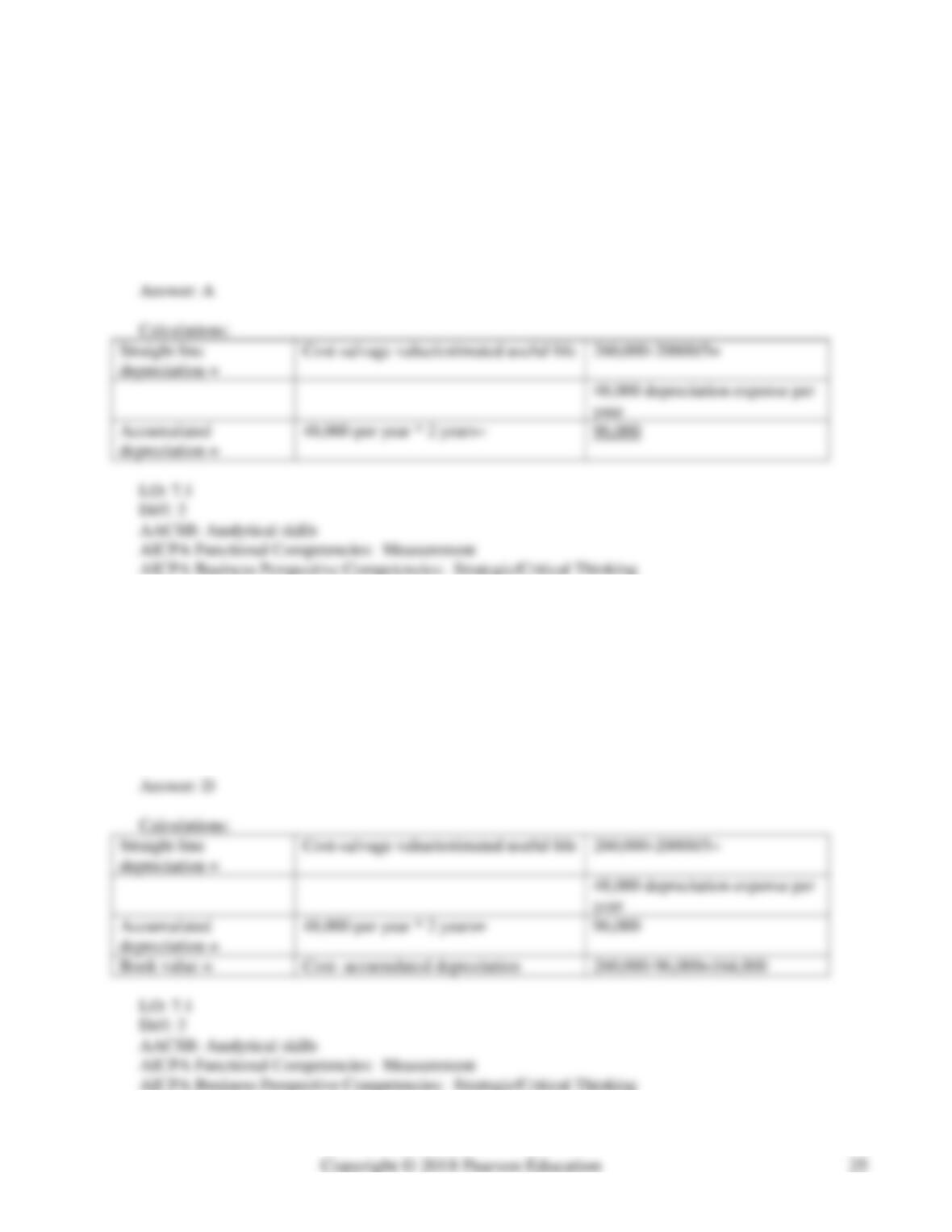
7.1-82 On January 2, 20X6, KJ Corporation acquired equipment for $260,000. The estimated life of the
equipment is 5 years or 40,000 hours. The estimated residual value is $20,000. What is the balance in
Accumulated Depreciation on December 31, 20X7, if KJ Corporation uses the straight-line method of
depreciation?
A) $96,000
B) $49,500
C) $51,500
D) $53,625
7.1-83 On January 2, 20X6, KJ Corporation acquired equipment for $260,000. The estimated life of the
equipment is 5 years or 40,000 hours. The estimated residual value is $20,000. What is the book value
of the asset on December 31, 20X7, if KJ Corporation uses the straight-line method of depreciation?
A) $80,000
B) $96,000
C) $104,000
D) $164,000
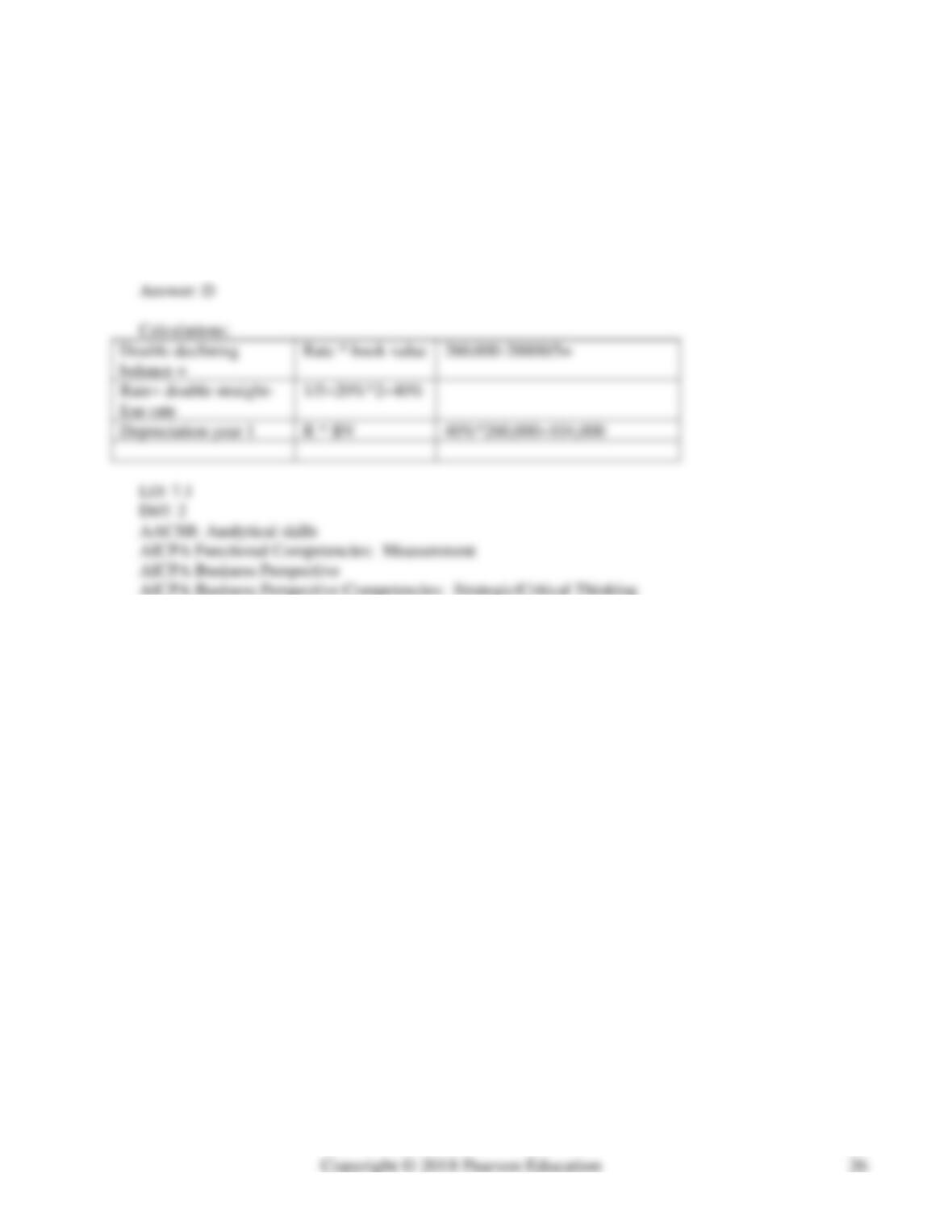
7.1-84 On January 2, 20X6, KJ Corporation acquired equipment for $260,000. The estimated life of the
equipment is 5 years or 40,000 hours. The estimated residual value is $20,000. What is the balance in
Accumulated Depreciation on December 31, 20X6, if KJ Corporation uses the double-declining-balance
method of depreciation?
A) $62,400
B) $88,000
C) $96,000
D) $104,000
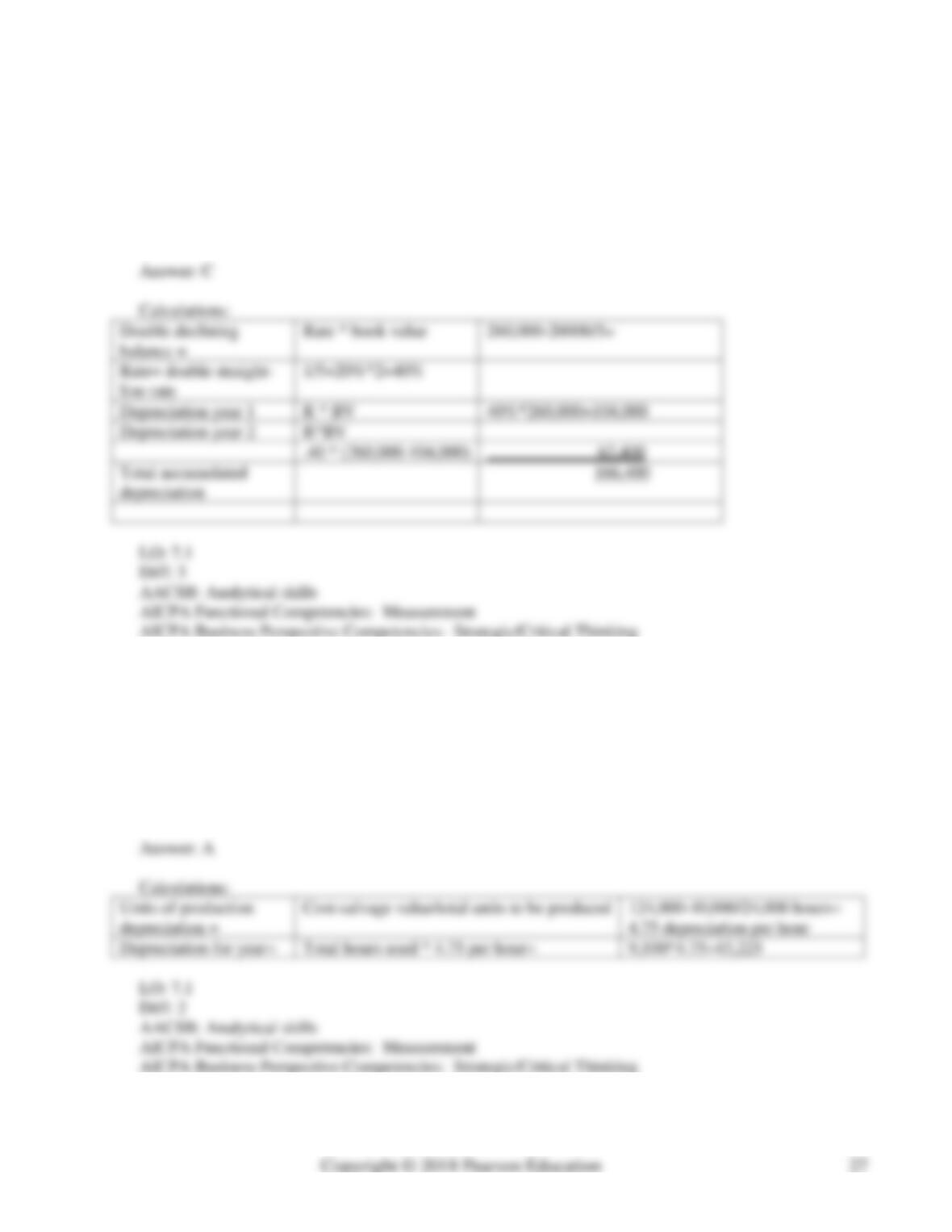
7.1-85 On January 2, 20X6, KJ Corporation acquired equipment for $260,000. The estimated life of the
equipment is 5 years or 40,000 hours. The estimated residual value is $20,000. What is the balance in
Accumulated Depreciation on December 31, 20X7, if KJ Corporation uses the double-declining-balance
method of depreciation?
A) $104,000
B) $38,400
C) $166,400
D) $104,000
7.1-86 On January 10, 20X6, Maxim Corporation acquired equipment for $124,000. The estimated life of the
equipment is 3 years or 24,000 hours. The estimated residual value is $10,000. What is the depreciation
for 20X6, if Baldwin Corporation uses the asset 9,100 hours and uses the units-of-production method of
depreciation?
A) $43,225
B) $47,017
C) $41,333
D) $38,000
7.1-87 On January 10, 20X6, Maxim Corporation acquired equipment for $124,000. The estimated life of the
equipment is 3 years or 24,000 hours. The estimated residual value is $10,000. What is the balance of
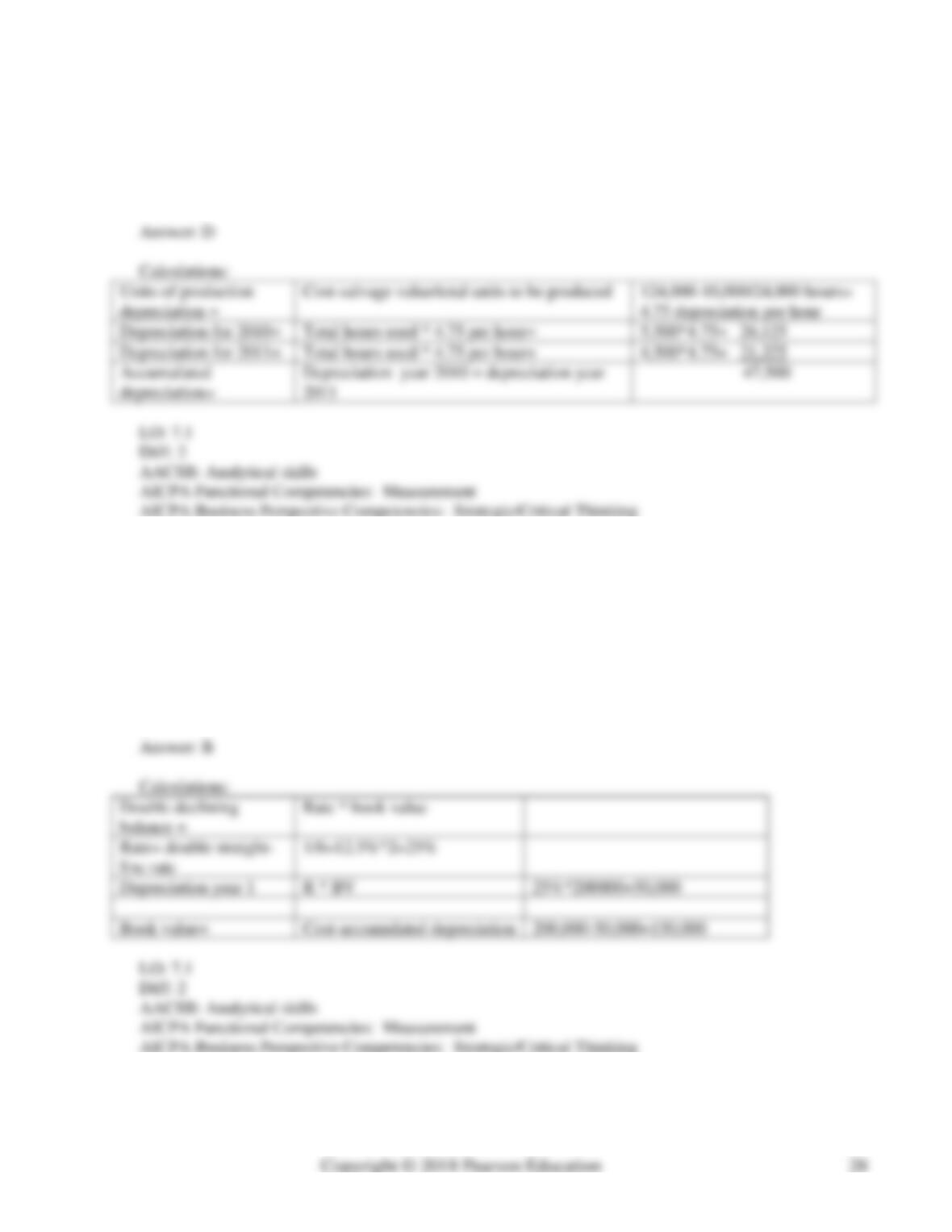
Accumulated Depreciation on December 31, 20X7, if Baldwin Corporation uses the asset 5,500 hours in
20X6 and 4,500 hours in 20X7?
A) $76,000
B) $61,218
C) $52,083
D) $47,500
7.1-88 On January 2, 20X7, Mosby Corporation acquired equipment for $200,000. The estimated life of the
equipment is 8 years or 35,000 hours. The estimated residual value is $40,000. What is the book value of
the equipment on December 31, 20X7, if Mosby Corporation uses the double-declining-balance method
of depreciation?
A) $128,000
B) $150,000
C) $87,500
D) $72,000
7.1-89 On January 2, 20X7, Mosby Corporation acquired equipment for $200,000. The estimated life of the
equipment is 8 years or 35,000 hours. The estimated residual value is $40,000. What is the amount of
depreciation expense for 20X7, if the company uses the double-declining-balance method of
depreciation?
A) $112,500
B) $87,500
C) $50,000
D) $30,000
7.1-90 On January 2, 20X7, Heidi’s Pet Boutique purchased a television for the dog sitting area which cost
$8,000. It had an estimated useful life of 5 years and a residual value of $1,000. What is the amount of
depreciation expense for 20X8, the second year of the asset’s life using the double declining-balance
method?
A) $3,200
B) $8,000
C) $1,920
D) $2,080
7.2-1 The use of the straight-line method of computing depreciation increases a company’s tax liability, thereby
increasing the company’s cash flow.
7.2-2 The IFRS states that only the straight-line method of depreciation may be used for income tax purposes.
7.2-3 It is neither legal nor ethical to use one method of depreciation for financial purposes and another method
for tax purposes.
7.2-4 IFRS determines the depreciation method used for financial reporting purposes and tax purposes.
7.2-5 Changes in accounting estimates are not allowed under the comparability principle.
7.2-6 When the book value of an asset is zero, the asset is worthless.
7.2-7 Revising depreciation estimates does not affect the amount of depreciation expense recorded in the prior
financial statements.
7.2-8 A company purchased PPE with first year depreciation $8,000 under straight-line method and $16,400
under double-declining-balance (DDB) method. The income tax rate is 30%. What is the tax savings if
DDB depreciation is used instead of straight-line depreciation?
A) $8,400.
B) $2,400.
C) $4,920.
D) $2,520.
7.2-9 Using an accelerated depreciation method will cause a profitable company to incur:
A) less taxes in early years of the asset’s use as compared to later years.
B) more taxes in early years of the asset’s use as compared to later years.
C) the same amount of taxes in early years of the asset’s use as in the later years.
D) none of the above.
7.2-10 Managers prefer accelerated depreciation over straight-line depreciation for income tax purposes because
accelerated depreciation:
A) provides the fastest tax deductions.
B) decreases immediate tax payments.
C) allows the company to reinvest the tax savings back in the business.
D) does all of the above.
7.2-11 A revision of an estimate which will extend the asset’s useful life is called a change in accounting:
A) theory.
B) policy.
C) procedure.
D) estimate.
7.2-12 When an asset is fully depreciated:
A) the total depreciation is equal to the accumulated depreciation, and the asset has reached the end of its
actual useful life.
B) the book value is equal to the salvage value, and the asset has reached the end of its estimated useful
life.
C) the depreciable cost is equal to the salvage value, and the asset is of no further use to the company.
D) the book value is zero, and the asset has no market value.
7.2-13 Companies may keep a separate set of depreciation records for income tax purposes because:
A) companies want to evade taxes.
B) certain jurisdictions may mandate a specific treatment for specific assets.
C) tax regulations could provide alternative depreciation methods or schedules that are more favorable
than what is being used for financial reporting.
D) both B and C.
7.2-14 Which of the following is not a reason why companies choose accelerated over straight-line depreciation
for income tax purposes?
A) accelerated depreciation provides the fastest tax deductions.
B) accelerated depreciation delays immediate tax payments and improve cash flows.
C) the business can reinvest tax savings back into the business or pay off interest-bearing debts.
D) the tax authorities are less likely to investigate companies with lower net income for tax evasion.
7.2-15 Which of the following statements regarding depreciation for a partial year is NOT true?
A) If an asset is not purchased at the beginning of the year, depreciation must be computed only for the
portion of the year the company held the asset.
B) Many businesses record no monthly depreciation on assets purchased after the 15th of the month.
C) An asset purchased on June 5 will be depreciated for seven months for the first year.
D) An asset purchased on June 5 will be depreciated for six months for the first year.
7.2-16 Carl’s Cigar Corporation’s net income before depreciation and taxes is $310,000. Using straight-line
depreciation, the current year’s depreciation expense would be $24,000. Using double-declining-balance
depreciation, the current year’s depreciation expense would be $36,000. Assuming a tax rate of 35%,
what is Carl’s Cigar Corporation’s net income if the double-declining-balance depreciation method is
used?
A) $171,600
B) $166,400
C) $185,900
D) $178,100
7.2-17 Income before depreciation and taxes amounts to $167,200. Using straight-line depreciation, the current
year’s depreciation expense will be $31,200. Using double-declining-balance depreciation, the current
year’s depreciation expense will be $41,200. Assuming a tax rate of 30%, what is the net cash saved in
income taxes by using double-declining-balance depreciation over straight-line depreciation?
A) $3,000
B) $4,000
C) $7,000
D) $11,100
7.2-18 Art Modell Company reported $61,000 in depreciation expense for the current year using the double-
declining-balance method. The company estimates that it saved net cash of $12,000 in income taxes by
using the double-declining-balance instead of the straight-line method. The company has a 30% tax rate.
What would depreciation expense have been using the straight-line method?
A) $43,857
B) $40,000
C) $21,000
D) $7,200
7.2-19 Deland Company purchased equipment on March 1, 20X7, for $130,000. The residual value is $40,000
and the estimated life is 10 years or 60,000 hours. Compute depreciation expense for the year ending
December 31, 20X7, if the company uses the straight-line method of depreciation.
A) $7,500
B) $9,000
C) $14,444
D) $21,666
7.2-20 Deland Company purchased equipment on March 1, 20X7, for $130,000. The residual value is $40,000
and the estimated life is 10 years or 60,000 hours. Compute depreciation expense for the year ending
December 31, 20X7, if the company uses the units-of-production method of depreciation and uses the
equipment for 9,000 hours.
A) $9,000
B) $10,500
C) $13,500
D) $29,500
7.2-21 Deland Company purchased equipment on March 1, 20X6, for $130,000. The residual value is $40,000
and the estimated life is 10 years or 60,000 hours. Compute depreciation expense for the year ending
December 31, 220X7, if the company uses the double-declining-balance method of depreciation.
A) $21,666
B) $20,800
C) $26,333
D) $24,666
7.2-22 Bay Back Company acquired equipment on June 30, 20X7, for $210,000. The residual value is $35,000
and the estimated life is 5 years or 40,000 hours. Compute the balance in Accumulated Depreciation as of
December 31, 20X9, if Bay Back Company uses the double-declining-balance method of depreciation.
A) $68,040
B) $134,400
C) $141,960
D) $149,520
7.2-23 Paul’s Lodging Corporation purchased equipment on January 1, 20X6 for $180,000. The equipment had
an estimated useful life of 10 years and an estimated salvage value of $30,000. After using the equipment
for 3 years, the company determined that the equipment could be used for an additional 9 years and
have a salvage value of $9,000. Assuming Paul’s Lodging Corporation uses straight-line depreciation,
compute depreciation expense for the year ending December 31, 20X9.
A) $11,250
B) $13,500
C) $15,000
D) $14,000
7.2-24 Jackson Corporation acquired equipment on January 1, 20X6, for $320,000. The equipment had an
estimated useful life of 10 years and an estimated salvage value of $25,000. On January 1, 20X9, Jackson
Corporation revised the total useful life of the equipment to 8 years and the estimated salvage value to be
$20,000. Compute depreciation expense for the year ending December 31, 20X9, if Jackson Corporation
uses straight-line depreciation.
A) $26,477
B) $39,300
C) $42,300
D) $46,300
7.2-25 Jackson Corporation acquired equipment on January 1, 20X6, for $320,000. The equipment had an
estimated useful life of 10 years and an estimated salvage value of $25,000. On January 1, 20X9, Jackson
Corporation revised the total useful life of the equipment to 6 years and the estimated salvage value to be
$20,000. What is the book value as of December 31, 20X9?
A) $161,000
B) $159,000
C) $154,333
D) $146,000
7.2-26 The Fall River Corporation bought a PPE on January 1, 20X6, at a cost of $45,000. Estimated residual
value is $5,000 and the estimated useful life is 8 years. The company uses straight-line depreciation.
On January 1, 20X9, Fall River’s management revises the total estimated life to be 10 years, with
estimated residual value of $2,000. The balance in Accumulated Depreciation on December 31, 20X9,
is:
A) $16,358.
B) $21,429.
C) $10,000.
D) $19,000.
7.2-27 A PPE is acquired by a business on January 1, 20X6, for $30,000. The asset’s estimated residual value is
$8,000 and its estimated life is 5 years. Management chooses to use straight-line depreciation. On January
1, 20X8, management revises the total useful life to 6 years and the residual value to be zero. Compute
the balance in Accumulated Depreciation on December 31, 20X8.
A) $4,400
B) $5,300
C) $8,800
D) $14,100
7.3-1 To account for the disposal of a PPE, the cost of the asset and its related accumulated depreciation are
removed from the books.
7.3-2 When an asset is sold at a gain, total assets and total equity both increase.
7.3-3 When computing the gain or loss on the sale of a PPE, the annual depreciation for the year of sale must be
considered, but if the amount is small, this amount can be ignored.
7.3-4 A gain will result when the book value of a PPE exceeds the cash received from the sale of the asset.