Chapter 07 Master Budgeting Answer Key
True / False Questions
1.
The cash budget is usually prepared after the budgeted income statement.
2.
The manufacturing overhead budget is typically prepared before the production budget.
3.
Self-imposed budgets prepared by lower-level managers should be scrutinized by higher
levels of management.
4.
The basic idea underlying responsibility accounting is that each manager should be held
responsible for the overall profit of the company to ensure that all managers are acting
together.
5.
Budgets are used to plan and to control operations.
6.
The sales budget is usually prepared before the production budget.
7.
A continuous or perpetual budget is a budget that almost never needs to be revised.
8.
The cash budget is typically prepared before the direct materials budget.
9.
In business, a budget is a method for putting a limit on spending.
10.
Planning involves gathering feedback to ensure that the plan is being properly executed or
modified as circumstances change.
11.
A benefit of self-imposed budgeting is that it may allow lower-level managers to create
budgetary slack.
12.
The first budget a company prepares in a master budget is the production budget.
13.
One disadvantage of a self-imposed budget is that budget estimates prepared by front-line
managers are often less accurate and reliable than estimates prepared by top managers.
14.
The direct materials budget is typically prepared before the production budget.
15.
A self-imposed budget is a budget that is prepared with the full cooperation and participation
of managers at all levels.
16.
The sales budget often includes a schedule of expected cash collections.
17.
The number of units to be produced in a period can be determined by adding the expected
sales to the beginning inventory and then deducting the desired ending inventory.
18.
In a merchandising company, the required merchandise purchases for a period are
determined by subtracting the desired ending inventory from the sum of the units to be sold
during the period and the units in beginning inventory.
19.
When preparing a direct materials budget, the units of raw material needed to meet production
should be added to desired ending inventory and the beginning inventory for raw materials
should be subtracted to determine the amount of raw materials to be purchased.
20.
In companies that do not have “no lay-off” policies, the total direct labor cost for a budget
period is computed by multiplying the total direct labor hours needed to make the budgeted
output of completed units by the direct labor wage rate.
21.
The direct labor budget shows the direct labor-hours required to produce the desired ending
inventory.
22.
The manufacturing overhead budget lists all costs of production other than selling and
administrative expenses.
23.
Only variable manufacturing overhead costs are included in the manufacturing overhead
budget.
24.
The budgeted selling and administrative expense is calculated by multiplying the budgeted
unit sales by the selling and administrative expense per unit.
25.
Both variable and fixed manufacturing overhead costs are included in the selling and
administrative expense budget.
26.
On a cash budget, the total amount of budgeted cash payments for manufacturing overhead
should not include any amounts for depreciation on factory equipment.
Multiple Choice Questions
27.
Which of the following budgets are prepared before the production budget?
Direct Materials Budget
Sales Budget
A)
Yes
Yes
B)
Yes
No
C)
No
Yes
D)
No
No
28.
Which of the following represents the normal sequence in which the below budgets are
prepared?
29.
Which of the following is NOT an objective of the budgeting process?
30.
Which of the following benefits could an organization reasonably expect from an effective
budget program?
Increased employee
motivation
Uncover potential
bottlenecks
A)
Yes
Yes
B)
Yes
No
C)
No
Yes
D)
No
No
31.
The budget method that maintains a constant twelve-month planning horizon by adding a new
month on the end as the current month is completed is called:
32.
All the following are considered to be benefits of participative budgeting, except for:
Topic Area: What is a Budget?
33.
When preparing a production budget, the required production equals:
34.
The direct labor budget is based on:

35.
Which of the following might be included as a disbursement on a cash budget?
Depreciation on factory equipment
Income taxes to be paid
A)
Yes
Yes
B)
Yes
No
C)
No
Yes
D)
No
No
36.
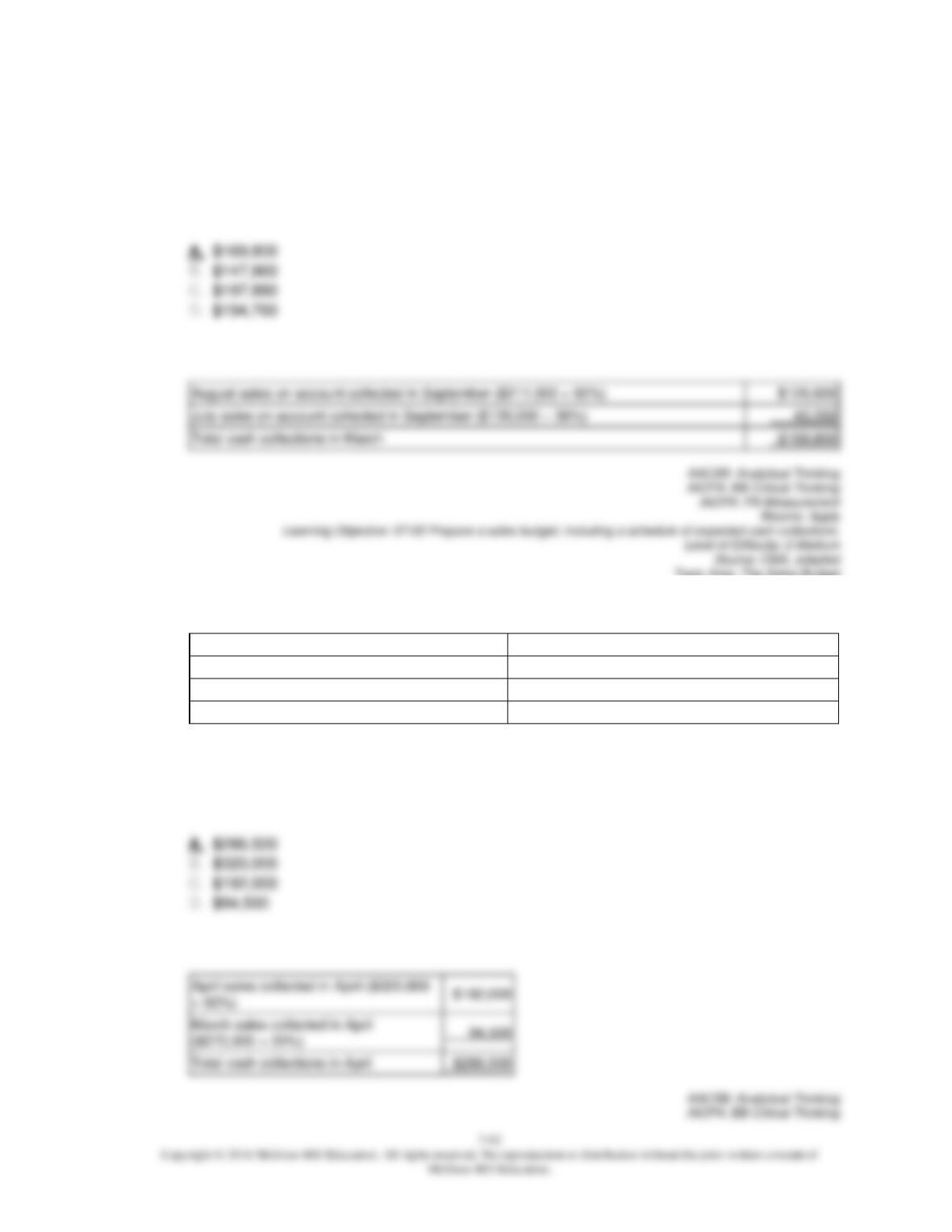
The WRT Corporation makes collections on sales according to the following schedule:
25% in month of sale
65% in month following sale
5% in second month following sale
5% uncollectible
The following sales have been budgeted:
Sales
April
$120,000
May
$100,000
June
$110,000
Total cash collections in June
Budgeted cash collections in June would be:
37.
Trumbull Corporation budgeted sales on account of $120,000 for July, $211,000 for August,
and $198,000 for September. Experience indicates that none of the sales on account will be
collected in the month of the sale, 60% will be collected the month after the sale, 36% in the
second month, and 4% will be uncollectible. The cash receipts from accounts receivable that
should be budgeted for September would be:
Topic Area: The Sales Budget
38.
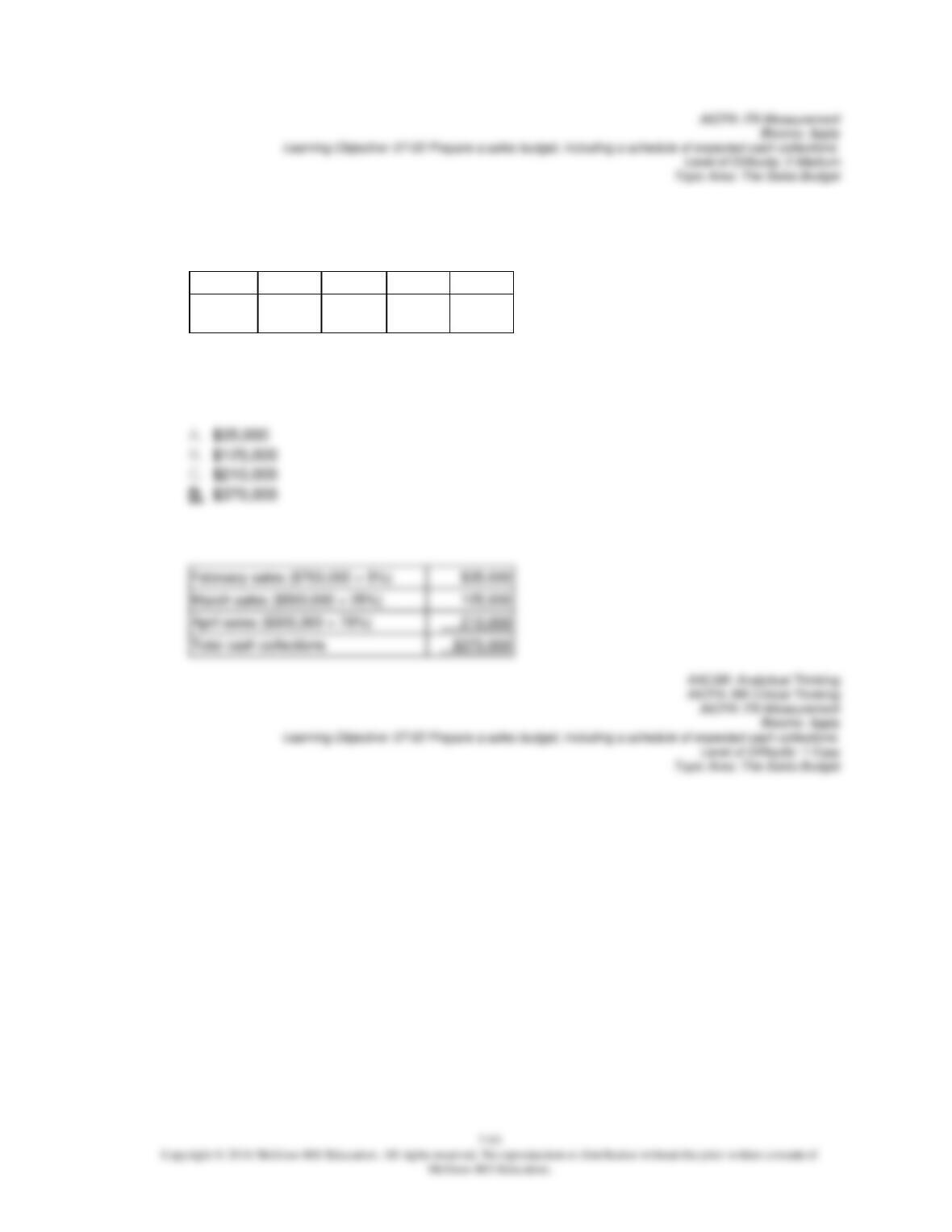
Sioux Corporation is estimating the following sales for the first four months of next year:
January
$260,000
February
$230,000
March
$270,000
April
$320,000
Sales are normally collected 60% in the month of sale, 35% in the month following the sale,
and the remaining 5% being uncollectible. Based on this information, how much cash should
Sioux expect to collect during the month of April?
39.
Seventy percent of Parlee Corporation’s sales are collected in the month of sale, 25% in the
month following sale, and 5% in the second month following sale. The following are budgeted
sales data for the company:
January
February
March
April
Total
sales
$600,000
$700,000
$500,000
$300,000
Total budgeted cash collections in April would be:
40.
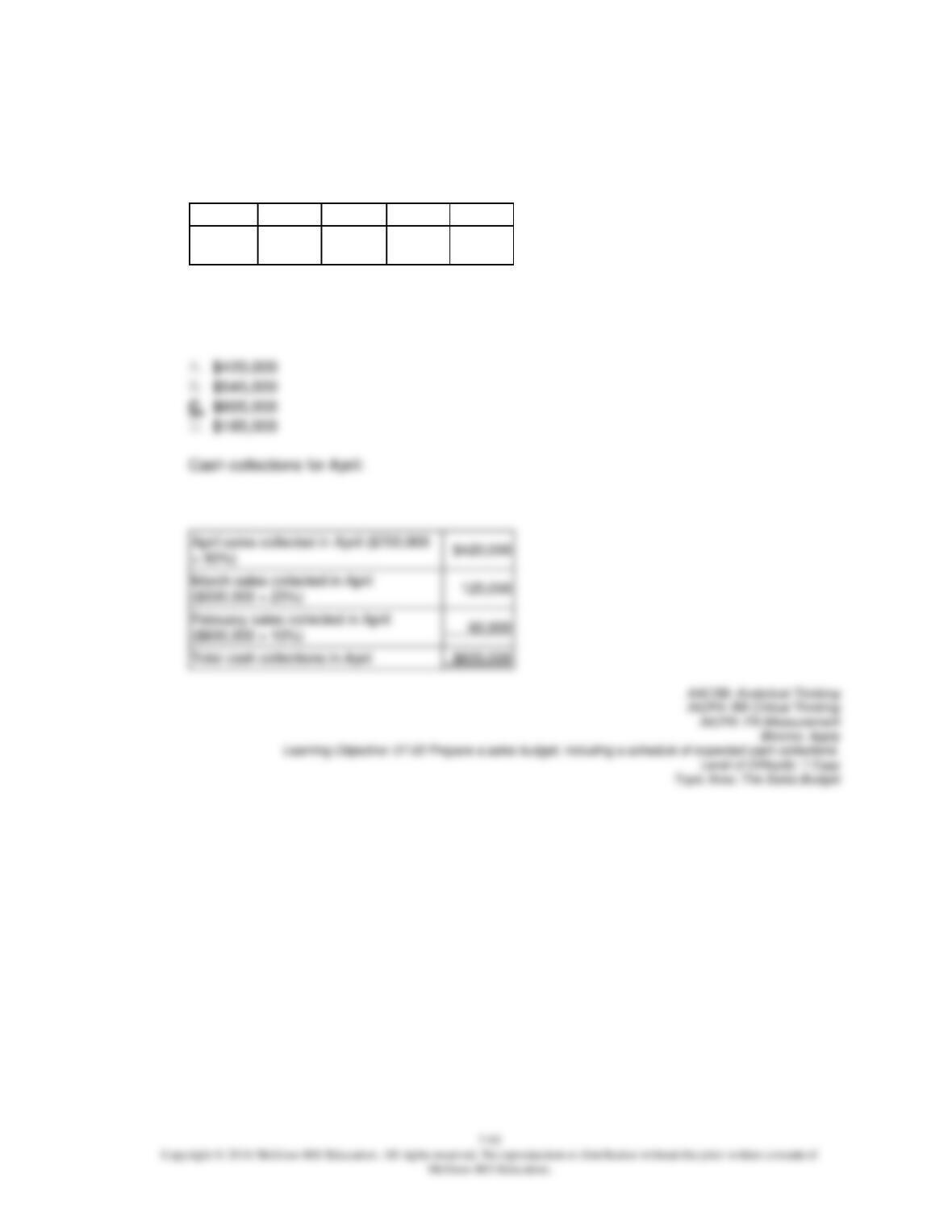
Budgeted sales in Acer Corporation over the next four months are given below:
September
October
November
December
Budgeted sales
$140,000
$150,000
$170,000
$130,000
December credit sales collected in December ($130,000 × 75% × 50%)
November credit sales collected in December ($170,000 × 75% × 30%)
Total cash collections in December
Twenty-five percent of the company’s sales are for cash and 75% are on account. Collections
for sales on account follow a stable pattern as follows: 50% of a month’s credit sales are
collected in the month of sale, 30% are collected in the month following sale, and 15% are
collected in the second month following sale. The remainder are uncollectible. Given these
data, cash collections for December should be:
41.
All of Porter Corporation’s sales are on account. Sixty percent of the credit sales are collected
in the month of sale, 25% in the month following sale, and 10% in the second month following
sale. The remainder are uncollectible. The following are budgeted sales data for the company:
January
February
March
April
Total
sales
$400,000
$600,000
$500,000
$700,000
April sales collected in April ($700,000
March sales collected in April
February sales collected in April
Cash receipts in April are expected to be:
42.
Paradise Corporation budgets on an annual basis for its fiscal year. The following beginning
and ending inventory levels (in units) are planned for next year.
Beginning
Inventory
Ending
Inventory
Raw material*
40,000
50,000
Finished goods
80,000
50,000
*Three pounds of raw material are needed to produce each unit of finished product.
If Paradise Corporation plans to sell 480,000 units during next year, the number of units it
would have to manufacture during the year would be:
43.
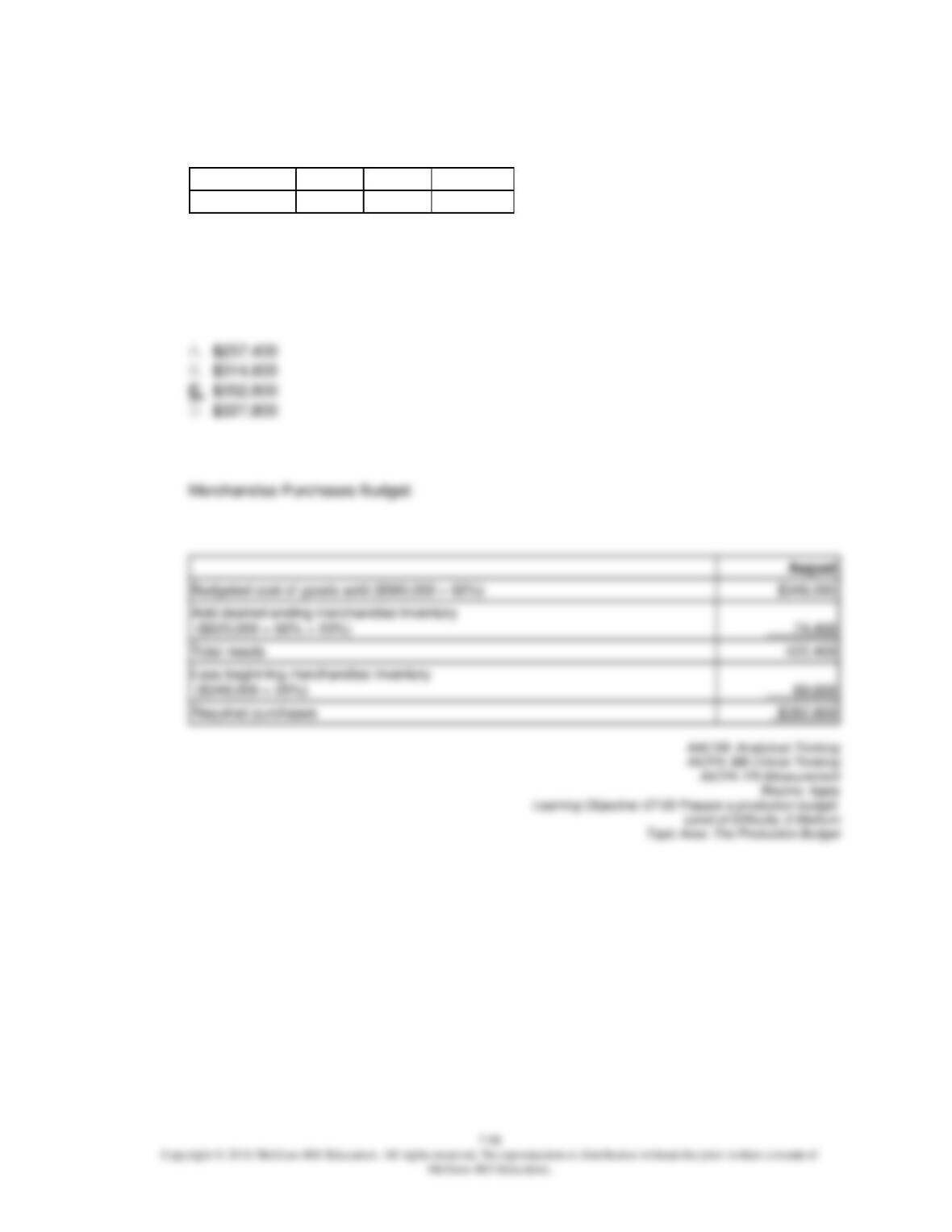
Frodic Corporation has budgeted sales and production over the next quarter as follows:
July
August
September
Sales in units
40,000
52,000
?
Production in units
41,200
52,300
56,650
Budgeted unit sales
Total needs
The company has 4,000 units of product on hand at July 1. 10% of the next month’s sales in
units should be on hand at the end of each month. October sales are expected to be 71,500
units. Budgeted sales for September would be (in units):
44.
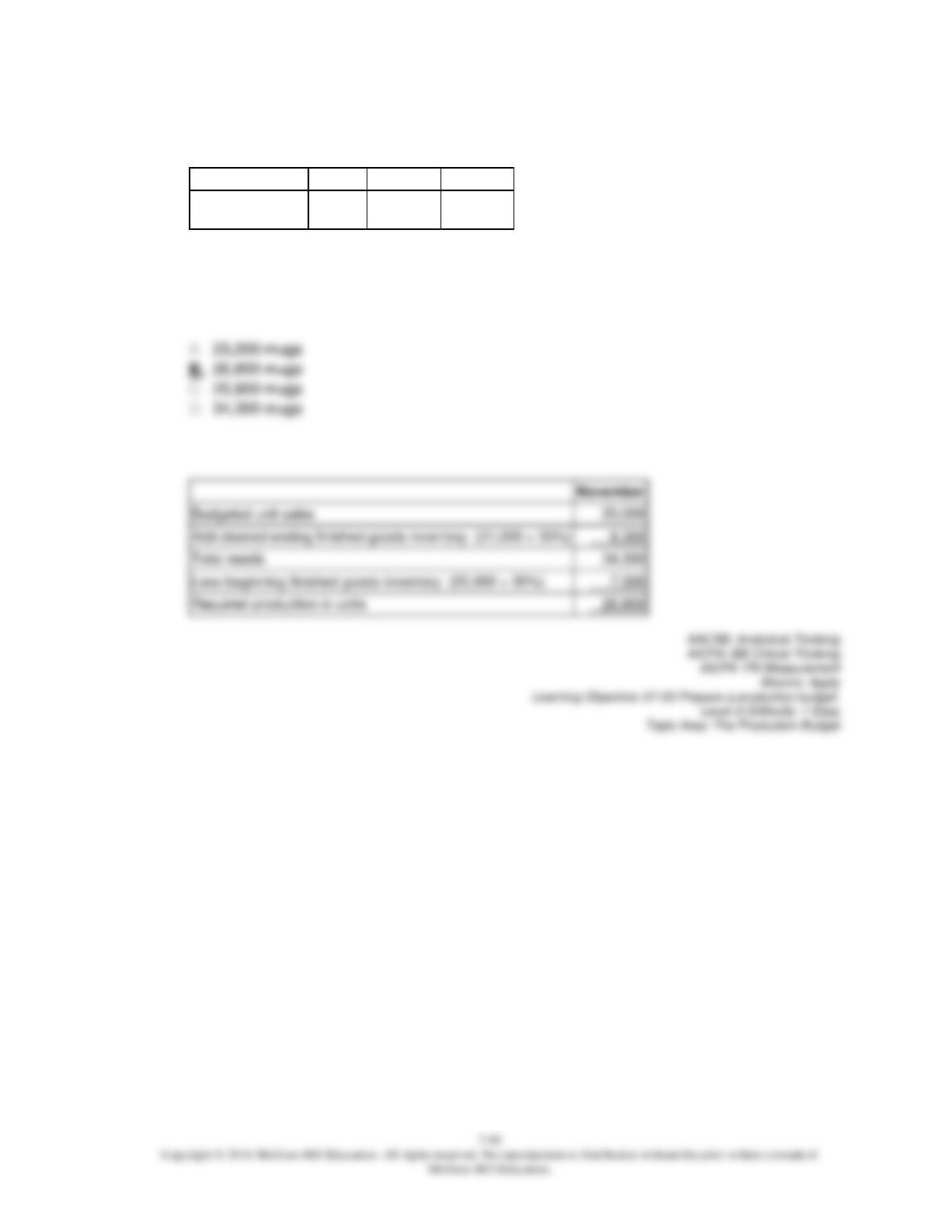
JT Department Store expects to generate the following sales for the next three months:
July
August
September
Expected sales
$460,000
$580,000
$620,000
JT’s cost of gods sold is 60% of sales dollars. At the end of each month, JT wants a
merchandise inventory balance equal to 20% of the following month’s expected cost of goods
sold. What dollar amount of merchandise inventory should JT plan to purchase in August?
Budgeted cost of goods sold ($580,000 × 60%)
45.
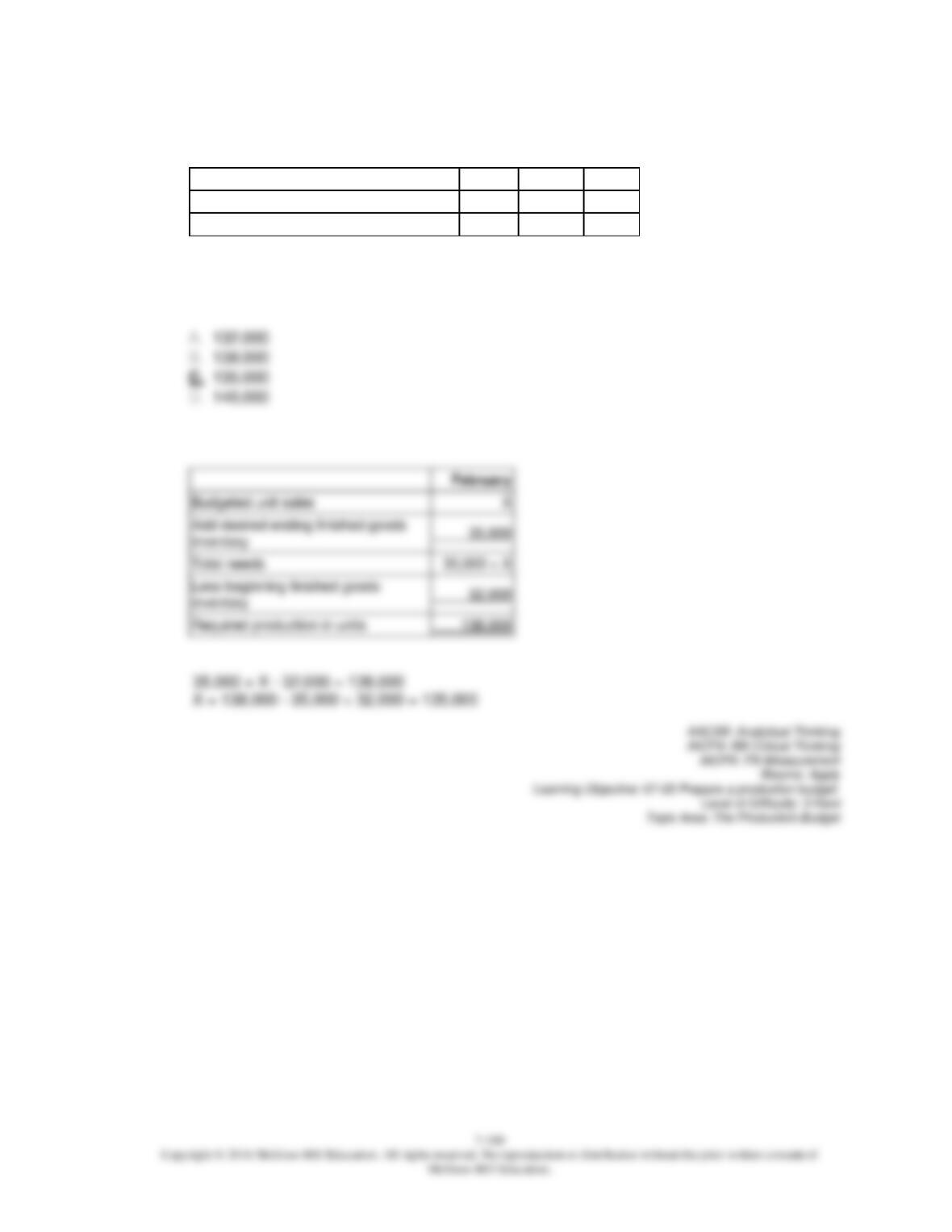
Fab Manufacturing Corporation manufactures and sells stainless steel coffee mugs. Expected
mug sales at Fab (in units) for the next three months are as follows:
October
November
December
Budgeted unit
sales
28,000
25,000
31,000
November
Fab likes to maintain a finished goods inventory equal to 30% of the next month’s estimated
sales. How many mugs should Fab plan on producing during the month of November?
46.
The following information was taken from the production budget of Paeke Corporation for next
quarter:
January
February
March
Units to be produced
130,000
138,000
154,000
Desired ending inventory of finished goods
32,000
35,000
38,000
How many units is the company expecting to sell in the month of February?
Budgeted unit sales
Total needs
Required production in units
138,000