Accounting Information Systems, 2e (Kay/Ovlia)
Chapter 7 Accounting and Business Intelligence
Objective 1
1) Uninformed consumers drive enterprises to use their information assets in more intelligent
ways.
2) Intelligence involves the ability to see meaningful interrelationships and glean insights.
3) Business intelligence cannot be used to improve decision making and business performance.
4) By using various analysis, such as data mining and predictive modeling, data can be
transformed into business intelligence.
5) Executive information systems provide information for tactical, semi-structured decisions.
6) Decision support systems provided support for strategic decisions.
7) ________ are IT tools suited for storing data, but have limitations for analyzing data.
8) ________ uses mathematical algorithms to find patterns, trends, and relationships among data,
such as customer purchasing patterns.
9) ________ uses mathematical algorithms to predict future trends, such as future customer
purchases.
10) ________ provide information for tactical, semi-structured decisions and was a predecessor
of today’s intelligence tools.
11) ________ systems provided information for routine, operational decisions.
12) Business intelligence answers questions such as
A) What products did customers buy last week?
B) What products did customers buy today?
C) What products will customers will buy next year?
D) What products did customers buy last years?
13) Which business intelligence tool is more likely to identify a credit card transaction from a
stolen credit and not from the cardholder?
A) Data mining
B) Predictive modeling
C) Interactive decision model
D) Shadow data
14) Which business intelligence tool is more likely to identify the next “must have” children’s
toy?
A) Shadow data
B) Predictive modeling
C) Data mining
D) Interactive decision model
15) Which of the following is an example of a routine business decision?
A) Contracting with another enterprise to provide a customer support call center
B) Using the most cost effective shipping procedure
C) Purchasing a competing business
D) Launching a new product
16) Which of the following is an example of a strategic decision?
A) Contracting with another enterprise to provide a customer support call center
B) Using the most cost effective shipping procedure
C) Purchasing a competing business
D) Launching a new product
17) Tactical decisions are
A) Recurring and typically relate to ongoing business operations
B) Usually long term in nature and unstructured with a high degree of ambiguity
C) Typically short term, impacting one year or less
D) Structured
18) Which one of the following is NOT a predecessor of today’s tools used for data analysis?
A) Executive information systems
B) Business intelligence systems
C) Enterprise resource planning systems
D) Decision support systems
19) The purpose of integrating quantitative and qualitative factors in the decision making process
is to
A) Organize the decision making process
B) Bring order to the complex business environment
C) Improve the quality of the decision
D) To analyze why customers buy a certain product or service
20) What are the three main functions of an accounting system?
21) Define the three of business decisions. Provide an example of each.
22) What were the predecessors of today’s sophisticated intelligence tools used for data analysis?
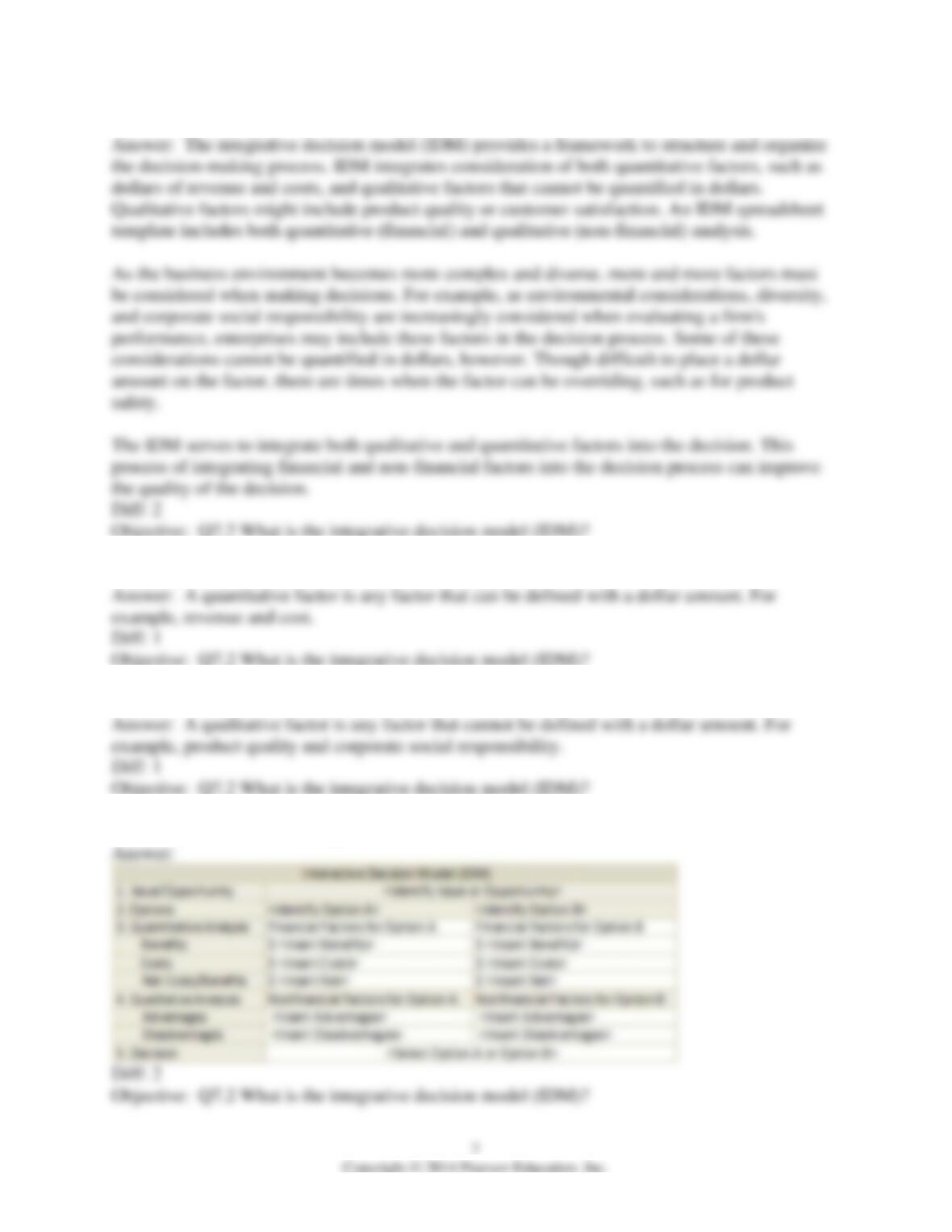
1) IDM provides a framework to structure and organize the decision-making process.
2) As the business environment becomes more complex and diverse, more factors must be
considered when making decisions.
3) The process of integrating financial and non-financial factors into the decision process can
lessen the quality of the decision.
4) The ________ provides a framework to structure and organize the decision-making process.
5) With ________ analysis you are attempting to compare the financial costs and benefits of
each option and determine the differences.
6) The first step in IDM is
A) Define the symptom of the issue
B) Analyze the quantitative factors
C) Evaluate performance
D) Identify options
7) In the IDM basic steps framework, quantitative analysis may consist of
A) Product quality, timeliness, the stress factor, streamlining, ease of use, overall satisfaction
B) Creative solutions and brainstorming techniques
C) Cost-benefit analysis, cost-volume-profit analysis, capital budgeting
D) Make certain you have identified and are addressing the core issue rather than a symptom
8) The last step in IDM is
A) Analyze the quantitative factors
B) Make recommendations
C) Implement the decision
D) Evaluate performance
9) What is the integrative decision model?
10) What is a quantitative factor? Provide an example.
11) What is a qualitative factor?
12) Create/draw the IDM template.
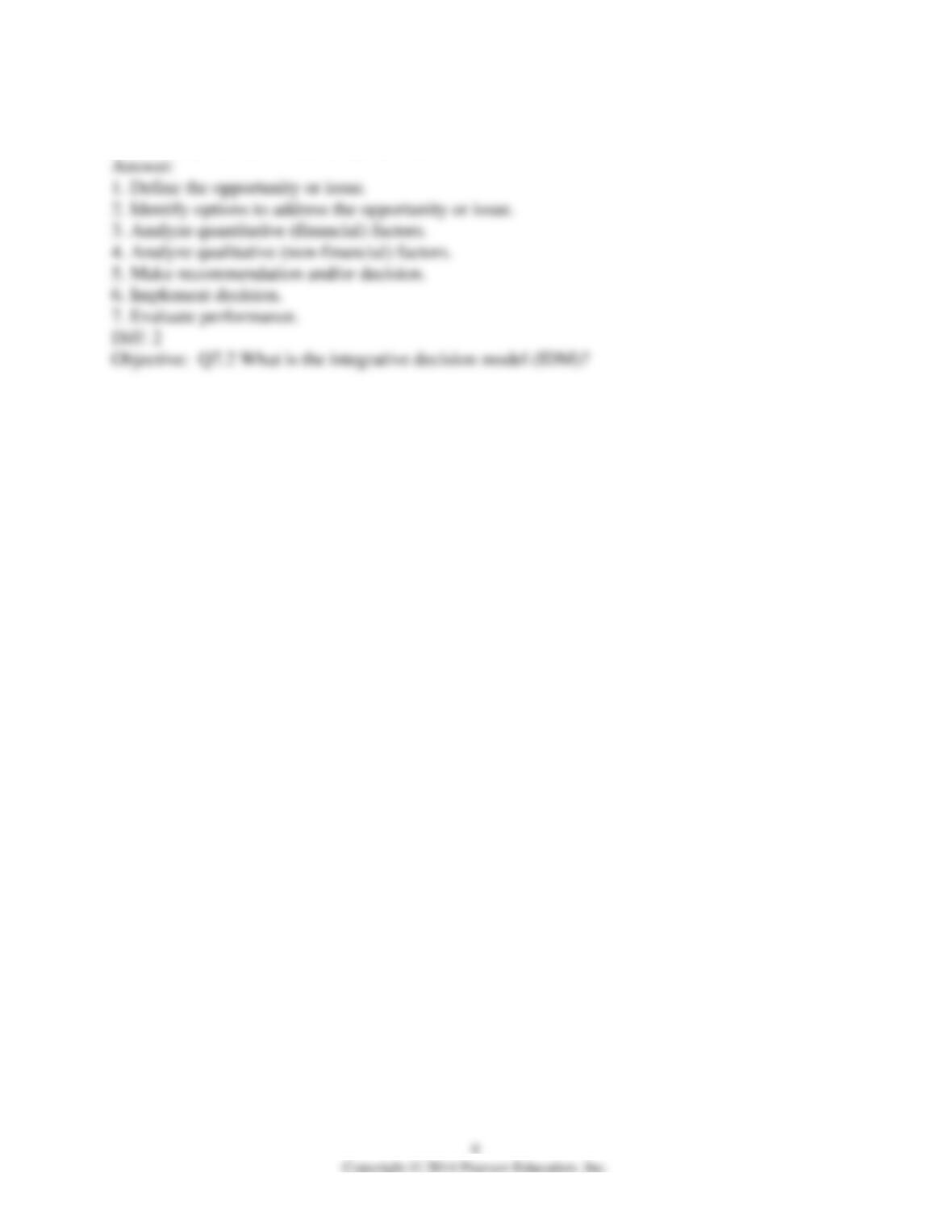
13) The IDM consists of seven basic steps as a framework for the decision-making and
evaluation process. List these steps in order.
14) List and explain the seven basic steps in the IDM framework.
1) Business intelligence technologies are typically under the control of the enterprise’s IT
professionals.
2) Shadow data typically includes analytics, data mining, and predictive modeling.
3) ________ is used when data is stored in spreadsheets and other tools that shadow the formal
accounting system.
4) A digital dashboard, an interactive tool that allows a user to see the effect of changes in
various scenarios, is an example of ________.
5) Business ________ focuses on how to use information technology to solve business problems.
6) Control of business intelligence technologies is usually under the control of
A) IT professionals
B) Accounting professionals
C) Security professionals
D) Executive management
7) Control of shadow data is usually under the control of
A) IT professionals
B) Accounting professionals
C) Security professionals
D) Middle management
8) The main components of an intelligent system work together to
A) Identify meaningful interrelationships
B) Create shadow data
C) Prevent unauthorized access to the data
D) Store data
9) A digital dashboard is a(n)
A) Tool used to extract data from a data database
B) Interactive data visualization tool
C) Transfers data to a data analysis tool
D) Stores data
10) Business informatics focuses on how to
A) Visualize data
B) Store data
C) Keep data secure
D) Use information technology to solve business problems
11) What are two approaches to business intelligence commonly used by companies?
12) List and explain the four components of an intelligent enterprise system.
1) Shadow data can exist in tools other than spreadsheets, such as user-developed databases.
2) Data storage for shadow data is kept in a centralized location in an organization.