Financial Accounting, 11e (Harrison/Horngren/Thomas)
Chapter 7 Plant Assets, Natural Resources, & Intangibles
1 Learning Objective 7-1
1) The costs assigned to the Land account include legal fees, survey fees, and expenditures for grading
and clearing the land.
2) The cost of land includes the cost of any back property taxes that the purchaser pays.
3) The cost of land includes the cost of fencing the property and paving the parking lot on the land.
4) Leasehold improvements are not subject to depreciation or amortization.
5) The installation costs for a new machine should be part of the cost of the machine and should be
depreciated.
6) The cost of a new building includes the cost to demolish and remove an old building on the same site
as the new building.
7) If a company buys a building and the surrounding land for cash, total assets increase.
8) The long-term asset that is not depreciated or amortized is:
A) land improvement.
B) leasehold improvement.
C) office computers.
D) land.
9) Major Company purchased equipment to be used in its distribution center. All of the following
should be included in the cost of the equipment EXCEPT for:
A) insurance while in transit.
B) wages of workers who test the equipment before it is placed in service.
C) employee training costs before the equipment is placed in service.
D) insurance costs after the equipment is up and running.
10) Which of the following should be included in the cost of land improvements?
A) fencing
B) sprinkler system for the landscaping
C) driveways
D) all of the above
11) Minor Company purchased land and which is being prepared for the construction of a new office
building. Which of the following should be included in the cost of the land?
A) cost of removing an old building
B) cost of clearing and grading the land
C) cost of the fence which surrounds the property
D) A and B
12) ABC Company purchased land with an old building. ABC plans to demolish the old building and
then construct a new, modern building. The cost of demolishing the building will be part of the cost of
the:
A) new building.
B) old building.
C) land.
D) land improvements.
13) The cost of installing lights in a company’s parking lot should be recorded as a cost of:
A) land.
B) land improvements.
C) leasehold improvements.
D) leaseholds.
14) The ________ method is used to allocate the cost of multiple assets acquired in a basket purchase.
A) book-value
B) cost
C) gross margin ratio
D) relative-sales-value
15) A lump-sum purchase of multiple, long-term plant assets requires the company to:
A) record the assets purchased as a single asset.
B) divide the total cost among the various assets according to values estimated by the company’s
management.
C) divide the total cost among the various assets according to their market values.
D) divide the total cost among the various assets according to their book values.
16) Which of the following statements is INCORRECT?
A) The cost of land includes fencing and paving.
B) The cost of any asset is the sum of all the costs incurred to bring the asset to its intended use.
C) The cost of leasehold improvements should be amortized over the shorter of the useful life or the
term of the lease.
D) All of the above statements are correct.
17) Land, a building and equipment are acquired for a lump sum of $6,000,000. The market values of the
land, building and equipment are $400,000, $800,000 and $300,000, respectively. What is the cost
assigned to the equipment? (Do not round any intermediary calculations, and round your final answer
to the nearest dollar.)
A) $500,000
B) $1,200,000
C) $300,000
D) $2,000,000
18) Land is purchased for $400,000. Back taxes paid by the purchaser were $6900; total costs to demolish
an existing building were $13,000 and the cost to clear the land was $18,000. The cost of paving the
parking lot was $7200. The cost of land is ________ and the cost of land improvements is ________.
A) $419,900; $25,200
B) $437,900; $7200
C) $445,100; $0
D) $438,200; $6900
19) Jimmy Company leased a delivery van for payments of $6000 per year for three years. In addition,
Jimmy Company also paid $1300 for new larger windows in the van and spent $4400 for special storage
racks for the van. Leasehold Improvements equal:
A) $6000.
B) $1300.
C) $4400.
D) $5700.
20) Gengler Company acquired three pieces of equipment for $1,600,000. Equipment #1 is appraised at
$740,000, equipment #2 is appraised at $560,000 and equipment #3 is appraised for $720,000. The cost of
equipment #1 is: (Do not round any intermediary calculations, and round your final answer to the
nearest dollar.)
A) $342,250.
B) $271,089.
C) $586,139.
D) $740,000.
21) Barbarino Corporation purchased land and a building for $1,200,000. An appraisal indicates that the
land’s market value is $500,000 and the building’s market value is $1,000,000. When recording this
transaction Barbarino should debit:
(Do not round any intermediary calculations, and round your final answer to the nearest dollar.)
A) Land for $500,000.
B) Land for $400,000.
C) Building for $1,000,000.
D) Building for $1,200,000.
22) A machine is purchased for $80,000. The transportation from the seller was $1000, installation costs
were $1000 and taxes on the purchase price were $400. Testing runs of the new machine cost $2000.
What is the cost of the machine?
A) $80,000
B) $82,000
C) $82,400
D) $84,400
23) A company incurred the following costs:
Purchase price of land
$280,000
Survey fees
4000
Payment for demolition of old building on land
40,000
Back property taxes on land
3000
Paving costs for parking lot
70,000
Fence around perimeter of land
15,000
Lights in parking lot
90,000
Signs for new business
5,000
What is the cost of the land?
A) $280,000
B) $327,000
C) $397,000
D) $324,000
24) A company incurred the following costs for a new delivery truck:
Purchase price
$130,000
Sales tax
8200
Delivery charge from seller’s location
1400
Special racks for storage
3,000
Normal repairs to the truck before it was used
for the first time
1,100
Signs painted on the truck
2,000
Insurance on truck before it was used for the
first time
3,000
What is the cost of the delivery truck?
A) $139,600
B) $141,600
C) $144,600
D) $148,700
25) Land improvements include expenditures for:
A) paving the parking lot.
B) grading and clearing the land.
C) removing an unwanted building.
D) all of the above.
26) Which of the following is NOT included in the cost of a building that was constructed by the
company?
A) interest on money borrowed to finance the construction
B) cost of removing an unwanted building from the property
C) architectural fees
D) payments for material, labor and overhead
27) On January 1, 2017, Roadway Delivery Company purchased a truck for $20,000. Depreciation
Expense is $2000 per year. During the first year of use, the company paid $2000 to repaint the truck and
$1100 for new tires. What is the total expense for the year ended December 31, 2017?
A) $2000
B) $4000
C) $3100
D) $5100
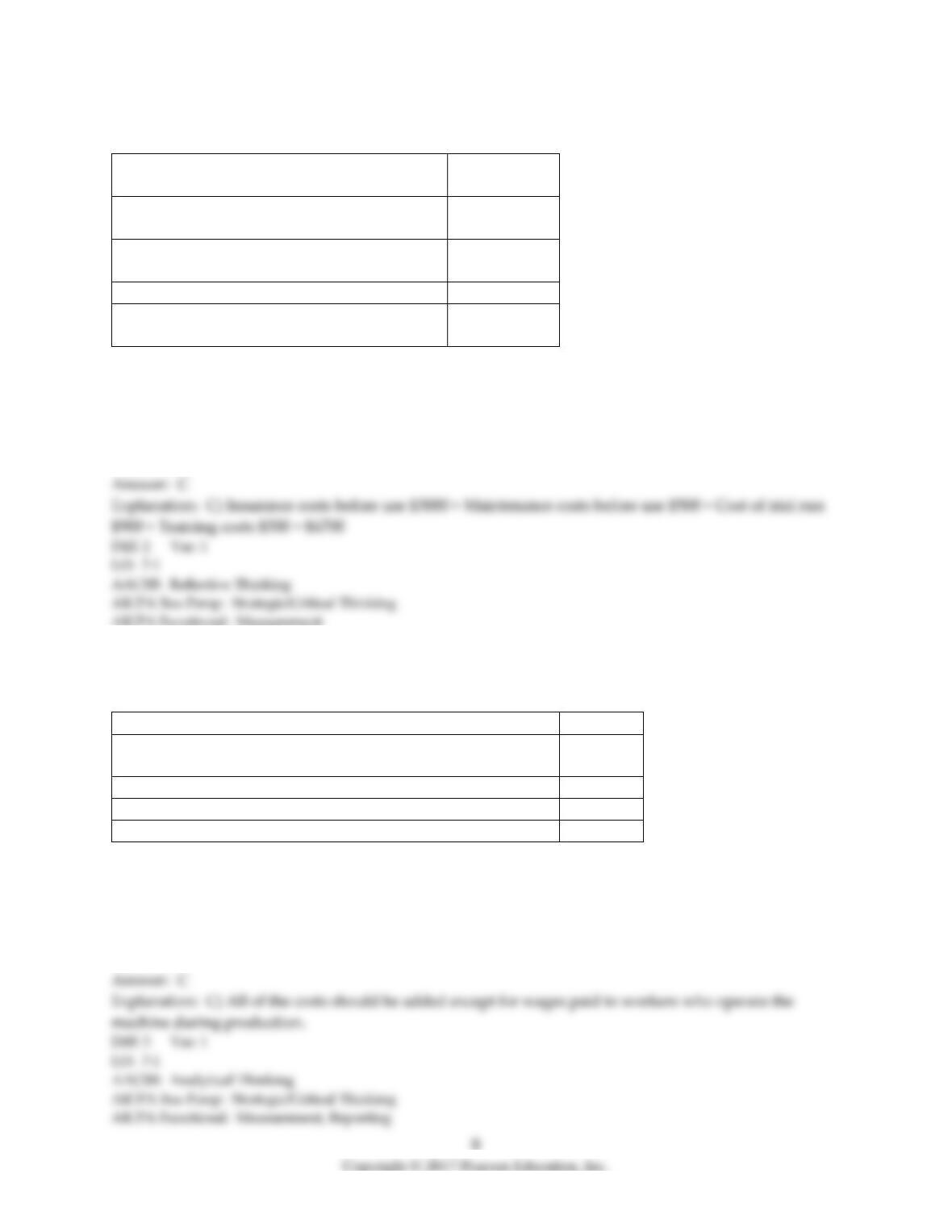
28) Miscellaneous costs associated with the purchase of new equipment include:
Insurance costs before the equipment is ready
for use
$3000
Maintenance costs before the equipment is
ready for use
500
Insurance costs after the equipment is placed
into service
1800
Cost of trial run
900
Training costs for employees to learn how to use
equipment
300
What is the amount assigned to the new equipment?
A) $4200
B) $4400
C) $4700
D) $6500
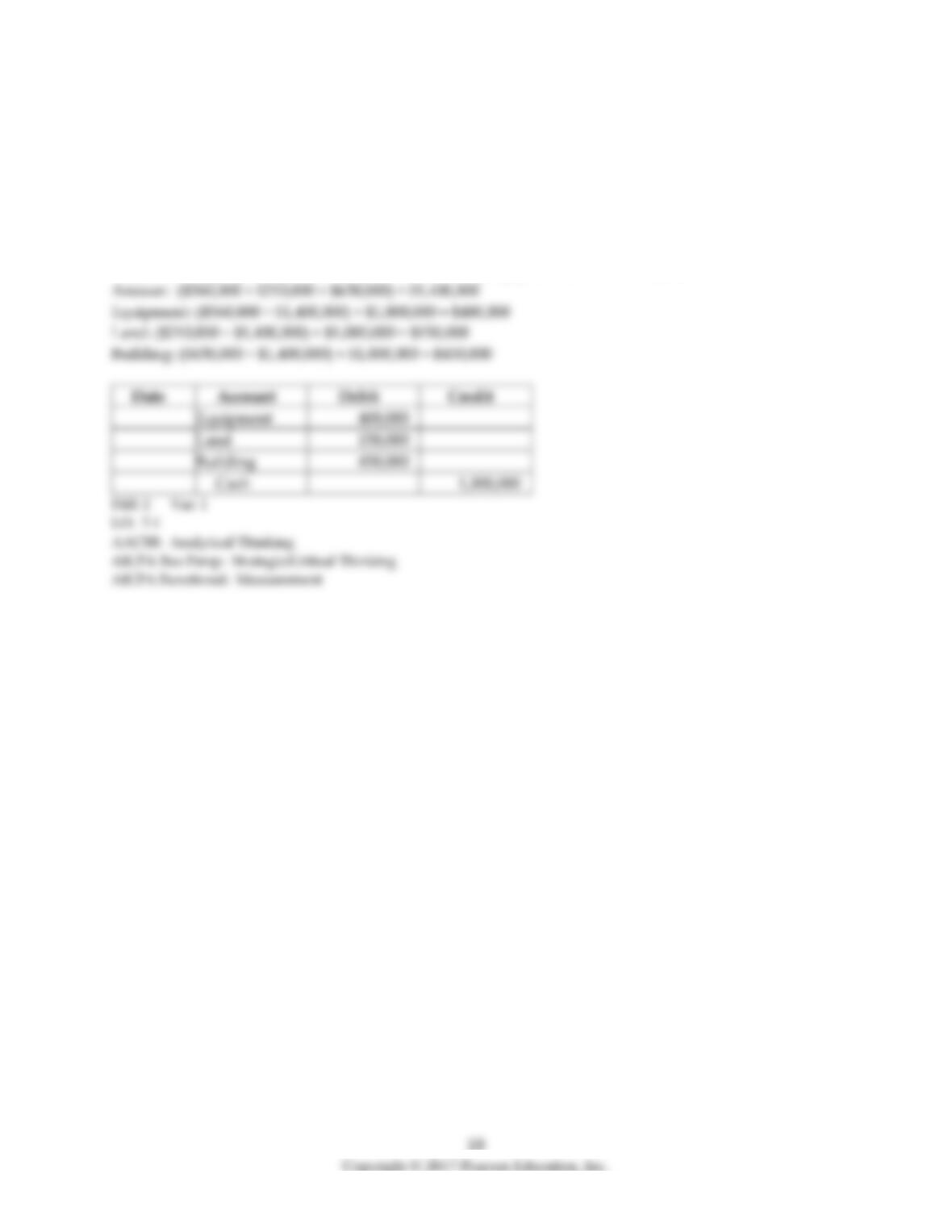
29) Dorman Company purchased a new machine for its production process. The following costs were
incurred for the new machine:
Training costs for workers who will operate the machine
$10,000
Wages paid to workers who operate the machine during
production
102,000
Ordinary repairs to the machine before the first production run
4000
Cost of platform used to properly secure the machine
20,000
Cost of trial run which took place before the first production run
13,000
Which costs should be added to the cost of the machine?
A) $10,000
B) $30,000
C) $47,000
D) $149,000
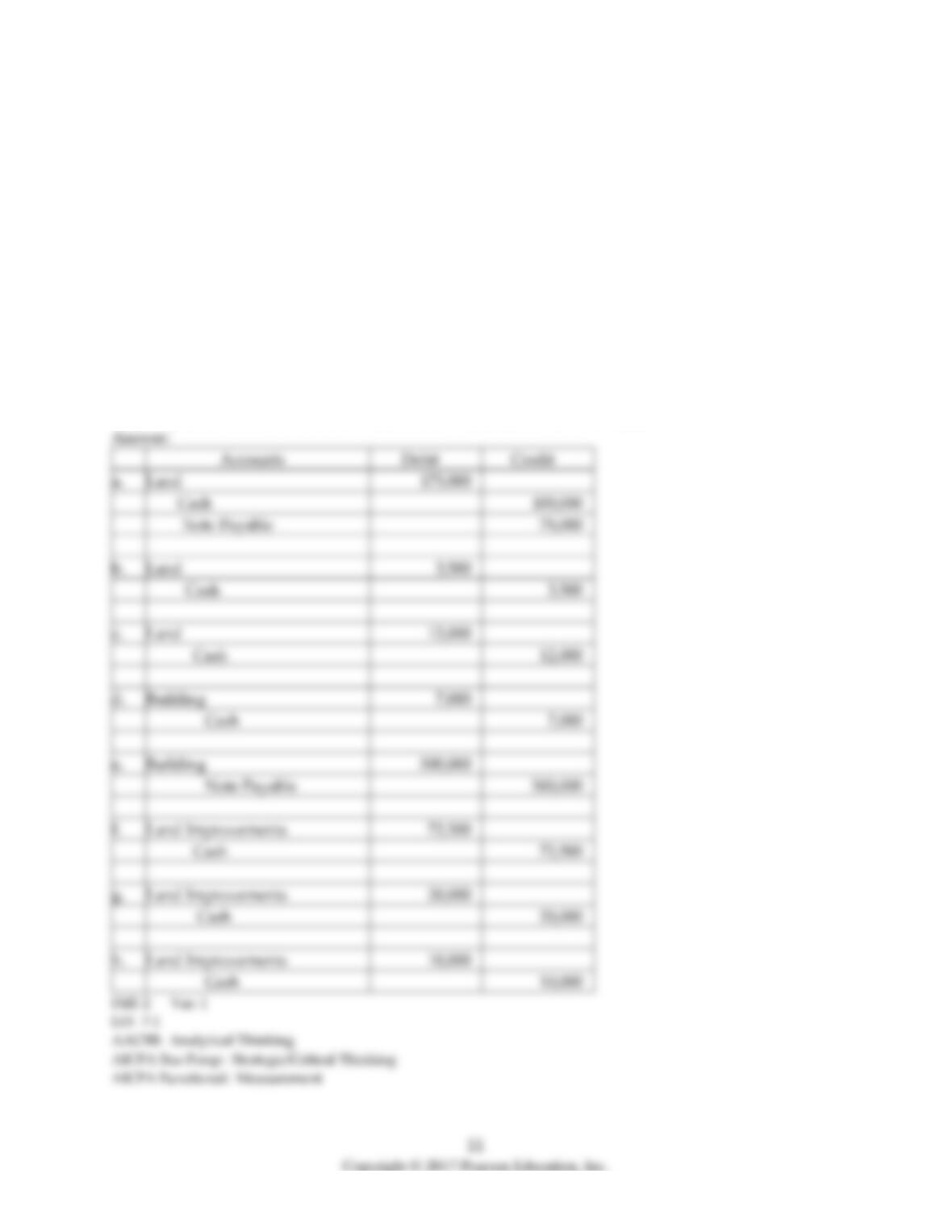
30) The Manson Company purchased assets for a lump-sum price of $1,000,000. An appraisal indicates
the following market prices:
Equipment $560,000
Land $210,000
Building $630,000
Prepare the appropriate journal entry if Manson Company paid cash for this transaction.
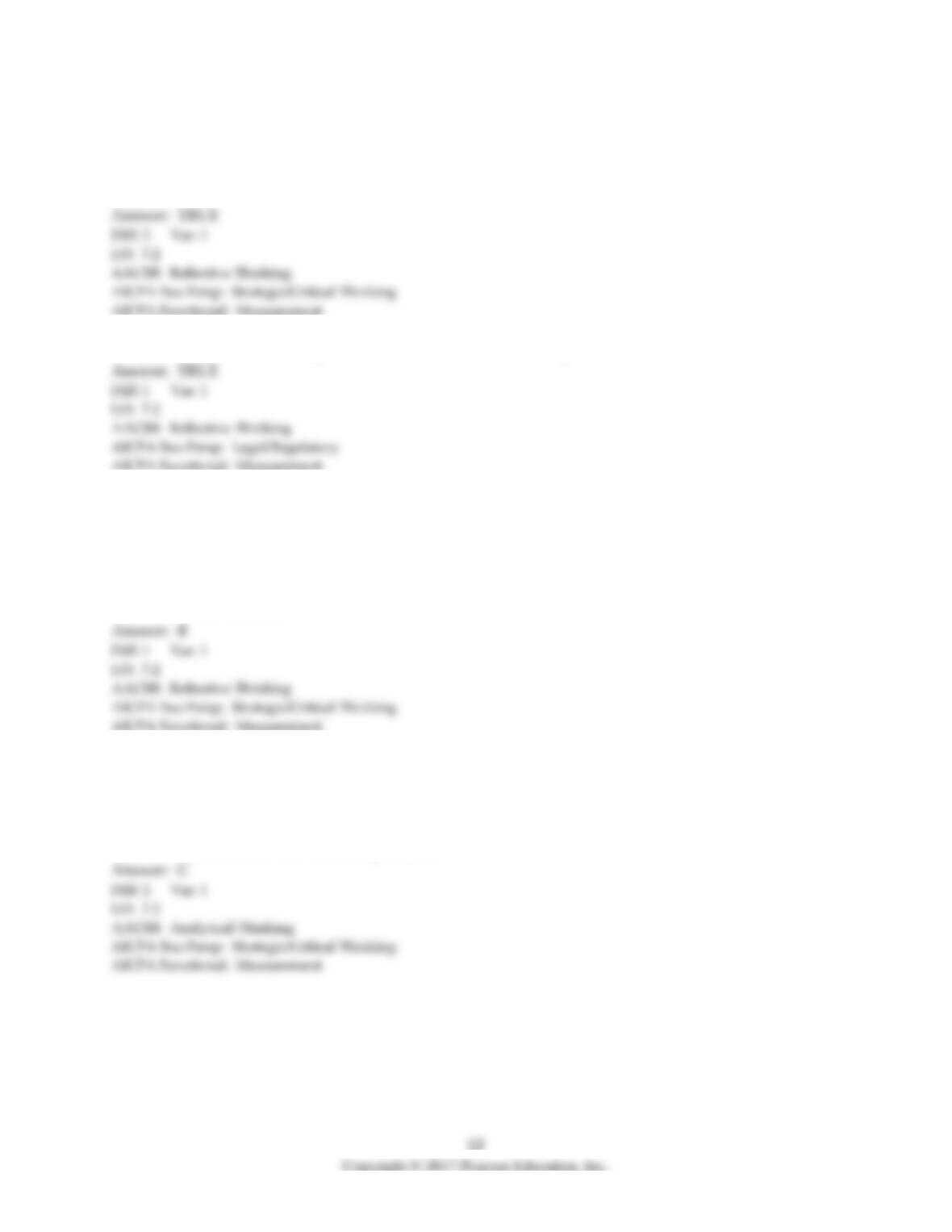
31) Auto Shop, Inc., incurred the following costs in acquiring plant assets:
a. Purchased land with a $100,000 down payment and signed a $75,000 note payable for the balance.
b. Delinquent property tax of $2,500 and legal fees of $1,000 had to be paid before the land could be
purchased.
c. $12,000 was paid to demolish an unwanted building on the land.
d. Architect fee of $7,000 was paid for the design of a new office building.
e. An office building was constructed at a cost of $500,000. A long-term note payable was used to pay
for the cost.
f. $17,500 was paid for fencing around the new building. $55,000 was paid for paving the parking lot
by the new building.
g. $20,000 was paid for lights in the new parking lot.
h. $10,000 was paid for a sprinkler system for the bushes and grass.
Required:
Prepare journal entries for the above transactions. Explanations are not required.
2 Learning Objective 7-2
1) The distinction between a capital expenditure and an immediate expense for a plant asset requires
judgment.
2) Expenditures that extend a plant asset’s useful life should be capitalized.
3) Costs that do not extend a plant asset’s capacity or its useful life, but merely maintain the asset or
restore it to working order are recorded as:
A) capital expenditures.
B) expenses.
C) extraordinary repairs.
D) modification of assets.
4) Which of the following costs associated with a delivery van should NOT be capitalized?
A) The van’s engine is overhauled and this will extend the useful life by five years.
B) The van is modified so it can be used for multiple purposes in the business.
C) The van is repainted.
D) All of the above items should be capitalized.
5) The journal entry to record an addition to an office building would include:
A) credit to Depreciation Expense.
B) credit to Accumulated Depreciation.
C) debit to Repair Expense.
D) debit to Office Building.
6) Pat’s Pets recently paid $15,000 to have the engine in its delivery van overhauled. The estimated
useful life of the van was originally estimated to be 4 years. The overhaul is expected to extend the
useful life of the van to 10 years. The overhaul is regarded as a(n):
A) revenue expenditure.
B) capital expenditure.
C) equity expenditure.
D) The answer depends on management’s judgment.
7) Capital expenditures are not immediately expensed because these items:
A) extend the useful life of a plant asset.
B) return a plant asset to its prior condition.
C) decrease the plant asset’s capacity.
D) maintain a plant asset in working condition.
8) Morgan Oaks Company replaced the windshields and painted several of its vehicles during the year.
These costs should be:
A) debited to Equipment.
B) depreciated over the life of the vehicles.
C) credited to Accumulated Depreciation.
D) debited to Repair Expense.
9) On June 1, Roadway’s Trucking Company paid $7000 to overhaul the engine on a delivery truck to
allow it to be used for two additional years. It also paid $8500 to change the storage capacity of the truck
so that it could haul more merchandise. Which of the following statements is TRUE?
A) The $7000 is a capital expenditure and the $8500 is an expense.
B) The $7000 is an expense and the $8500 is a capital expenditure.
C) Both items are capital expenditures.
D) Both items are expenses.
10) Treating a capital expenditure as an immediate expense:
A) overstates assets and stockholders’ equity in the year of the error.
B) understates assets and stockholders’ equity in the year of the error.
C) understates assets and overstates stockholders’ equity in the year of the error.
D) overstates assets and understates stockholders’ equity in the year of the error.
11) If a company capitalizes a cost that should have been expensed:
A) expenses and net income will be overstated in the year of the error.
B) expenses and net income will be understated in the year of the error.
C) expenses will be overstated and net income will be understated in the year of the error.
D) expenses will be understated and net income will be overstated in the year of the error.
12) WorldCom’s fraudulent scheme of capitalizing telephone line costs instead of expensing them was
discovered by:
A) external auditors.
B) astute investors.
C) U.S. Securities and Exchange Commission.
D) internal auditors.
13) Which of the following statements is INCORRECT?
A) The rules for determining whether a cost should be expensed or capitalized are so complete and
clear that judgment is not needed.
B) Capital expenditures are capitalized when the cost is added to an asset account.
C) Most companies expense all small (immaterial) costs regardless of whether the costs are capital in
nature.
D) An expense merely maintains the asset in its present condition or restores it to working order.
14) Which of the following costs for a delivery vehicle should NOT be capitalized?
A) repair dented fender
B) service air conditioning system
C) repair air conditioning system
D) all of the above
15) Costs that maintain a plant asset in its present condition should be ________. Costs that restore a
plant asset to working order or its prior condition should be ________.
A) capitalized; capitalized
B) capitalized; expensed
C) expensed; capitalized
D) expensed; expensed
16) A conservative policy with regard to capitalizing or expensing costs associated with plant assets
avoids ________.
A) understating profits and assets
B) overstating profits and assets
C) overstating profits and understating assets
D) understating profits and overstating assets
17) State the general rule that is used to determine whether costs relating to plant assets should be
capitalized or expensed.
3 Learning Objective 7-3
1) The depreciation process follows the revenue recognition principle.
2) The Accumulated Depreciation account is an income statement account.
3) Obsolescence may cause an asset’s useful life to be longer than the asset’s physical life.
4) Book value of a plant asset equals the cost of the asset less the current year’s depreciation expense.
5) The normal balance of the Accumulated Depreciation account is a debit.
6) At the end of its useful life, the book value of an asset must be zero.
7) In the units-of-production method, a fixed amount of depreciation expense is assigned to each unit of
output.
8) When compared to the accelerated depreciation methods, the use of the straight-line method
increases a company’s tax liability.
9) Under the double-declining-balance method of depreciation, residual value is initially ignored.
10) Depreciation expense decreases both assets and stockholders’ equity.
11) The book value of an asset cannot be less than its residual value.
12) The depreciation process follows the ________ principle.
A) revenue recognition
B) expense recognition
C) disclosure
D) consistency
13) An asset is ________ when another asset can do the job more efficiently.
A) fully depreciated
B) deteriorated
C) physically worn
D) obsolete
14) Double-declining-balance depreciation:
A) is an accelerated depreciation method.
B) ignores the residual value in computing depreciation, except during the last year.
C) is based on the book value of the plant asset.
D) is all of the above.
15) Which of the following depreciation methods best applies to those assets that generate greater
revenue earlier in their useful lives?
A) straight-line method
B) depletion method
C) double-declining-balance method
D) units-of-production method
16) All of the following are needed to measure depreciation, EXCEPT for:
A) cost.
B) market value.
C) estimated useful life.
D) estimated residual value.
17) A depreciation method in which an equal amount of depreciation expense is assigned to each year
of the asset’s use is the:
A) units-of-production method.
B) straight-line method.
C) accelerated depreciation method.
D) estimated residual value method.
18) The expected cash value of a plant asset at the end of its useful life is known as:
A) scrap value.
B) salvage value.
C) estimated residual value.
D) all of the above.
19) The depreciable cost of a plant asset equals the:
A) historical cost of the asset plus the estimated residual value.
B) historical cost of the asset minus the estimated residual value.
C) historical cost of the asset minus accumulated depreciation.
D) current replacement cost minus accumulated depreciation.
20) The book value of a plant asset is defined as:
A) historical cost minus estimated residual value.
B) historical cost minus accumulated deprecation.
C) current sales value minus historical cost.
D) replacement cost minus accumulated depreciation.
21) Cost minus residual value divided by useful life, in years, is the formula for the:
A) straight-line method.
B) units-of-production method.
C) double-declining-balance method.
D) modified accelerated cost recovery method.
22) When compared to the other methods of depreciation, the double-declining-balance method of
depreciation gives depreciation expense that is:
A) less in the earlier periods.
B) higher in the earlier periods.
C) approximately the same in earlier periods as with other methods.
D) the same from year to year.