Chapter 7 – Cost-Volume-Profit Analysis
7-1
Chapter 7
Cost-Volume-Profit Analysis
Answer Key
True / False Questions
1. The break-even point is that level of activity where total revenue equals total cost.
2. Total contribution margin is defined as total sales revenue plus total variable expenses.
3. The contribution-margin ratio is calculated as unit contribution margin divided by the
selling price per unit.
Chapter 7 – Cost-Volume-Profit Analysis
7-2
4. The contribution margin ratio can also be expressed as a percentage.
5. The relevant range is the range of activity in which management of a company expects to
operate.
6. On the CVP graph, the break-even point is determined by the intersection of the total-
revenue line and the total-expense line.
Chapter 7 – Cost-Volume-Profit Analysis
7-3
7. The difference between budgeted sales revenue and break-even sales revenue is the
operating leverage.
8. The safety margin is another name for the breakeven point.
9. For any organization selling multiple products, the relative proportion of each type of
product sold is called the sales mix.
Chapter 7 – Cost-Volume-Profit Analysis
7-4
10. Total contribution margin is an important assumption in multiproduct CVP analysis.
11. Cost-volume-profit analysis is based on certain general assumptions. One of these
assumptions is that product prices will remain constant as volume varies within the relevant
range.
12. Sensitivity analysis has become relatively easy to perform with the advent of personal
computers and spreadsheet software.
Chapter 7 – Cost-Volume-Profit Analysis
7-5
13. Many operating managers find the traditional income-statement format difficult to use,
because it does not separate revenues and expenses.
14. The management functions of planning, control, and decision making all are facilitated by
an understanding of cost-volume-profit relationships.
15. The extent to which an organization uses fixed costs in its cost structure is measured by
financial leverage.
Chapter 7 – Cost-Volume-Profit Analysis
7-6
16. Cost structures differ widely among industries and among firms within an industry.
17. Activity-based costing systems should not be used in conjunction with cost-volume-profit
analyses.
18. An ABC cost-volume-profit analysis recognizes that some costs that are fixed with respect
to sales volume may not be fixed with respect to other important cost drivers.
Chapter 7 – Cost-Volume-Profit Analysis
7-7
19. Companies with advanced manufacturing technology tend to have lower fixed costs.
20. Companies with advanced manufacturing technology tend to have higher break-even
points.
21. The requirement that companies pay income taxes does not affect their cost-volume-profit
relationships.
Chapter 7 – Cost-Volume-Profit Analysis
7-8
22. When a firm is required to pay taxes on income, it is important to distinguish between
after-tax (AT) income and before-tax (BT) income.
Chapter 7 – Cost-Volume-Profit Analysis
7-9
Multiple Choice Questions
Use the following information to answer Questions 23-26.
Narchie sells a single product for $50. Variable costs are 60% of the selling price, and the
company has fixed costs that amount to $400,000. Current sales total 16,000 units.
23. Narchie:
24. Each unit that Narchie sells will:
Chapter 7 – Cost-Volume-Profit Analysis
7-10
25. In order to produce a target profit of $22,000, Narchie’s dollar sales must total:
26. If Narchie sells 24,000 units, its safety margin will be:
Chapter 7 – Cost-Volume-Profit Analysis
7-11
27. CVP analysis can be used to study the effect of:
28. The break-even point is that level of activity where:
Chapter 7 – Cost-Volume-Profit Analysis
7-12
29. The break-even point is that level of activity where:
30. The unit contribution margin is calculated as the difference between:
Chapter 7 – Cost-Volume-Profit Analysis
7-13
31. Which of the following would produce the largest increase in the contribution margin per
unit?
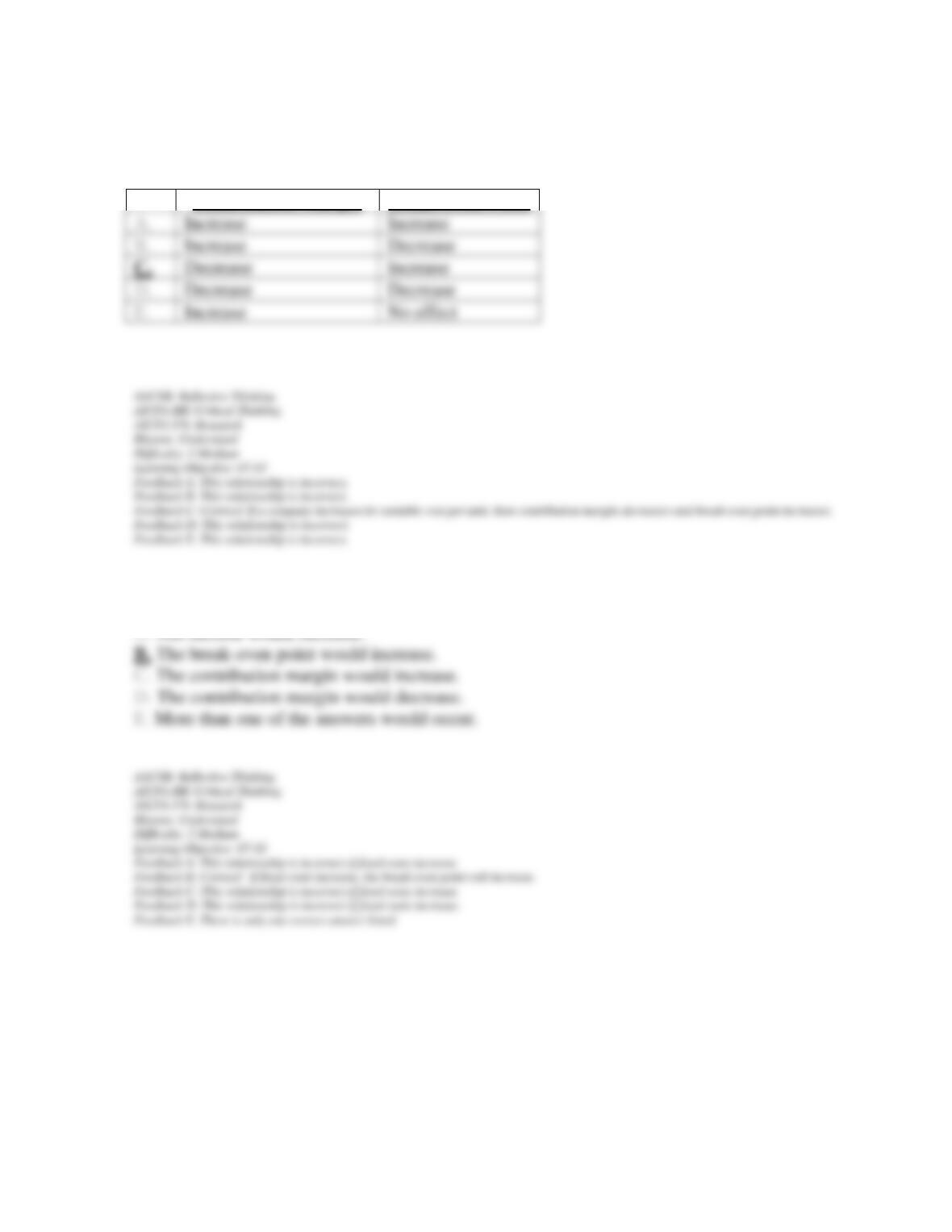
32. Which of the following occurs if a company was able to reduce its variable cost per unit?
Contribution Margin
Break-even Point
Increase
Increase
Increase
Decrease
Decrease
Increase
Decrease
Decrease
Increase
No effect
Chapter 7 – Cost-Volume-Profit Analysis
7-14
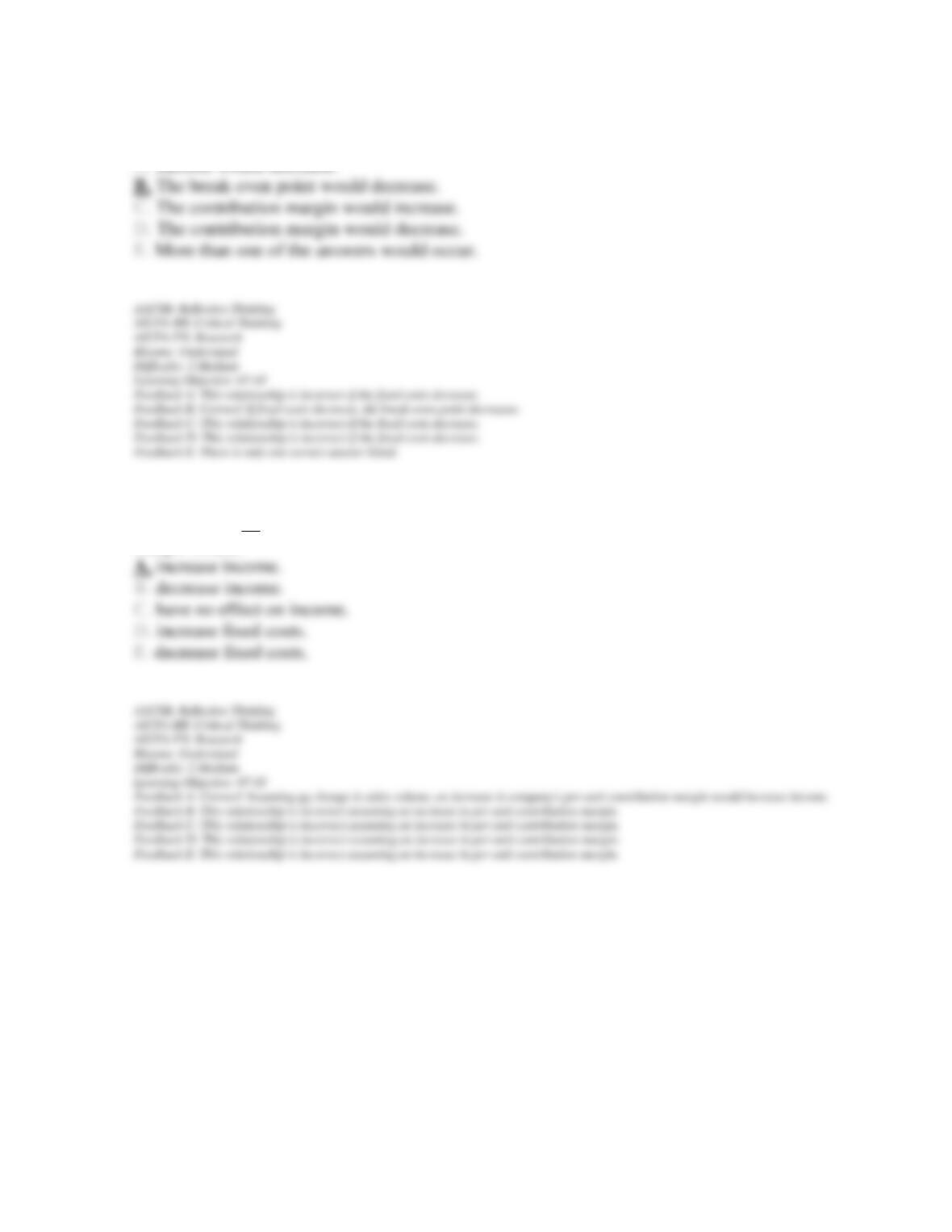
33. Which of the following would occur if a company increases its variable cost per unit?
Contribution Margin
Break-Even Point
34. Which of the following occurs if a company experiences an increase in its fixed costs?
Increase
Increase
Increase
Decrease
Decrease
Increase
Decrease
Decrease
Increase
No effect
Chapter 7 – Cost-Volume-Profit Analysis
7-15
35. Which of the following occurs if a company experiences a decrease in its fixed costs?
36. Assuming no change in sales volume, an increase in company’s per-unit contribution
margin would:
Chapter 7 – Cost-Volume-Profit Analysis
7-16
37. A company that desires to lower its break-even point should strive to:
A. decrease selling prices.
38. A company has fixed costs of $900 and a per-unit contribution margin of $3. Which of the
following statements is true?
A. Each unit “contributes” $3 toward covering the fixed costs of $900.
Chapter 7 – Cost-Volume-Profit Analysis
7-17
39. Partner Industries sells a single product for $50 that has a variable cost of $30. Fixed costs
amount to $5 per unit when anticipated sales targets are met. If the company sells one unit in
excess of its break-even volume, profit will be:
40. At a volume of 20,000 units, Almount Industries reported sales revenues of $1,000,000,
variable costs of $300,000, and fixed costs of $260,000. The company’s contribution margin
per unit is:
Chapter 7 – Cost-Volume-Profit Analysis
7-18
41. At a volume of 20,000 units, Almount Industries reported sales revenues of $1,000,000,
variable costs of $300,000, and fixed costs of $260,000. The company’s break-even point in
units is:
42. A recent income statement of Benton Corporation reported the following data:
Sales revenue
$8,000,000
Variable costs
5,000,000
Fixed costs
2,200,000
If these data are based on the sale of 20,000 units, the contribution margin per unit would be:
Chapter 7 – Cost-Volume-Profit Analysis
7-19
43. A recent income statement of Benton Corporation reported the following data:
Sales revenue
$8,000,000
Variable costs
5,000,000
Fixed costs
2,200,000
If these data are based on the sale of 20,000 units, the break-even point would be:
Chapter 7 – Cost-Volume-Profit Analysis
7-20
44. A recent income statement of Safety Corporation reported the following data:
Sales revenue
$6,800,000
Variable costs
2,800,000
Fixed costs
2,500,000
If these data are based on the sale of 20,000 units, the break-even point would be: