Chapter 07 – Reporting and Interpreting Cost of Goods Sold and Inventory
1. The use of raw materials in the manufacturing process is reported as an operating expense
on the income statement.
2. Manufactured goods transferred out of work in process are reported as finished goods on
the balance sheet.
3. Inventory inspection costs incurred at the time of purchase are reported as operating
expenses on the income statement.
Chapter 07 – Reporting and Interpreting Cost of Goods Sold and Inventory
4. Factory overhead manufacturing costs are a component of the cost of the work-in process
inventory.
5. A decrease in the merchandise inventory account occurs when inventory purchases are
greater than cost of goods sold.
6. Costs of goods available for sale ends up being allocated to both ending inventory and cost
of goods sold.
Chapter 07 – Reporting and Interpreting Cost of Goods Sold and Inventory
7. The LIFO inventory method will result in the highest gross margin when costs are
increasing in comparison to the specific identification, FIFO and weighted average inventory
methods.
8. A company can use the LIFO inventory method for income tax purposes and the FIFO
inventory method for financial reporting purposes during a given year.
9. A large retail department store probably would use the specific identification inventory
costing method for most of the items in its inventory.
Chapter 07 – Reporting and Interpreting Cost of Goods Sold and Inventory
10. The FIFO inventory method allocates the most recent inventory purchase costs to ending
inventory.
11. The LIFO inventory method allocates the most recent inventory purchase costs to cost of
goods sold.
12. During periods of decreasing prices, use of the LIFO inventory method will result in a
larger amount of inventory than will the use of the FIFO inventory method.
Chapter 07 – Reporting and Interpreting Cost of Goods Sold and Inventory
13. During periods of increasing prices, use of the LIFO inventory method will result in a
lower inventory amount on the balance sheet and a lower net income than will use of the
FIFO inventory method.
14. During periods of increasing prices, the LIFO inventory method results in lower income
taxes.
Chapter 07 – Reporting and Interpreting Cost of Goods Sold and Inventory
15. During periods of decreasing prices, use of the FIFO inventory method results in lower
gross profit than would use of the LIFO method.
16. The lower-of-cost-or-market (LCM) rule is used because of the conservatism constraint,
which allows a departure from the historical cost principle.
17. The journal entry to write-down inventory under the lower-of-cost-or-market (LCM) rule
results in a decrease in both ending inventory and cost of goods sold.
Chapter 07 – Reporting and Interpreting Cost of Goods Sold and Inventory
18. The journal entry to write-down inventory under the lower-of-cost-or-market (LCM) rule
results in a debit to cost of goods sold and a credit to inventory.
19. Inventory turnover is calculated as cost of goods sold divided by average inventory.
20. Inventory turnover under LIFO is greater than inventory turnover under FIFO when prices
are increasing.
Chapter 07 – Reporting and Interpreting Cost of Goods Sold and Inventory
21. The average days to sell inventory decreases as inventory turnover increases.
22. An increase in inventory is deducted from net income when determining operating
activities cash flows.
23. An increase in accounts payable is added to net income when determining operating
activities cash flows.
Chapter 07 – Reporting and Interpreting Cost of Goods Sold and Inventory
24. Cash flow from operations increases by $1,000,000 when there is a $3,000,000 decrease
in inventory and a $2,000,000 decrease in accounts payable.
25. The LIFO Reserve is a contra-asset account which represents the excess of FIFO
inventory costs over LIFO inventory costs.
Chapter 07 – Reporting and Interpreting Cost of Goods Sold and Inventory
26. In a period of rising costs, the LIFO Reserve account would be deducted from the ending
inventory under LIFO costing to convert it to ending inventory under FIFO costing.
27. An understatement of ending inventory results in an overstatement of net income.
28. When a company using the LIFO inventory method reduces its inventory levels at the end
of the year, it can lead to LIFO liquidation.
Chapter 07 – Reporting and Interpreting Cost of Goods Sold and Inventory
29. An overstatement of the 2011 ending inventory results in an understatement of net income
during 2012.
30. An overstatement of the 2011 ending inventory results in an overstatement of
stockholders’ equity as of the end of 2012.
Chapter 07 – Reporting and Interpreting Cost of Goods Sold and Inventory
31. A company reported the following information for its most recent year of operation:
purchases, $100,000; beginning inventory, $20,000; and cost of goods sold, $110,000. How
much was the company’s ending inventory?
32. Coleman Company has provided the following information: beginning inventory,
$100,000; cost of goods sold, $450,000; and ending inventory, $80,000. How much were
Coleman’s inventory purchases?
Chapter 07 – Reporting and Interpreting Cost of Goods Sold and Inventory
33. Which of the following statements is incorrect?
34. Which of the following costs is not included as inventory on the balance sheet?
Chapter 07 – Reporting and Interpreting Cost of Goods Sold and Inventory
35. Which of the following costs will not affect cost of goods sold?
36. Which of the following statements is incorrect for a manufacturing entity?
Chapter 07 – Reporting and Interpreting Cost of Goods Sold and Inventory
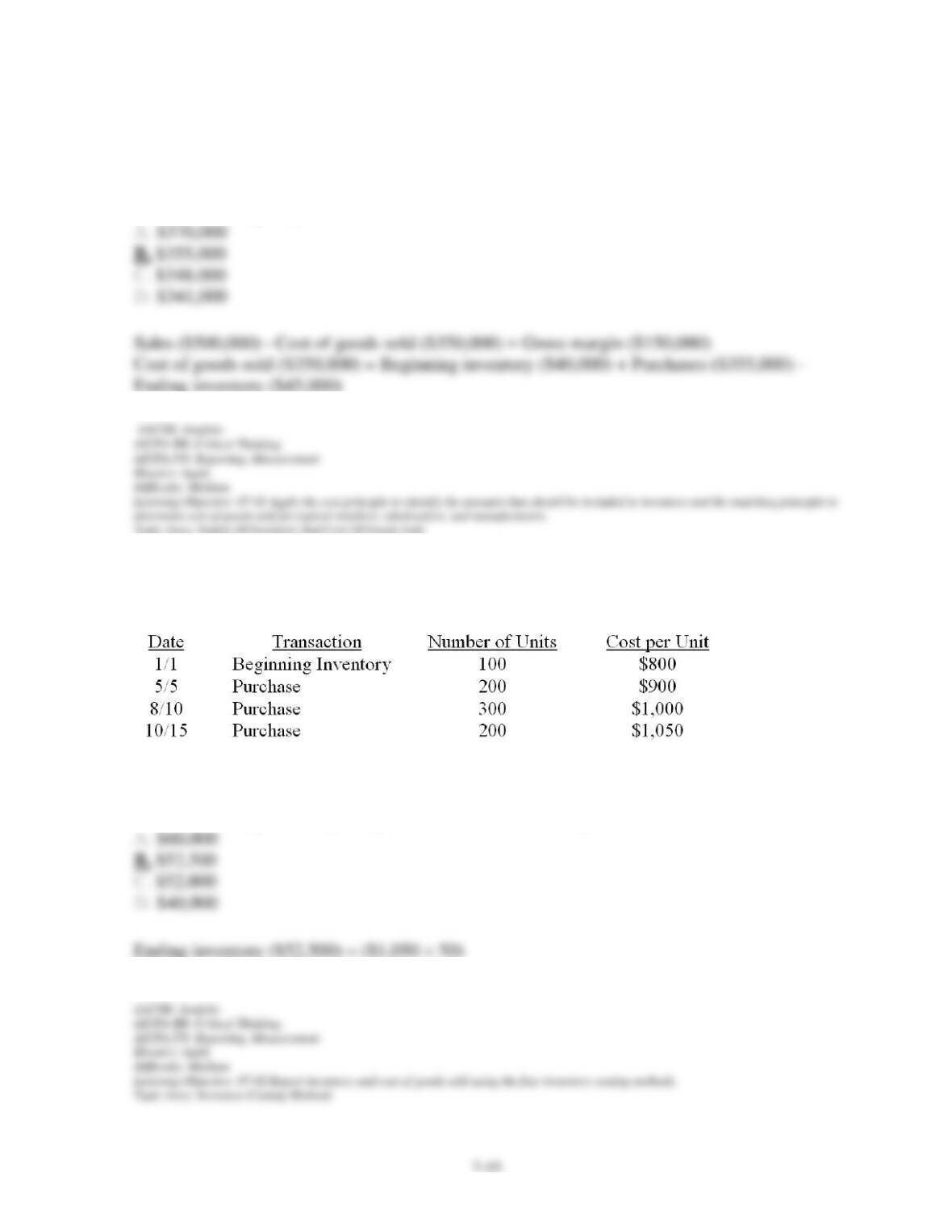
37. A company provided the following data: sales, $500,000; beginning inventory, $40,000;
ending inventory, $45,000; and gross margin, $150,000. What was the amount of inventory
purchased during the year?
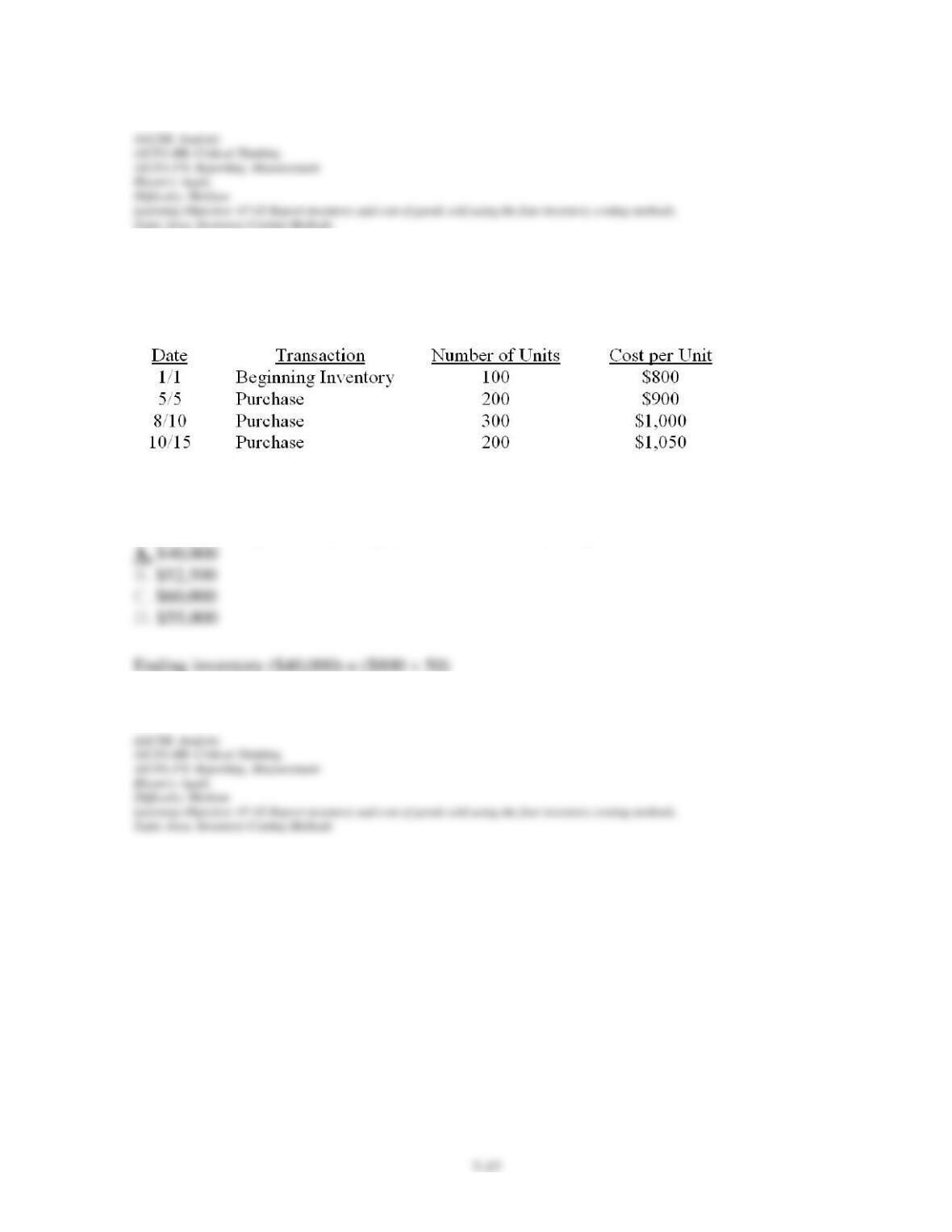
38. Lauer Corporation uses the periodic inventory system and has provided the following
information about one of their laptop computers:
During the year, 750 laptop computers were sold.
What was ending inventory using the FIFO cost flow assumption?
Chapter 07 – Reporting and Interpreting Cost of Goods Sold and Inventory
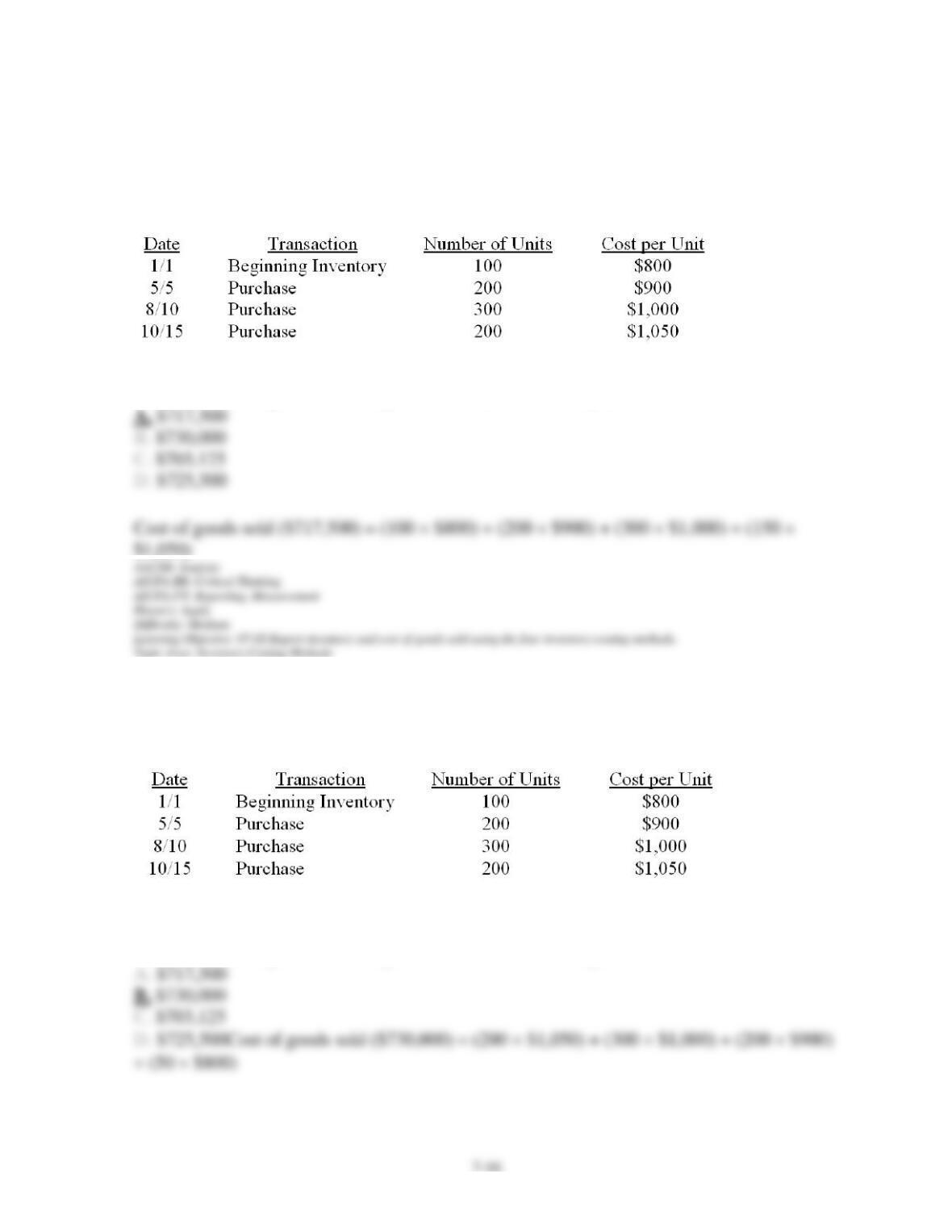
39. Lauer Corporation uses the periodic inventory system and has provided the following
information about one of their laptop computers:
During the year, 750 laptop computers were sold.
What was cost of goods sold using the FIFO cost flow assumption?
40. Lauer Corporation uses the periodic inventory system and has provided the following
information about one of their laptop computers:
During the year, 750 laptop computers were sold.
What was cost of goods sold using the LIFO cost flow assumption?
Chapter 07 – Reporting and Interpreting Cost of Goods Sold and Inventory
41. Lauer Corporation uses the periodic inventory system and has provided the following
information about one of their laptop computers:
During the year, 750 laptop computers were sold.
What was ending inventory using the LIFO cost flow assumption?
Chapter 07 – Reporting and Interpreting Cost of Goods Sold and Inventory
42. Under the FIFO cost flow assumption during a period of inflation, which of the following
is false?
43. Under the LIFO cost flow assumption during a period of inflation, which of the following
is false?
44. Which of the following statements is correct when inventory prices are increasing?
Chapter 07 – Reporting and Interpreting Cost of Goods Sold and Inventory
45. Which of the following statements is correct when inventory prices are decreasing?
Chapter 07 – Reporting and Interpreting Cost of Goods Sold and Inventory
46. Which of the following statements is correct?
47. Which of the following statements is correct?