42) Which of the following journal entries correctly records bad debt expense?
A)
Bad debt expense
xxx
Accounts receivable
xxx
B)
Allowance for doubtful accounts
xxx
Accounts receivable
xxx
C)
Allowance for doubtful accounts
xxx
Bad debt expense
xxx
D)
Bad debt expense
xxx
Allowance for doubtful accounts
xxx
43) Which of the following journal entries correctly records the write off of an uncollectible
account receivable when using the allowance method?
A)
Bad debt expense
xxx
Uncollectible sales
xxx
B)
Allowance for doubtful accounts
xxx
Accounts receivable
xxx
C)
Allowance for doubtful accounts
xxx
Bad debt expense
xxx
D)
Bad debt expense
xxx
Allowance for doubtful accounts
xxx
44) The CHS Company has provided the following information:
• Accounts receivable written-off as uncollectible during the year amounted to $11,500.
• The accounts receivable balance at the beginning of the year was $150,000.
• The accounts receivable balance at the end of the year was $210,000.
• The allowance for doubtful accounts balance at the beginning of the year was $14,000.
• The allowance for doubtful accounts balance at the end of the year after the recording of bad
debt expense was $12,900.
• Credit sales during the year totaled $900,000.
How much was CHS Company’s bad debt expense?
A) $11,500.
B) $12,900.
C) $10,400.
D) $14,000.
45) The CHS Company has provided the following information:
• Accounts receivable written-off as uncollectible during the year amounted to $11,500.
• The accounts receivable balance at the beginning of the year was $150,000.
• The accounts receivable balance at the end of the year was $210,000.
• The allowance for doubtful accounts balance at the beginning of the year was $14,000.
• The allowance for doubtful accounts balance at the end of the year after the recording of bad
debt expense was $12,900.
• Credit sales during the year totaled $900,000.
How much cash was received from collections of accounts receivable?
A) $888,500.
B) $828,500.
C) $690,000.
D) $701,500.
46) Superior Company has provided you with the following information before any year-end
adjustments:
Net credit sales are $120,000.
Historical percentage of credit losses is 2%.
Allowance for doubtful accounts has a credit balance of $300.
Accounts receivables ending balance is $47,000.
What is the estimated bad debt expense using the percentage of credit sales method?
A) $2,100.
B) $2,400.
C) $940.
D) $2,700.
47) Which of the following statements is correct?
A) The journal entry to record bad debt expense requires a debit to bad debt expense and a credit
to accounts receivable.
B) The journal entry to record bad debt expense requires a debit to bad debt expense and a credit
to allowance for doubtful accounts.
C) The journal entry to record the write off of an uncollectible account receivable requires a
debit to bad debt expense and a credit to accounts receivable.
D) The journal entry to record the write off of an uncollectible account receivable requires a
debit to bad debt expense and a credit to allowance for doubtful accounts.
48) Clark Company estimated the net realizable value of its accounts receivable as of December
31, 2019, to be $165,000, based on an aging schedule of accounts receivable. Clark has also
provided the following information:
• The accounts receivable balance on December 31, 2019 was $175,000.
• Uncollectible accounts receivable written off during 2019 totaled $12,000.
• The allowance for doubtful accounts balance on January 1, 2019 was $15,000.
How much is Clark’s 2019 bad debt expense?
A) $10,000.
B) $7,000.
C) $13,000.
D) $3,000.
49) What would be incorrect about reporting accounts receivable in the balance sheet?
A) Presenting accounts receivable net of allowance for doubtful accounts.
B) Presenting accounts receivable at estimated net realizable value.
C) Presenting accounts receivable less bad debt expense and write-offs.
D) Presenting accounts receivable at gross amount, less allowance for doubtful accounts.
50) Which of the following statements correctly describes the effect of recording the collection
of a $10,000 account receivable for which a 2% sales discount was recorded at the time of
collection?
A) Current assets will remain the same.
B) Gross profit will decrease $200.
C) Accounts receivable will decrease $9,800.
D) Net sales will increase $9,800.
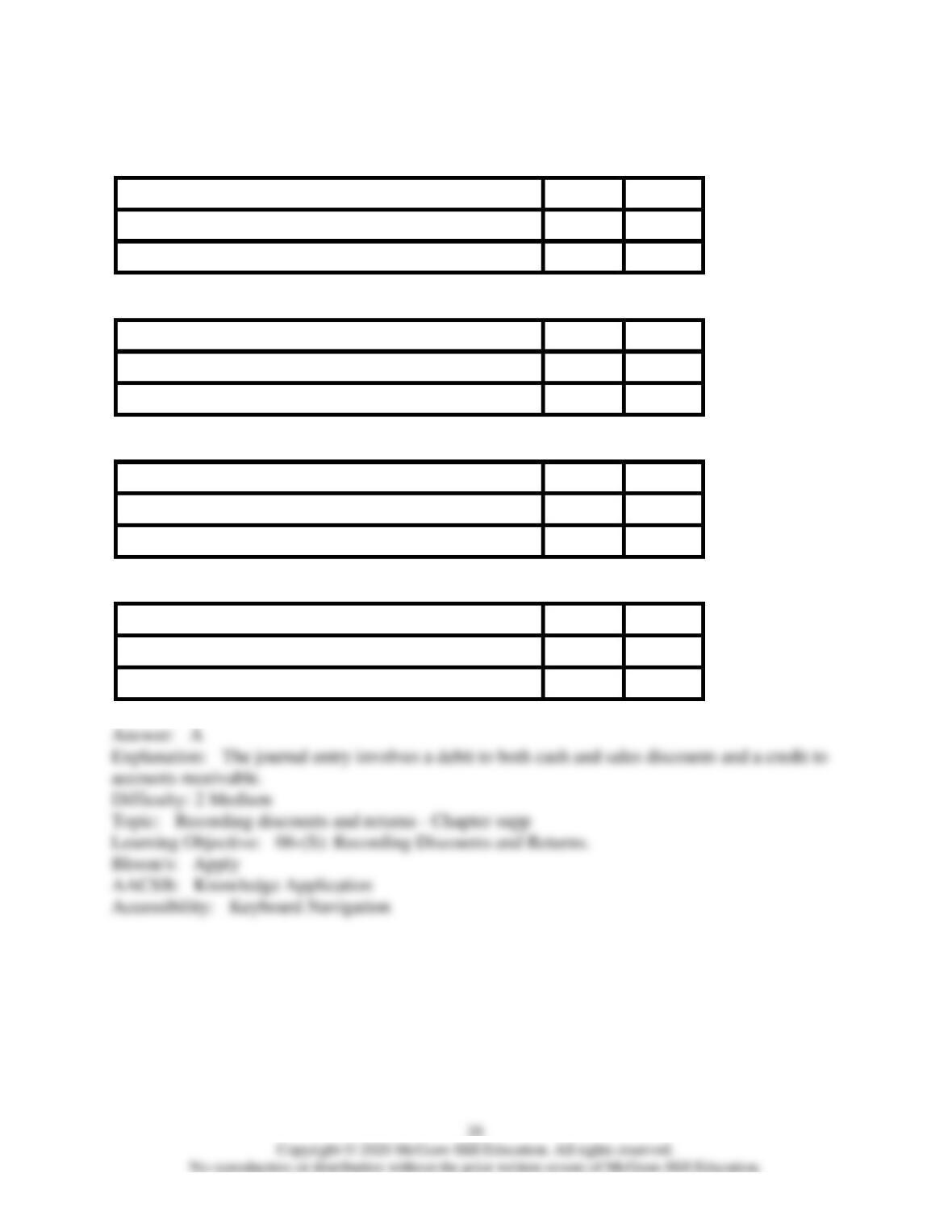
51) Which of the following journal entries correctly records the collection of an account
receivable for which a 1% sales discount was recorded at the time of collection?
A)
Cash
xxx
Sales discounts
xxx
Accounts receivable
xxx
B)
Cash
xxx
Bad debt expense
xxx
Accounts receivable
xxx
C)
Cash
xxx
Sales discounts
xxx
Accounts receivable
xxx
D)
Cash
xxx
Gross profit
xxx
Accounts receivable
xxx
52) Which of the following correctly describes the effect of a journal entry involving the
recording of a sales return?
A) Gross profit decreases.
B) Net sales increases.
C) Current assets remain the same.
D) Net income increases.
53) Which of the following correctly describes the effect of a sales discount?
A) Gross profit increases.
B) Net sales increases.
C) Current assets remain the same.
D) Net income decreases.
54) Which of the following does not correctly describe the effect of a credit card discount?
A) Net sales decrease and gross profit decreases.
B) Net sales decrease and net income decreases.
C) Operating expenses remain the same and net income decreases.
D) Neither operating expenses nor net income is affected
55) Which of the following does not correctly describe the effect of a journal entry involving the
recording of a credit card discount?
A) Net sales decrease and net income decreases.
B) Net sales decrease, operating expenses increase, and net income remains the same.
C) Operating expenses remain the same and net income decreases.
D) Net sales decrease and gross profit decreases.
56) Which of the following correctly describes credit terms of 2/10, n/30?
A) A two percent discount for early payment is available if the invoice is paid before the tenth
day of the month following the month the sale.
B) A two percent discount for early payment is available if the invoice is paid within ten days of
the date of sale.
C) A ten percent discount for early payment is available if the invoice is paid within two days of
the date of the invoice.
D) A two percent discount for early payment is available if the invoice is paid after the tenth day,
but before the thirtieth day of the invoice date.
57) A customer purchased and received $5,000 of goods on credit from Discount Paper Supply
on September 1. The customer received the bill on September 13 and mailed a $5,000 check on
September 30. Discount Paper Supply received the check on October 4. On which of the
following dates should Discount Paper Supply record sales revenue?
A) September 1
B) September 13
C) September 30
D) October 4
58) When a credit sale is made with terms of 2/10, n/30 on May 10 and the customer’s check is
received on May 19, which of the following is true about the May 19 journal entry?
A) The debit to cash will equal the credit to accounts receivable because the discount was
recorded on May 10.
B) There will be a debit to sales discounts on May 10.
C) The debit to cash will be less than the credit to accounts receivable on May 19.
D) There will be a credit to sales discounts on May 19.
59) A company had the following partial list of account balances at year-end:
Sales Returns and Allowances
$
1,000
Accounts Receivable
38,000
Sales Discounts
2,100
Sales Revenue
95,000
Allowance for Doubtful Accounts
1,200
How much is net sales revenue?
A) $91,900.
B) $90,700.
C) $89,900.
D) $88,600.
60) A company purchased goods on credit with credit terms of 3/15, n/45. Although the
company does not have cash available to pay within the discount period, the manager of the
company is considering borrowing money to take advantage of the discount. In order to make the
appropriate decision, the manager computed the annual interest rate associated with the sales
discount. Which of the following is the annual interest rate (rounded)? (Use 365 days a year)
A) 56%.
B) 38%.
C) 25%.
D) 18%.
61) When credit terms for a sale are 2/15, n/40, the customer saves by paying early. What
percent (rounded) would this savings amount to on an annual basis?
A) 18.2%.
B) 20.0%.
C) 29.2%.
D) 36.5%.
62) Which of the following accounts is not a contra-revenue account?
A) Sales discounts
B) Credit card discounts
C) Sales returns and allowances
D) Allowance for doubtful accounts
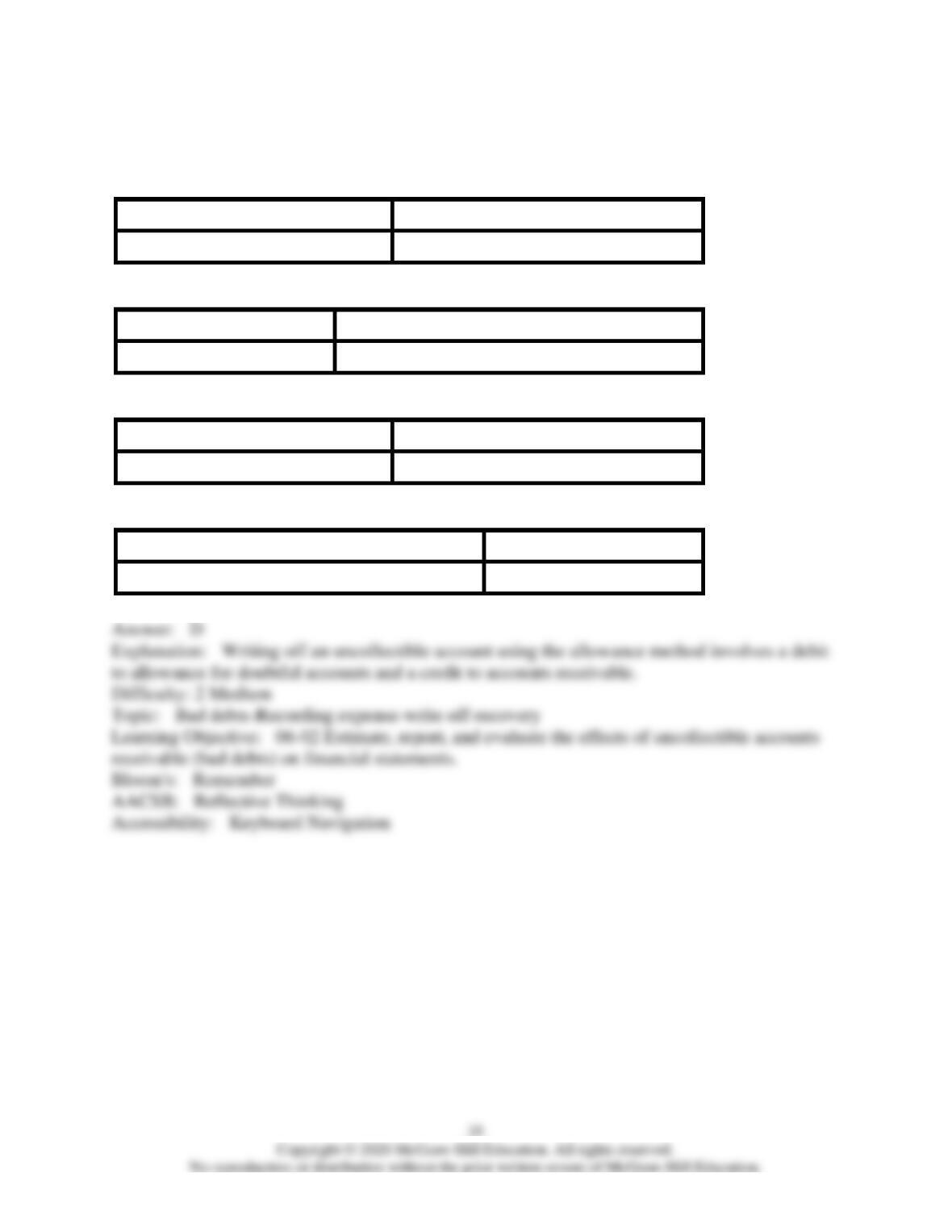
63) Dillon Company uses the allowance method to account for bad debts. The entry to write off a
bad account (one that will never be collected) should be:
A)
Debit
Credit
Bad debt expense
Accounts receivable
B)
Debit
Credit
Bad debt expense
Allowance for doubtful accounts
C)
Debit
Credit
Sales revenue
Accounts receivable
D)
Debit
Credit
Allowance for doubtful accounts
Accounts receivable
64) When using the allowance method for accounting for bad debts, accounts receivable is
reported on the balance sheet at the expected net realizable value. When a particular receivable
from a customer ultimately is determined to be uncollectible and is written off, the recording of
this event will:
A) Decrease the net realizable value of the accounts receivable.
B) Have an effect that is not determinable from the information given.
C) Increase the net realizable value of the accounts receivable.
D) Have no effect on the net realizable value of the accounts receivable.
65) Oakwood Company had accounts receivable of $750,000 and an allowance for doubtful
accounts of $21,500 just prior to writing off as worthless a customer’s $5,000 account receivable.
The net realizable value of Oakwood’s accounts receivable as shown by the accounting records
before and after the write off was as follows:
A)
Before
After
$750,000
$745,000
B)
Before
After
$721,500
$733,500
C)
Before
After
$728,500
$723,500
D)
Before
After
$728,500
$728,500
66) Woodland Company uses the allowance method to account for bad debts. During the current
year, a customer declared bankruptcy and a receivable of $10,000 was deemed uncollectible.
Which of the following journal entries records Woodland’s uncollectible account write-off?
A)
Allowance for doubtful accounts
10,000
Accounts receivable
10,000
B)
Bad debt expense
10,000
Allowance for doubtful accounts
10,000
C)
Allowance for doubtful accounts
10,000
Bad debt expense
10,000
D)
Loss on receivables
10,000
Accounts receivable
10,000
67) At year-end, Chief Company has a balance of $10,000 in accounts receivable of which
$1,000 is more than 30 days overdue. Chief has a credit balance of $100 in the allowance for
doubtful accounts before any year-end adjustments. Using the aging of accounts receivable
method, Chief estimates that 1% of current accounts and 10% of accounts over thirty days are
uncollectible. What is the amount of bad debt expense?
A) $90.
B) $190.
C) $290.
D) $100.
68) Upon completing an aging analysis of accounts receivable, the accountant for Rosco Works
prepared an aging of accounts receivable and estimated that $5,000 of the $98,000 accounts
receivable balance would be uncollectible. The allowance for doubtful accounts had a $400 debit
balance at year-end prior to adjustment. What is the amount of bad debt expense?
A) $5,000.
B) $5,400.
C) $4,600.
D) $400.
69) Which of the following statements does not correctly describe the allowance for doubtful
accounts balance?
A) It is reported on the balance sheet as a component of current assets.
B) It is a contra-asset account.
C) It is reported on the balance sheet as a component of stockholders’ equity.
D) It is created as a result of the adjusting entry to record bad debt expense.
70) The Roscoe Company’s March 31 bank statement balance was $70,000. As of March 31,
outstanding checks total $22,000 and deposits in transit total $15,000. Assuming there are no
other reconciling items, what was the March 31 cash balance on Roscoe’s books?
A) $63,000.
B) $77,000.
C) $70,000.
D) $107,000.