71) The Tanner Company’s April 30 pre-reconciliation cash balance on its books was $35,000.
While preparing the April 30 bank reconciliation, Tanner determined that outstanding checks
total $11,000, deposits in transit total $7,000, and bank service charges are $50. Assuming there
are no other reconciling items, what was Tanner’s April 30 cash balance per the bank statement?
A) $31,000.
B) $30,950.
C) $38,950.
D) $39,000.
72) The Conner Company’s August 31 pre-reconciliation cash balance on its books was $90,000.
As of August 31, outstanding checks total $44,000 and deposits in transit total $30,000.
Assuming there are no other reconciling items, what was the August 31 cash balance on Conner’s
bank statement?
A) $76,000.
B) $90,000.
C) $13,000.
D) $104,000.
73) Which of the following statements pertaining to bank reconciliations is false?
A) Outstanding checks are deducted from the bank cash balance.
B) Deposits in transit are added to the bank cash balance.
C) Bank service charges are deducted from the bank cash balance.
D) Non-sufficient funds checks identified in the bank statement are deducted from the book cash
balance.
74) When a depositor receives a bank statement indicating that there was a “NSF check,” the
depositor should do which of the following?
A) Reduce the cash account per the books for the amount of the “NSF check.”
B) Reduce the cash account per the bank statement for the amount of the “NSF check.”
C) Debit allowance for doubtful accounts for the amount of the check.
D) Increase the sales returns and allowances account.
75) A deposit in transit in a bank reconciliation should be:
A) Added to the depositor’s book cash balance.
B) Subtracted to the depositor’s book cash balance.
C) Added to the bank statement balance.
D) Subtracted from the bank statement balance.
76) CHS Company has just finished preparing its bank reconciliation. If CHS did everything
correctly, which items would have been included as an addition to the company’s cash account?
A) Deposits in transit.
B) Interest received.
C) Outstanding checks.
D) ATM and check printing fees.
77) Dally Company has just finished preparing its bank reconciliation. If everything was done
correctly, which of the following items would be reported as a deduction from the company’s
ending balance per the bank?
A) Deposits in transit.
B) Service Fees.
C) Outstanding checks.
D) NSF checks.
78) Linetech Company’s bank statement showed an ending balance of $8,000. Items appearing in
the bank reconciliation included: outstanding checks, $500; deposits in transit, $1,000; bank
service charges, $50; and Driver Company’s $250 check erroneously deducted from Linetech’s
bank account by the bank. What is the correct cash balance at the end of the month?
A) $10,600.
B) $8,750.
C) $8,500.
D) $8,250.
79) Which of the following demonstrates a poor internal control procedure?
A) The bookkeeper makes cash deposits and records journal entries related to cash, while the
treasurer prepares the bank reconciliation.
B) The president, who does no bookkeeping, prepares the bank reconciliation each month.
C) The treasurer signs all checks after the bookkeeper prepares the supporting documents.
D) One bookkeeper prepares cash deposits and the other bookkeeper enters the collections in the
journal and ledger.
80) The cash records and the bank statement of Frankel Company showed the following at the
end of February: Outstanding checks as of the beginning of February, $8,000; checks written by
Frankel Company according to its books during February, $50,000; and checks cleared by the
bank during February, $54,000. What was the amount of the outstanding checks at the end of
February?
A) $2,000.
B) $4,000.
C) $6,000.
D) $8,000.
81) The cash account and the December bank statement of Gomez Company showed the
following: deposits made by Gomez Company during December, $90,000; deposits reflected on
the December bank statement, $88,000; and deposits in transit on November 30, $5,000. What
was the amount of deposits in transit at the end of December?
A) $10,000.
B) $7,000.
C) $5,000.
D) $2,000.
82) When preparing the monthly bank reconciliation, the accountant for Farris Corporation
discovered that a check correctly written to one of Farris’ suppliers for $159 had been incorrectly
recorded in the books as $195. Which of the following statements is correct with respect to the
bank reconciliation process?
A) The cash balance per the books will be decreased.
B) The cash balance per the bank statement will be increased.
C) The cash balance per the bank statement will be decreased.
D) The cash balance per the books will be increased.
83) When preparing a bank reconciliation, which of the following would be deducted from the
company’s cash balance?
A) Interest income paid by the bank.
B) The dollar amount of deposits in transit.
C) The dollar amount of outstanding checks.
D) The bank service charges included on the bank statement.
84) Merchandise was sold on credit for $10,000, terms 2/10, n/30. Which of the following
journal entry descriptions correctly describes the cash collection?
A) Cash is debited for $10,000 and accounts receivable is credited for $10,000 if the collection is
within the discount period.
B) Cash is debited for $10,000, accounts receivable is credited for $9,800, and sales discounts is
credited for $200 if the collection is within the discount period.
C) Cash is debited for $10,000, accounts receivable is credited for $9,800, and sales discounts is
credited for $200 if the collection is after the discount period.
D) Cash is debited for $10,000 and accounts receivable is credited for $10,000 if the collection is
after the discount period.
85) Merchandise was sold on credit for $30,000, terms 3/15, n/30. Which of the following
journal entry descriptions correctly describes the cash collection?
A) Cash is debited for $25,500 and accounts receivable is credited for $25,500 if the collection is
within the discount period.
B) Cash is debited for $29,100, sales discounts is debited for $900, and accounts receivable is
credited for $30,000 if the collection is within the discount period.
C) Cash is debited for $30,000, accounts receivable is credited for $29,100, and sales discounts
is credited for $900 if the collection is within the discount period.
D) Cash is debited for $29,100 and accounts receivable is credited for $29,100 if the collection is
after the discount period.
86) Which of the following does not correctly describe the following journal entry?
Cash
xxx
Credit card discount
xxx
Accounts receivable
xxx
A) Current assets decrease.
B) Gross profit decreases.
C) Net sales decreases.
D) Net income is not affected.
87) Which of the following correctly describes the following journal entry?
Cash
xxx
Sales discounts
xxx
Accounts receivable
xxx
A) The gross profit does not change.
B) Net income decreases.
C) Current assets increase.
D) Net sales increases.
88) Which of the following does not correctly describe the following journal entry?
Sales returns and allowances
xxx
Accounts receivable
xxx
A) Current assets decrease.
B) Gross profit decreases.
C) Net sales decreases.
D) Operating expenses increase.
89) The Ward Company has provided the following information:
• Net sales totaled $750,000.
• Beginning net accounts receivable was $65,000.
• Ending net accounts receivable was $85,000.
What was Ward’s receivables turnover ratio?
A) 10.0
B) 8.8
C) 11.5
D) 5.0
90) The Ward Company has provided the following information:
• Net sales totaled $750,000.
• Beginning net accounts receivable was $65,000.
• Ending net accounts receivable was $85,000.
What was Ward’s average collection period? (Use 365 days a year)
A) 73.0 days.
B) 41.8 days.
C) 31.6 days.
D) 36.5 days.
91) The Rye Corporation has provided the following information:
• Total sales were $1,200,000.
• Beginning net accounts receivable was $45,000.
• Ending net accounts receivable was $65,000.
• Sales returns and allowances totaled $100,000.
What was Rye’s receivables turnover ratio?
A) 21.8
B) 18.5
C) 10.0
D) 20.0
92) The Rye Corporation has provided the following information:
• Total sales were $1,200,000.
• Beginning net accounts receivable was $45,000.
• Ending net accounts receivable was $65,000.
• Sales returns and allowances totaled $100,000.
What was Rye’s average collection period? (Use 365 days a year)
A) 16.73 days.
B) 19.75 days.
C) 36.50 days.
D) 18.25 days.
93) Which of the following transactions will result in a decrease in the receivables turnover
ratio?
A) The journal entry to record bad debt expense.
B) Writing off an uncollectible account receivable.
C) Selling inventory on account.
D) Collecting an account receivable.
94) Which of the following transactions will result in an increase in the receivables turnover
ratio?
A) The journal entry to record bad debt expense.
B) Writing off an uncollectible account receivable.
C) Selling inventory on account.
D) Purchasing inventory on account.
95) Which of the following statements is correct?
A) A decrease in the accounts receivable balance means that credit sales exceeded cash
collections from customers.
B) The accounts receivable balance increases when cash collected from customers exceeds credit
sales.
C) A decrease in accounts receivable is deducted from net income when determining cash flow
from operating activities.
D) An increase in accounts receivable is deducted from net income when determining cash flow
from operating activities.
96) Which of the following does not correctly describe the effect of recording a credit sale of
inventory for a profit?
A) Sales are recorded when title and risks of ownership are transferred to the buyer.
B) Current assets increase.
C) Gross profit increases.
D) Operating expenses increase.
97) The Soft Company has provided the following information after year-end adjustments:
• Allowance for doubtful accounts was $11,000 at the beginning of the year and $30,000 at the
end of the year.
• Accounts receivable were $80,000 at the beginning of the year and $420,000 at the end of the
year.
• Accounts written off as uncollectible totaled $20,000.
• Net sales totaled $2,700,000.
• Sales discounts were $100,000.
What was the amount of Soft’s bad debt expense for the year?
A) $39,000.
B) $1,000.
C) $19,000.
D) $20,000.
98) The Tanner Company has provided the following information after year-end adjustments:
• Allowance for doubtful accounts increased $19,000.
• Accounts receivable increased $390,000 during the year.
• Accounts written off as uncollectible totaled $20,000.
• Sales totaled $2,500,000.
• Sales discounts were $100,000.
What was the amount of Tanner’s net sales?
A) $1,990,000.
B) $2,380,000.
C) $2,400,000.
D) $2,420,000.
99) Redwing Company sold inventory costing $500 to a customer on account for $700. Which of
the following correctly describes the collection of $686 cash when the customer takes advantage
of a sales discount?
A) Operating expenses increase $14.
B) Accounts receivable decreases $686.
C) Current assets decrease $14.
D) Gross profit is not affected.
100) Redwing Company sold inventory costing $500 to a customer on account for $700. Which
of the following does not correctly describe the collection of $686 cash when the customer takes
advantage of a sales discount?
A) Gross profit decreases $14.
B) Accounts receivable decrease $700.
C) Net sales decrease $14.
D) Net income is not affected.
101) Sabre Company sold inventory costing $600 to a customer on account for $900 with terms
of 3/15, n/30. Which of the following is not correct?
A) Gross profit increases $300 on the date of sale.
B) Total current assets are not affected on the date of cash collection if the customer pays 30
days after the date of sale.
C) Total current assets increase $27 on the date of cash collection if the customer pays within 15
days of the date of sale.
D) Gross profit and net sales both decrease $27 on the date of cash collection if the customer
pays within 15 days of the date of sale.
102) One of Hawk Company’s customers returned a product that cost Hawk $300, which was
sold on account for $450. Which of the following does not correctly describe the effect of the
return on the financial statements?
A) Gross profit decreases $150.
B) Total current assets decrease $150.
C) Sales returns and allowances increase $450.
D) Operating expenses increase $150.
103) One of Trent Company’s customers returned products that had been sold on account for
$800. Which of the following correctly describes the effect on the financial statements of the
return?
A) A contra-revenue account decreases $800.
B) Accounts receivable decrease $800.
C) Sales returns and allowances decrease $800.
D) Net sales increase $800.
104) Which of the following transactions does not affect gross profit?
A) A customer returning merchandise that was sold for a profit.
B) The collection of cash on an account receivable, which was paid for by the customer within
the discount period.
C) The journal entry to record bad debt expense.
D) Accepting a credit card for a sale and paying a service fee to the credit card company.
105) Which of the following is not a component of the gross profit calculation?
A) Cost of sales.
B) Sales returns and allowances.
C) Allowance for doubtful accounts.
D) Credit card discounts.
60
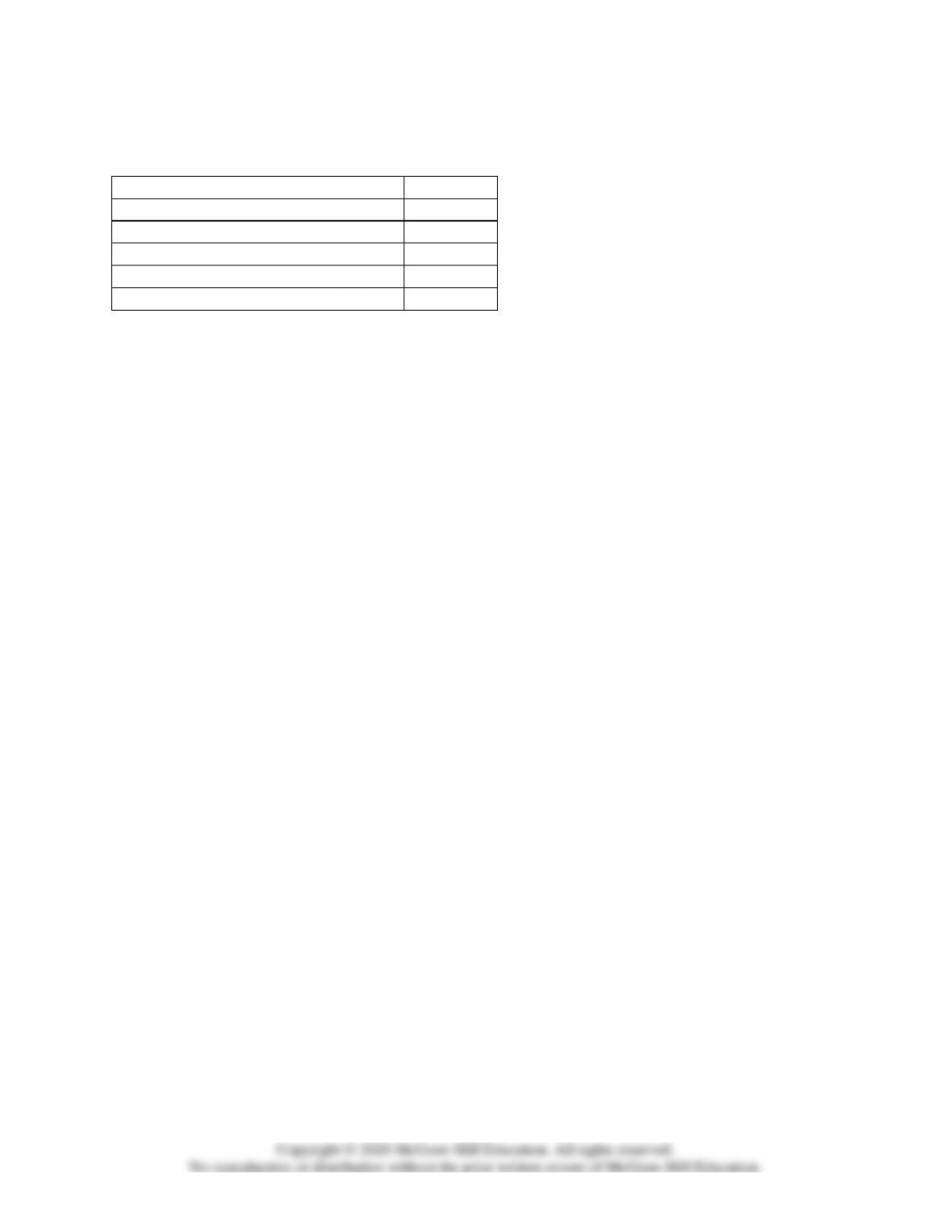
106) The following data were taken from the records of Lilo Corporation for the year ended
December 31, 2019 before any adjustment for bad debt expense:
Sales of merchandise for cash
$150,000
Sales of merchandise on credit
800,000
Sales returns and allowances
10,000
Sales salaries expense
80,000
Cost of sales
610,000
Administrative expenses
90,000
The following items have not been included in above amounts:
Estimated bad debt expense is 1% of credit sales.
The income tax rate is 35%.
10,000 of shares of common stock are outstanding.
A. Calculate the bad debt expense.
B. Prepare a multiple-step income statement (including gross profit, income before income taxes,
and earnings per share).