Chapter 06 – Inventories
TRUE/FALSE
1. Supply-chain management works well in a just–in-time operating environment.
2. The higher the value assigned to ending inventory, the lower the gross margin.
3. Days’ inventory on hand equals the inventory turnover divided by 365.
4. The costs included in work in process and finished goods inventories would not contain manufacturing
overhead costs.
5. Indirect materials and indirect labor are components of manufacturing overhead.
6. Periodic and perpetual are examples of inventory costing systems.
7. Supply-chain management helps companies maintain higher levels of inventory.
8. A manufacturer’s inventory usually consists of raw materials, work in process, and finished goods.
9. Inventory is an example of a long-term asset.
10. The just-in-time operating environment produces decreased carrying costs for inventory.
11. The portion of cost of goods available for sale that is not assigned to ending inventory is assigned to
cost of goods sold.
12. Inventory turnover is a measure not expressed in terms of a percentage.
13. An understatement of ending inventory in a period will result in an understatement of gross margin in
the next period.
14. The higher the inventory turnover, the lower the days’ inventory on hand.
15. The determination of the balance sheet cost of merchandise inventory is important to the determination
of net income.
16. An overstatement of ending inventory in a period will result in an understatement of gross margin in
that period.
17. An overstatement of beginning inventory in a period will result in an overstatement of gross margin in
the next period.
18. The term goods flow refers to the association of costs with their assumed flow in the operation of a
business.
19. Goods in transit shipped FOB shipping point should be included in the seller’s ending inventory.
20. Goods in transit shipped FOB destination should be included in the seller’s ending inventory.
21. Goods held on consignment should be included in the consignee’s ending inventory.
22. In accounting for inventory, the assumed cost flow must match the physical goods flow.
23. Costs incurred in storing inventory usually are included in inventory costs.
24. Freight charges associated with the purchase of inventory normally are included in inventory cost.
25. When the cost of inventory is written down due to a market decline, a loss must be recorded.
26. Merchandise inventory is always valued on the balance sheet at its historical cost.
27. The lower-of-cost-or-market rule implies that it is misleading to carry inventory at a cost that is in
excess of its market value.
28. Inventory methods such as LIFO and FIFO deal more with goods flow than with cost flow.
29. The specific identification method identifies the cost of each item in ending inventory.
30. The average-cost method relies on a calculation of average unit cost.
31. The LIFO method agrees with the actual physical goods flow in most businesses.
32. A major criticism of the LIFO method is that it magnifies the effects of the business cycle on business
income.
33. Under the periodic inventory system, cost of goods sold is recorded throughout the accounting period
as inventory is sold.
34. Specific identification is a very popular inventory method because it is very easy to apply.
35. The matching of revenue with inventory costs is best achieved with the FIFO method.
36. The LIFO method tends to smooth out the peaks and valleys of a business cycle.
37. If prices were to never change, there would still be a need for alternative inventory methods.
38. The LIFO method is rarely used because most companies do not sell the last goods they purchase first.
39. The LIFO inventory method produces the most up–to-date figure for ending inventory.
40. If a company uses LIFO for tax purposes, it must also use LIFO for financial reporting purposes.
41. In periods of declining prices, the FIFO method will result in a larger gross margin than the LIFO
method.
42. In periods of rising inventory prices, the LIFO method will result in a higher inventory valuation than
will the average-cost method.
43. In periods of falling prices, FIFO will result in a higher ending inventory valuation than LIFO.
44. In general, when prices are rising, use of the FIFO method will result in a lower tax liability than the
other methods.
45. In general, in times of declining prices, using FIFO has a favorable effect on cash flows.
46. During periods of consistently falling prices, the FIFO inventory method will produce the highest
possible amount of net income.
47. The average-cost method produces an ending inventory figure that is higher than the figures produced
by FIFO and LIFO.
48. The specific identification method and the LIFO method produce the same results under both the
perpetual and periodic inventory systems.
49. The computer has made the perpetual inventory system more popular and easier to apply.
50. Under the perpetual inventory system, cost of goods sold is accumulated as sales are made throughout
the accounting period.
51. Ending merchandise inventory for LIFO will be the same dollar amount under a periodic inventory
system as under a perpetual inventory system.
52. When the average-cost method is applied to a perpetual inventory system, the sale and purchase of
goods will not change the unit cost of the goods that remain in inventory.
53. When the average-cost method is applied to a perpetual inventory system, a moving average cost per
unit is computed with each purchase.
54. The retail method is the only method that is useful in estimating the inventory cost.
55. When taking a physical inventory under the retail method, it is necessary to know only the quantity of
items on hand.
56. In verifying a claim for a loss of inventory, an insurance company will most likely use the retail
method.
57. The gross profit method requires that records be kept at both cost and retail.
58. A cost-to-retail percentage must be calculated when applying the gross profit method.
MULTIPLE CHOICE
1. All of the following are inventory costing methods except
a.
last-in, last-out.
b.
average-cost.
c.
perpetual.
d.
specific identification.
2. Which of the following is an inventory processing system?
a.
Periodic
b.
First-in, first,out
c.
Lower-of-cost-or-market
d.
Average-cost
3. Manufacturing overhead would not include which of the following costs?
a.
Packing materials
b.
Depreciation of plant assets
c.
Factory rent
d.
Direct labor
4. Which of the following is an inventory valuation method?
a.
Specific identification
b.
Average-cost
c.
Lower-of-cost-or-market
d.
Periodic
5. Which of the following is an inventory costing method?
a.
Cost
b.
Lower-of-cost-or-market
c.
First-in, First-out
d.
Periodic
6. Inventory turnover is expressed in terms of
a.
days.
b.
a percentage.
c.
dollars.
d.
times.
7. Days’ inventory on hand equals 365 divided by
a.
inventory turnover.
b.
cost of goods sold.
c.
goods available for sale.
d.
average inventory.
8. Which of the following accounts would not appear as an asset on a manufacturer’s balance sheet?
a.
Finished Goods
b.
Work in Process
c.
Factory Overhead
d.
Raw Materials
9. An overstatement of beginning inventory results in
a.
no effect on the period’s gross margin.
b.
an overstatement of gross margin.
c.
an understatement of gross margin.
d.
a need to adjust purchases.
10. An overstatement of ending inventory in one period results in
a.
an overstatement of the ending inventory of the next period.
b.
an understatement of gross margin of the next period.
c.
an overstatement of gross margin of the next period.
d.
no effect on gross margin of the next period.
11. An understatement of year 1’s ending inventory will
a.
cause year 2’s cost of goods sold to be overstated.
b.
result in an understatement of year 2’s beginning inventory.
c.
not affect year 2’s ending owner’s equity.
d.
have no effect on year 2’s gross margin.
12. An understatement of year 1’s beginning inventory will
a.
cause year 2’s gross margin to be overstated.
b.
cause year 1’s cost of goods sold to be understated.
c.
cause year 2’s gross margin to be understated.
d.
have no effect on year 1’s gross margin.
13. The most important accounting problem in dealing with merchandise inventory is the application of
which of the following conventions or rules?
a.
Materiality
b.
Cost-benefit
c.
Matching
d.
Consistency
14. Average inventory equals $200,000, and cost of goods sold equals $432,000. Days’ inventory on hand
equals
a.
168.98 days.
b.
170.0 days.
c.
157.9 days.
d.
193.1 days.
15. Average inventory equals $200,000, and cost of goods sold equals $432,000. Inventory turnover
equals
a.
0.46 times.
b.
1.23 times.
c.
2.16 times.
d.
168.98 times.
16. Cost of goods sold equals $1,000,000, and average inventory equals $400,000. Days’ inventory on
hand equals
a.
91.3 days.
b.
146.0 days.
c.
821.9 days.
d.
912.5 days.
17. Cost of goods sold equals $1,000,000, and average inventory equals $400,000. Inventory turnover
equals
a.
0.4 times.
b.
2.5 times.
c.
5 times.
d.
146.0 times.
18. During the year, Toyz for Boyz had beginning inventory of $350,000, ending inventory of $320,000,
and cost of goods sold of $1,507,500. The days’ inventory on hand was
a.
4.5 days.
b.
4.7 days.
c.
81.1 days.
d.
77.7 days.
19. When applying the lower–of-cost-or-market rule to inventory valuation, market generally means
a.
original cost, less physical deterioration.
b.
replacement cost.
c.
original cost.
d.
resale value.
20. Applying the lower-of-cost-or-market rule follows which of the following accounting conventions?
a.
Full disclosure
b.
Consistency
c.
Cost-benefit
d.
Conservatism
21. Goods held on consignment are
a.
kept for sale on the premises of the consignor.
b.
included as part of no one’s ending inventory.
c.
never owned by the consignee.
d.
included in the consignee’s ending inventory.
22. Inventory costing methods place primary reliance on assumptions about the flow of
a.
costs.
b.
goods.
c.
resale prices.
d.
values.
23. Which of the following costs would not be included in the inventory cost?
a.
Invoice price
b.
Cost of goods held on consignment
c.
Cost of outgoing goods shipped FOB destination
d.
Sales tax
24. Which of the following costs usually would not be included in the inventory cost?
a.
Ordering costs
b.
Related tariffs
c.
Invoice price less purchases discounts
d.
Freight-in
25. Which of the following costs normally would be included in the inventory cost?
a.
Ordering costs
b.
Receiving costs
c.
Freight-in
d.
Storage costs
26. An assumption about cost flow is necessary
a.
because it is required by income tax regulations.
b.
only when the flow of goods cannot be determined.
c.
because prices usually change, and tracking which units have been sold is difficult.
d.
even when there is no change in the purchase price of inventory.
27. Which of the following terms best describes the assumption made in applying the four inventory
methods?
a.
Cost flow
b.
Goods flow
c.
Asset flow
d.
Physical flow
28. A fur dealer probably would use which of the following inventory methods?
a.
Specific identification
b.
FIFO
c.
Average-cost
d.
LIFO
29. Use this inventory information for the month of November to answer the following question.
November
1
Beginning inventory
10 units @ $240
7
Purchase
60 units @ $224
16
Sale
40 units
23
Purchase
30 units @ $232
28
Sale
28 units
Assuming that a periodic inventory system is used, what is cost of goods sold on a LIFO basis?
a.
$15,392
b.
$15,472
c.
$7,328
d.
$7,408
30. Use this inventory information for the month of November to answer the following question.
November
1
Beginning inventory
10 units @ $240
7
Purchase
60 units @ $224
16
Sale
40 units
23
Purchase
30 units @ $232
28
Sale
28 units
Assuming that a periodic inventory system is used, what is cost of goods sold under the average-cost
method?
a.
$7,296
b.
$15,504
c.
$7,424
d.
$15,776
31. Use this inventory information for the month of November to answer the following question.
November
1
Beginning inventory
10 units @ $240
7
Purchase
60 units @ $224
16
Sale
40 units
23
Purchase
30 units @ $232
28
Sale
28 units
What is cost of goods sold under the specific identification method?
a.
More information is needed.
b.
$7,408
c.
$15,392
d.
$15,472
32. Use this inventory information for the month of May to answer the following question.
May
1
Beginning inventory
20 units @ $76
7
Purchase
70 units @ $80
18
Sale
25 units
22
Purchase
10 units @ $88
29
Sale
40 units
Assuming that a periodic inventory system is used, what is ending inventory (rounded) under the
average-cost method?
a.
$5,200
b.
$5,288
c.
$2,848
d.
$2,800
33. Use this inventory information for the month of May to answer the following question.
May
1
Beginning inventory
20 units @ $76
7
Purchase
70 units @ $80
18
Sale
25 units
22
Purchase
10 units @ $88
29
Sale
40 units
Assuming that a periodic inventory system is used, what is cost of goods sold on a FIFO basis?
a.
$2,880
b.
$5,120
c.
$5,200
d.
$2,800
34. Use this inventory information for the month of May to answer the following question.
May
1
Beginning inventory
20 units @ $76
7
Purchase
70 units @ $80
18
Sale
25 units
22
Purchase
10 units @ $88
29
Sale
40 units
What is ending inventory under the specific identification method?
a.
$2,720
b.
$2,800
c.
More information is needed.
d.
$2,880
35. Use this information to answer the following question.
Beginning inventory
100 units @ $16.00
Purchase—Oct.
200 units @ $12.00
Purchase—Dec.
100 units @ $24.00
A periodic inventory system is used; ending inventory is 150 units.
What is ending inventory under the average-cost method?
a.
$1,800
b.
$2,100
c.
$2,700
d.
$2,400
36. Use this information to answer the following question.
Beginning inventory
100 units @ $16.00
Purchase—Oct.
200 units @ $12.00
Purchase—Dec.
100 units @ $24.00
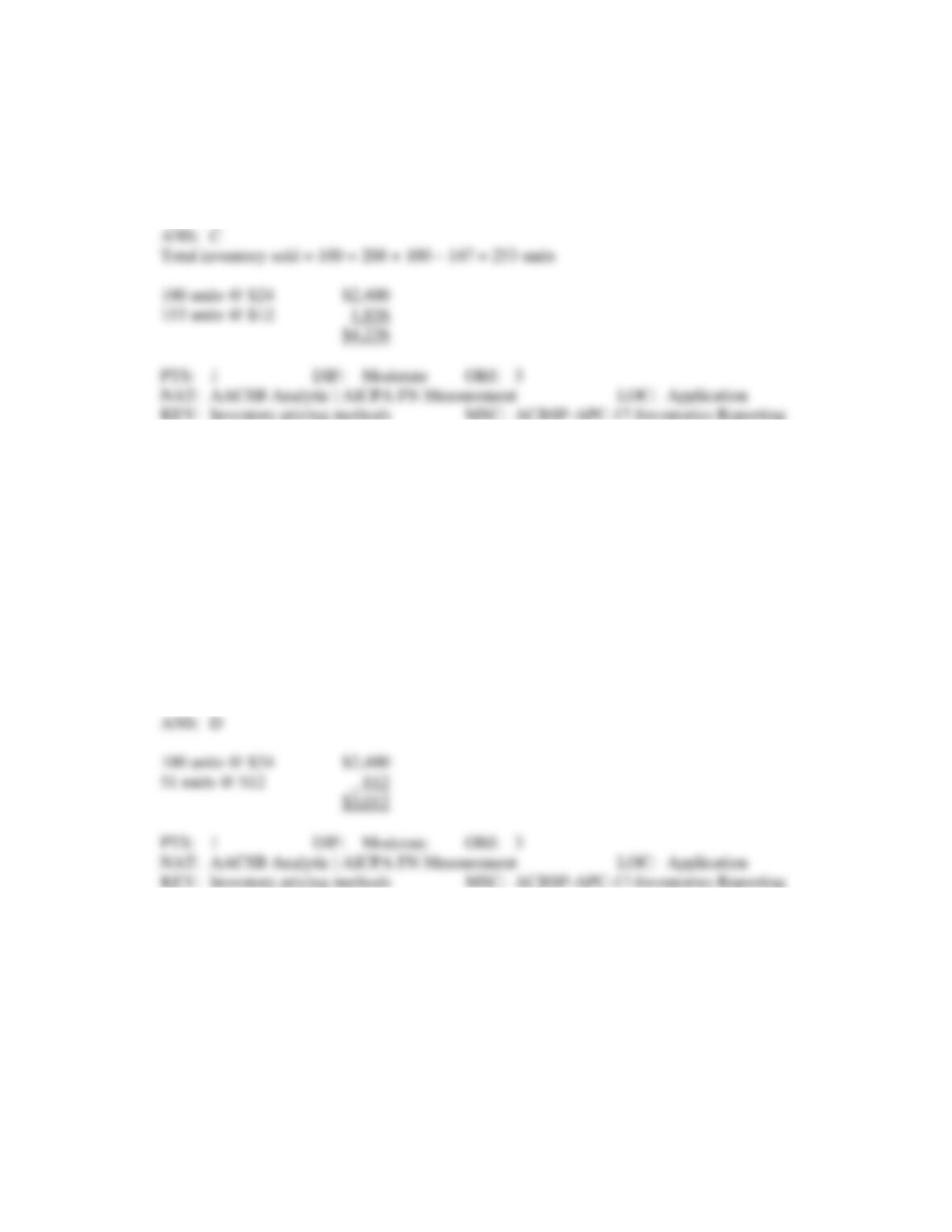
A periodic inventory system is used; ending inventory is 147 units.
What is cost of goods sold under LIFO?
a.
$2,236
b.
$6,236
c.
$4,236
d.
$8,236
37. Use this information to answer the following question.
Beginning inventory
100 units @ $16.00
Purchase—Oct.
200 units @ $12.00
Purchase—Dec.
100 units @ $24.00
A periodic inventory system is used; ending inventory is 151 units.
What is the value of ending inventory under FIFO?
a.
$2,812
b.
$3,212
c.
$2,612
d.
$3,012
38. Use this information to answer the following question.
Feb.
1
Inventory
200 units @ $6.00
6
Purchase
300 units @ $6.60
13
Purchase
100 units @ $7.20
20
Purchase
200 units @ $7.80
25
Purchase
40 units @ $8.40
Total sales
620 units
A periodic inventory system is used.
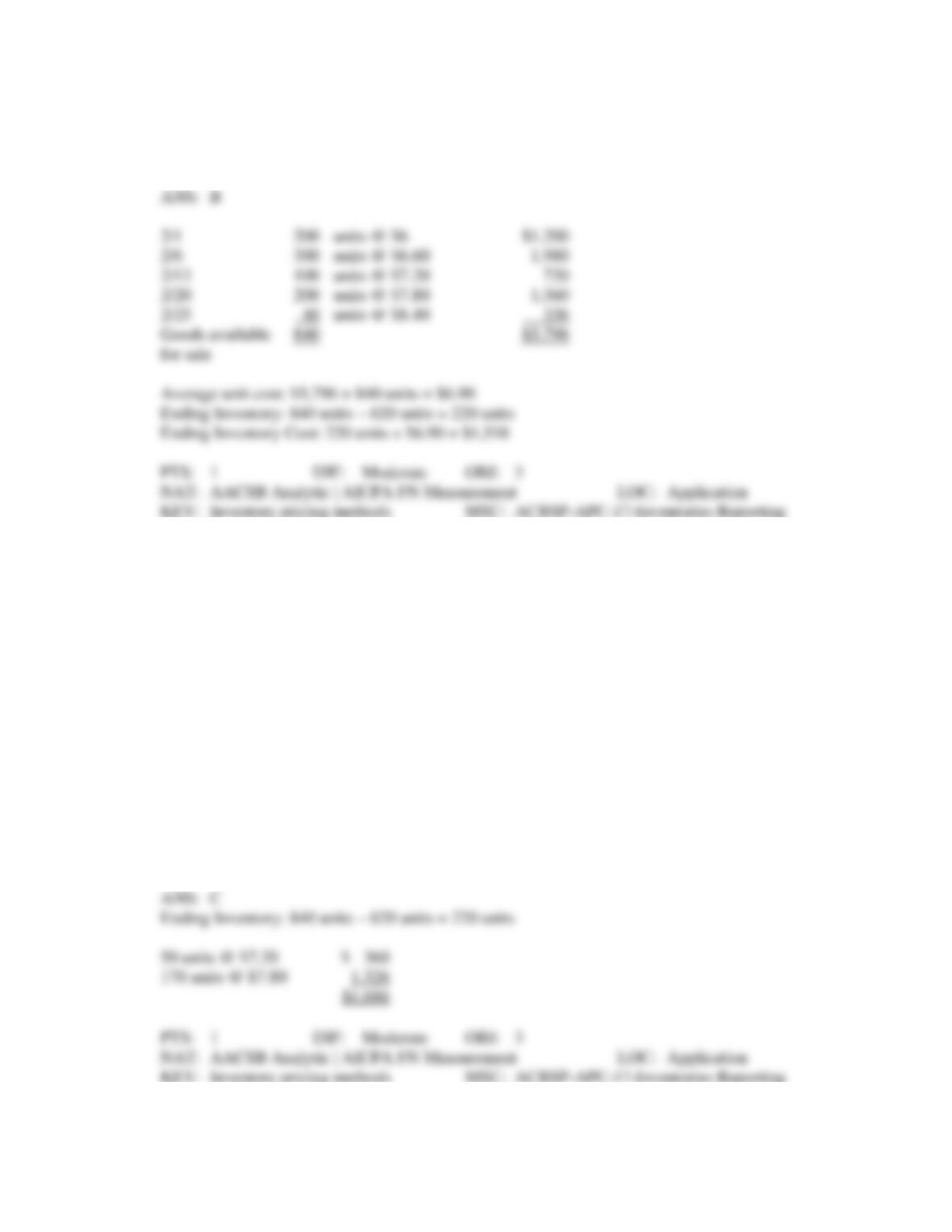
Using the average-cost method, the cost assigned to ending inventory is
a.
$4,278.
b.
$1,518.
c.
$1,692.
d.
$1,584.
39. Use this information to answer the following question.
Feb.
1
Inventory
200 units @ $6.00
6
Purchase
300 units @ $6.60
13
Purchase
100 units @ $7.20
20
Purchase
200 units @ $7.80
25
Purchase
40 units @ $8.40
Total sales
620 units
A periodic inventory system is used.
Using the specific identification method and assuming that 50 of the items left are from the February
13 purchase and the rest are from the February 20 purchase, the cost assigned to ending inventory is
a.
$1,920.
b.
$1,656.
c.
$1,686.
d.
$1,588.
40. Use this information to answer the following question.
Feb.
1
Inventory
200 units @ $6.00
6
Purchase
300 units @ $6.60
13
Purchase
100 units @ $7.20
20
Purchase
200 units @ $7.80
25
Purchase
40 units @ $8.40
Total sales
620 units
A periodic inventory system is used.
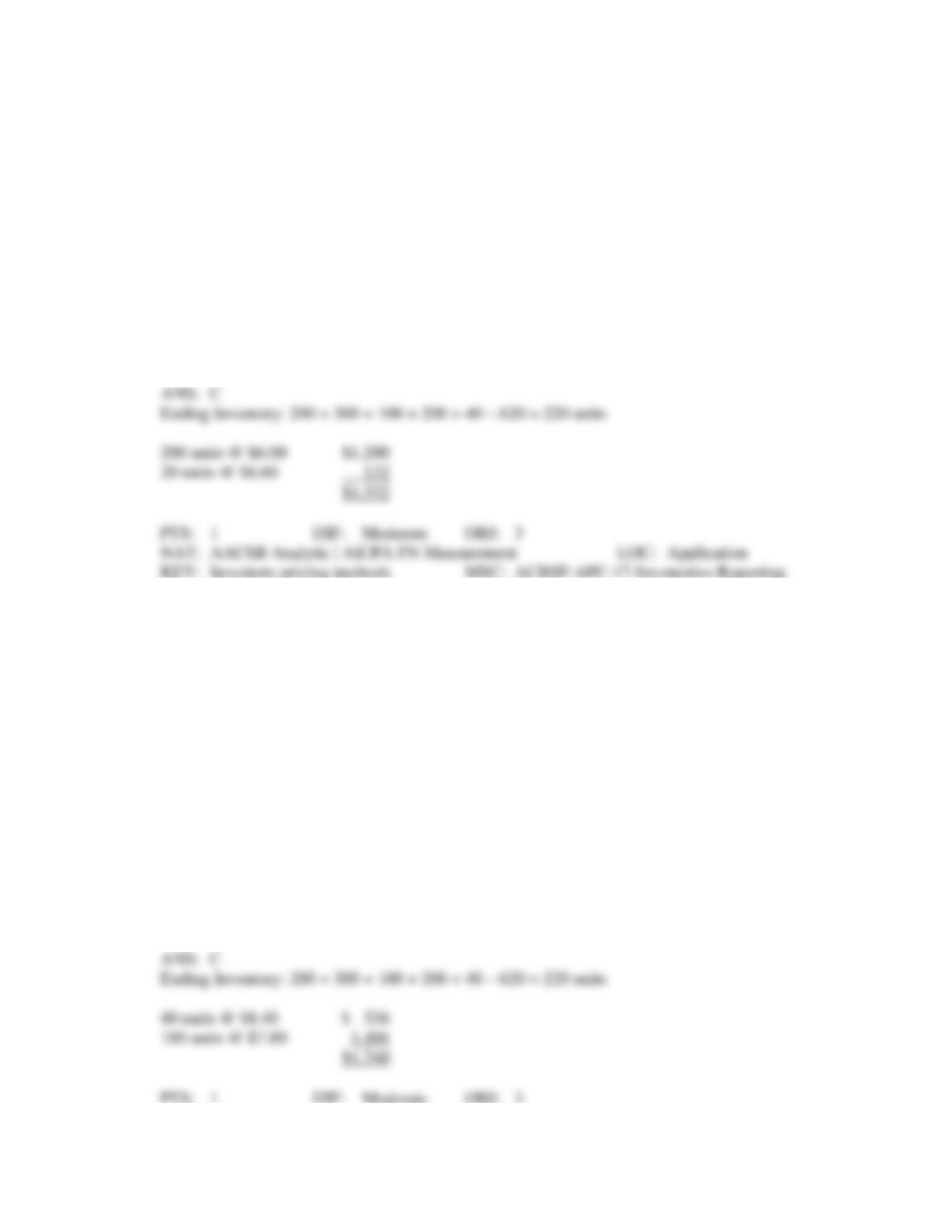
Using LIFO, the cost assigned to ending inventory is
a.
$1,740.
b.
$4,056.
c.
$1,332.
d.
$4,464.
41. Use this information to answer the following question.
Feb.
1
Inventory
200 units @ $6.00
6
Purchase
300 units @ $6.60
13
Purchase
100 units @ $7.20
20
Purchase
200 units @ $7.80
25
Purchase
40 units @ $8.40
Total sales
620 units
A periodic inventory system is used.
Using FIFO, the cost assigned to ending inventory is
a.
$4,056.
b.
$1,332.
c.
$1,740.
d.
$4,464.
42. Use this information to answer the following question.
Feb.
1
Inventory
200 units @ $6.00
6
Purchase
300 units @ $6.60
13
Purchase
100 units @ $7.20
20
Purchase
200 units @ $7.80
25
Purchase
40 units @ $8.40
Total sales
620 units
A periodic inventory system is used.
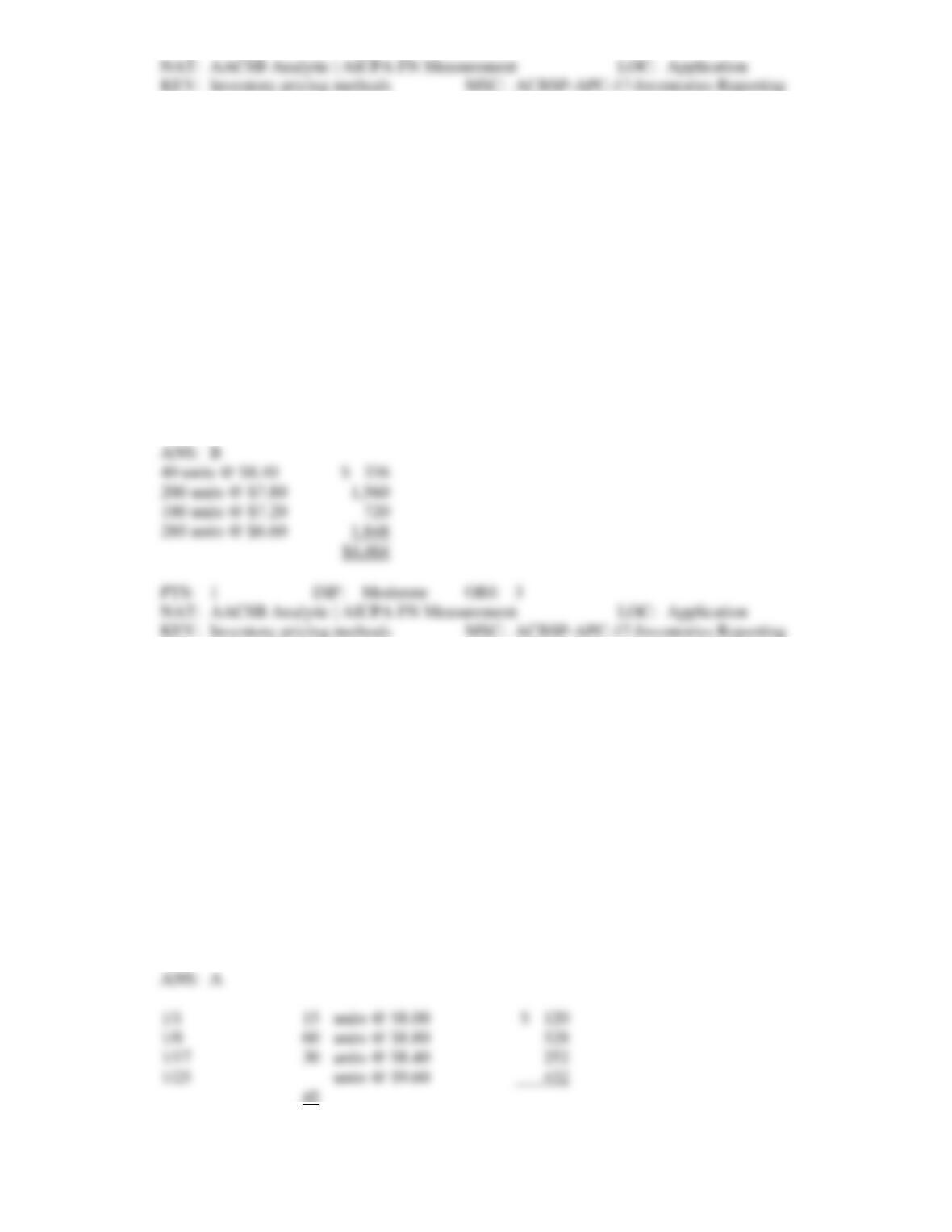
Using LIFO, cost of goods sold is
a.
$1,740.
b.
$4,464.
c.
$1,332.
d.
$4,056.
43. Use this information to answer the following question.
July
1
Inventory
15 units @ $8.00
8
Purchase
60 units @ $8.80
17
Purchase
30 units @ $8.40
25
Purchase
45 units @ $9.60
Total sales
100 units
A periodic inventory system is used.
Cost of goods sold under the average-cost method is
a.
$888.
b.
$666.
c.
$870.
d.
$444.