6-122
185.
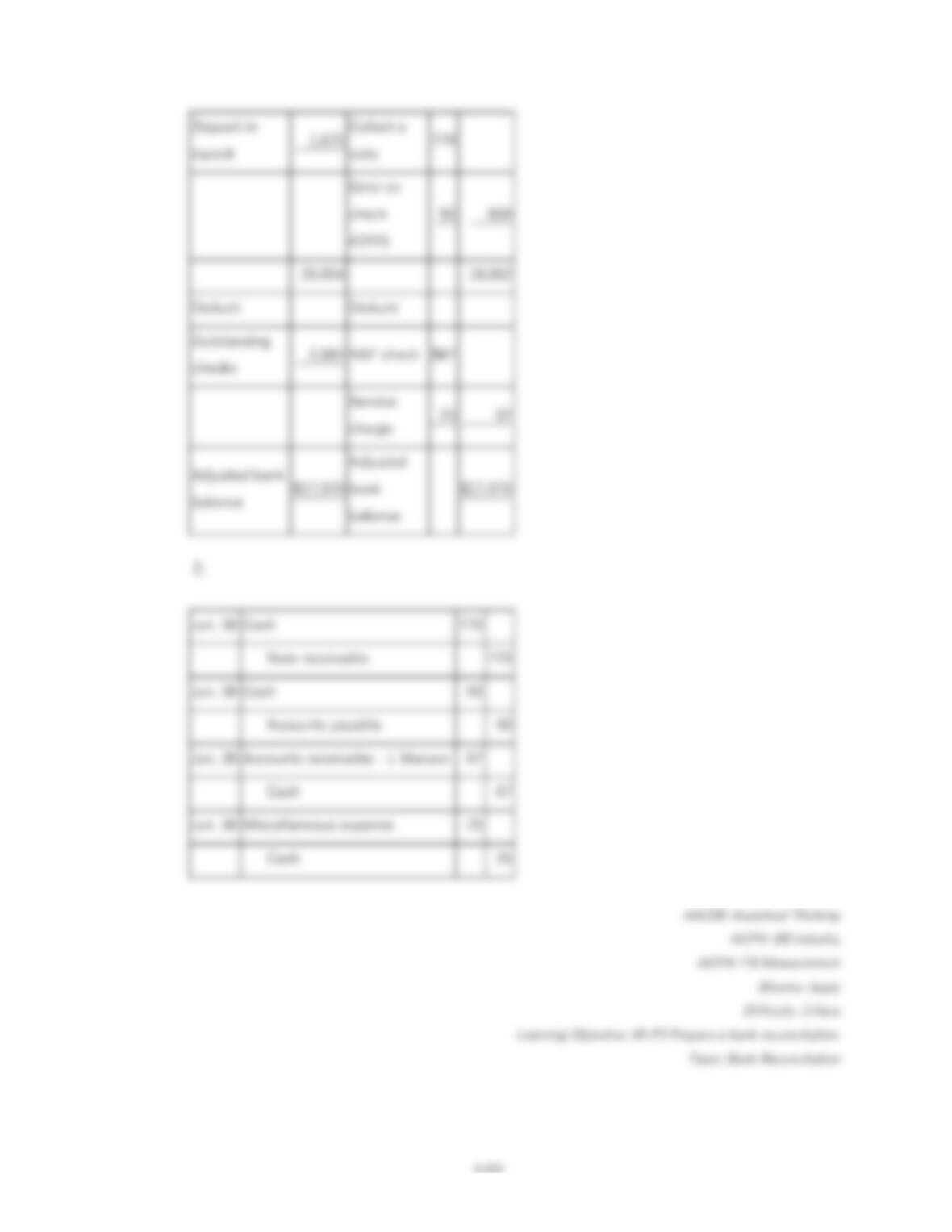
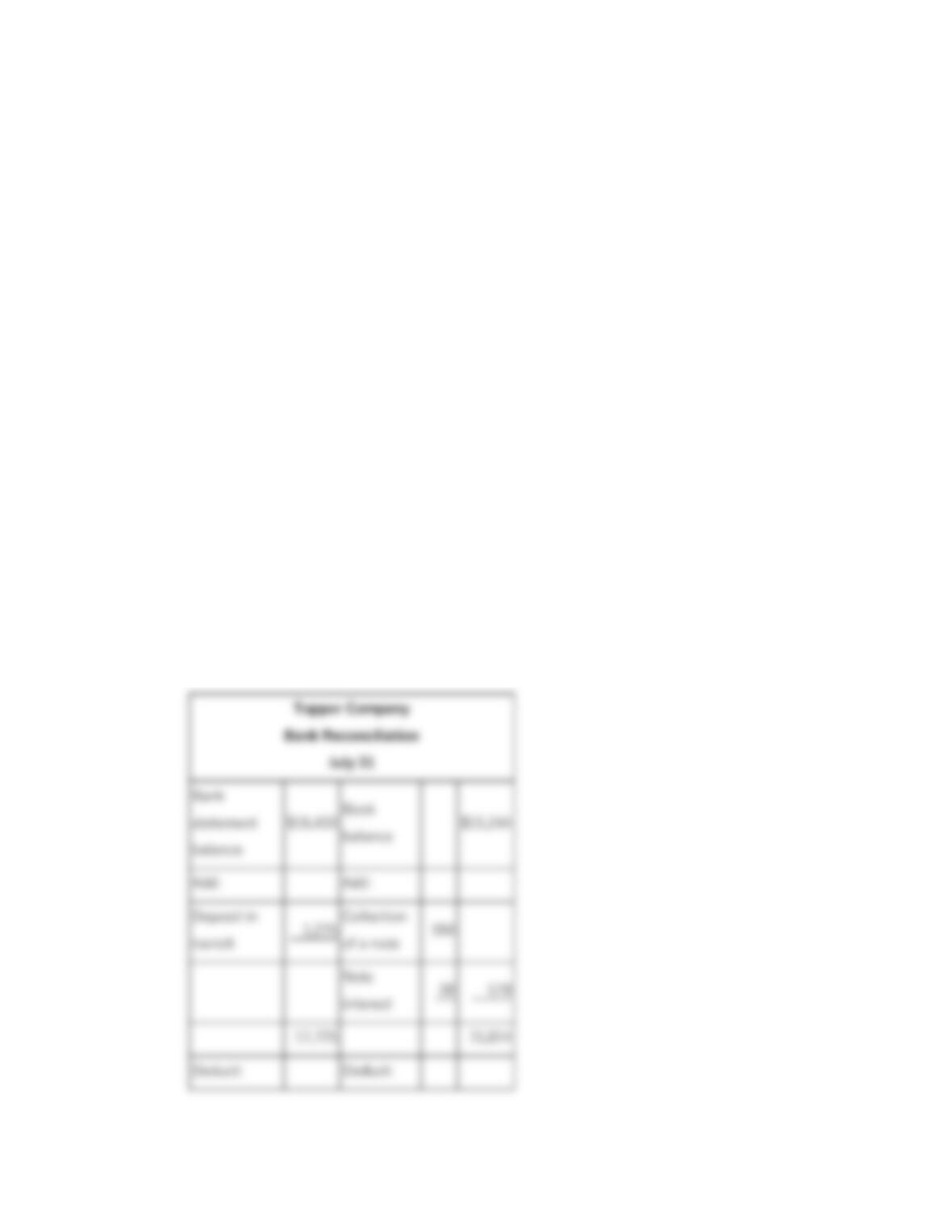
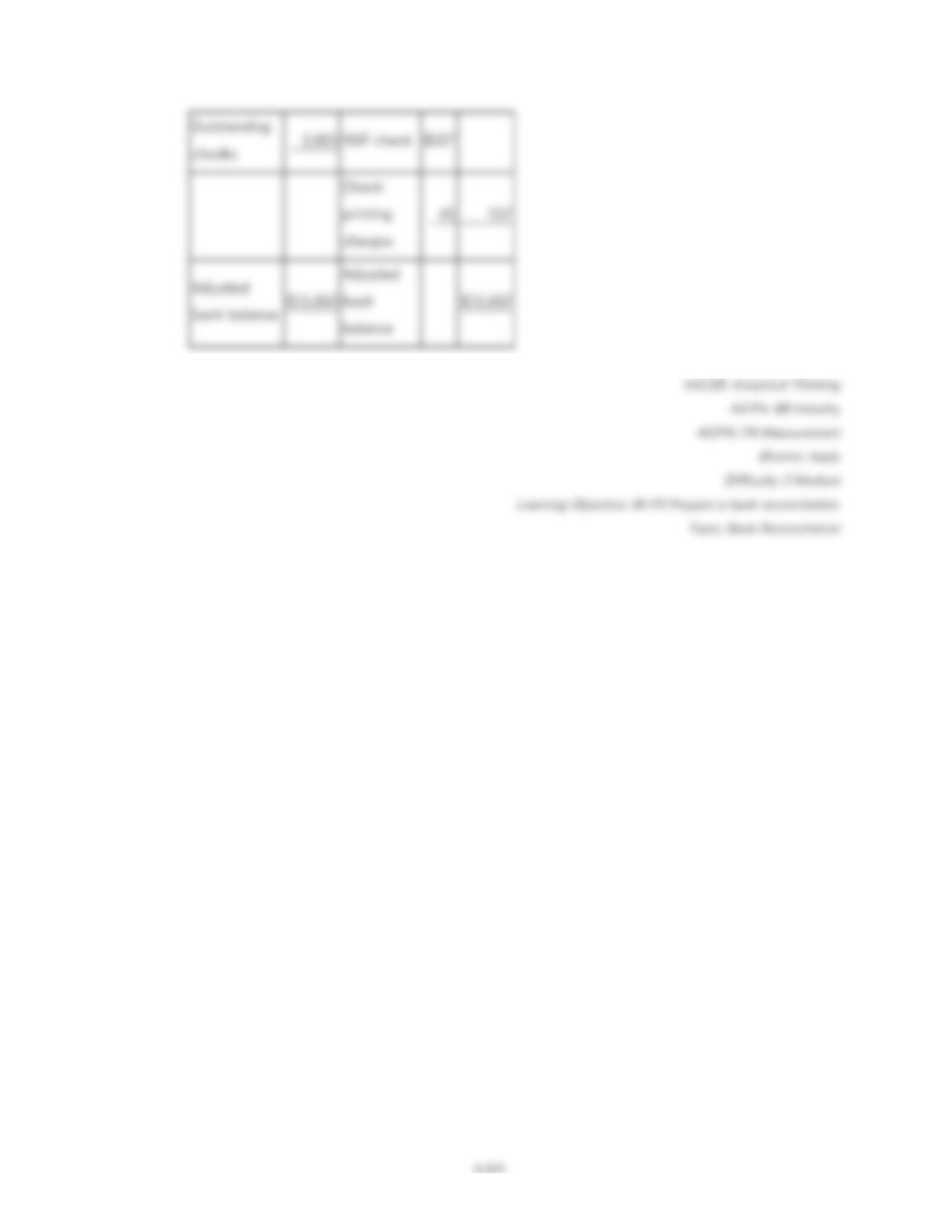
The following information is available for the Topper Company for the month of July.
a. On July 31, after all transactions have been recorded, the balance in the company’s
Cash account has a balance of $15,244.
b. The company’s bank statement shows a balance on July of $16,450.
c. Outstanding checks at July total $2,063.
d. A credit memo included with the bank statement indicates that the bank collected $570
on a note receivable for Topper. The $570 includes $550 principle and $20 interest.
e. A debit memo included with the bank statement shows a $107 NSF check from a
customer, P. Flank.
f. A deposit placed in the bank’s night depository on July 31 totaling $1,275 did not appear
on the bank statement.
g. Included with the bank statement was a debit memorandum in the amount of $45 for
check printing charges that have not been recorded on the company’s books.
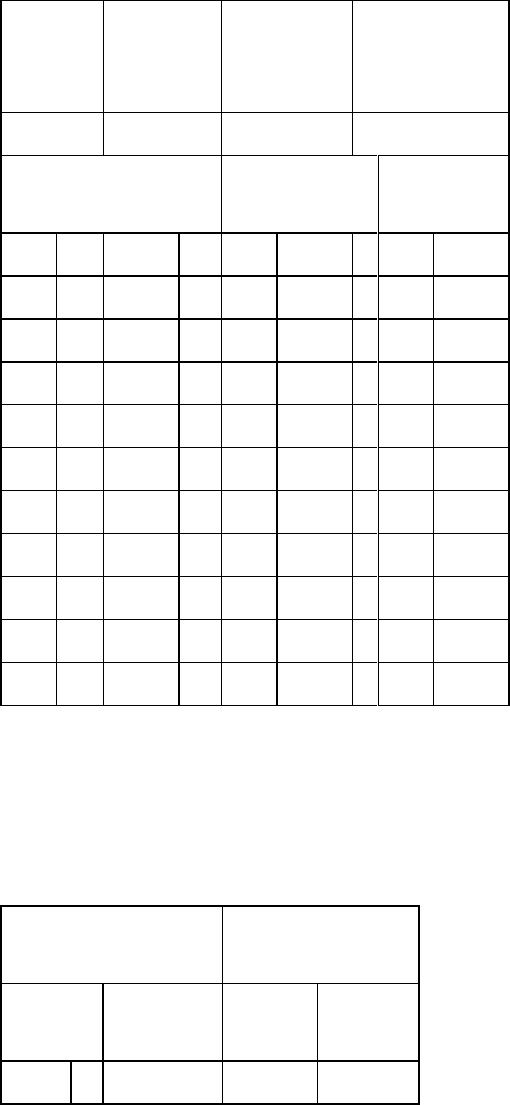
Prepare the July bank reconciliation for the Topper Company.
6-124
186.
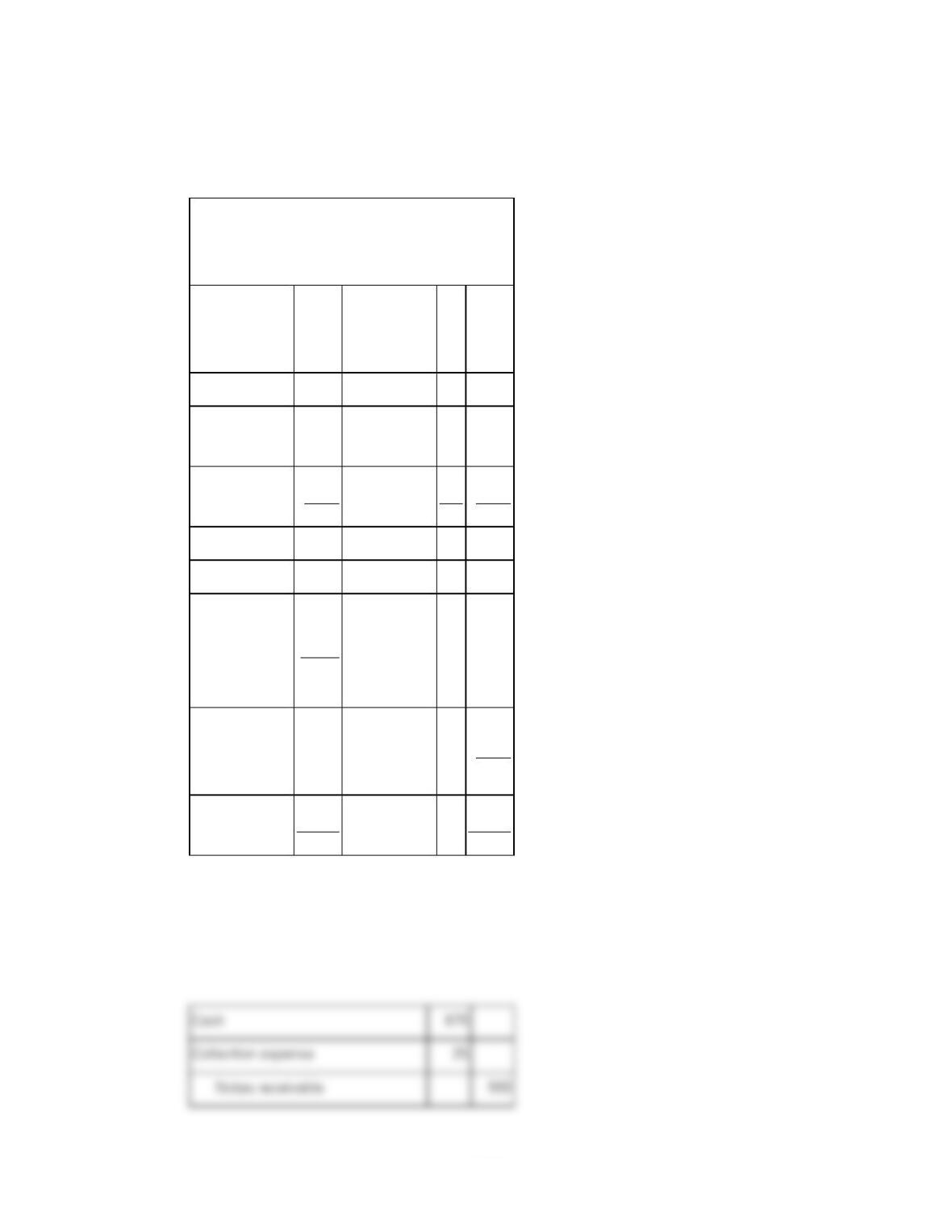
Umber Company’s bank reconciliation for September is presented below. Prepare the
necessary adjusting journal entries based on the reconciliation report.
UMBER COMPANY
Bank Reconciliation
September 30
Bank
statement
balance
$1,350
Book balance
of cash
$995
Add:
Add:
Deposit in
transit
1,250
Proceeds of
note
900
Bank error
275
Less note
collection fee
25
875
$2,875
1,870
Deduct:
Deduct:
Outstanding
checks
1,145
NSF check
plus
processing
fee
125
Bank
service
charge
15
Adjusted bank
balance
$1,730
Adjusted
book balance
$1,730
Cash
Collection expense
6-126
187.
The following information is available for the Victor Company for its March 31 bank
reconciliation:
From the March 31 bank statement:
Previous
Balance
Total
Checks and
Debits
Total
Deposits and
Credits
Current Balance
$9,908
$7,805
$11,905
$14,008
Checks and Debits
Deposits and
Credits
Daily Balance
Date
No.
Amount
Date
Amount
Date
Amount
03/03
2874
1,210
03/02
4,340
03/01
9,908
03/11
2906
3,850
03/27
7,270
03/02
14,248
03/15
2905
170
03/31
295
IN
03/03
1,038
03/25
2909
725
03/11
9,188
03/29
2908
1,350
03/15
9,018
03/30
500
NSF
03/25
8,293
03/27
15,563
03/29
14,213
03/30
13,713
03/31
14,008
NSF: A check from a customer, Booker Co. in payment of their account.
IN: Interest earned on the account.
From the Victor Company’s accounting records:
Cash Receipts
Deposited
Cash Disbursements
Date
Cash Debit
Check
No.
Cash
Debit
March
7
4,340
2905
170
27
7,270
2906
3,850
31
2,090
2907
460
13, 700
2908
1,350
2909
725
2910
340
6,895
Cash
Acct. No. 101
Date
Explanation
PR
Debit
Credit
Balance
February
28
Balance
8,698
March
31
Total receipts
R4
13,700
22,398
31
Total
disbursements
D5
6,895
15,503
1. Based on the above information, prepare a bank reconciliation for the Victor Company.
2. Prepare the necessary general journal entries to adjust cash to the reconciled
balance.
Add:
Add:

6-129
188.
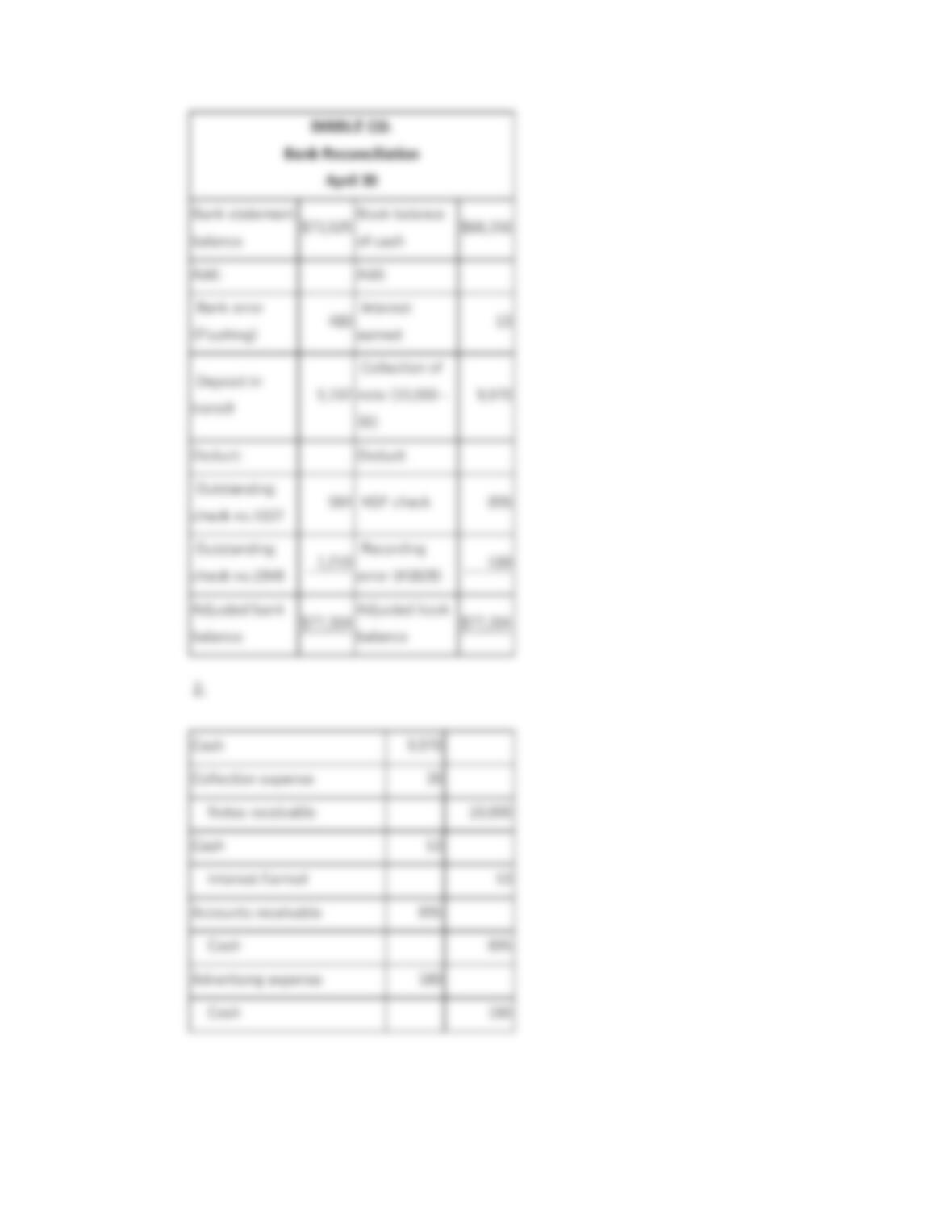
The following information is available to reconcile Dibble Co.’s book balance of cash with
its bank statement cash balance as of April 30. The April 30 cash balance according to the
accounting records is $68,356, and the bank statement cash balance for that date is
$73,525.
a. The bank erroneously cleared a $480 check against the account in April that was not
issued by Dibble. The check documentation included with the bank statement indicates
the check was actually issued by Flushing Co.
b. On April 30, the bank issued a credit memorandum for $53 interest earned on Dibble’s
account.
c. When the April checks are compared with entries in the accounting records, it is found
that Check No. 1828 had been correctly drawn for $1,530 to pay for advertising but was
erroneously entered in the accounting records as $1,350.
d. A credit memorandum indicates that the bank collected $10,000 cash on a note
receivable for Dibble, deducted a $30 collection fee, and credited the balance to the
company’s Cash account. Dibble did not record this transaction before receiving the
statement.
e. A debit memorandum of $895 is enclosed with the bank statement for an NSF check for
$870 received from a customer. The bank assessed a $25 fee for processing it.
f. Dibble’s April 30 daily cash receipts of $5,102 were placed in the bank’s night
depository on that date, but do not appear on the April 30 bank statement.
g. Dibble’s April 30 cash disbursements journal indicates that Check No. 1837 for $584
and Check No. 1840 for $1,219 were both written and entered in the accounting records,
but are not among the canceled checks.
1. Prepare the bank reconciliation for this company as of April 30.
2. Prepare the journal entries necessary to bring the company’s book balance of cash into
conformity with the reconciled cash balance as of April 30.
6-130
189.
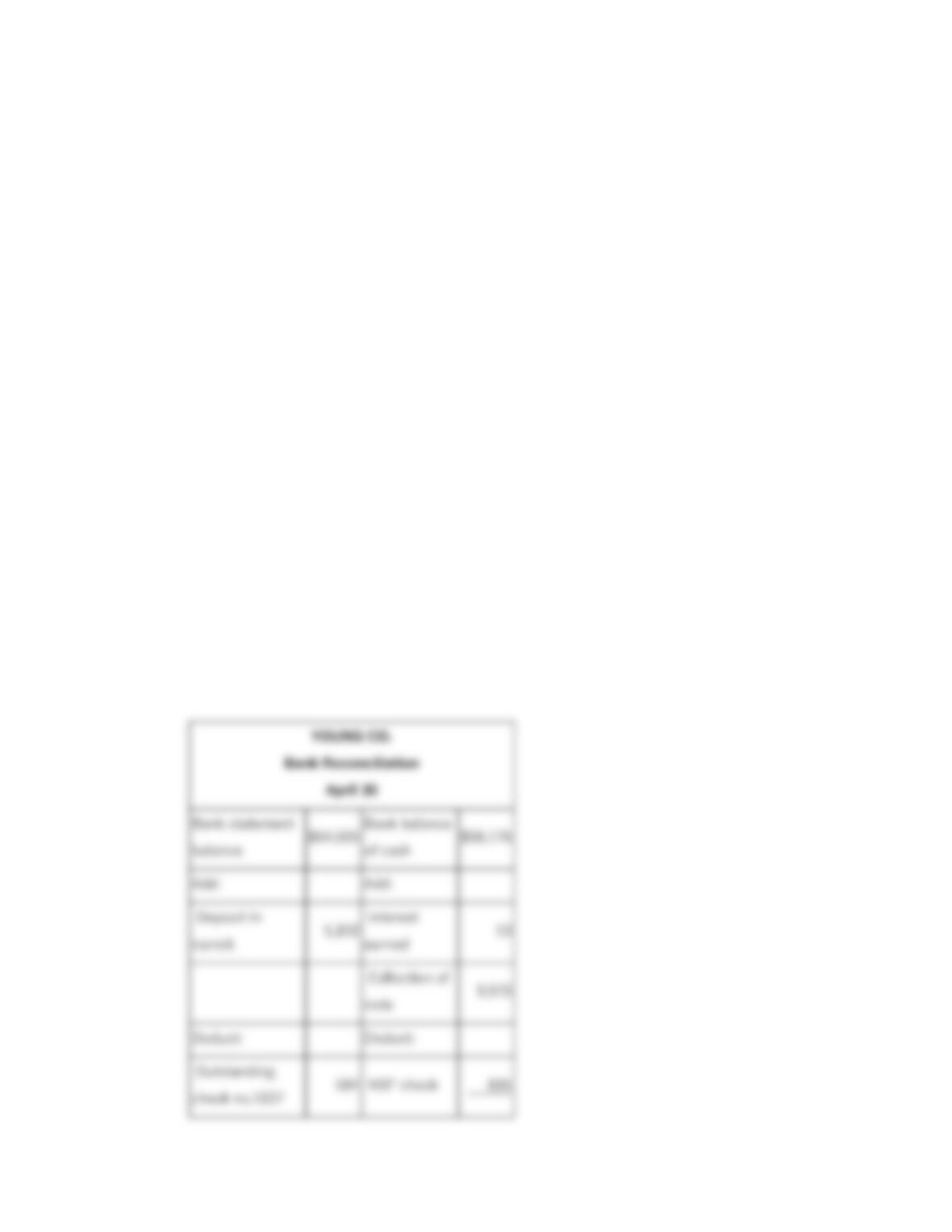
The following information is available to reconcile Young Co.’s book balance of cash with
its bank statement cash balance as of April 30. The April 30 cash balance according to the
6-131
accounting records is $58,176, and the bank statement cash balance for that date is
$64,005.
a. On April 30, the bank issued a credit memorandum for $53 interest earned on Young’s
account.
b. A credit memorandum indicates that the bank collected $9,970 cash on a note
receivable for Young, and credited the balance to the company’s Cash account. Young did
not record this transaction before receiving the statement.
c. A debit memorandum of $895 is enclosed with the bank statement for an NSF check for
$870 received from a customer. The bank assessed a $25 fee for processing it.
d. Young’s April 30 daily cash receipts of $5,102 were placed in the bank’s night depository
on that date, but do not appear on the April 30 bank statement.
e. Young’s April 30 cash disbursements journal indicates that Check No. 1837 for $584 and
Check No. 1840 for $1,219 were both written and entered in the accounting records, but
are not among the canceled checks.
Required: Prepare the bank reconciliation for this company as of April 30.
6-133
190.
Zeller Company’s bank reconciliation for April is presented below. Prepare the necessary
adjusting journal entries based on the reconciliation report.
Zeller Co.
Bank Reconciliation
April 30
Bank statement
balance
$63,323
Book balance
of cash
$62,117
Add:
Add:
Deposit in
transit
4,600
Interest
earned
23
Collection of
note
5,000
Deduct:
Deduct:
Outstanding
check no.1631
432
NSF check
820
Outstanding
check no.1640
1,171
Adjusted bank
balance
$66,320
Adjusted
book balance
$66,320
Interest Earned
Accounts receivable
191.
The following account balances are taken from Everest Events at December 31.
2017
2016
Accounts receivable
$170,230
$260,450
Net sales
1,500,750
1,450,600
Calculate the number of days’ sales uncollected for both years. According to this analysis,
is the company’s collection of receivables improving? Explain.