
Chapter 6 Cost Allocation and Activity-Based Costing
6-39
151. Sanford Tracking has two production plants. Recently, the company conducted an ABM
study to determine the cost of activities involved in processing orders for parts at each of
the plants. How might an operations manager use this information to manage the cost of
processing orders?
A. By closing down the plant with the highest cost
B. By comparing the cost to process an order at each plant and the nature of the
orders to determine if costs are out of control—if out of control, investigate
C. By setting up an ABC costing system
D. By including all manufacturing overhead in a single cost pool to reduce the cost
of analysis
Answers to Multiple Choice

Test Bank to accompany Jiambalvo Managerial Accounting, 6th Edition
6-40
MATCHING
152. Match each of the following terms with the phrase that most closely describes it. Each
answer may be used only once.
_____ 1. Cost driver
_____ 2. Cost objective
_____ 3. Cost pool
_____ 4. Cost-plus contract
_____ 5. Lump-sum allocation
_____ 6. Unitized costs
_____ 7. Ability to bear costs
_____ 8. Activity-based costing
_____ 9. Activity-based management
_____ 10. Cost allocation
A. Assigning indirect costs to cost objectives
B. A method of allocation that assigns more costs to more profitable cost objectives
C. A measure of the activity that is used to allocate costs
D. Fixed costs stated on a per unit basis
E. Price for this includes actual costs plus a fixed amount or percentage
F. A method of cost allocation that uses cost drivers to allocate costs to products
G. The object or recipient of the cost allocation
H. A management tool that involves analyzing and costing activities with the goal of
improving efficiency and effectiveness
I. A grouping of individual costs whose total is allocated using one allocation base
J. Allocations of fixed costs in which predetermined amounts are allocated regardless of
changes in the level of activity
Answers to Matching
Chapter 6 Cost Allocation and Activity-Based Costing
6-41
EXERCISES
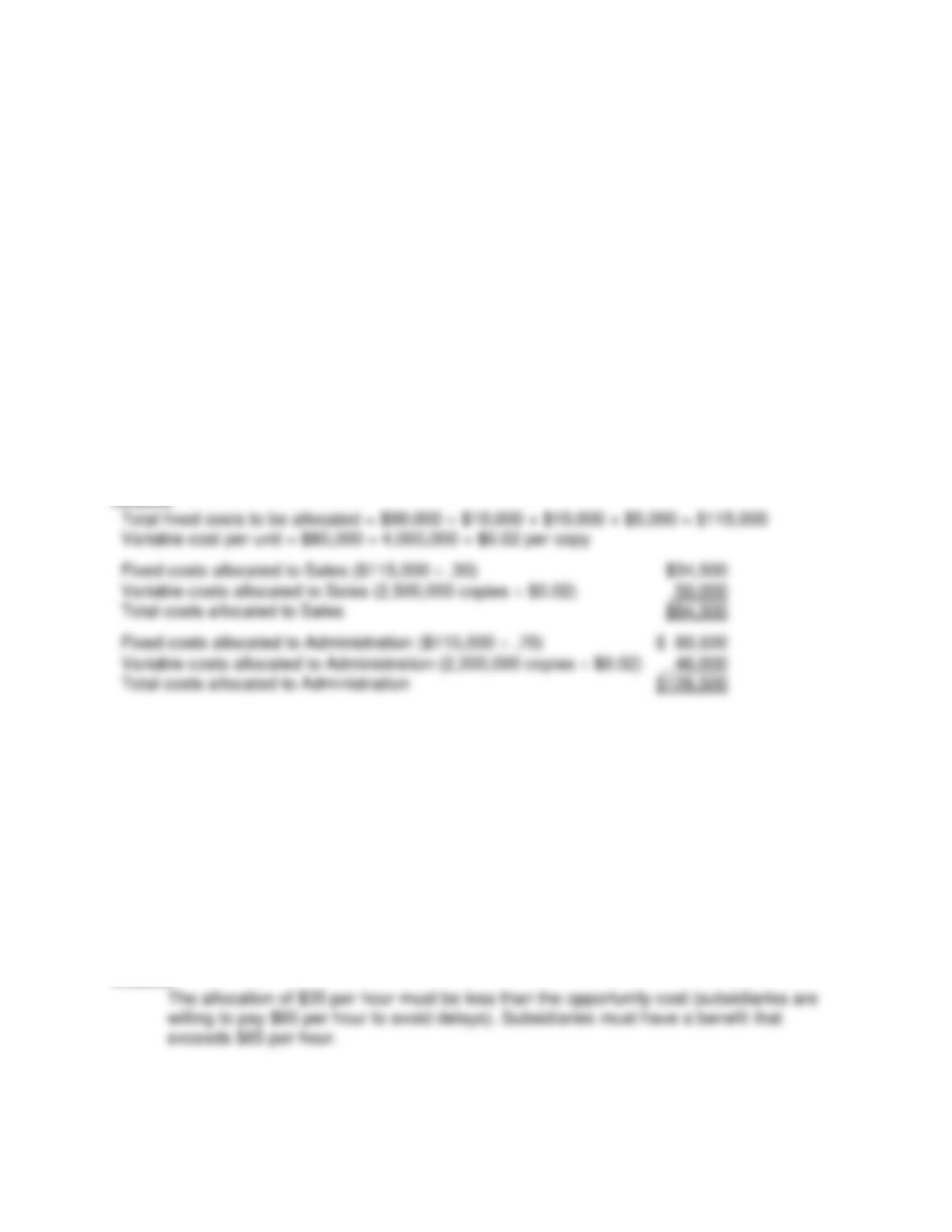
153. APC Service’s copy department, which does almost all of the photocopying for the sales
and administrative departments, budgets the following costs for the year, based on the
expected activity of 4,000,000 copies:
Salaries $90,000
Employee benefits for salaried employees 10,000
Depreciation of copy machines 10,000
Utilities (fixed) 5,000
Paper (variable, 1 cent per copy) 40,000
Toner (variable, 1 cent per copy) 40,000
The costs are assigned to two cost pools—one for fixed and one for variable costs. The
costs are then assigned to the sales department and the administrative department.
Fixed costs are assigned on a lump-sum basis, 30 percent to sales and 70 percent to
administration. During the year, 4,800,000 copies were made consisting of 2,500,000 for
Sales and 2,300,000 for Administration. Calculate the copy department costs allocated
to the Sales Department and separately to the Administration Department.
Answer
154. Cheez-It Financial has a website department that maintains and updates its website
used by clients of the company’s two subsidiaries—Commercial Banking and Personal
Banking. For practical purposes, the costs of the website department are primarily fixed
and consist primarily of salaries of the department’s two employees and depreciation on
workstations and the web server.
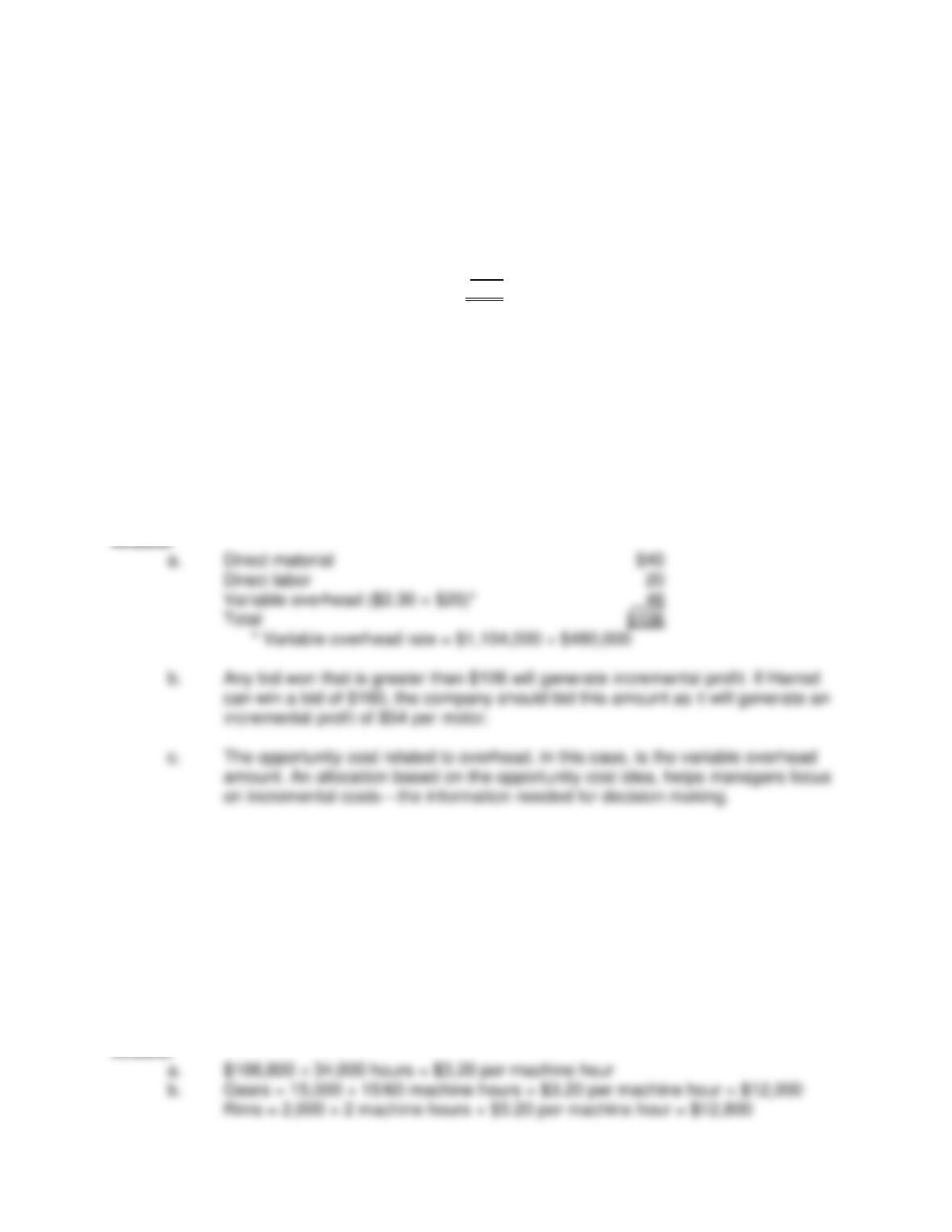
Each subsidiary receives a cost allocation of $35 per website hour. Jobs
requested by the subsidiaries generally take weeks to complete often causing the
subsidiaries to go outside the company for emergency services rather than wait for jobs
to be completed. Outside website maintenance services cost $65 per hour. How does
the allocation of $35 per website hour compare to the opportunity cost of using internal
services?
Answer
Test Bank to accompany Jiambalvo Managerial Accounting, 6th Edition
6-42
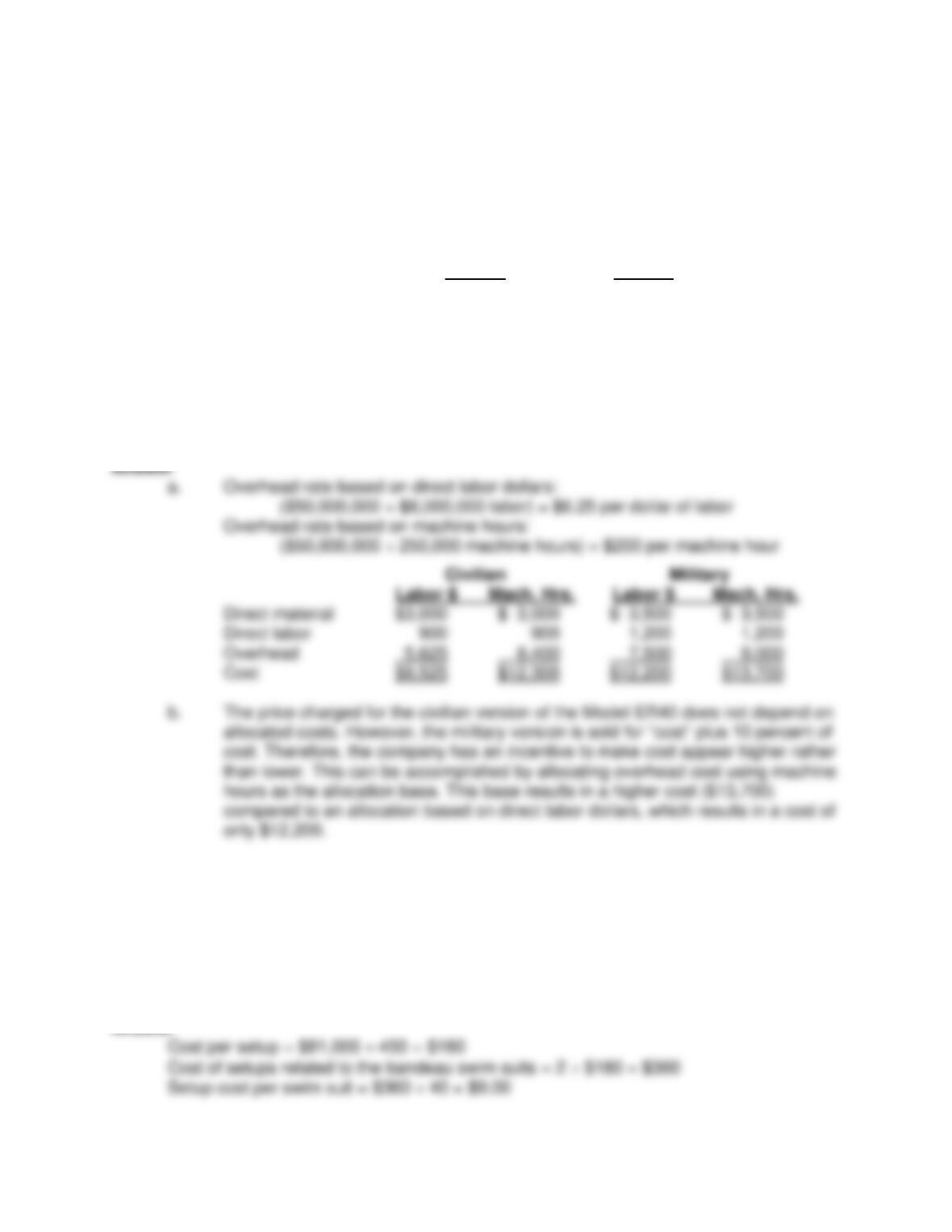
155. Harrod Productions manufactures small electric motors used by appliance companies. In
the past year, the company has experienced severe excess capacity due to competition
from a foreign company that has entered Harrod’s market. The company is currently
bidding on a potential order from Kenmore Elite for 4,000 Model 44 motors. The
estimated cost of each motor follows:
Direct material $ 40
Direct labor 20
Overhead 110
Total $170
The predetermined overhead rate is $5.50 per direct labor dollar based on estimated
annual overhead of $2,640,000 and estimated annual direct labor of $480,000. The
overhead is composed of $1,104,000 of variable costs and $1,536,000 of fixed costs.
The largest fixed cost relates to depreciation of plant and equipment.
a. What is the incremental cost of producing one Model 44 motor?
b. Suppose Harrod can win the Kenmore Elite business by bidding a price of $160
per motor. Should Harrod bid $160? Support your answer with explanation.
c. Discuss how an allocation of overhead based on opportunity cost would facilitate
an appropriate bidding decision.
156. Sanders Enterprises allocates manufacturing overhead costs to its two products—gears
and rims—based on the machine hours used. Manufacturing overhead costs are
expected to total $108,800 in the coming year and the company plans to use 34,000
machine hours in the year. The production of rims requires 2 machine hours per rim and
gears require 15 minutes per gear. The current production schedule calls for 2,000 rims
and 15,000 gears during the year.
a. What is the overhead rate per machine hour?
b. If production and overhead costs occur as scheduled, how much manufacturing
overhead will be allocated to each of the two products?
Answer
Chapter 6 Cost Allocation and Activity-Based Costing
6-43
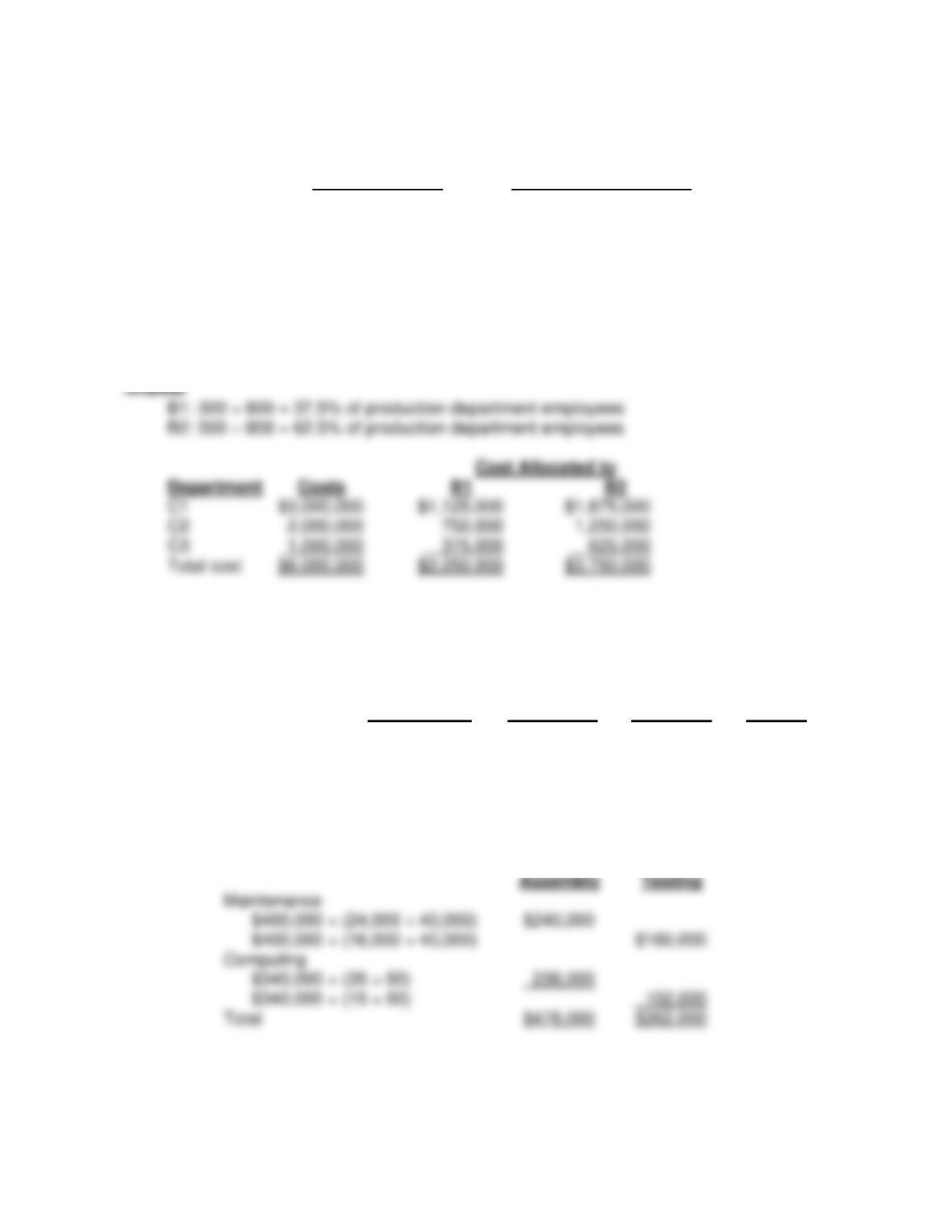
157. Likewise Instruments manufactures a variety of electronic instruments that are used in
military and civilian applications. Sales to the military are generally on a cost-plus profit
basis with profit equal to 10 percent of cost. Instruments used in military applications
require more direct labor time because “fail–safe” devices must be installed.
At the start of the year, Likewise estimates that the company will incur
$50,000,000 of overhead, $8,000,000 of direct labor, and 250,000 machine hours.
Consider the Model ET40 gauge that is produced for both civilian and military uses:
Civilian Military
Direct material $3,000 $3,500
Direct labor $900 $1,200
Machine hours 42 45
a. Calculate the cost of civilian and military versions of Model ET40 using both
direct labor dollars and machine hours as alternative allocation bases.
b. Explain why Likewise Instruments may decide to use machine hours as an
overhead allocation base.
158. Venus Swimwear is the designer and maker of elite swimwear. The president of Venus
wants to switch to an activity-based costing approach in the upcoming year to assign
prices to the suits. Production line setups are a major activity at Venus. In the coming
year, Venus expects to perform 450 setups at a total cost of $81,000. Venus plans to
produce bandeau swimsuits that will require 2 setups for the batch of 40. How much
setup cost will be allocated to each bandeau swimsuit that is produced?
Answer
Test Bank to accompany Jiambalvo Managerial Accounting, 6th Edition
6-44
159. Fanatics Company has three service departments (C1, C2, and C3) and two production
departments (B1 and B2). The following data relate to Fanatic’s allocation of service
department costs:
Budgeted Costs Number of Employees
C1 $3,000,000 80
C2 2,000,000 60
C3 1,000,000 30
B1 300
B2 500
Service department costs are allocated by the direct method. The number of employees
is used as the allocation base for all service department costs. Calculate the total service
department cost allocated to each production department.
160. CSI Equipment produces surveillance equipment for security purposes. Maintenance
costs are allocated to assembly and testing on the basis of square footage occupied,
and computing costs are allocated on the basis of the number of computer terminals.
The following data relate to allocations of service department costs:
Maintenance Computing Assembly Testing
Service department costs $400,000 $340,000
Square footage 24,000 16,000
Terminals 35 15
Allocate the service department costs to production departments using the direct
method.
Answer
Chapter 6 Cost Allocation and Activity-Based Costing
6-45
161. Rickets Consulting has two divisions: Internal Audit and Management Services. The
firm’s accountants are in the process of selecting an allocation base to allocate centrally
provided personnel costs to the two departments. Two allocation bases have been
proposed—dollars of salary and number of employees. Personnel costs are expected to
be $2,500,000. The following data relate to the allocations:
Internal Audit Management Services
Salaries in dollars $14,000,000 $18,000,000
Number of employees 150 50
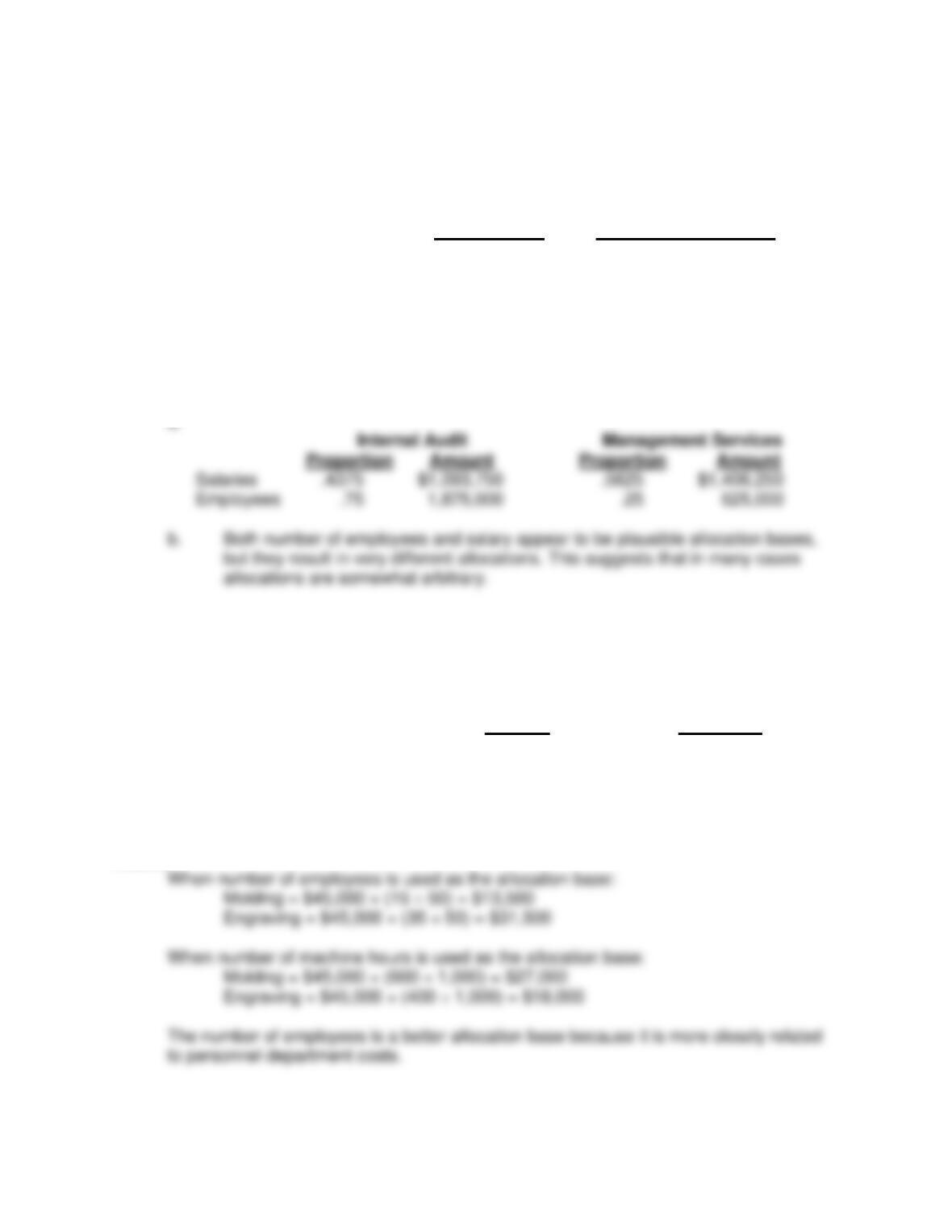
a. Prepare a schedule showing the allocations to the two divisions using each
allocation base.
b. Referring to your answer to part a, explain why allocations are sometimes
considered arbitrary.
Answer
a.
162. The personnel department at Dansford Company has $45,000 in budgeted costs for the
coming period. Dansford is trying to determine whether to allocate these costs to the two
production departments based on the number of employees or based on machine hours
used in the department. Information about the production departments is given below:
Molding Engraving
Number of employees 15 35
Anticipated machine hours 600 400
Calculate the costs allocated to each of the production departments using each
allocation base. Which allocation base is preferable?
Answer
Test Bank to accompany Jiambalvo Managerial Accounting, 6th Edition
6-46
163. The costs of the personnel department at Mama Maids total $37,800 annually. These
costs are allocated based on the number of employees in the production departments
using the direct method. If 12 of Mama Maids’ 36 employees work in the residential
services department, what amount of the personnel department costs should be
allocated to the residential services?
Answer
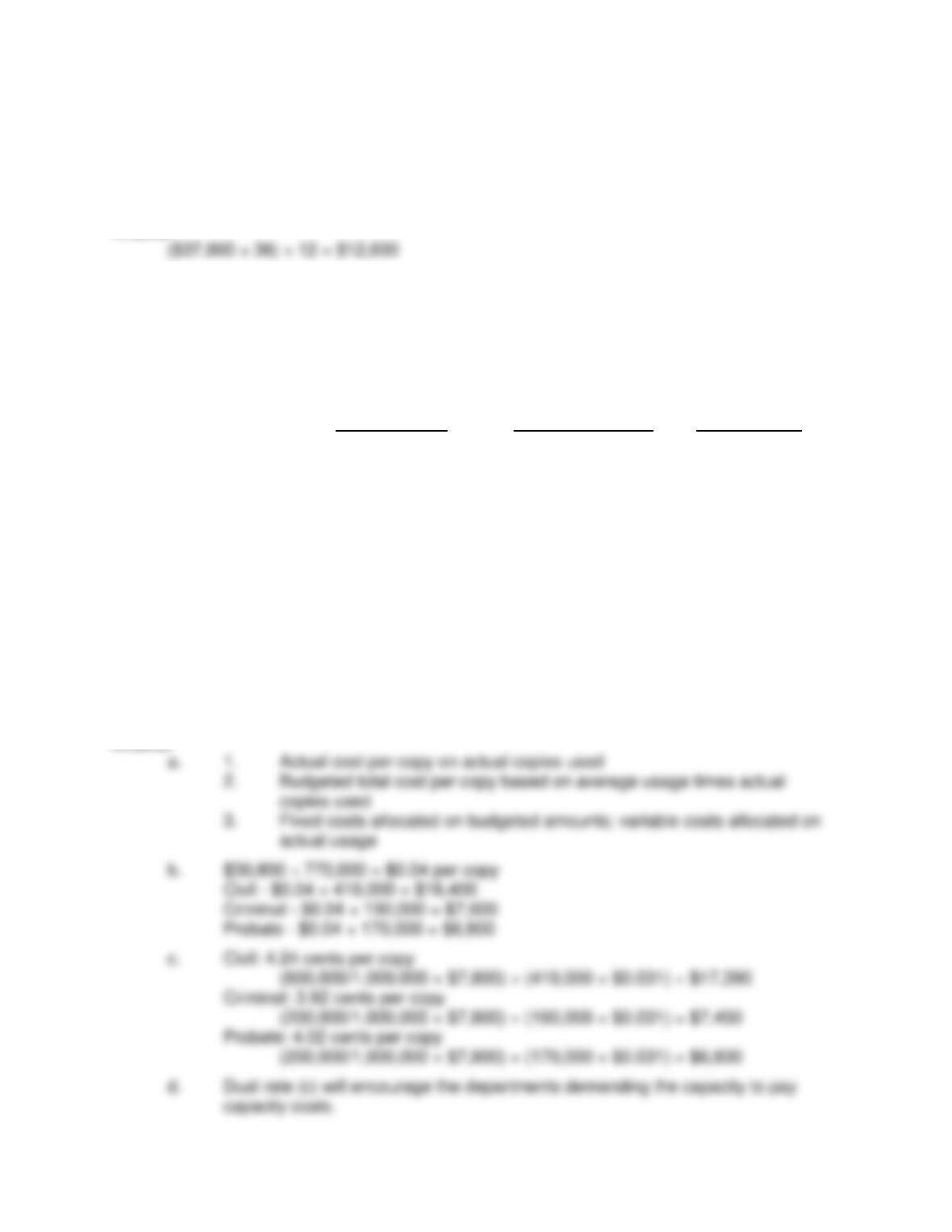
164. Sentry Company has three departments, Civil, Criminal, and Probate. Each department
uses the services of the photocopying department. The photocopying department has 10
copiers, and each copier can produce 100,000 copies per month and has a budgeted
fixed annual cost of $7,800. The variable cost to produce a copy is $0.031 per copy.
During March, the Copying Department incurred $6,930 fixed and $23,870 in variable
copying costs. Following is the three production departments’ monthly consumption
information:
Peak Demand Average Demand March Usage
Civil 600,000 copies 300,000 copies 410,000 copies
Criminal 200,000 copies 180,000 copies 190,000 copies
Probate 200,000 copies 180,000 copies 170,000 copies
a. Describe three alternative ways that the production departments can be charged
for services.
b. Assign the actual cost of March copying to the production departments based on
the actual copies used by each department. What is the cost per copy? (Round
cost per copy to two decimal places and charges to departments to nearest
whole dollar.)
c. Assign the cost of March copying to the production departments, where the
budgeted fixed cost is based on peak usage requirements, and the budgeted
variable cost is based on actual usage. What is the total cost per copy assigned
to each department?
d. Which allocation do you believe is more equitable? Why?
Answer
Chapter 6 Cost Allocation and Activity-Based Costing
6-47
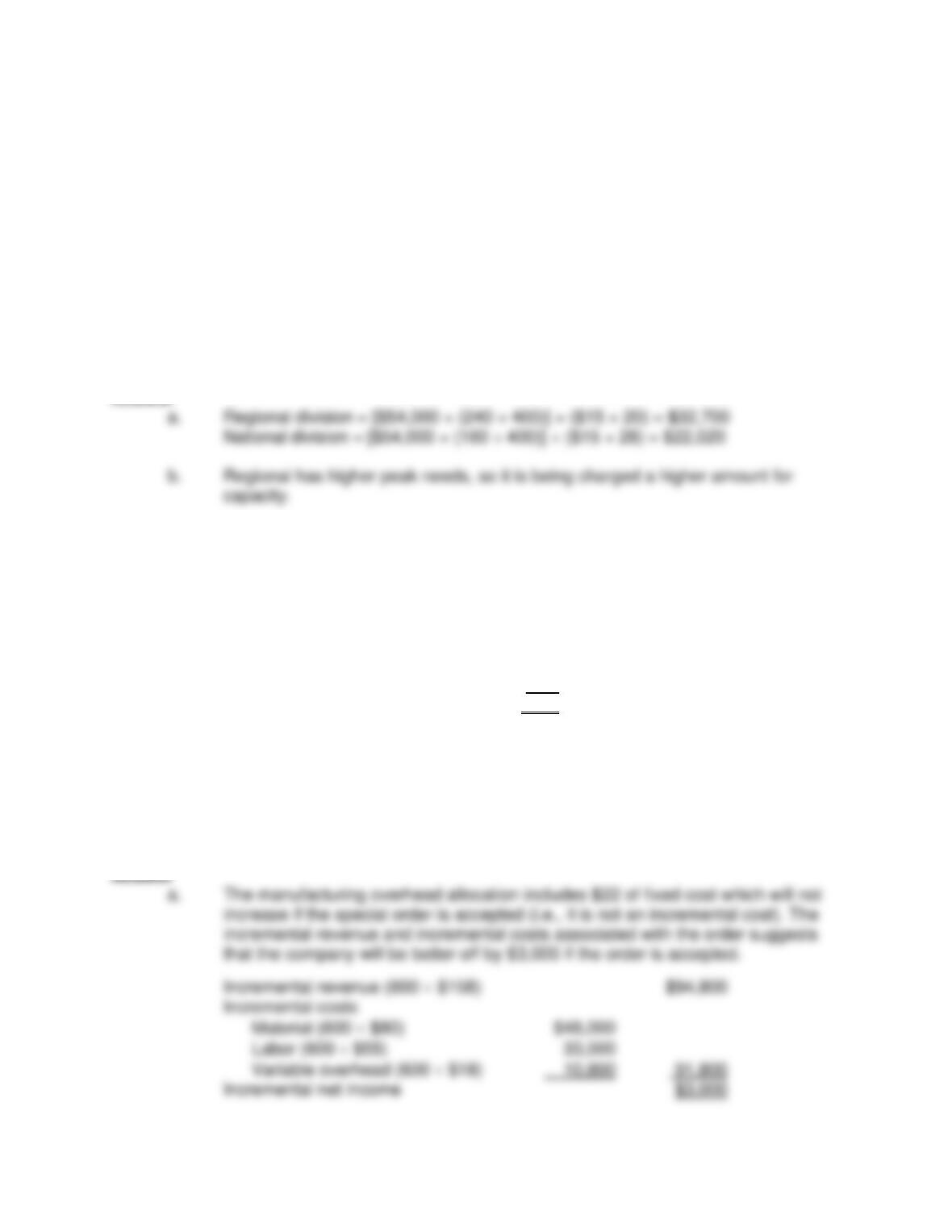
165. Waller Company has a regional division and a national division. A travel department
supports the employees in both divisions. The fixed costs of the travel department
($54,000 per month) are allocated based on the peak usage of reservation services. The
national division has a peak monthly usage of 160 reservations and the regional has a
peak usage of 240 reservations. The variable costs of the travel department are
allocated to the divisions based on the number of reservations made at a rate of $15 per
reservation.
a. If the national division requires 28 reservations in November and the regional
division requires 20 reservations during November, calculate the amount of travel
department costs that will be allocated to each of the divisions.
b. Explain why the allocation is higher to the regional division when it uses fewer
reservations.
Answer
166. Hanson Inc. is operating at 60 percent of its capacity. Hanson has received an offer from
a retail company to purchase 600 granite tables for $158 each. Hanson’s accountants
determined that the order can be accommodated within the excess capacity. The
following costs information is provided:
Direct material $ 80
Direct labor 55
Manufacturing overhead 40
Total $175
Of the $40 of overhead, $18 is variable and $22 relates to fixed costs. The $22 of fixed
overhead is allocated as $3.00 per direct labor hour.
a. What will be the effect on profit if the order is accepted?
b. Explain why managers who focus on the full reported cost per unit may be
inclined to turn down the order.
Test Bank to accompany Jiambalvo Managerial Accounting, 6th Edition
6-48
b. Managers who focus on the full reported cost may incorrectly treat the $22 of
fixed cost as an incremental cost. In this case, they will incorrectly conclude that
the order should not be accepted because the total full cost of $175 is more than
the offer price of $158.
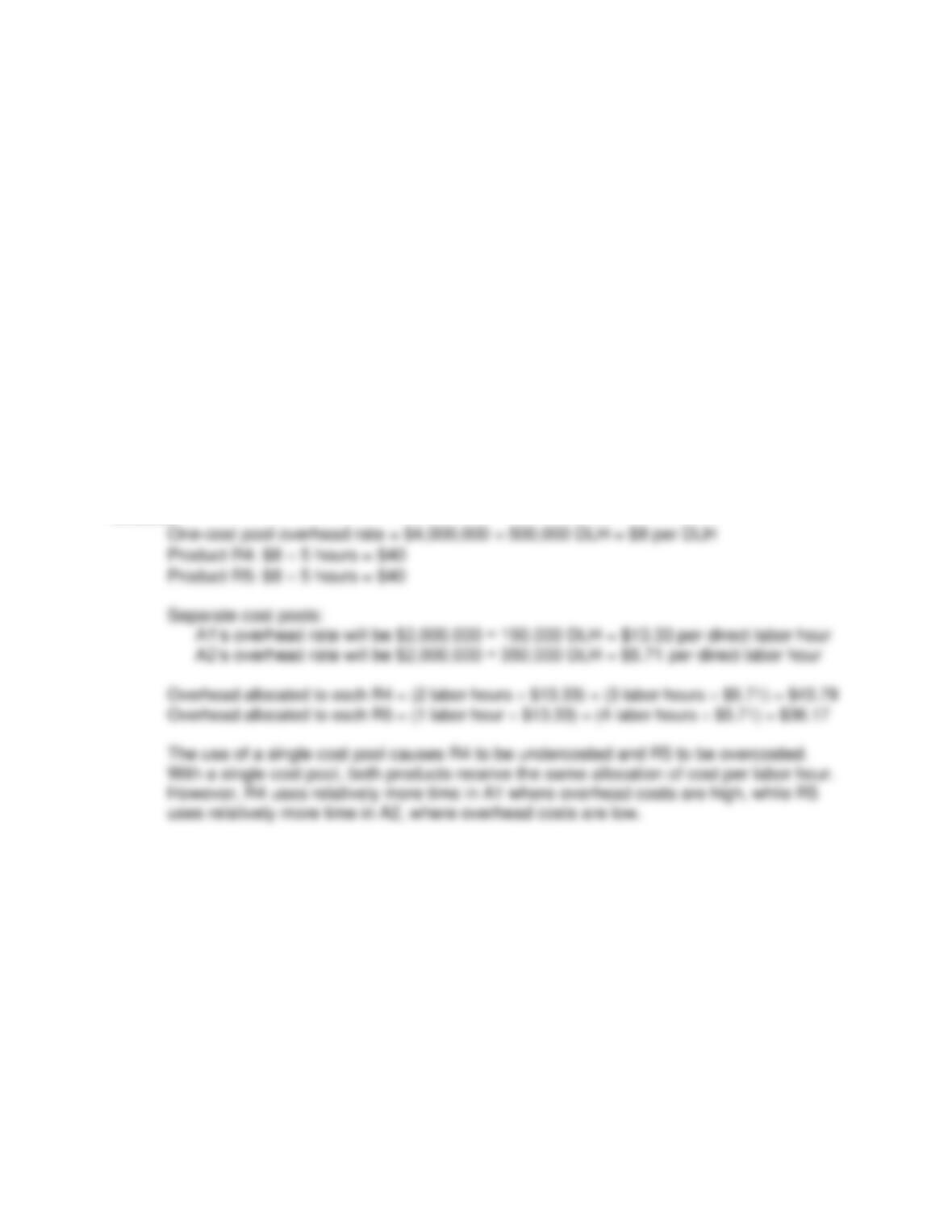
167. Bowcock Manufacturing allocates factory overhead using one cost pool with direct labor
hours as the allocation base. Bowcock has two production departments (A1 and A2).
The new accountant at Bowcock estimates that next year the total factory overhead
costs will be $4,000,000 and approximately 500,000 direct labor hours will be worked.
The accountant also estimates that A1 will use 150,000 direct labor hours and there will
be about $2,000,000 in overhead costs in A1. A2 will use 350,000 direct labor hours and
there will be $2,000,000 in overhead costs in A2. Bowcock has two products: R4 and
R5. It takes two direct labor hours in A1 and three direct labor hours in A2 to complete
one unit of R4. It takes one direct labor hour in A1 and four direct labor hours in A2 to
complete one unit of R5.
Which product will be undercosted and which will be overcosted using a single cost pool
system? Support your answer with appropriate calculations.
Answer
Chapter 6 Cost Allocation and Activity-Based Costing
6-49
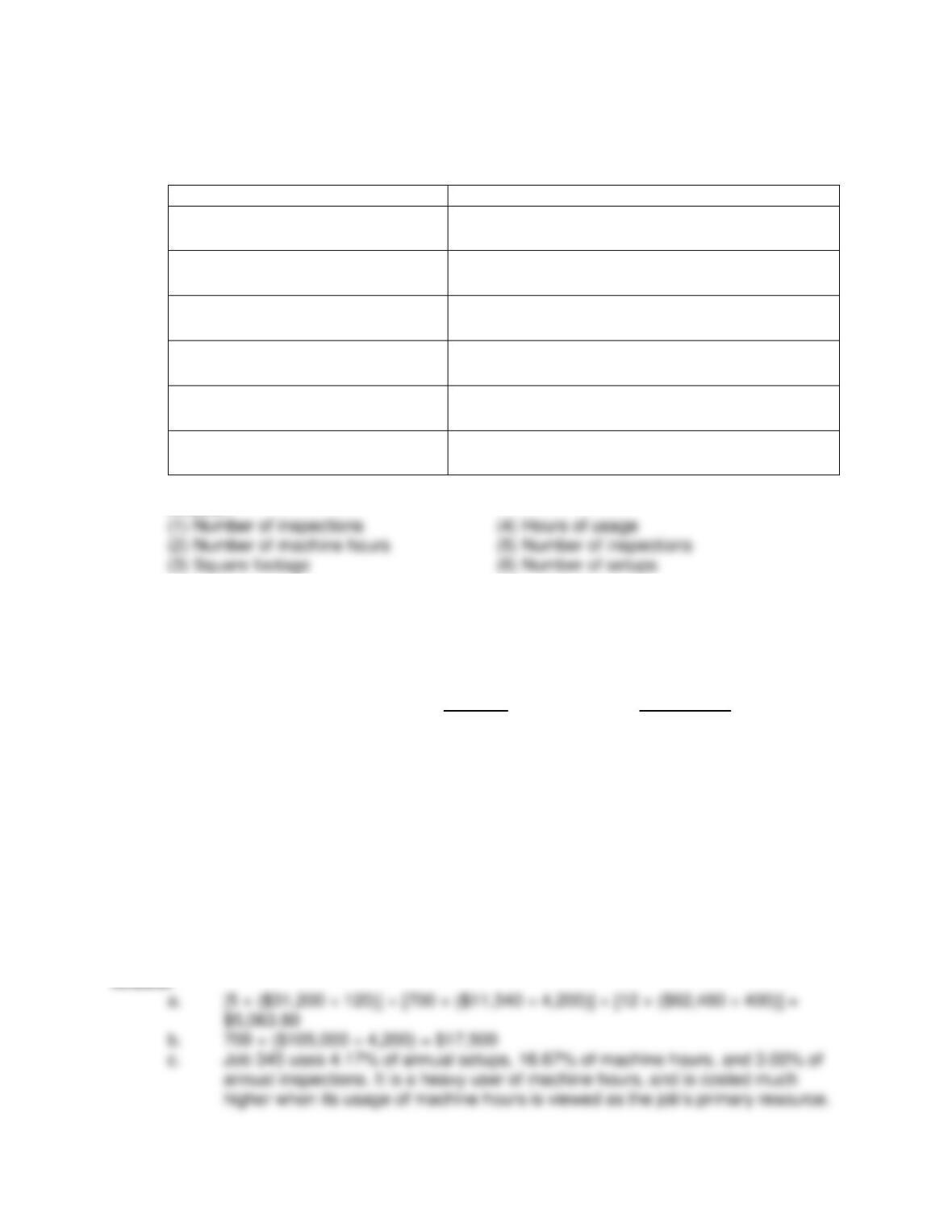
168. The following are six cost pools established for a company using activity-based costing.
The pools are related to the company’s products using cost drivers. For each of the cost
pools, identify a possible cost driver.
COST POOL
COST DRIVER
(1) Handling of raw materials
(2) Production equipment repairs
and maintenance
(3) Raw materials storage
(4) Plant heat, light, water, and
power
(5) Finished product quality control
(6) Production line setups
Answer
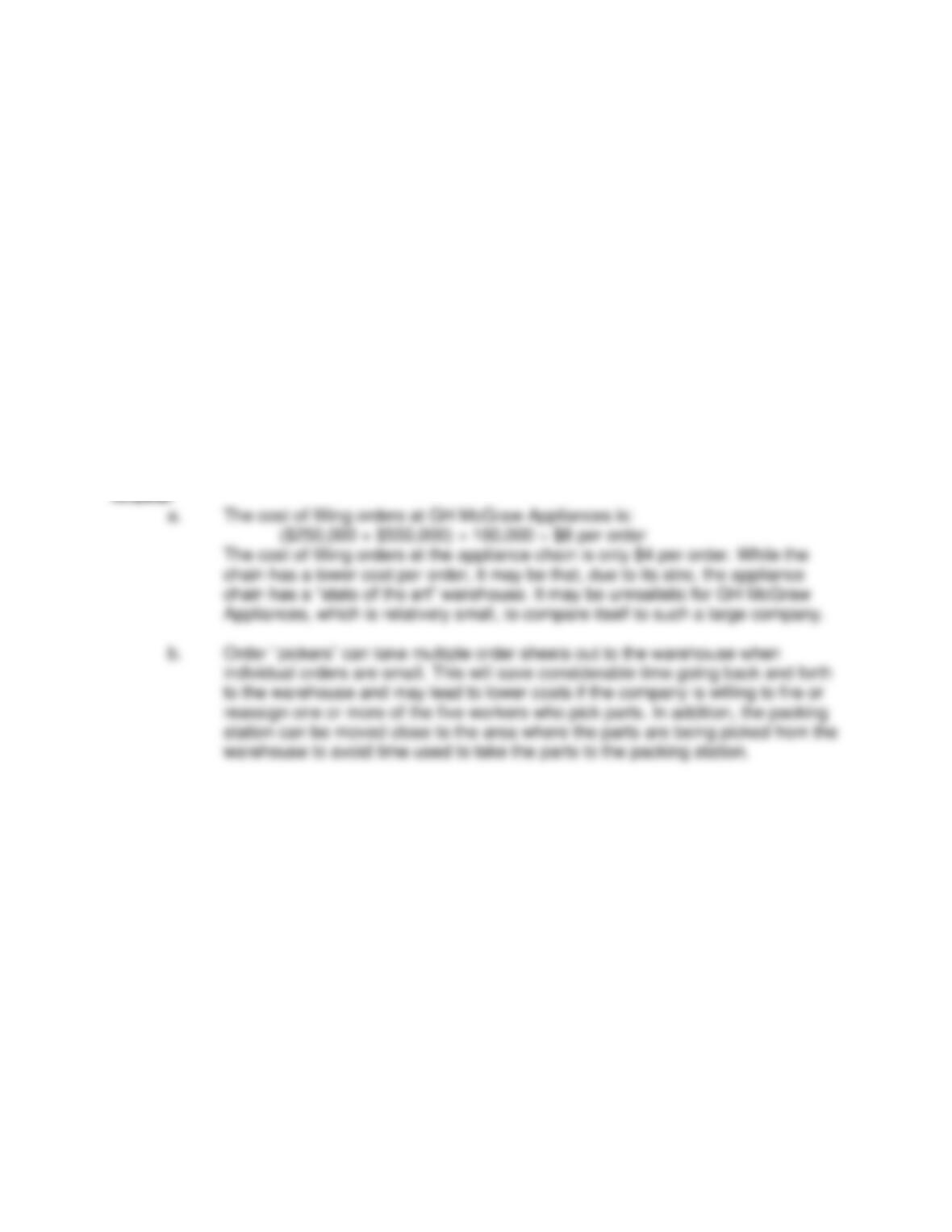
169. Carriage Hill Tooling produces specialized equipment. Currently, overhead costs are
allocated at a rate of $25 per machine hour and the company used 4,200 machine hours
last year. Carriage Hill’s CEO, Ralston, would like to see if ABC would make any
difference in the costs allocated to jobs at the company. The accounting staff has
provided the following information about manufacturing overhead:
Amount Cost Driver
Setups $31,200 Number of setups
Equipment 11,340 Number of machine hours
Inspection 62,460 Number of inspections
The company estimates that it will perform 120 setups and 400 inspections each year
and will use 4,200 machine hours. Job 345 will require 5 setups, 700 machine hours,
and 12 inspections.
a. Using ABC, what amount of manufacturing overhead will be allocated to Job
345?
b. What amount would Ralston allocate to job 345 using the company’s current,
traditional system?
c. Why do the two methods yield such different answers?
Answer
Test Bank to accompany Jiambalvo Managerial Accounting, 6th Edition
6-50
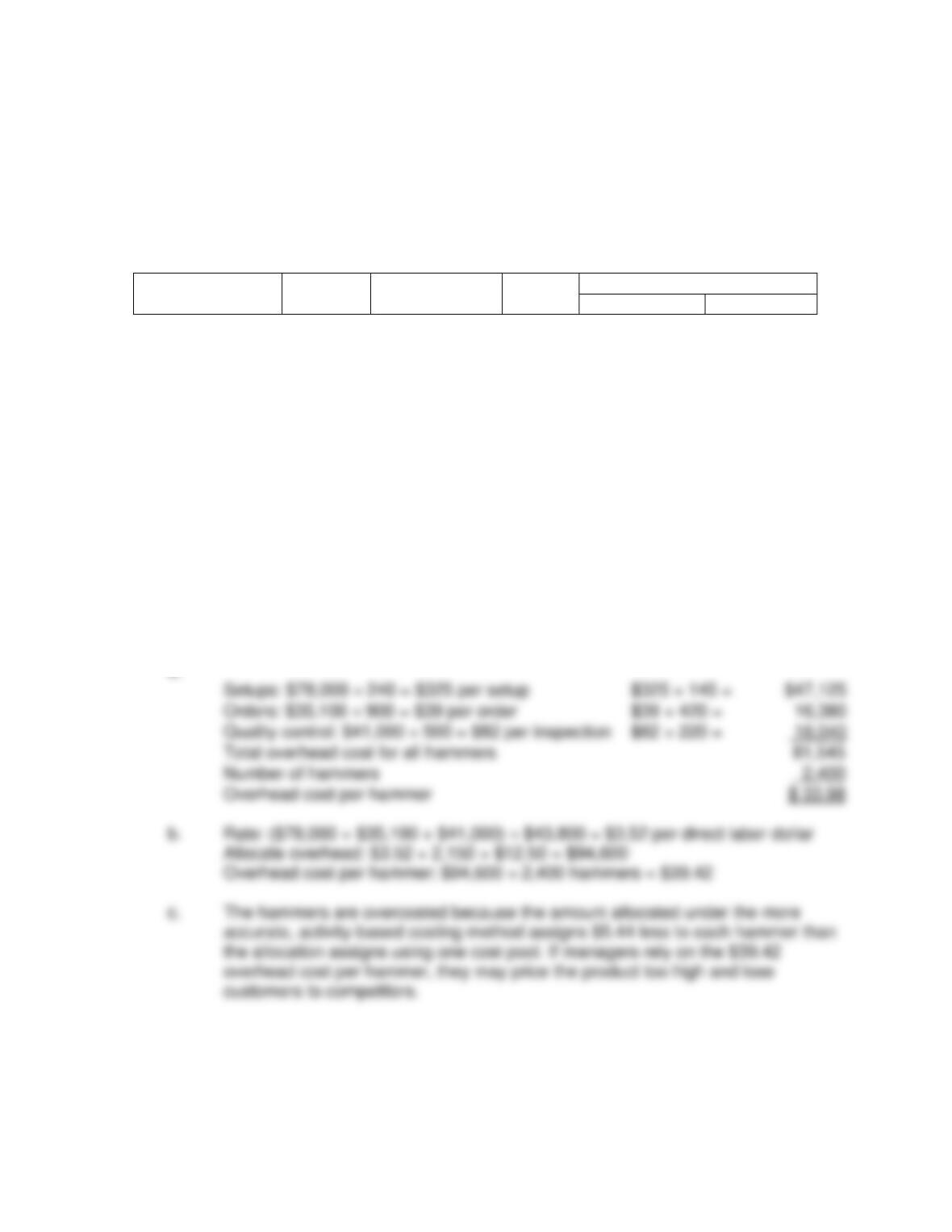
170. GH Mcgraw Appliances supplies parts for laundry and kitchen appliances. Customer
orders are placed over the Internet and are generally filled in one or two days using
express mail services. The company is conducting an ABM study of inventory
management. Management has determined that the cost of filling customer orders in the
past year consisted primarily of $250,000 of salary expense related to five workers who
“pick” parts from the warehouse and $550,000 of salary expense related to six workers
who pack the orders for shipment. In the past year, the company filled 100,000 orders
annually. Based on work performed for a chain of appliance manufacturers,
management has determined a benchmark cost of $4 per order.
a. Comment on the advisability of comparing the costs at GH McGraw Appliances
to those at the appliance manufacturers’ chain store.
b. Management has observed the following: Workers go to a box that contains
individual customer order sheets. They take the bottom order (the “oldest”) and
go into the warehouse with a handcart and a box. They then fill the order and
carry the parts to a packing station. Can you suggest ways of improving this
process?
Chapter 6 Cost Allocation and Activity-Based Costing
6-51
CHALLENGE EXERCISES
171. VeraTrac has traditionally used direct labor cost to allocate overhead to its two
products—hammers and mallets. To improve cost determination, VeraTrac set up 3
activity pools: setups, purchase ordering, and quality control. VeraTrac provided the
following information for the last quarter of 2017 related to the actual production of 2,400
hammers and 1,600 mallets:
Estimated
Cost
Expected
Activity
Actual
Cost
Actual Activity
Hammers
Mallets
Setups
$78,000
240 setups
$81,400
145 setups
90 setups
Purchase ordering
35,100
900 orders
34,800
420 orders
470 orders
Quality control
41,000
500 inspections
42,300
220 inspections
275 inspections
Direct labor
43,800
3,650 hours
46,875
2,150 hours
1,600 hours
Direct materials
19,360
4,400 pounds
19,800
2,100 pounds
3,400 pounds
Actual labor cost is $12.50 per hour and actual material cost is $3.60 per pound.
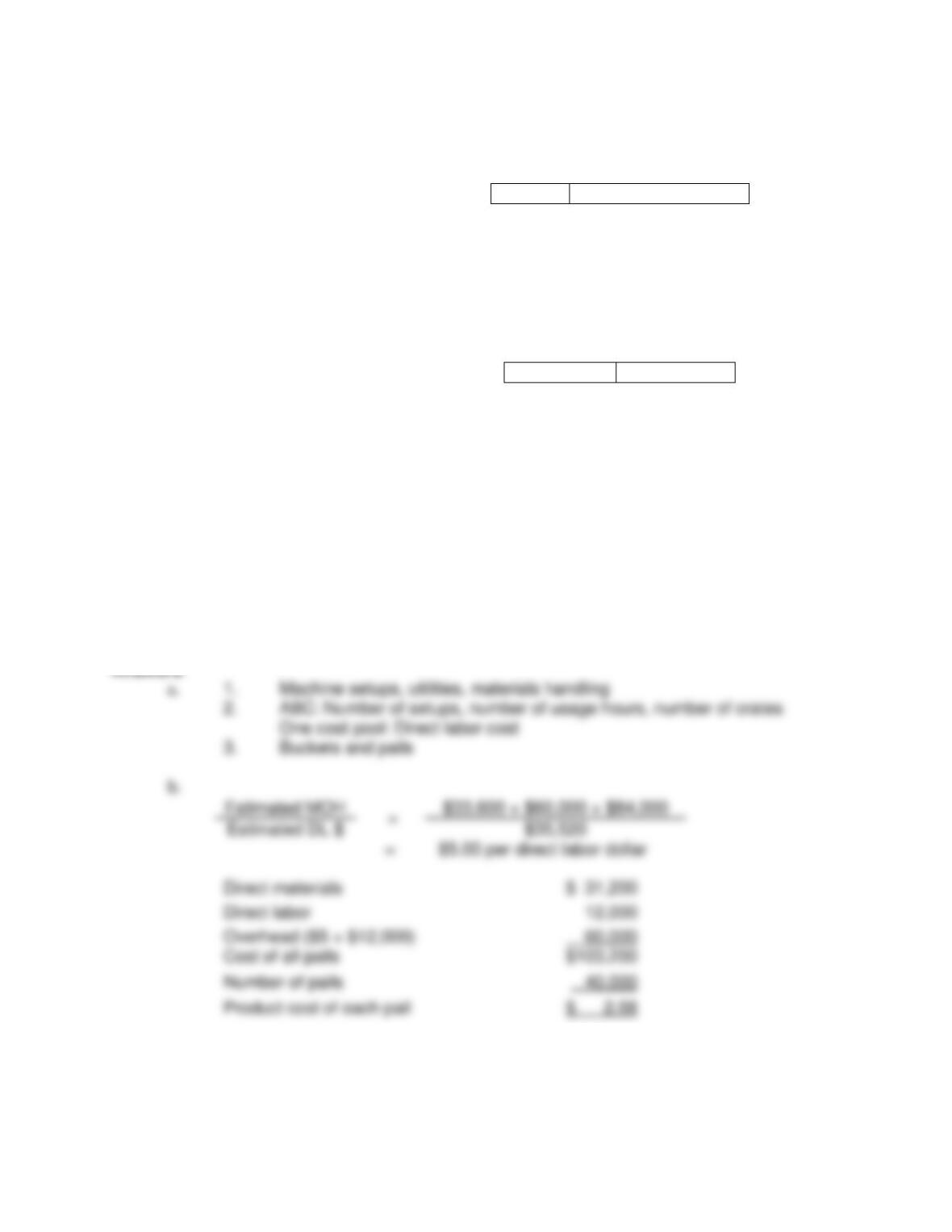
a. How much is the overhead unit cost of each hammer using activity-based
costing?
b. How much is the overhead unit cost of each hammer if the company continues
to use one cost pool? (Round your intermediate calculations to two decimal
places)
c. Is the cost of the hammer over or undercosted? Explain some possible
consequences of this.
Answer
a.
Test Bank to accompany Jiambalvo Managerial Accounting, 6th Edition
6-52
172. Sandifer Company is contemplating the establishment of an activity-based costing
system. It current applies all overhead cost based on direct labor costs. The company
has estimated the following costs and activities for May:
Cost
Activity
Machine Setups
$33,600
400 setups
Utilities
60,000
200,000 usage hours
Materials Handling
84,000
12,500 crates
Direct labor
35,520
$20 per labor hour
Direct material
60,000
$1 per pound
Direct labor cost is $20 per hour. The following information pertains to the actual
production of buckets and pails during May:
Buckets
Pails
Units produced
60,000
40,000
Direct material cost incurred
$30,000
$31,200
Direct labor cost incurred ($20 per hour)
$24,000
$12,000
Setups implemented
120
290
Crates handled
6,800
5,200
Utility hours used
80,000
125,000
a. 1. Which items are cost pools?
2. Which are cost drivers?
3. Which are cost objectives?
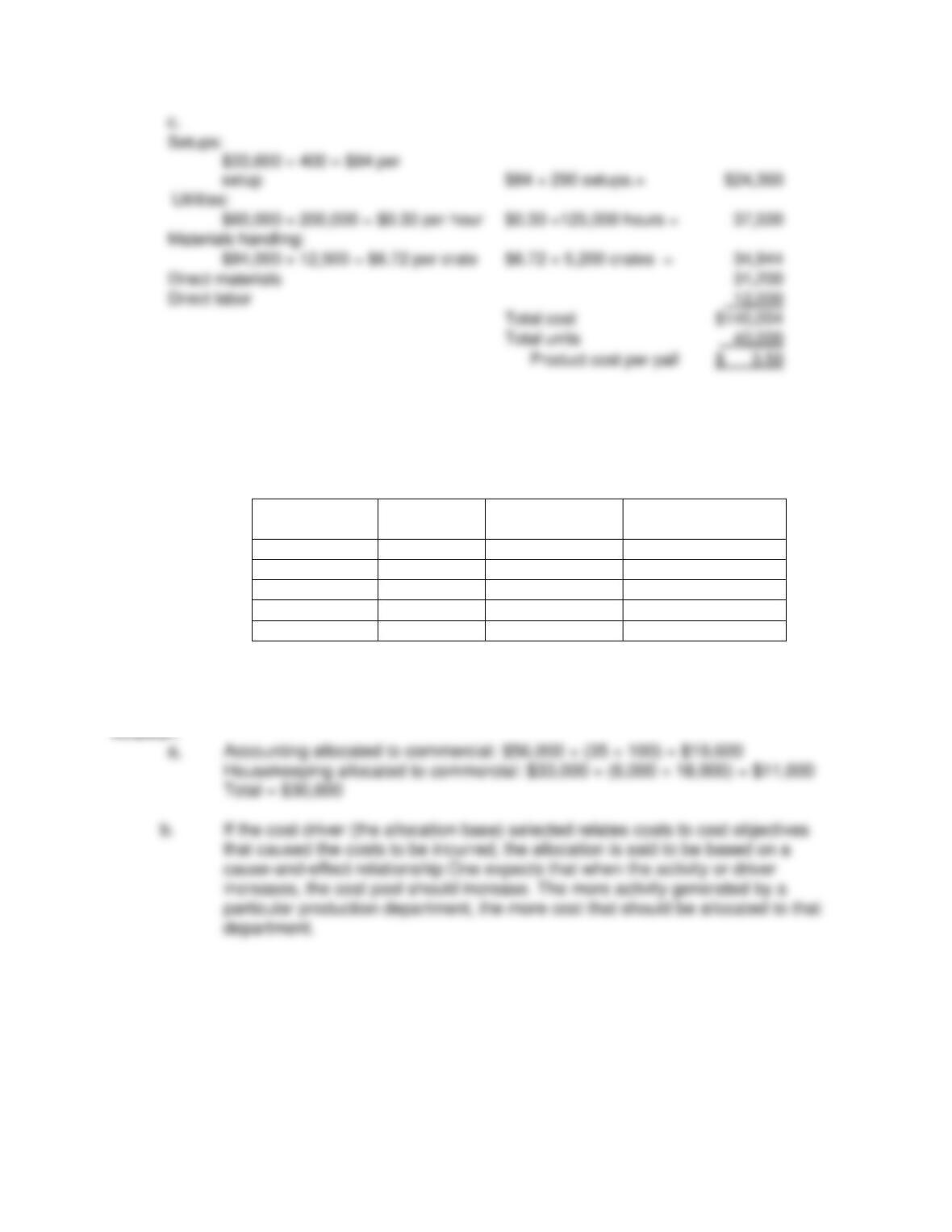
b. How much is the product cost per pail if Sandifer uses one cost pool to allocate
all overhead costs to the cost objectives?
c. How much is the product cost per pail if Sandifer uses ABC?
Direct materials
Direct labor
Overhead ($5 × $12,000)
Cost of all pails
Number of pails
Product cost of each pail
Chapter 6 Cost Allocation and Activity-Based Costing
6-53
173. Clark Inc. has 3 operating departments—commercial, industry, and private for which the
corporate office provides 2 kinds of services, accounting and housekeeping. Accounting
costs are allocated on the basis of number of employees, and housekeeping costs are
allocated based on the basis of number of square feet.
Direct
costs
# of Square
feet
# of Employees
Accounting
$ 56,000
2,000
10
Housekeeping
33,000
3,000
5
Commercial
116,000
6,000
35
Industry
124,000
4,000
40
Private
105,000
8,000
25
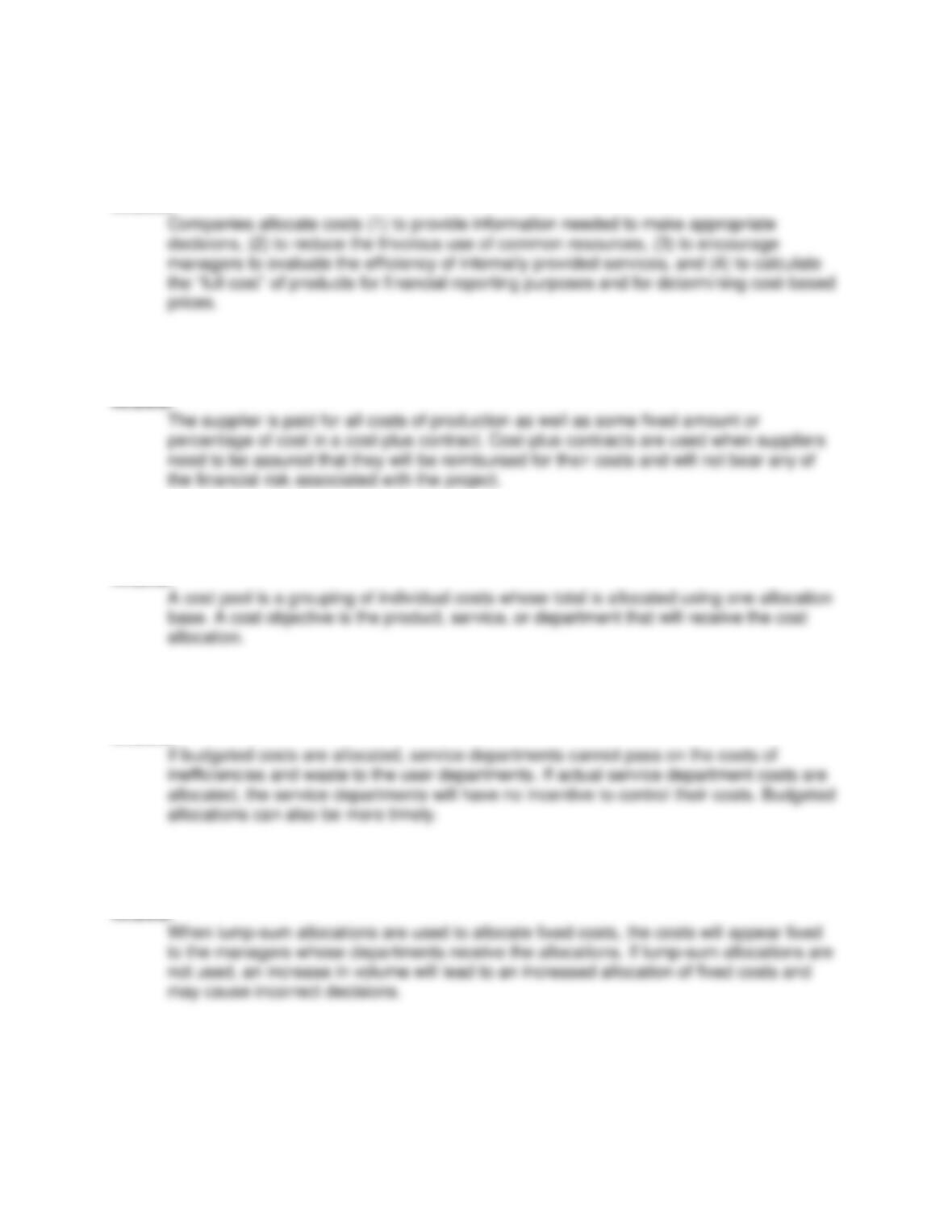
a. How much total cost will Clark, Inc. allocate to the commercial department?
b. As it relates to Clark, Inc., what is meant by a cause–and-effect relationship?
Test Bank to accompany Jiambalvo Managerial Accounting, 6th Edition
6-54
SHORT-ANSWER ESSAYS
174. List the four major reasons that companies allocate costs.
Answer
175. What is a cost-plus contract? Why are cost-plus contracts used?
176. What is the difference between a cost pool and a cost objective?
Answer
177. Why is it better to allocate budgeted rather than actual service department costs?
Answer
178. Why is lump-sum allocations used to allocate fixed costs?
Chapter 6 Cost Allocation and Activity-Based Costing
6-55
179. If a manager is allocated the costs of service departments based on actual costs and
actual activity usage levels, what frustrations might the manager feel?
Answer
180. Describe the difference between the traditional approach to allocating costs and activity–
based costing.
Answer
*181. What is the difference between ABC and ABM?
Answer
*182. What are the four steps in ABM?
Answer