Chapter 6
148. Titan Manufacturing uses a process cost system. The following information pertains to operations for the month of
December.
Units
Beginning work-in-process inventory, December 1 7,000
Started in production during December 185,000
Completed production during December 93,500
Ending work-in–process inventory, December 31 98,500
The beginning inventory was 80% complete for materials and 40% complete for conversion costs. The ending inventory
was 85% complete for materials and 30% complete for conversion costs.
Costs pertaining to the month of December are as follows:
Beginning inventory costs are: materials, $38,200; conversion cost $41,400.
Costs incurred during December are: materials used, $462,300; conversion cost $602,700.
Required:
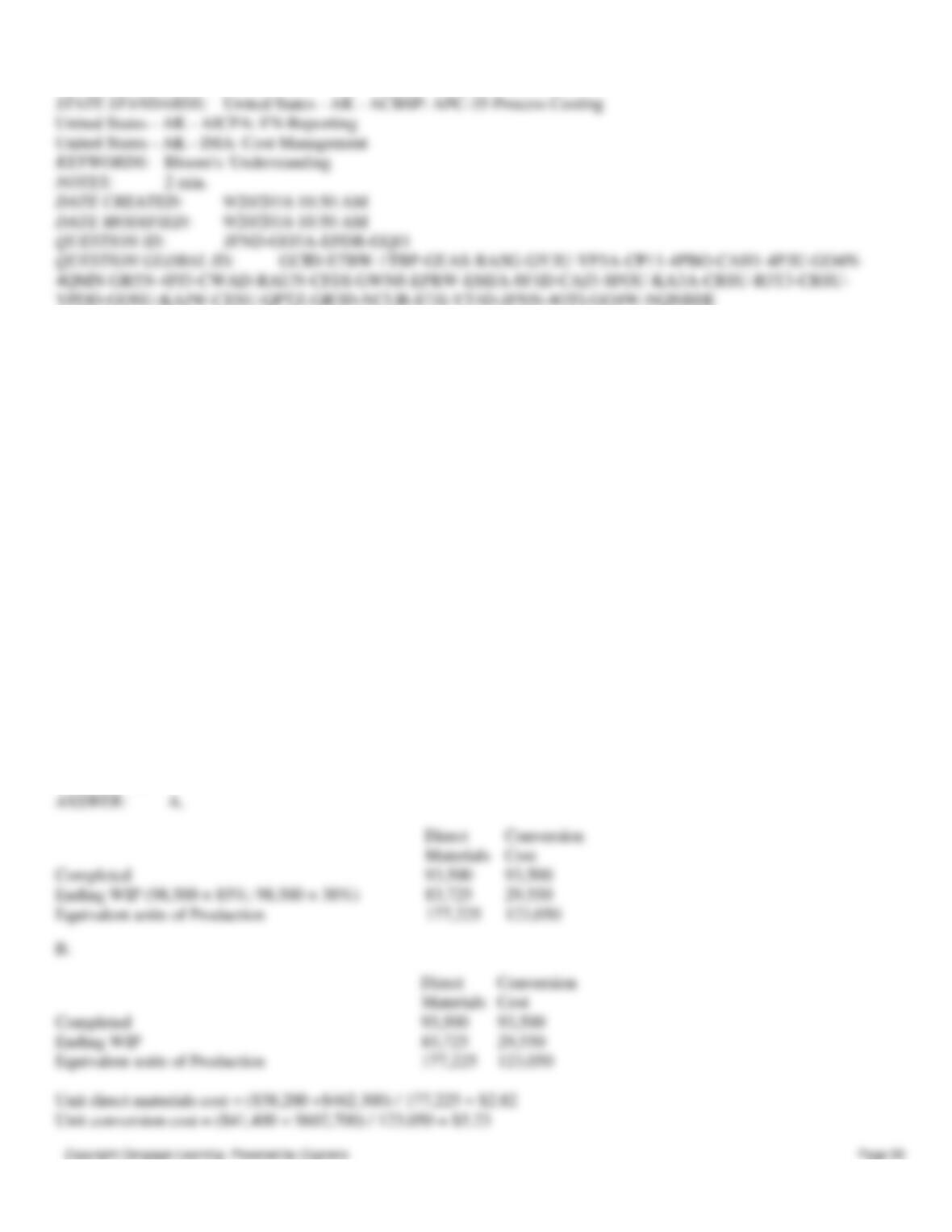
A. Using the weighted average method calculate the total equivalent units of production for direct materials and
conversion cost.
B. Using the weighted average method, calculate the unit cost of materials and conversion for December.
C. Using the weighted average method, calculate the total cost of the units in the ending work-in-process inventory at
December 31.
Chapter 6
149. Davidson Company manufactures a product that passes through two processes. The following information is
available for the first department for October.
All materials are added at the beginning of the process.
Beginning work in process consisted of 20,000 units that were 80% complete with respect to conversion.
Ending work in process consisted of 15,000 units that were 40% complete with respect to conversion.
During the month, 90,000 units were started in process.
Required:
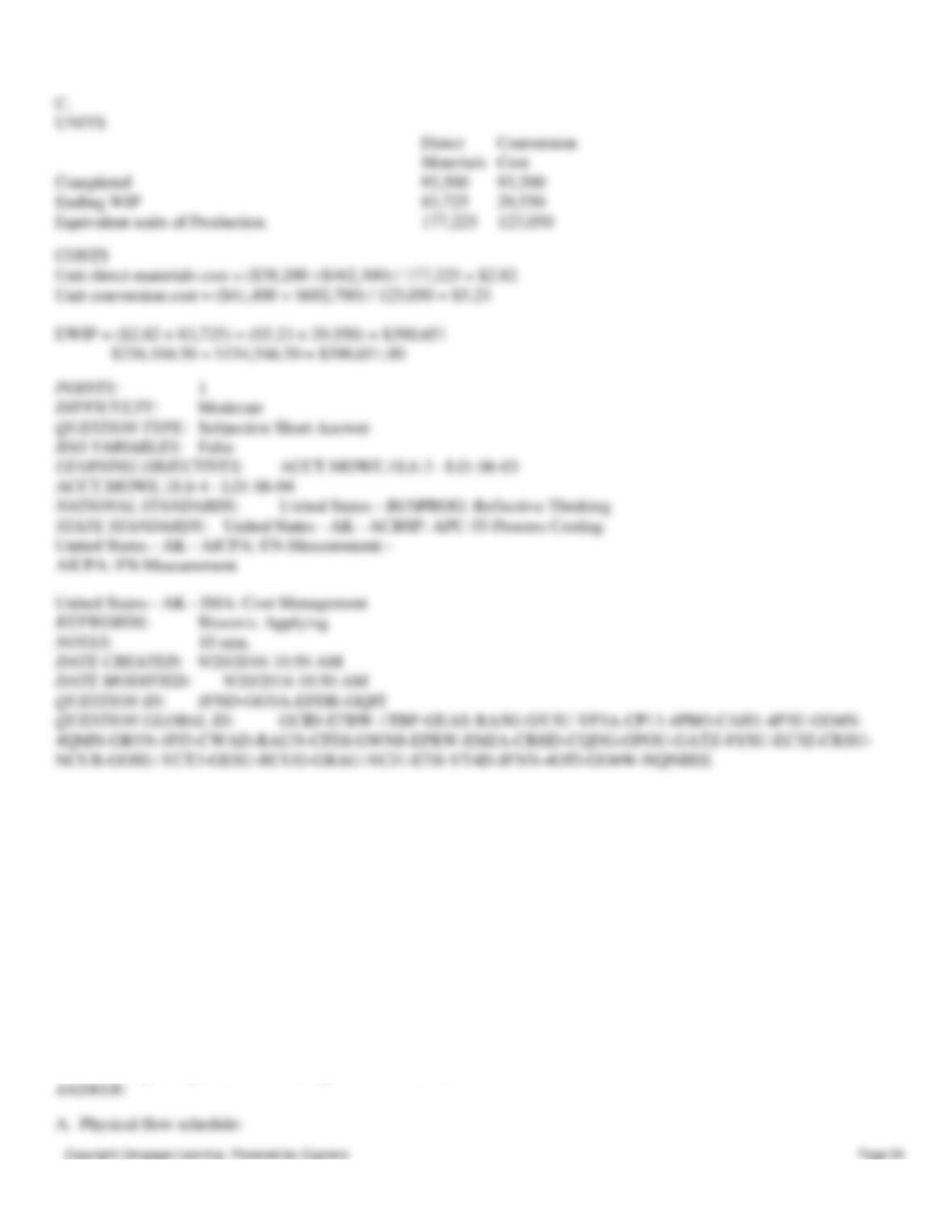
A. Prepare a physical flow schedule.
B. Compute equivalent units using the FIFO method.
Chapter 6
150. Plemmon Company adds materials at the beginning of the process in the forming department, which is the first of
two stages of its production cycle. Information concerning the materials used in the forming department in April follows:
Materials
Units Costs
Work in process at April 1 15,000 $ 8,000
Units started during April 60,000 $38,500
Units completed and transferred to next department
Chapter 6
during April 65,000
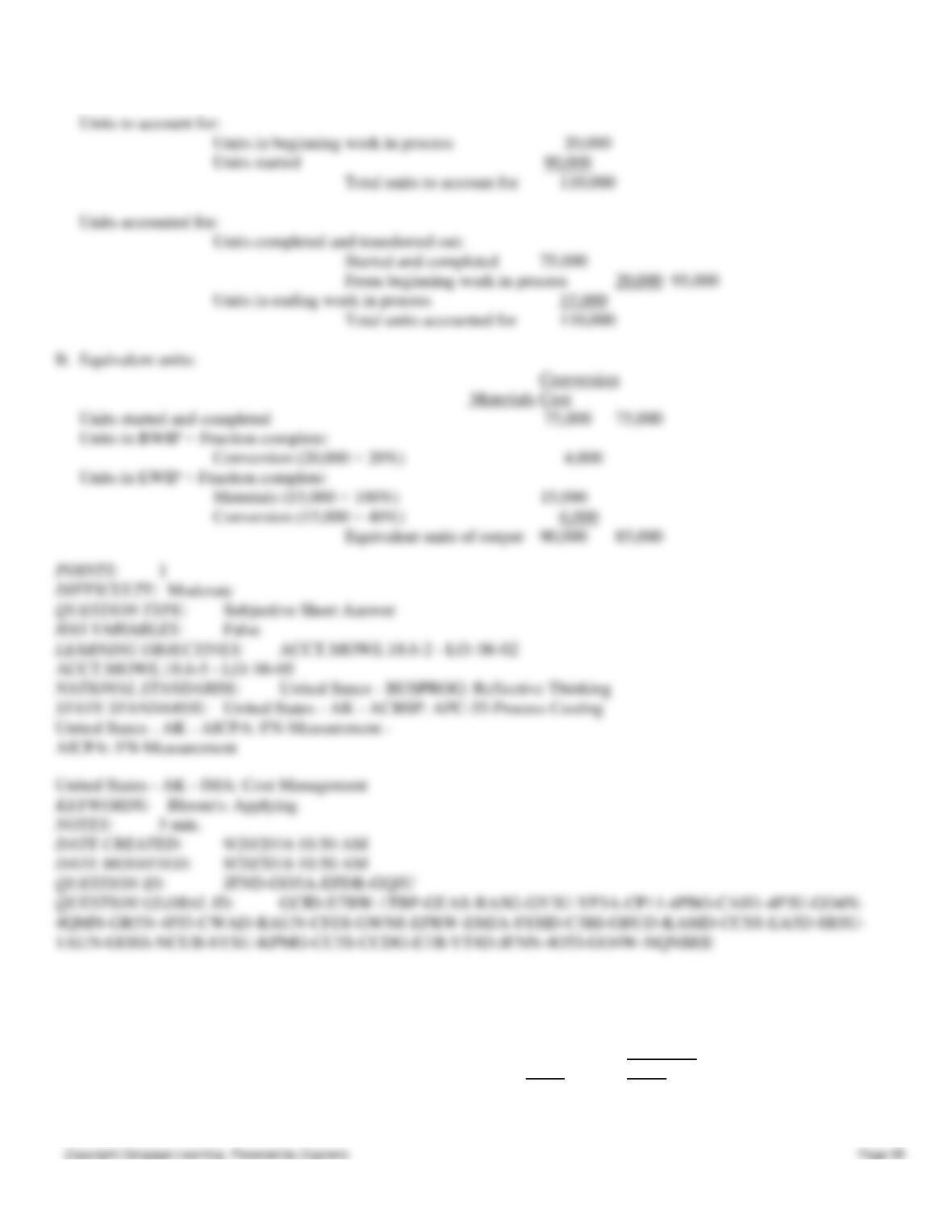
Using the FIFO method, what is the cost of materials in work in process at April 30 (round unit calculations to the nearest
cent)?
151. The Roberto Company had computed the flow of units for Department A for the month of May as follows:
Work in process, May 1: 10,000
Started into production during May 39,000
Units to be accounted for 49,000
Beginning Added during the
work in process current month
Materials $20,800 $ 97,500
Chapter 6
Labor 5,200 34,920
Factory overhead 4,800 32,980
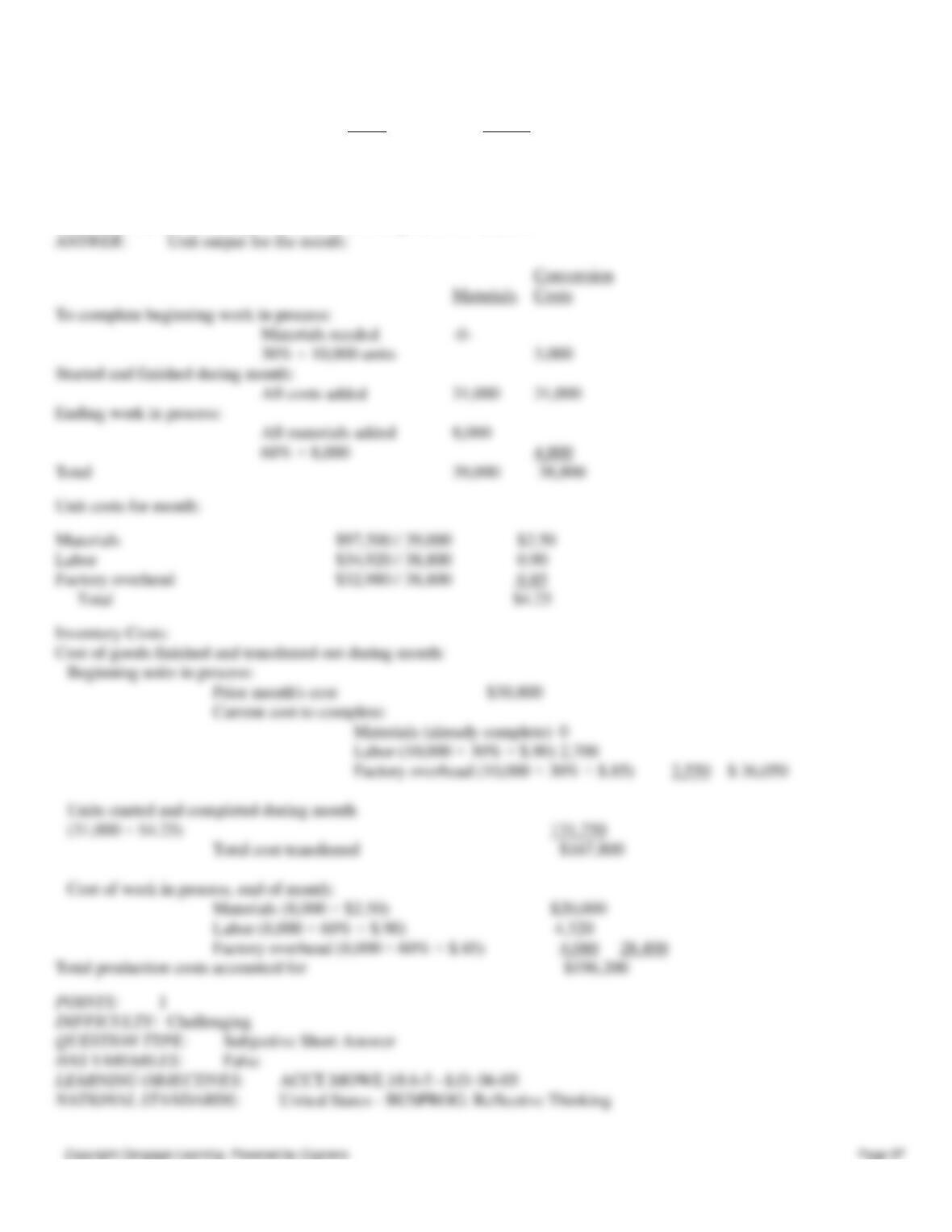
Total $30,800 $165,400
Materials are added at the beginning of the process. There were 8,000 units of work in process at
May 31. The work in process at May 1 was 70% complete as to direct labor and factory overhead costs and the work in
process at May 31 was 60% complete as to direct labor and factory overhead costs. What was the cost of the goods
transferred out and in ending work in process using the FIFO method?
Chapter 6
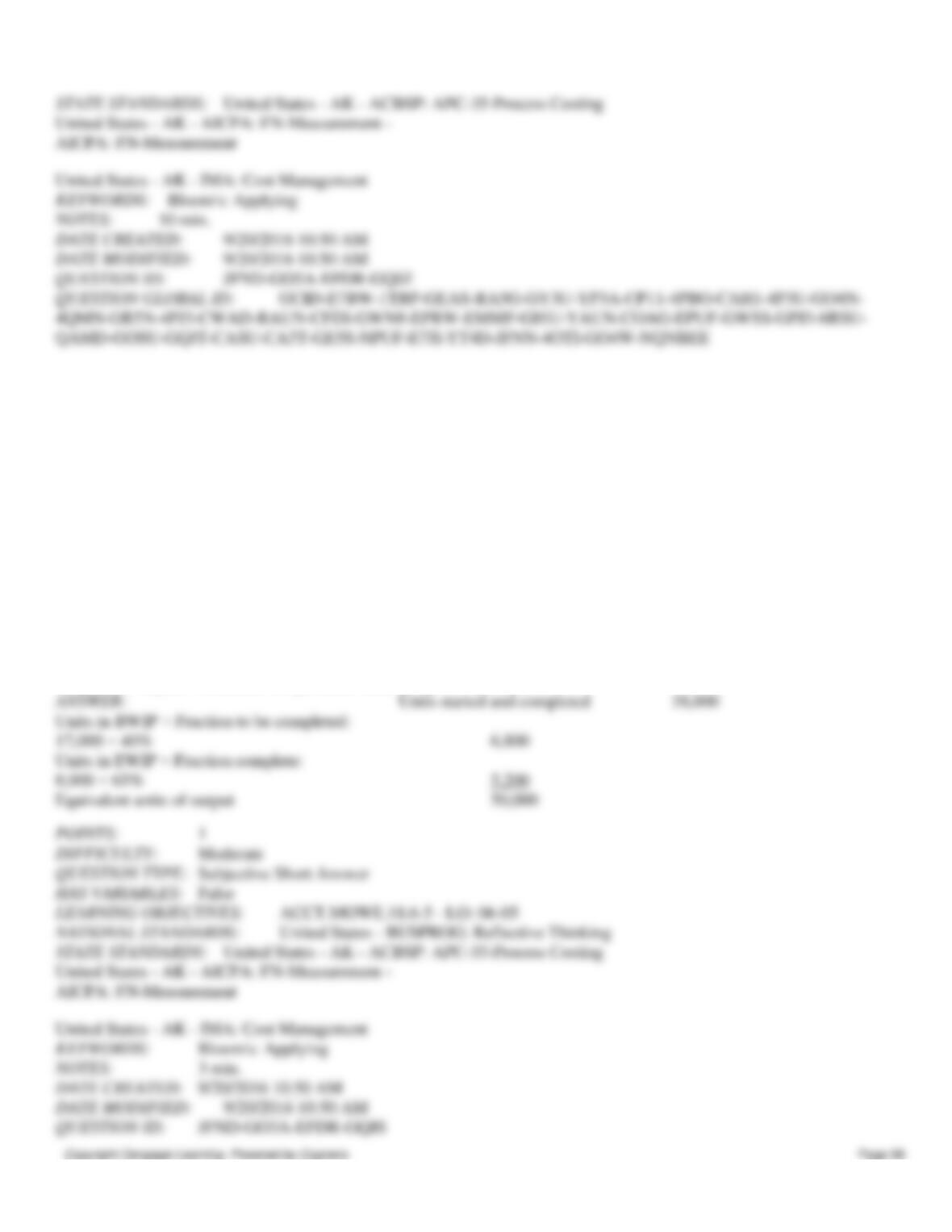
152. Garrison Inc. manufactures product where all manufacturing inputs are applied uniformly. The company produced
the following physical flow schedule for July:
Units to account for:
Units in BWIP (60% complete) 17,000
Units started 46,000
Total units to account for 63,000
Units accounted for:
Units completed:
From BWIP 17,000
Started and completed 38,000
55,000
Units, EWIP (65% completed) 8,000
Total units accounted for 63,000
Required: Prepare a schedule of equivalent units using the FIFO method.
Chapter 6
153. Costing system used by a chemical manufacturer.
154. Costing system used by an architectural firm.
155. Costing system used by a home builder.
156. Costing system used by a manufacturer of custom furniture.
Chapter 6
157. Costing system used by a tire manufacturer.
158. Costing system used by a food manufacturer.
159. partially completed units can be worked on simultaneously in different processes then brought together in a final
process for completion
160. units pass through one process before they can be worked on in the next processes
Chapter 6
161. works well whenever relatively homogeneous products pass through a series of processes and receive similar
amounts of manufacturing costs
162. combines beginning inventory costs and work done with current-period costs and work to calculate this period’s unit
cost
163. calculation of equivalent units
164. cost reconciliation
Chapter 6
165. physical flow analysis
166. computation of unit cost
167. valuation of inventories
Chapter 6
168. Complete units that could have been produced given the total amount of manufacturing effort expended for the
period under consideration.
169. The costs transferred from a prior process to a subsequent process.
170. Separates work and costs of the equivalent units in beginning inventory from work and costs of the equivalent units
produced during the current period.
171. The document that summarizes the manufacturing activity that takes place in a process department for a given period
of time.