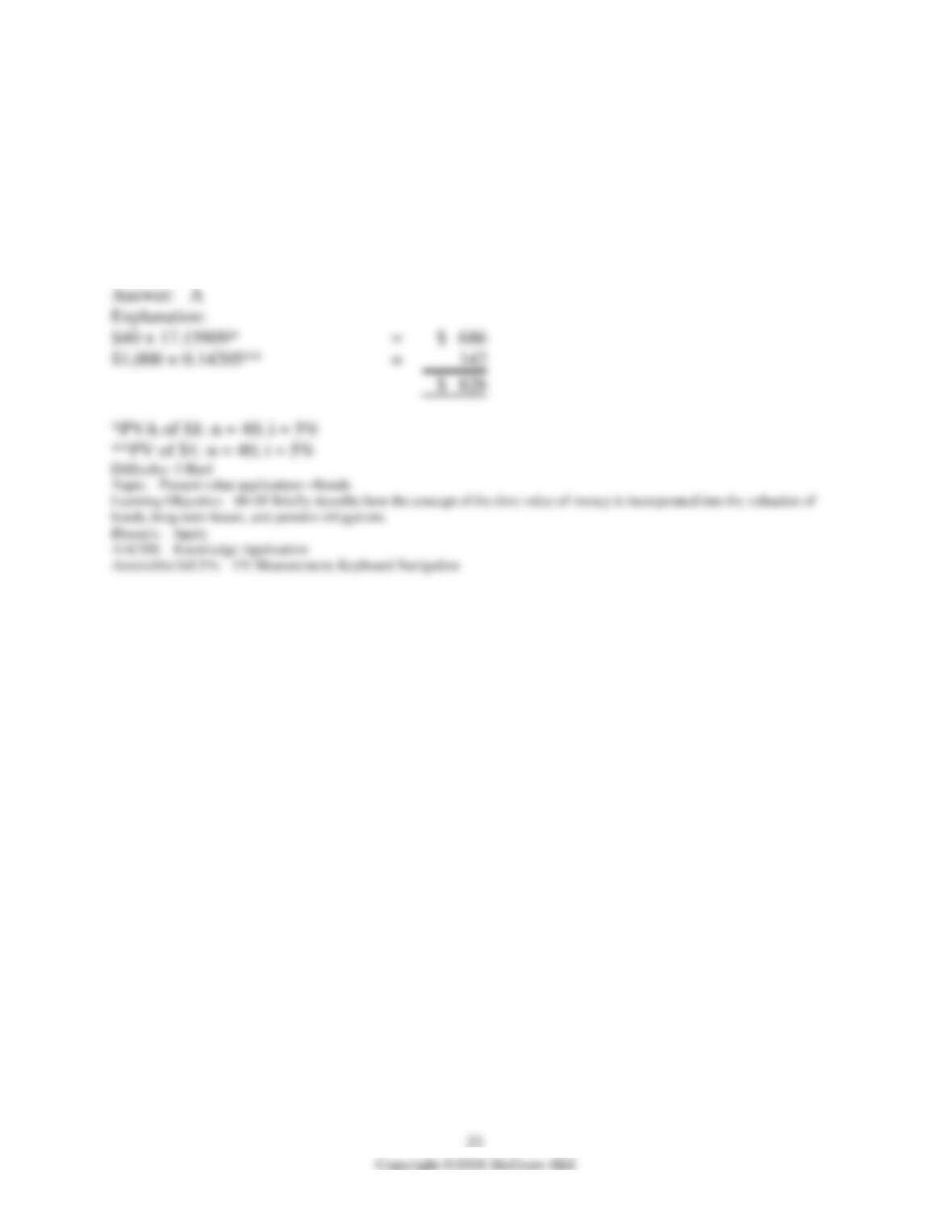
52) An investor purchases a 20-year, $1,000 par value bond that pays semiannual interest of $40.
If the semiannual market rate of interest is 5%, what is the current market value of the bond? (FV
of $1, PV of $1, FVA of $1, PVA of $1, FVAD of $1 and PVAD of $1)
A) $828.
B) $1,686.
C) $1,000.
D) $893.
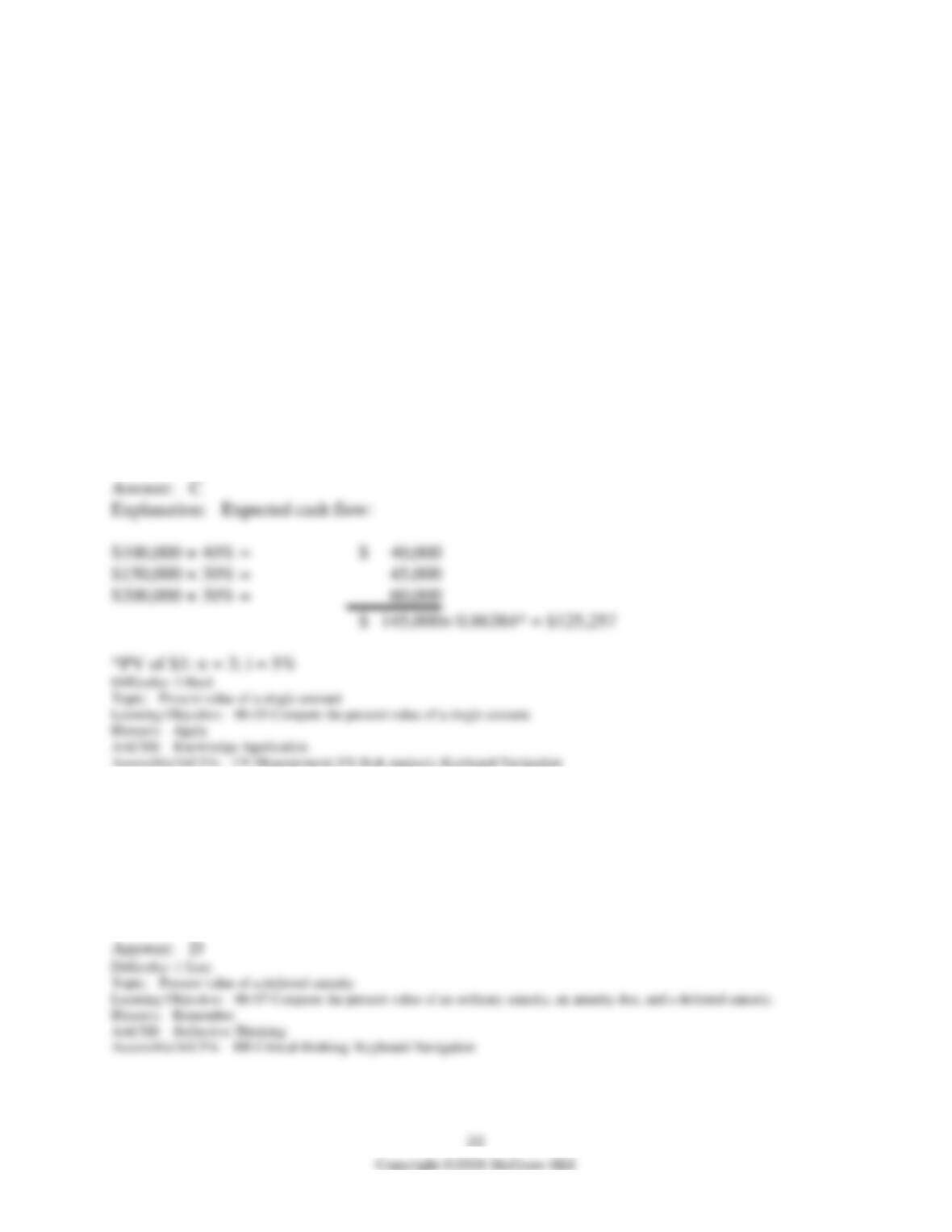
53) Simpson Mining is obligated to restore leased land to its original condition after its
excavation activities are completed in three years. The cash flow possibilities and probabilities
for the restoration costs in three years are as follows:
Cash Outflow
Probability
$
100,000
40
%
150,000
30
%
200,000
30
%
The company’s credit-adjusted risk-free interest rate is 5%. The liability that Simpson must
record at the beginning of the project for the restoration costs is: (FV of $1, PV of $1, FVA of
$1, PVA of $1, FVAD of $1 and PVAD of $1)
A) $129,576.
B) $145,000.
C) $125,257.
D) $172,768.
$100,000 × 40% =
$
$150,000 × 30% =
$200,000 × 30% =
$
145,000
× 0.86384* = $125,257
54) A series of equal periodic payments that starts more than one period after the agreement is
called:
A) An annuity due.
B) An ordinary annuity.
C) A future annuity.
D) A deferred annuity.
55) A series of equal periodic payments in which the first payment is made one compounding
period after the date of the contract is:
A) A deferred annuity.
B) An ordinary annuity.
C) An annuity due.
D) A delayed annuity.
56) Loan A has the same original principal, interest rate, and payment amount as Loan B.
However, Loan A is structured as an annuity due, while Loan B is structured as an ordinary
annuity. The maturity date of Loan A will be:
A) Earlier than Loan B.
B) Later than Loan B.
C) The same as Loan B.
D) Indeterminate with respect to Loan B.
57) To determine the future value factor for an annuity due for period n when given tables only
for an ordinary annuity:
A) Obtain the FVA factor for n + 1 and deduct 1.
B) Obtain the FVA factor for n and deduct 1.
C) Obtain the FVA factor for n – 1 and add 1.
D) Obtain the FVA factor for n + 1 and add 1.
58) Yamaha Inc. hires a new chief financial officer and promises to pay him a lump-sum bonus
four years after he joins the company. The new CFO insists that the company invest an amount
of money at the beginning of each year in a 7% fixed rate investment fund to insure the bonus
will be available. To determine the amount that must be invested each year, a computation must
be made using the formula for:
A) The future value of a deferred annuity.
B) The future value of an ordinary annuity.
C) The future value of an annuity due.
D) None of these answer choices are correct.
59) Zulu Corporation hires a new chief executive officer and promises to pay her a signing bonus
of $2 million per year for 10 years, starting five years after she joins the company. The liability
for this bonus when the CEO is hired:
A) Is the present value of a deferred annuity.
B) Is the present value of an annuity due.
C) Is $20 million.
D) Is zero because no cash is owed for five years.
60) Which of the following must be known in order to compute the interest rate when financing
an asset purchase with an annuity?
A) Fair value of the asset purchased, number and dollar amount of the annuity payments.
B) Present value of the annuity, dollar amount and timing of the annuity payments.
C) Fair value of the asset and timing of the annuity payments.
D) Number of annuity payments and future value of the annuity.
61) Davenport Inc. offers a new employee a single-sum signing bonus at the date of
employment. Alternatively, the employee can receive $30,000 at the date of employment and
another $50,000 two years later. Assuming the employee’s time value of money is 8% annually,
what single sum at the employment date would make her indifferent between the two options?
(FV of $1, PV of $1, FVA of $1, PVA of $1, FVAD of $1 and PVAD of $1)
A) $60,000.
B) $62,867.
C) $72,867.
D) $80,000.
62) Quaker State Inc. offers a new employee a single-sum signing bonus at the date of
employment. Alternatively, the employee can receive $8,000 at the date of employment plus
$20,000 at the end of each of his first three years of service. Assuming the employee’s time value
of money is 10% annually, what lump sum at employment date would make him indifferent
between the two options?
A) $23,026.
B) $57,737.
C) $62,711.
D) None of these answer choices are correct.
63) Garland Inc. offers a new employee a single-sum signing bonus at the date of employment,
June 1, 2018. Alternatively, the employee can receive $39,000 at the date of employment plus
$10,000 each June 1 for five years, beginning in 2022. Assuming the employee’s time value of
money is 9% annually, what single amount at the employment date would make the options
equally desirable?
A) $44,035.
B) $40,855.
C) $69,035.
D) $65,855.
64) On January 1, 2018, Glanville Company sold goods to Otter Corporation. Otter signed an
installment note requiring payment of $15,000 annually for six years. The first payment was
made on January 1, 2018. The prevailing rate of interest for this type of note at date of issuance
was 8%.
Glanville should record sales revenue in January 2018 of:
A) $90,000.
B) $69,343.
C) $74,891.
D) None of these answer choices are correct.
65) Loan C has the same principal amount, payment amount, and maturity date as Loan D.
However, Loan C is structured as an annuity due, while Loan D is structured as an ordinary
annuity. Loan C’s interest rate is:
A) Higher than Loan D.
B) Less than Loan D.
C) The same as Loan D.
D) Indeterminate compared to Loan D.
66) Tammy wants to buy a car that costs $10,000 and wishes to know the amount of the monthly
payments, which will be made at the first of the month, with interest of 12% on the unpaid
balance. She should use a table for the:
A) Present value of $1.
B) Present value of an ordinary annuity of $1.
C) Present value of an annuity due of $1.
D) Future value of an annuity due of $1.
67) George Jones is planning on a cruise for his 70th birthday party. He wants to know how
much he should set aside at the beginning of each month at 6% interest to accumulate the sum of
$4,800 in five years. He should use a table for the:
A) Future value of an ordinary annuity of $1.
B) Future value of an annuity due of $1.
C) Future value of $1.
D) Present value of an annuity due of $1.
68) Sandra won $5,000,000 in the state lottery, which she has elected to receive at the end of
each month over the next 30 years. She will receive 7% interest on unpaid amounts. To
determine the amount of her monthly check, she should use a table for the:
A) Present value of an annuity due of $1.
B) Future value of an annuity due of $1.
C) Present value of an ordinary annuity of $1.
D) Future value of an ordinary annuity of $1.
69) First Financial Auto Loan Department wishes to know the payment required at the first of
each month on a $10,500, 48-month, 11% auto loan. To determine this amount, First Financial
would:
A) Multiply $10,500 by the present value of $1.
B) Divide $10,500 by the future value of an ordinary annuity of $1.
C) Divide $10,500 by the present value of an annuity due of $1.
D) Multiply $10,500 by the present value of an ordinary annuity of $1.
70) Koko Company pays $10 million at the beginning of each year for 10 years to Mocha Inc. in
exchange for a building that now has a fair value of $75 million. What interest rate is Mocha
earning on financing this land sale?
A) Between 13% and 14%.
B) Between 7% and 8%.
C) Between 5.5% and 6%.
D) Cannot be determined from the given information.
71) Kunkle Company wishes to earn 20% annually on its investments. If Kunkle makes an
investment that equals or exceeds that rate, it considers it a success. Assume that Kunkle invests
$2 million and gets $500,000 in return at the end of each year for X years. What is the minimum
value of X (number of years) for which Kunkle will consider the investment a success? Assume
that Kunkle can’t invest for fractional parts of a year.
A) 4 years.
B) 6 years.
C) 7 years.
D) 9 years.
72) Chancellor Ltd. sells an asset with a $1 million fair value to Sophie Inc. Sophie agrees to
make six equal payments, each to be paid one year apart, commencing on the date of sale. The
payments include principal and 6% annual interest. Compute the annual payments.
A) $166,651.
B) $135,252.
C) $203,351.
D) $191,852.
73) You borrow $20,000 to buy a boat. The loan is to be paid off in monthly installments over
one year at 18% interest annually. The first payment is due one month from today. What is the
amount of each monthly payment?
A) $1,667.
B) $1,511.
C) $1,834.
D) None of these answer choices are correct.
74) Fenland Co. plans to retire $100 million in bonds in five years, so it wishes to fund a savings
account at the beginning of each year during that period for which it expects to earn 8%
annually. At the end of the five years, there will be enough money in the account to pay off the
bonds. What amount does Fenland need to invest each year?
A) $15,783,077.
B) $17,045,650.
C) $23,190,400.
D) Cannot be determined from the given information.
Listed below are five terms followed by a list of phrases that describe or characterize each of the
terms. Match each phrase with the correct term.
A) Accumulation of a series of equal payments with the last payment accruing interest.
B) Accumulation of an amount with interest.
C) Accumulation of a series of equal payments with the last payment accruing no interest.
D) A dollar now is worth more than a dollar later.
E) A series of equal periodic payments.
75) Future value
76) Future value of an annuity due
77) Annuity
78) Future value of an ordinary annuity
79) Time value of money
Listed below are five terms followed by a list of phrases that describe or characterize each of the
terms. Match each phrase with the correct term.
A) Based on initial investment only.
B) Amount today equivalent to a specified future amount.
C) Current worth of a series of equal payments received at the beginning of a period.
D) Claim to a fixed amount of cash.
E) Its amount is not fixed or determinable.
80) Monetary asset
81) Present value of an annuity due
82) Present value of a single amount
83) Simple interest
84) Nonmonetary asset
Listed below are five terms followed by a list of phrases that describe or characterize each of the
terms. Match each phrase with the correct term.
A) Interest accumulates on interest.
B) Current worth of future cash flow(s).
C) Fixed obligation to pay an amount in cash.
D) The rate at which money will actually grow.
E) Current worth of a series of equal payments received at the end of a period.
85) Present value of an ordinary annuity
86) Effective yield
87) Monetary liability
88) Compound interest
89) Present value
Listed below are five terms followed by a list of phrases that describe or characterize each of the
terms. Match each phrase with the correct term.
A) Rent paid or received for the use of money.
B) Series of equal cash payments received at the beginning of each period.
C) The money to which an amount invested will grow over time.
D) Series of equal cash payments received at the end of each period.
E) Series of equal cash payments with the first cash payment more than one period after the
contract date.
90) Future value of a single amount
91) Annuity due
92) Interest
93) Ordinary annuity
94) Deferred annuity
95) Listed below are columns of time value of money tables for the 9% rate, followed by labels
for five of the columns. Match the columns with their appropriate labels by placing the letter
designating the column in the space provided by the label.
A
B
C
D
E
F
1
1.090
0.917
1.000
0.917
1.000
1.090
2
1.188
1.759
1.917
0.842
2.090
2.278
3
1.295
2.531
2.759
0.772
3.278
3.573
________ Present value of an annuity due of $1
________ Future value of an annuity due of $1
________ Present value of $1
________ Future value of $1
________ Present value of an ordinary annuity of $1
Listed below are ten terms followed by a list of phrases that describe or characterize each of the
terms. Match each phrase with the correct term.
A) Amount of money paid/received in excess of the amount borrowed/lent.
B) The rate to use is the risk-free rate of interest.
C) Claim to a fixed amount of cash.
D) Amount of money required today that is equivalent to a given future amount.
E) First cash flow occurs on the first day of the agreement.
F) The first cash flow occurs more than one period after the date of the agreement.
G) Present value of equal-sized cash flows beginning at the end of the period.
H) The amount of money that a dollar will grow to.
I) A series of equal-sized cash flows.
J) Future value of equal-sized cash flows starting at the beginning of the period.
96) Deferred annuity
97) Future value of an annuity due
98) Annuity
99) Monetary asset
100) Expected cash flow approach
101) Present value of a single amount
102) Future value of a single amount
103) Annuity due
104) Present value of an ordinary annuity
105) Interest
Use this information to answer the following questions:
The note about debt included in the financial statements of Healdsburg Company for the year
ended December 31, 2017 disclosed the following:
Debt. The following table summarizes the long-term debt of the Company at December 31,
2017. All of the notes were originally issued at their face (maturity) value and have been
gradually repaid over time so that these amounts are the remaining balances at this date.
7.25% notes due 2018 $201,335,000
7.75% notes due 2025 $345,154,000
8% notes due 2032 $225,000,000
7.63% notes due 2040 $200,000,000
6.55% notes due 2019 $ 25,000,000
Required: Assuming that the notes pay interest annually and mature on December 31 of the
respective years, compute the following:
106) The total cash interest payments in 2018 for these notes.
107) Suppose that Healdsburg wants to pay off the 7.75% notes on December 31, 2018, (i.e., five
years early) when the going interest rate is 6%, thereby retiring the $345,154,000 in debt. How
much would Healdsburg have to pay for the notes (principal only) on this date in order to satisfy
the noteholders?
108) Suppose that Healdsburg renegotiates the 8% notes on December 31, 2023, when the going
interest rate is 8%. Healdsburg agrees to make 12 equal annual installments, commencing on
December 31, 2024, rather than pay the annual interest payments and the $225 million in a single
amount at maturity. What would the annual payments be?
109) Suppose that Healdsburg enters into a sales contract with an auto manufacturer on January
1, 2018, to provide tires that cost Healdsburg $18 million to produce. The buyer offers
Healdsburg $6 million in cash and agrees to take over only the principal payment on
Healdsburg’s 6.55% debt notes. Assume that the going market interest is 7% at the time. What
would Healdsburg’s gross profit be on the sale?
110) Compute the future value of the following invested amounts at the specified periods and
interest rates.
Invested Interest Number of
Item Amount Rate Periods
a. $20,000 8% 10
b. $30,000 4% 8
c. $10,000 12% 15
111) Compute the present value of the following single amounts to be received at the end of the
specified period at the given interest rate.
Invested Interest Number of
Item Amount Rate Periods
a. $40,000 7% 20
b. $20,000 6% 25
c. $50,000 11% 10
112) DON Corp. is contemplating the purchase of a machine that will produce cash savings of
$20,000 per year for five years. At the end of five years, the machine can be sold to realize cash
flows of $5,000. Interest is 12%. Assume the cash flows occur at the end of each year.
Required: Calculate the total present value of the cash savings.