Chapter 6: Receivables and Inventories
67. Inventory costing methods place primary emphasis on assumptions about:
a. flow of goods.
b. flow of costs.
c. flow of goods or costs depending on the method.
d. flow of values.
68. When merchandise sold is assumed to be in the order in which the expenditures were made,
the inventory costing method is called:
a. first-in, last-out.
b. last-in, first-out.
c. first-in, first-out.
d. average cost.
69. Under which method of inventory costing is the ending inventory assumed to be composed of
the most recent costs?
a. Average cost
b. Last-in, first-out
c. First-in, last-out
d. First-in, first-out
70. The two most widely used methods for determining the cost of inventory are:
a. FIFO and LIFO.
b. FIFO and average cost.
c. LIFO and average cost.
d. specific identification and average cost.
71. The inventory costing method that assigns the most recent costs to cost of good sold is:
a. FIFO.
b. LIFO.
c. average cost.
d. specific identification.
Chapter 6: Receivables and Inventories
72. Under which method of inventory costing is the cost flow assumed to be in the reverse order in
which the expenditures were made?
a. Average cost
b. Last-in, first-out
c. First-in, first-out
d. Specific identification method
The inventory data for an item for November are:
Nov. 1
Inventory
20 units at $25 each
10
Purchase
25 units at $20 each
30
Purchase
20 units at $22 each
Sale
35 units
73. Using the first-in, first-out method, what is the cost of the merchandise inventory of 30 units
on November 30?
a. $640
b. $660
c. $700
d. $600
74. Using the last-in, first-out method, what is the cost of the merchandise inventory of 30 units on
November 30?
a. $600
b. $660
c. $640
d. $700
75. Use the following data to calculate the cost of ending inventory under the FIFO method.
September 1
Beginning Inventory
15 units at $20 each
September 10
Purchase
20 units at $25 each
September 20
Purchase
25 units at $28 each
September 30
Ending Inventory
30 units
a. $825
b. $750
c. $675
d. $840
Chapter 6: Receivables and Inventories
76. Use the following data to calculate cost of merchandise sold under FIFO method.
September 1
Beginning Inventory
15 units at $20 each
September 10
Purchase
20 units at $25 each
September 20
Purchase
25 units at $28 each
September 30
Ending Inventory
30 units
a. $825
b. $750
c. $675
d. $600
77. Use the following data to calculate the cost of ending inventory using the LIFO method.
September 1
Beginning Inventory
15 units at $20 each
September 10
Purchase
20 units at $25 each
September 20
Purchase
25 units at $28 each
September 30
Ending Inventory
30 units
a. $825
b. $750
c. $675
d. $600
78. Use the following data to calculate the cost of ending inventory under average cost method.
September 1
Beginning Inventory
20 units at $10 each
September 10
Purchase
25 units at $20 each
September 20
Purchase
40 units at $25 each
September 30
Ending Inventory
35 units
a. $992
b. $400
c. $875
d. $700
Chapter 6: Receivables and Inventories
79. Calculate the cost of ending inventory using FIFO method.
1/1
Beginning inventory
10 units at $10 each
2/28
Purchase
40 units at $12 each
5/10
Purchase
50 units at $14 each
9/20
Purchase
30 units at $16 each
12/31
a. $800
Ending inventory
50 units
b. $760
c. $580
d. $500
b
80. During a period of consistently rising prices, the method of inventory costing that will result in
reporting the greatest cost of merchandise sold is:
a. FIFO.
b. average cost.
c. LIFO.
d. All methods will generate the same cost of merchandise sold.
81. If merchandise inventory is being valued at cost and the price level is steadily rising, the
method of costing that will yield the highest net income is:
a. average cost.
b. LIFO.
c. FIFO.
d. All methods will generate the same net income.
82. If merchandise inventory is being valued at cost and the price level is consistently rising,
which method of costing will yield the highest inventory?
a. Average cost
b. LIFO
c. FIFO
d. All methods will generate the same gross profit.
83. If merchandise inventory is being valued at cost and the price level is steadily falling, which
method of costing will yield the largest gross profit?
a. Average cost
b. LIFO
c. FIFO
d. All methods will generate the same gross profit.
Chapter 6: Receivables and Inventories
84. If the cost of an item of inventory is $60 and the current replacement cost is $65, the amount
included in inventory according to the lower-of-cost-or market method is:
a. $5.
b. $60.
c. $65.
d. $125.
85. If the cost of an item of inventory is $70, the current replacement cost is $65, and the sales
price is $85, the amount included in inventory according to the lower-of-cost-or-market
method is:
a. $65.
b. $70.
c. $85.
d. $160.
86. Merchandise inventory is reported on the balance sheet in the section entitled:
a. current assets.
b. fixed assets.
c. current liabilities.
d. stockholders’ equity.
87. The accounts receivable turnover is computed by dividing:
a. total assets by average accounts receivable.
b. net sales by average accounts receivable.
c. net income by average accounts receivable.
d. net purchases by average accounts receivable.
88. Inventory turnover is calculated by dividing:
a. cost of merchandise sold by average inventory.
b. amount of total asset by average inventory.
c. cost of inventory by average inventory.
d. amount of current assets by average inventory.
Chapter 6: Receivables and Inventories
89. If net sales is $550,000, beginning inventory is $110,000, and ending inventory is $125,000,
how much would be the accounts receivables turnover?
a. 4.4
b. 5.0
c. 4.7
d. 4.0
90. If sales is $1,000,000, cost of merchandise sold is $750,000, and average inventory is
$220,000, how much would be inventory turnover?
a. 1.1
b. 3.4
c. 1.3
d. 4.5
91. Classify the following as either Current Assets (CA), Investments (I), or both (CA and I).
(a) Trade Receivables
(b) Note Receivable due in 30 days
(c) Interest Receivable on note due in 30 days
(d) Note Receivable due in 2 years
(e) Five-year Note Receivable due in a series of equal annual payments
92. Other than accounts receivable and notes receivable, name other receivables that might be
included on the balance sheet.
93.
(a)
If the interest on a note is $1,500, the interest rate is 5%, and the time is 90 days, what
is the principal? (Assume 360 days in a year)
(b)
If the principal of a note is $50,000, the interest is $1,000, and the time is 60 days,
what is the interest rate? (Assume 360 days in a year)
Chapter 6: Receivables and Inventories
94. Determine the due date and amount of interest due at maturity on the following notes (Assume
360 days in a year):
Origination
Date
Face
Amount
Term
of Note
Interest
Rate
Maturity
Date
Interest
Amount
(a) March 1
$5,000
60 days
9%
_______
_______
(b) May 15
$9,000
120 days
8%
_______
_______
95. Determine the amount to be added to Allowance for Doubtful Accounts in each of the
following cases:
(a)
Balance of $3,000 in the allowance account just prior to adjustment. Analysis of
accounts receivable indicates doubtful accounts of $25,000.
(b)
Balance of $500 in the allowance account just prior to adjustment. Uncollectibles are
estimated at 2% of sales, which totaled $800,000 for the year.
96. Beginning inventory, purchases, and sales data for May are as follows:
May 1
Inventory
20 units at $40 each
12
Purchase
18 units at $42 each
Sales
25 units
The business uses the first-in, first-out inventory costing method. Determine the cost of the
inventory on hand at the end of May.
97. The following units are available for sale during the year:
January 1
Beginning Inventory
10 units at $18 each
April 3
Purchase
30 units at $20 each
August 31
Purchase
28 units at $25 each
September 29
Purchase
17 units at $30 each
December 31
Ending Inventory
21 units
Determine ending inventory cost by (a) FIFO method, (b) LIFO method, and (c) average cost
method.
Chapter 6: Receivables and Inventories
98. Beginning inventory, purchases and sales data for the month are as follows:
Beginning Inventory 10 units at $42 each
First Purchase 15 units at $44 each
Second Purchase 13 units at $45 each
Sales 26 units
Determine the total cost of ending inventory according to (a) FIFO method and (b) LIFO
method.
99.
September 5 Purchase 65 units at $6 each
September 13 Purchase 55 units at $8 each
September 29 Purchase 44 units at $10 each
September 30 Ending Inventory 70 units
Determine ending inventory cost by (a) FIFO method, (b) LIFO method, and (c) average cost method.
100. On the basis of the following data related to current assets for Mission Co. at December 2016,
prepare a partial balance sheet in good form.
Cash and cash equivalents
$100,000
Notes receivable
50,000
Accounts receivable
290,000
Allowance for doubtful accounts
20,000
Interest receivable
750
Merchandise inventory at lower-of-cost-(first-in, first-out method) or-market
120,000
Chapter 6: Receivables and Inventories
101. Prepare the Current Assets section of a balance sheet using some or all of the following
accounts:
Cash
Property, Plant, and Equipment
Accounts Receivable
Notes Receivable—90-day note
Merchandise Inventory
Allowance for Doubtful Accounts
Interest Receivable
Prepaid Advertising
Sales Returns and Allowances
102. Indicate the section of the balance sheet (current assets, fixed assets, investments, current
liabilities, long-term liabilities, stockholders’ equity) in which each of the following is
reported:
(a) Note receivable due in 3 years
(b) Note receivable due in 90 days
(c) Allowance for doubtful accounts
103. Beginning inventory, purchases, and sales for Product XCX are as follows:
Oct. 1
Beginning Inventory
24 units
at
$12 each
Oct. 17
Purchase
10 units
at
$15 each
Oct. 30
Sale
25 units
Assuming a periodic inventory system and the first-in, first-out method, determine (a) the cost
of the merchandise sold and (b) the inventory on October 31.
Chapter 6: Receivables and Inventories
104. Beginning inventory, purchases, and sales for Product XCX are as follows:
Oct. 1
Beginning Inventory
24 units
at
$12 each
Oct. 17
Purchase
10 units
at
$14 each
Oct. 30
Sale
52 units
Assuming a periodic inventory system and the last-in, first-out method, determine (a) the cost
of the merchandise sold for the October 30 sale and (b) the inventory on October 31.
105. The units of Product YY2 available for sale during the year were as follows:
Apr. 1
Inventory
16 units
at
$30 each
Jun. 16
Purchase
30 units
at
$33 each
Sep. 28
Purchase
45 units
at
$37 each
There are 17 units of the product in the physical ending inventory at March 31. The periodic
inventory system is used. Determine the ending inventory cost by (a) FIFO, (b) LIFO, and (c)
average cost methods.
106. The units of Product YY2 available for sale during the year were as follows:
Apr 1
Inventory
16 units
at
$30 each
Jun 16
Purchase
30 units
at
$33 each
Sep 28
Purchase
45 units
at
$37 each
There are 15 units of the product in the physical inventory at March 31. The periodic inventory
system is used. Determine the difference in gross profit between the LIFO and FIFO inventory
cost systems.
Chapter 6: Receivables and Inventories
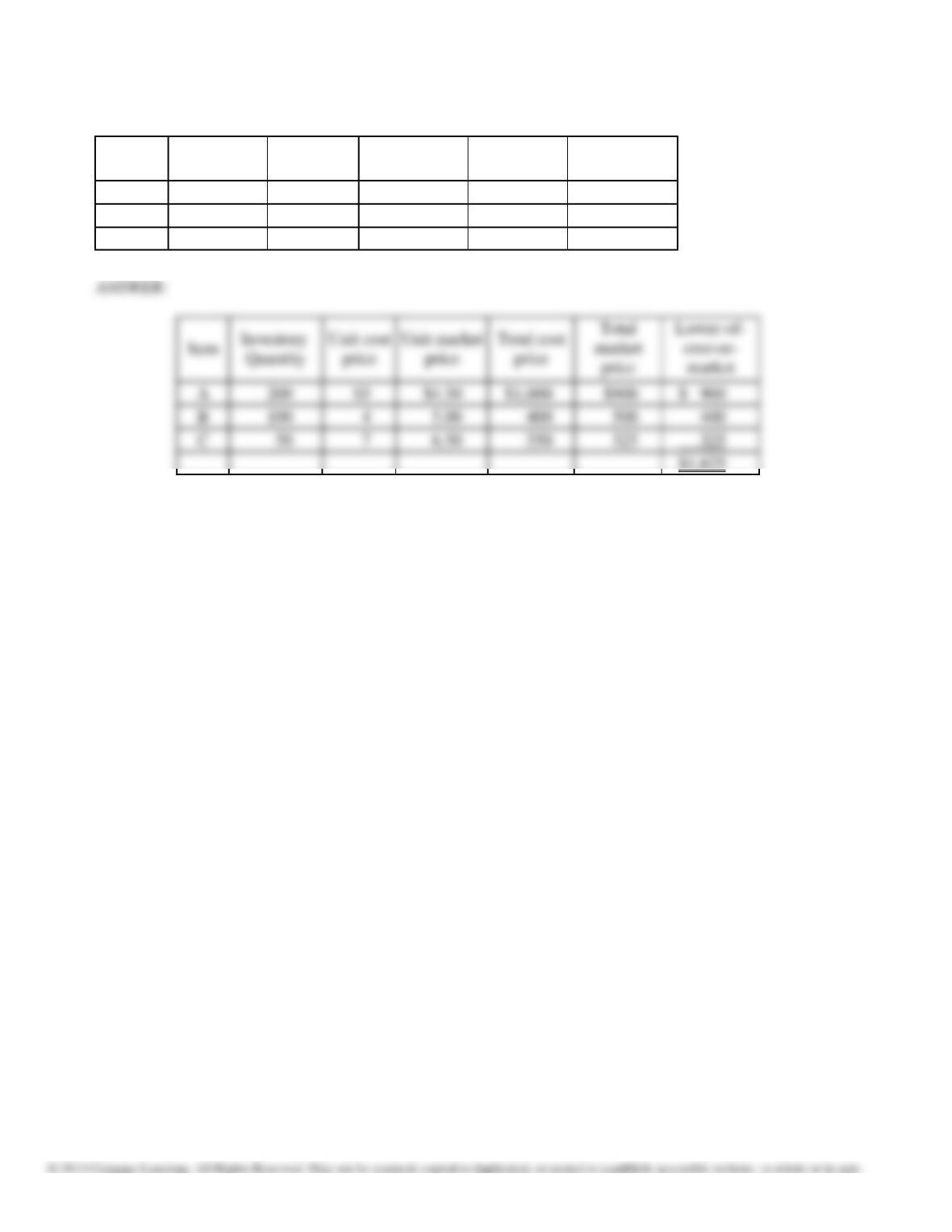
107. Using the lower-of-cost-or-market method of inventory valuation, what should the total
inventory value be for the following items:
Item
Inventory
Quantity
Unit cost
price
Unit market
price
Total cost
price
Total market
price
A
200
$5
$4.50
$1,000
$900
B
100
4
5.00
400
500
C
50
7
6.50
350
325
$5
$4.50
5.00
6.50