6-81
144.
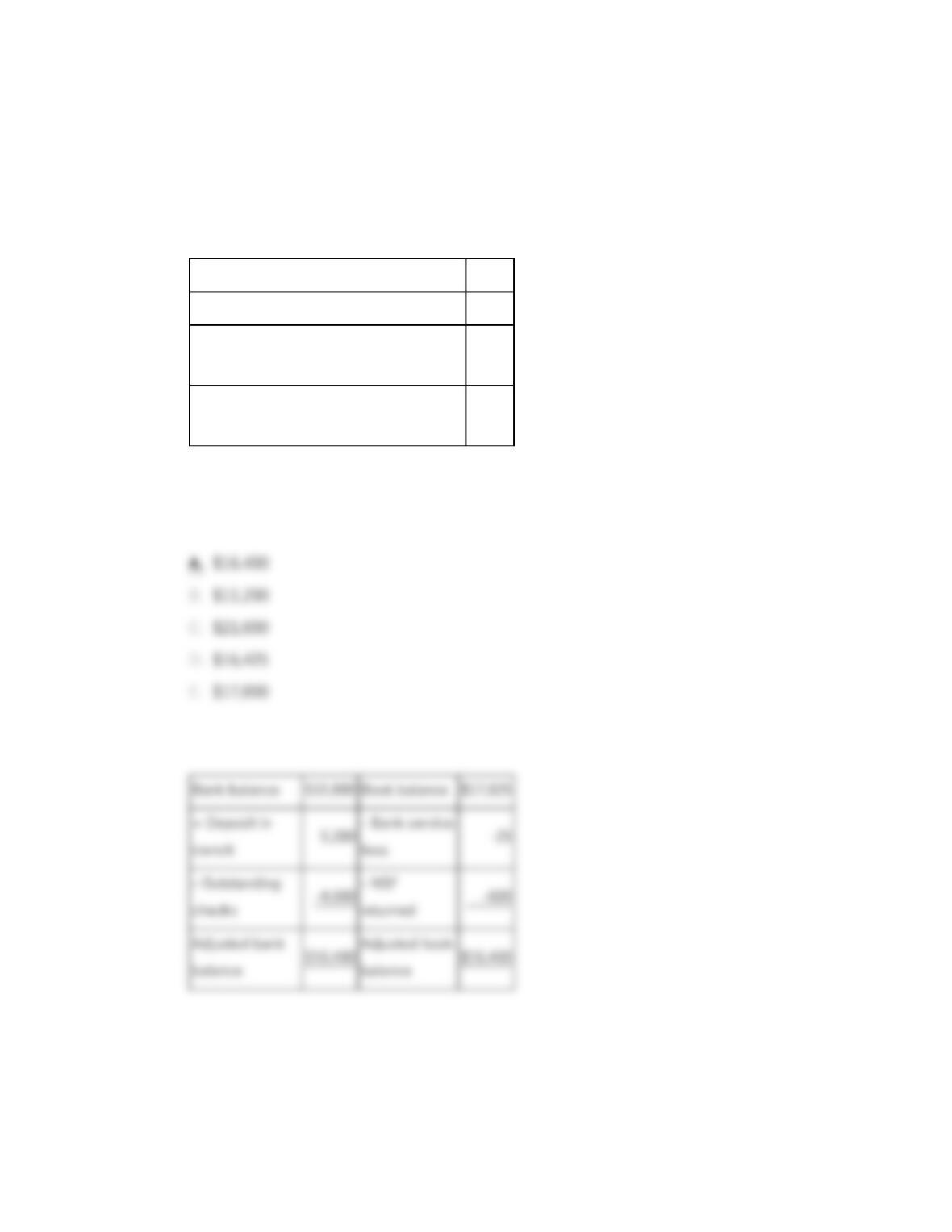
Clayborn Company deposits all cash receipts on the day they are received and makes all
cash payments by check. At the close of business on May 31, its Cash account shows a
debit balance of $17,025. Clayborn’s May bank statement shows $15,800 on deposit in the
bank. Determine the adjusted cash balance using the following information:
Deposit in transit
$5,200
Outstanding checks
$4,600
Bank service fees, not yet recorded by
company
$25
A NSF check from a customer, not yet
recorded by the company
$600
The adjusted cash balance should be:
145.
Franklin Company deposits all cash receipts on the day they are received and makes all
cash payments by check. At the close of business on August 31, its Cash account shows a
debit balance of $13,162. Franklin’s August bank statement shows $14,237 on deposit in
Bank balance
Book balance
+ Deposit in
transit
– Bank service
Adjusted bank
Adjusted book
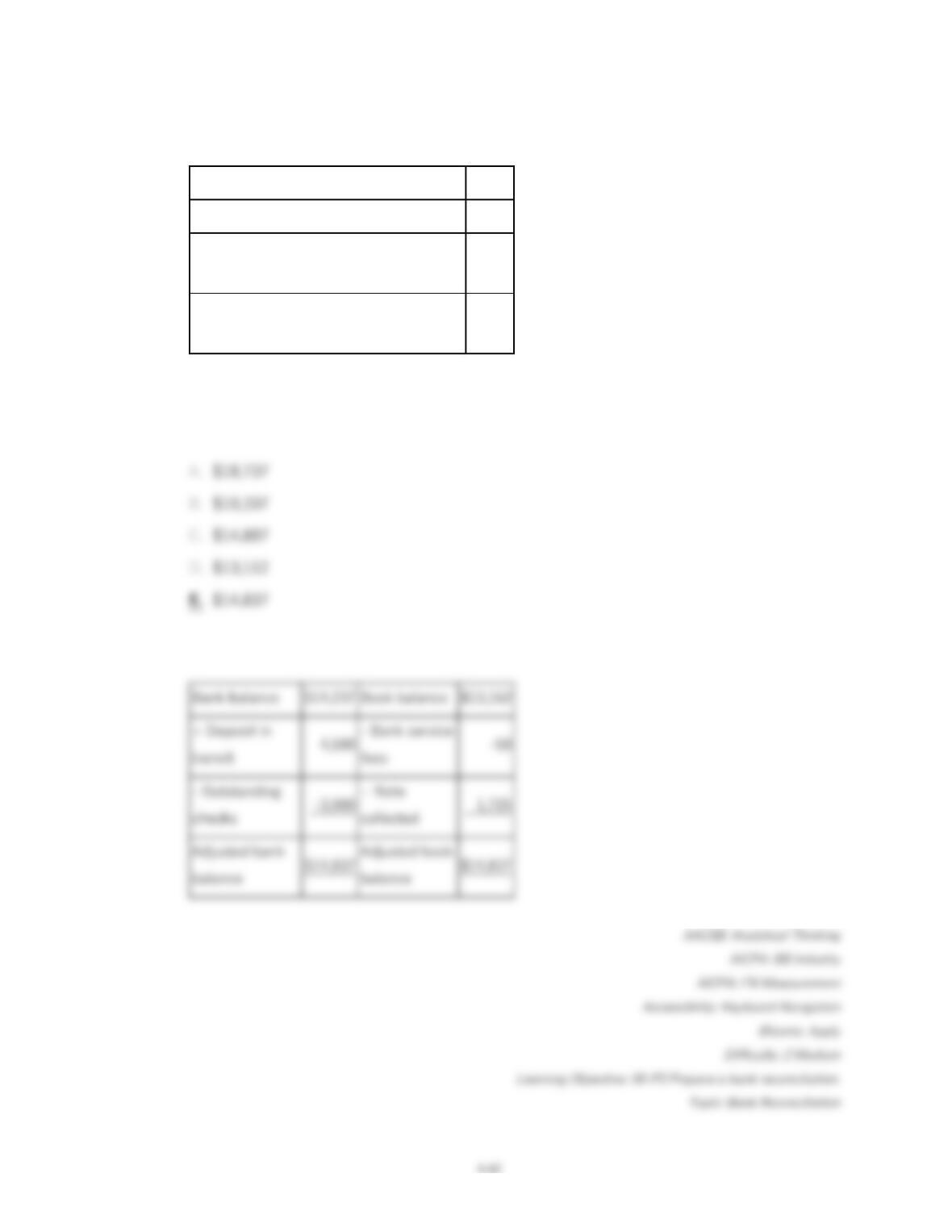
the bank. Determine the adjusted cash balance using the following information:
Deposit in transit
$4,500
Outstanding checks
$3,900
Bank service fees, not yet recorded by
company
$50
The bank collected on a note receivable,
not yet recorded by the company
$1,725
Bank balance
Book balance
+ Deposit in
transit
– Bank service
– Outstanding
Adjusted bank
Adjusted book
The adjusted cash balance should be:
146.
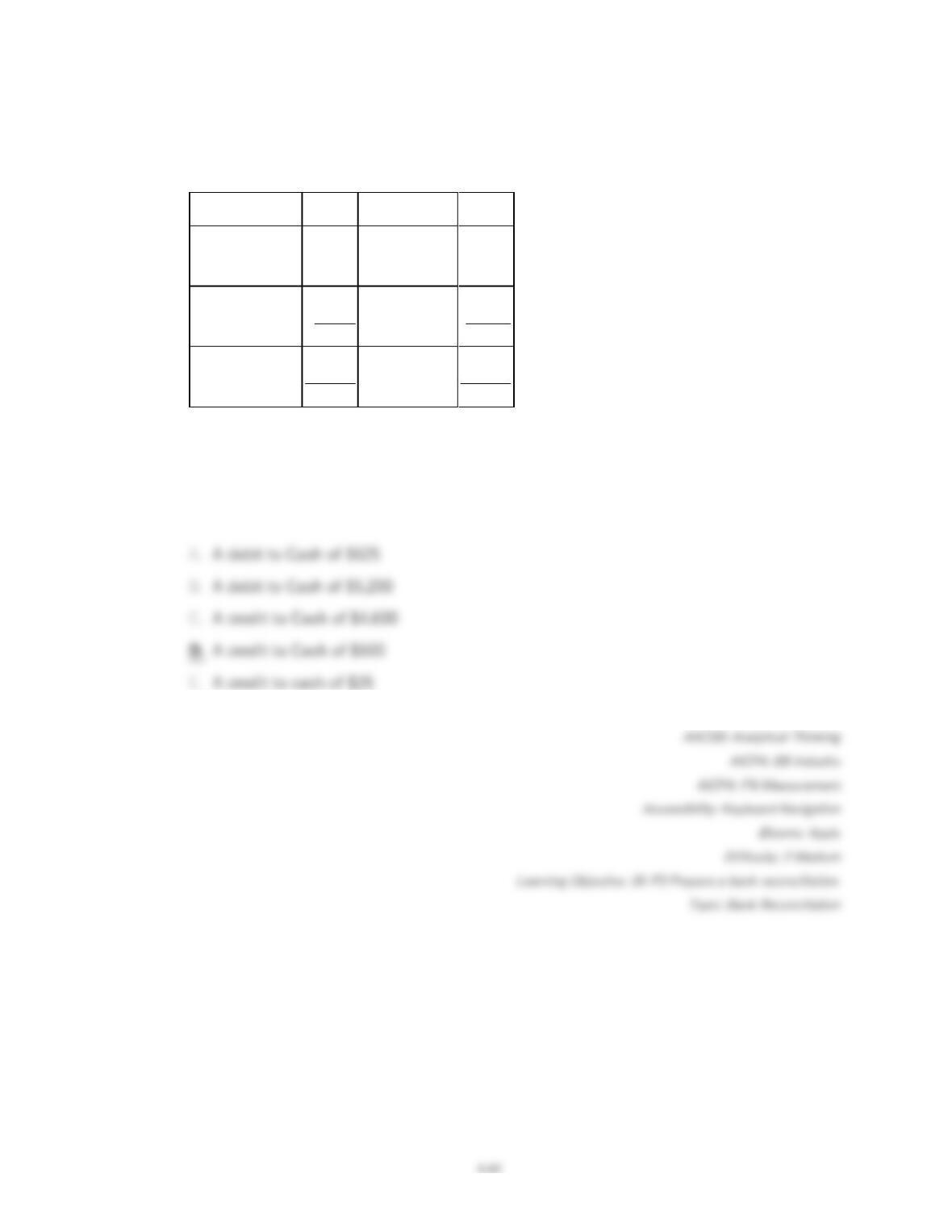
Clayborn Company’ bank reconciliation as of May 31 is shown below
Bank balance
$15,800
Book balance
$16,975
+ Deposit in
transit
5,200
+ Interest
earned
+25
– Outstanding
checks
-4,600
– NSF
returned
–600
Adjusted bank
balance
$16,400
Adjusted book
balance
$16,400
The adjusting journal entries that Clayborn must record as a result of the bank
reconciliation include:
147.
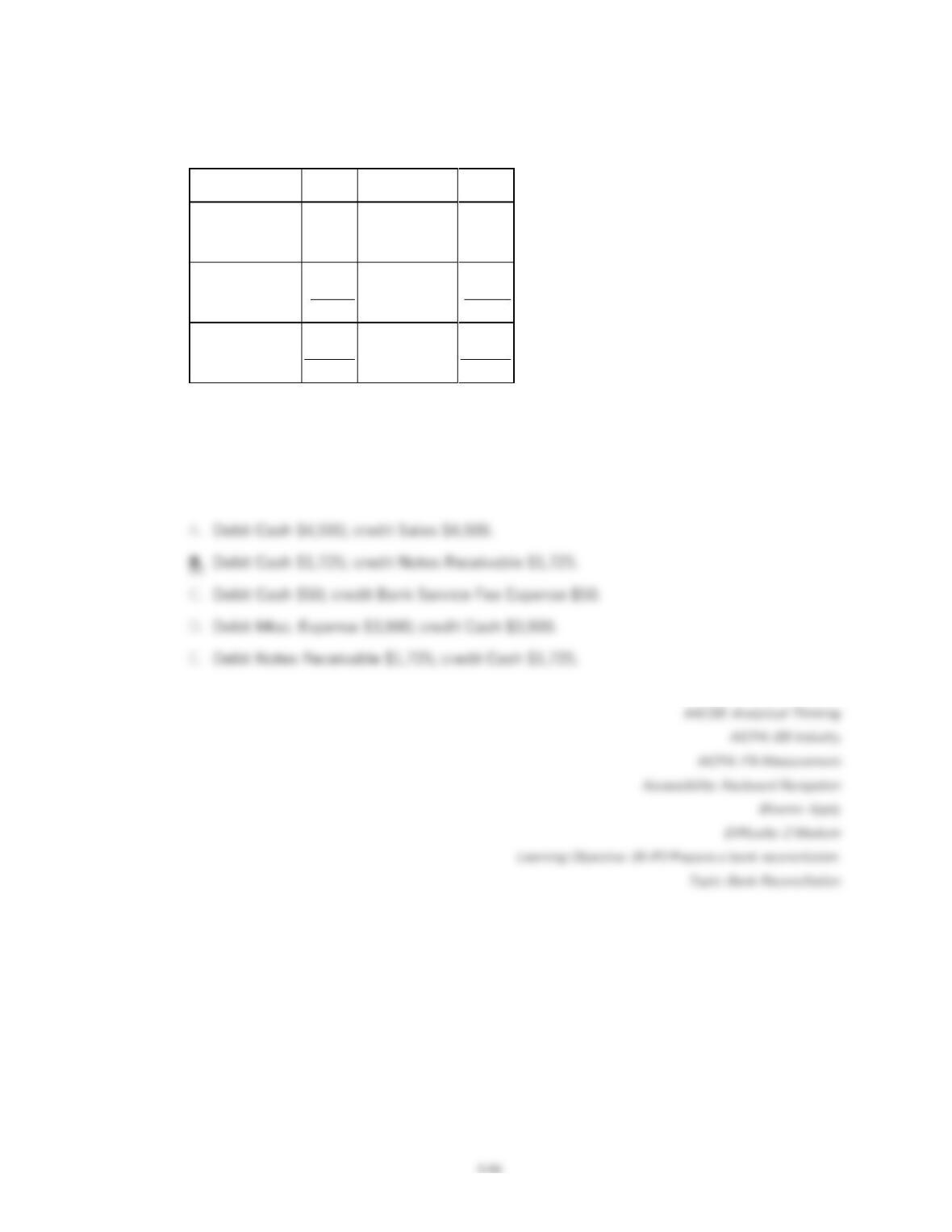
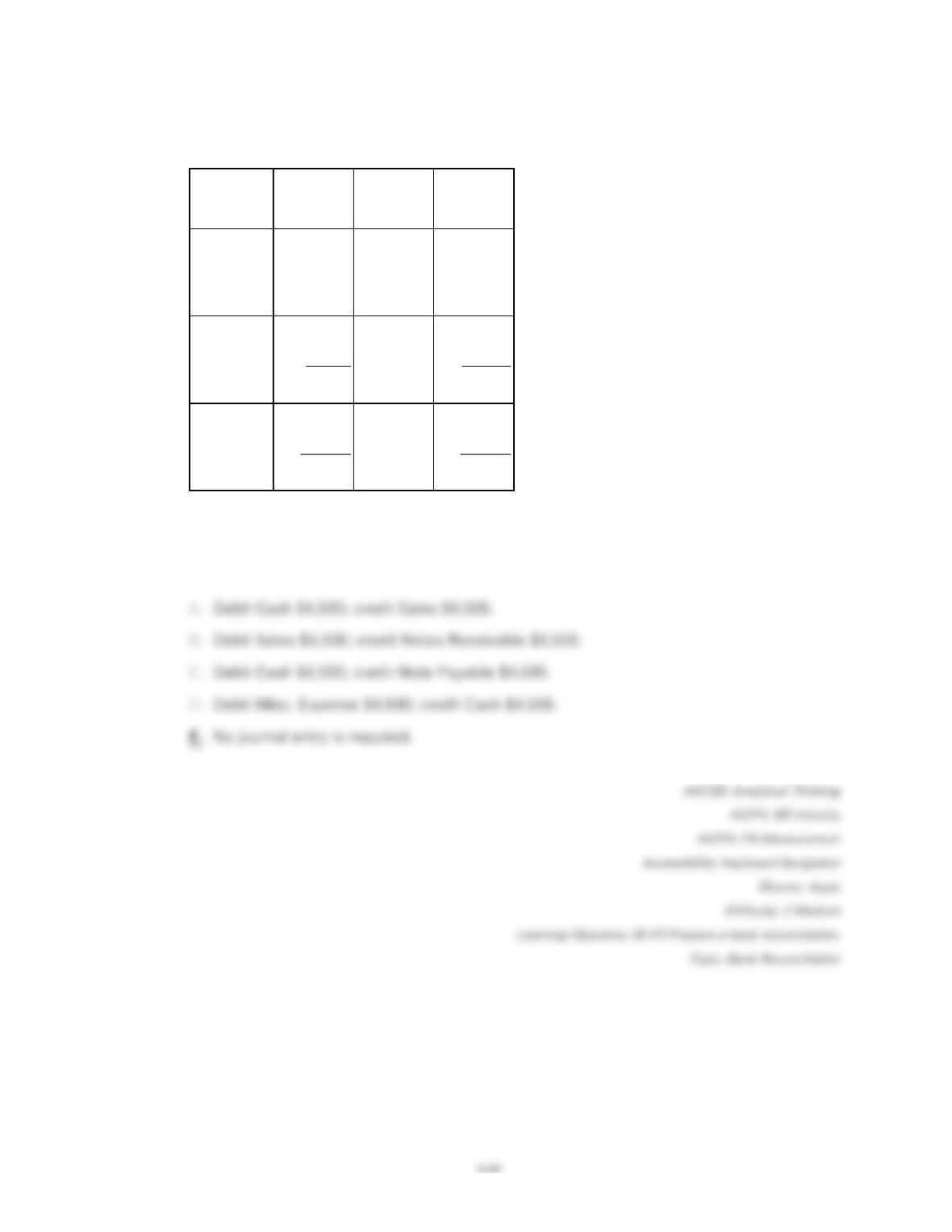
Franklin Company’s bank reconciliation as of August 31 is shown below.
Bank balance
$14,237
Book balance
$13,162
+ Deposit in
transit
4,500
– Bank service
fees
–50
– Outstanding
checks
-3,900
+ Note
collected
1,725
Adjusted bank
balance
$14,837
Adjusted book
balance
$14,837
The adjusting journal entries that Franklin must record as a result of the bank
reconciliation include:
148.
Marshall Company’s bank reconciliation as of August 31 is shown below.
Bank
balance
$14,237
Book
balance
$13,162
+ Deposit
in transit
4,500
– Bank
service
fees
–50
–
Outstanding
checks
-3,900
+ Note
collected
+1,725
Adjusted
bank
balance
$14,837
Adjusted
book
balance
$14,837
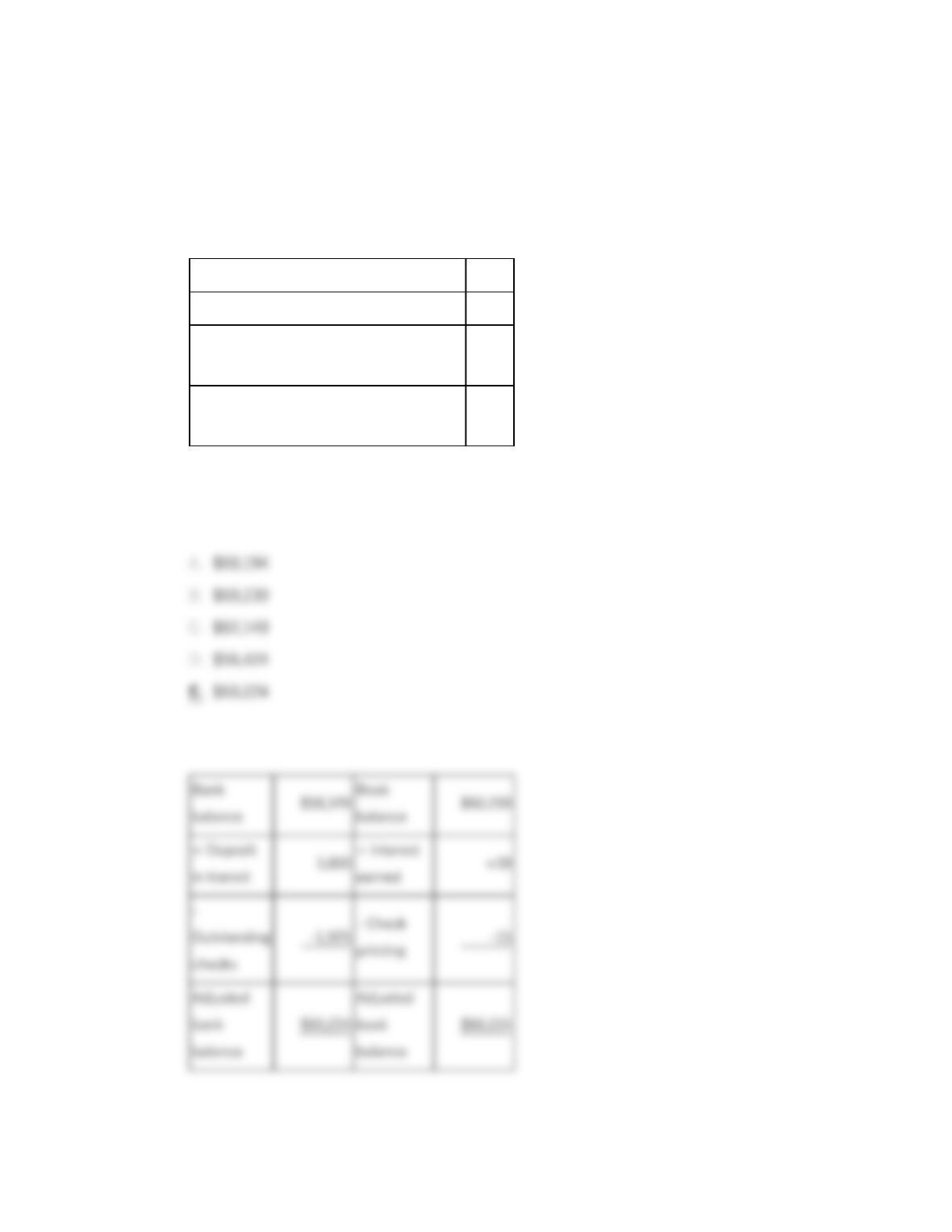
The adjusting journal entries that Marshall must record for the deposit in transit is:
6-86
149.
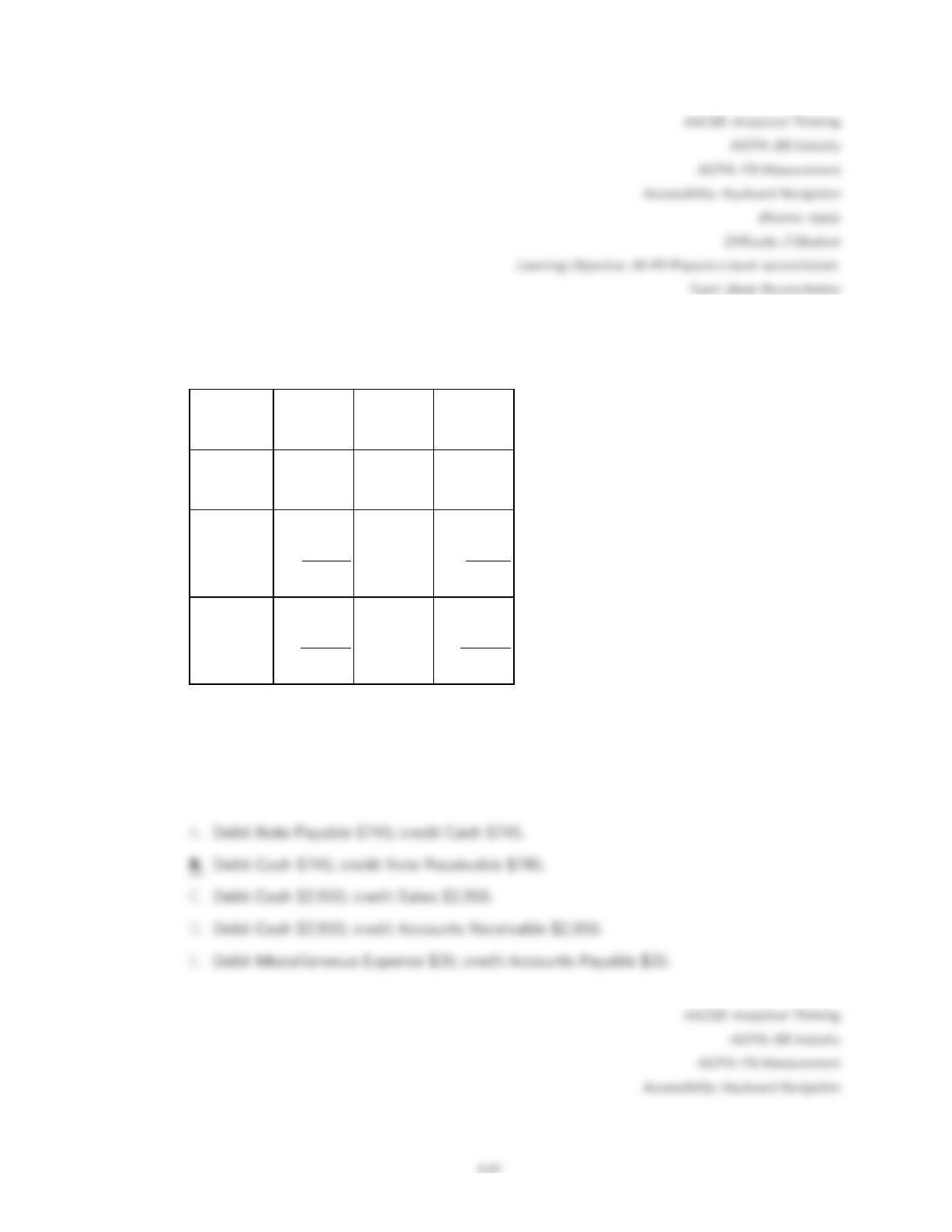
Easton Co. deposits all cash receipts on the day they are received and makes all cash
payments by check. At the close of business on June 30, its Cash account shows a debit
balance of $60,209. Easton’s June bank statement shows $58,349 on deposit in the bank.
Determine the adjusted cash balance using the following information:
Deposit in transit
$3,800
Outstanding checks
$1,925
Check printing fee, not yet recorded by
company
$15
Interest earned on account, not yet
recorded by the company
$30
The adjusted cash balance should be:
Bank
balance
Book
balance
+ Deposit
+ Interest
checks
150.
Great Falls Co.’s bank reconciliation as of February 28 is shown below.
Bank
balance
$37,643
Book
balance
$38,153
+ Deposit
in transit
2,950
+ Note
collection
+745
–
Outstanding
checks
-1,730
– Check
printing
–35
Adjusted
bank
balance
$38,863
Adjusted
book
balance
$38,863
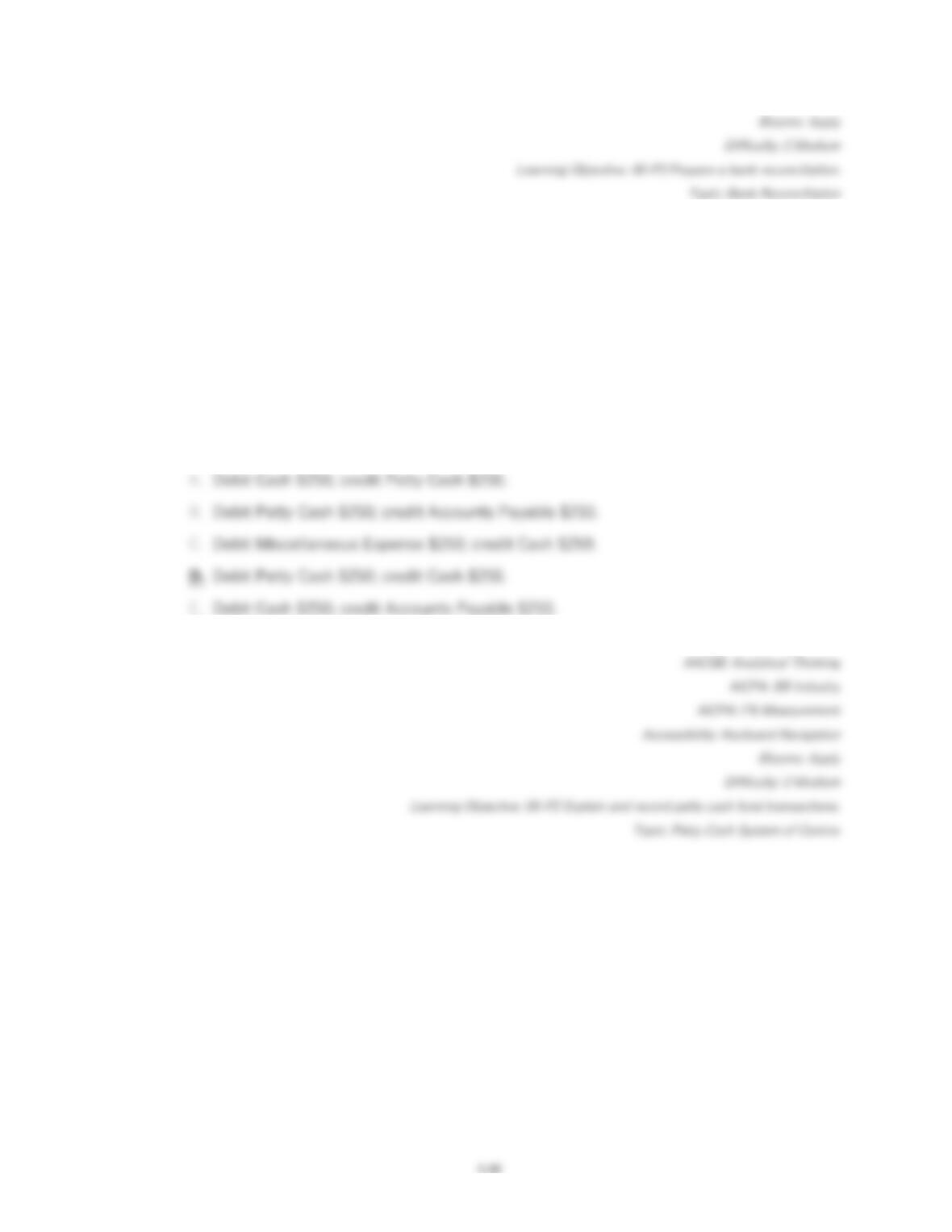
The adjusting journal entries that Great Falls must record as a result of the bank
reconciliation include:
151.
Havermill Co. establishes a $250 petty cash fund on September 1. On September 30, the
fund is reimbursed. The accumulated receipts on that date represent $73 for Office
Supplies, $137 for merchandise inventory, and $22 for miscellaneous expenses. The fund
has a balance of $18. On October 1, the accountant determines that the fund should be
increased by $50. The journal entry to record the establishment of the fund on September
1 is:
152.
Havermill Co. establishes a $250 petty cash fund on September 1. On September 30, the
fund is reimbursed. The accumulated receipts on that date represent $73 for Office
Supplies, $137 for merchandise inventory, and $22 for miscellaneous expenses. The fund
has a balance of $18. On October 1, the accountant determines that the fund should be
increased by $50. The journal entry to record the reimbursement of the fund on September
30 includes a:
6-90
153.
Havermill Co. establishes a $250 petty cash fund on September 1. On September 30, the
fund is reimbursed. The accumulated receipts on that date represent $73 for Office
Supplies, $137 for merchandise inventory, and $22 for miscellaneous expenses. The fund
has a balance of $18. On October 1, the accountant determines that the fund should be
increased by $50. The journal entry to record the increase in the fund balance on October
1 is:
Matching Questions
6-91
154.
Match each of the following terms with the appropriate definitions.
Fundamental guidelines applicable to all
companies established to minimize the risk
of fraud and theft and to increase the
reliability and accuracy of the accounting
2. Cash Over and
An income statement account used to
record the income effects of cash overages
and cash shortages arising from missing
petty cash receipts or errors in making
3. Receiving
The practice of dividing responsibility for
a transaction or a series of related
transactions between two or more
4. Purchase
A set of procedures and approvals
designed to control cash disbursements and
5. Days’ sales
A report explaining any differences
between the checking account balance
according to the depositor’s records and the
The ability of a company to pay for its
7. Bank
A document used within the company to
notify the appropriate persons that ordered
goods have been received and to describe
8. Voucher
A measure of how quickly a company can
duties
uses to place an order with a supplier.
internal control
10. Principles of
The purchasing of an insurance policy on
an employee against losses from theft by
155.
Match the following terms a through j with the appropriate definition 1 through 10.
1. Vendor
A device that perforates the amount of a
check into its face, making it difficult to alter.
10
requisition
2. Purchase
3. Sarbanes-
The collaboration of two or more individuals
to bypass internal controls in order to commit
4. Internal
control
5. Liquid
The set of policies and procedures
managers use to monitor and control business
6. Invoice
7
Currency, coins, and amounts on deposit in
7. Cash
2
An internal document listing the goods
needed by a department and requesting that
equivalent
8. Cash
An asset such as cash that can be readily
Regulation requiring public companies to
document and certify their system of internal
8
10. Check
Short-term, highly liquid investments that
are readily convertible to a known cash amount
and are sufficiently close to their maturity date
so that the market value is not sensitive to
6-94
Short Answer Questions

156.
Match each of the following transactions 1 through 10 with the applicable internal control
principle that is being violated listed in “a” through “g“.
A. Establish responsibility
B. Maintain adequate records
C. Insure assets and bond employees
D. Separate recordkeeping from custody of assets
E. Divide responsibility for related transactions
F. Apply technological controls
G. Perform regular and independent reviews
_____ 1. Cashiers have access to the cash register recorded tape or file.
_____ 2. A company uses a voucher system, but the cash disbursement clerk pays directly
from invoices received.
_____ 3. Only sales clerks use the cash registered, but they all share the same cash
drawer.
_____ 4. The bookkeeper prepares and signs checks and completes the bank
reconciliation.
_____ 5. A restaurant allows servers to keep cash collected in their aprons and ring in all
sales at the end of the night.
_____ 6. A company fails to hire a CPA to perform an annual audit.
_____ 7. A company does not bond its key cash-handling employees.
_____ 8. A company has a single department that handles purchasing, receiving, and
inventory management.
_____ 9. A large company has no internal auditor on staff.
_____ 10. A company manager keeps pre-signed checks in his desk drawer for employees
to hand write when the accountant is out of the office.
157.
Identify each of the following items 1 through 10 as either (A) cash or (B) cash equivalent.
_____ 1. Coins
_____ 2. Petty cash
_____ 3. Three-month certificate of deposit
_____ 4. Commercial paper
_____ 5. Currency
_____ 6. Certified check
_____ 7. Cashier’s check
_____ 8. Money market accounts
_____ 9. Money orders
_____ 10. U.S. treasury bills
158.
Identify whether each of the following items 1 through 10 would on appear on the bank
side or the book side of a bank reconciliation.
____ 1. Bank service charges
____ 2. Outstanding checks
____ 3. Deposits in transit
____ 4. NSF check
____ 5. Interest on a checking account
____ 6. The company properly wrote a check for $95.80 that the bank incorrectly paid as
$9.58.
____ 7. The bank printed checks for the depositor for a fee.
____ 8. Bank debit memorandum
____ 9. Bank credit memorandum
____10. The bank collected a $1,000 note for the depositor.
159.
Define an internal control system and describe its purpose.
160.
List the principles of internal control.
161.
Explain the difference between cash and cash equivalents.
162.
Describe the basic bank services that contribute to the control of cash and identify at least
two internal control objectives served by the banking activities.
163.
What is the purpose of the days’ sales uncollected ratio?