164.
What is a voucher system and what are the two areas for which it establishes control
procedures?
165.
Discuss how the principles of internal control apply to cash receipts over-the-counter by
giving several examples of good control measures that should be implemented.
166.
Discuss how the principles of internal control apply to cash receipts through the mail by
giving several examples of good control measures that should be implemented.
167.
Describe a petty cash account and its purpose.
168.
Describe a bank reconciliation and discuss its purpose.
169.
When using a voucher system, what are the steps on the invoice approval checklist that
must be completed before an invoice approval is complete and a voucher prepared?
170.
The Sarbanes-Oxley Act (SOX) requires managers and auditors of companies whose stock
is traded on an exchange to document and certify the system of internal controls. What
are the specific requirements for auditors set forth by SOX?
6-106
171.
The treasurer of a company is responsible for cash management. List five cash
management principles that are essential for effective cash management.
Essay Questions
6-107
172.
For each of the independent cases below, identify the principle of internal control that is
violated, and recommend what should be done to remedy the violation.
1. In order to save money, Indigo Company has decided to drop its property insurance on
assets; and stop bonding the cashiers who handle upwards of $5,000 in cash each day.
2. Jobs Company records each sale on a preprinted invoice. Because invoices are
sometimes damaged in the process of preparation, the invoices are not prenumbered.
Instead, the sales clerk writes the next number on each invoice as it is prepared.
3. Keegan Company is a very small business. Dylan Epps, one of the two office clerks,
opens the mail each day and removes the cash receipts that come in the mail. Dylan also
records the receipts in the cash records and the customer’s account and deposits the cash
in the bank.
4. Ludwig Company prides itself on hiring only the most competent employees. The owner,
Jeremy Ludwig, believes that since the employees are highly competent he can show he
trusts them completely by not checking up on their performance.
5. Maple Industries is a small business with three accounting employees. Each employee
is well-trained and able to perform any of the accounting tasks, including handling cash
receipts and cash disbursements, and preparing the bank reconciliation. Because of this
cross-training, the employees share responsibilities for all of the tasks.
173.
At the end of the current period, a company reported $725,000 in net credit sales and
$100,000 in ending accounts receivable. Calculate this company’s days’ sales uncollected
at the end of the current period.
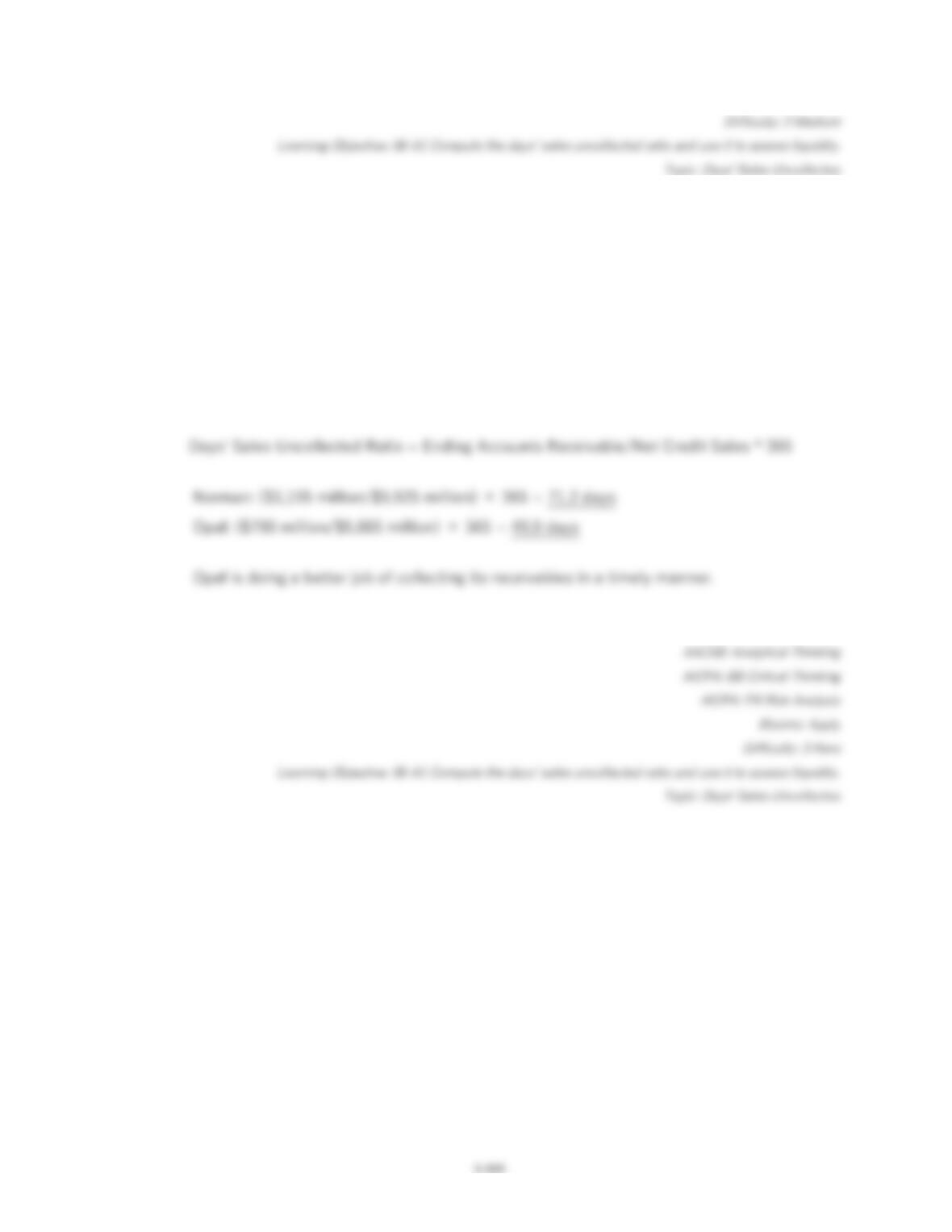
174.
Norman Co. had $5,925 million in sales and $1,155 million in ending accounts receivable
for the current period. For the same period, Opal Co. reported $5,885 million in sales and
$790 million in ending accounts receivable. Calculate the days’ sales uncollected for both
companies as of the end of the current period and indicate which company is doing a
better job in managing the collection of its receivables.
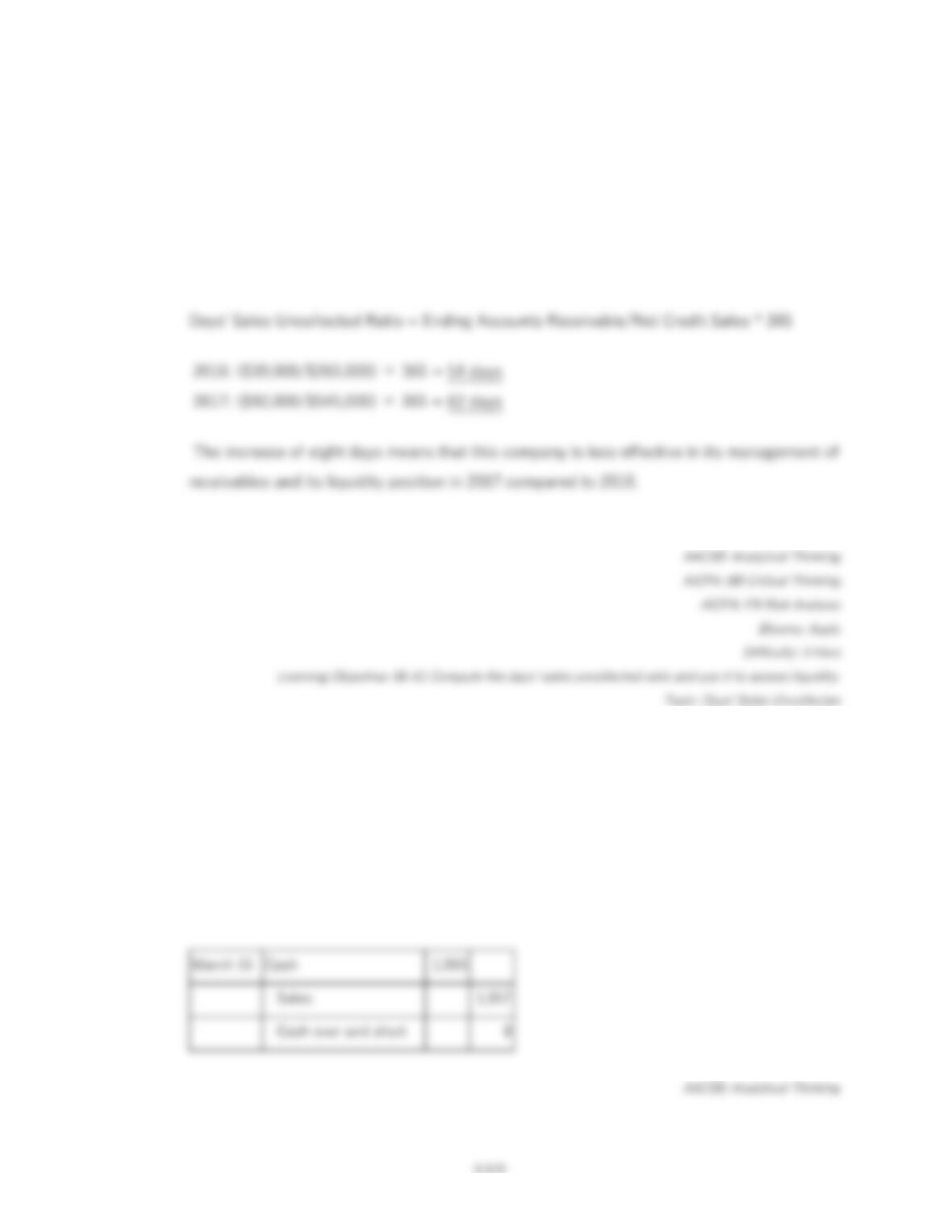
175.
A company reported net sales for 2016 of $265,000 and $545,000 for 2017. The year-end
balances of accounts receivable were $39,000 for 2016 and $92,000 for 2017. Calculate
the days’ sales uncollected at the end of each year for this company and describe any
changes in the apparent liquidity of the company’s receivables.
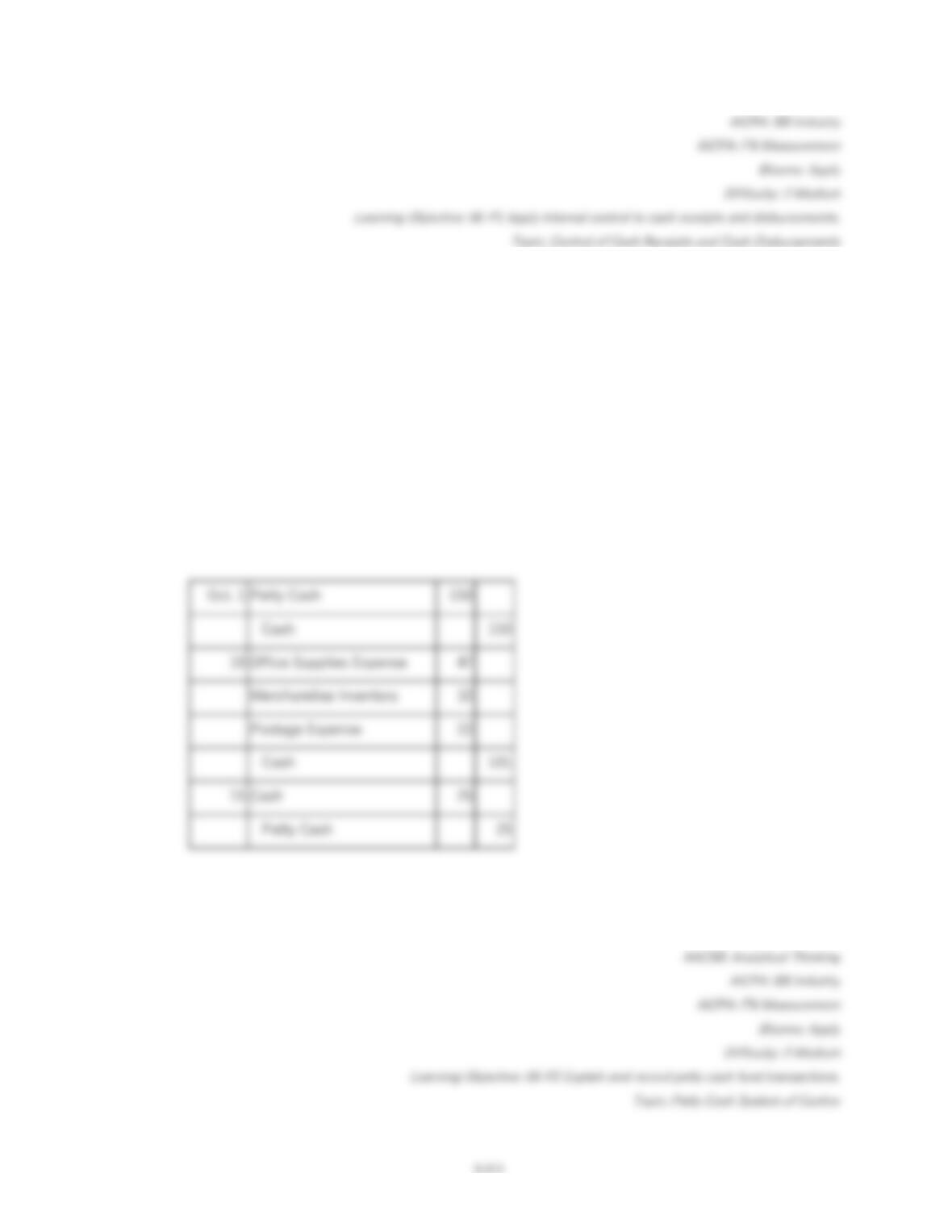
176.
At the end of the day on March 15, the cash register’s record shows $1,957, but the count
of cash in the register is $1,965. Prepare the general journal entry to record the day’s cash
sales.
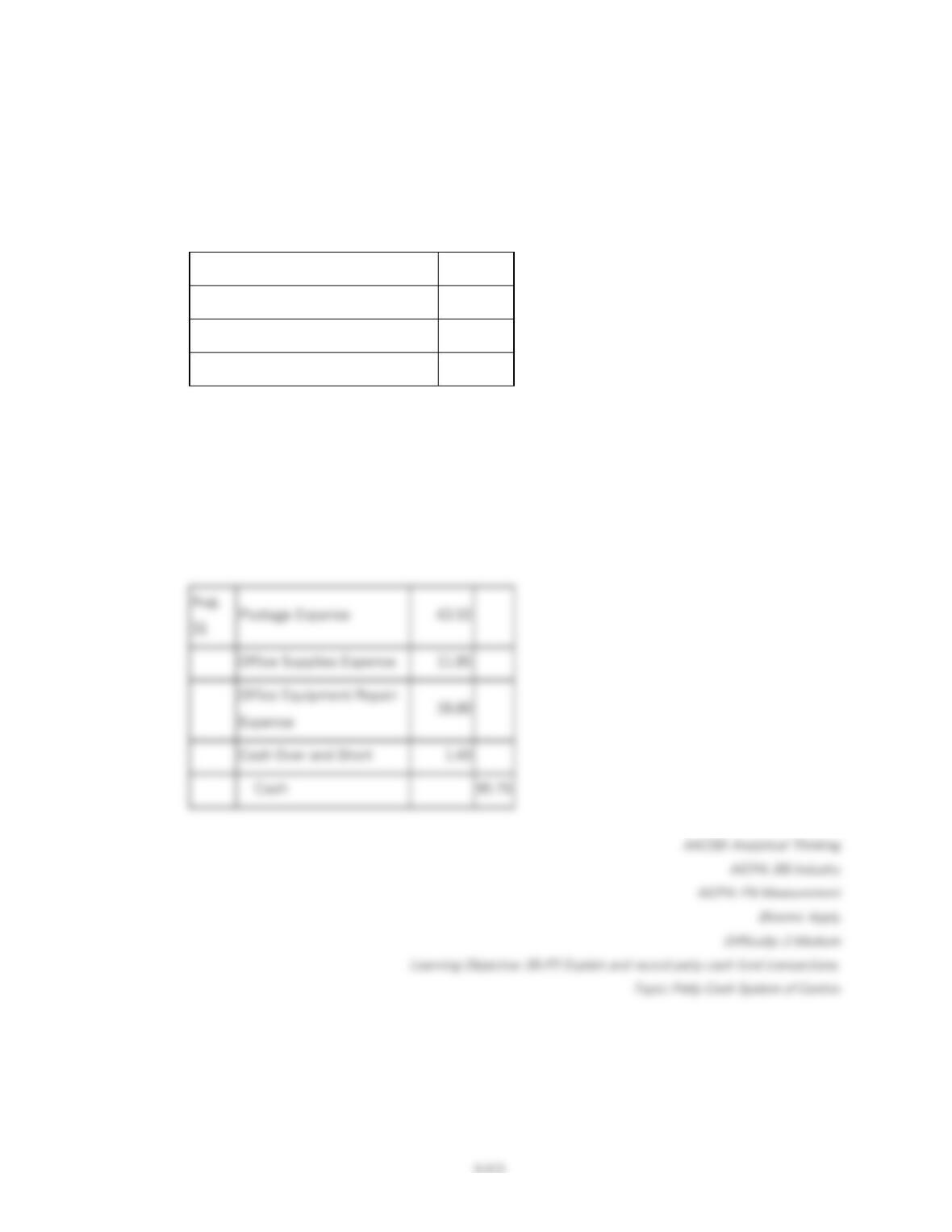
177.
Plenty Co. established a petty cash fund of $150 on October 1. On October 10, the petty
cash fund was reimbursed when there was $49 remaining and there were petty cash
receipts for: office supplies, $47; transportation-in on inventory purchased, $32; and
postage, $22. On October 15, the petty cash fund was decreased to $125 in total. Plenty
Co. uses a perpetual inventory system. Record the above transactions in general journal
form.
178.
A petty cash fund was originally established with a check for $100. On August 31, which is
the period end, the petty cash fund included the following:
Petty cash receipts:
Postage
$43.50
Office supplies
11.85
Office equipment repair
39.00
Cash
4.25
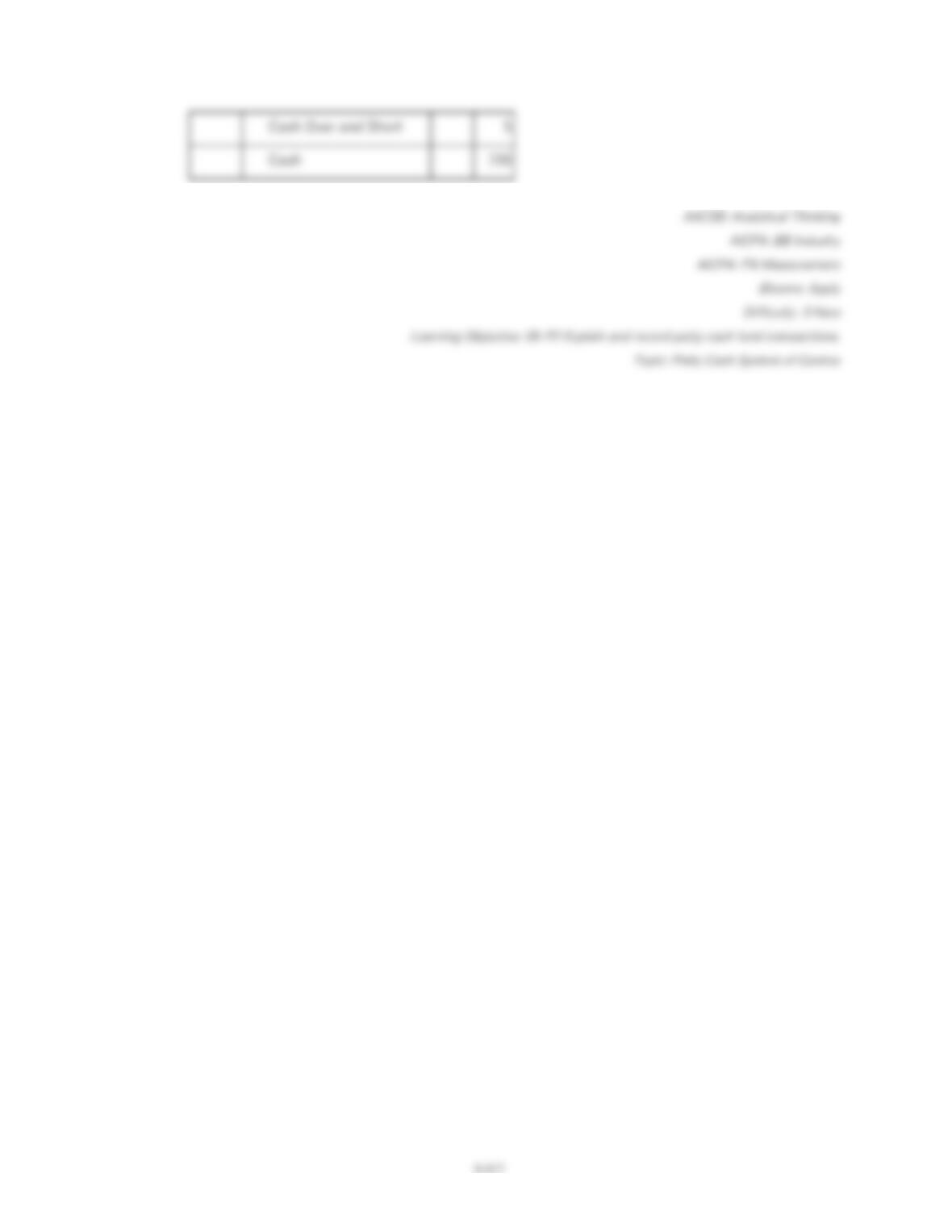
Prepare the general journal entry to record the reimbursement of the petty cash fund on
August 31.
Office Supplies Expense
Cash Over and Short
Cash
179.
Quibble Company established a $300 petty cash fund by issuing a check to the petty
cashier on February 1. On February 15, the petty cash fund was reimbursed and increased
to $800 in total. The contents of the petty cash fund at the time of the February 15
reimbursement were:
Currency and coins
$12
Petty cash receipts for:
Transportation-in for inventory
$39
Delivery expense
88
Repairs to office equipment
47
Postage
64
Entertainment of customers
53
291
Total
$303
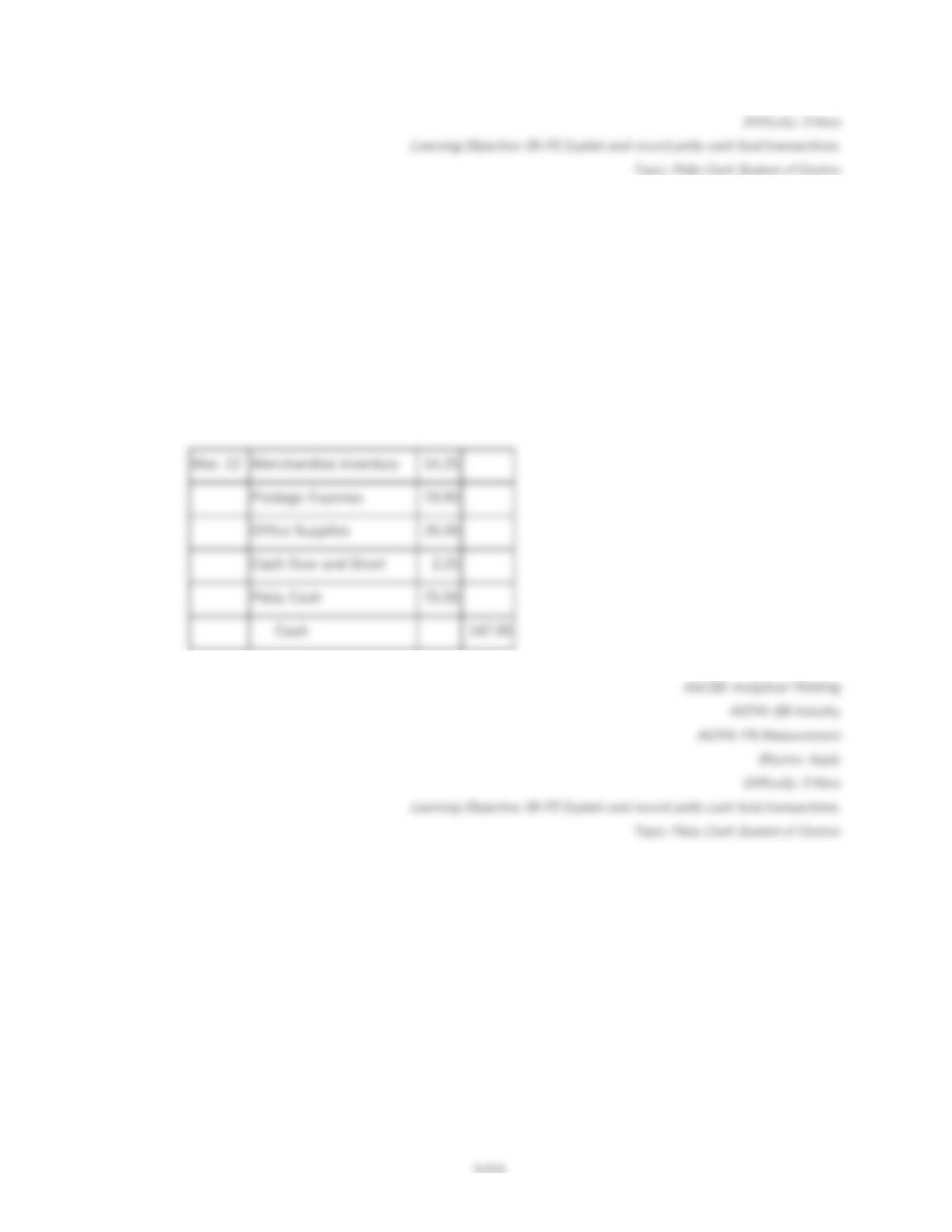
Prepare Quibble’s general journal entry to record both the reimbursement and the
increase of the petty fund on February 15.
Feb. 15
Merchandise Inventory
39
Delivery Expense
88
Repairs Expense
47
Postage Expense
64
Entertainment Expense
53
Petty Cash
Cash Over and Short
Cash
180.
On March 1, a company established a $75 petty cash fund. On March 12, the petty cash
fund contains $3 in cash and the following paid petty cash receipts: transportation-in on
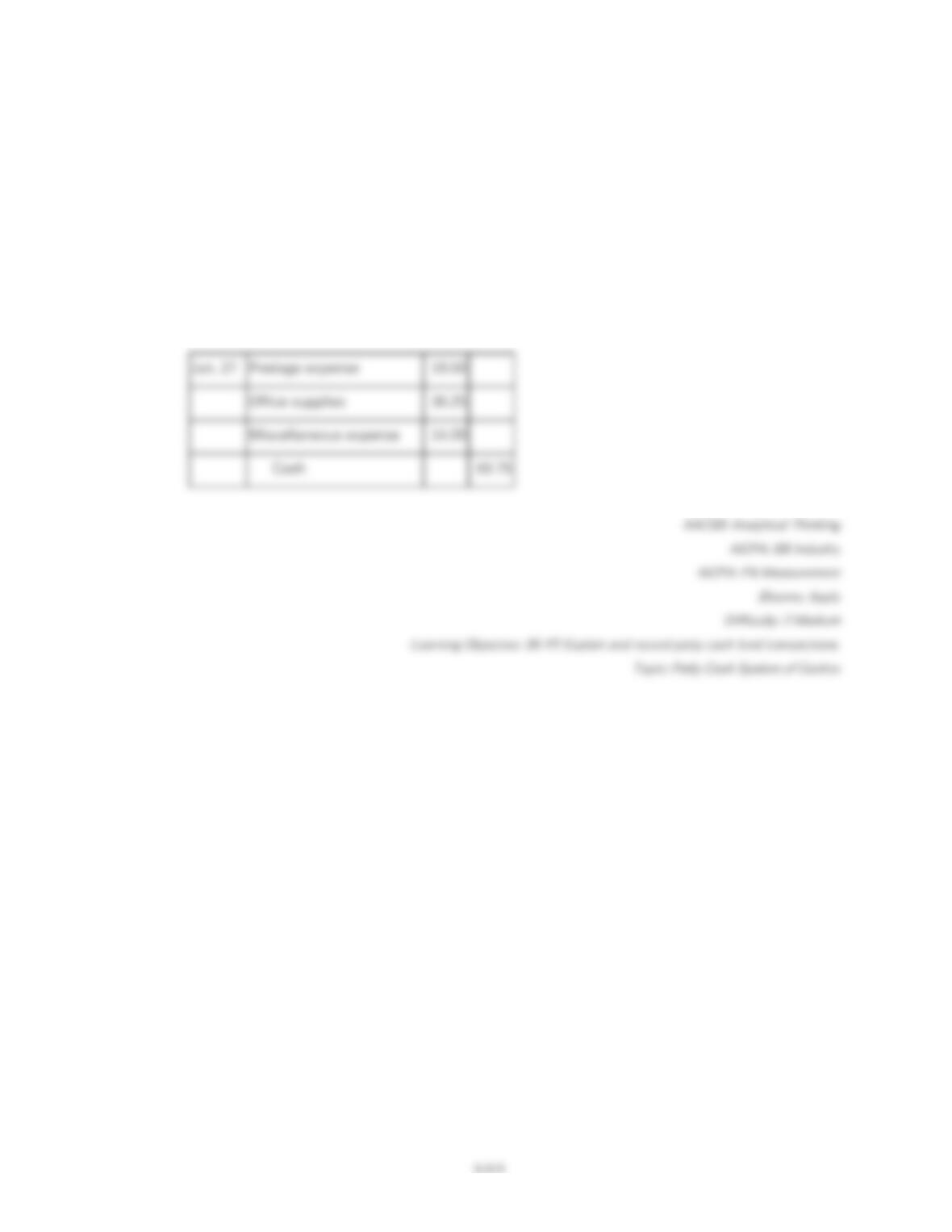
merchandise inventory $14.25; postage, $19.50; and office supplies, $36. Give the general
journal entry to reimburse the fund and to increase its amount to $150 on March 12.
181.
On June 1, a company established a $75 petty cash fund. On June 27, the petty cash fund
contains $5.25 in cash and the following paid petty cash receipts: postage, $19.50; office
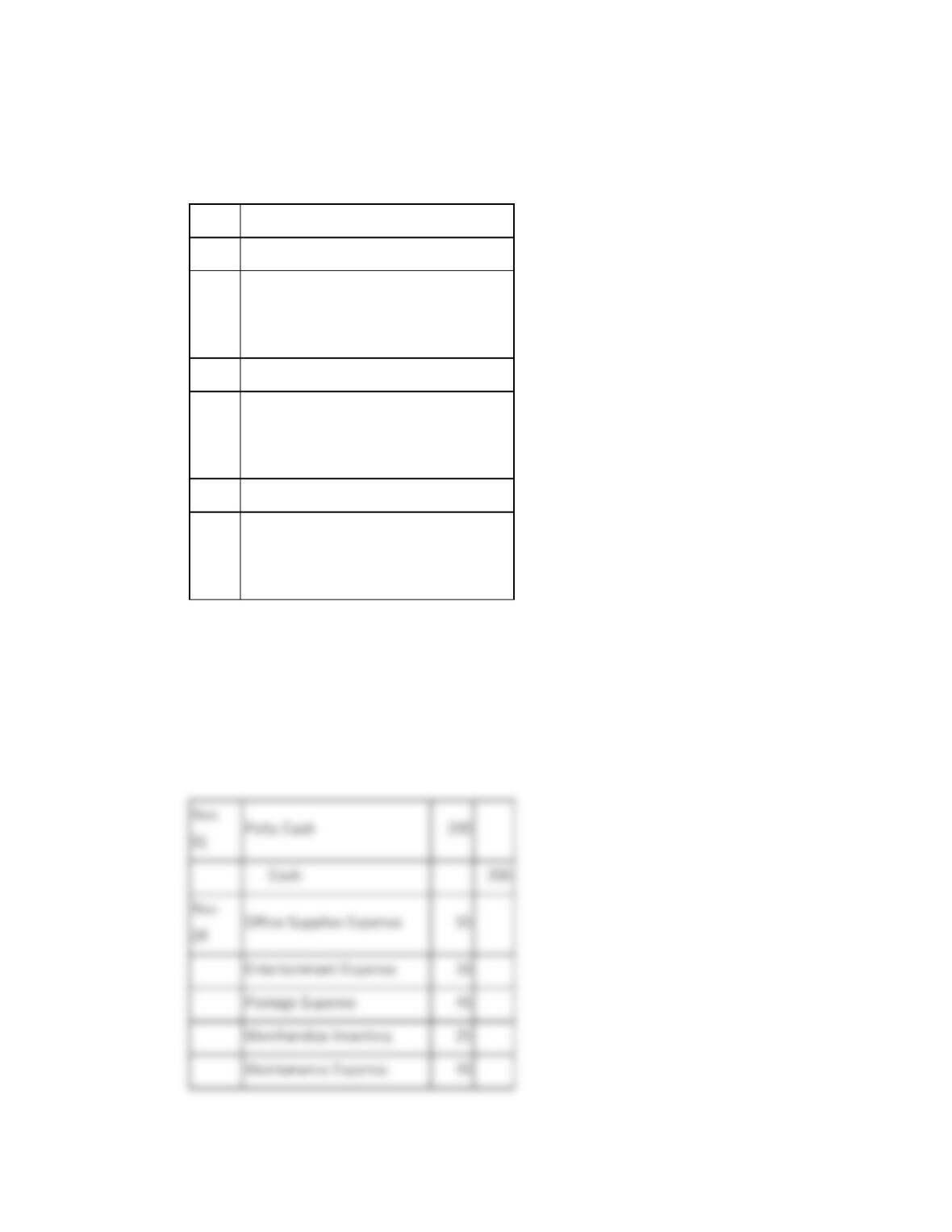
supplies, $36.25; and miscellaneous expense $14.00. Give the general journal entry to
reimburse the fund on June 27.
6-116
182.
A company established a petty cash fund in November of the current year and experienced
the following transactions affecting the fund during November:
Nov 1
Established a $200 petty cash fund.
5
Paid $55 to acquire office supplies.
8
Reimbursed the company controller for
$30 spent on beverages for recruits
(entertainment expense)
18
Paid $45 for postage.
20
Paid $25 for C.O.D. charges on
merchandise inventory, terms FOB
shipping point.
25
Paid $40 for janitorial services.
28
When sorting the petty cash receipts to
replenish the fund, the custodian noted
that there was $10 cash remaining.
Prepare the journal entries to establish the fund on November 1 and to reimburse the
fund on November 28.
01
Cash
28
Entertainment Expense
Postage Expense
Merchandise Inventory
6-118
183.
Following are seven items a through g that would cause Rembrandt Company’s book
balance of cash to differ from its bank statement balance of cash.
a. A service charge imposed by the bank.
b. A check listed as outstanding on the previous period’s reconciliation and still
outstanding at the end of this month.
c. A customer’s check returned by the bank is marked “Not Sufficient Funds (NSF)”.
d. A deposit mailed to the bank on the last day of the current month and not recorded on
this month’s bank statement.
e. A check paid by the bank at its correct $190 amount recorded in error in the company’s
check register at $109.
f. An unrecorded credit memorandum indicating that bank collected a note receivable for
Rembrandt Company and deposited the proceeds in the company’s account.
g. A check written in the current period that is not yet paid or returned by the bank.
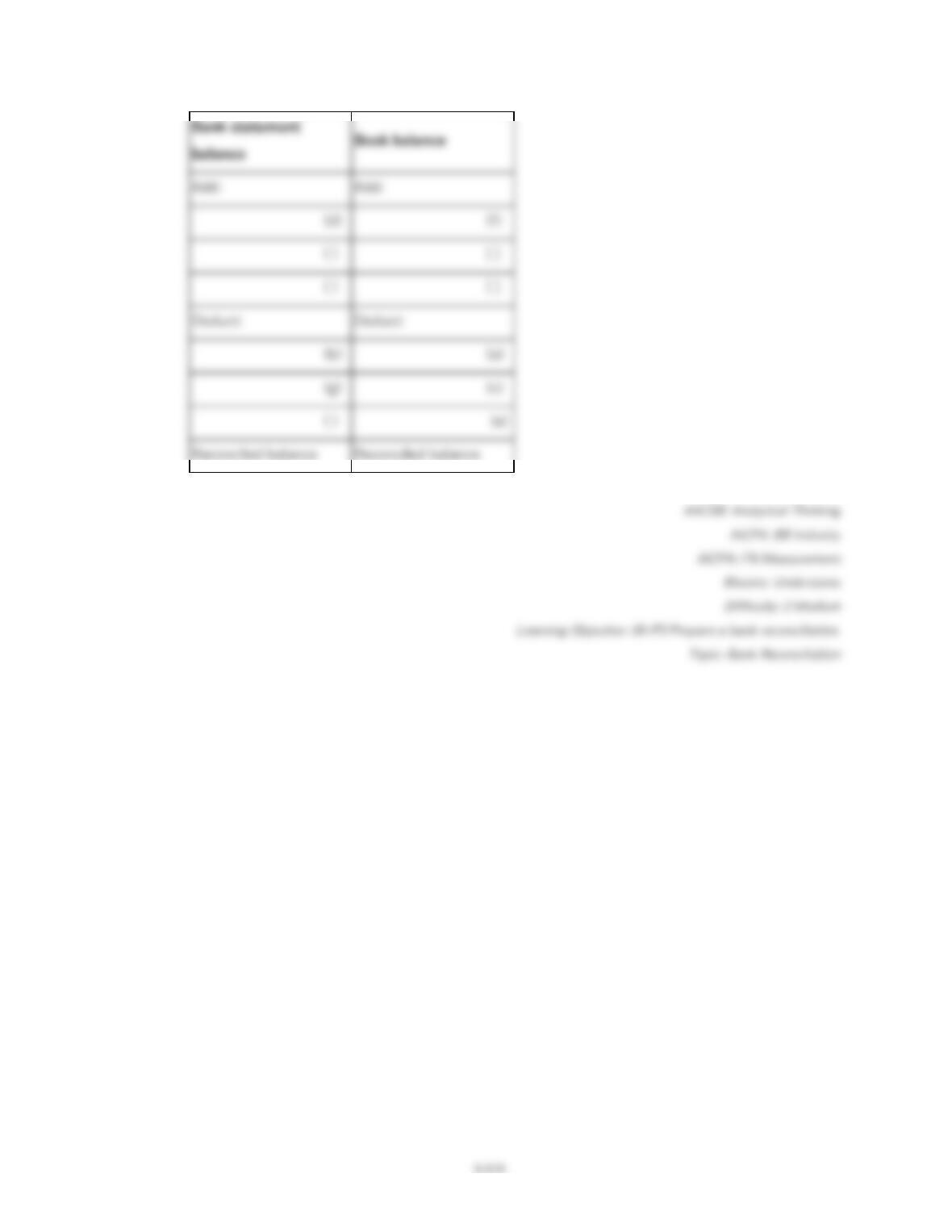
Indicate where each item, letters a-g, would appear on Rembrandt Company’s bank
reconciliation by placing its identifying letter in the parentheses in the proper section of
the form below.
Bank statement
balance
Book balance
Add:
Add:
( )
( )
( )
( )
Deduct:
Deduct:
( )
( )
( )
( )
Reconciled balance
Reconciled balance
184.
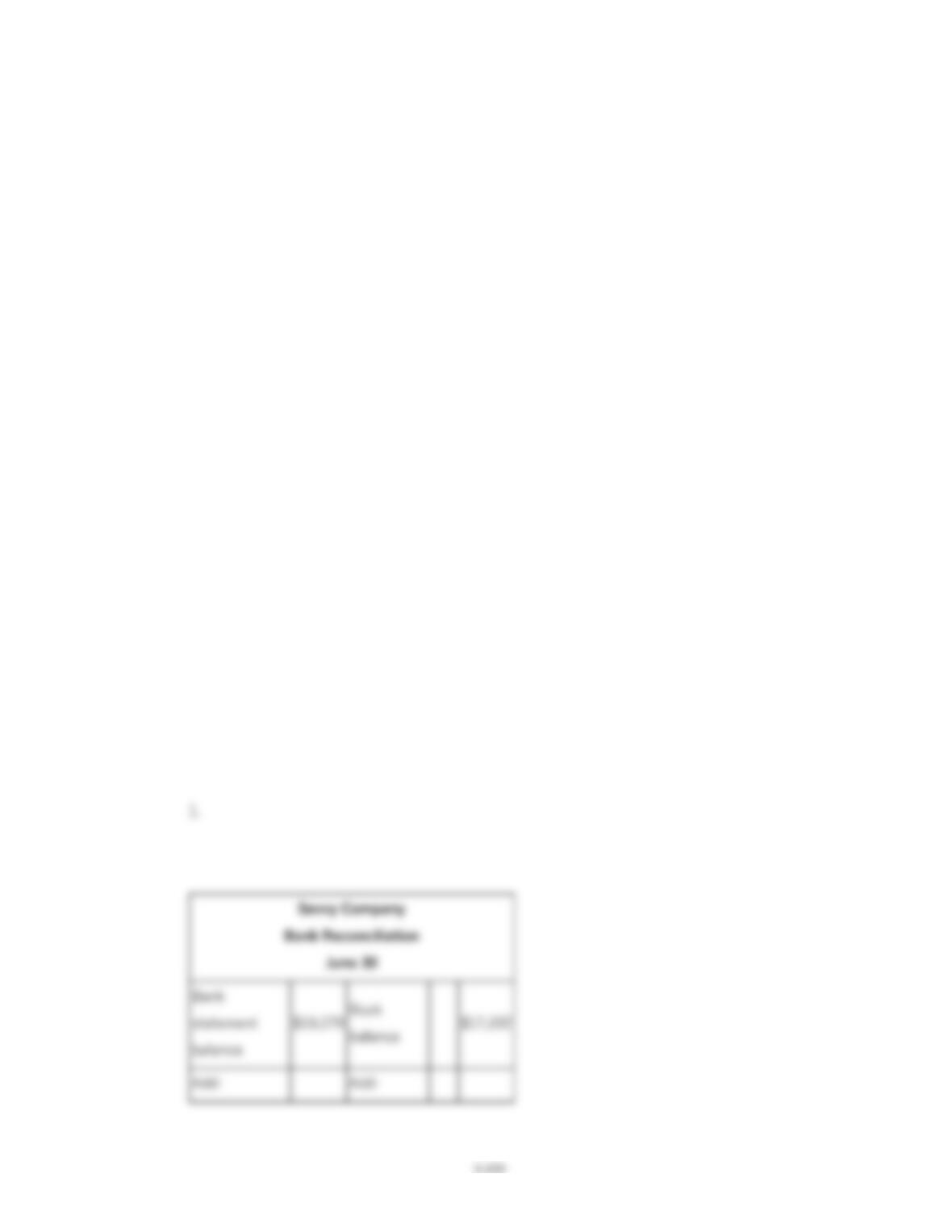
The following information is available for the Savvy Company for the month of June.
a. On June 30, after all transactions have been recorded, the balance in the company’s
Cash account has a balance of $17,202.
b. The company’s bank statement shows a balance on June 30 of $19,279.
c. Outstanding checks at June 30 total $2,984.
d. A credit memo included with the bank statement indicates that the bank collected $770
on a noninterest-bearing note receivable for Savvy.
e. A debit memo included with the bank statement shows a $67 NSF check from a
customer, J. Maroon.
f. A deposit placed in the bank’s night depository on June 30 totaling $1,675 did not
appear on the bank statement.
g. Comparing the checks on the bank statement with the entries in the accounting records
reveals that check #3445 for the payment of an account payable was correctly written for
$2,450, but was recorded in the accounting records as $2,540.
h. Included with the bank statement was a debit memorandum in the amount of $25 for
bank service charges. It has not been recorded on the company’s books.
1. Prepare the June bank reconciliation for the Savvy Company.
2. Prepare the general journal entries to bring the company’s book balance of cash into
conformity with the reconciled balance as of June 30.