Chapter 6
86. In the current period, Forward Co.started with the production of 21,000 units and completed 8,400 units, leaving
13,200 units in process that are 42% complete. How many equivalent units of production did Forward Co.have for the
period?
a. 13,500
b. 12,000
c. 13,944
d. 8,000
Chapter 6
87. In the current period, Forward Co. started with the production of 21,000 units and completed 8,400 units, leaving
13,200 units in process that are 42% complete. If Forward Co. incurred production costs of $34,980, what was Forward’s
cost per equivalent unit for the period? (Note: Round your answer to two decimal places.)
a. $2.51
b. $3.00
c. $2.75
d. $3.25
88. Following is the information of Piper Company for the month of May:
Units
Work in process, May 1 (10% complete) 4,200
Started in May 17,850
Work in process, May 31 (20% complete) 3,150
Materials and conversion are incurred uniformly throughout the process.
The equivalent units of production for conversion using the weighted average method would be:
Chapter 6
a. 19,467.
b. 18,900.
c. 21,575.
d. 22,000.
89. The Learner Company uses the weighted average method. Learner’s beginning work in process consists of 6,600 units
(100% complete with respect to materials and 60% complete with respect to conversion costs). The number of units
completed is 126,000. The ending work in process consists of 10,500 units (100% complete with respect to materials and
30% complete with respect to conversion costs). What are the equivalent units of production for conversion costs?
a. 120,850
b. 132,000
c. 129,150
d. 135,000
Chapter 6
90. Bartlow Company uses the weighted average method in its costing system. There were 6,000 units in beginning work-
in-process that were 60% complete. During the month, 39,600 units were started and 37,680 units were completed and
transferred. The ending work in process consists of:
a. 5,043 units.
b. 7,000 units.
c. 3,600 units.
d. 7,920 units.
91. Eclypso Inc. manufactures a product that passes through two processes: mixing and molding. All manufacturing costs
are added uniformly in the mixing department.
Information for the mixing department for October is as follows:
Work in process, October 1:
Units (45% complete) 7,200
Direct materials $42,000
Direct labor $50,400
Overhead $14,400
Chapter 6
During October, 38,400 units were completed and transferred to the molding department. The following costs were
incurred by the mixing department during October:
Direct materials $144,000
Direct labor $192,000
Overhead $60,000
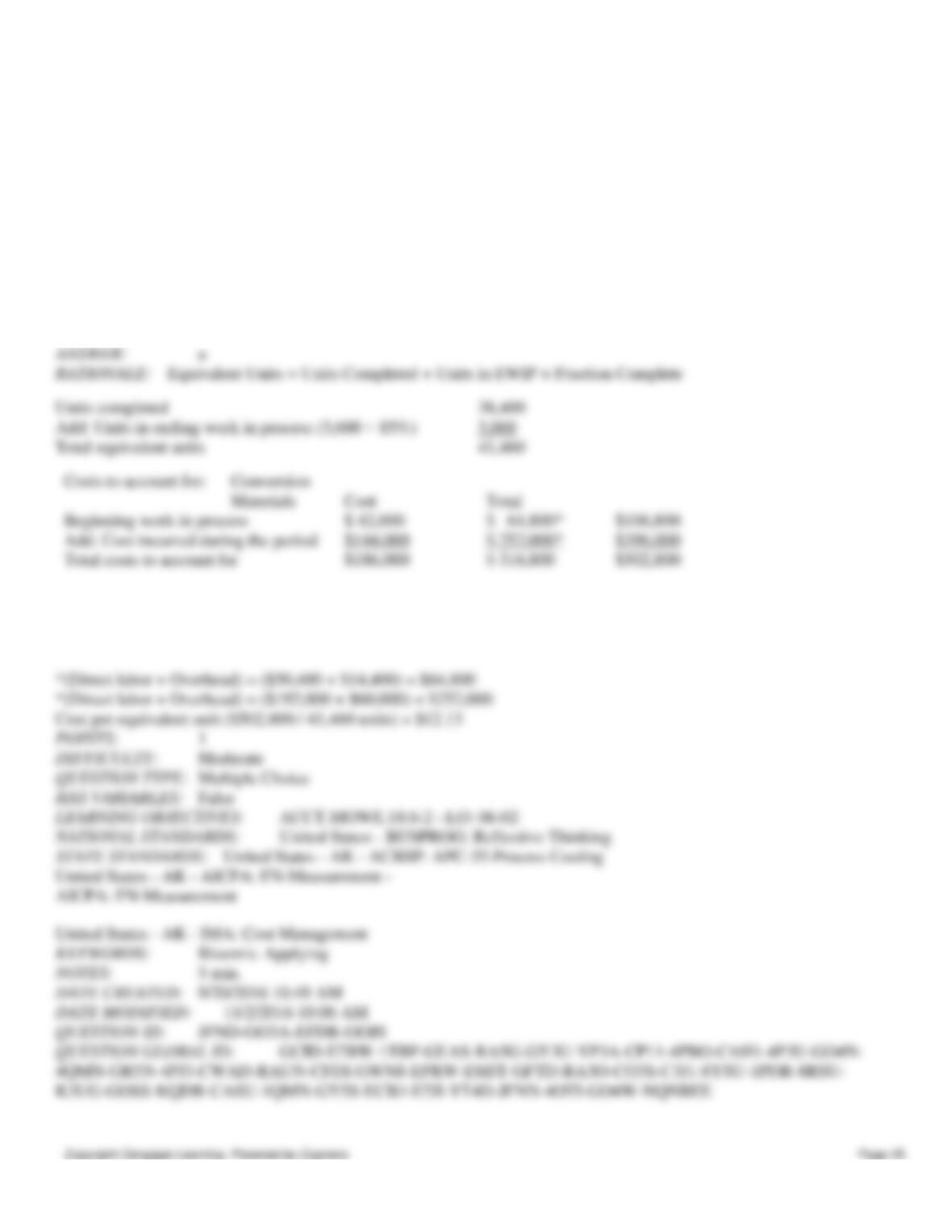
By October 31, the 3,600 units that were 85% complete remained in mixing department. Eclypso uses the weighted
average method. Which of the following is the total cost per equivalent unit of production? (Note: Round answer to two
decimal places)
a. $12.13
b. $10.76
c. $11.26
d. $8.52
Chapter 6
92. Beginning inventory of Talisman Inc. for the month had 3,600 units that were 65% complete with respect to materials.
During the month, 60,000 units were completed and transferred out. Ending inventory contained 6,000 units that were
40% complete with respect to materials. The weighted average equivalent units of production for materials for the month
would be:
a. 50,000.
b. 62,400.
c. 50,300.
d. 49,500.
93. Eclypso Inc. manufactures a product that passes through two processes: mixing and molding. All manufacturing costs
are added uniformly in the mixing department.
Information for the mixing department for October is as follows:
Work in process, October 1:
Units (45% complete) 7,200
Direct materials $42,000
Direct labor $50,400
Overhead $14,400
During October, 38,400 units were completed and transferred to the molding department. The following costs were
incurred by the mixing department during October:
Direct materials $144,000
Direct labor $192,000
Overhead $60,000
Chapter 6
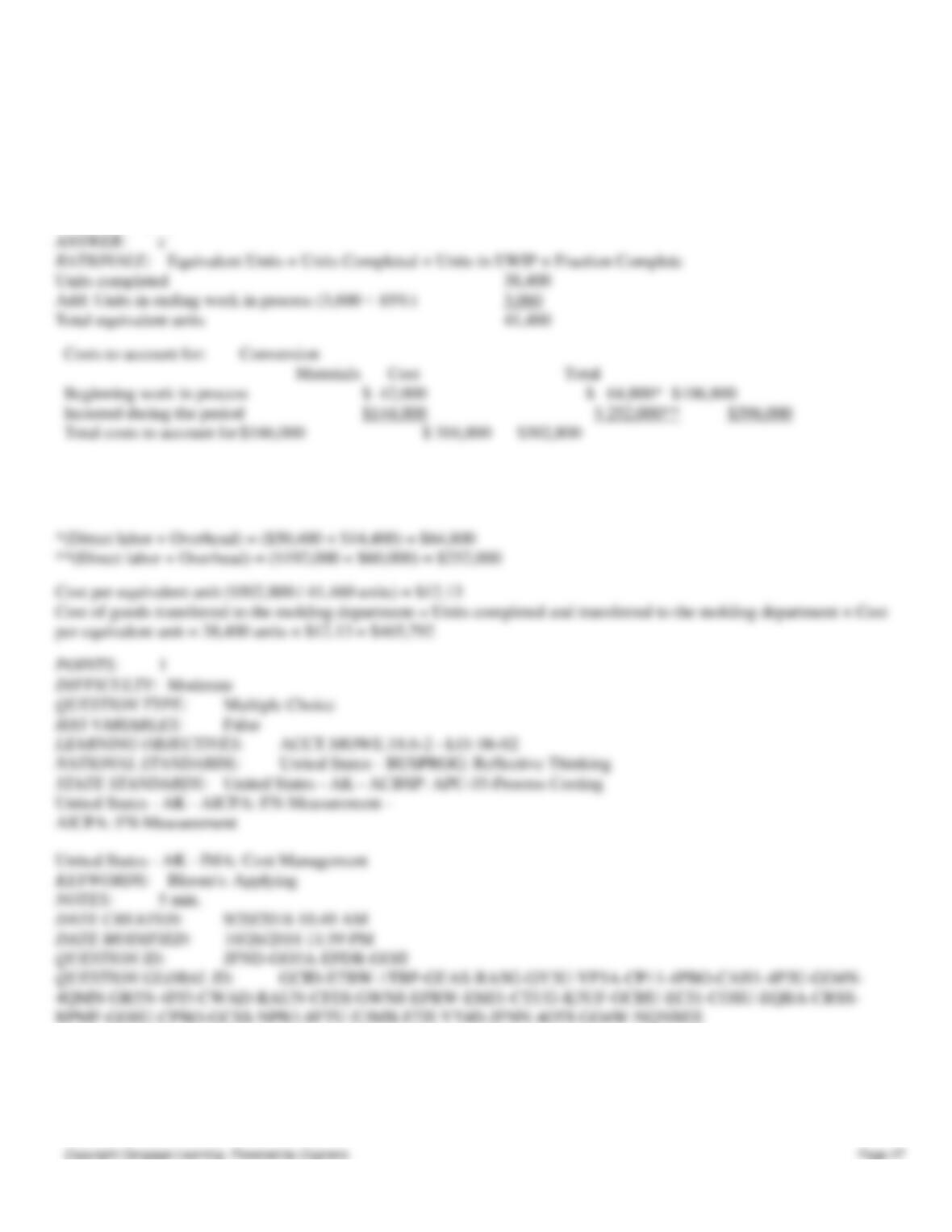
By October 31, the 3,600 units that were 85% complete remained in mixing department. Eclypso uses the weighted
average method. Eclypso’s cost of goods transferred to the molding department (Note: Round answer to two decimal
places.) during October would be:
a. $310,347.
b. $261,050.
c. $465,792.
d. $294,000.
94. Eclypso Inc. manufactures a product that passes through two processes: mixing and molding. All manufacturing costs
are added uniformly in the mixing department.
Information for the mixing department for October is as follows:
Chapter 6
Work in process, October 1:
Units (45% complete) 7,200
Direct materials $42,000
Direct labor $50,400
Overhead $14,400
During October, 38,400 units were completed and transferred to the molding department. The following costs were
incurred by the mixing department during October:
Direct materials $144,000
Direct labor $192,000
Overhead $60,000
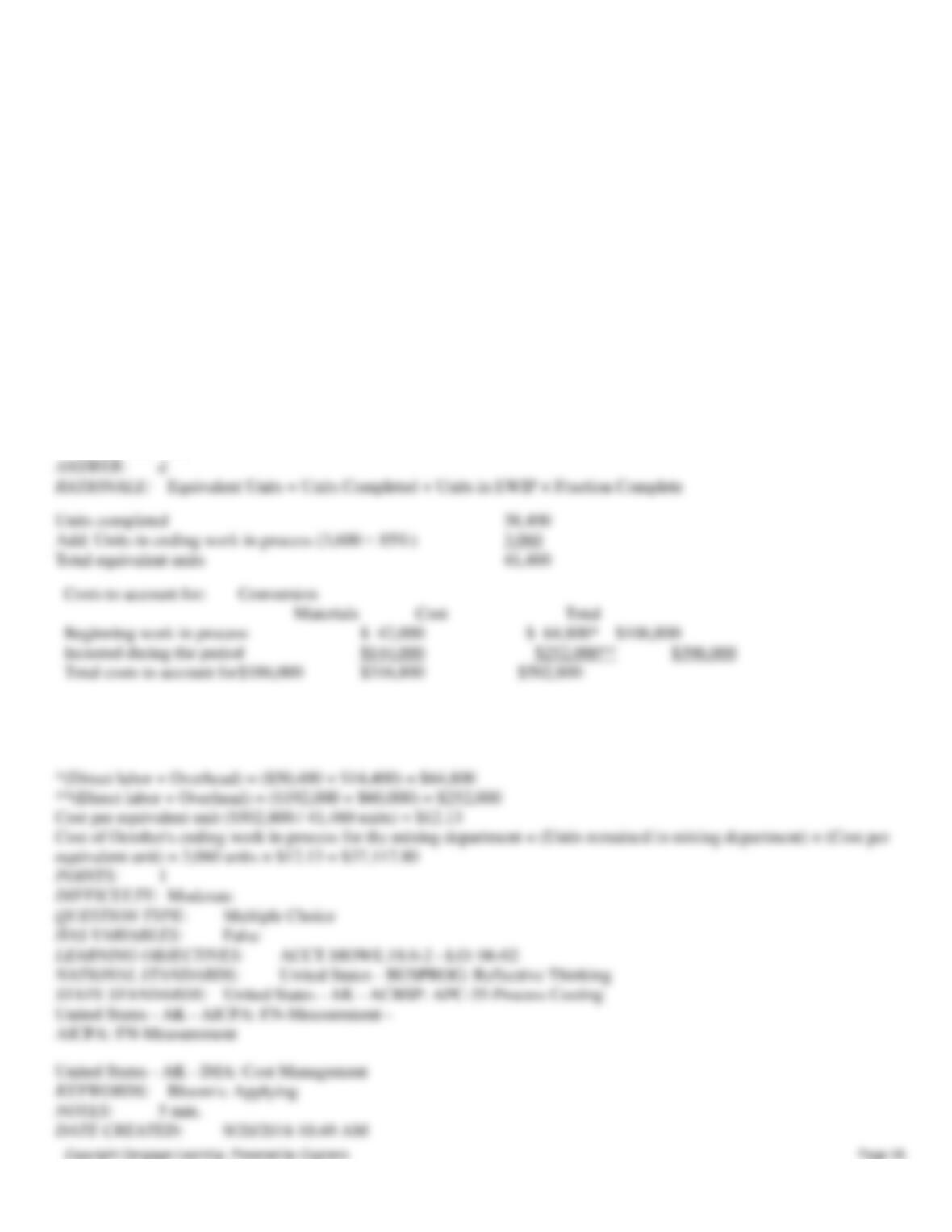
By October 31, the 3,600 units that were 85% complete remained in mixing department. Eclypso uses the weighted
average method. Which of the following is Eclypso’s cost of October’s ending work in process for the mixing department?
(Note: Round answer to two decimal places.)
a. $27,500.40
b. $29,200.60
c. $22,520.50
d. $37,117.80
Chapter 6
95. The following information is available for Department X for the month of August:
Work in process, August 1:
Materials $ 8,480
Conversion costs $15,900
Costs added during August:
Materials $29,680
Conversion costs $26,500
Equivalent units of production (weighted average):
Materials 4,240
Conversion 5,300
Department X’s cost per equivalent unit for materials using the weighted average method would be:
a. $2.00.
b. $7.00.
c. $8.00.
d. $9.00.
Chapter 6
96. The following information is available for Department X for the month of August:
Work in process, August 1:
Materials $ 8,480
Conversion costs $15,900
Costs added during August:
Materials $29,680
Conversion costs $26,500
Equivalent units of production (weighted average):
Materials 4,240
Conversion 5,300
Department X’s cost per equivalent unit for conversion using the weighted average method would be:
a. $8.00.
b. $5.00.
c. $3.00.
d. $9.00.
97. Under the FIFO production costing method, the two categories of completed units used to compute the total
cost of units completed during a period are:
a. beginning work-in-process units and units started.
b. units started and completed and ending work-in-process units.
c. beginning work-in-process units and units started and completed during the current period.
d. other categories.
Chapter 6
98. The total associated manufacturing costs for beginning work in process units under the FIFO method are:
a. the sum of the prior-period costs plus the costs incurred in the current period to finish the units in beginning work
in process
b. the cost of ending work-in-process units.
c. the cost of units started and completed.
d. conversion costs.
99. The Learner Company uses the weighted average method. Learner’s beginning work in process consists of 6,600 units
(100% complete with respect to materials and 60% complete with respect to conversion costs). The number of units
completed is 126,000. The ending work in process consists of 10,500 units (100% complete with respect to materials and
30% complete with respect to conversion costs). Calculate the number of units started during the period.
a. 129,900
Chapter 6
b. 100,000
c. 120,000
d. 133,500
100. Simplicity is the main advantage of which of the following process costing methods?
a. LIFO
b. FIFO
c. weighted average
d. exact cost method
101. Which of the following does not appear in the production report?
a. costs transferred from prior departments
Chapter 6
b. costs added in the department
c. physical units passing through the department
d. retail value of the units produced
102. A production report is divided into two sections:
a. work in process and completed goods.
b. a unit information section and a cost information section.
c. finished goods and cost of goods sold.
d. goods produced and goods in process.
103. The production report
a. is a subsidiary to the work in process account.
b. provides information about the manufacturing costs incurred by the department.
c. provides information about the physical units processed by the department.
d. All of these.
Chapter 6
104. What is the major advantage of the weighted average cost method?
a. simplicity
b. accuracy
c. it is the required method
d. it is the preferred method
105. Burgundy Manufacturing uses a process cost system and computes cost using the weighted average method. During
the current period, the beginning work-in-process inventory cost was $13,525. Manufacturing cost added was $57,000. If
Burgundy’s ending work-in-process inventory was valued at $15,100, then cost of goods transferred must have been
a. $70,525
b. $55,425
c. $84,625
d. $58,575
Chapter 6
106. Which step is cost reconciliation in the general pattern of a process-costing production report?
a. as part of the physical flow analysis
b. before calculation of equivalent units
c. before the computation of unit cost
d. the last step
Chapter 6
107. Which step is physical flow analysis in the general pattern of a process-costing production report?
a. the first step
b. after calculation of equivalent units
c. after the computation of unit cost
d. the last step
108. The following amounts were selected from the production report of Chandon Corporation:
Actual units in production 42,000
Equivalent units (materials) 42,000
Equivalent units (conversion) 39,000
Cost per equivalent unit (materials) $1.10
Cost per equivalent unit (conversion) $0.90
Chandon uses the weighted average method in preparing its production reports. Chandon’s total production cost to be
accounted for must have been
a. $89,100.
b. $84,000.
c. $81,300.
d. $72,900.
Chapter 6
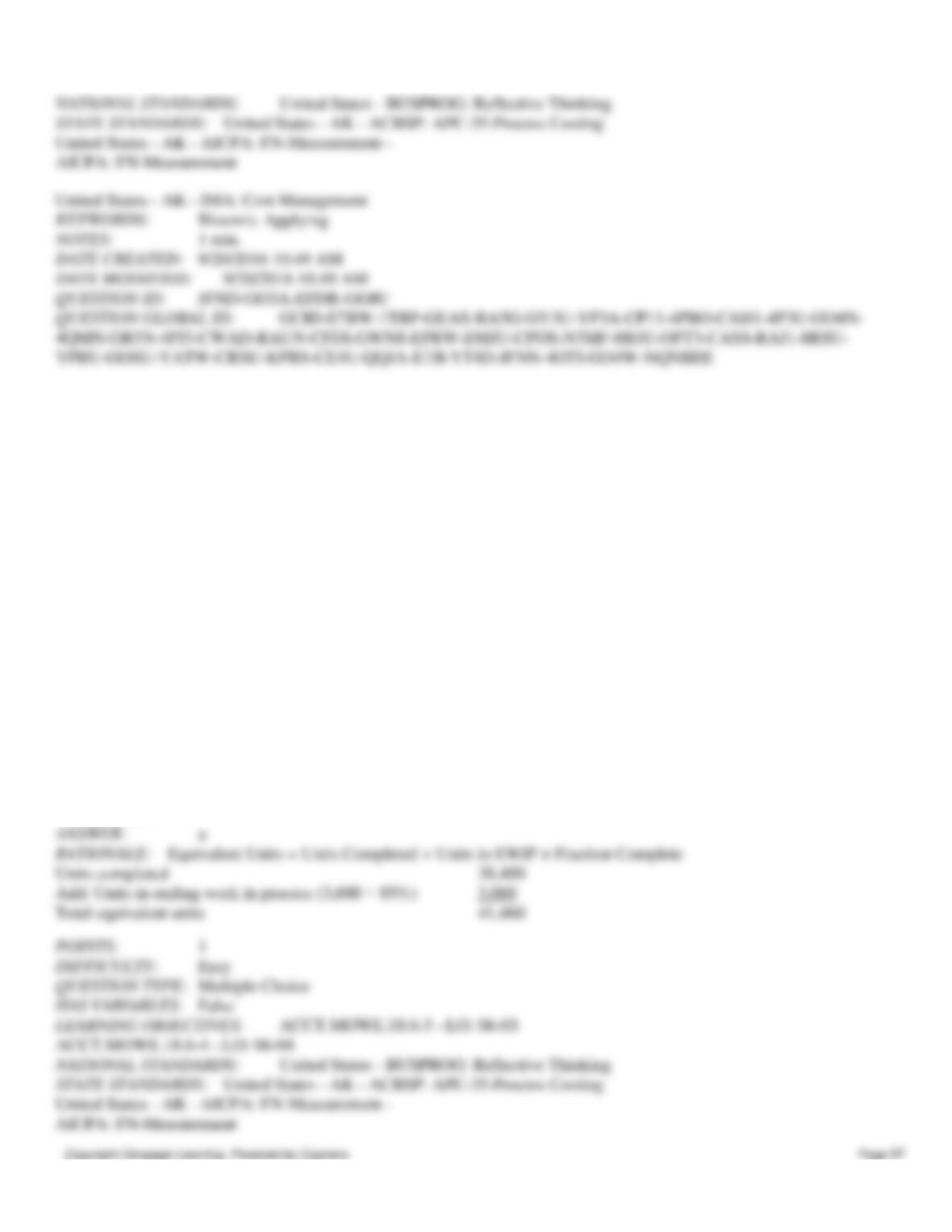
109. Eclypso Inc. manufactures a product that passes through two processes: mixing and molding. All manufacturing
costs are added uniformly in the mixing department.
Information for the mixing department for the month of October is as follows:
Work in process, October 1:
Units (45% complete) 7,200
Direct materials $42,000
Direct labor $50,400
Overhead $14,400
During October, 38,400 units were completed and transferred to the molding department. The following costs were
incurred by the mixing department during October:
Direct materials $144,000
Direct labor $192,000
Overhead $60,000
By October 31, the 3,600 units that were 85% complete remained in the mixing department. Eclypso uses the weighted
average method. Eclypso’s equivalent units of production using the weighted average method would be:
a. 41,460.
b. 32,000.
c. 35,000.
d. 24,740.
Chapter 6
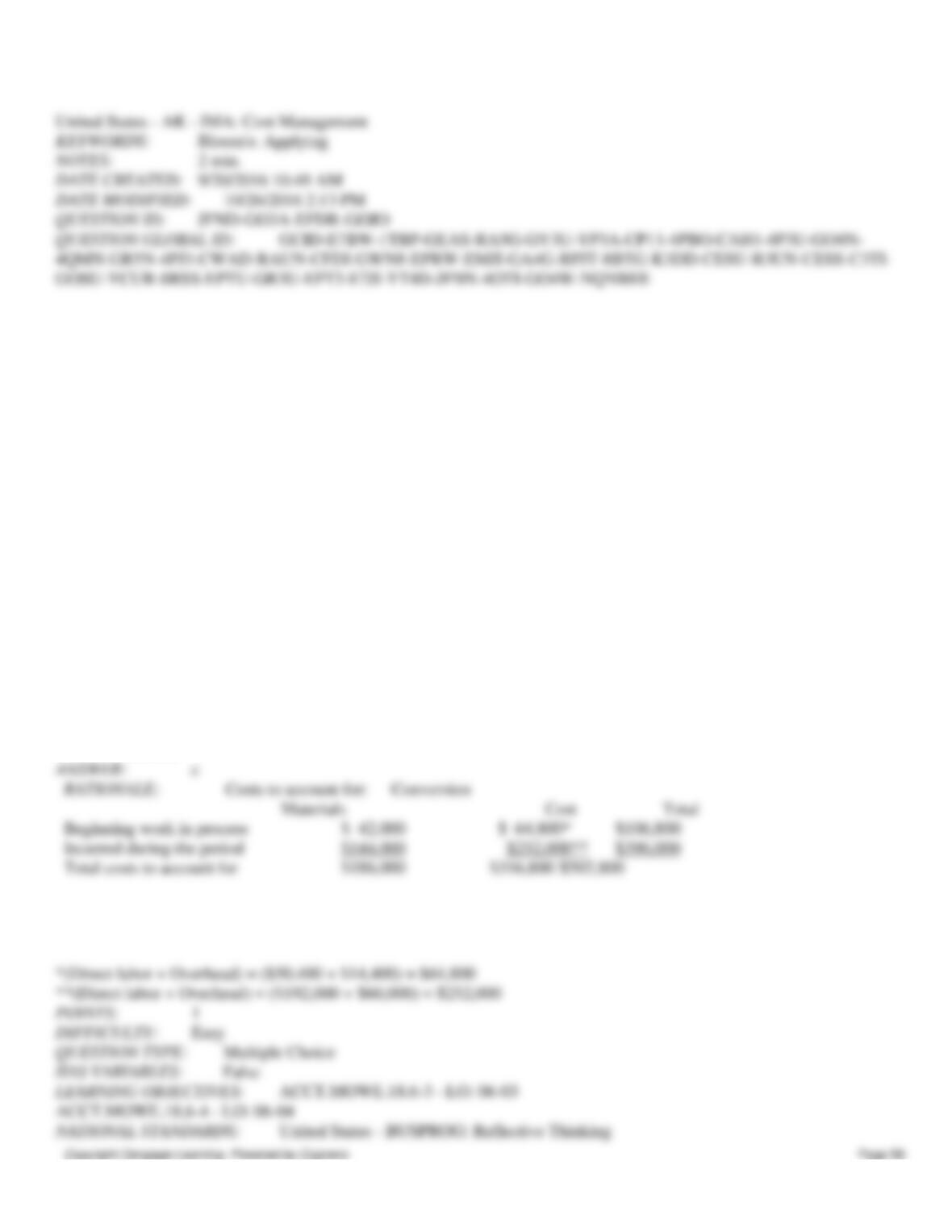
110. Eclypso Inc. manufactures a product that passes through two processes: mixing and molding. All manufacturing
costs are added uniformly in the mixing department.
Information for the mixing department for October is as follows:
Work in process, October 1:
Units (45% complete) 7,200
Direct materials $42,000
Direct labor $50,400
Overhead $14,400
During October, 38,400 units were completed and transferred to the molding department. The following costs were
incurred by the mixing department during October:
Direct materials $144,000
Direct labor $192,000
Overhead $60,000
By October 31, the 3,600 units that were 85% complete remained in mixing department. Eclypso uses the weighted
average method. Eclypso’s total costs to account for would be:
a. $304,000.
b. $264,000.
c. $502,800.
d. $155,000.
Chapter 6
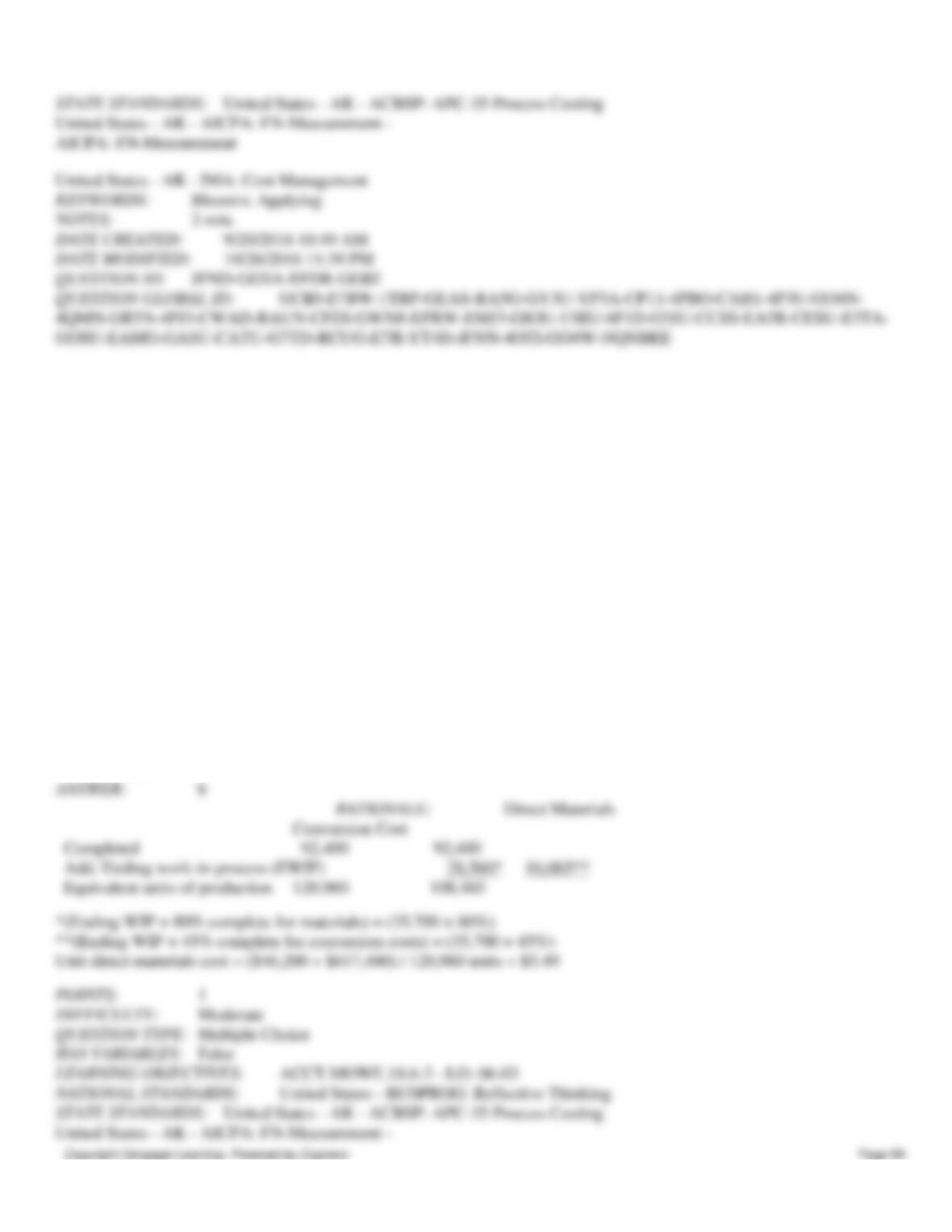
111. Excellent Manufacturing uses a process cost system to manufacture sensors for the security industry. The following
information pertains to operations for the month of March:
Units
Beginning work-in-process inventory, March 1 12,600
Started production during March 115,500
Completed production during March 92,400
Ending work-in–process inventory, March 31 35,700
The beginning inventory was 65% complete for materials and 25% complete for conversion costs. The ending inventory
was 80% complete for materials and 45% complete for conversion costs.
Costs pertaining to the month of March are as follows:
Beginning inventory costs: materials = $46,200; conversion cost = $32,025
Costs incurred during March: materials used = $617,400; conversion cost = $655,200
Which of the following is the unit cost of materials calculated using the weighted average method? (Note: Round answer
to two decimal places.)
a. $4.50
b. $5.49
c. $5.00
d. $5.46
Chapter 6
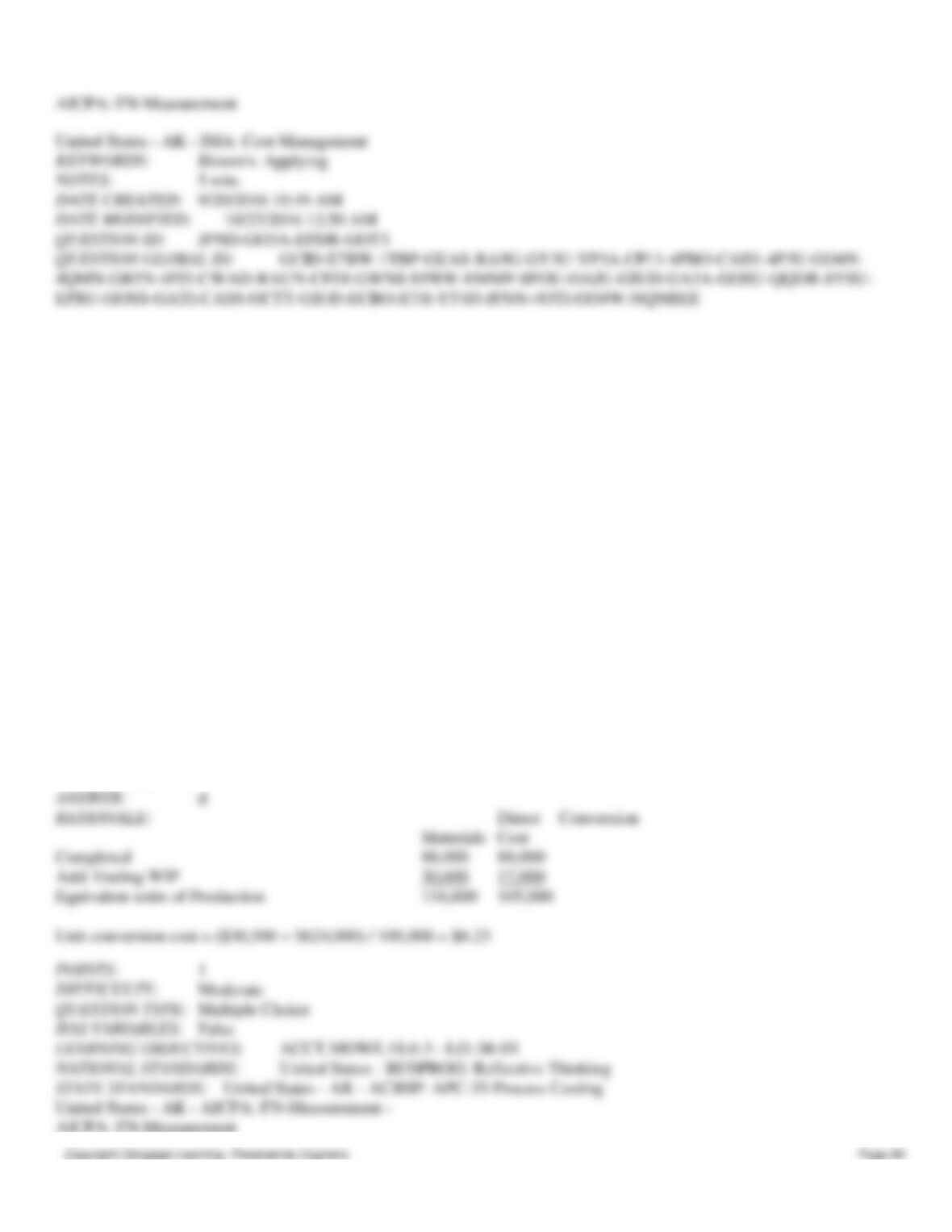
112. Geller Manufacturing uses a process cost system to manufacture sensors for the security industry. The following
information pertains to operations for the month of March.
Units
Beginning work-in-process inventory, March 1 12,000
Started in production during March 110,000
Completed production during March 88,000
Ending work-in–process inventory, March 31 34,000
The beginning inventory was 70% complete for materials and 30% complete for conversion costs. The ending inventory
was 90% complete for materials and 50% complete for conversion costs.
Costs pertaining to the month of March are as follows:
Beginning inventory costs are: materials, $44,400; conversion cost $30,500.
Costs incurred during March are: materials used, $588,000; conversion cost $624,000.
Using the weighted average method, the equivalent unit conversion cost, rounded to 2 decimal places, for March is
a. $5.95.
b. $6.00.
c. $5.13.
d. $6.23.