35) Deposits in transit result because of a timing difference between the bank records and checkbook
records.
36) Any adjustment to the depositor’s records because of an item on the bank statement requires a journal
entry.
37) When adjustments are made to the bank balance when completing a bank reconciliation, a journal
entry is needed to bring the bank balance up to date.
38) Transferring money without paper checks is called electronic funds transfer.
39) If a check marked NSF is returned from the bank, an adjusting entry crediting Cash is needed.
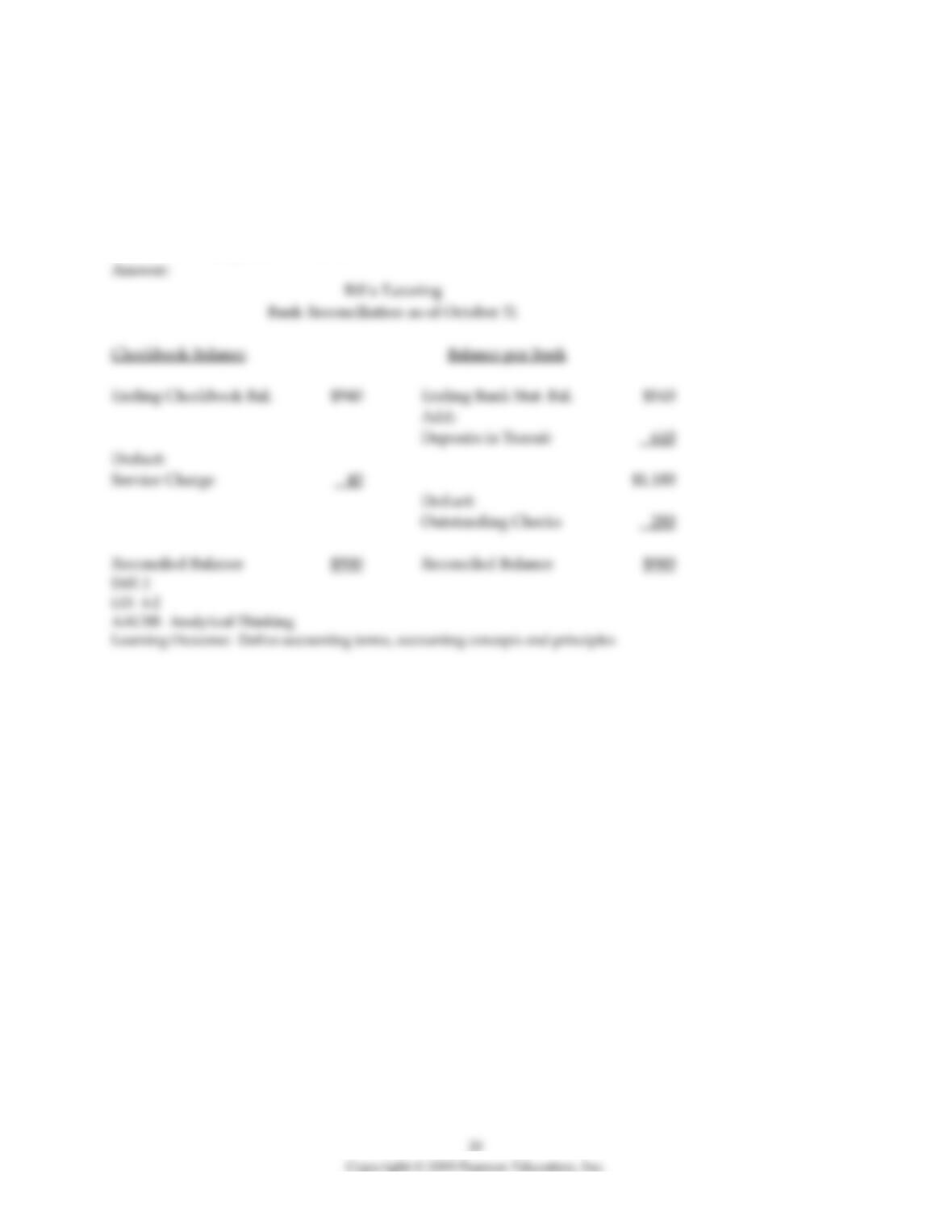
40) Construct the bank reconciliation for Bill’s Tutoring, as of October 31, from the following information:
Ending checkbook balance $940
Ending bank statement balance 540
Deposits in transit 640
Outstanding checks 280
Bank service charge (debit memo) 40
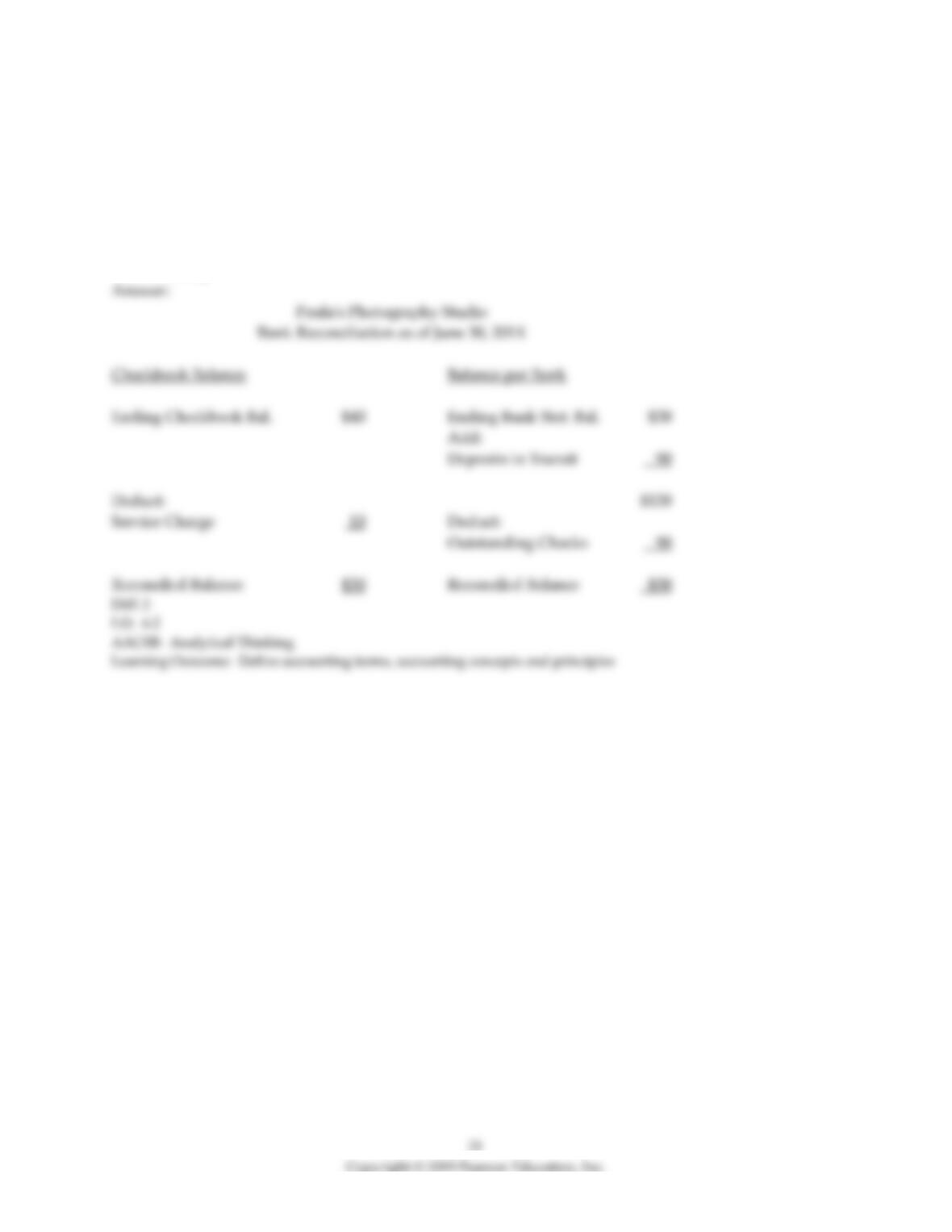
41) From the following information, prepare the bank reconciliation for Paula’s Photography Studio as of
June 30.
Ending checkbook balance $40
Ending bank statement balance 30
Deposits in transit 90
Outstanding checks 90
Service Charge 10
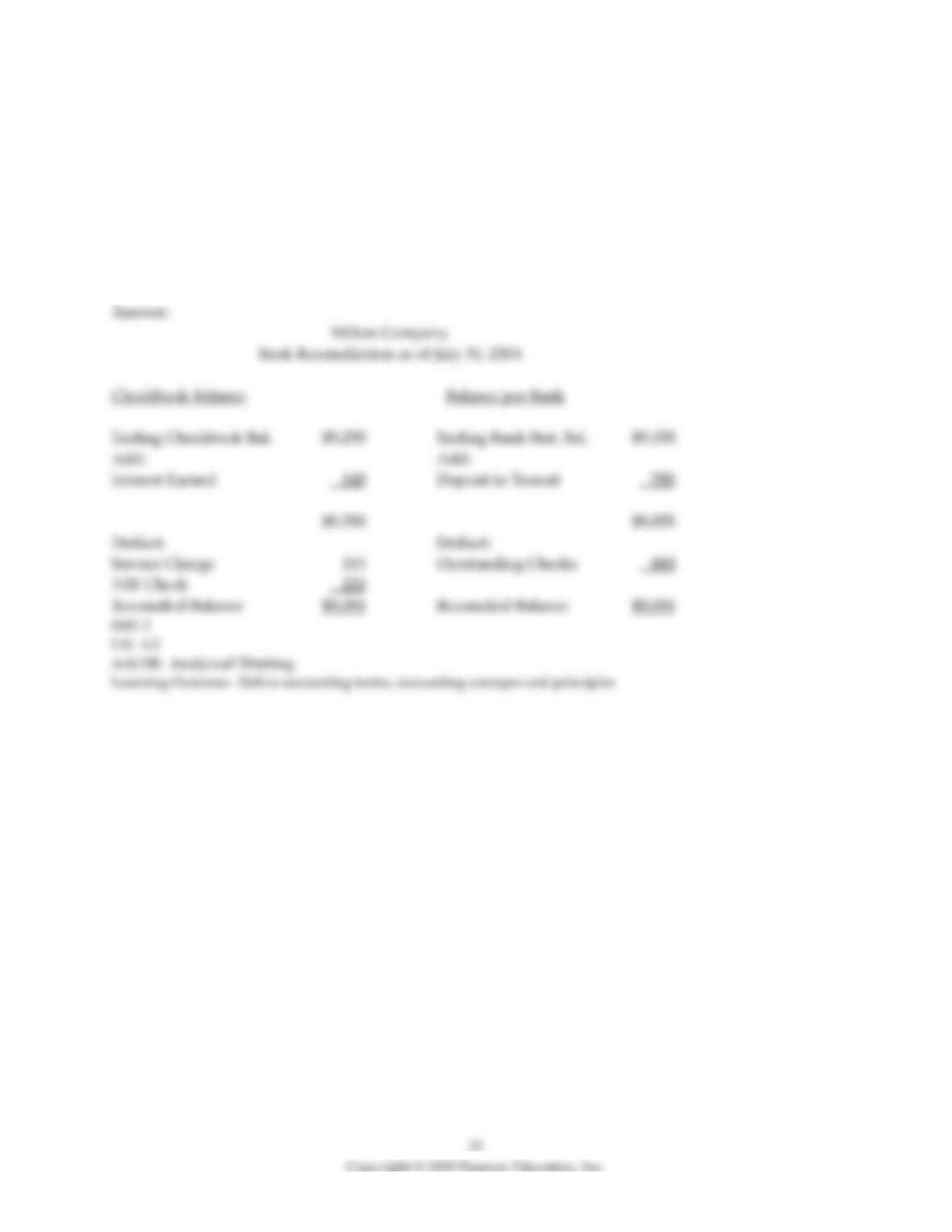
42) Construct the bank reconciliation for Milton Company as of July 31, from the following information:
a. Balance per bank statement $9,150
b. Deposit in transit 705
c. Checkbook balance 9,250
d. Outstanding checks 800
e. NSF check (debit memo) 220
f. Service charges 115
g. Interest earned on account 140
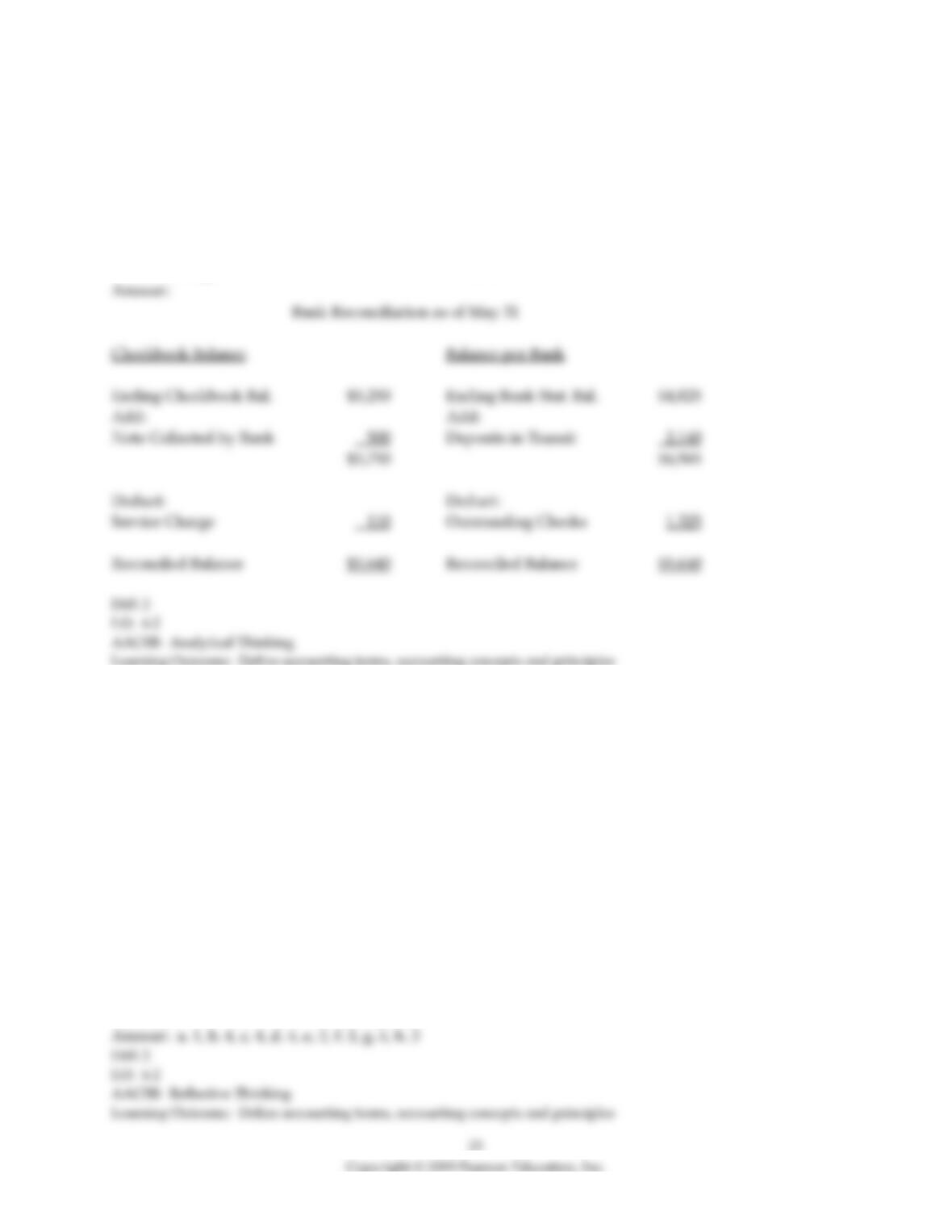
43) Prepare a bank reconciliation as of May 31 from the following information:
a. Balance per bank statement of May $4,825
b. Checkbook balance 5,250
c. Collection of note by bank 500
d. Service charges 110
e. Deposit in transit 2,140
f. Outstanding checks 1,325
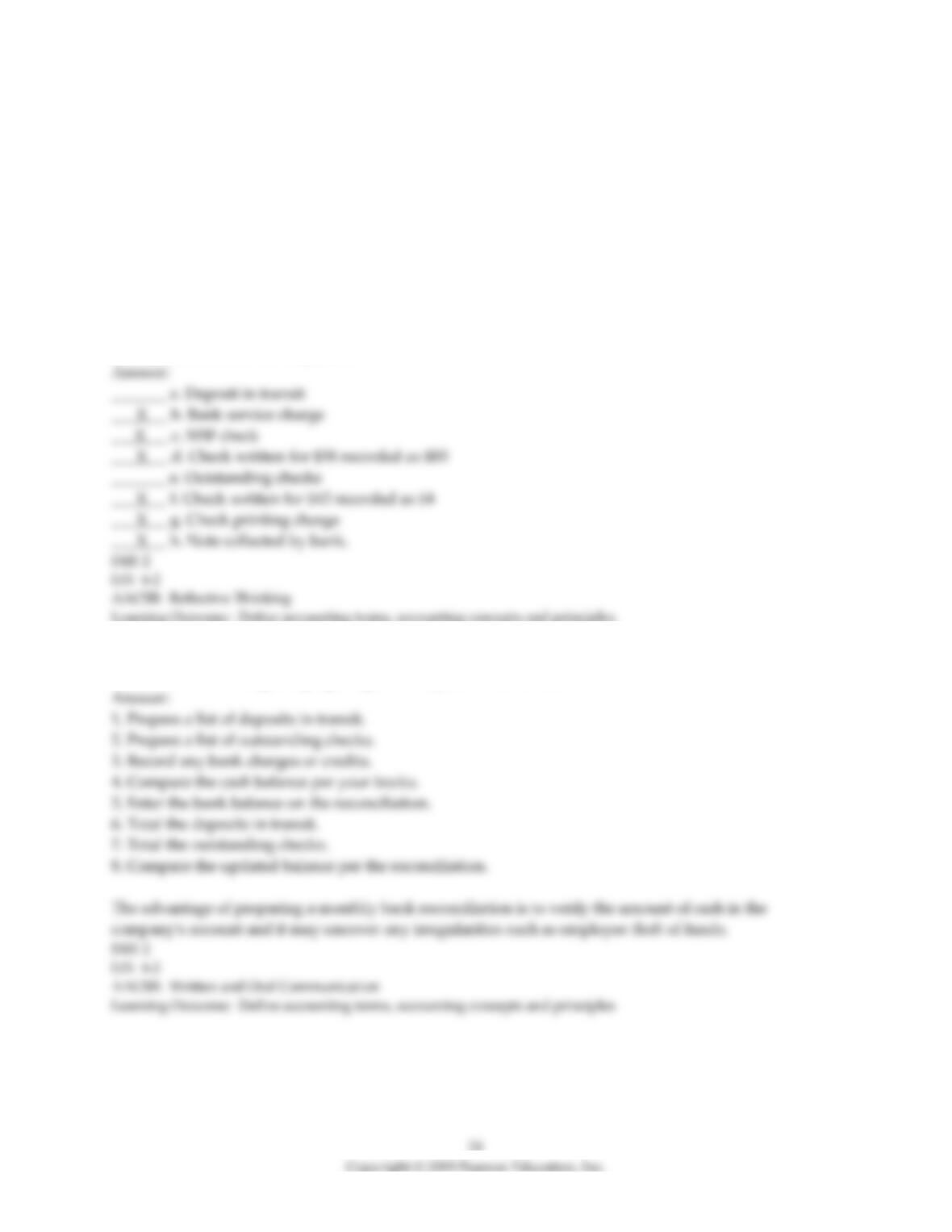
44) Indicate what effect each situation will have on the bank reconciliation process. Place the number of
your choice beside the items listed.
1. Add to bank balance
2. Deduct from bank balance
3. Add to checkbook balance
4. Deduct from checkbook balance
________ a. deposit in transit
________ b. bank service charge
________ c. NSF check
________ d. Check written for $95 recorded on the company’s ledger as $59
________ e. Outstanding checks
________ f. Check written for $80 recorded as $800
________ g. Check printing charges
________ h. Interest earned on checking account
45) Indicate which adjustments would require a journal entry during the completion of the bank
reconciliation. Place an “X” on the respective line(s).
________ a. Deposit in transit
________ b. Bank service charge
________ c. NSF check
________ d. Check written for $58 recorded on the company’s ledger as $85
________ e. Outstanding checks
________ f. Check written for $42 recorded as $4
________ g. Check printing charge
________ h. Note collected by bank.
46) List the various steps and procedures included in the bank reconciliation process.
What are the advantages in preparing a monthly bank reconciliation?
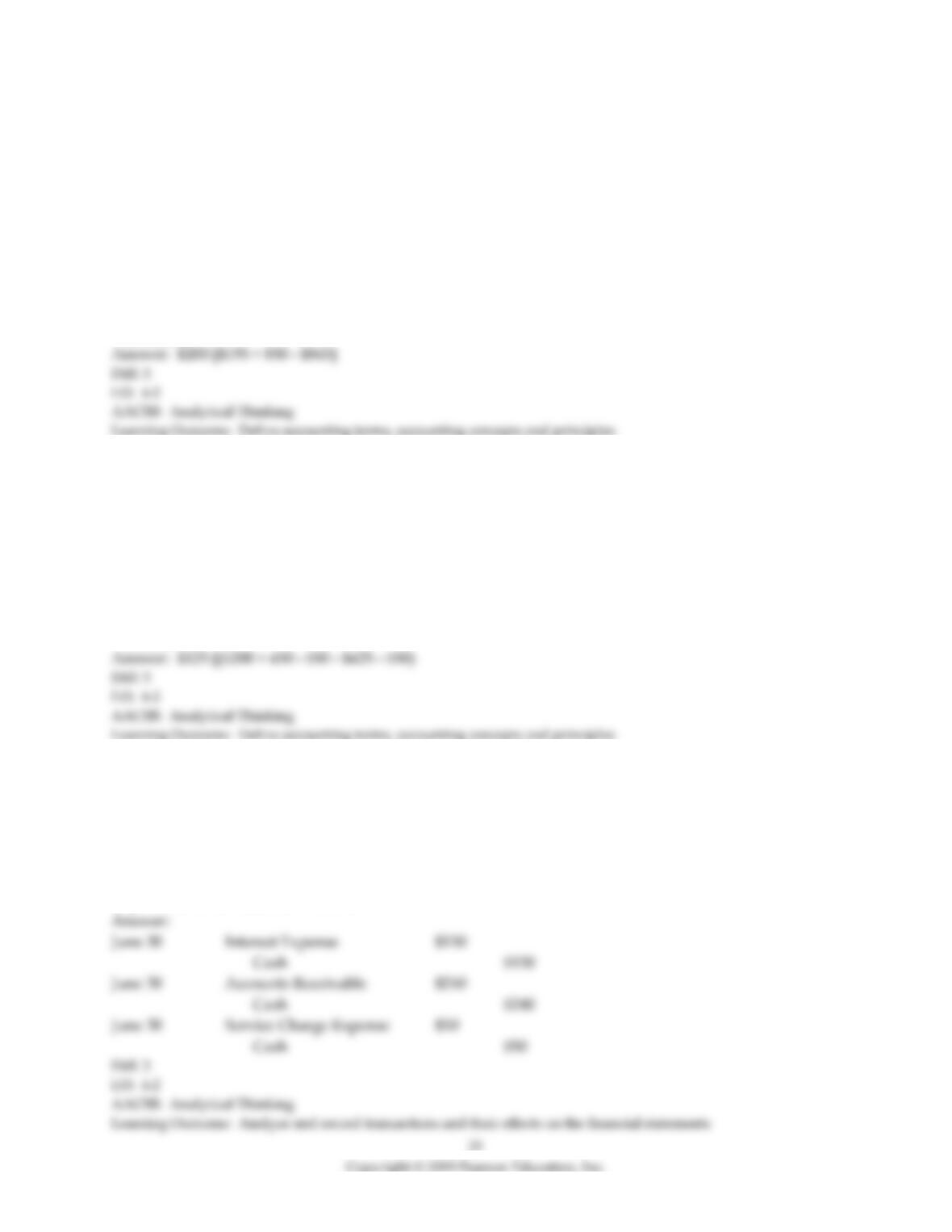
47) Determine the reconciled bank balance given the following:
The balance per bank statement is $ 195.
The balance per general ledger is $192.
There is a credit memo for a note collected, $408.
There is a credit memo for interest earned, $25.
There is a debit memo for a customer’s NSF check $350.
Deposits in transit, $850.
Outstanding checks amount to $845.
This month’s service charge amounts to $50.
There is a debit memo for check printing fees, $25.
$ ________
48) Determine the unadjusted balance per bank statement given the following:
The balance per general ledger is $200.
There is a credit memo for a note collected, $450.
There is a debit memo for interest expense, $50.
There is a debit memo for a customer’s NSF check $425.
Outstanding checks amount to $2,000.
This month’s service charge amounts to $50.
Deposits in transit amount to $1,500.
$ ________
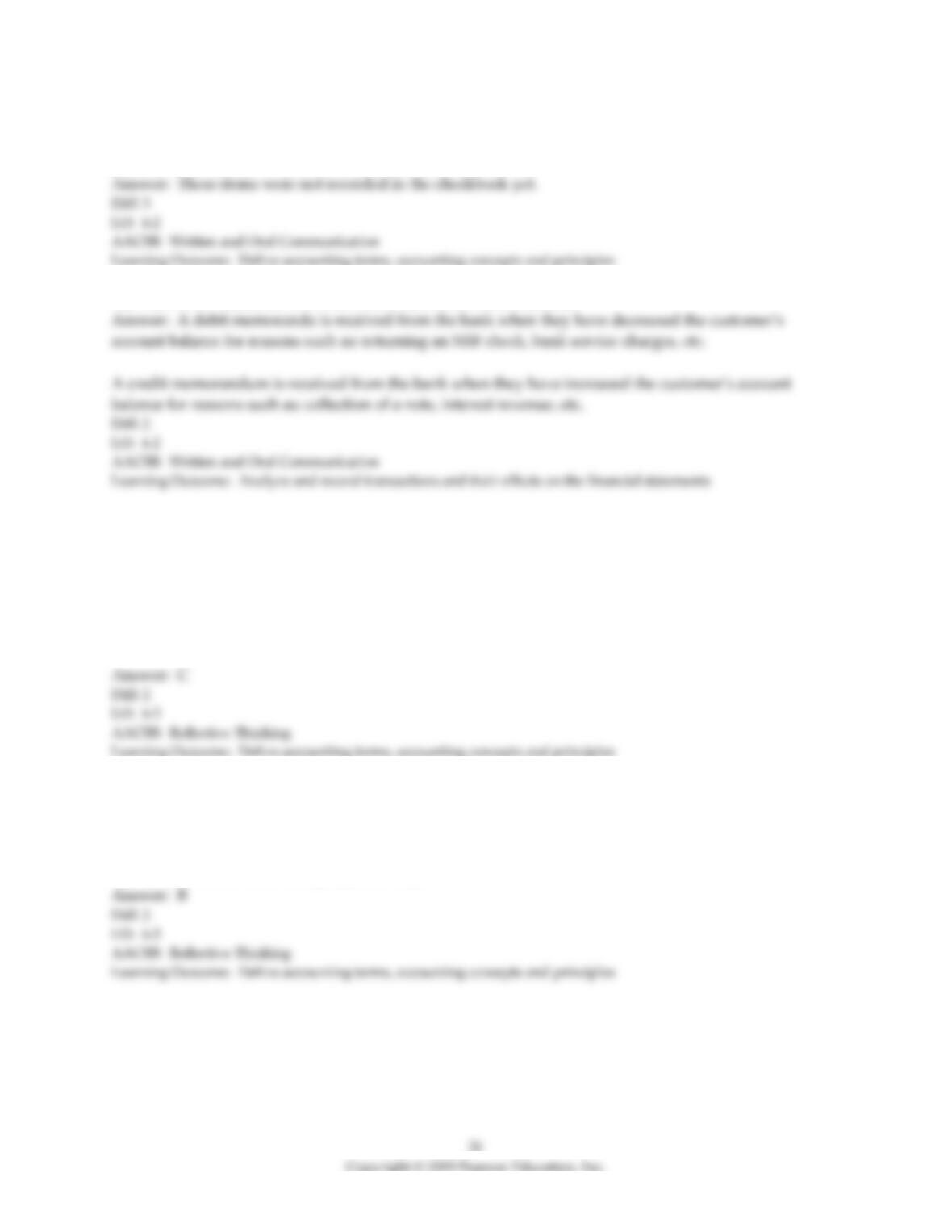
49) Prepare the required journal entries from the bank reconciliation below as of the end of June:
The balance per general ledger is $200.
There is a debit memo for interest expense, $150.
There is a debit memo for a customer’s NSF check $240.
Outstanding checks amount to $2,000.
This month’s service charge amounts to $50.
Deposits in transit amount to $1,500.
50) When completing a bank reconciliation, explain why all adjustments to the checkbook balance require
journal entries?
51) What is the difference between a debit and credit memorandum?
6.3 Learning Objective 6-3
1) What type of an account is the petty cash fund?
A) Contra-asset
B) Expense
C) Asset
D) Liability
2) A petty cash fund is set up:
A) to pay for office supplies only.
B) to pay for small expenses.
C) for the owner to withdraw money for personal use conveniently.
D) to pay for business meeting expenses only.
3) The credit recorded in the journal to replenish the petty cash fund is to:
A) Cash.
B) Petty Cash.
C) Accounts Receivable.
D) Miscellaneous Expense
4) The debit recorded in the journal to establish the petty cash fund is to:
A) Cash.
B) Petty Cash.
C) Accounts Receivable.
D) Accounts Payable.
5) Which of the following accounts would most likely be debited in the replenishment of petty cash?
A) Cash
B) Petty Cash
C) Postage Expense
D) Withdrawals
6) The credit recorded in the journal entry to establish the petty cash fund is to:
A) Cash.
B) Petty Cash.
C) Accounts Payable.
D) Withdrawals.
7) A $100 petty cash fund has cash of $20 and valid receipts for $40. The entry to replenish the fund
would include a:
A) credit to Cash for $80.
B) credit to Cash for $40.
C) credit to Petty Cash for $20.
D) debit to Petty Cash for $40.
8) The entry establishing a $220 petty cash fund would include a:
A) debit to Cash for $220.
B) credit to Petty Cash for $220.
C) debit to Petty Cash for $220.
D) debit to Miscellaneous Expense for $220.
9) The Petty Cash account is debited when:
A) the account is being replenished.
B) the account balance is being decreased.
C) the account balance is being increased.
D) the account is closed.
10) The entry to replenish the petty cash fund debited Insurance Expense for postage. This would cause:
A) Petty Cash to be overstated.
B) Cash to be understated.
C) Postage Expense to be overstated.
D) Insurance Expense to be overstated.
11) Jim’s Limousines’ entry to establish a $160 petty cash fund for the office would include a:
A) debit to Cash for $160.
B) credit to Petty Cash for $160.
C) credit to Cash for $160.
D) debit to Office Expense for $160.
12) The entry to replenish the petty cash fund included a debit to Equipment instead of Supplies for the
purchase of supplies. This would cause:
A) Petty Cash to be overstated.
B) Petty Cash to be understated.
C) Equipment to be understated.
D) Supplies to be understated.
13) The replenishment of the petty cash fund was recorded twice. This would cause:
A) Expenses to be overstated.
B) Expenses to be understated.
C) Petty Cash to be overstated.
D) Petty Cash to be understated.
14) The entry to establish the petty cash fund was not completed. This would cause:
A) Cash to be understated.
B) Cash to be overstated.
C) Petty Cash to be understated.
D) Both B and C are correct.
15) The entry to establish the petty cash fund debited Misc. Expense. This would cause:
A) Revenues to be overstated.
B) Revenues to be understated.
C) Expenses to be overstated.
D) Expenses to be understated.
16) Which of the following transactions would be recorded in an auxiliary petty cash record?
A) Purchase of first aid supplies
B) Payment of Salaries Expense
C) Owner Withdrawal of $1,200
D) Purchase of a $2,400 piece of Equipment
17) Which of the following transactions would most likely NOT be recorded in an auxiliary petty cash
record?
A) Purchase of first aid supplies
B) Purchase of postage stamps
C) Payment on a $700 rent bill
D) Payment of gas for the company vehicle
18) A company would use a change fund if:
A) there are cash transactions daily.
B) they want to pay the postage expense without writing a check.
C) the owner wants to make personal withdrawals easily.
D) there are supplies purchased for cash.
19) The entry to replenish a $300 petty cash fund, which has cash of $160 and valid receipts for $130
would include:
A) a credit to Cash for $140.
B) a debit to Petty Cash for $140.
C) a credit to Cash for $130.
D) a credit to Petty Cash for $130.
20) Sam’s Tutoring Service’s $480 petty cash fund has a shortage of $3. The facts are: $210 in valid receipts
for expenses; $477 in coins and currency. The journal entry to replenish the petty cash fund would
include a:
A) credit to Cash for $210.
B) credit to Petty Cash for $213.
C) credit to Cash Short and Over for $3.
D) debit to Cash Short and Over for $3.
21) Vanessa’s Gymnastics’ cash register tapes do not agree with cash receipts. The facts are: total cash
register tapes $410; total coins and currency $416. The summary journal entry to record the day’s
transactions would include a:
A) $410 debit to Cash; $6 debit to Cash Short and Over; and $416 credit to Service Revenue.
B) $416 debit to Cash; $6 credit to Cash Short and Over; and $410 credit to Service Revenue.
C) $416 debit to Cash and $416 credit to Service Revenue.
D) $410 debit to Cash and $410 credit to Service Revenue.
22) The change fund is what type of account?
A) Expense
B) Contra-asset
C) Asset
D) Revenue
23) The petty cash overage was not recorded. This would cause:
A) Revenues to be overstated.
B) Revenues to be understated.
C) Expenses to be overstated.
D) Accounts Receivable to be understated.
24) Cash Short and Over is:
A) a Misc. Expense account.
B) a Misc. Revenue account.
C) a Misc. Expense or Misc. Revenue account depending on the balance in the account.
D) an asset or liability depending on the balance in the account.
25) If the ending balance in the Cash Short and Over account is a credit, it indicates that cash shortages
have exceeded cash overages for the period.
26) If the ending balance in the Cash Short and Over account is a debit, it indicates that cash shortages
have exceeded cash overages for the period.
27) Petty Cash is an asset shown on the income statement.
28) The Petty Cash account is used to pay for small items such as postage stamps and supplies.
29) An employee assigned the responsibility for overseeing the petty cash fund is called the Accounts
Receivable clerk.
30) The normal balance of the Petty Cash account is a credit.
31) The Petty Cash account should never be debited when the fund is replenished.
Indicate which effect(s) each situation will have:
1. New check written
2. Recorded in the general journal
3. Recorded in auxiliary petty cash record
4. Petty cash voucher prepared
32) ________ Establishment of petty cash
33) ________ Bought Supplies on account
34) ________ Bought coffee and rolls for a business meeting and used petty cash
35) ________ Filled up the company’s truck with gas and used petty cash
36) ________ Owner withdrew $2,000 from the company for personal use
37) ________ Replenishment of petty cash
38) Determine the cash overage given the following:
The balance per the Petty Cash account $100
The count of coin and currency amounts to $65
There are receipts: for gas of $9, for office supplies of $18, for first aid supplies $14
$ ________
39) Determine the cash shortage given the following:
The balance per the petty cash account $200
The count of coin and currency amounts to $120
There are receipts: for telephone costs of $25, for supplies of $6, for transportation $6, for funeral flowers
$38
$ ________
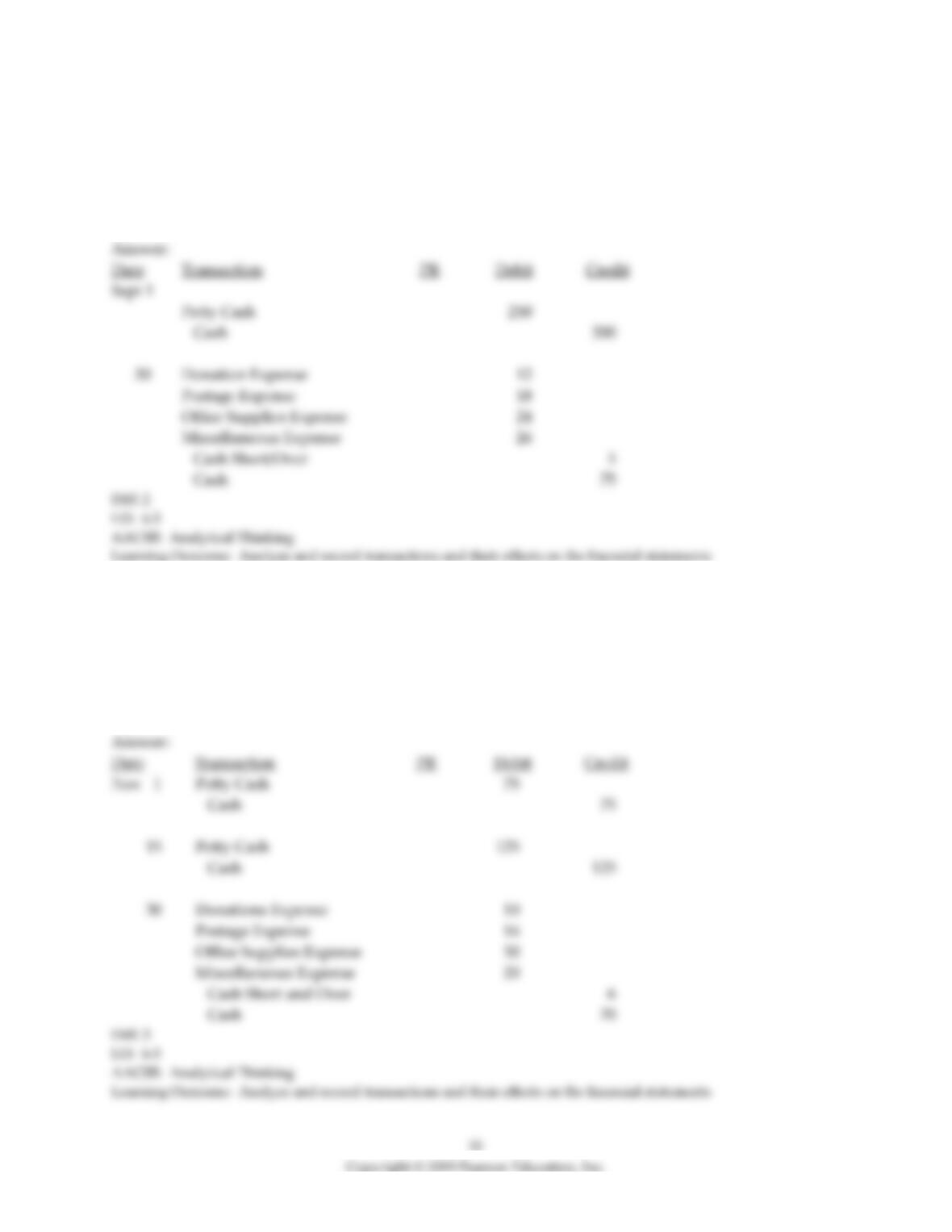
40) Prepare journal entries for the following petty cash fund transactions:
Sept. 1 Established a $300 petty cash fund.
30 Replenished the petty cash fund. Currency and coins remaining was $225; approved paid
vouchers were: $12 donation expense; $18 postage; $24 office supplies expense; and $26 miscellaneous
expense.
41) Prepare journal entries for the following petty cash fund transactions:
Nov. 1 Established a $75 petty cash fund.
15 Increased the petty cash fund to have a new balance of $200.
30 Replenished the petty cash fund. Currency and coins remaining were $30. Approved paid
vouchers were: $10 donation expense; $16 postage expense; $30 office supplies expense; and $20 misc.
expense.