119) If a check that was outstanding on last period’s bank reconciliation was not among the
cancelled checks returned by the bank this period, in preparing this period’s reconciliation, the
amount of this check should be:
A) Added to the book balance of cash as an outstanding check.
B) Deducted from the book balance of cash as an outstanding check.
C) Added to the bank balance of cash as an outstanding check.
D) Deducted from the bank balance of cash as an outstanding check.
E) Ignored in preparing the period’s bank reconciliation as an outstanding check.
120) If a company made a bank deposit on September 30 that did not appear on the bank
statement dated September 30, in preparing the September 30 bank reconciliation, the company
should:
A) Deduct the deposit from the bank statement balance.
B) Skip the bank reconciliation this month.
C) Deduct the deposit from the September 30 book balance and add it to the October 1 book
balance.
D) Add the deposit to the book balance of cash.
E) Add the deposit to the bank statement balance.
121) If a check correctly written and paid by the bank for $749 is incorrectly recorded in the
company’s books for $794, how should this error be treated on the bank reconciliation?
A) Subtract $45 from the bank’s balance.
B) Add $45 to the bank’s balance.
C) Subtract $45 from the book balance.
D) Add $45 to the book balance.
E) Subtract $45 from the bank’s balance and add $45 to the book’s balance.
122) If a check correctly written and paid by the bank for $272 is incorrectly recorded in the
company’s books for $227, how should this error be treated on the bank reconciliation?
A) Subtract $45 from the bank’s balance.
B) Add $45 to the bank’s balance.
C) Subtract $45 from the book balance.
D) Add $45 to the book balance.
E) Subtract $45 from the bank’s balance and add $45 to the book’s balance.
123) During the month of July, Clanton Industries issued a check in the amount of $845 to a
supplier on account. The check did not clear the bank during July. In preparing the July 31 bank
reconciliation, the company should:
A) Deduct the check amount from the book balance of cash.
B) Add the check amount to the book balance of cash.
C) Deduct the check amount from the bank balance.
D) Add the check amount to the bank balance.
E) Make a journal entry in the company records for an error.
124) In the process of reconciling its bank statement for April, Donahue Enterprises’ accountant
compiles the following information:
Cash balance per company books on April 30
$
6,275
Deposits in transit at month-end
$
1,300
Outstanding checks at month-end
$
620
Bank charge for printing new checks
$
45
Note receivable and interest collected by bank on Donahue’s behalf
$
770
A check paid to Donahue during the month by a customer is returned by
the bank as NSF
$
480
The adjusted cash balance per the books on April 30 is:
A) $6,900
B) $8,160
C) $4,600
D) $6,520
E) $5,840
Book balance
$
6,275
+ note collection & interest revenue
– bank charge for printing new checks
– NSF check returned by bank
Adjusted book balance
$
6,520
125) In the process of reconciling its bank statement for January, Maxi’s Clothing’s accountant
compiles the following information:
Cash balance per company books on January 30
$
4,725
Deposits in transit at month-end
$
1,800
Outstanding checks at month-end
$
520
Bank service charges
$
25
EFT automatically deducted monthly, not yet recorded by Maxi
$
380
An NSF check returned on a customer account
$
265
The adjusted cash balance per the books on January 31 is:
A) $5,855
B) $5,335
C) $4,055
D) $4,815
E) $4,585
Explanation:
Book balance
$
– bank service charges
-25
– EFT
-380
– NSF check returned by bank
-265
Adjusted book balance
$
126) Which of the following events would cause a bank to reduce a depositor’s account?
A) The depositor orders new checks through the bank at a cost of $50.
B) The bank collects a note receivable and related interest on the depositor’s behalf.
C) There are outstanding checks drawn on the account at month-end.
D) There are deposits in transit on the account at month-end.
E) The bank corrects an error from previous month by adding $75 to the depositor account.
127) A seller (or supplier) of goods or services to a business organization is known as a:
A) Vendor.
B) Payee.
C) Vendee.
D) Creditor.
E) Debtor.
128) The internal document prepared by a department manager that informs the purchasing
department of its merchandise needs and requests that the merchandise be purchased is the:
A) Purchase requisition.
B) Purchase order.
C) Invoice.
D) Receiving report.
E) Invoice approval.
129) The document that the purchasing department prepares and sends to the vendor to place an
order is called the:
A) Purchase requisition.
B) Purchase order.
C) Invoice.
D) Receiving report.
E) Invoice approval.
130) The itemized statement of goods prepared by a vendor listing the customer’s name, items
sold, sales prices, and terms of the sale is called the:
A) Purchase requisition.
B) Purchase order.
C) Invoice.
D) Receiving report.
E) Invoice approval.
131) The internal document prepared to notify the appropriate persons that goods ordered have
been received, describing the quantities and condition of the goods is the:
A) Purchase requisition.
B) Purchase order.
C) Invoice.
D) Receiving report.
E) Invoice approval.
132) The checklist of steps necessary for approving an invoice for recording and payment, also
known as the check authorization, is the:
A) Purchase requisition.
B) Purchase order.
C) Invoice.
D) Receiving report.
E) Invoice approval.
133) A voucher system is a set of procedures and approvals:
A) Designed to eliminate the need for subsidiary ledgers.
B) Designed to determine if the company is operating profitably.
C) Used almost exclusively by small companies.
D) Used to ensure that the company sells on credit only to creditworthy customers.
E) Designed to control cash payments and the acceptance of liabilities.
134) Internal controls are crucial to global companies because of all of the following risks
except:
A) Possible misstatement of financial information.
B) Possible fraud.
C) Controls are significantly different across the globe.
D) Additional costs of inefficient operations.
E) Management’s inability to certify the effectiveness of the controls.
135) All of the following are considered effective cash management principles except:
A) Encouraging collection of receivables by offering discounts for early payments.
B) Keeping only necessary assets.
C) Planning expenditures.
D) Retaining excess cash for unexpected expenditures.
E) Delaying payment of liabilities until the last possible day.
50
136) Ryan Company deposits all cash receipts on the day they are received and makes all cash
payments by check. Ryan’s June bank statement shows $18,361 on deposit in the bank. Ryan’s
comparison of the bank statement to its cash account revealed the following:
Deposit in transit
1,450
Outstanding checks
837
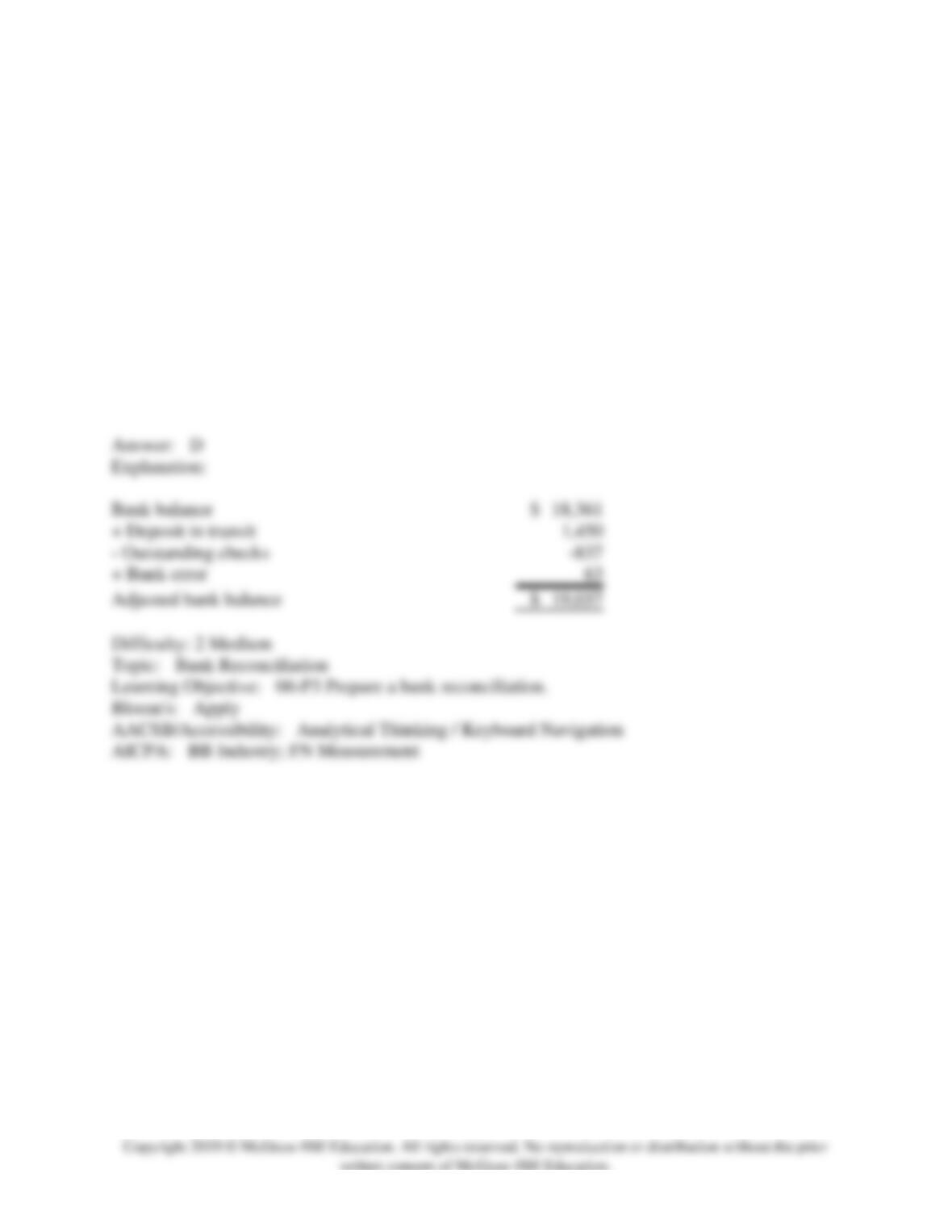
Additionally, a $29 check written and recorded by the company correctly was recorded by the
bank as a $92 deduction. The adjusted cash balance per the bank records should be:
A) $18,974
B) $18,911
C) $20,711
D) $19,037
E) $16,137
Bank balance
+ Deposit in transit
– Outstanding checks
+ Bank error
Adjusted bank balance
137) Clayborn Company deposits all cash receipts on the day they are received and makes all
cash payments by check. At the close of business on May 31, its Cash account shows a debit
balance of $17,025. Clayborn’s May bank statement shows $15,800 on deposit in the bank.
Determine the adjusted cash balance using the following information:
Deposit in transit
$
5,200
Outstanding checks
$
4,600
Bank service fees, not yet recorded by company
$
25
A NSF check from a customer, not yet recorded by the company
$
600
The adjusted cash balance should be:
A) $16,400
B) $11,200
C) $21,000
D) $16,425
E) $17,000
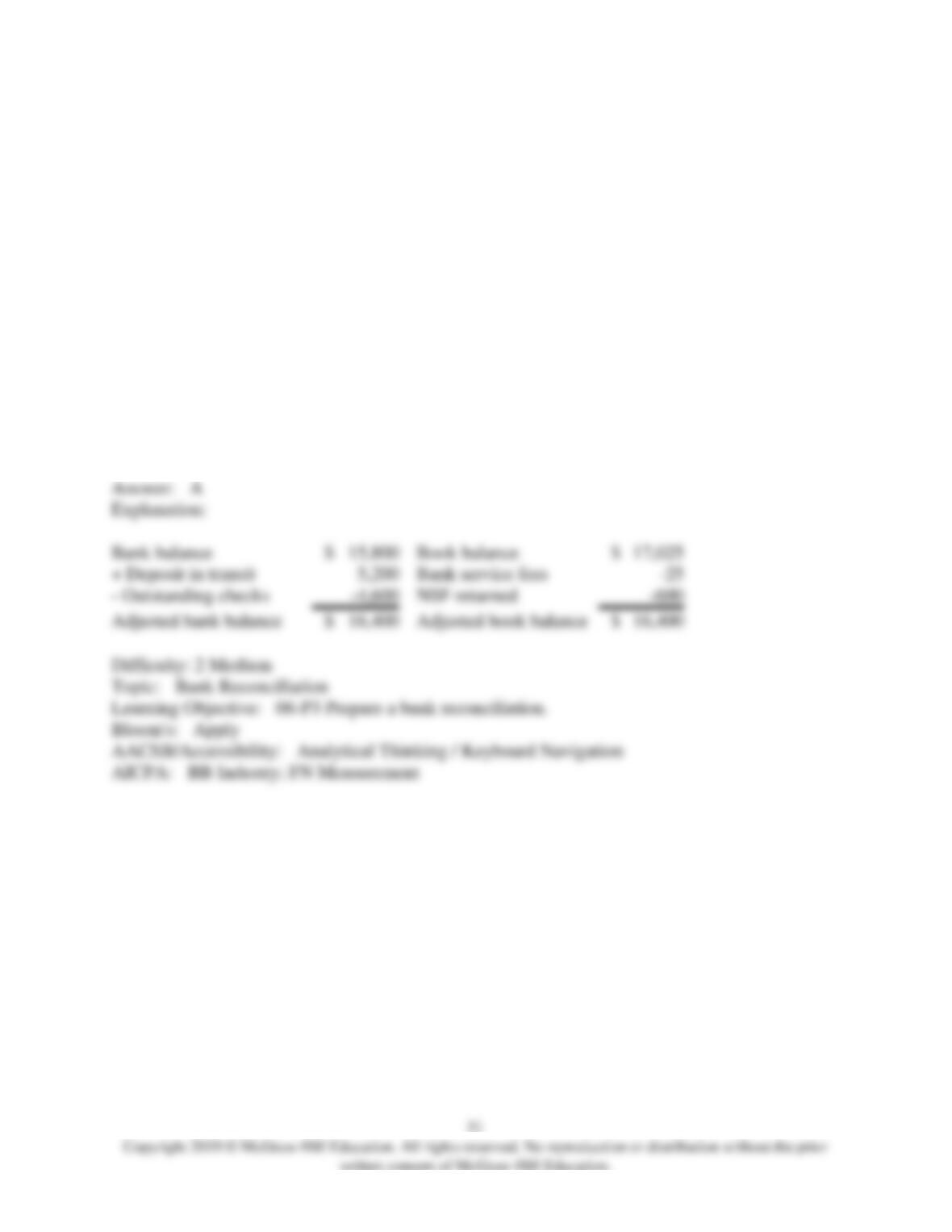
Bank balance
$
15,800
Book balance
$
17,025
+ Deposit in transit
Bank service fees
– Outstanding checks
NSF returned
Adjusted bank balance
$
16,400
Adjusted book balance
$
16,400
138) Franklin Company deposits all cash receipts on the day they are received and makes all
cash payments by check. At the close of business on August 31, its Cash account shows a debit
balance of $13,162. Franklin’s August bank statement shows $14,237 on deposit in the bank.
Determine the adjusted cash balance using the following information:
Deposit in transit
$
4,500
Outstanding checks
$
3,900
Bank service fees, not yet recorded by company
$
50
The bank collected on a note receivable, not yet recorded by the
company
$
1,725
The adjusted cash balance should be:
A) $18,737
B) $10,337
C) $14,887
D) $13,112
E) $14,837
Bank balance
$
14,237
Book balance
$
13,162
+ Deposit in transit
Bank service fees
– Outstanding checks
Note collected
Adjusted bank balance
Adjusted book balance
139) Clayborn Company’ bank reconciliation as of May 31 is shown below.
Bank balance
$
15,800
Book balance
$
17,025
+ Deposit in transit
5,200
Bank service fees
-25
– Outstanding checks
-4,600
NSF returned
-600
Adjusted bank balance
$
16,400
Adjusted book balance
$
16,400
One of the adjusting journal entries that Clayborn must record as a result of the bank
reconciliation includes:
A) A debit to Cash of $625
B) A debit to Cash of $5,200
C) A credit to Cash of $4,600
D) A credit to Cash of $600
E) A debit to cash of $25
140) Franklin Company’s bank reconciliation as of August 31 is shown below.
Bank balance
$14,237
Book balance
$13,162
+ Deposit in transit
4,500
Bank service fees
-50
– Outstanding checks
-3,900
Note collected
1,725
Adjusted bank balance
$14,837
Adjusted book balance
$14,837
The adjusting journal entries that Clayborn must record as a result of the bank reconciliation
include:
A) Debit Cash $4,500; credit Sales $4,500.
B) Debit Cash $1,725; credit Notes Receivable $1,725.
C) Debit Cash $50; credit Bank Service Fee Expense $50.
D) Debit Misc. Expense $3,900; credit Cash $3,900.
E) Debit Notes Receivable $1,725; credit Cash $1,725.
141) Easton Co. deposits all cash receipts on the day they are received and makes all cash
payments by check. At the close of business on June 30, its Cash account shows a debit balance
of $60,209. Easton’s June bank statement shows $58,349 on deposit in the bank. Determine the
adjusted cash balance using the following information:
Deposit in transit
$
3,800
Outstanding checks
$
1,925
Check printing fee, not yet recorded by company
$
15
Interest earned on account, not yet recorded by the company
$
30
The adjusted cash balance should be:
A) $60,194
B) $60,239
C) $62,149
D) $56,424
E) $60,224
Bank balance
$
58,349
Book balance
$
60,209
+ Deposit in transit
Interest earned
– Outstanding checks
Check printing
Adjusted bank balance
$
60,224
Adjusted book balance
$
60,224
142) Great Falls Co.’s bank reconciliation as of February 28 is shown below.
Bank balance
$
37,643
Book balance
$
38,153
+ Deposit in transit
2,950
Note collection
+745
– Outstanding checks
-1,730
Check printing
-35
Adjusted bank balance
$
38,863
Adjusted book balance
$
38,863
One of the adjusting journal entries that Great Falls must record as a result of the bank
reconciliation includes:
A) Debit Note Payable $745; credit Cash $745.
B) Debit Cash $745; credit Note Receivable $745.
C) Debit Cash $2,950; credit Sales $2,950.
D) Debit Cash $2,950; credit Accounts Receivable $2,950.
E) Debit Miscellaneous Expense $35; credit Accounts Payable $35.
143) Havermill Co. establishes a $250 petty cash fund on September 1. On September 30, the
fund is replenished. The accumulated receipts on that date represent $73 for Office Supplies,
$137 for merchandise inventory, and $22 for miscellaneous expenses. The fund has a balance of
$18. On October 1, the accountant determines that the fund should be increased by $50. The
journal entry to record the establishment of the fund on September 1 is:
A) Debit Cash $250; credit Petty Cash $250.
B) Debit Petty Cash $250; credit Accounts Payable $250.
C) Debit Miscellaneous Expense $250; credit Cash $250.
D) Debit Petty Cash $250; credit Cash $250.
E) Debit Cash $250; credit Accounts Payable $250.
144) Havermill Co. establishes a $250 petty cash fund on September 1. On September 30, the
fund is replenished. The accumulated receipts on that date represent $73 for Office Supplies,
$137 for merchandise inventory, and $22 for miscellaneous expenses. The fund has a balance of
$18. On October 1, the accountant determines that the fund should be increased by $50. The
journal entry to record the reimbursement of the fund on September 30 includes a:
A) Debit to Office Supplies for $73.
B) Credit to Merchandise Inventory for $137.
C) Credit to Cash for $250.
D) Debit Petty Cash for $232.
E) Credit to Cash for $18.
145) Havermill Co. establishes a $250 petty cash fund on September 1. On September 30, the
fund is replenished. The accumulated receipts on that date represent $73 for Office Supplies,
$137 for merchandise inventory, and $22 for miscellaneous expenses. The fund has a balance of
$18. On October 1, the accountant determines that the fund should be increased by $50. The
journal entry to record the increase in the fund balance on October 1 is:
A) Debit Petty Cash $300; credit Cash $300.
B) Debit Cash $50; credit Petty Cash $50.
C) Debit Miscellaneous Expense $50; credit Cash $50.
D) Debit Petty Cash $50; credit Accounts Payable $50.
E) Debit Petty Cash $50; credit Cash $50.
146) Meng Co. maintains a $300 petty cash fund. On January 31, the fund is replenished. The
accumulated receipts on that date represent $80 for office supplies, $160 for merchandise
inventory, and $20 for miscellaneous expenses. There is a cash shortage of $8. Based on this
information, the amount of cash in the fund before the replenishment is:
A) $300.
B) $260.
C) $40.
D) $48.
E) $32.
147) Meng Co. maintains a $300 petty cash fund. On January 31, the fund is replenished. The
accumulated receipts on that date represent $80 for office supplies, $160 for merchandise
inventory, and $20 for miscellaneous expenses. There is a cash shortage of $8. The journal entry
to replenish the fund on January 31 is:
A) Dr. Office Supplies, $80; Dr. Merchandise inventory, $160; Dr. Miscellaneous expenses, $20;
Dr. Cash over and short, $8; Cr. Petty cash, $268.
B) Dr. Office Supplies, $80; Dr. Merchandise inventory, $160; Dr. Miscellaneous expenses, $20;
Cr. Cash over and short, $8; Cr. Petty cash, $252.
C) Dr. Office Supplies, $80; Dr. Merchandise inventory, $160; Dr. Miscellaneous expenses, $20;
Cr. Cash over and short, $8; Cr. Cash, $252.
D) Dr. Office Supplies, $80; Dr. Merchandise inventory, $160; Dr. Miscellaneous expenses, $20;
Dr. Cash over and short, $8; Cr. Cash, $268.
E) Dr. Office Supplies, $80; Dr. Merchandise inventory, $160; Dr. Miscellaneous expenses, $20;
Cr. Cash over and short, $8; Cr. Petty cash, $400.
148) Pelcher Co. maintains a $400 petty cash fund. On January 31, the fund is replenished. The
accumulated receipts on that date represent $110 for office supplies, $140 for merchandise
inventory, and $70 for miscellaneous expenses. There is a cash overage of $4. Based on this
information, the amount of cash in the fund before the replenishment is:
A) $400.
B) $320.
C) $80.
D) $76.
E) $84.
149) Pelcher Co. maintains a $400 petty cash fund. On January 31, the fund is replenished. The
accumulated receipts on that date represent $110 for office supplies, $140 for merchandise
inventory, and $70 for miscellaneous expenses. There is a cash overage of $4. The journal entry
to replenish the fund on January 31 is:
A) Dr. Office Supplies, $110; Dr. Merchandise inventory, $140; Dr. Miscellaneous expenses,
$70; Dr. Cash over and short, $4; Cr. Petty cash, $324.
B) Dr. Office Supplies, $110; Dr. Merchandise inventory, $140; Dr. Miscellaneous expenses,
$70; Dr. Cash over and short, $4; Cr. Cash, $324.
C) Dr. Office Supplies, $110; Dr. Merchandise inventory, $140; Dr. Miscellaneous expenses,
$70; Cr. Cash over and short, $4; Cr. Petty cash, $316.
D) Dr. Office Supplies, $110; Dr. Merchandise inventory, $140; Dr. Miscellaneous expenses,
$70; Cr. Cash over and short, $4; Cr. Cash, $316.
E) Dr. Office Supplies, $110; Dr. Merchandise inventory, $140; Dr. Miscellaneous expenses,
$70; Dr. Cash over and short, $4; Cr. Petty cash, $400.
59
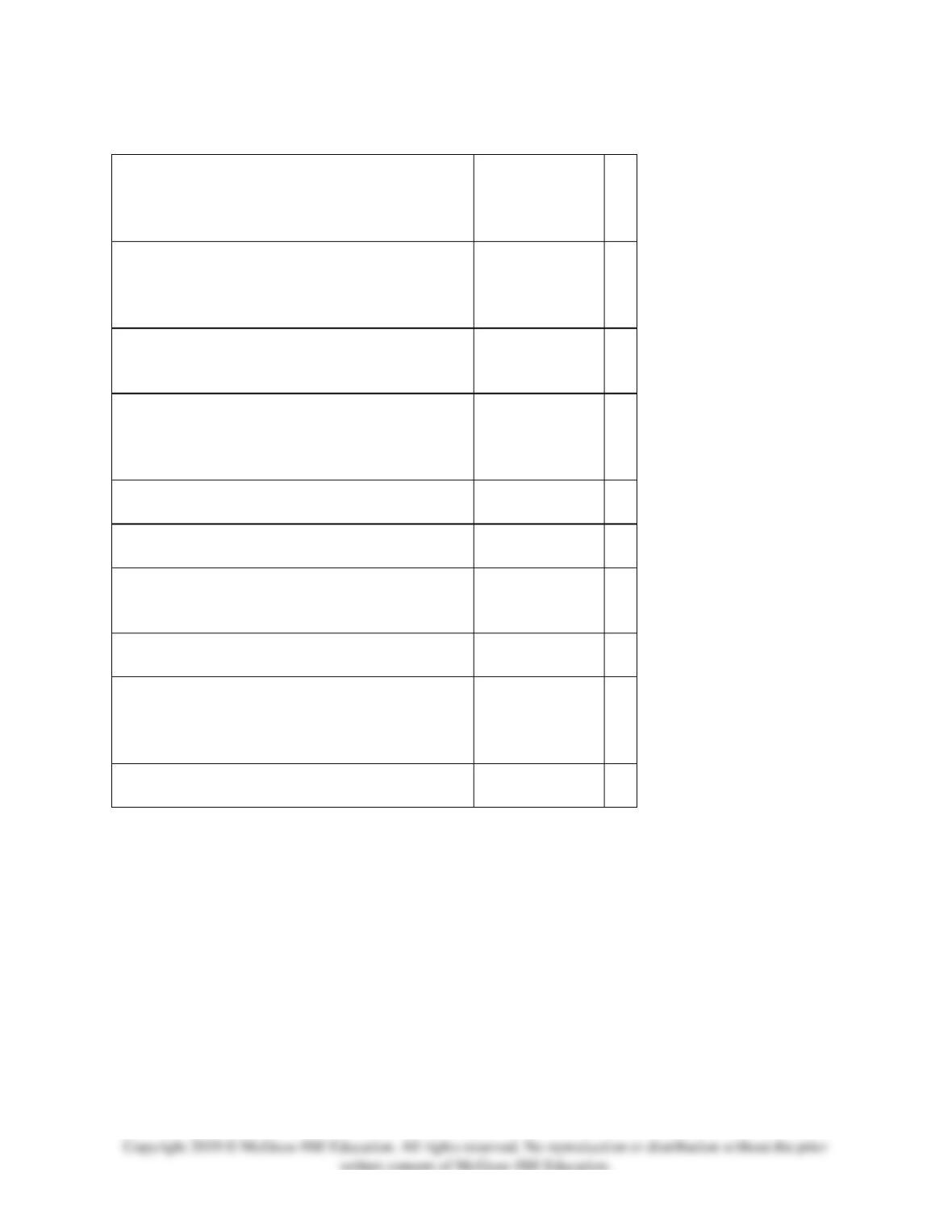
150) Match each of the following terms with the appropriate definitions.
1.Fundamental guidelines applicable to all
companies established to minimize the risk of
fraud and theft and to increase the reliability
and accuracy of the accounting records.
Bank
reconciliation
2.Short-term, highly liquid investment assets
that are readily convertible to cash and close
enough to their due date so that their market
value will not greatly change.
Voucher system
3.An internal document used to collect
information to control cash payments and to
ensure that a transaction is properly recorded.
Principles of
internal control
4.An income statement account used to record
the income effects of cash overages and cash
shortages arising from missing petty cash
receipts or errors in making change.
Days’ sales
uncollected
5.A measure of how quickly a company can
convert its accounts receivable into cash.
Liquidity
6.Principle that says the costs of internal
controls must not exceed their benefits
Cash equivalent
7.A set of procedures and approvals designed to
control cash payments and the acceptance of
liabilities.
Signature card
8.Used by the bank to verify signatures of
persons authorized to write checks.
Cost-benefit
9.A report explaining any differences between
the checking account balance according to the
depositor’s records and the balance reported on
the bank statement.
Voucher
10.The ability of a company to pay for its near-
term obligations.
Cash Over and
Short