
Name:
Class:
Date:
chapter 6
Indicate whether the statement is true or false.
1. Merchandise Inventory normally has a debit balance.
a.
True
b.
False
2. Cost of merchandise sold is the amount that a merchandising company pays for the merchandise it intends to sell.
a.
True
b.
False
3. A deduction allowed to wholesalers and retailers from the price of merchandise listed in catalogs is called a cash
discount.
a.
True
b.
False
4. For Sullivan Company, the asset turnover increased from 1.25 to 1.50. This is an unfavorable change.
a.
True
b.
False
5. In the periodic inventory system, purchases of merchandise for resale are debited to the purchases account.
a.
True
b.
False
6. On a multiple-step income statement, the dollar amount for income from operations is always the same as net income.
a.
True
b.
False
7. The statement of owner’s equity for a merchandising business is prepared in the same manner as for a service business.
a.
True
b.
False
8. Purchases of merchandise are typically credited to the merchandise inventory account under the perpetual inventory
system.
a.
True
b.
False
9. On the income statement in the single-step format, the total of all expenses is deducted from the total of all revenues.
a.
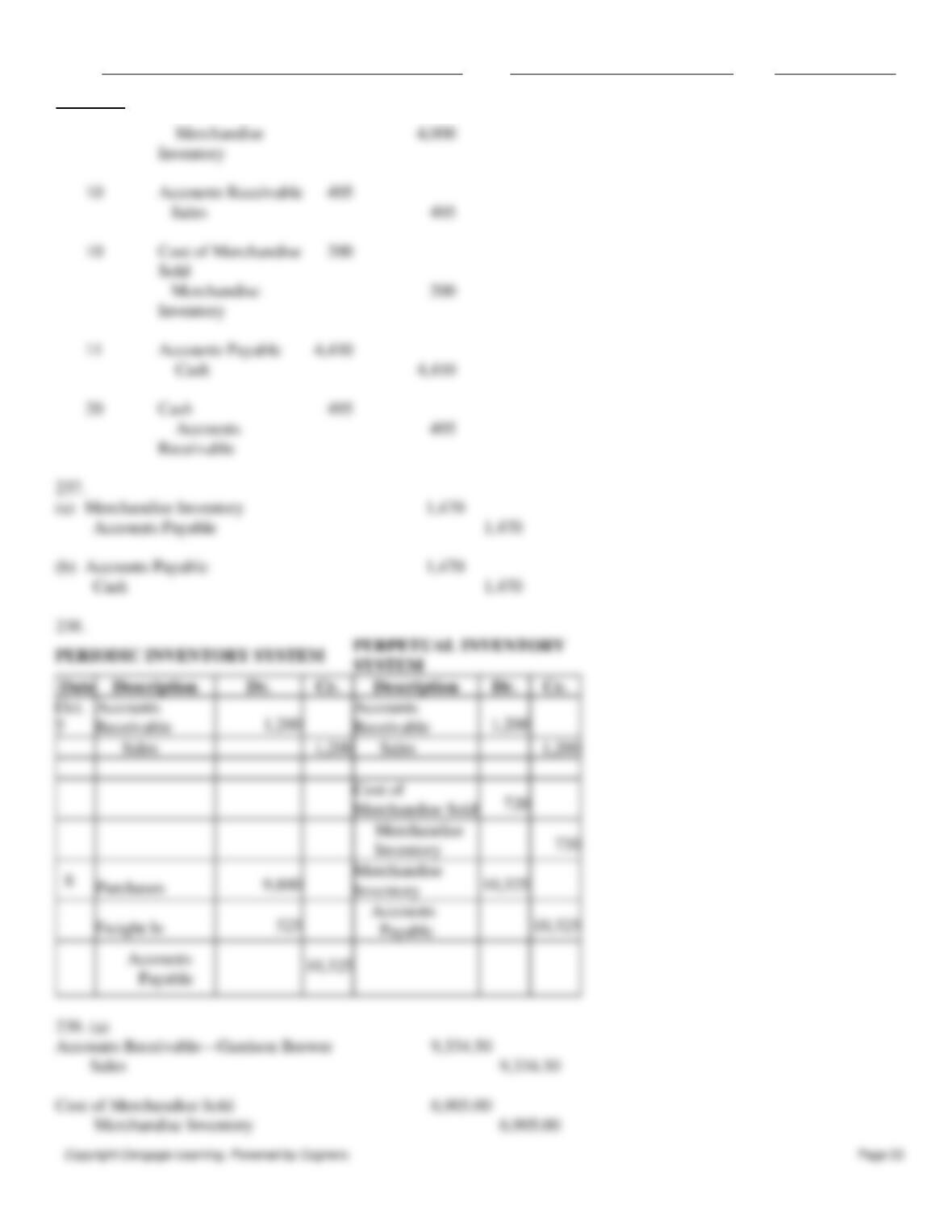
True
b.
False
10. The single-step income statement is easier to prepare, but a criticism of this format is that gross profit and income
from operations are not readily available.
a.
True
b.
False
11. Under the perpetual inventory system, when a sale is made, both the sale and cost of merchandise sold are recorded.

Name:
Class:
Date:
chapter 6
a.
True
b.
False
12. Most companies will not take a purchase discount, because 1% or 2% discounts are insignificant.
a.
True
b.
False
13. The most important differences between a service business and a retail business are reflected in their operating cycles
and financial statements.
a.
True
b.
False
14. Customer Refunds Payable is an account used to record the estimated liability for amounts due to customers for cash
refunds and allowances.
a.
True
b.
False
15. Gross profit minus selling expenses equals net income.
a.
True
b.
False
16. When the seller offers a sales discount, even if borrowing has to be done, it is generally advantageous for the buyer to
pay within the discount period.
a.
True
b.
False
17. The fees associated with credit card sales are periodically recorded as expenses.
a.
True
b.
False
18. The cost of merchandise inventory is limited to the purchase price less any purchase discounts.
a.
True
b.
False
19. Closing entries for a merchandising business are not similar to those for a service business.
a.
True
b.
False
20. In a perpetual inventory system, the merchandise inventory account is only used to reflect the beginning inventory.
a.
True
b.
False
21. Buyers and sellers do not normally record the list prices of merchandise and the trade discounts in accounts.
a.
True
b.
False

Name:
Class:
Date:
chapter 6
22. Under the periodic inventory system, the accounts Purchases, Purchases Returns and Allowances, Purchases
Discounts, and Freight In are found on the balance sheet.
a.
True
b.
False
23. Service businesses provide services for income, while merchandising businesses sell merchandise.
a.
True
b.
False
24. In a periodic inventory system, the cost of merchandise purchased includes the cost of freight in.
a.
True
b.
False
25. Estimated Returns Inventory is an account used when adjusting for expected merchandise sales in the next period.
a.
True
b.
False
26. The abbreviation FOB stands for “free on board.”
a.
True
b.
False
27. When merchandise is sold for $600 plus a 6% sales tax, the sales account should be credited for $636.
a.
True
b.
False
28. The asset turnover measures how effectively a business is using its assets to generate sales.
a.
True
b.
False
29. When companies use a perpetual inventory system, the journal entry for the purchase of inventory will include a debit
to Purchases.
a.
True
b.
False
30. When a large quantity of merchandise is purchased, a reduction allowed on the sale price is called a trade discount.
a.
True
b.
False
31. When the terms of sale are FOB shipping point, the buyer should pay the freight charges.
a.
True
b.
False
32. On the balance sheet, Allowance for Sales Discounts will appear as a contra asset account to Sales.
a.
True
b.
False

Name:
Class:
Date:
chapter 6
33. When merchandise that was sold is returned, a credit to Customer Refunds Payable is made.
a.
True
b.
False
34. Title to merchandise shipped FOB shipping point passes to the buyer upon delivery of the merchandise to the buyer’s
place of business.
a.
True
b.
False
35. Most retailers record all credit card sales as credit sales.
a.
True
b.
False
36. Freight is considered a part of the buyer’s total cost of purchasing inventory under FOB shipping point terms.
a.
True
b.
False
37. Under the periodic inventory system, the cost of merchandise sold is equal to the beginning merchandise inventory
plus the cost of merchandise purchased plus the ending merchandise inventory.
a.
True
b.
False
38. Sales is equal to the cost of merchandise sold less the gross profit.
a.
True
b.
False
39. In a perpetual inventory system, when merchandise is returned to the supplier, Cost of Merchandise Sold is debited as
part of the transaction.
a.
True
b.
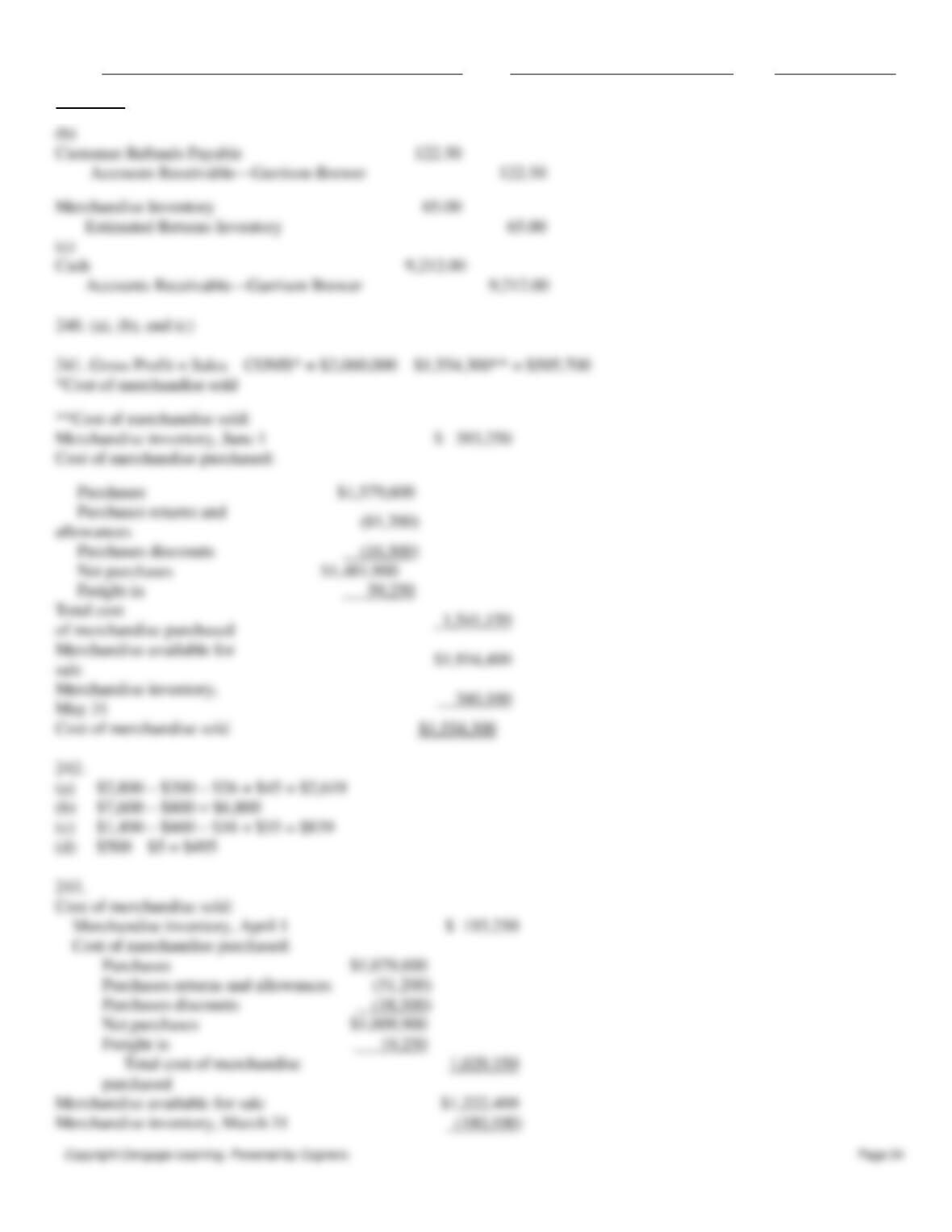
False
40. If the buyer bears the freight costs related to a purchase, the terms are said to be FOB destination.
a.
True
b.
False
41. Purchased goods in transit should be included in the ending inventory of the buyer if the goods were shipped FOB
shipping point.
a.
True
b.
False
42. The chart of accounts for a merchandising business would include an account called Delivery Expense.
a.
True
b.
False
43. The adjusting entry for inventory shrinkage would generally include a debit to Cost of Merchandise Sold.
a.
True

Name:
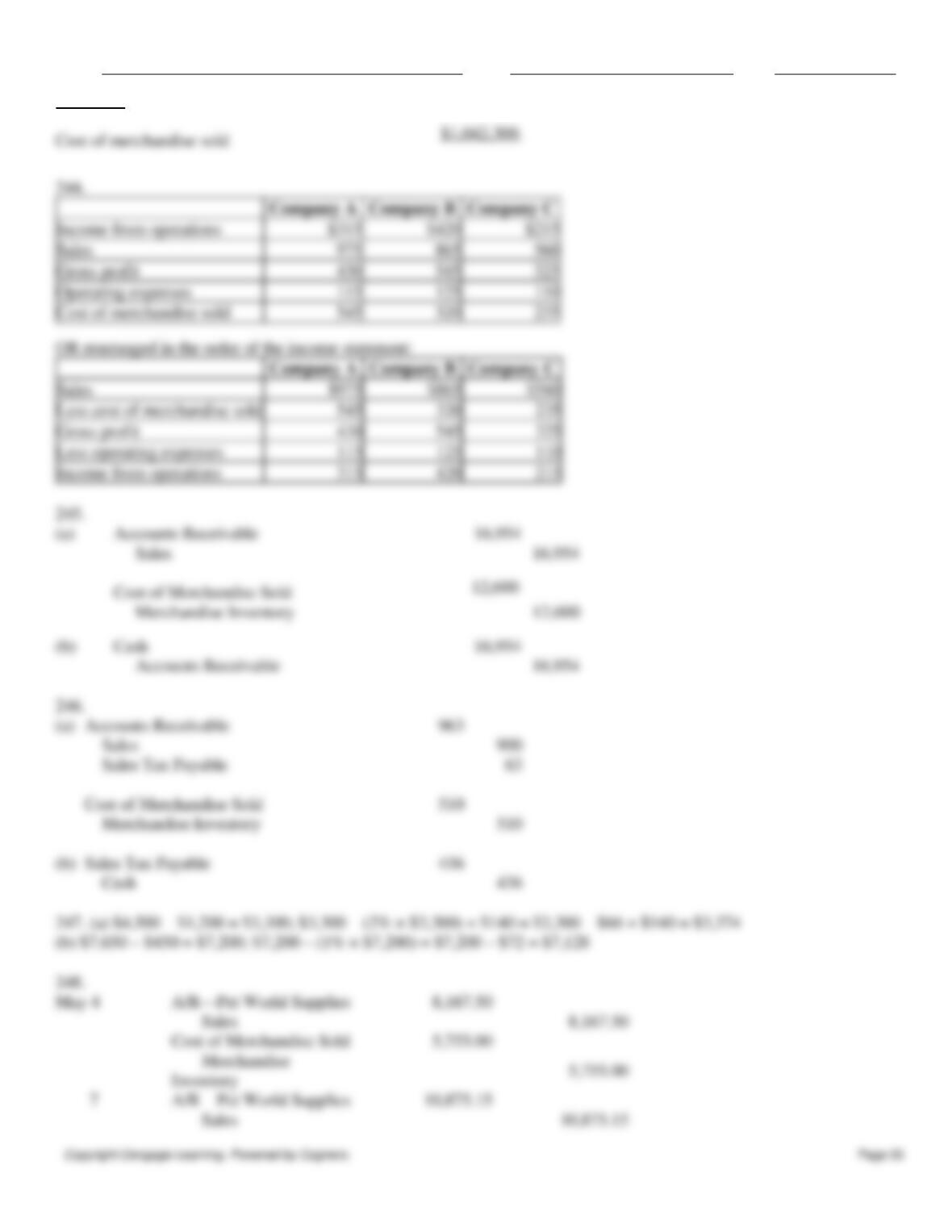
Class:
Date:
chapter 6
a.
True
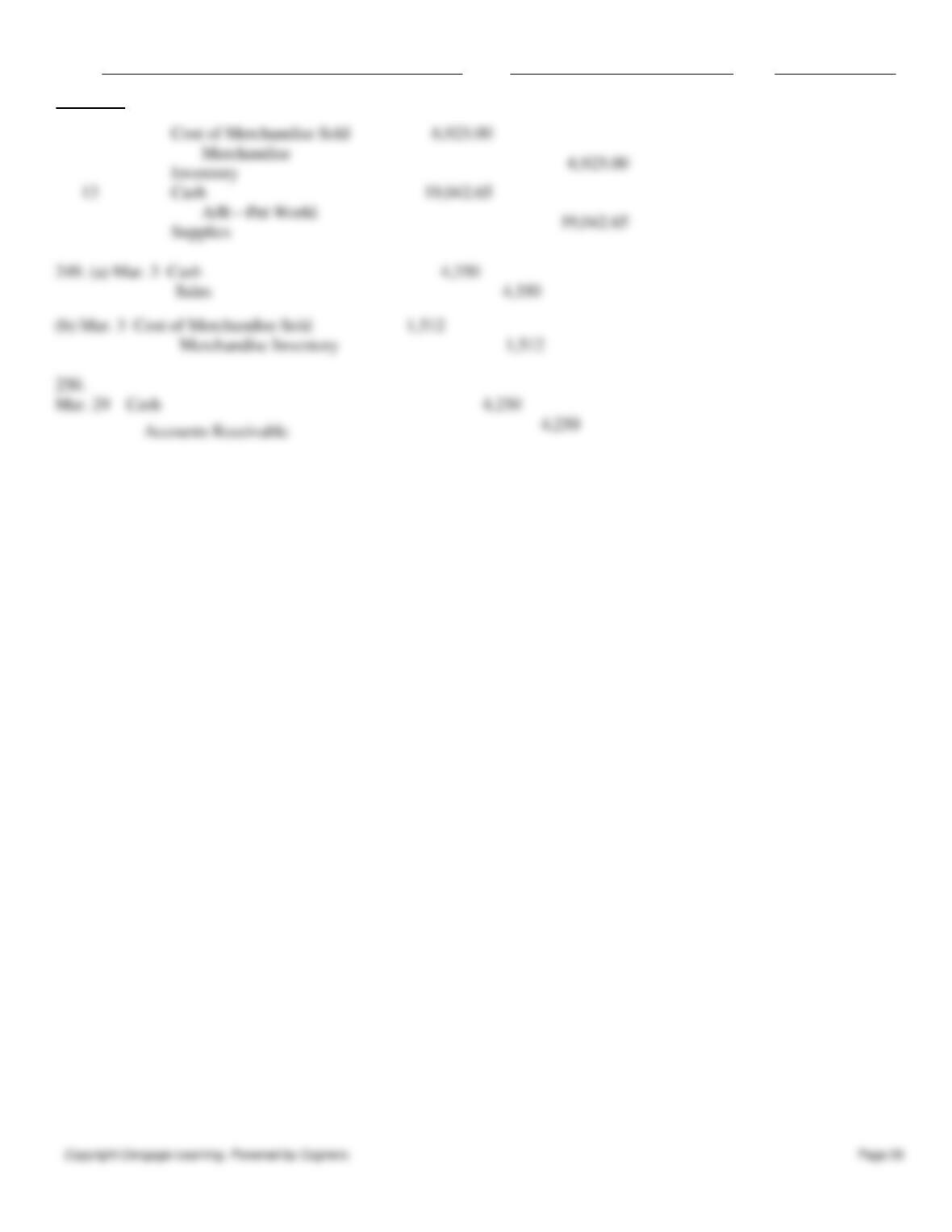
b.
False
44. Other revenue and expense items are not related to the primary operations of the business.
a.
True
b.
False
45. Sellers and buyers are required to record trade discounts.
a.
True
b.
False
46. Large businesses that make sales to customers who use credit cards, such as American Express, generally treat these
sales as cash sales.
a.
True
b.
False
47. Purchased goods in transit, shipped FOB destination, should be excluded from the ending inventory of the buyer.
a.
True
b.
False
48. Cost of merchandise sold is often the largest expense on a merchandising company’s income statement.
a.
True
b.
False
49. Freight is the amount paid by the seller to deliver merchandise sold to a customer under FOB shipping point terms.
a.
True
b.
False
50. In a merchandise business, sales minus operating expenses equals net income.
a.
True
b.
False
51. A sales discount encourages customers to pay their invoice early.
a.
True
b.
False
52. There is no difference between the recording of cash sales and the recording of MasterCard or VISA sales.
a.
True
b.
False
53. If payment is due by the end of the month in which the sale is made, the invoice terms are expressed as n/30.
a.
True
b.
False
54. If the ownership of merchandise passes to the buyer when the seller delivers the merchandise to the carrier, the terms
are considered FOB destination.

Name:
Class:
Date:
chapter 6
b.
False
55. Under a perpetual inventory system, the cost of merchandise on hand at the end of the year can only be determined by
reviewing the ledger.
a.
True
b.
False
56. On the merchandising income statement, sales will be reduced by administrative expenses to arrive at income from
operations.
a.
True
b.
False
57. The seller records the sales tax as part of the sales amount.
a.
True
b.
False
58. Under the perpetual inventory system, a company purchases merchandise on terms 2/10, n/30. The journal entry for
this purchase will include a debit to Cash and a credit to Sales.
a.
True
b.
False
59. Sales to customers who use bank credit cards, such as MasterCard and VISA, are generally treated as credit sales.
a.
True
b.
False
60. Because many companies use computerized accounting systems, periodic inventory is widely used.
a.
True
b.
False
61. A seller may grant a buyer a reduction in selling price, and this is called a customer discount.
a.
True
b.
False
62. A buyer who acquires merchandise under credit terms of 1/10, n/30 has 30 days after the invoice date to take
advantage of the sales discount.
a.
True
b.
False
63. Revenue that cannot be associated definitely with operations, such as a gain from the sale of a fixed asset, is listed as
Other Revenue on the multiple-step income statement.
a.
True
b.
False
64. In a perpetual inventory system, merchandise returned to vendors reduces the merchandise inventory account.
a.
True
b.
False

Name:
Class:
Date:
chapter 6
65. If merchandise costing $3,500, terms FOB destination, 2/10, n/30, with prepaid freight costs of $125, is paid within 10
days, the amount of the purchases discount is $70.
a.
True
b.
False
66. Under the gross method of recording sales discounts, the adjusting entry at the end of the accounting period reduces
Sales for the estimated sales discounts related to the current period’s sales that are expected to be taken in the next period.
a.
True
b.
False
67. As we compare a merchandise business to a service business, the financial statement that changes the most is the
balance sheet.
a.
True
b.
False
68. In retail businesses, inventory is reported as a current asset.
a.
True
b.
False
69. A business using the perpetual inventory system, with its detailed subsidiary records, does not need to take a physical
inventory.
a.
True
b.
False
70. A sale of $750 on account subject to a sales tax of 6% would be recorded as an account receivable of $750.
a.
True
b.
False
71. Merchandise is sold for $3,600, terms 2/10, n/30, with prepaid freight costs of $150. The amount of the sale recorded
is $3,528.
a.
True
b.
False
72. Under the gross method of recording sales discounts, the journal entry for a sale of merchandise on account for
$3,500, terms 2/10, n/30, would include a credit to Sales Discounts for $70.
a.
True
b.
False
73. If the perpetual inventory system is used, an account entitled Cost of Merchandise Sold is included in the general
ledger.
a.
True
b.
False
74. The gross method of recording sales discounts requires an adjusting entry and a contra asset account.
a.
True
b.
False
Name:
Class:
Date:
chapter 6
75. Under the periodic inventory system, the cost of merchandise sold is recorded when sales are made.
a.
True
b.
False
76. The seller may prepay the freight costs even though the terms are FOB shipping point.
a.
True
b.
False
Indicate the answer choice that best completes the statement or answers the question.
77. Merchandise Inventory is classified on the balance sheet as a
a.
current liability
b.
current asset
c.
long-term asset
d.
long-term liability
78. Determine income from operations for Jonas Company based on the following data:
Sales
$764,000
Operating expenses
52,500
Cost of merchandise sold
538,000
a.
$485,500
b.
$711,500
c.
$173,500
d.
$226,000
79. Using a perpetual inventory system, the journal entry for the return from a customer of merchandise sold on account
includes a
a.
credit to Customer Refunds Payable
b.
debit to Merchandise Inventory
c.
credit to Merchandise Inventory
d.
debit to Cash
80. The journal entry for the receipt of inventory purchased for cash in a perpetual inventory system would be
a.
Jan. 1 Merchandise Inventory 1,500
Cash 1,500
b.
Jan. 1 Office Supplies 1,500
Cash 1,500
c.
Jan. 1 Purchases 1,500
Accounts Payable 1,500
d.
Jan. 1 Cash 1,500
Accounts Receivable 1,500
81. Merchandise with a sales price of $5,000 is sold on account with terms 2/10, n/30. The journal entry for the sale would
include a
a.
debit to Cash for $5,000
Name:
Class:
Date:
chapter 6
of the merchandise if paid on September 12, assuming the discount is taken?
b.
debit to Sales Discounts for $100
c.
credit to Sales for $4,900
d.
debit to Accounts Receivable for $4,880
82. Using the following information, what is the amount of income from operations?
Purchases
$32,000
Selling expenses
$ 960
Merchandise inventory,
September 1
5,700
Merchandise inventory,
September 30
6,370
Administrative expenses
910
Sales
63,000
Rent revenue
1,200
Interest expense
1,040
a.
$32,870
b.
$31,910
c.
$30,710
d.
$29,800
83. Abbey Co. sold merchandise to Gomez Co. on account, $35,000, terms 2/15, net 45. The cost of the merchandise sold
was $24,500. Abbey Co. issued a credit memo for $3,600 for defective merchandise, which was not returned to Abbey.
Gomez Co. paid the invoice within the discount period. What is the gross profit earned by Abbey Co. on these
transactions?
a.
$10,500
b.
$30,772
c.
$6,272
d.
$31,400
84. Which of the following accounts has a normal credit balance?
a.
Accounts Receivable
b.
Sales
c.
Merchandise Inventory
d.
Delivery Expense
85. If the physical count of inventory revealed $158,000 of merchandise on hand and the inventory records reported
$163,000, what would be the necessary adjusting entry for inventory shrinkage?
a.
debit Merchandise Inventory, $158,000; credit Cost of Merchandise Sold, $158,000
b.
debit Merchandise Inventory, $5,000; credit Cost of Merchandise Sold, $5,000
c.
debit Cost of Merchandise Sold, $163,000; credit Merchandise Inventory, $163,000
d.
debit Cost of Merchandise Sold, $5,000; credit Merchandise Inventory, $5,000
86. Who is responsible for the freight cost when the terms are FOB destination?
a.
the seller
b.
the buyer
c.
the customer
d.
either the buyer or the seller
87. Merchandise is purchased for $6,000 on September 2 subject to terms of 2/10, n/30, FOB destination. What is the cost

Name:
Class:
Date:
chapter 6
a.
$6,120
b.
$5,940
c.
$6,090
d.
$5,880
88. If title to merchandise purchases passes to the buyer when the goods are shipped from the seller, the terms are
a.
n/30
b.
FOB shipping point
c.
FOB destination
d.
consigned
89. When goods are shipped FOB destination and the seller pays the freight charges, the buyer
a.
journalizes a reduction for the cost of the merchandise
b.
journalizes a reimbursement to the seller
c.
does not take a discount
d.
makes no journal entry for the freight
90. Which of the following accounts will only be found in the chart of accounts of a merchandising company?
a.
Sales
b.
Accounts Receivable
c.
Merchandise Inventory
d.
Accounts Payable
91. The journal entry for the return of merchandise from a customer would include a
a.
debit to Sales
b.
credit to Sales
c.
debit to Customer Refunds Payable
d.
debit to Estimated Returns Inventory
92. Merchandise subject to terms 2/10, n/30, FOB shipping point, is sold on account to a customer for $25,000. What is
the amount of the sales discount allowable?
a.
$260
b.
$500
c.
$460
d.
$150
93. Using the following information, what is the amount of gross profit?
Purchases
$32,000
Selling expenses
$ 960
Merchandise inventory,
September 1
5,700
Merchandise inventory,
September 30
6,370
Administrative expenses
910
Sales
63,000
Rent revenue
1,200
Interest expense
1,040
a.
$25,300
b.
$31,670

Name:
Class:
Date:
chapter 6
c.
$30,600
d.
$62,840
94. The inventory system employing accounting records that continuously disclose the amount of inventory is called
a.
retail
b.
periodic
c.
physical
d.
perpetual
95. Determine the gross profit for Jefferson Company based on the following data:
Sales
$764,000
Selling expenses
42,500
Cost of merchandise sold
538,000
a.
$495,500
b.
$183,500
c.
$721,500
d.
$226,000
96. Which of the following items would not affect the cost of merchandise inventory acquired during the period?
a.
quantity discounts
b.
purchases discounts
c.
freight in
d.
sales commissions
97. Emma Co. sold to Isabella Co. merchandise on account FOB shipping point, 2/10, net 30, for $15,000. Emma
Co. prepaid the $750 shipping charge. Using the perpetual inventory method, which of the following entries will Isabella
Co. make for the payment for the merchandise if Isabella Co. pays within the discount period?
a.
Accounts Payable—Emma Co., debit $15,000; Cash, credit $15,000
b.
Accounts Payable—Emma Co., debit $15,450; Cash, credit $15,450
c.
Accounts Payable—Emma Co., debit $15,000; Freight In, debit $750; Cash, credit $15,750
d.
Accounts Payable—Emma Co., debit $15,750; Merchandise Inventory, debit $300; Cash, credit $16,050
98. Under a perpetual inventory system,
a.
accounting records continuously disclose the amount of inventory
b.
increases in inventory resulting from purchases are debited to Purchases
c.
a physical count is required to determine cost of merchandise on hand
d.
the purchases returns and allowances account is credited when goods are returned to vendors
99. When comparing a retail business to a service business, the financial statement that changes the least is the
a.
balance sheet
b.
income statement
c.
statement of owner’s equity
d.
statement of cash flows

Name:
Class:
Date:
chapter 6
100. A sales invoice included the following information: merchandise price, $12,000; terms 1/10, n/eom, FOB shipping
point with prepaid freight of $900 added to the invoice. Assuming that a credit for merchandise returned of $500 (before
discount) is granted prior to payment and the invoice is paid within the discount period, what amount of cash should be
received by the seller?
a.
$12,285
b.
$11,500
c.
$10,480
d.
$11,385
101. Dollar Co. sold merchandise to Pound Co. on account, $25,500, terms 2/15, net 45. Pound Co. paid the invoice
within the discount period. What is the amount of sales from these transactions?
a.
$25,500
b.
$26,010
c.
$24,990
d.
$16,000
102. Expenses that are incurred directly or entirely in connection with the sale of merchandise are classified as
a.
selling expenses
b.
general expenses
c.
other expenses
d.
administrative expenses
103. When the perpetual inventory system is used, the inventory sold is debited to
a.
Supplies Expense
b.
Cost of Merchandise Sold
c.
Merchandise Inventory
d.
Sales
104. What type of company would normally offer trade discounts to its customers?
a.
service company
b.
retailer
c.
wholesaler
d.
online retailer
105. A retailer purchases merchandise with a catalog list price of $30,000. The retailer receives a 15% trade discount and
has credit terms of 2/10, n/30. How much cash will be needed to pay this invoice within the discount period?
a.
$30,000
b.
$24,900
c.
$29,400
d.
$24,990
106. Sales to customers who use bank credit cards, such as MasterCard and VISA, are generally treated as
a.
sales on account
b.
sales returns
c.
cash sales

Name:
Class:
Date:
chapter 6
d.
sales when the credit card company remits the cash
107. Which account is not classified as a selling expense?
a.
Sales Salaries
b.
Delivery Expense
c.
Cost of Merchandise Sold
d.
Advertising Expense
108. Pierce Company sold merchandise to Stanton Company on account FOB shipping point, 2/10, net 30, for $20,000.
Pierce prepaid the $500 shipping charge. Which of the following entries does Pierce make for this sale?
a.
Accounts Receivable—Stanton, debit $20,000; Sales, credit $20,000
b.
Accounts Receivable—Stanton, debit $19,600; Sales, credit $19,600, and
Accounts Receivable—Stanton, debit $500; Cash, credit $500
c.
Accounts Receivable—Stanton, debit $20,100; Sales, credit $20,100
d.
Accounts Receivable—Stanton, debit $20,000; Sales, credit $20,000, and
Delivery Expense, debit $500; Cash, credit $500
109. Gross profit is equal to
a.
sales plus cost of merchandise sold
b.
sales plus selling expenses
c.
sales less selling expenses
d.
sales less cost of merchandise sold
110. Which of the following items should not be included in the cost of ending merchandise inventory?
a.
purchased units in transit, shipped FOB shipping point
b.
purchased units in transit, shipped FOB destination
c.
units on hand in the warehouse
d.
sold units in transit, not invoiced, and shipped FOB destination
111. Which of the following accounts should be closed at the end of the fiscal year?
a.
Merchandise Inventory
b.
Accumulated Depreciation
c.
Owner’s Capital
d.
Cost of Merchandise Sold
112. Under the periodic inventory system, the journal entry for the purchase of merchandise inventory will include a debit
to
a.
Merchandise Inventory
b.
Purchases
c.
Accounts Payable
d.
Cost of Merchandise Purchased
113. The primary difference between a periodic and perpetual inventory system is that a periodic system
a.
determines the inventory on hand only at the end of the accounting period
b.
keeps a record showing the inventory on hand at all times

Name:
Class:
Date:
chapter 6
c.
provides an easy means to determine inventory shrinkage
d.
records the cost of the sale on the date the sale is made
114. Taking advantage of a 2/10, n/30 purchases discount is equal to a yearly savings rate of approximately
a.
2%
b.
24%
c.
20%
d.
36%
115. Which of the following accounts will not be found in the Cost of Merchandise Sold section of the income statement
for a company using the periodic inventory method?
a.
Purchases
b.
Freight In
c.
Selling Expense
d.
Merchandise Inventory
116. In recording the cost of merchandise sold based on data available from perpetual inventory records, the journal entry
is a
a.
debit to Cost of Merchandise Sold and a credit to Sales
b.
debit to Cost of Merchandise Sold and a credit to Merchandise Inventory
c.
debit to Merchandise Inventory and a credit to Cost of Merchandise Sold
d.
debit to Accounts Receivable and a credit to Merchandise Inventory
117. Using a perpetual inventory system, the journal entry for the sale of merchandise on account includes a
a.
debit to Sales
b.
debit to Merchandise Inventory
c.
credit to Merchandise Inventory
d.
credit to Accounts Receivable
118. In a merchandising business, operating income plus operating expenses is equal to
a.
cost of merchandise sold
b.
cost of merchandise available for sale
c.
sales
d.
gross profit
119. Norfolk Sporting Goods purchases merchandise with a catalog list price of $30,000. The retailer receives a 30% trade
discount and credit terms of 2/10, n/30. What amount should Norfolk debit to the merchandise inventory account?
a.
$21,000
b.
$20,580
c.
$30,000
d.
$29,400
120. Under the perpetual inventory system, all purchases of merchandise are debited to the account
a.
Merchandise Inventory
b.
Cost of Merchandise Sold

Name:
Class:
Date:
chapter 6
c.
Cost of Merchandise Available for Sale
d.
Purchases
121. When a buyer returns merchandise purchased for cash, the buyer will journalize the transaction as a
a.
debit to Merchandise Inventory and a credit to Cash
b.
debit to Cash and a credit to Merchandise Inventory
c.
debit to Cash and a credit to Sales
d.
debit to Sales and a credit to Accounts Payable
122. Jacob Co. sells merchandise on account to Isaiah Co. for $9,700. The invoice is dated on May 1 with terms of 1/15,
net 45. What is the discount, and up to what date must the invoice be paid in order for the buyer to take advantage of the
discount?
a.
$194, May 15
b.
$194, May 16
c.
$97, May 15
d.
$97, May 16
123. When purchases of merchandise are made on account with a perpetual inventory system, the transaction is
journalized with which entry?
a.
debit Accounts Payable; credit Merchandise Inventory
b.
debit Merchandise Inventory; credit Accounts Payable
c.
debit Merchandise Inventory; credit Cash Discounts
d.
debit Merchandise Inventory; credit Purchases
124. Cumberland Co. sells $2,000 of merchandise to Hancock Co. for cash. Cumberland paid $1,250 for the merchandise.
Under a perpetual inventory system, which of the following is the correct journal entry(ies)?
a.
debit Cash, $2,000; credit Merchandise Inventory, $2,000
b.
debit Cash, $2,000; credit Sales, $2,000; and debit Cost of Merchandise Sold, $1,250; credit Merchandise
Inventory, $1,250
c.
debit Cash, $1,250; credit Sales, $1,250
d.
debit Accounts Receivable, $2,000; credit Sales, $2,000; and debit Cost of Merchandise Sold, $1,250; credit
Merchandise Inventory, $1,250
125. The form of income statement that derives its name from the fact that the total of all expenses is deducted from the
total of all revenues is called a
a.
multiple-step income statement
b.
revenue statement
c.
report-form income statement
d.
single-step income statement
126. The statement of owner’s equity shows
a.
only net income and beginning and ending capital
b.
only total assets and beginning and ending capital
c.
only net income, beginning capital, and withdrawals
d.
beginning and ending capital, all the changes in the owner’s capital as a result of net income (loss), and
Name:
Class:
Date:
chapter 6
withdrawals
127. Kaden Co. sells merchandise on account to Jase Co. for $9,600. The invoice is dated July 15 with terms of 1/15, net
45. If Jase Co. chooses not to take the discount, by when should the payment be made?
a.
July 30
b.
August 29
c.
August 15
d.
July 25
128. Sales to customers who use bank credit cards such as MasterCard and VISA are usually journalized by a
a.
debit to Bank Credit Card Sales, a debit to Credit Card Expense, and a credit to Sales
b.
debit to Cash and a credit to Sales
c.
debit to Cash, a credit to Credit Card Expense, and a credit to Sales
d.
debit to Sales, a debit to Credit Card Expense, and a credit to Cash
129. Using a perpetual inventory system, the entry to journalize the purchase of $30,000 of merchandise on account would
include a
a.
debit to Accounts Payable
b.
debit to Merchandise Inventory
c.
credit to Merchandise Inventory
d.
credit to Sales
130. Bountiful Company had sales of $650,000 and cost of merchandise sold of $200,000 during the year. The total assets
balance at the beginning of the year was $175,000 and at the end of the year was $167,000. Compute the asset turnover.
a.
3.00
b.
3.80
c.
0.29
d.
0.26
131. Using the following information, determine the cost of merchandise sold.
Purchases
$32,000
Selling expenses
$ 960
Merchandise inventory,
September 1
5,700
Merchandise inventory,
September 30
6,370
Administrative expenses
910
Sales
63,000
Rent revenue
1,200
Interest expense
1,040
a.
$32,400
b.
$32,670
c.
$31,330
d.
$38,370
132. Bradford Company had sales of $700,000 for the year. The total assets at the beginning of the year were $240,000,
and the total assets at the end of the year were $280,000. The asset turnover is (round answer to two decimal places)
a.
2.69
b.
0.40
c.
2.92

Name:
Class:
Date:
chapter 6
d.
0.34
133. Under a periodic inventory system, closing entries will include
a.
debits to Sales, Purchases Returns and Allowances, and Purchases Discounts
b.
credits to Purchases and Sales Discounts
c.
adjustments to Merchandise Inventory to match physical inventory
d.
All of these choices
134. A company using the periodic inventory system has the following account balances: Merchandise Inventory at the
beginning of the year, $3,600; Freight In, $650; Purchases, $10,700; Purchases Returns and Allowances, $1,950;
Purchases Discounts, $330. The cost of merchandise purchased is equal to
a.
$12,670
b.
$9,070
c.
$8,420
d.
$17,230
135. Merchandise is ordered on November 10; the merchandise is shipped by the seller and the invoice is prepared, dated,
and mailed by the seller on November 13; the merchandise is received by the buyer on November 18; and the entry is
made in the buyer’s accounts on November 20. The credit period begins with what date?
a.
November 10
b.
November 13
c.
November 18
d.
November 20
136. President’s salaries, depreciation of office furniture, and office supplies are
a.
selling expenses
b.
miscellaneous expenses
c.
administrative expenses
d.
inventory expenses
137. If the buyer is to pay the freight costs of delivering merchandise, delivery terms are stated as
a.
FOB shipping point
b.
FOB destination
c.
FOB n/30
d.
FOB buyer
138. For a buyer using a perpetual inventory system, the entry to record the return of merchandise purchased on account
includes a
a.
debit to Cost of Merchandise Sold
b.
credit to Accounts Payable
c.
credit to Merchandise Inventory
d.
credit to Sales
139. Which term is applied to the excess of revenue from sales over the cost of merchandise sold?
a.
gross profit

Name:
Class:
Date:
chapter 6
b.
income from operations
c.
net income
d.
gross sales
140. If merchandise sold on account is damaged in shipment, the seller may inform the customer of a reduction to the
customer’s account by issuing a
a.
sales invoice
b.
purchase invoice
c.
credit memo
d.
debit memo
141. If merchandise sells for $3,500 on account, with terms of 3/15, n/45, and the cost of the inventory sold is $2,100, the
amount charged to sales under the gross method is
a.
$3,395
b.
$3,500
c.
$2,037
d.
$2,100
142. If merchandise sells for $3,500 on account, with terms of 3/15, n/45, and the cost of the inventory sold is $2,100, the
journal entry for the receipt of the customer’s payment on account within the discount period under the gross method
would include
a.
a credit to Cash for $3,395
b.
a credit to Accounts Receivable for $3,395
c.
a debit to Sales of $105
d.
a credit to Sales Discounts for $105
143. A chart of accounts for a merchandising business
a.
usually is the same as the chart of accounts for a service business
b.
usually requires more accounts than does the chart of accounts for a service business
c.
usually is standardized by the FASB for all merchandising businesses
d.
always uses a three-digit numbering system
144. In credit terms of 3/15, n/45, the “3” represents the
a.
number of days in the discount period
b.
full amount of the invoice
c.
number of days when the entire amount is due
d.
percent of the available discount for early payment
145. Inventory shrinkage is journalized when
a.
merchandise is returned by a buyer
b.
merchandise purchased from a seller is incomplete or short
c.
merchandise is returned to a seller
d.
there is a difference between the physical count of inventory and the perpetual inventory records
146. When merchandise purchased on account is returned under the perpetual inventory system, the buyer would debit

Name:
Class:
Date:
chapter 6
a.
Merchandise Inventory
b.
Purchases Returns and Allowances
c.
Accounts Payable
d.
Accounts Receivable
147. The proper journal entry for the receipt of inventory purchased on account in a periodic inventory system would be
a.
Jan. 1 Merchandise Inventory 1,600
Accounts Payable 1,600
b.
Jan. 1 Office Supplies 1,600
Accounts Payable 1,600
c.
Jan. 1 Purchases 1,600
Accounts Payable 1,600
d.
Jan. 1 Purchases 1,600
Accounts Receivable 1,600
148. Which of the following accounts has a normal debit balance?
a.
Accounts Payable
b.
Merchandise Inventory
c.
Sales
d.
Interest Revenue
149. If merchandise sells for $3,500, with terms of 3/15, n/45, and the cost of the inventory sold is $2,100, the amount
charged to sales is
a.
$3,395
b.
$3,500
c.
$2,037
d.
$2,100
150. Where are selling and administrative expenses found on the multiple-step income statement?
a.
before gross profit
b.
after sales and before gross profit
c.
after net income and before expenses
d.
after gross profit
151. Multiple-step income statements show
a.
gross profit but not income from operations
b.
neither gross profit nor income from operations
c.
both gross profit and income from operations
d.
income from operations but not gross profit
152. Generally, the revenue account for a merchandising business is entitled
a.
Sales
b.
Fees Earned
c.
Gross Sales
d.
Gross Profit

Name:
Class:
Date:
chapter 6
153. Who is responsible for the freight costs when the terms are FOB shipping point?
a.
the ultimate customer
b.
the buyer
c.
the seller
d.
either the seller or the buyer
154. What is the major difference between a periodic and a perpetual inventory system?
a.
Under the periodic inventory system, the purchase of inventory will be debited to the purchases account.
b.
Under the periodic inventory system, no journal entry is made at the time of the sale of inventory for the cost
of the inventory.
c.
Under the periodic inventory system, all adjustments such as purchases returns and allowances and discounts
are reconciled at the end of the month.
d.
All of these choices are correct.
155. Under the periodic inventory system, the journal entry for the cost of merchandise sold at the point of sale will
include which of the following?
a.
None of these choices
b.
Cost of Merchandise Sold
c.
Inventory
d.
Purchases
156. If title to merchandise purchases passes to the buyer when the goods are delivered to the buyer, the terms are
a.
consigned
b.
n/30
c.
FOB shipping point
d.
FOB destination
157. Which account will be included in the closing entries of both service and merchandising businesses?
a.
Advertising Expense
b.
Cost of Merchandise Sold
c.
Customer Refunds Payable
d.
Merchandise Inventory
158. A company using the periodic inventory system has merchandise inventory costing $210 on hand at the beginning of
a period. During the period, merchandise costing $635 is purchased. At year-end, merchandise inventory costing $160 is
on hand. The cost of merchandise sold for the year is
a.
$795
b.
$685
c.
$265
d.
$635
159. Corbit Corp. sold merchandise for $10,000 cash. The cost of merchandise sold was $7,590. The journal entries for
this transaction under the perpetual inventory system would be
a.
Cash 10,000

Name:
Class:
Date:
chapter 6
Merchandise Inventory 10,000
Cost of Merchandise Sold 7,590
Sales 7,590
b.
Cash 10,000
Sales 10,000
Cost of Merchandise Sold 7,590
Merchandise Inventory 7,590
c.
Cash 10,000
Sales 10,000
Cost of Merchandise Sold 10,000
Merchandise Inventory 10,000
d.
Cash 7,590
Sales 7,590
Cost of Merchandise Sold 7,590
Merchandise Inventory 7,590
160. To encourage a buyer to pay before the end of the credit period, the seller may offer a (answer from perspective of
seller)
a.
purchases discount
b.
sales discount
c.
trade discount
d.
volume discount
161. The arrangements between buyer and seller as to when payments for merchandise are to be made are called
a.
credit terms
b.
net cash
c.
cash on demand
d.
gross cash
162. Which of the following is not a difference between a retail business and a service business?
a.
what is sold by the business
b.
the inclusion of gross profit on the income statement
c.
elements of the accounting equation
d.
the inclusion of merchandise inventory on the balance sheet
163. When the perpetual inventory system is used, the inventory sold is shown on the income statement as
a.
cost of merchandise sold
b.
purchases
c.
purchases returns and allowances
d.
net purchases
164. If the seller is to pay the freight costs of delivering merchandise, the delivery terms are stated as
a.
FOB shipping point
Name:
Class:
Date:
chapter 6
b.
FOB destination
c.
FOB n/30
d.
FOB seller
165. Merchandise is sold for cash. The selling price of the merchandise is $6,000, and the sale is subject to a 7% state
sales tax. The journal entry for the sale would include a credit to
a.
Cash for $6,000
b.
Sales for $6,240
c.
Sales Tax Payable for $420
d.
Sales for $5,580
166. When comparing a merchandising business to a service business, the financial statement that changes the most is the
a.
balance sheet
b.
income statement
c.
statement of owner’s equity
d.
statement of cash flows
167. Using the following information, what is the amount of net income?
Purchases
$32,000
Selling expenses
$ 960
Merchandise inventory,
September 1
5,700
Merchandise inventory,
September 30
6,370
Administrative expenses
910
Sales
63,000
Rent revenue
1,200
Interest expense
1,040
a.
$29,800
b.
$29,960
c.
$28,760
d.
$31,670
Match each of the following definitions with the term (a–h) it defines.
a.
Freight In
b.
Delivery Expense
c.
Merchandise Inventory
d.
Sales discount
e.
Purchases Returns and Allowances
f.
Debit memo
g.
Purchase discount
h.
Trade discount
168. Discount taken by the buyer for early payment of invoice
169. Account used to journalize merchandise on hand under a perpetual inventory system
170. Early payment discount offered to customers by the seller

Name:
Class:
Date:
chapter 6
171. Expense account for recording shipping costs paid by the seller
172. Discount to government agencies or customers who purchase large quantities of merchandise
173. Account where returned merchandise or price adjustments are recorded by the buyer under the periodic inventory
system
174. Expense account for recording shipping costs paid by the buyer under the periodic inventory system
175. Informs the seller of the reasons for the return of merchandise or the request for a price allowance
Match each of the following definitions with the term (a–h) it defines.
a.
Credit terms
b.
FOB destination
c.
FOB shipping point
d.
Periodic inventory system
e.
Perpetual inventory system
f.
Inventory shrinkage
g.
Single-step income statement
h.
Multiple-step income statement
176. Shipping terms where the ownership of merchandise passes to the buyer when the buyer receives the merchandise
177. Losses of inventory due to theft, damage, spoilage, etc., that cause the actual inventory on hand to be less than that
on record
178. Statement where net income is determined by deducting all expenses from all revenues
179. Payment arrangements determined by the seller as to when invoices are due and whether early payment discount is
offered
180. Inventory system that updates the merchandise inventory account for every purchase and sales transaction
181. Inventory system that updates the merchandise inventory account only at the end of the accounting period based on a
physical count of merchandise on hand
182. Statement that includes subtotals for gross profit and income from operations in determining net income
183. Shipping terms where the ownership of merchandise passes to the buyer when the seller delivers the merchandise to
the freight carrier
Match each of the following accounts with its normal balance (a or b).
a.
Debit
b.
Credit
184. Sales Tax Payable
185. Merchandise Inventory

Name:
Class:
Date:
chapter 6
186. Delivery Expense
187. Cost of Merchandise Sold
188. Customer Refunds Payable
189. Sales
Match each of the following accounts with the business in which the account would be included in the chart of accounts
(a–c).
a.
Merchandising business with a periodic inventory system
b.
Merchandising business with a perpetual inventory system
c.
Merchandising business with either a periodic or perpetual inventory system
190. Purchases
191. Merchandise Inventory
192. Sales
193. Purchases Discounts
194. Cost of Merchandise Sold
195. Freight In
196. Delivery Expense
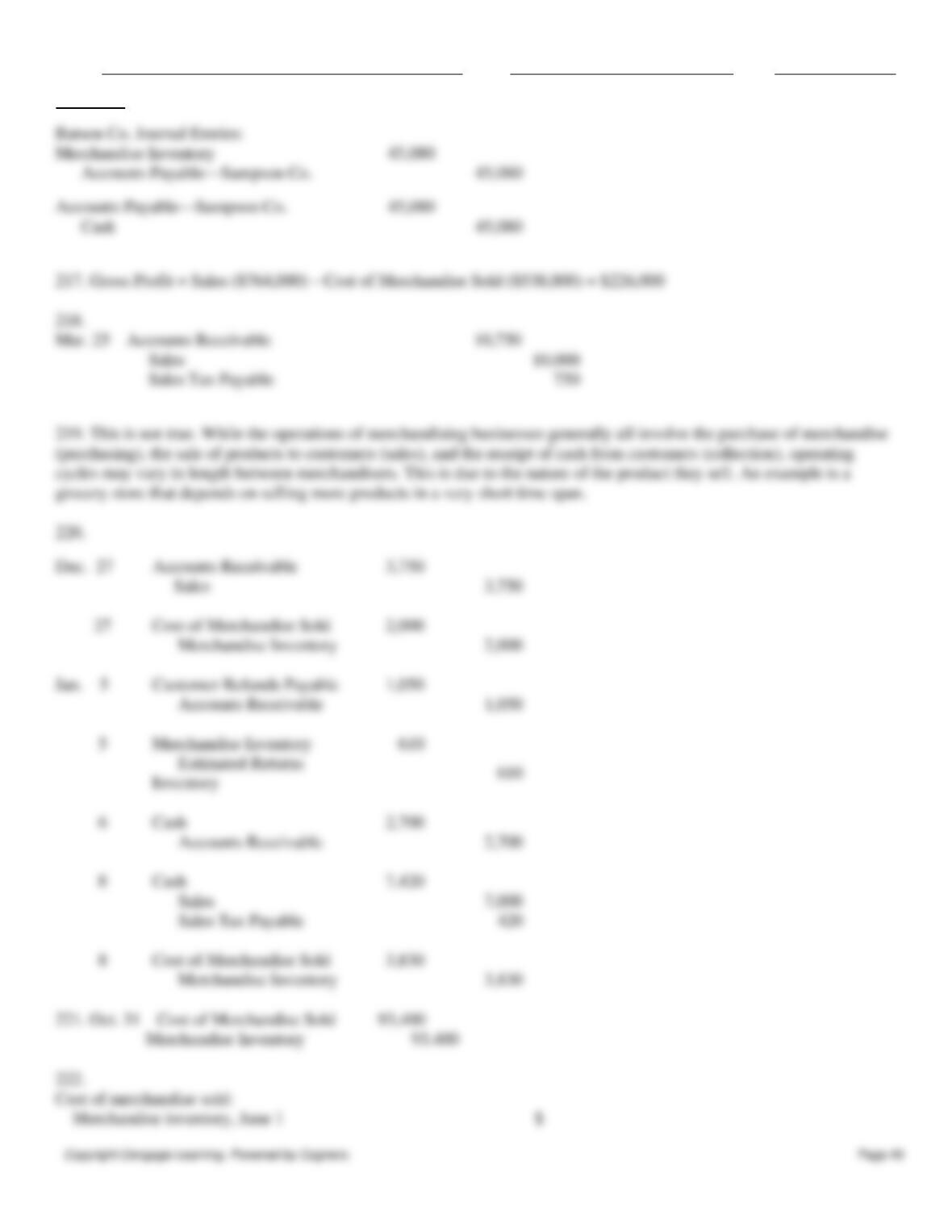
197. Marshall Supplies is a janitorial supply store that uses a perpetual inventory system. Journalize the following
transactions:
July
4
Marshall purchases inventory for sale from Tidy Wholesalers for $8,500 with terms
1/10, n/30.
5
Marshall pays Express Transfer $45 for freight on the July 4 order.
7
Marshall buys an additional $11,985 in inventory from Tidy Wholesalers with terms
1/10, n/30.
13
Marshall pays Tidy Wholesalers the balance due on both invoices.
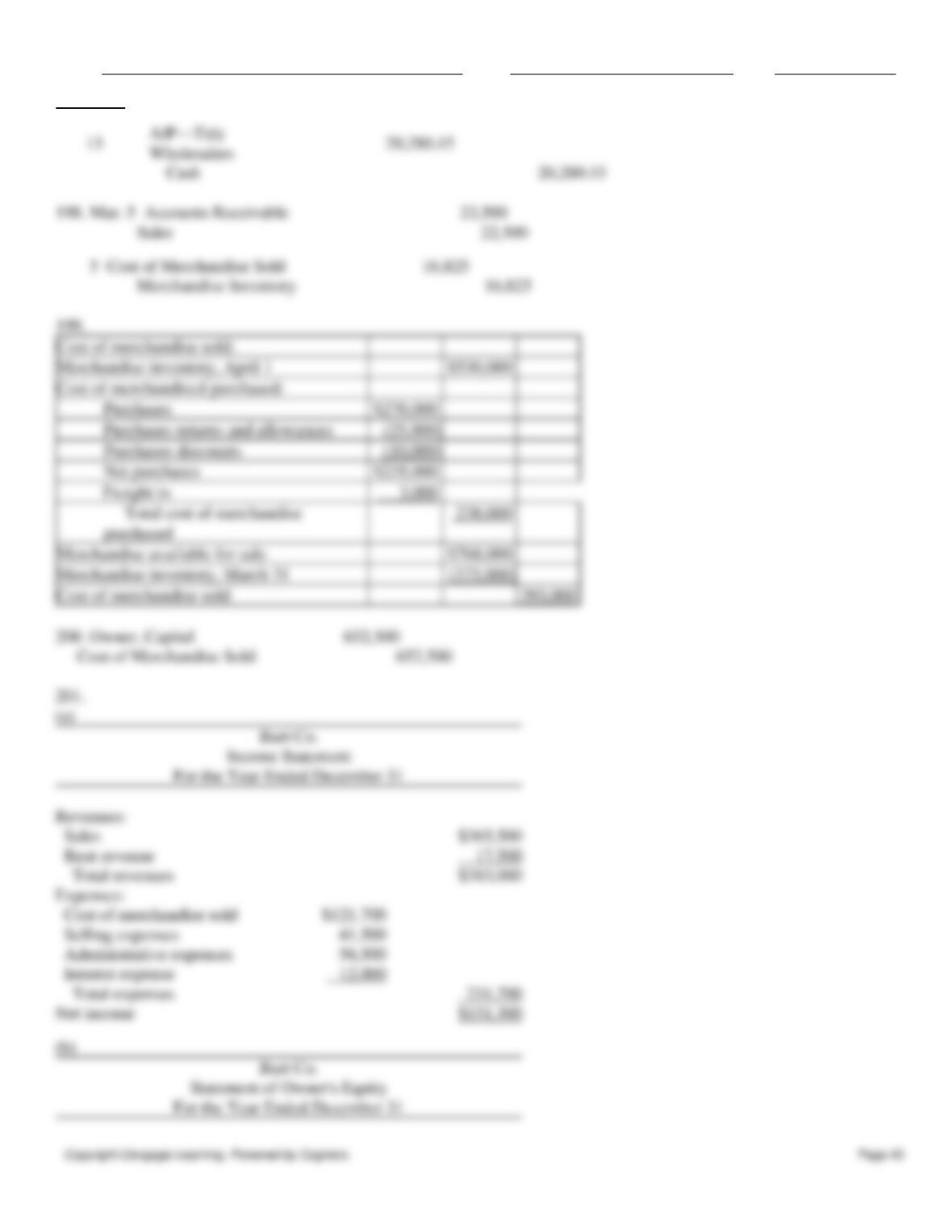
198. On March 5, Blowout Sales makes $22,500 in sales on account. The cost of the merchandise sold is $16,825.
Journalize the sales and recognition of the cost of merchandise sold.
199. The following data were extracted from the accounting records of Dana Designs for the year ended March 31:
Merchandise inventory, April 1
$530,000
Merchandise inventory, March 31
375,000
Purchases
270,000
Purchases returns and allowances
25,000
Purchases discounts
10,000
Sales
770,000
Freight in
3,000

Name:
Class:
Date:
chapter 6
Prepare the Cost of Merchandise Sold section of the income statement for the year ended March 31, using the periodic
method.
200. Selected accounts and amounts at the end of the period are as follows. Journalize the closing entry, assuming a
perpetual inventory system.
Merchandise Inventory
$ 45,500
Cost of Merchandise Sold
652,500
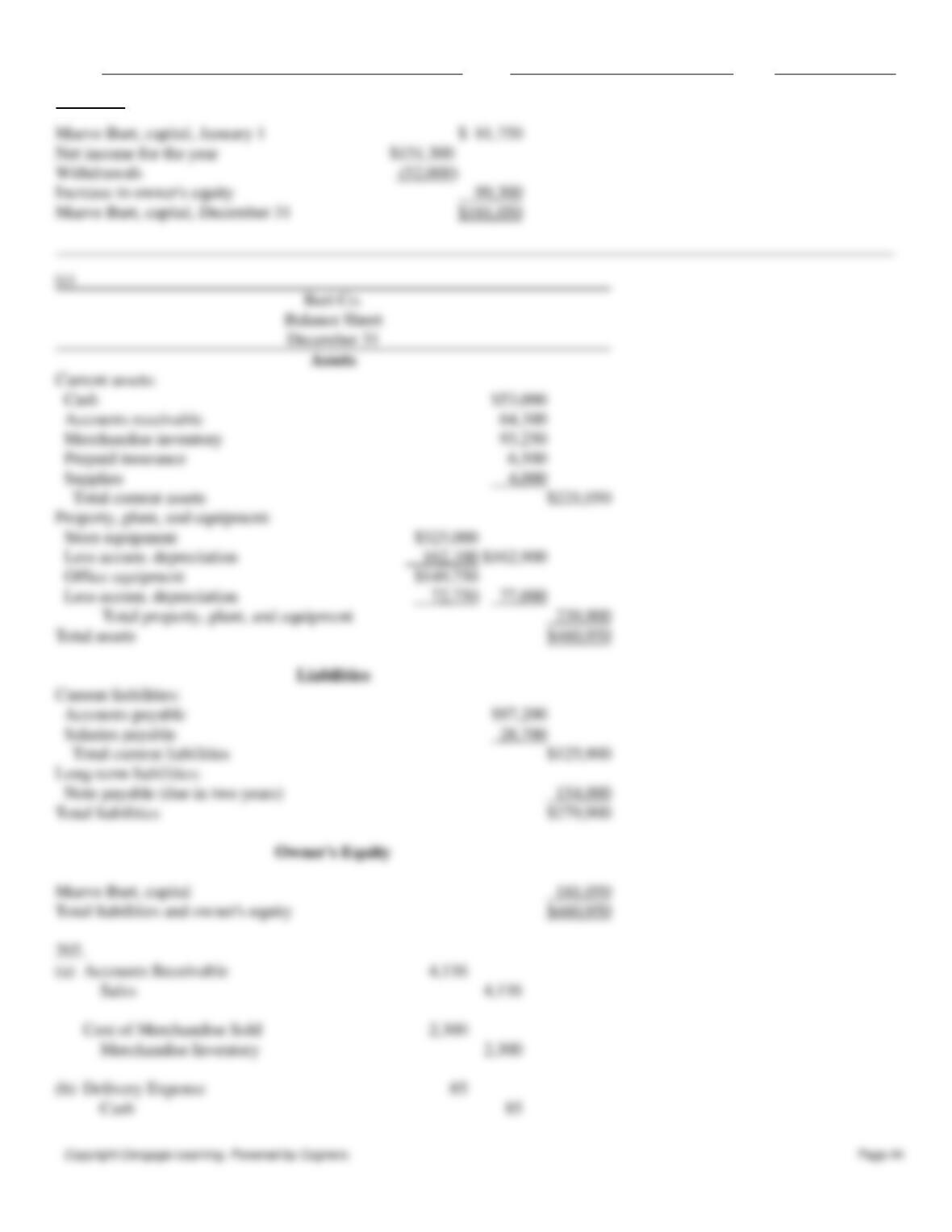
201. Prepare (a) a single-step income statement, (b) a statement of owner’s equity, and (c) a balance sheet from the
following data for Burt Co., taken from the ledger after adjustments on December 31, the end of the fiscal year.
Accounts Payable
$97,200
Accounts Receivable
64,300
Accumulated Depreciation—Office Equipment
72,750
Accumulated Depreciation—Store Equipment
162,100
Administrative Expenses
56,500
Cash
53,000
Cost of Merchandise Sold
121,700
Interest Expense
12,000
Maeve Burt, Capital
81,750
Maeve Burt, Drawing
52,000
Merchandise Inventory
93,250
Note Payable (due in two years)
154,000
Office Equipment
149,750
Prepaid Insurance
6,500
Rent Revenue
17,500
Salaries Payable
28,700
Sales
365,500
Selling Expenses
41,500
Store Equipment
325,000
Supplies
4,000
202. Merchandise with a list price of $4,200 and costing $2,300 is sold on account, subject to the following terms: FOB
destination, 2/10, n/30. The seller pays the freight costs of $85 (debit Delivery Expense for the freight costs). Prior to
payment for the goods, the seller issues a credit memo for $750 to the customer for merchandise that is defective and not
returned. Payment is received within the discount period. The company uses a perpetual inventory system.
Journalize the foregoing transactions of the seller in the following sequence:
(a)
Sold the merchandise, recognizing the sale and cost of merchandise sold.
(b)
Paid the freight charges.
(c)
Issued the credit memo.
(d)
Received payment from the customer.
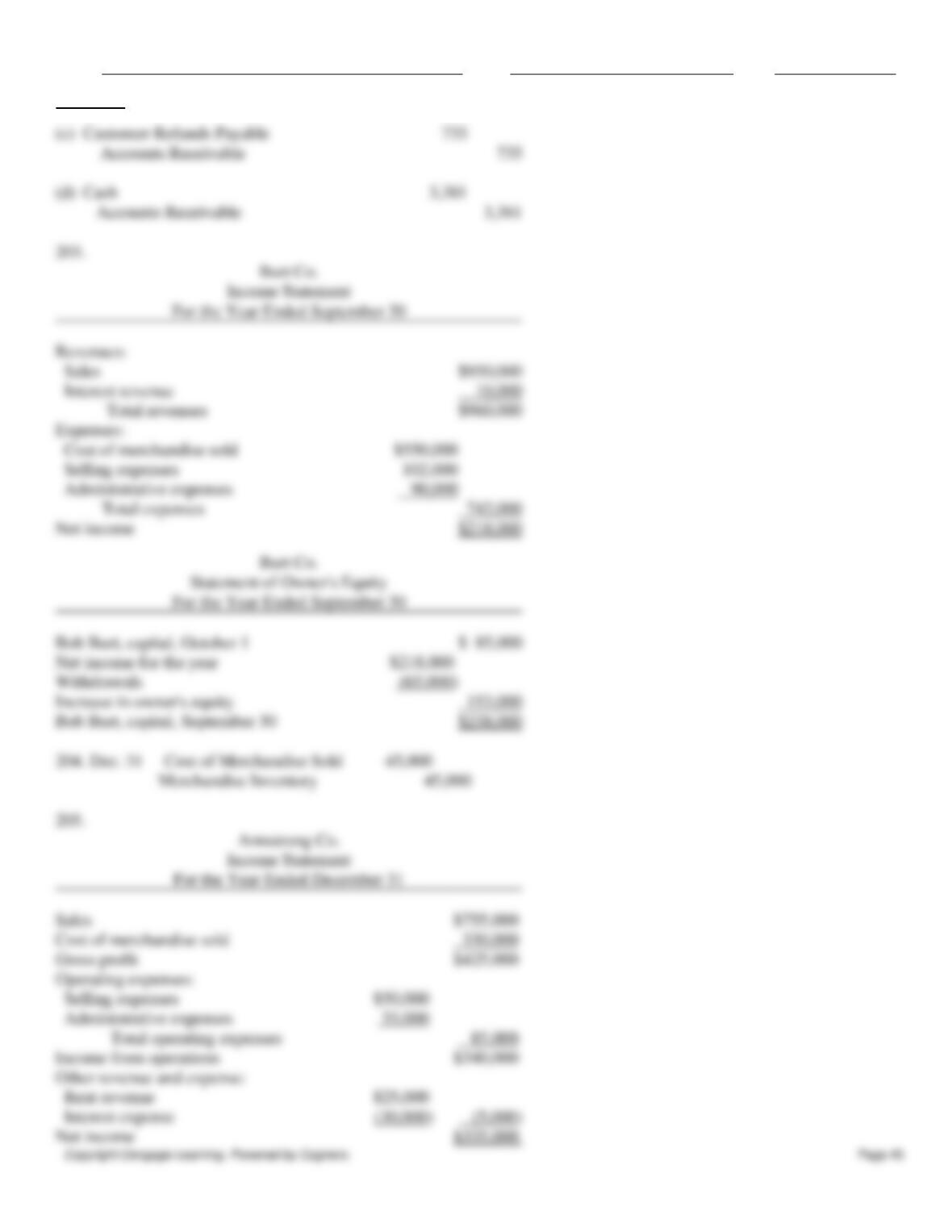
203. Selected data from the ledger of Burt Co., after adjustments, on September 30, the end of the fiscal year, are listed as
follows:
Accounts Receivable
$ 39,120
Office Equipment
$ 82,700
Accumulated Depreciation
60,540
Prepaid Insurance
4,680
Administrative Expenses
90,000
Note Payable
77,750
Bob Burt, Capital
85,000
Salaries Payable
3,060

Name:
Class:
Date:
chapter 6
Bob Burt, Drawing
65,000
Sales
950,000
Cost of Merchandise Sold
550,000
Selling Expenses
102,000
Interest Revenue
10,000
Supplies
3,125
Prepare a single-step income statement and a statement of owner’s equity.
204. The perpetual inventory records of Penny Co. indicate that $415,000 of merchandise should be on hand on December
31. The physical inventory indicates that $370,000 of merchandise is actually on hand. Journalize the adjusting entry for
the inventory shrinkage for the year ended December 31.
205. Prepare a multiple-step income statement for Armstrong Co. from the following data for the year ended December
31.
Sales, $755,000; cost of merchandise sold, $330,000; administrative expenses, $35,000; interest expense, $30,000; rent
revenue, $25,000; selling expenses, $50,000.
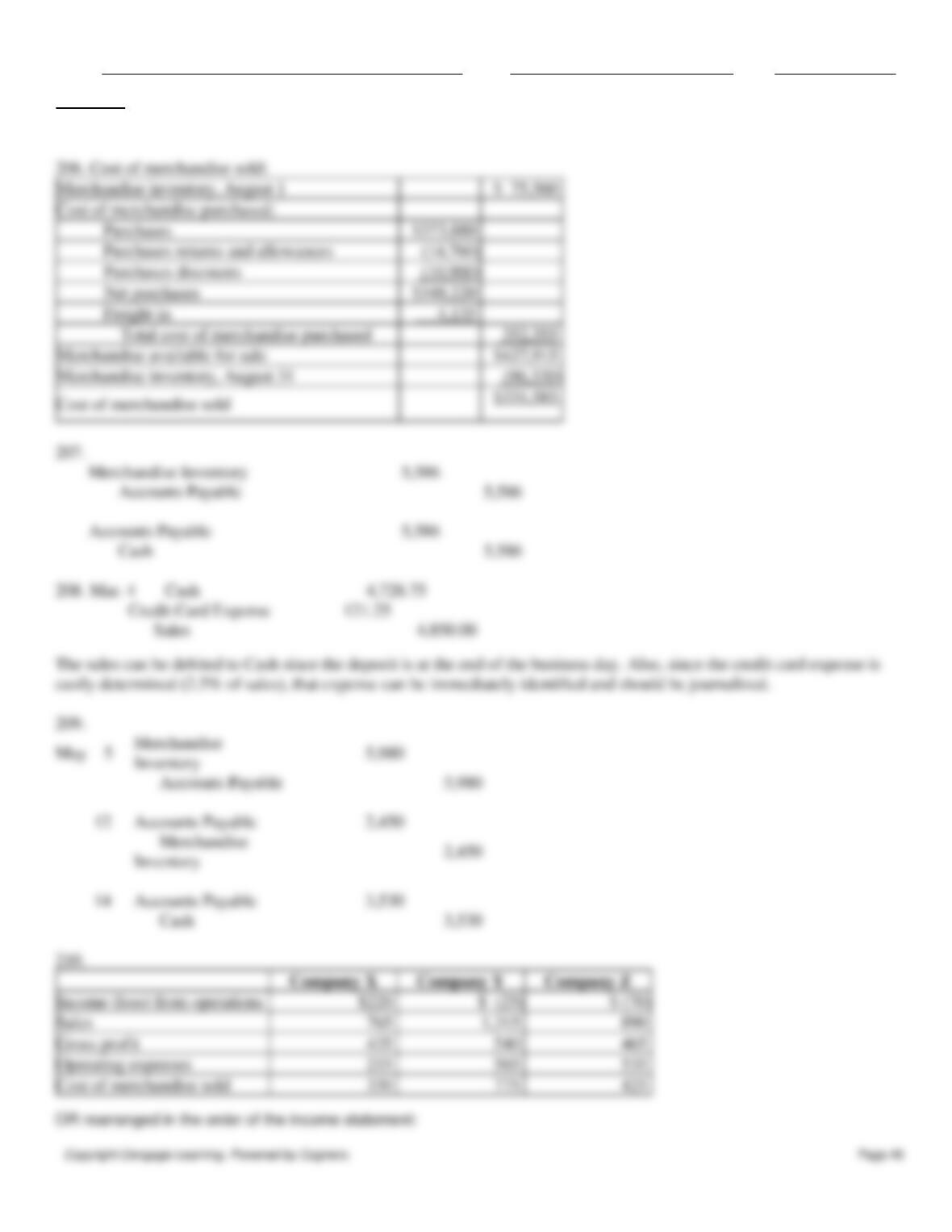
206. Based upon the following data for a business with a periodic inventory system, determine the cost of merchandise
sold for August.
Merchandise inventory, August 1
$ 75,560
Merchandise inventory, August 31
96,330
Purchases
373,880
Purchases returns and allowances
14,760
Purchases discounts
10,900
Freight in
4,135
207. Travis Company purchased merchandise on account from a supplier for $5,700, terms 2/10, net 30. Travis Company
paid for the merchandise within the discount period.
Under a perpetual inventory system, journalize these transactions.
208. On March 4, Micro Sales makes $4,850 in sales on bank credit cards that charge a 2.5% service charge. Funds are
deposited net of credit card expenses into Micro Sales’ bank account at the end of the business day. Journalize the sales
and recognition of expense as a single journal entry.
209. Journalize the following transactions on the books of Veronica Company, assuming a perpetual inventory system:
May 5
Purchased merchandise from Archie Co., $6,000, terms FOB shipping point, 2/10, n/30.
Prepaid freight costs of $100 were added to the invoice.
12
Issued a debit memo to Archie Co. for $2,500 of merchandise returned from purchase on
May 5.
14
Paid Archie Co. for invoice of May 5, less debit memo of May 12 and discount.
210. Complete the following data taken from the condensed income statements for merchandising Companies X, Y, and
Z.
Company X
Company Y
Company Z
Income (loss) from operations
$220
$ ?
$ (70)
Sales
?
1,315
890
Gross profit
435
?
465
Operating expenses
?
565
?
Cost of merchandise sold
330
775
?
Name:
Class:
Date:
chapter 6
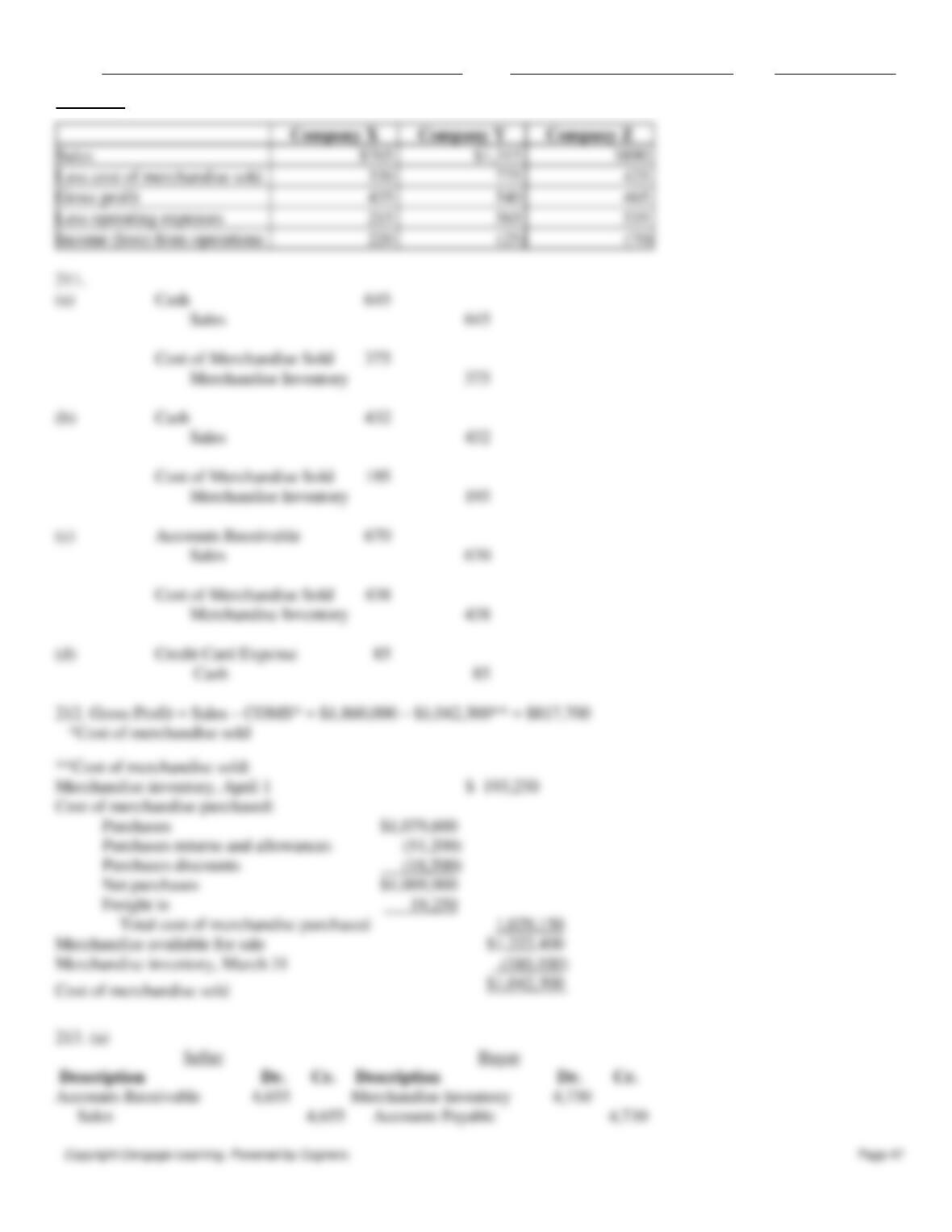
211. Journalize the following transactions for Evans Company. Assume the company uses a perpetual inventory system.
(a)
Sold merchandise for $645 cash. The cost of merchandise sold was $375.
(b)
Sold merchandise for $432 and accepted VISA as the form of payment.
The cost of merchandise sold was $195.
(c)
Sold merchandise on account for $670. The cost of merchandise sold was $438.
(d)
Paid credit card fees for the month of $85.
212. Using the following data taken from Hsu’s Imports Inc., which uses a periodic inventory system, determine the gross
profit to be reported on the income statement for the year ended March 31.
Merchandise inventory, April 1
$ 193,250
Merchandise inventory, March 31
180,100
Purchases
1,079,600
Purchases returns and allowances
51,200
Purchases discounts
18,500
Sales
1,860,000
Freight in
19,250
213. Based on the following information, journalize the entries for the seller and the buyer. Both use a perpetual inventory
system.
(a)
Seller sold merchandise on account to the buyer, $4,750, terms 2/10, net 30, FOB shipping
point. The cost of the merchandise is $2,850. The seller prepays the freight of $75.
(b)
Buyer issues a $700 debit memo for defective merchandise that is not returned.
(c)
Buyer pays within the discount period.
Seller
Buyer
Description
Dr.
Cr.
Description
Dr.
Cr.
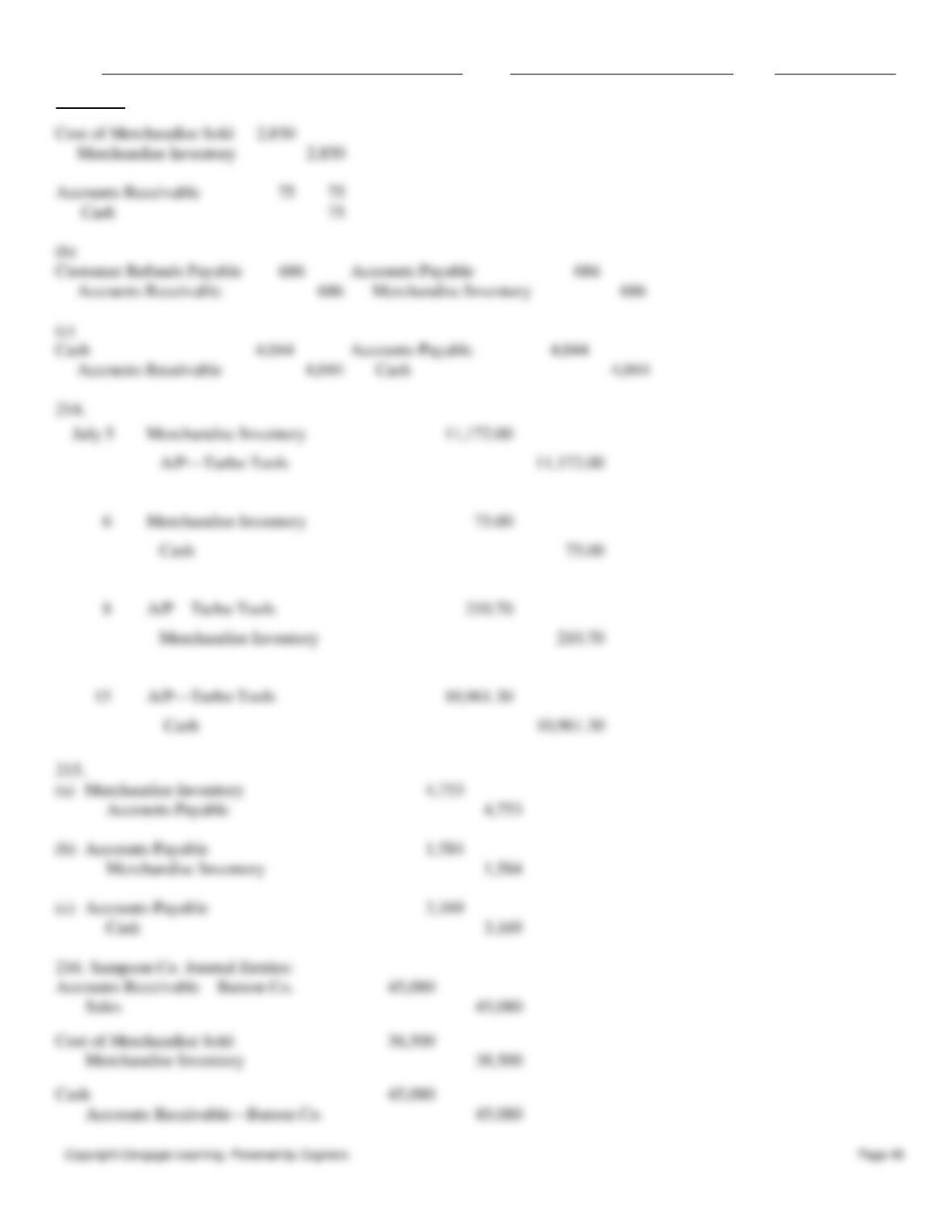
214. Gadget Palace is a retailer selling unique hardware. Gadget Palace uses a perpetual inventory system. Journalize the
following transactions:
July 5
Gadget Palace purchases inventory for sale from Turbo Tools for $11,400 with terms 2/10, n/30.
6
Gadget Palace pays Fast Truck Transport $75 for freight on the July 5 order.
8
Gadget Palace receives a credit memo from Turbo Tools for $215 for damaged merchandise. The
merchandise is not returned.
15
Gadget Palace pays Turbo Tools the balance due.
215. Merchandise with a list price of $4,700 is purchased on account, terms FOB shipping point, 1/10, n/30. The seller
prepaid freight costs of $100. Prior to payment, $1,600 of the merchandise is returned. The invoice is paid within the
discount period.
Name:
Class:
Date:
chapter 6
Journalize the foregoing transactions of the buyer in the following sequence, assuming a perpetual inventory system is
used.
(a)
Purchased the merchandise.
(b)
Recorded receipt of the credit memo for merchandise returned.
(c)
Paid the amount owed.
216. Sampson Co. sold merchandise to Batson Co. on account, $46,000, terms 2/15, net 45. The cost of the merchandise
sold is $38,500. Batson Co. paid the invoice within the discount period. Journalize these transactions for both Sampson
and Batson. Assume both Sampson and Batson use a perpetual inventory system.
217. Determine the gross profit for Jonas Company based on the following data:
Sales
$764,000
Selling expenses
52,500
Cost of merchandise sold
538,000
218. On March 25, Osgood Company sold merchandise on account, $10,000, terms n/30. The applicable sales tax
percentage is 7.5%. Journalize the transaction
219. Explain the following statement:
“Operating cycles for all merchandising businesses are the same, with similar profit margins.”
Include an example(s) to illustrate your explanation.
220. Journalize the following transactions assuming the perpetual inventory system and adjustments for customer refunds
and estimated returns inventory were made at year-end. The company uses the net method to record sales.
Dec. 27
Sold merchandise on account for $3,750, terms n/15. The cost of the merchandise
sold was $2,000.
Jan. 5
Issued credit memo for $1,050 for merchandise returned from sale on December 27.
The cost of the merchandise returned was $610.
6
Received check for the amount due for sale on December 27 less return on January
5.
8
Sold merchandise for $7,000 plus 6% sales tax to cash retail customers. The cost of
the merchandise sold was $3,830.
221. Madison Company’s perpetual inventory records indicate that $875,300 of merchandise should be on hand on
October 31. The physical inventory indicates that $781,900 is actually on hand. Journalize the adjusting entry for the
inventory shrinkage for Madison Company for the year ended October 31.
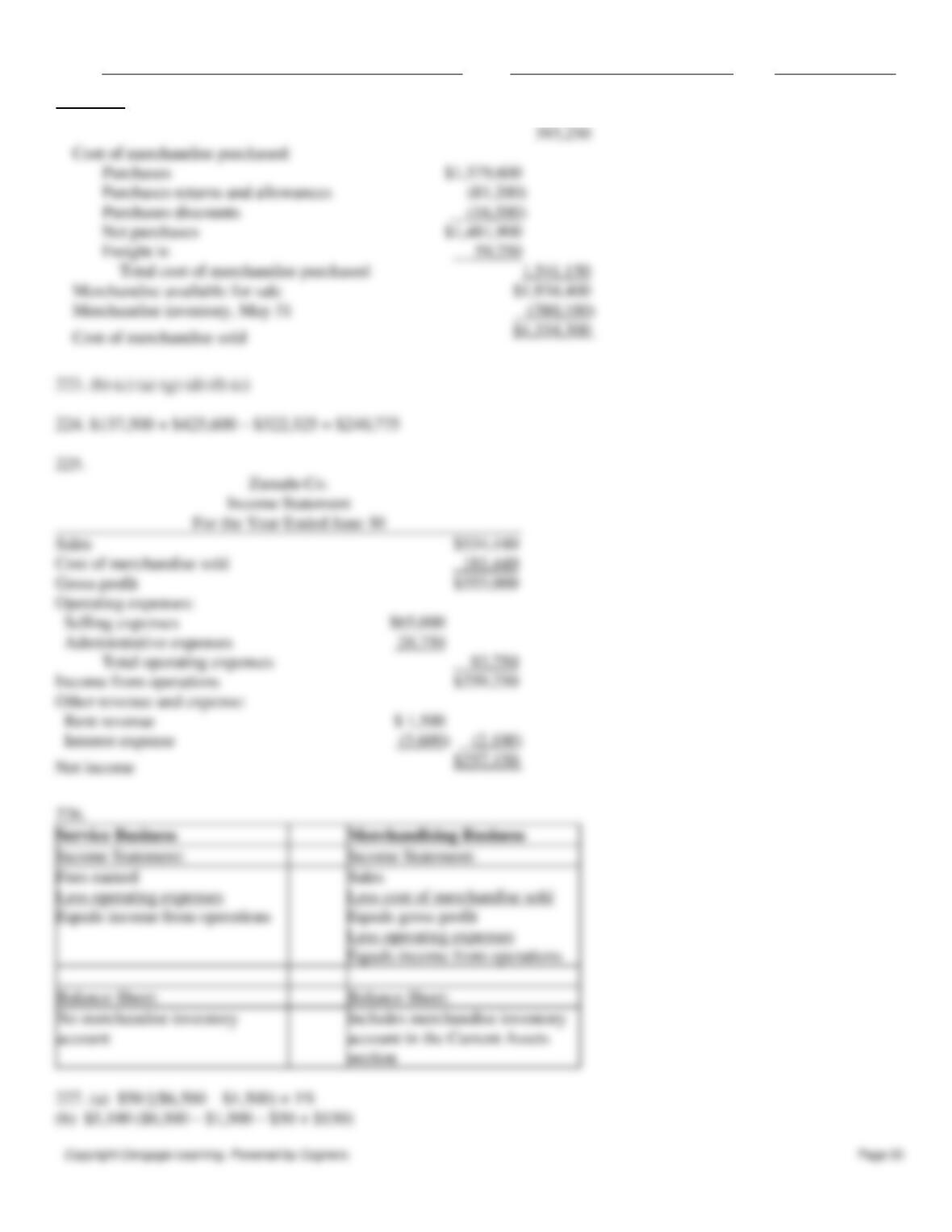
222. Using the following data taken from Payton Inc., which uses a periodic inventory system, prepare the Cost of
Merchandise Sold section of the income statement for the year ended May 31.
Merchandise inventory, June 1
$ 393,250
Merchandise inventory, May 31
380,100
Purchases
1,579,600
Purchases returns and allowances
81,200
Purchases discounts
16,500
Sales
2,060,000
Freight in
59,250

Name:
Class:
Date:
chapter 6
223. Using the letter preceding each account, arrange the following selected accounts in the order they would normally
appear in a chart of accounts of a company that uses a multiple-step income statement.
(a)
Accounts Payable
(b)
Accounts Receivable
(c)
Merchandise Inventory
(d)
Miscellaneous Selling Expense
(e)
Interest Expense
(f)
Miscellaneous Administrative Expense
(g)
Delivery Expense
224. During the current year, merchandise is sold for $137,500 cash and $425,600 on account. The cost of the
merchandise sold is $322,325. What is the amount of the gross profit?
225. The following data for the current year ended June 30 are from the accounting records of Zanadu Co.:
Administrative expenses
$ 28,750
Cost of merchandise sold
181,440
Interest expense
3,600
Rent revenue
1,500
Sales
534,440
Selling expenses
65,000
Prepare a multiple-step income statement for the year ended June 30.
226. Describe the major differences in preparing the financial statements for a service business and a merchandising
business.
Service Business
Merchandising Business
Income Statement:
Income Statement:
Balance Sheet:
Balance Sheet:
227. Details of a purchase invoice and related credit memo are summarized as follows:
Invoice:
Cost of merchandise listed on purchase invoice
$6,500
Prepaid freight charge added to invoice
150
Terms, FOB shipping point, 1/10, n/eom
Credit memo received for defective merchandise
1,500
Assume that the credit memo was received prior to payment and that the invoice is paid within the discount period.
Determine the following:
(a)
Amount of the purchase discount allowed.
(b)
Amount to be paid by the purchaser if the discount is taken.
(c)
Cost of the merchandise to the purchaser if the discount is not taken.
Name:
Class:
Date:
chapter 6
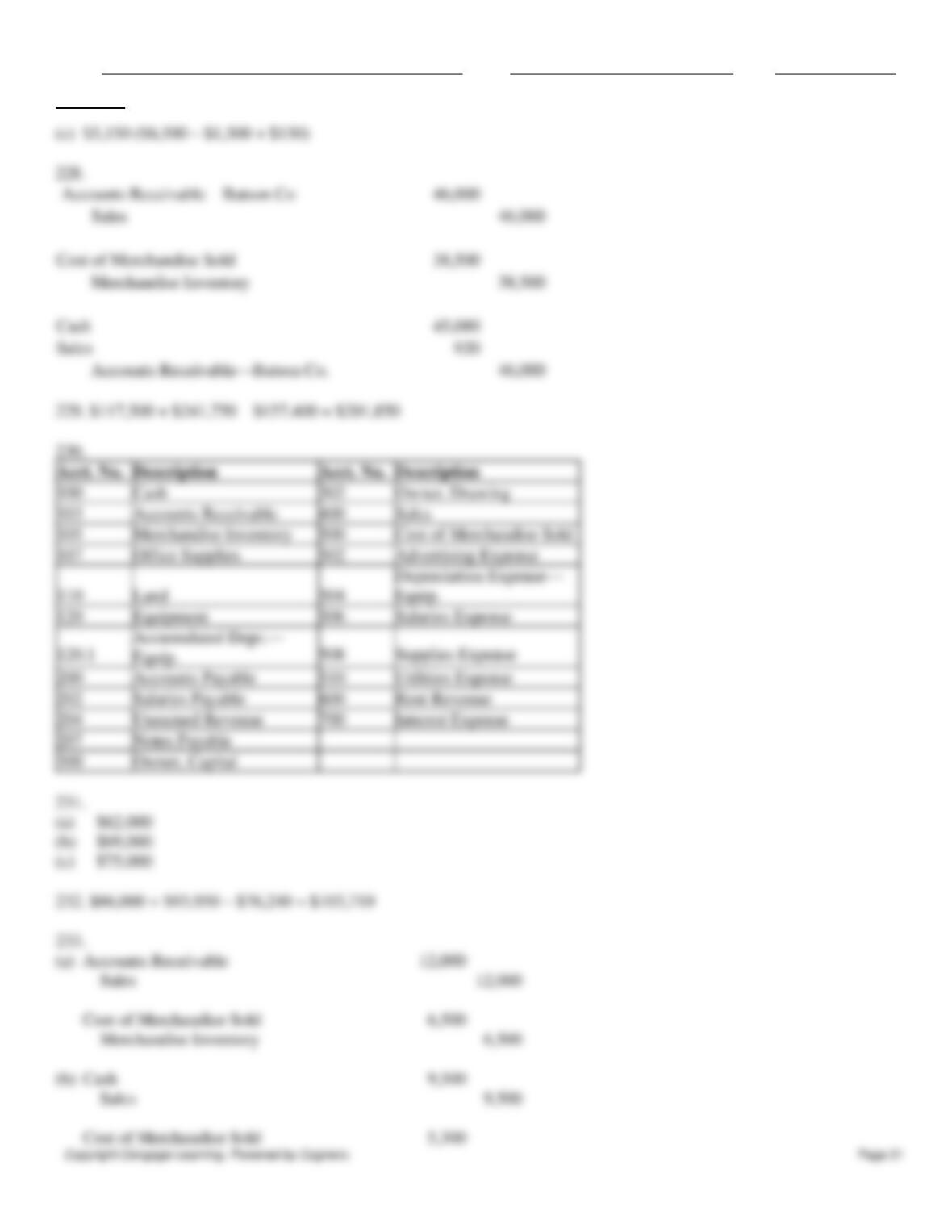
228. Sampson Co. sold merchandise to Batson Co. on account, $46,000, terms 2/15, net 45. The cost of the merchandise
sold is $38,500. Batson Co. paid the invoice within the discount period. Journalize these transactions for Sampson Co.,
assuming Sampson uses the gross method of recording sales discounts and has a perpetual inventory system.
229. During the current year, merchandise is sold for $117,500 cash and $241,750 on account. The cost of the
merchandise sold is $157,400. What is the amount of the gross profit?
230. Using the following list of accounts, construct a chart of accounts for a merchandising business that rents out a
portion of its building, and assign account numbers and arrange the accounts in balance sheet and income statement order
(“1” for assets, and so on). Each account number should have three digits. Contra accounts should be designated with a
decimal of the account (100.1 for contra of account 100). Assets and liabilities should be in order of liquidity; expenses
should be in alphabetical order.
Accounts Payable
Interest Expense
Salaries Payable
Accounts Receivable
Land
Sales
Accumulated Depr.—Equip
Merchandise Inventory
Supplies Expense
Advertising Expense
Notes Payable
Unearned Revenue
Cash
Office Supplies
Utilities Expense
Cost of Merchandise Sold
Owner, Capital
Depreciation Expense—Equip.
Owner, Drawing
Equipment
Rent Revenue
Salaries Expense
231. For each of the following, determine the cost of inventory reported on the balance sheet.
(a)
The total merchandise on hand at the end of the year is $62,000. Of the $62,000, $8,000 has
been sold FOB destination and is awaiting pickup by the carrier.
(b)
The total merchandise inventory at the end of the year was $63,000. Excluded from the
amount were purchases of $6,000 in transit under FOB shipping point terms.
(c)
The total merchandise inventory at the end of the year was $75,000. Excluded from the
amount were purchases of $5,000 in transit under FOB destination terms.
232. During the current year, merchandise is sold for $86,000 cash and for $93,950 on account. The cost of the
merchandise sold is $76,240. What is the gross profit?
233. Using the perpetual inventory system, journalize the entries for the following selected transactions:
(a)
Sold merchandise on account, for $12,000, terms n/30. The cost of the merchandise sold
was $6,500.
(b)
Sold merchandise to customers who used MasterCard and VISA, $9,500. The cost of the
merchandise sold was $5,300.
(c)
Sold merchandise to customers who used American Express, $2,900. The cost of the
merchandise sold was $1,700.
(d)
Paid an invoice from First National Bank for $385, representing a service fee for processing
MasterCard and VISA sales.
(e)
Paid a $75 processing fee associated with sales made to customers who used American
Express.
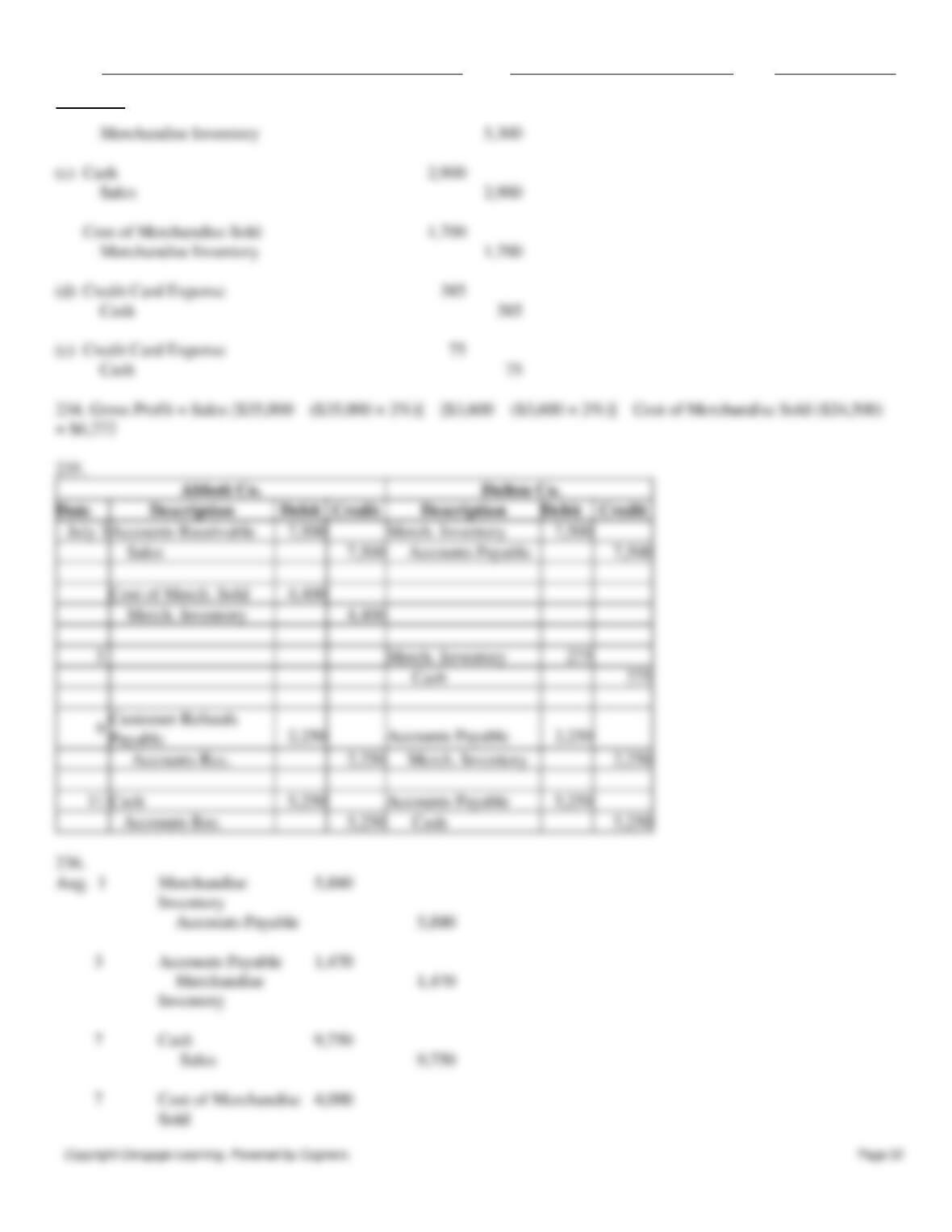
234. Abbey Co. sold merchandise to Gomez Co. on account, $35,000, terms 2/15, net 45. The cost of the merchandise
sold is $24,500. Abbey Co. issued a credit memo for $3,600 for defective merchandise which was not returned. Gomez
Co. paid the invoice within the discount period. What is the amount of gross profit earned by Abbey Co. on these
transactions?
Name:
Class:
Date:
chapter 6
235. Journalize the following transactions for both Abbott Co. (seller) and Dalton Co. (buyer). Assume both companies
use a perpetual inventory system.
July 3
Abbott Co. sold merchandise on account to Dalton Co., $7,500, terms FOB shipping
point, n/eom. The cost of the merchandise sold was $4,400.
5
Dalton Co. paid $275 to freight company for purchase from Abbott Co.
9
Abbott Co. issued Dalton Co. a credit memo for defective merchandise, $2,250. The
merchandise was not returned.
11
Abbott Co. received payment from Dalton Co. for purchase of July 3.
Abbott Co.
Dalton Co.
Date
Description
Debit
Credit
Description
Debit
Credit
236. Journalize the following transactions on the books of Sparky’s Pet Shop assuming a perpetual inventory system is
used.
Date
Transaction
Aug. 1
Purchased $6,000 of merchandise on account, terms 2/10, n/30.
3
Returned $1,500 of merchandise purchased on August 1 due to defects.
7
Recorded cash sales for the first week of August, $9,750; cost of the
merchandise was $4,000.
10
Made sale on account to a local breeder for $500, terms 1/10, net 30; cost of
the merchandise was $200.
11
Paid for the merchandise purchased on August 1, less return.
20
Received payment from sale of August 10. The customer took the discount.
237. Conquest Company uses a perpetual inventory system. Conquest purchased $1,500 of merchandise on account and
payment was made within the discount period. The credit terms were 2/10, n/30. Journalize Conquest’s purchase and
payment.
238. Journalize these transactions for Armour Inc. using both the periodic inventory system and the perpetual inventory
system, presented in the side-by–side format of the following form.
Oct.7 Sold merchandise on credit to Rondo Distributors, terms n/30. The cost of the merchandise was $720.
Name:
Class:
Date:
chapter 6
8 Purchased merchandise, $10,000, terms FOB shipping point, 2/15, n/30, with prepaid freight charges of $525 added
to the invoice.
PERIODIC INVENTORY
SYSTEM
PERPETUAL INVENTORY
SYSTEM
Date
Description
Dr.
Cr.
|
Description
Dr.
Cr.
|
|
|
|
|
|
|
239. Journalize the following transactions on the books of Monroe Sales Company, assuming a perpetual inventory
system is used and adjustments for customer refunds and estimated returns inventory were made at year-end. Monroe
Sales Company uses the net method to record sales.
(a) On December 27, 20Y8, Monroe Sales sells $9,525 on account to Garrison Brewer with terms of 2/10, n/30. The cost
of the merchandise sold was $6,905.
(b) On January 2, 20Y9, a $125 credit memo is given to Garrison Brewer due to returned merchandise. The cost of the
returned merchandise was $65.
(c) On January 4, 20Y9, Garrison Brewer submits payment in full.
240. Which of the following costs would be included in the merchandise inventory of the buyer?
(a)
Purchase price
(b)
Insurance in transit FOB shipping point
(c)
Freight for delivery FOB shipping point
(d)
Repair due to negligence of receiving clerk
(e)
Receiving department employee salary
(f)
Cost of processing purchase orders
241. Using the following data taken from Connor Inc. which uses a periodic inventory system, determine the gross profit
to be reported on the income statement for the year ended May 31.
Merchandise inventory, June 1
$ 393,250
Merchandise inventory, May 31
380,100
Purchases
1,579,600
Purchases returns and allowances
81,200
Purchases discounts
16,500
Sales
2,060,000
Freight in
59,250
242. Details of invoices for purchases of merchandise are as follows:
Returns and
Merchandise
Freight
Terms
Allowances
(a)
$2,800
$45
FOB shipping point, 1/10, n/30
$200
(b)
7,600
60
FOB destination, n/30
800
(c)
1,400
55
FOB shipping point, 2/10, n/30
600
(d)
500
50
FOB destination, 1/10, n/30
0
Determine the amount to be paid in full settlement of each of the invoices, assuming that credit for returns and allowances
Name:
Class:
Date:
chapter 6
was received prior to payment and that all invoices were paid within the discount period.
243. Using the following data taken from Hsu’s Imports Inc., which uses a periodic inventory system, prepare the Cost of
Merchandise Sold section of the income statement for the year ended March 31.
Merchandise inventory, April 1
$ 193,250
Merchandise inventory, March 31
180,100
Purchases
1,079,600
Purchases returns and allowances
51,200
Purchases discounts
18,500
Sales
1,860,000
Freight in
19,250
244. Complete the following data taken from the condensed income statements for merchandising Companies A, B, and
C.
Company A
Company B
Company C
Income from operations
$315
$ ?
$215
Sales
?
865
560
Gross profit
430
?
325
Operating expenses
?
125
?
Cost of merchandise sold
545
320
?
245. Journalize the following merchandise transactions:
(a)
Sold merchandise on account, $17,300, with terms 2/10, net 30. The cost of the
merchandise sold was $12,600.
(b)
Received payment within the discount period.
246. Journalize the following selected transactions, assuming a perpetual inventory method is used:
(a)
Sold $900 of merchandise on account, subject to 7% sales tax. The cost of the
merchandise sold was $510.
(b)
Paid $436 to the state sales tax department for taxes collected.
247. Determine the amount to be paid in full settlement of each purchase invoice, assuming that credit for returns and
allowances was received prior to payment and that all invoices were paid within the discount period
Merchandise
Freight Paid by
Seller
Freight Terms
Returns and
Allowances
(a)
$4,500
$140
FOB shipping point,
2/10, net 30
$1,200
(b)
7,650
$200
FOB destination,
1/10, net 45
450
248. Bargain Wholesalers sells pet supplies to retailers including Pet World Supplies. Bargain Wholesalers uses a
perpetual inventory system. Journalize the following transactions:
May
4
Bargain Wholesalers sells inventory to Pet World Supplies for $8,250 with terms
1/10, n/30. The cost of the merchandise is $5,755.
7
Bargain Wholesalers sells an additional $10,985 in inventory to Pet World Supplies
with terms 1/10, n/30. The cost of the merchandise is $6,925.

Name:
Class:
Date:
chapter 6
13
Bargain Wholesalers receives a check from Pet World Supplies paying the balance
due on both invoices.
249. On March 3, Bluebird Sales makes $4,350 in cash sales of general merchandise that has a cost of $1,512. Bluebird
uses a perpetual inventory system.
(a) Journalize the sale.
(b) Journalize the cost of merchandise sold.
250. On March 29, a customer who owes $10,500 on account to Sonic Sales Company submits a payment of $4,250.
Journalize this transaction.
Name:
Class:
Date:
chapter 6
Answer Key
Name:
Class:
Date:
chapter 6
Name:
Class:
Date:
chapter 6
Name:
Class:
Date:
chapter 6
Name:
Class:
Date:
chapter 6
Name:
Class:
Date:
chapter 6
Name:
Class:
Date:
chapter 6
Name:
Class:
Date:
chapter 6
Name:
Class:
Date:
chapter 6
Name:
Class:
Date:
chapter 6
Name:
Class:
Date:
chapter 6
Name:
Class:
Date:
chapter 6
Name:
Class:
Date:
chapter 6
Name:
Class:
Date:
chapter 6
Name:
Class:
Date:
chapter 6
Name:
Class:
Date:
chapter 6
Name:
Class:
Date:
chapter 6
Name:
Class:
Date:
chapter 6
Name:
Class:
Date:
chapter 6
Name:
Class:
Date:
chapter 6
Name:
Class:
Date:
chapter 6
Name:
Class:
Date:
chapter 6