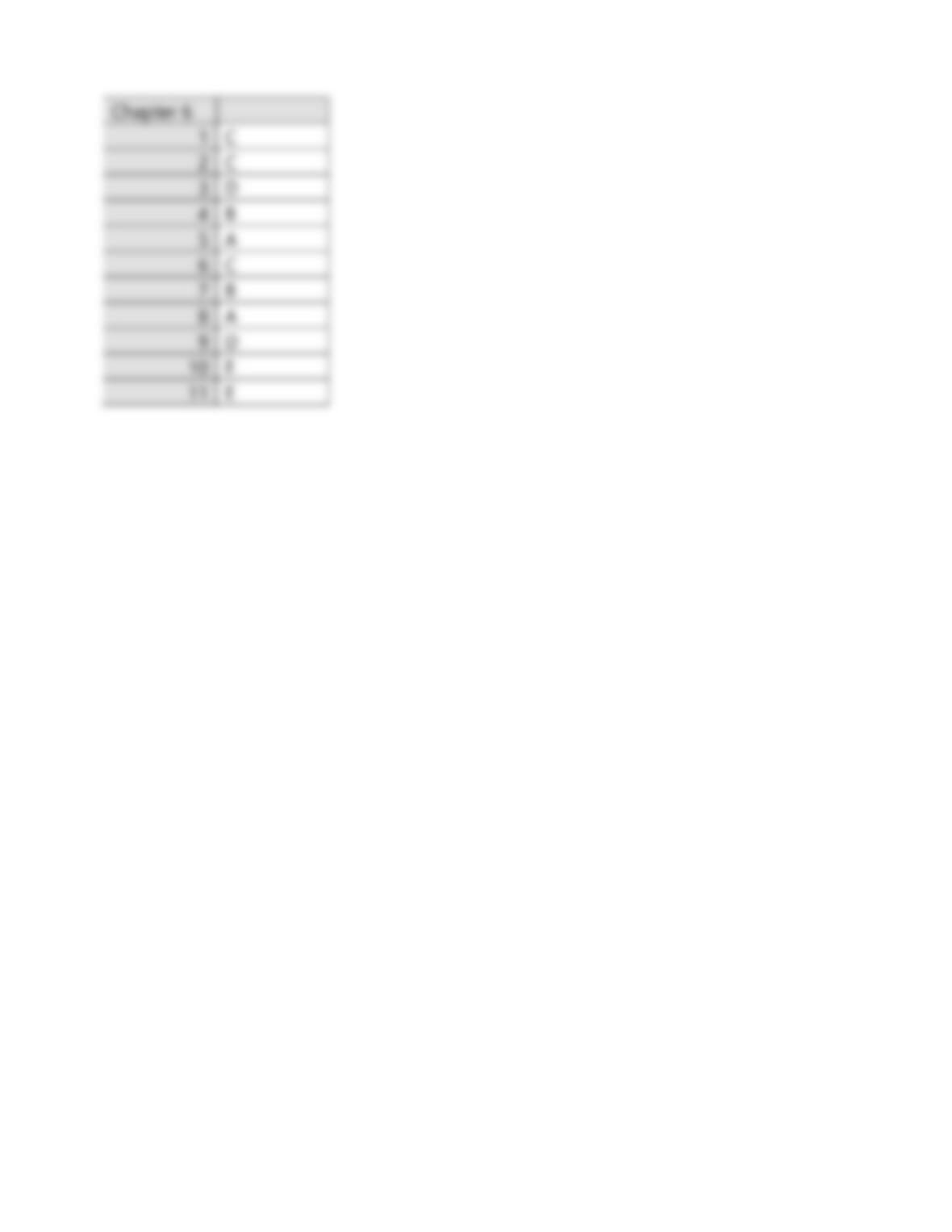
CHAPTER 6
1. Which of the following are differences between U.S. GAAP and IFRS?
A. U.S. GAAP allows revaluation of nonfinancial assets
B. U.S. GAAP prohibits LIFO inventory accounting
C. U.S. GAAP and IFRS adopt contrasting approaches to revenue recognition
D. IFRS provides substantially more industry guidance
2. Which of the following statements regarding IFRS 1 is true?
A. The core principle of IFRS 1 is for the entity to apply the same accounting principles
in its opening balance sheet and across all periods in the first IFRS financial
statements.
B. A statement of financial position must be prepared for two years prior to establish
opening balances for the prior year.
C. All of the above
D. None of the above
3. IFRS requires disclosure that explains how the transition from previous GAAP to IFRS
affect the entity‘s reported:
A. Financial position
B. Financial performance
C. Cash flows
D. All of the above
4. Which of the following is the correct order of steps that should be applied to the
opening IFRS statement of financial position and must be prepared and presented on
the date of transition to IFRS?
(1) Identify all assets and liabilities required under the IFRS
(2) Reclassify items previously under GAAP that were recognized as one type of asset or
liability but are now recognized as a different asset or liability under the IFRS
(3) Remove assets and liabilities not permitted under the IFRS
(4) Measure the assets and liabilities recognized under the IFRS
A. (1) (2) (3) (4)
B. (1) (3) (2) (4)
C. (1) (2) (4) (3)
D. (1) (4) (2) (3)
5. Which is one of the key activities that will lead to IFRS
conversion?
A. Development of a conversion timeline
B. Implementation of effective training only in the accounting department
C. Development of a new conversion strategy different from Europe
D. Establishment of a project management team which can create own specific plan for
individual
6. Which of the following does IFRS require accounting students and educators to
learn?
A. To master specific IFRS policies to better accept the new accounting standards
B. To focus on underlying concepts and their application
C. To realize the difference between U.S. GAAP and IFRS to better develop the
financial statements
D. To research standards and interpretations on GAAP in order to differentiate policies
from IFRS
7. Which is one of the FASB/IASB convergence projects?
A. Fixed Asset impairment
B. Revenue recognition
C. Financial instruments with characteristics of liability
D. Lower of cost or market measurement guidance
8. Which of the following are the main financial values of adopting IFRS?
A. Mitigating financial reporting risk, decreasing financial transparency risk, and
creating operational efficiencies
B. Strengthening financial performance, decreasing financial transparency risk, and
creating operational efficiencies
C. Strengthening financial performance, decreasing financial transparency risk,
increasing the comparability of financial statement
D. Mitigating financial reporting risk, decreasing financial transparency risk, increasing
the comparability of financial statement
9. Which of the following statements is true regarding IFRS accounting education?
A. The emphasis in IFRS accounting will be on memorization of rules
B. The emphasis in IFRS accounting will be on the application of the conceptual
framework
C. The bookkeeping techniques are essential knowledge.
D. The single analytical effect of transactions resulting from business decisions and
changes in the environment must be understood.
10. IFRS requires accounting students (and educators) to realize that virtually every
number in financial statements:
A. results from judgment and estimates
B. has a basis in valuation and fair value
C. is rooted in the conceptual framework
D. is based on an application of a standard
E. all of the above
11. In learning IFRS, accounting students (and educators) must learn to:
A. make judgments in a world of uncertainty
B. apply a variety of valuation models
C. focus on underlying concepts and their application
D. research standard and interpretations
E. all of the above