Intermediate Accounting, 9e (Spiceland)
Chapter 6 Time Value of Money Concepts
1) Compound interest includes interest earned on interest.
2) When interest is compounded, the stated rate of interest exceeds the effective rate of interest.
3) The calculation of future value requires the removal of interest.
4) The company’s credit-adjusted risk-free rate of interest is used when computing present value
applying the expected cash flow approach.
5) The calculation of present value eliminates interest from future cash flows.
6) With an ordinary annuity, a payment is made or received on the date the agreement begins.
7) In the future value of an ordinary annuity, the last cash payment will not earn any interest.
8) An annuity consists of level principal payments plus interest on the unpaid balance.
9) With an annuity due, a payment is made or received on the date the agreement begins.
10) An annuity is a series of equal periodic payments.
11) Given identical current amounts owed and identical interest rates, annual payments of an
ordinary annuity will be greater than annual payments of an annuity due.
12) Other things being equal, the present value of an annuity due will be less than the present
value of an ordinary annuity.
13) A deferred annuity is one in which interest charges are deferred for a stated time period.
14) Monetary assets include only cash and cash equivalents.
15) Most, but not all, liabilities are monetary liabilities.
Use the information below to answer the following questions.
Present and future value tables of $1 at 3% are presented below:
N
FV $1
PV $1
FVA $1
PVA $1
FVAD $1
PVAD $1
1
1.03000
0.97087
1.0000
0.97087
1.0300
1.00000
2
1.06090
0.94260
2.0300
1.91347
2.0909
1.97087
3
1.09273
0.91514
3.0909
2.82861
3.1836
2.91347
4
1.12551
0.88849
4.1836
3.71710
4.3091
3.82861
5
1.15927
0.86261
5.3091
4.57971
5.4684
4.71710
6
1.19405
0.83748
6.4684
5.41719
6.6625
5.57971
7
1.22987
0.81309
7.6625
6.23028
7.8923
6.41719
8
1.26677
0.78941
8.8923
7.01969
9.1591
7.23028
9
1.30477
0.76642
10.1591
7.78611
10.4639
8.01969
10
1.34392
0.74409
11.4639
8.53020
11.8078
8.78611
11
1.38423
0.72242
12.8078
9.25262
13.1920
9.53020
12
1.42576
0.70138
14.1920
9.95400
14.6178
10.25262
13
1.46853
0.68095
15.6178
10.63496
16.0863
10.95400
14
1.51259
0.66112
17.0863
11.29607
17.5989
11.63496
15
1.55797
0.64186
18.5989
11.93794
19.1569
12.29607
16
1.60471
0.62317
20.1569
12.56110
20.7616
12.93794
16) Today, Thomas deposited $100,000 in a three-year, 12% CD that compounds quarterly.
What is the maturity value of the CD?
A) $109,270.
B) $119,410.
C) $142,576.
D) $309,090.
17) Carol wants to invest money in a 6% CD account that compounds semiannually. Carol would
like the account to have a balance of $50,000 five years from now. How much must Carol
deposit to accomplish her goal?
A) $35,069.
B) $43,131.
C) $37,205.
D) $35,000.
18) Shane wants to invest money in a 6% CD account that compounds semiannually. Shane
would like the account to have a balance of $100,000 four years from now. How much must
Shane deposit to accomplish his goal?
A) $88,849.
B) $78,941.
C) $25,336.
D) $22,510.
19) Bill wants to give Maria a $500,000 gift in seven years. If money is worth 6% compounded
semiannually, what is Maria’s gift worth today?
A) $66,110.
B) $81,309.
C) $406,545.
D) $330,560.
20) Monica wants to sell her share of an investment to Barney for $50,000 in three years. If
money is worth 6% compounded semiannually, what would Monica accept today?
A) $8,375.
B) $41,874.
C) $11,941.
D) $41,000.
21) At the end of the next four years, a new machine is expected to generate net cash flows of
$8,000, $12,000, $10,000, and $15,000, respectively. What are the (rounded) cash flows worth
today if a 3% interest rate properly reflects the time value of money in this situation?
A) $41,556.
B) $39,982.
C) $32,400.
D) $38,100.
22) At the end of each quarter, Patti deposits $500 into an account that pays 12% interest
compounded quarterly. How much will Patti have in the account in three years?
A) $7,096.
B) $7,213.
C) $7,129.
D) $8,880.
23) Sondra deposits $2,000 in an IRA account on April 15, 2018. Assume the account will earn
3% annually. If she repeats this for the next nine years, how much will she have on deposit on
April 14, 2028?
A) $20,600.
B) $20,928.
C) $23,616.
D) $24,715.
24) Shelley wants to cash in her winning lottery ticket. She can either receive eight $100,000
semiannual payments starting today, or she can receive a single-amount payment today based on
a 6% annual interest rate. What is the single-amount payment she can receive today?
A) $853,020.
B) $801,969.
C) $744,090.
D) $1,293,794.
25) On January 1, 2018, you are considering making an investment that will pay three annual
payments of $10,000. The first payment is not expected until December 31, 2020. You are eager
to earn 3%. What is the present value of the investment on January 1, 2018?
A) $26,662.
B) $27,462.
C) $28,286.
D) $29,135.
26) On January 1, 2018, you are considering making an investment that will pay three annual
payments of $10,000. The first payment is not expected until December 31, 2021. You are eager
to earn 3%. What is the present value of the investment on January 1, 2018?
A) $28,286.
B) $25,886.
C) $26,662.
D) $27,300.
27) Rosie’s Florist borrows $300,000 to be paid off in six years. The loan payments are
semiannual with the first payment due in six months, and interest is at 6%. What is the amount of
each payment?
A) $25,750.
B) $29,761.
C) $30,139.
D) $25,500.
28) Jimmy has $255,906 accumulated in a 401K plan. The fund is earning a low, but safe, 3%
per year. The withdrawals will take place at the end of each year starting a year from now. How
soon will the fund be exhausted if Jimmy withdraws $30,000 each year?
A) 11 years.
B) 10 years.
C) 8.5 years.
D) 8.8 years.
29) Debbie has $368,882 accumulated in a 401K plan. The fund is earning a low, but safe, 3%
per year. The withdrawals will take place annually starting today. How soon will the fund be
exhausted if Debbie withdraws $30,000 each year?
A) 15 years.
B) 16 years.
C) 14 years.
D) 12.3 years.
30) Jose wants to cash in his winning lottery ticket. He can either receive five $5,000 annual
payments starting today, or he can receive one lump-sum payment today based on a 3% annual
interest rate. What would be the lump-sum payment?
A) $23,586.
B) $22,899.
C) $21,565.
D) $23,000.
31) Micro Brewery borrows $300,000 to be repaid in equal installments over a period of three
years. The loan payments are semiannual with the first payment due in six months, and interest is
at 6%. What is the amount of each payment?
A) $55,379.
B) $106,059.
C) $30,138.
D) $60,276.
32) A firm leases equipment under a long-term lease (analogous to an installment purchase) that
calls for 12 semiannual payments of $39,014.40. The first payment is due at the inception of the
lease. The annual rate on the lease is 6%. What is the value of the leased asset at inception of the
lease?
A) $388,349.
B) $400,000.
C) $454,128.
D) $440,082.
Use the information below to answer the following questions.
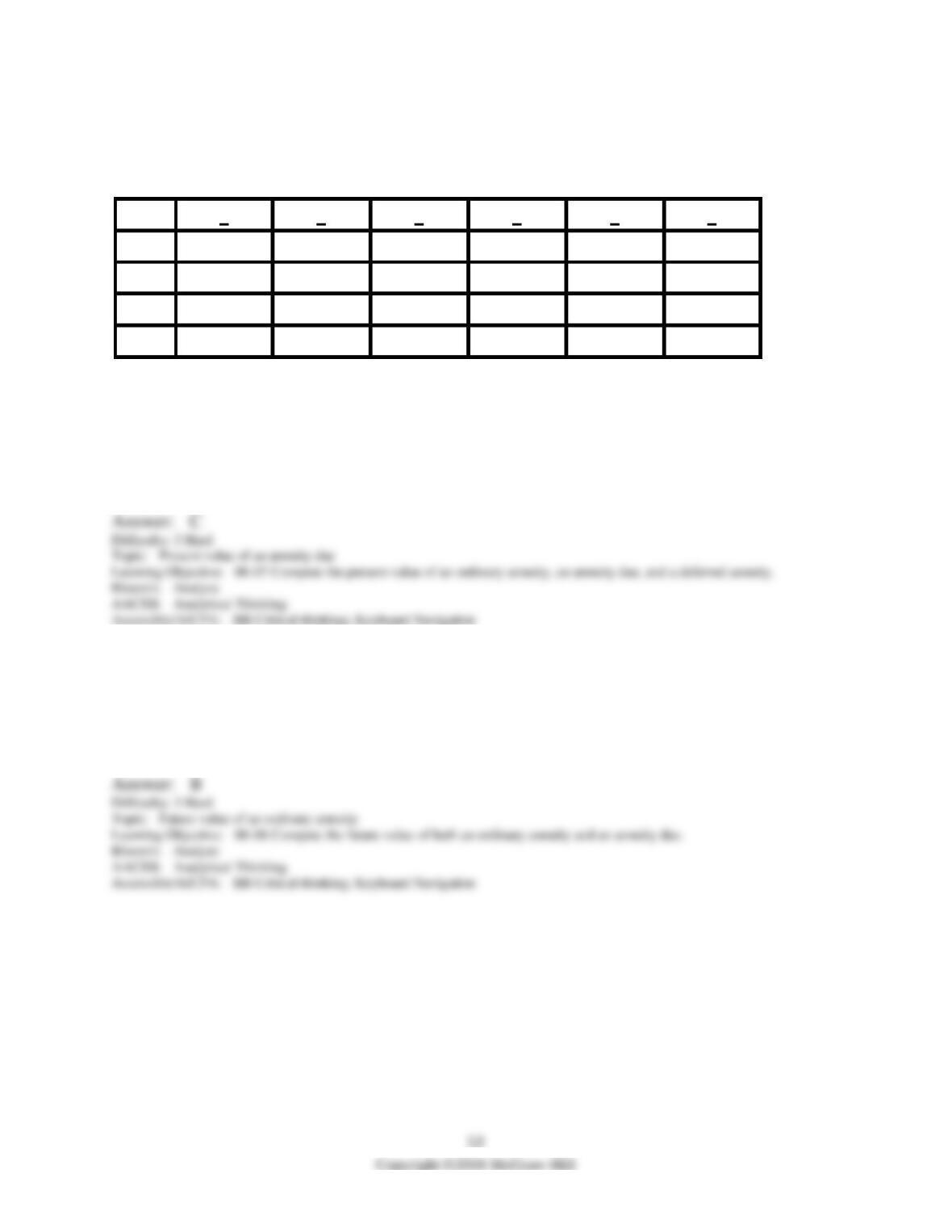
Below are excerpts from time value of money tables for the 8% rate.
1
2
3
4
5
6
1
1.000
1.000
0.926
1.080
1.080
0.926
2
1.926
2.080
0.857
2.246
1.166
1.783
3
2.783
3.246
0.794
3.506
1.260
2.577
4
3.577
4.506
0.735
4.867
1.360
3.312
33) Column 1 is an interest table for the:
A) Present value of an ordinary annuity of $1.
B) Future value of an ordinary annuity of $1.
C) Present value of an annuity due of $1.
D) Future value of an annuity due of $1.
34) Column 2 is an interest table for the:
A) Present value of an ordinary annuity of $1.
B) Future value of an ordinary annuity of $1.
C) Present value of an annuity due of $1.
D) Future value of an annuity due of $1.
35) Column 3 is an interest table for the:
A) Present value of $1.
B) Future value of $1.
C) Present value of an ordinary annuity of $1.
D) Present value of an annuity due of $1.
36) Column 4 is an interest table for the:
A) Present value of an ordinary annuity of $1.
B) Future value of an ordinary annuity of $1.
C) Present value of an annuity due of $1.
D) Future value of an annuity due of $1.
37) Column 5 is an interest table for the:
A) Present value of $1.
B) Future value of $1.
C) Present value of an ordinary annuity of $1.
D) Present value of an annuity due of $1.
38) Column 6 is an interest table for the:
A) Present value of an ordinary annuity of $1.
B) Future value of an ordinary annuity of $1.
C) Present value of an annuity due of $1.
D) Future value of an annuity due of $1.
39) Reba wishes to know how much would be in her savings account if she deposits a given sum
in an account and leaves it there at 6% interest for five years. She should use a table for the:
A) Future value of an ordinary annuity of $1.
B) Future value of $1.
C) Future value of an annuity of $1.
D) Present value of an annuity due of $1.
Use the information below to answer the following questions.
Present and future value tables of $1 at 9% are presented below.
PV of $1
FV of $1
PVA of $1
FVAD of $1
FVA of $1
1
0.91743
1.09000
0.91743
1.0900
1.0000
2
0.84168
1.18810
1.75911
2.2781
2.0900
3
0.77218
1.29503
2.53129
3.5731
3.2781
4
0.70843
1.41158
3.23972
4.9847
4.5731
5
0.64993
1.53862
3.88965
6.5233
5.9847
6
0.59627
1.67710
4.48592
8.2004
7.5233
40) Ajax Company purchased a five-year certificate of deposit for its building fund in the
amount of $220,000. How much should the certificate of deposit be worth at the end of five
years if interest is compounded at an annual rate of 9%?
A) $855,723.
B) $142,985.
C) $319,000.
D) $338,496.
41) How much must be invested now at 9% interest to accumulate to $10,000 in five years?
A) $9,176.
B) $6,499.
C) $5,500.
D) $5,960.
42) How much must be deposited at the beginning of each year to accumulate to $10,000 in four
years if interest is at 9%?
A) $1,671.
B) $2,570.
C) $2,358.
D) $2,006.
43) Claudine Corporation will deposit $5,000 into a money market sinking fund at the end of
each year for the next five years. How much will accumulate by the end of the fifth and final
payment if the sinking fund earns 9% interest?
A) $32,617.
B) $29,924.
C) $27,250.
D) $26,800.
44) Mustard’s Inc. sold the rights to use one of its patented processes that will result in cash
receipts of $2,500 at the end of each of the next four years and a lump sum receipt of $4,000 at
the end of the fifth year. The total present value of these payments if interest is at 9% is:
A) $10,699.
B) $11,468.
C) $12,100.
D) $14,000.
45) An investment product promises to pay $42,000 at the end of 10 years. If an investor feels
this investment should produce a rate of return of 12%, compounded annually, what’s the most
the investor should be willing to pay for the investment?
A) $15,146.
B) $13,523.
C) $42,000.
D) $130,446.
46) LeAnn wishes to know how much she should invest now at 7% interest in order to
accumulate a sum of $5,000 in four years. She should use a table for the:
A) Present value of $1.
B) Future value of $1.
C) Present value of an ordinary annuity of $1.
D) Future value of an annuity due of $1.
Use the information below to answer the following questions.
Present and future value tables of $1 at 11% are presented below.
PV of $1
FV of $1
PVA of $1
FVA of $1
1
0.90090
1.11000
0.90090
1.0000
2
0.81162
1.23210
1.71252
2.1100
3
0.73119
1.36763
2.44371
3.3421
4
0.65873
1.51807
3.10245
4.7097
5
0.59345
1.68506
3.69590
6.2278
6
0.53464
1.87041
4.23054
7.9129
47) Spielberg Inc. signed a $200,000 noninterest-bearing note due in five years from a
production company eager to do business. Comparable borrowings have carried an 11% interest
rate. What is the value of this debt at its inception?
A) $200,000.
B) $178,000.
C) $118,690.
D) $222,000.
48) On October 1, 2018, Justine Company purchased equipment from Napa Inc. in exchange for
a noninterest-bearing note payable in five equal annual payments of $500,000, beginning Oct 1,
2019. Similar borrowings have carried an 11% interest rate. The equipment would be recorded
at:
A) $2,500,000.
B) $2,225,000.
C) $1,847,950.
D) $2,115,270.
49) Titanic Corporation leased executive limousines under terms of $20,000 to be paid at the
inception of the lease, and four equal annual payments of $30,000 to each be paid thereafter on
the anniversary date of the lease. The interest rate implicit in the lease is 11%. The first year’s
interest expense would be:
A) $13,200.
B) $10,238.
C) $33,200.
D) $15,543.
50) Polo Publishers purchased a multi-color offset press with terms of $50,000 to be paid at the
date of purchase, and a noninterest-bearing note requiring payment of $20,000 at the end of each
year for five years. The interest rate implicit in the purchase contract is 11%. Polo would record
the asset at:
A) $73,918.
B) $123,918.
C) $130,000.
D) $169,560.
51) Mary Alice just won the lottery and is trying to decide between the options of receiving the
annual cash flow payment option of $250,000 per year for 25 years beginning today, or receiving
one lump-sum amount today. Mary Alice can earn 6% investing this money. At what lump-sum
payment amount would she be indifferent between the two alternatives? (FV of $1, PV of $1,
FVA of $1, PVA of $1, FVAD of $1 and PVAD of $1)
A) $6,250,000.
B) $3,195,840.
C) $3,637,590.
D) $3,387,590.