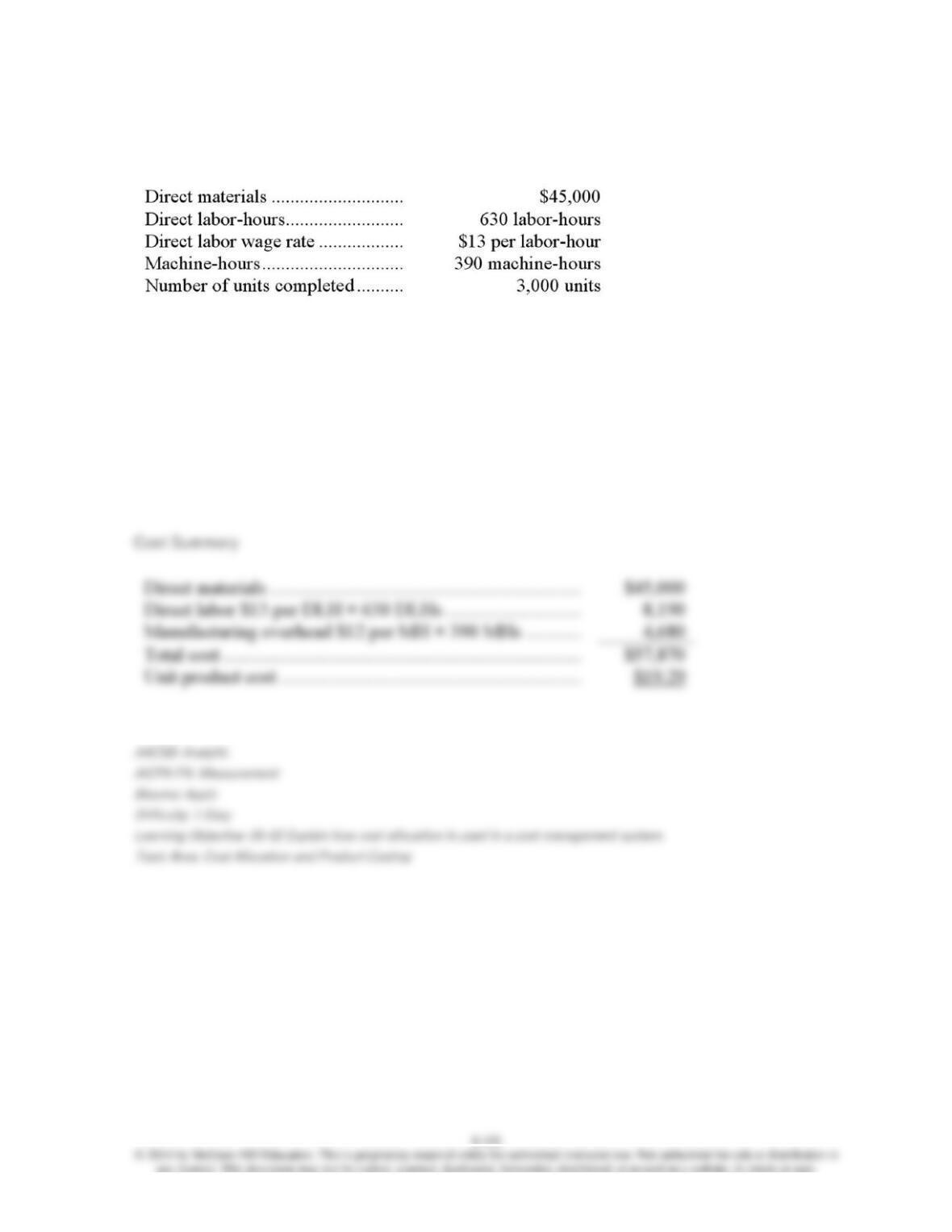
126. Job 434 was recently completed. The following data have been recorded on its job cost
sheet:
The company applies manufacturing overhead on the basis of machine-hours. The predetermined
overhead rate is $12 per machine-hour.
Required:
Compute the unit product cost that would appear on the job cost sheet for this job.
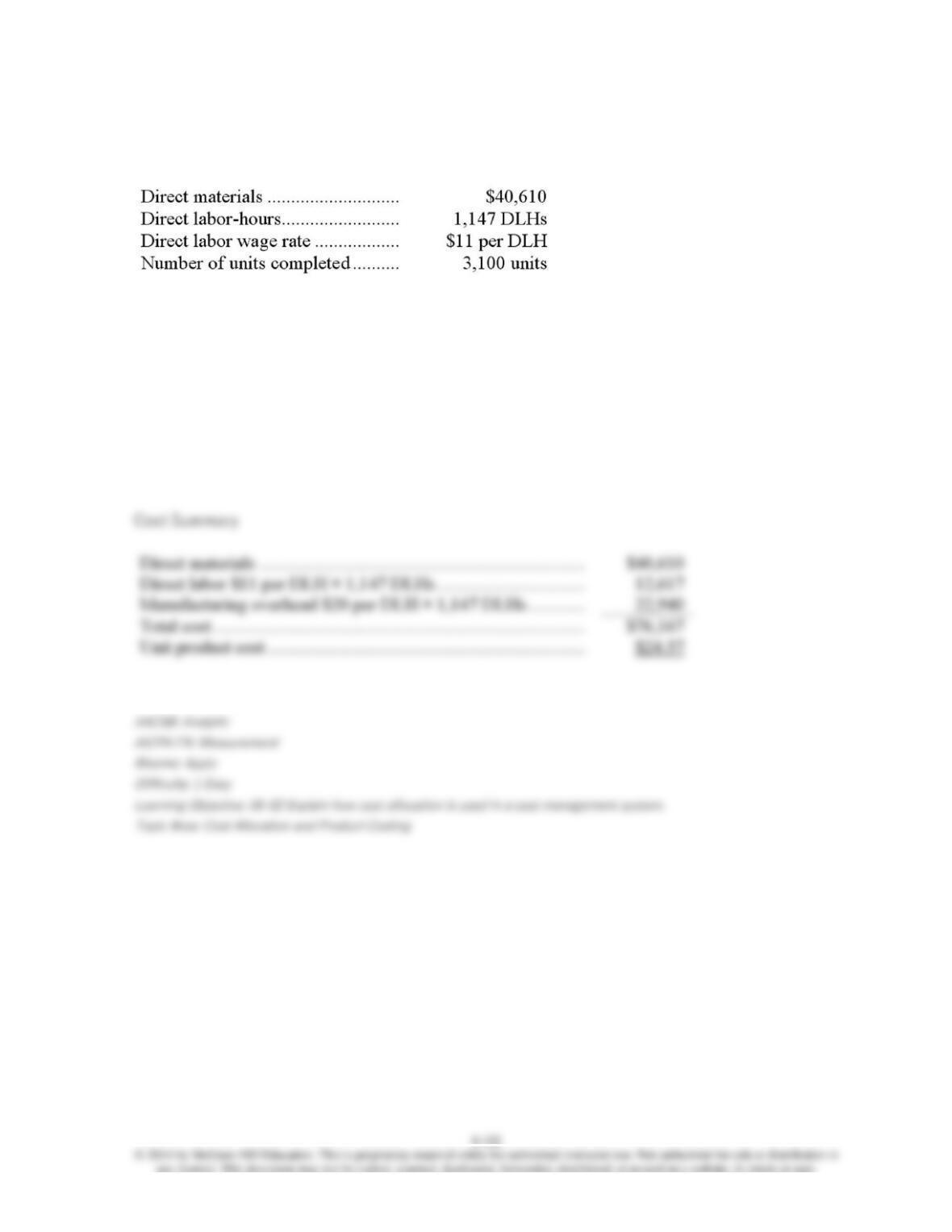
127. Job 599 was recently completed. The following data have been recorded on its job cost
sheet:
The company applies manufacturing overhead on the basis of direct labor-hours. The
predetermined overhead rate is $20 per direct labor-hour.
Required:
Compute the unit product cost that would appear on the job cost sheet for this job.

6-103
128. The management of Gruwell Corporation would like to investigate the possibility of basing
its predetermined overhead rate on activity at capacity rather than on the estimated amount of
activity for the year. The company’s controller has provided an example to illustrate how this new
system would work. In this example, the allocation base is machine-hours and the estimated
amount of the allocation base for the upcoming year is 48,000 machine-hours. In addition,
capacity is 53,000 machine-hours and the actual activity for the year is 47,700 machine-hours. All
of the manufacturing overhead is fixed and is $1,144,800 per year. For simplicity, it is assumed
that this is the estimated manufacturing overhead for the year as well as the manufacturing
overhead at capacity and the actual amount of manufacturing overhead for the year. Job J42O,
which required 40 machine-hours, is one of the jobs worked on during the year.
Required:
a. Determine the predetermined overhead rate if the predetermined overhead rate is based on the
estimated amount of the allocation base.
b. Determine how much overhead would be applied to Job J42O if the predetermined overhead
rate is based on estimated amount of the allocation base.
c. Determine the predetermined overhead rate if the predetermined overhead rate is based on the
amount of the allocation base at capacity.
d. Determine how much overhead would be applied to Job J42O if the predetermined overhead
rate is based on the amount of the allocation base at capacity.
129. The management of Niemeyer Corporation would like to investigate the possibility of
basing its predetermined overhead rate on activity at capacity rather than on the estimated
amount of activity for the year. The company‘s controller has provided an example to illustrate
how this new system would work. In this example, the allocation base is machine-hours and the
estimated amount of the allocation base for the upcoming year is 70,000 machine-hours. In
addition, capacity is 82,000 machine-hours and the actual activity for the year is 72,900 machine–
hours. All of the manufacturing overhead is fixed and is $4,132,800 per year. For simplicity, it is
assumed that this is the estimated manufacturing overhead for the year as well as the
manufacturing overhead at capacity and the actual amount of manufacturing overhead for the
year. Job O65A, which required 300 machine-hours, is one of the jobs worked on during the year.
Required:
a. Determine the predetermined overhead rate if the predetermined overhead rate is based on the
amount of the allocation base at capacity.
b. Determine how much overhead would be applied to Job O65A if the predetermined overhead
rate is based on the amount of the allocation base at capacity.
6-106
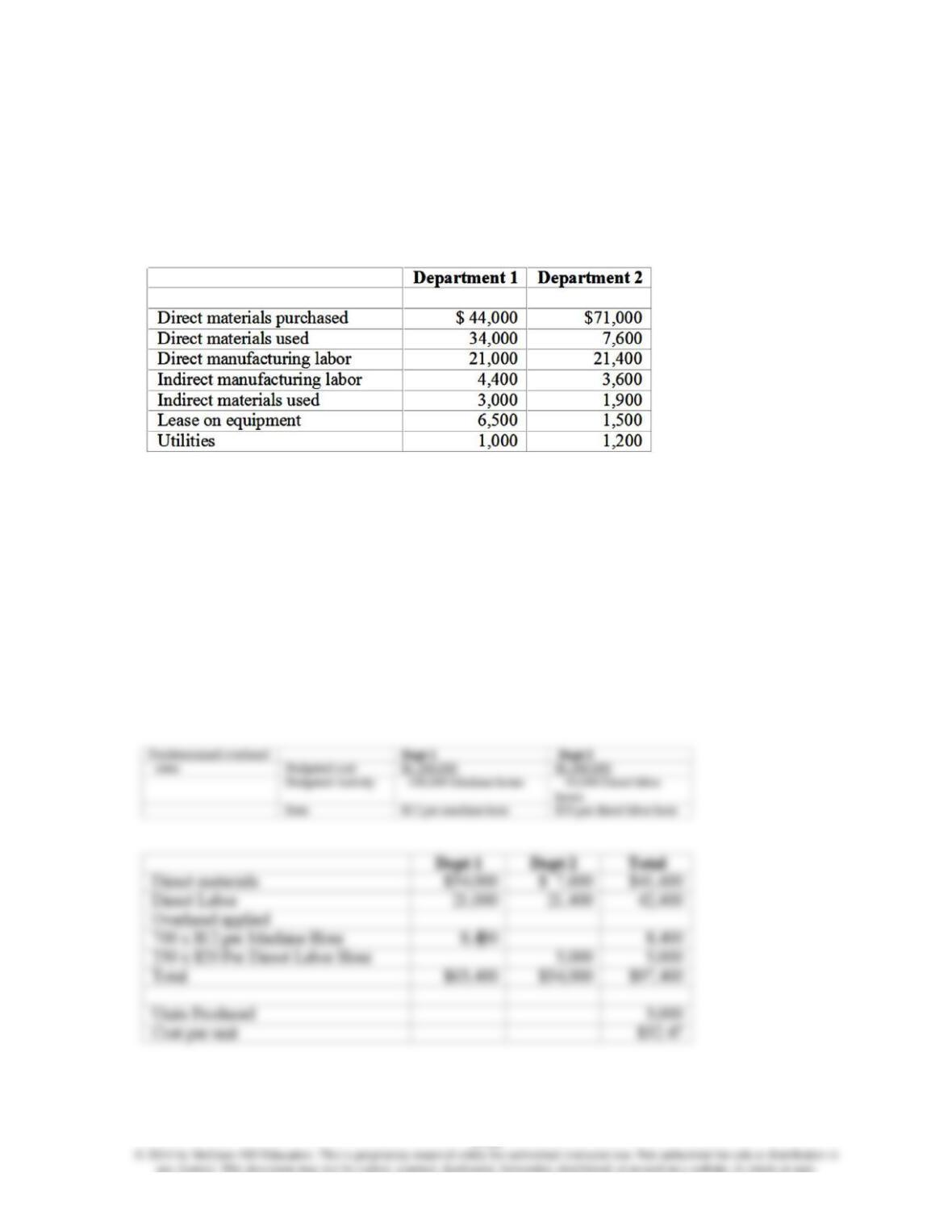
130. Osterville Manufacturing produces lamps for large department stores. For 2012, the two
production departments had budgeted allocation bases of 100,000 machine hours in Department
1 and 50,000 direct manufacturing labor hours in Department 2. The budgeted manufacturing
overheads for 2012 were $1,200,000 for Department 1 and $1,000,000 for Department 2. For Job
100, the actual costs incurred in the two departments were as follows:
Job 100 incurred 700 machine hours in Department 1 and 75 in Department 2 and 200
manufacturing labor hours in Department 1 and 250 in Department 2. The company uses a
budgeted departmental overhead rate for applying overhead to production. Job 100 consisted of
3,000 lamps.
Required:
Calculate the total cost and per unit cost of Job 100.
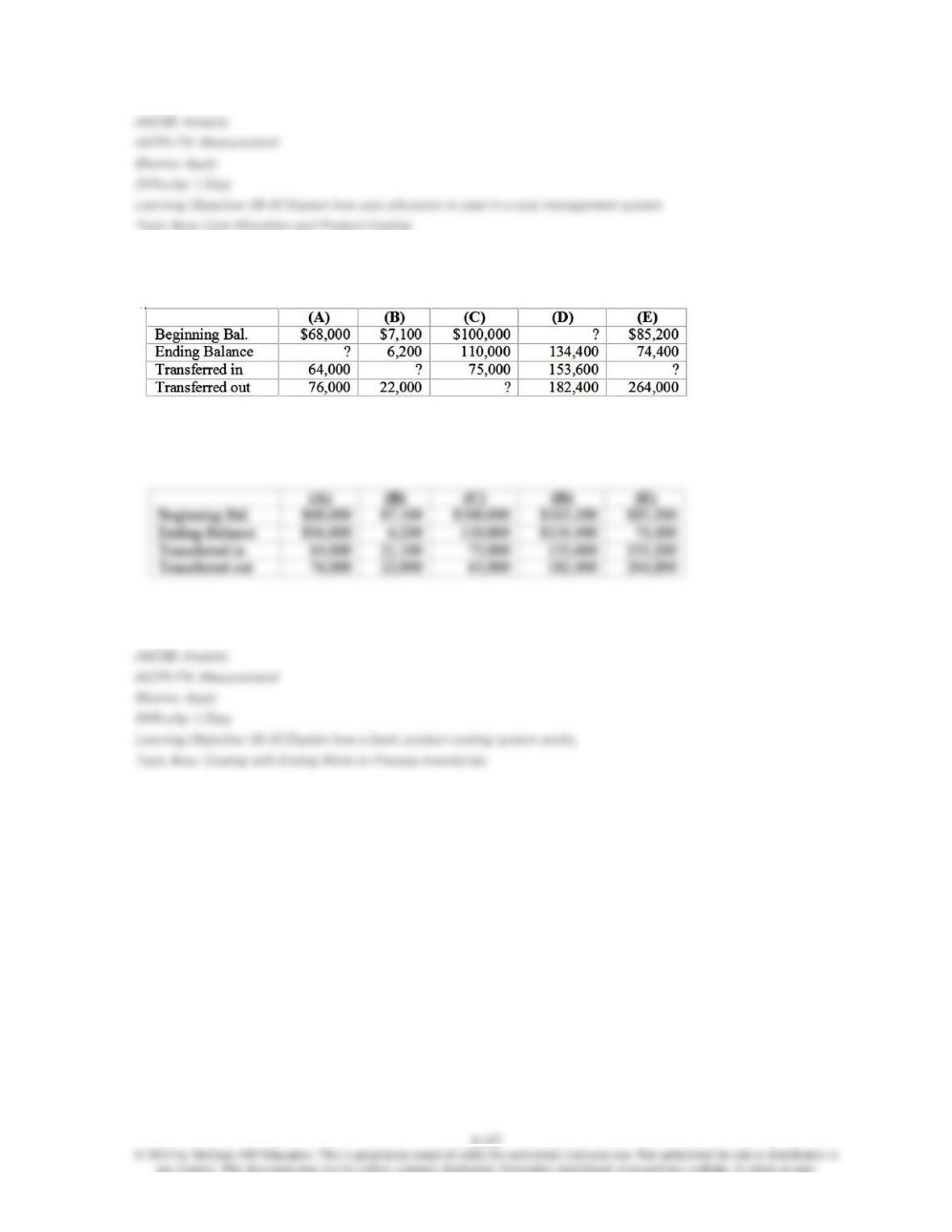
131. Fill in the missing items for the following inventories:
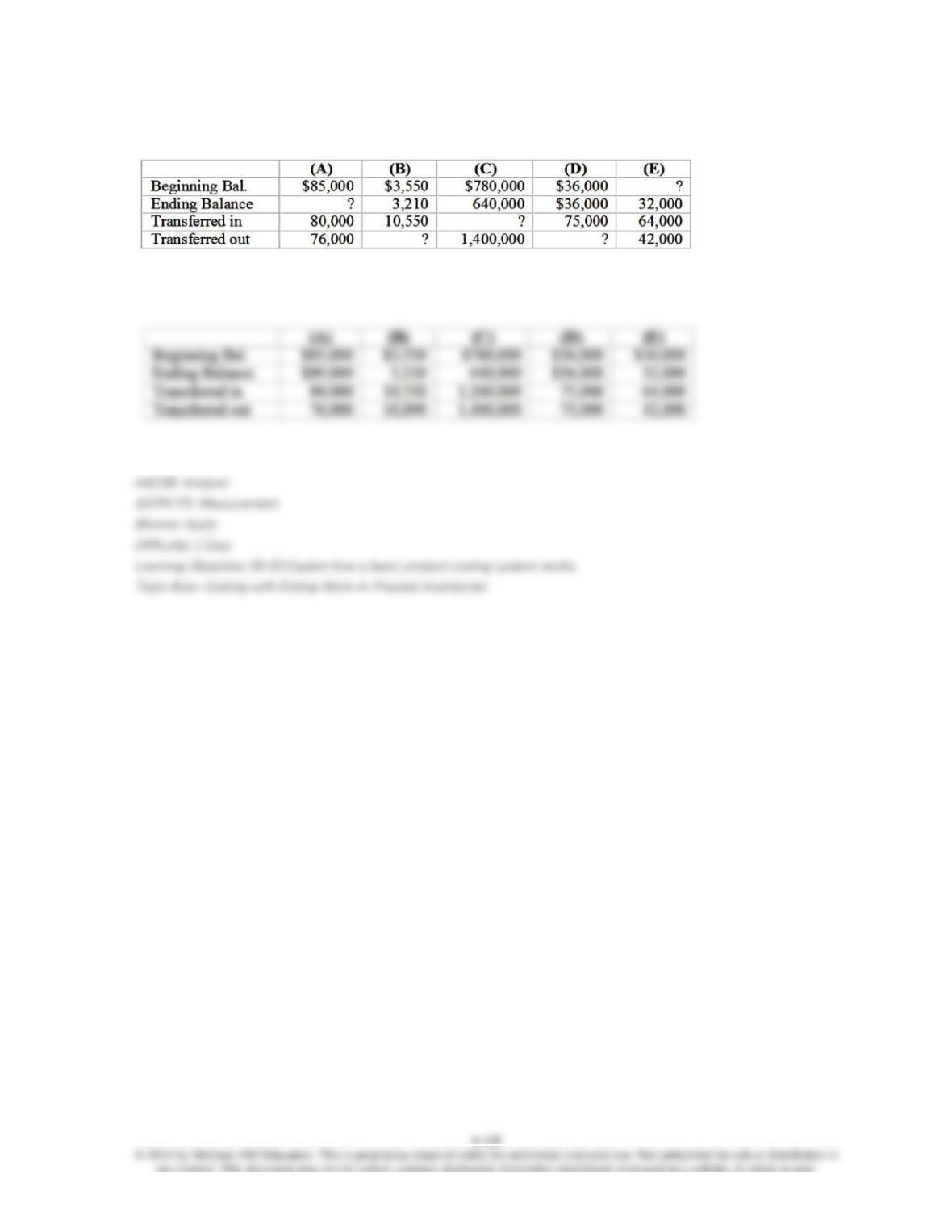
132. Fill in the missing items for the following inventories:
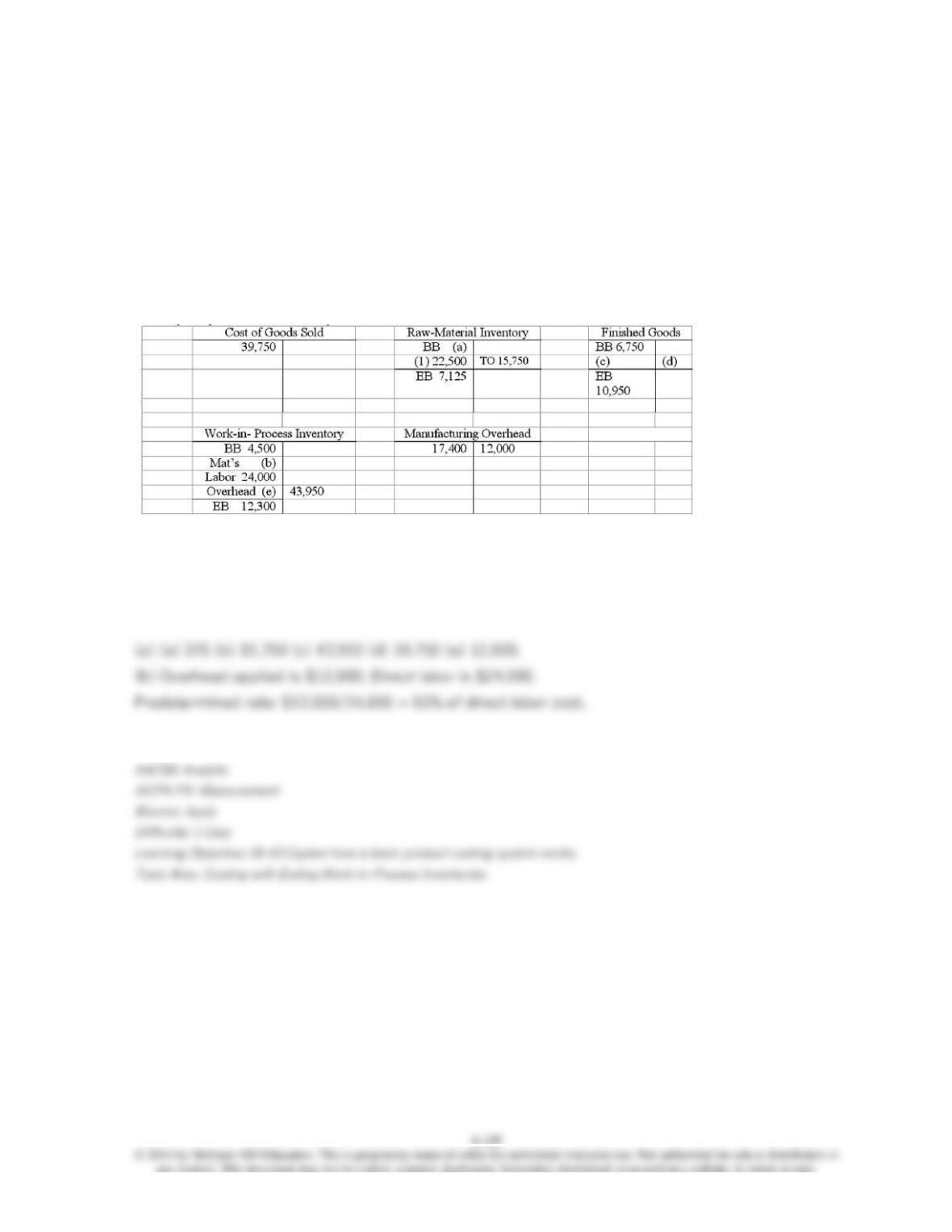
133. Assume that the following T-accounts represent data from the Bertelson Corporation’s
accounting records.
Required:
(a) Find the missing amounts represented by the letters a, b, c, d and e.
(b) Determine the company’s predetermined overhead rate, based on labor cost.
BB = Beginning Balance; EB = Ending Balance TO = Transferred Out
(1) Denotes materials purchased
134. Butte Boat Company, experienced the following events during 2012:
Purchased $1,800,000 of lumber and other materials for building boats.
Incurred $200,000 for advertising.
Paid $60,000 to have lumber transported to its factory.
Had sales revenue of $6,000,000 during the year.
Incurred $400,000 of general and administrative expenses.
Took a periodic inventory at year-end and determined that material costing $400,000 was on
hand. The inventory at the beginning of the year was $200,000.
All costs incurred were added to the appropriate accounts. All sales were on credit.
Required:
Solve for the following items in Butte Boat Company’s Raw-Material inventory account:
a) Transfers in (TI).
b) Beginning balance (BB).
c) Transfers out (TO).
d) Ending balance (EB).
135. Why might a company use direct labor cost as an overhead allocation base rather than
using direct labor hours?
136. Describe the two-stage allocation method. When is it important to use a two-stage
approach rather than a single-stage approach?
137. How does job costing differ from process costing?
138. Why is operations costing often called a “hybrid” system?
139. If costs are allocated on a somewhat arbitrary base, what purpose does computing
product costs have?
6-114
140. Thompson Metal Corporation (TMC) supplies various types of machine tools to
manufacturing companies. TMC has always paid a lot of attention to the quality of its products.
Recently, an outside supplier has approached TMC to supply an important and intricate
component of one of its more advanced tools that TMC has been manufacturing in-house. Sam
Weiss, a junior accountant at TMC, has collected the following information regarding this
proposal.
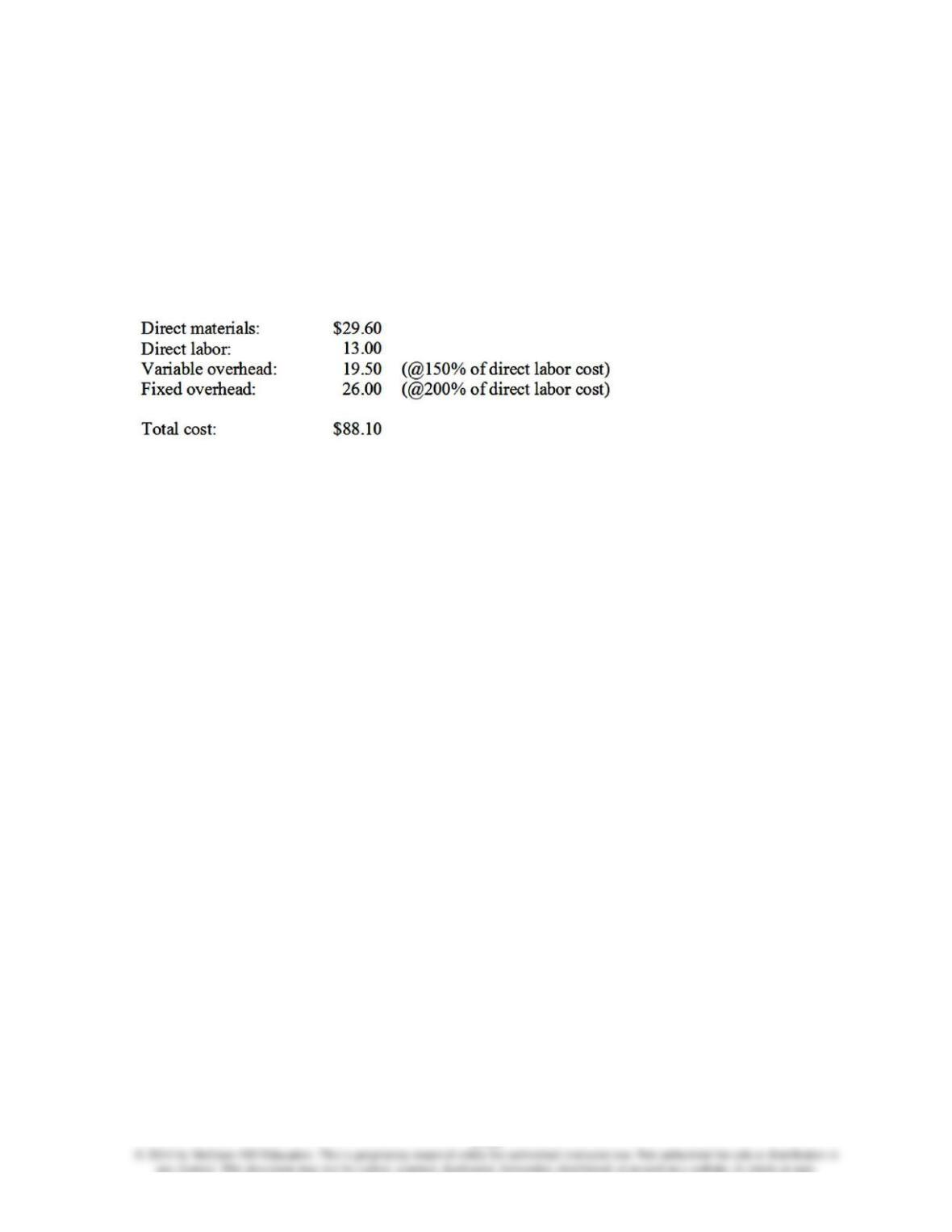
The cost of manufacturing one unit of this component internally are as follows:
The outside supplier has quoted a price of $90 per unit for supplying this component. The
following is a conversation that took place among the manufacturing manager (Dana Rice), the
buyer (Emily Scanlon), and Sam Weiss.
Weiss: I think that we should continue to manufacture internally because we can save $1.90 per
unit on this component.
Rice: According to your report, we would save $1.90 per unit, but I do not agree with those
numbers.
Weiss: What do you mean? I have followed the same costing guidelines this company has used for
years. I have even cross-checked my numbers with historical data and know for sure that the
overhead rates which I have used are correct.
Rice: I am sure you have done your job thoroughly, but I think that our costing system is archaic.
This component is complex and difficult to manufacture. I believe that our overhead allocation
method does not accurately capture the production difficulties and the additional resources that
are devoted to the manufacture of this component. For example, a significant portion of our
quality problems are due to this component. We spend close to a third of our quality inspection
time on just this component alone, but that is not reflected. These quality problems cause delays
in getting this component to the assembly department, and that causes a delay in getting the final
product to the customers. Many of our customers are expecting just–in-time deliveries, and they
get upset when we’re late.
Scanlon: I know that the supplier that has approached us has a strong reputation for quality.
Therefore, we can rest assured that we will have negligible quality problems.
Rice: Sam, your report does not consider this additional benefit from buying outside. I would
appreciate it if you can rework your numbers to more accurately reflect the true costs associated
with manufacturing this component internally.

6-115
Required:
(a) Assume the role of Sam Weiss. What are the different elements of costs that are likely to be
associated with the manufacture of the component? Does the current costing system capture
these costs?
(b) Recommend improvements in the costing system.
(c) How can Weiss quantify “qualitative” benefits such as quality and on-time delivery?