7) Which of the following are clues that a company may have been “cooking the books” by fraudulently increasing
their level of net sales?
A) Several shipping clerks checked into hospitals from lifting heavy boxes.
B) There was a very high level of returned goods shortly after year-end.
C) Several company warehouses reported burglaries.
D) There was a high level of inventory purchases in the following period.
Learning Objective 6-7
1) Estimated ending inventory can be computed by subtracting Estimated cost of goods sold from Cost of goods
available for sale.
2) Gross profit is Sales revenue divided by Cost of goods sold.
3) The gross profit method is a way to estimate inventory on the basis of the cost of goods sold model.
4) Revenue is $400,000 and Cost of goods sold is $100,000. How much is the gross profit percent?
A) 75%
B) 25%
C) 60%
D) 40%
5) Revenue is $400,000 and Cost of goods sold is $320,000. How much is the gross profit percent?
A) 75%
B) 20%
C) 60%
D) 80%
6) Beginning inventory is $28,000. Purchases for the year are $110,000. Sales revenues are $180,000. The
company’s normal gross profit percent is 60%. How much is Estimated ending inventory?
A) $72,000
B) $246,000
C) $30,000
D) $66,000
7) Haley’s Florist Shop has the following account balances at the end of the current accounting period.
Beginning inventory
$53,500
Net purchases
75,500
Net sales revenue
93,700
A normal gross profit percent is 30%. What is the estimated ending inventory as determined by the gross profit
method?
A) $100,890
B) $28,110
C) $63,410
D) $65,590
8) Golden Oak Antique Shop has the following account balances at the end of the current accounting period.
Beginning inventory
$73,250
Net purchases
57,650
Net sales revenue
85,500
A normal gross profit for the company is $45%. What is the company’s estimated cost of goods sold for the
accounting period?
A) $92,425
B) $38,475
C) $47,025
D) $83,875
9) Callahan Computers stores its inventory in a warehouse that burned to the ground in late November, 2012. Their
sales office was at a different location. In order to file a claim with their insurance, the owners ask you to estimate
the inventory in the warehouse. The following information is available:
Beginning inventory
$375,500
Purchases through November 30
470,250
Net sales revenue through November 31
793,000
The company’s gross profit has historically been 40% of Net sales revenue. Estimate the value of the inventory
destroyed in the fire using the gross profit method.
A) $369,950
B) $528,550
C) $410,000
D) $388,450
10) Owens Janitor Supply has the following account balances at the end of the current accounting period.
Beginning inventory
$ 50,000
Net purchases
400,000
Net sales revenue
500,000
A normal gross profit percent is 40%. What is the Estimated ending inventory as determined by the gross profit
method?
A) $150,000
B) $50,000
C) $200,000
D) $300,000
11) The following data is available:
Net sales, first month
$13,000
Normal gross profit
45%
Beginning inventory
8,000
Net purchases
7,000
Using the gross profit method, the amount of Gross profit would be:
A) $15,000.
B) $6,750.
C) $5,850.
D) $3,600.
12) The following data is available:
Net sales, first month
$13,000
Normal gross profit
45%
Beginning inventory
8,000
Net purchases
7,000
Using the gross profit method, the Cost of goods sold would be:
A) $15,000.
B) $7,150.
C) $7,850.
D) $5,850.
13) The following data is available:
Net sales, first month
$13,000
Normal gross profit
45%
Beginning inventory
8,000
Net purchases
7,000
Using the gross profit method, the Estimated ending inventory balance would be:
A) $15,000.
B) $7,150.
C) $7,850.
D) $5,850.
Learning Objective 6-8
1) Using the FIFO costing method will always produce the same results whether a company uses perpetual or
periodic inventory.
2) Using the LIFO costing method will always produce the same results whether a company uses perpetual or
periodic inventory.
3) When using periodic inventory, the closing process begins with closing out the Beginning inventory to Cost of
goods sold.
4) When using periodic inventory, the closing process begins with closing out the Beginning inventory to Cost of
goods sold. The second step is to set up the ending inventory by debiting Cost of goods sold and crediting
Inventory.
5) Under periodic inventory, the company first calculates Cost of goods sold for the period, and then determines
what the Ending inventory balance is.
6) Samson Company had the following balances and transactions during 2012.
Beginning inventory
10 units at $70
March 10
Sold 8 units
June 10
Purchased 20 units at $80
October 30
Sold 15 units
What would the company’s Inventory amount be on the December 31, 2012 balance sheet if the periodic FIFO
costing method is used? (Answers are rounded to the nearest dollar.)
A) $554
B) $490
C) $537
D) $560
7) Samson Company had the following balances and transactions during 2012.
Beginning inventory
10 units at $70
March 10
Sold 8 units
June 10
Purchased 20 units at $80
October 30
Sold 15 units
What would the company’s Inventory amount be on the December 31, 2012 balance sheet if the periodic LIFO
costing method is used? (Answers are rounded to the nearest dollar.)
A) $560
B) $537
C) $554
D) $490
8) Samson Company had the following balances and transactions during 2012.
Beginning inventory
10 units at $70
March 10
Sold 8 units
June 10
Purchased 20 units at $80
October 30
Sold 15 units
What would the company’s Inventory amount be on the December 31, 2012 balance sheet if the periodic average–
costing method is used? (Answers are rounded to the nearest dollar.)
A) $540
B) $554
C) $490
D) $537
9) A company uses periodic inventory in connection with FIFO costing. The company began the year with zero
inventory balance. They had the following transactions during the year:
Purchased 50 units at $4.00 per unit
Purchased 100 units at $4.10 per unit
Sold 80 units at a price of $12.00 per unit
Purchased 60 units at $3.20 per unit
Sold 75 units at a price of $12.75 per unit
At the end of the year, they counted the inventory and found 55 units remaining. How much was the Cost of goods
sold for the year? (Please round to the nearest whole dollar.)
A) $541
B) $582
C) $626
D) $680
10) A company uses periodic inventory in connection with LIFO costing. The company began the year with zero
inventory balance. They had the following transactions during the year:
Purchased 50 units at $4.00 per unit
Purchased 100 units at $4.10 per unit
Sold 80 units at a price of $12.00 per unit
Purchased 60 units at $3.20 per unit
Sold 75 units at a price of $12.75 per unit
At the end of the year, they counted the inventory and found 55 units remaining. How much was the Cost of goods
sold for the year? (Please round to the nearest whole dollar.)
A) $541
B) $582
C) $626
D) $680
11) A company uses periodic inventory in connection with the average-cost method. The company began the year
with zero inventory balance. They had the following transactions during the year:
Purchased 50 units at $4.00 per unit
Purchased 100 units at $4.10 per unit
Sold 80 units at a price of $12.00 per unit
Purchased 60 units at $3.20 per unit
Sold 75 units at a price of $12.75 per unit
At the end of the year, they counted the inventory and found 55 units remaining. How much was the Cost of goods
sold for the year? (Please round to the nearest whole dollar.)
A) $541
B) $582
C) $626
D) $592
12) A company that uses the periodic inventory method provides the following information:
Beginning inventory $4,000
Purchases $120,000
Purchase discounts $2,400
Purchase returns and allowances $800
At the end of the period, the company does an inventory count and finds $16,000 of inventory on hand.
How much is the Cost of goods sold?
A) $104,800
B) $111,200
C) $108,000
D) $128,800
13) A company that uses the periodic inventory method provides the following information:
Beginning inventory $4,000
Net Purchases $85,000
At the end of the period, the company does an inventory count and finds $9,000 of inventory on hand.
How much is the Cost of goods sold?
A) $98,000
B) $72,000
C) $80,000
D) $90,000
14) Company uses the periodic inventory method and offers the following information:
Beginning inventory $4,000
Purchases $120,000
Purchase discounts $2,400
Purchase returns and allowances $800
At the end of the period, the company does an inventory count and finds $16,000 of inventory on hand.
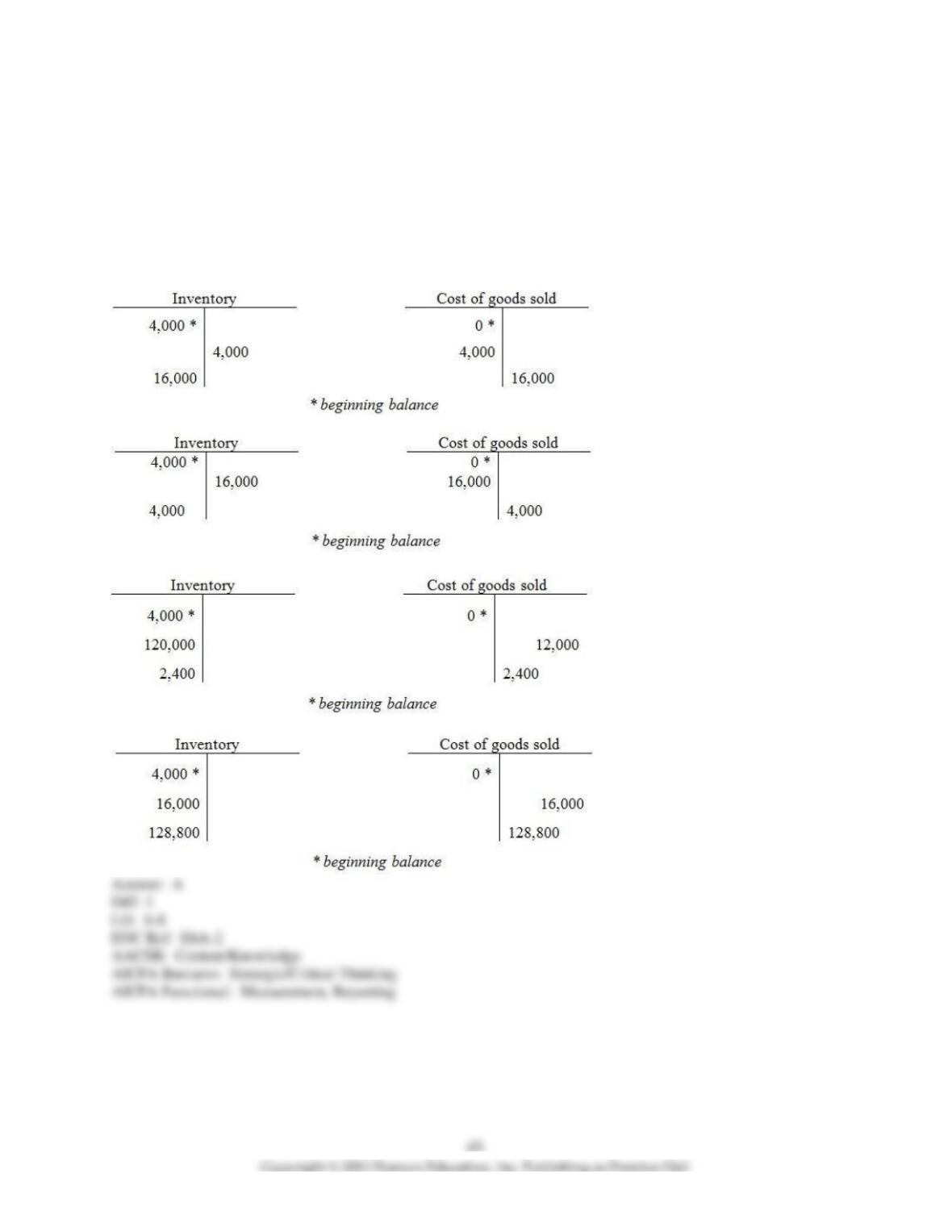
Which of the following pairs of T-accounts accurately represents the first two closing entries?
A)
B)
C)
D)
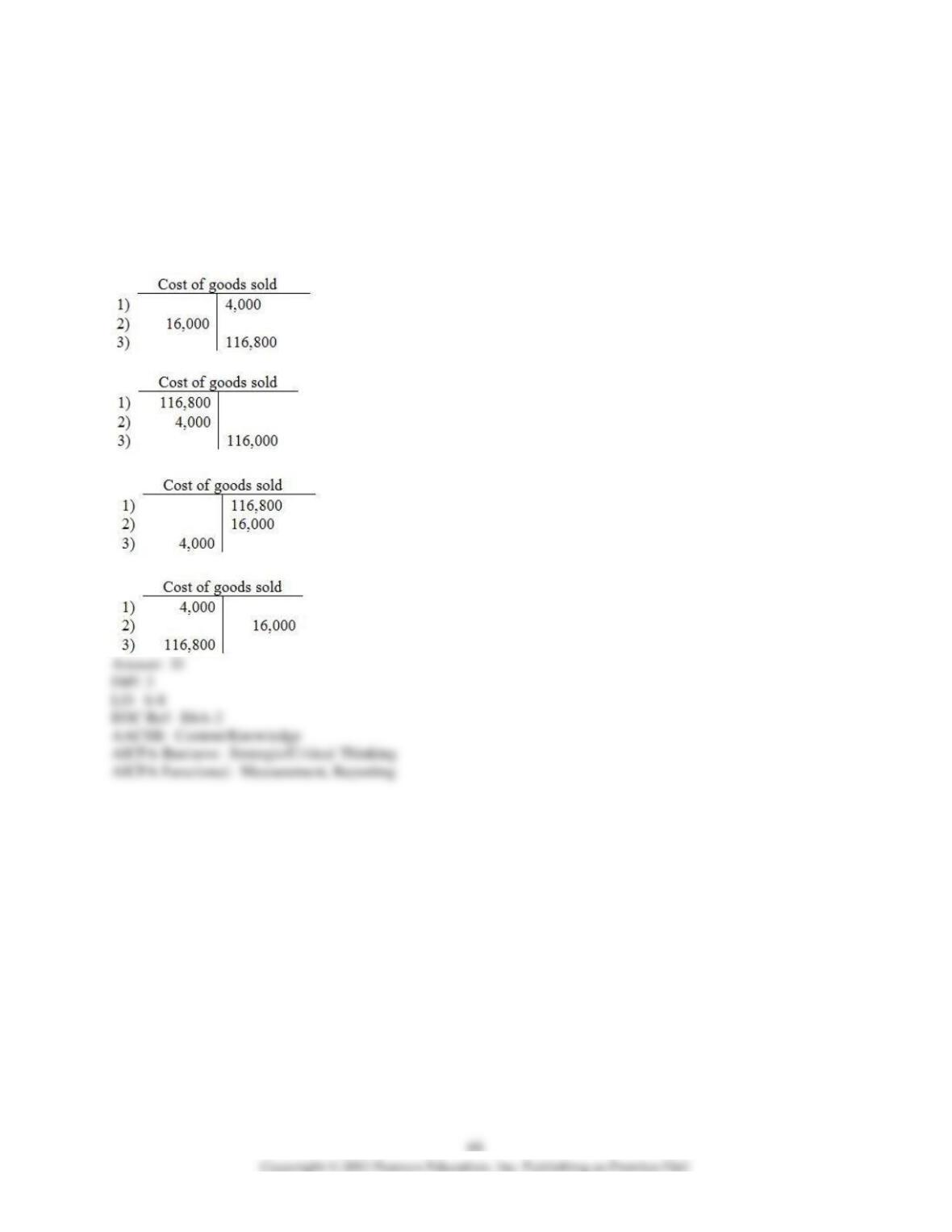
15) Company uses the periodic inventory method and offers the following information:
Beginning inventory $4,000
Purchases $120,000
Purchase discounts $2,400
Purchase returns and allowances $800
At the end of the period, the company does an inventory count and finds $16,000 of inventory on hand.
Which of the following T-accounts accurately represents the first three closing entries?
A)
B)
C)
D)