9) Beginning inventory for the year ended December 31, 2017, is understated. How will this error affect
net income for 2017 and 2018?
A) 2017 overstated; 2018 understated
B) 2017 understated; 2018 overstated
C) 2017 overstated; 2018 no effect
D) 2017 understated; 2018 no effect
10) If ending inventory is understated for Year 1, then in Year 2:
A) cost of goods sold and gross profit will both be understated.
B) cost of goods sold and gross profit will both be overstated.
C) cost of goods sold will be overstated and gross profit will be understated.
D) cost of goods sold will be understated and gross profit will be overstated.
11) If ending inventory for the year ended December 31, 2017, is understated, this error will cause
owners’ equity to be:
A) overstated at the end of 2017 and understated at the end of 2018.
B) understated at the end of 2017 and overstated at the end of 2018.
C) overstated at the end of 2017 and correctly stated at the end of 2018.
D) understated at the end of 2017 and correctly stated at the end of 2018.
12) There is an error in computing ending inventory in Year 1. Which statement is TRUE?
A) The error will have no effect on Year 2 financial statements.
B) After three years, the inventory error will counterbalance.
C) Gross profit will continue to be incorrect until an adjusting entry is made.
D) The total gross profit for Year 1 and Year 2 combined will be correct.
13) Slowinski Corporation reported net income of $415,000 for the current year. After the financial
statements had been prepared, it was discovered that ending inventory had been overstated by $35,000
and beginning inventory was understated by $2000. The correct net income was:
A) $378,000.
B) $382,000.
C) $448,000.
D) $452,000.
14) Speedy Corporation reported net income of $385,000 for the current year. After the financial
statements had been prepared, it was discovered that ending inventory had been understated by
$35,000. If the tax rate is 30%, after the error has been corrected, net income, after tax, will:
A) increase by $24,500.
B) decrease by $24,500.
C) increase by $35,000.
D) decrease by $35,000.
15) In 2017, ending inventory is overstated. What is the effect of the error on net income in 2017 and
2018?
A) Net income is overstated in 2017 and understated in 2018.
B) Net income is understated in 2017 and overstated in 2018.
C) Net income is understated in 2017 and 2018.
D) Net income is overstated in 2017 and 2018.
16) In 2017, ending inventory is overstated. What is the effect of the error on total stockholders’ equity in
2017 and 2018?
A) Total stockholders’ equity is overstated in 2017 and 2018.
B) Total stockholders’ equity is understated in 2017 and 2018.
C) Total stockholders’ equity is overstated in 2017 and correctly stated at the end of 2018.
D) Total stockholders‘ equity is overstated in 2017 and understated in 2018.
17) In 2017, beginning inventory is overstated. What is the effect of the error on net income in 2017 and
2018?
A) Net income is overstated in 2017 and 2018.
B) Net income is understated in 2017 and 2018.
C) Net income is understated in 2017 and overstated in 2018.
D) Net income is understated in 2017 and correctly stated in 2018.
18) In 2017, beginning inventory is overstated. What is the effect of the error on total stockholders’
equity in 2018?
A) Total stockholders’ equity is overstated in 2018.
B) Total stockholders’ equity is understated in 2018.
C) Total stockholders’ equity is correctly stated in 2018.
D) none of the above.
7 Learning Objective 6-7
1) In the periodic inventory system, the Inventory account is debited for the purchases made during the
year.
2) Under the periodic inventory system, a physical inventory count is taken to determine the cost of the
inventory on hand and the cost of the merchandise sold.
3) The journal entry to record the purchase of inventory on account under the periodic inventory system
is:
A) debit Inventory and credit Accounts Payable.
B) debit Purchases and credit Accounts Payable.
C) debit Cost of Goods Sold and credit Accounts Payable.
D) debit Inventory and credit Cost of Goods Sold.
4) Under the periodic inventory system:
A) the Inventory account is always up-to-date.
B) the Purchases account is an asset account.
C) an entry to credit Inventory must be made at the time a sale is recorded.
D) an entry must be made at the end of the period to transfer Purchases to Cost of Goods Sold.
5) The journal entry to remove the beginning inventory under the periodic inventory system is:
A) debit Purchases and credit Cost of Goods Sold.
B) debit Purchases and credit Inventory.
C) debit Inventory and credit Cost of Goods Sold.
D) debit Cost of Goods Sold and credit Inventory.
6) Under the periodic inventory system, the journal entry to record the cost of ending inventory
determined by a physical count is:
A) debit Inventory and credit Cost of Goods Sold.
B) debit Inventory and credit Sales Revenue.
C) debit Purchases and credit Inventory.
D) debit Cost of Goods Sold and credit Inventory.
7) Jaronski Company uses the periodic inventory system. At the end of the accounting period, journal
entries are prepared to remove:
A) beginning and ending inventory balances.
B) purchases only.
C) beginning inventory balance and purchases.
D) beginning inventory balance, purchases, and ending inventory balance.
8) Bayer Company uses the periodic inventory system. Bayer Company sold goods on account with a
retail price of $1200 and a cost of $600. What journal entry(ies) is(are) prepared?
A) debit Accounts Receivable for $1200 and credit Sales Revenue for $1200
B) debit Accounts Receivable for $600 and credit Sales Revenue for $600
C) debit Accounts Receivable for $1200 and credit Sales Revenue for $1200, debit Cost of Goods Sold for
$600 and credit Inventory for $600
D) debit Inventory for $600 and credit Purchases for $600
9) Dole Company uses the periodic inventory system. At the end of the accounting period, ending
inventory is $10,000 and beginning inventory is $5,000. Purchases for the period are $99,000. How many
journal entries are necessary at the end of the accounting period?
A) none
B) one
C) two
D) three
10) Seifert Company uses the periodic inventory system. At the end of the accounting period, on
December 31, ending inventory is $18,000 and beginning inventory is $7000. Purchases for the period
are $102,000. Which of the following journal entries did Seifert Company prepare on December 31?
A) debit Cost of Goods Sold for $102,000 and credit Purchases for $102,000
B) debit Cost of Goods Sold for $18,000 and credit Inventory for $18,000
C) debit Inventory for $7000 and credit Cost of Goods Sold for $7000
D) all of the above
11) Under the periodic inventory system, which of the following entries is prepared at the end of the
accounting period?
A) debit Purchases and credit Cost of Goods Sold
B) debit Cost of Goods Sold and credit Inventory
C) debit Cost of Goods Sold and credit Purchases
D) B and C
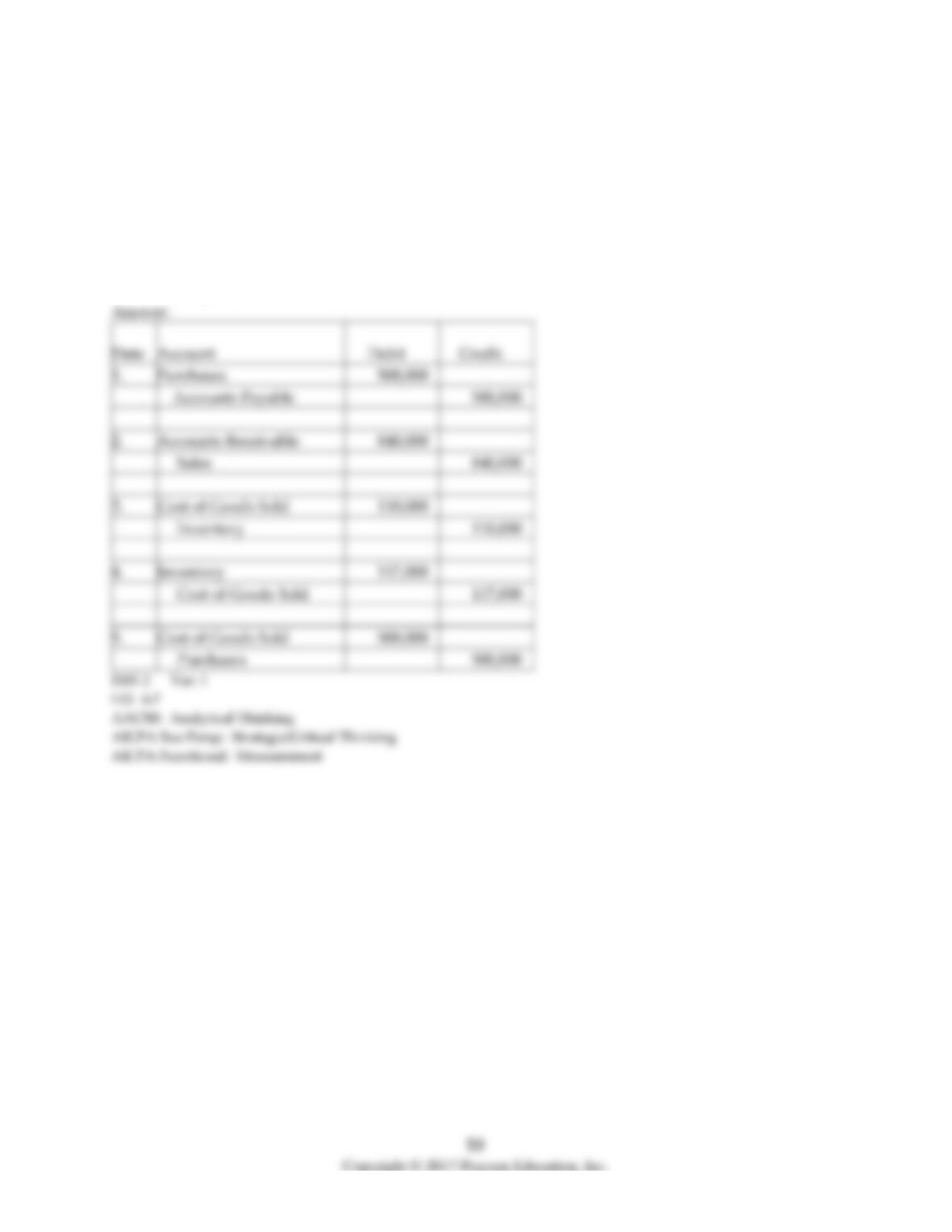
12) Jolly Rancher Company uses the periodic inventory system.
Required:
Prepare the journal entries to record the following transactions. Omit explanations.
1. Purchased $500,000 of inventory on account.
2. Sales on account were $840,000.
3. Closed out beginning inventory of $110,000.
4. The ending inventory based on a physical count was $117,000.
5. Closed out purchases account.
8 Learning Objective 6-8
1) The Internal Revenue Service allows companies to use LIFO for income tax purposes even if they use
FIFO for financial reporting.
2) The LIFO Reserve is the difference between the LIFO cost of inventory and what the cost of that
inventory
would be under FIFO.
3) The income tax saved by using LIFO instead of FIFO is equal to the ________ times the income tax
rate.
A) cost of the ending inventory
B) retail price of the ending inventory
C) cost of the beginning inventory
D) LIFO Reserve
4) The LIFO Reserve can increase only when:
A) inventory costs are stable.
B) inventory costs are falling.
C) inventory costs are rising.
D) the foreign exchange rate is rising.
5) Using the following data, by how much would taxable income change if LIFO is used rather than
FIFO?
Beginning inventory
4000 units at $44
Purchases
7000 units at $54
Units sold
7000
A) There is no difference.
B) Increase by $40,000.
C) Decrease by $40,000.
D) Decrease by $70,000.
7000 units × $54 =
COGS
FIFO
4000 units × $44 =
COGS
3000 units × $54 =
Difference
6) Using the following data, by how much would taxable income change if FIFO is used rather than
LIFO?
Beginning inventory
4000 units at $43
Purchases
7000 units at $53
Units sold
8000
A) Decrease by $30,000.
B) Decrease by $80,000.
C) Increase by $30,000.
D) Increase by $80,000.
LIFO
7000 units × $53 =
COGS
1000 units × $43=
8000 units
FIFO
4000 units × $43 =
COGS
4000 units × $53 =
Difference
7) Carboni Company had the following data available for the current month:
FIFO Cost of Goods Sold:
10 × $55 =
$550
30 × $60 =
1,800
Total
$2,350
LIFO Cost of Goods Sold:
25 × $65 =
$1,625
15 × $60 =
900
Total
$2,525
The income tax rate is 30%.
Required:
How much would Carboni Company save in income taxes if they used LIFO instead of FIFO?