2) Given the same purchase and sales data, the three major costing methods will result in three different amounts for
Cost of goods sold.
3) Given the same purchase and sales data, the three major costing methods will result in three different amounts for
Sales revenue.
4) Given the same purchase and sales data, the three major costing methods will result in three different amounts for
Gross profit.
5) The sum of the Cost of goods sold and the Ending inventory equals the Cost of goods available.
6) Which of the following inventory costing methods yields the highest cost of goods sold when costs are rising
during the accounting period?
A) Specific-unit-cost
B) Average-cost
C) Last-In, First-Out
D) First-In, First-Out
7) Which of the following inventory costing methods yields the lowest cost of goods sold when costs are rising
during the accounting period?
A) Specific-unit-cost
B) Average-cost
C) Last-In, First-Out
D) First-In, First-Out
8) Which of the following inventory costing methods yields the highest gross profit when costs are rising during the
accounting period?
A) Specific-unit-cost
B) Average-cost
C) Last-In, First-Out
D) First-In, First-Out
9) Which of the following inventory costing methods yields the lowest gross profit when costs are rising during the
accounting period?
A) Specific-unit-cost
B) Average-cost
C) Last-In, First-Out
D) First-In, First-Out
10) Which of the following inventory costing methods yields the highest ending inventory when costs are rising
during the accounting period?
A) Specific-unit-cost
B) Average-cost
C) Last-In, First-Out
D) First-In, First-Out
11) Which of the following inventory costing methods yields the lowest ending inventory when costs are rising
during the accounting period?
A) Specific-unit-cost
B) Average-cost
C) Last-In, First-Out
D) First-In, First-Out
12) Which inventory valuation model minimizes income tax when costs are rising?
A) First-In, First-Out
B) Last-In, First-Out
C) Average-cost
D) Specific-unit-cost
13) Which inventory valuation model deals with unique or high dollar items?
A) First-In, First-Out
B) Last-In, First-Out
C) Average-cost
D) Specific-unit-cost
14) Which inventory valuation model serves as a middle–of-the-road approach for taxes and income?
A) First-In, First-Out
B) Last-In, First-Out
C) Average-cost
D) Specific-unit-cost
15) The Cost of goods available for sale is equal to the:
A) Cost of goods sold minus the Ending inventory.
B) Sales revenue minus the Cost of goods sold.
C) Cost of goods sold plus the Ending inventory.
D) Ending inventory plus the Sales revenues.
Learning Objective 6-5
1) If the historical cost of inventory falls below replacement cost, the business must write down the inventory cost.
2) Which of the following assets must be reported at the lower-of-cost-or-market?
A) Accounts receivable
B) Inventory
C) Prepaid insurance
D) Cash
3) Which of the following is used for market when valuing inventory at lower–of-cost-or-market?
A) Sales price less the company’s normal mark-up percentage
B) Current replacement price
C) Cost plus the company’s normal mark-up percentage
D) Sales price
4) Which of the following amounts would be reported for Inventory on the balance sheet if the cost of an item is
$80, the current selling price is $100 and the current replacement cost is $75?
A) $100
B) The average of $75 and $80
C) $80
D) $75
5) Twenty units of inventory on hand at the end of the year are recorded at their cost of $5.00 per unit using FIFO.
Current replacement cost is $4.50 per unit. What amount would be reported as inventory on the balance sheet?
A) $100.00
B) $5.00
C) $4.50
D) $90.00
6) Better Buy has six CD players in inventory on December 31. The players were purchased in November for $170.
Price lists from Better Buy’s supplier indicate that the same CD player would now cost the company $175. The
current sales price for each of the CD players is $320. What would be the amount reported as Inventory on the
balance sheet?
A) $1,050
B) $1,035
C) $1,020
D) $1,920
7) Better Buy has six CD players in inventory on December 31. The players were purchased in November for $170.
Price lists from Better Buy’s supplier indicate that the same CD player would now cost the company $168. The
current sales price for each of the CD players is $320. What would be the amount reported as Inventory on the
balance sheet?
A) $1,008
B) $1,035
C) $1,020
D) $1,920
8) Better Buy has six CD players in inventory on December 31. The players were purchased in November for $170.
Price lists from Better Buy’s supplier indicate that the same CD player would now cost the company $168. The
current sales price for each of the CD players is $320. The adjustment would have what effect on Cost of goods
sold?
A) Cost of goods sold would increase by $2.
B) Cost of goods sold would not be affected.
C) Cost of goods sold would decrease by $12.
D) Cost of goods sold would increase by $12.
9) Better Buy has six CD players in inventory on December 31. The players were purchased in November for $170.
Price lists from Better Buy‘s supplier indicate that the same CD player would now cost the company $168. The
current sales price for each of the CD players is $320. The adjustment would have what effect on Gross profit?
A) Gross Profit would increase by $2.
B) Gross Profit would not be affected.
C) Gross Profit would decrease by $12.
D) Gross Profit would increase by $12.
10) When a company uses the perpetual inventory method, which of the following would be the entry to adjust
inventory to lower-of-cost-or-market?
A) Debit Purchases and credit Inventory
B) Debit Inventory and credit Purchases
C) Debit Cost of goods sold and credit Inventory
D) Debit Inventory and credit Cost of goods sold
11) Williams Company had the following balances and transactions during 2013.
Beginning inventory
10 units at $70
June 10
Purchased 20 units at $80
December 30
Sold 15 units
December 31
Replacement cost $60
What would the company’s inventory amount be on the December 31, 2013 balance sheet if the perpetual FIFO
method is used? (Answers are rounded to the nearest dollar.)
A) $1,200
B) $900
C) $1,050
D) $1,100
12) Williams Company had the following balances and transactions during 2013.
Beginning inventory
10 units at $70
June 10
Purchased 20 units at $80
December 30
Sold 15 units
December 31
Replacement cost $60
What would the company’s inventory amount be on the December 31, 2013 balance sheet if the perpetual LIFO
method is used? (Answers are rounded to the nearest dollar.)
A) $1,050
B) $1,100
C) $900
D) $1,200
13) Williams Company had the following balances and transactions during 2013.
Beginning inventory
10 units at $70
June 10
Purchased 20 units at $80
December 30
Sold 15 units
December 31
Replacement cost $60
What would the company’s inventory amount be on the December 31, 2013 balance sheet if the perpetual average-
costing method is used? (Answers are rounded to the nearest dollar.)
A) $1,200
B) $1,150
C) $1,050
D) $900
14) Williams Company had the following balances and transactions during 2013.
Beginning inventory
10 units at $70
June 10
Purchased 20 units at $80
December 30
Sold 15 units
December 31
Replacement cost $78
What would the company’s inventory amount be on the December 31, 2013 balance sheet if the perpetual FIFO
method is used? (Answers are rounded to the nearest dollar.)
A) $1,200
B) $1,170
C) $1,050
D) $1,100
15) Williams Company had the following balances and transactions during 2013.
Beginning inventory
10 units at $70
June 10
Purchased 20 units at $80
December 30
Sold 15 units
December 31
Replacement cost $78
What would the company’s inventory amount be on the December 31, 2013 balance sheet if the perpetual LIFO
method is used? (Answers are rounded to the nearest dollar.)
A) $1,050
B) $1,100
C) $900
D) $1,200
16) Williams Company had the following balances and transactions during 2013.
Beginning inventory
10 units at $70
June 10
Purchased 20 units at $80
December 30
Sold 15 units
December 31
Replacement cost $78
What would the company’s inventory amount be on the December 31, 2013 balance sheet if the perpetual average–
costing method is used? (Answers are rounded to the nearest dollar.)
A) $1,200
B) $1,150
C) $1,050
D) $900
17) One hundred units of inventory on hand at the end of the year are recorded at their cost of $10 each using LIFO.
Current replacement cost is $8.00. What amount would be reported as Inventory on the balance sheet?
A) $1,000.00
B) $10.00
C) $800.00
D) $8.00
18) One hundred units of inventory on hand at the end of the year are recorded at their cost of $10 each using LIFO.
Current replacement cost is $11.00. What amount would be reported as Inventory on the balance sheet?
A) $1,000.00
B) $10.00
C) $800.00
D) $8.00
19) One hundred units of inventory on hand at the end of the year are recorded at their cost of $10 each using LIFO.
Current replacement cost is $8.00. How would the Cost of goods sold be affected by the adjusting entry needed
under lower–of-cost-or-market?
A) Cost of goods sold would not be affected.
B) Cost of goods sold would go down by $80.
C) Cost of goods sold would go up by $200.
D) Cost of goods sold would go down by $200.
20) One hundred units of inventory on hand at the end of the year are recorded at their cost of $10 each using LIFO.
Current replacement cost is $8.00. How would the Gross profit be affected by the adjusting entry needed under
lower-of-cost-or-market?
A) Gross profit would not be affected.
B) Gross profit would go down by $80.
C) Gross profit would go up by $200.
D) Gross profit would go down by $200.
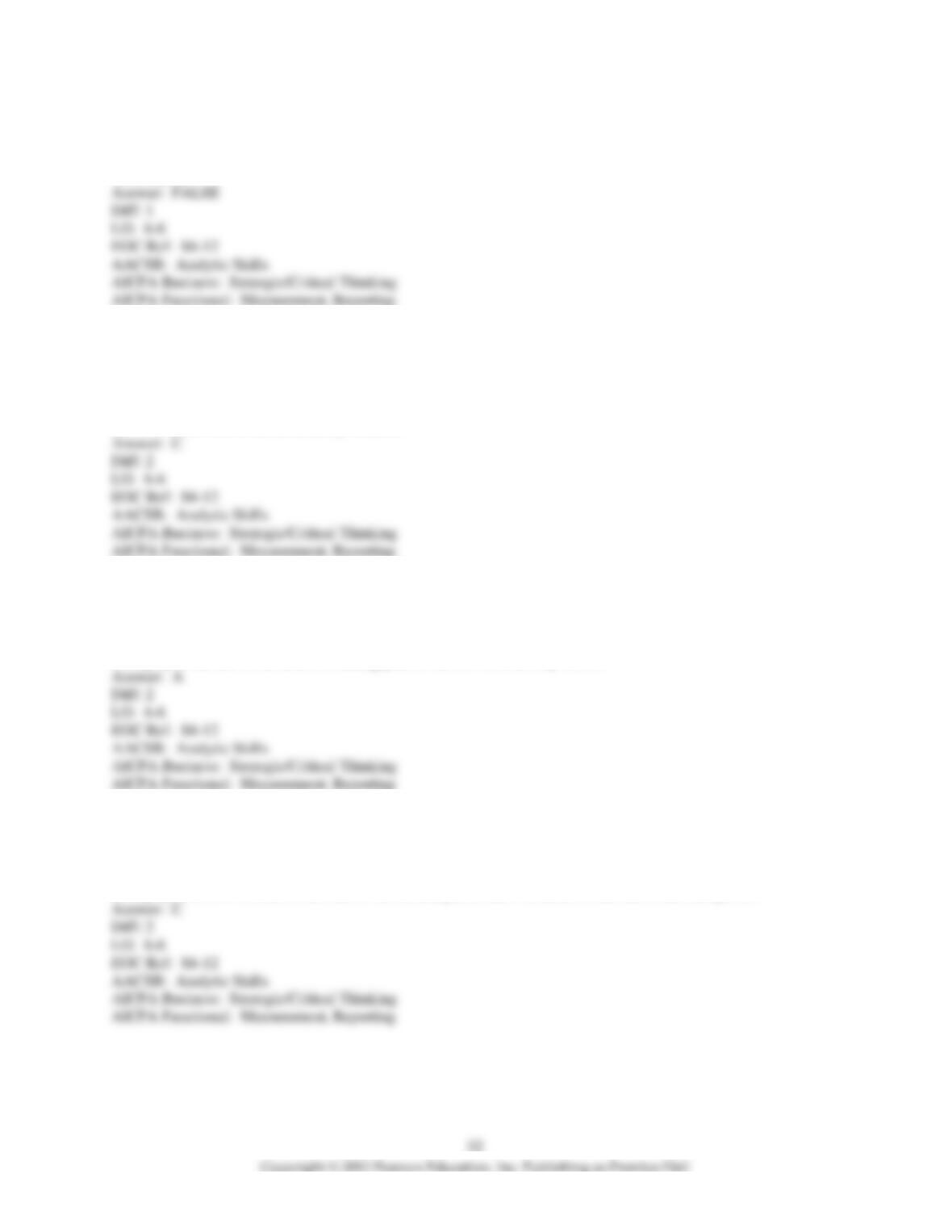
21) A company’s ending inventory is $450,000 using the perpetual FIFO inventory costing method. Replacement
cost for the ending inventory is $420,000. Prepare the journal entry to adjust inventory.
Cost of goods sold
Learning Objective 6-6
1) An overstatement of ending inventory in the current period results in the understatement of Net income in the
current year.
2) Ending inventory for the current year is overstated by $20,000. What effect will this error have on the following
year’s Net income?
A) The inventory overstatement will not affect Net income.
B) Net income will be overstated by $20,000.
C) Net income will be understated by $20,000.
D) Net income will be understated by $40,000.
3) Ending inventory for the current accounting period is overstated by $3,500. What will be effect of this error?
A) Net income for the current period will be overstated by $3,500.
B) Cost of goods sold for the current period will be overstated by $3,500.
C) Ending inventory for the next period will be overstated by $3,500.
D) Equity at the end of the next accounting period will be overstated by $3,500.
4) Ending inventory for the current period is understated. What effect will this error have on equity?
A) Equity will be overstated at the end of the current period, but it will be correct at the end of the next period.
B) Equity will be overstated at the end of the current period and understated at the end of the next period.
C) Equity will be understated at the end of the current period, but it will be correct at the end of the next period.
D) Equity will be overstated at the end of the current period and overstated at the end of the next period.
5) Ending inventory for the current accounting period is understated by $2,700. What effect will this error have on
Cost of goods sold and Net income?
A)
Cost of goods sold
Net income
Understated
Understated
B)
Cost of goods sold
Net income
Overstated
Overstated
C)
Cost of goods sold
Net income
Understated
Overstated
D)
Cost of goods sold
Net income
Overstated
Understated
6) Ending inventory for the current accounting period is overstated by $2,700. What effect will this error have on
Cost of goods sold and Net income?
A)
Cost of goods sold
Net income
Overstated
Overstated
B)
Cost of goods sold
Net income
Understated
Overstated
C)
Cost of goods sold
Net income
Overstated
Understated
D)
Cost of goods sold
Net income
Understated
Understated