64. On April 1, Robert LLC purchased two units of inventory, A and B. The cost of unit A
was $650, and the cost of unit B was $625. On April 30, Robert LLC had not sold the
inventory. The market value of unit A was now $685 while the market value of unit B was
$550. The adjustment associated with the lower-of-cost-or-market method on April 30 will
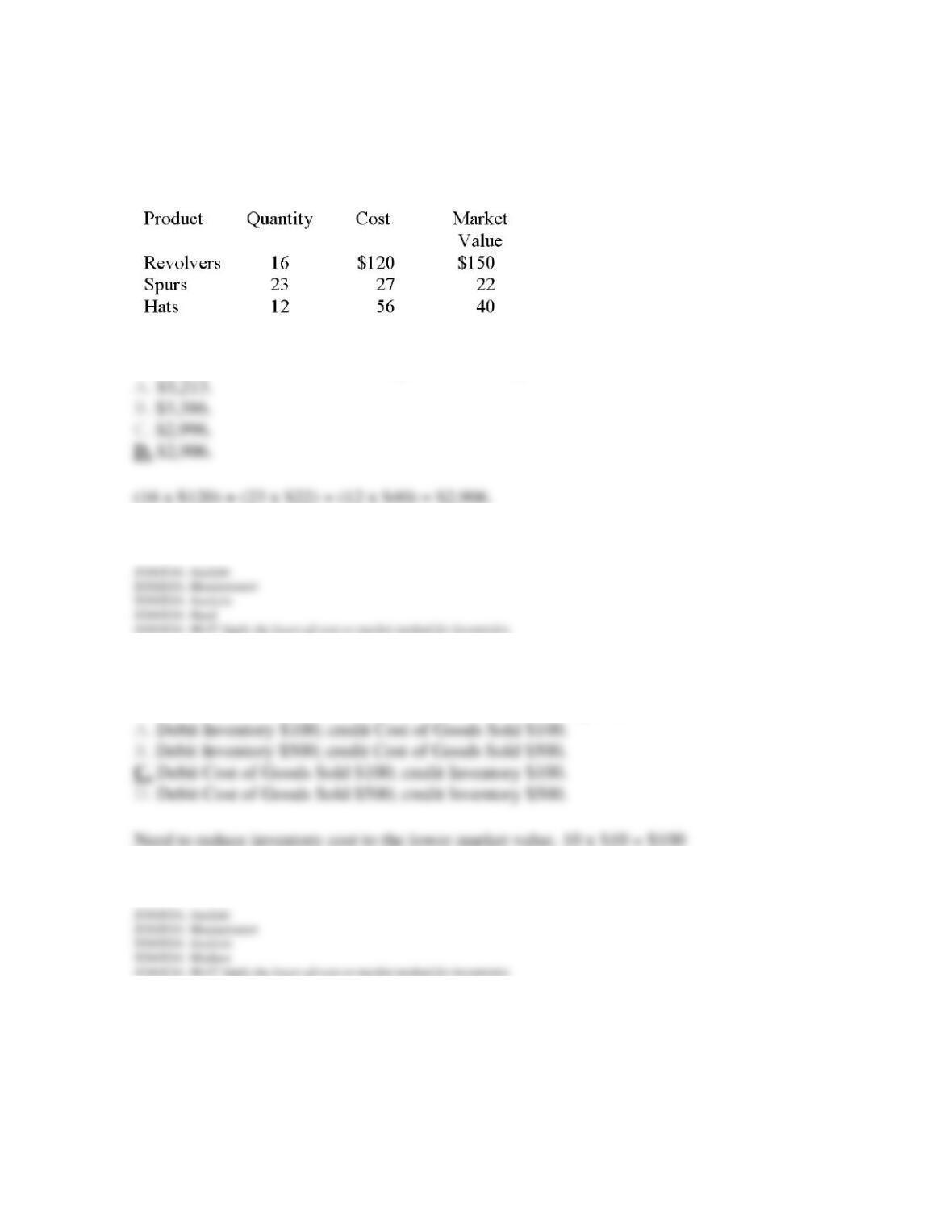
65. Consider the following information pertaining to OldWest’s inventory:
At what amount should OldWest report its inventory?
66. Under the principle of lower-of–cost-or-market, when a company has 10 units of inventory
A with market value of $50 and a cost of $60, what is the adjustment?
67. What effect would an adjustment to record inventory at the lower-of-cost-or-market have
on the company’s financial statements?
68. The practice of using the lower-of-cost-or-market to evaluate inventory reflects which of
the following accounting principles?
69. At the end of a reporting period, Gamble Corporation determines that its ending inventory
has a cost of $300,000 and a market value of $230,000. What would be the effect(s) of the
adjustment to write down inventory to market value?
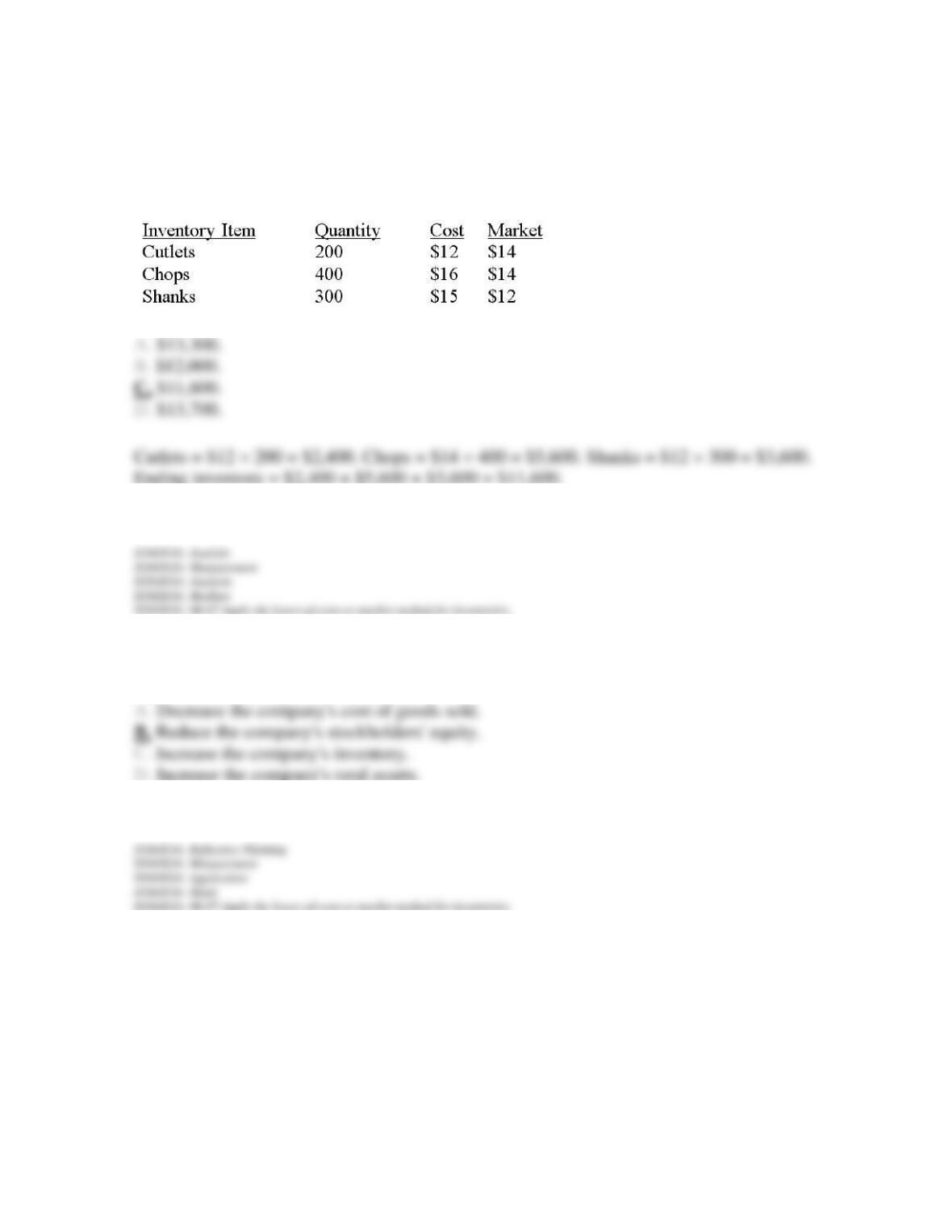
70. Using the information below, determine the ending inventory value applying the lower-of-
cost-or-market method.
71. After applying the lower-of-cost-or–market method, the accountant prepares a year-end
adjustment. That adjustment would:
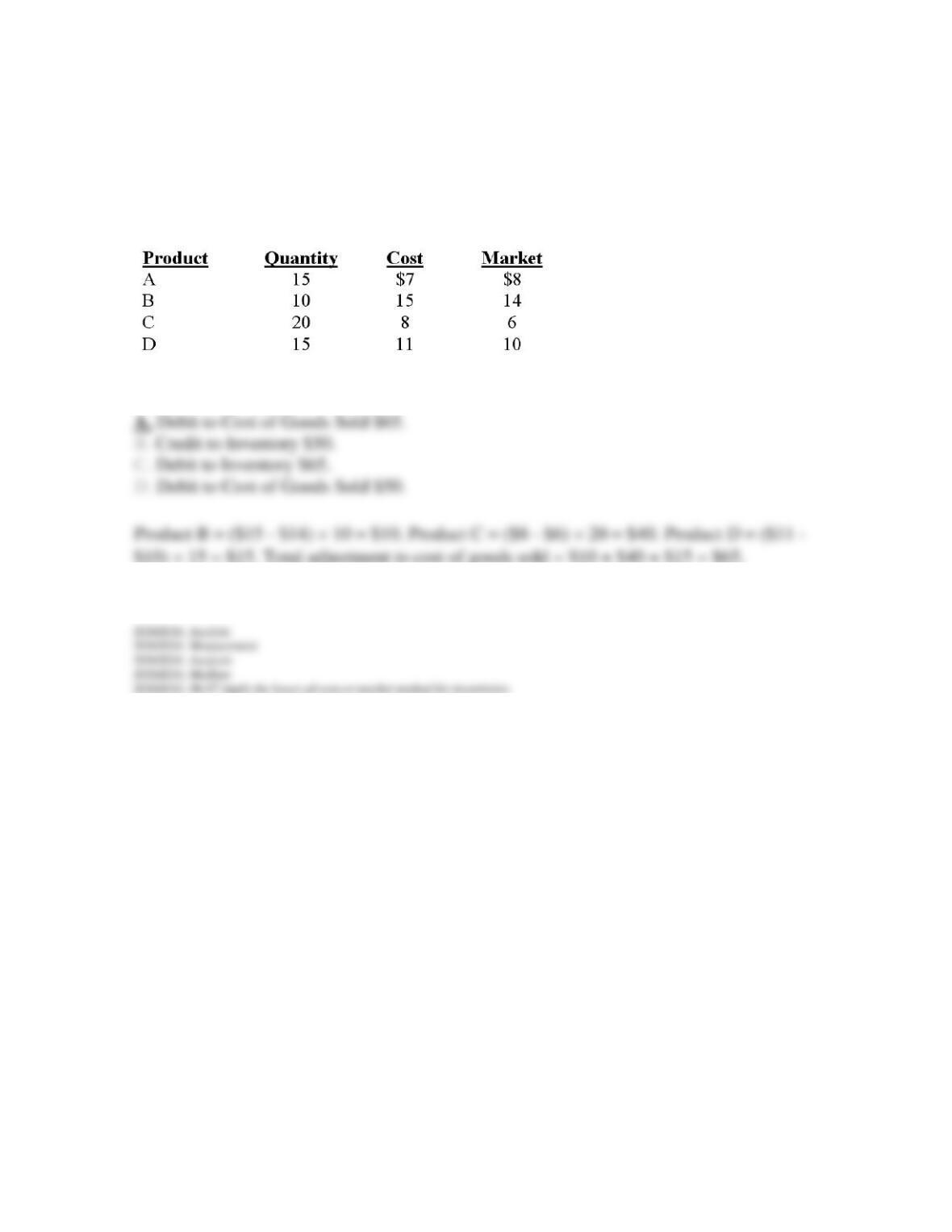
72. Northern Town Equipment has four types of products in its inventory. Northern applies
the rules under lower-of-cost or market (LCM) to its inventory at the end of each year as
shown below:
The year-end adjustment based upon the information above would include a:
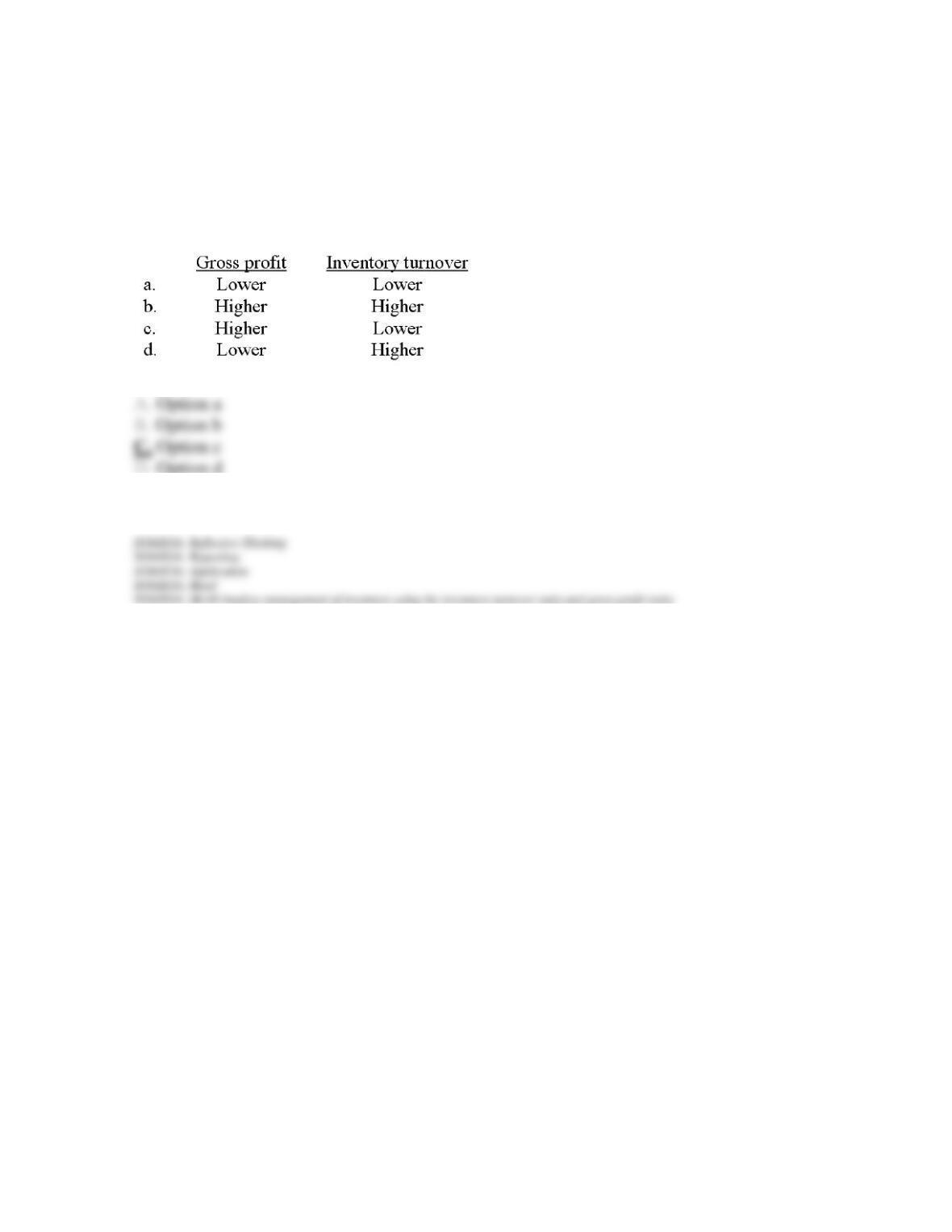
73. Company A is identical to Company B in every regard except that Company A uses FIFO
and Company B uses LIFO. In an extended period of rising inventory costs, Company A’s
gross profit and inventory turnover, compared to Company B’s, would be:
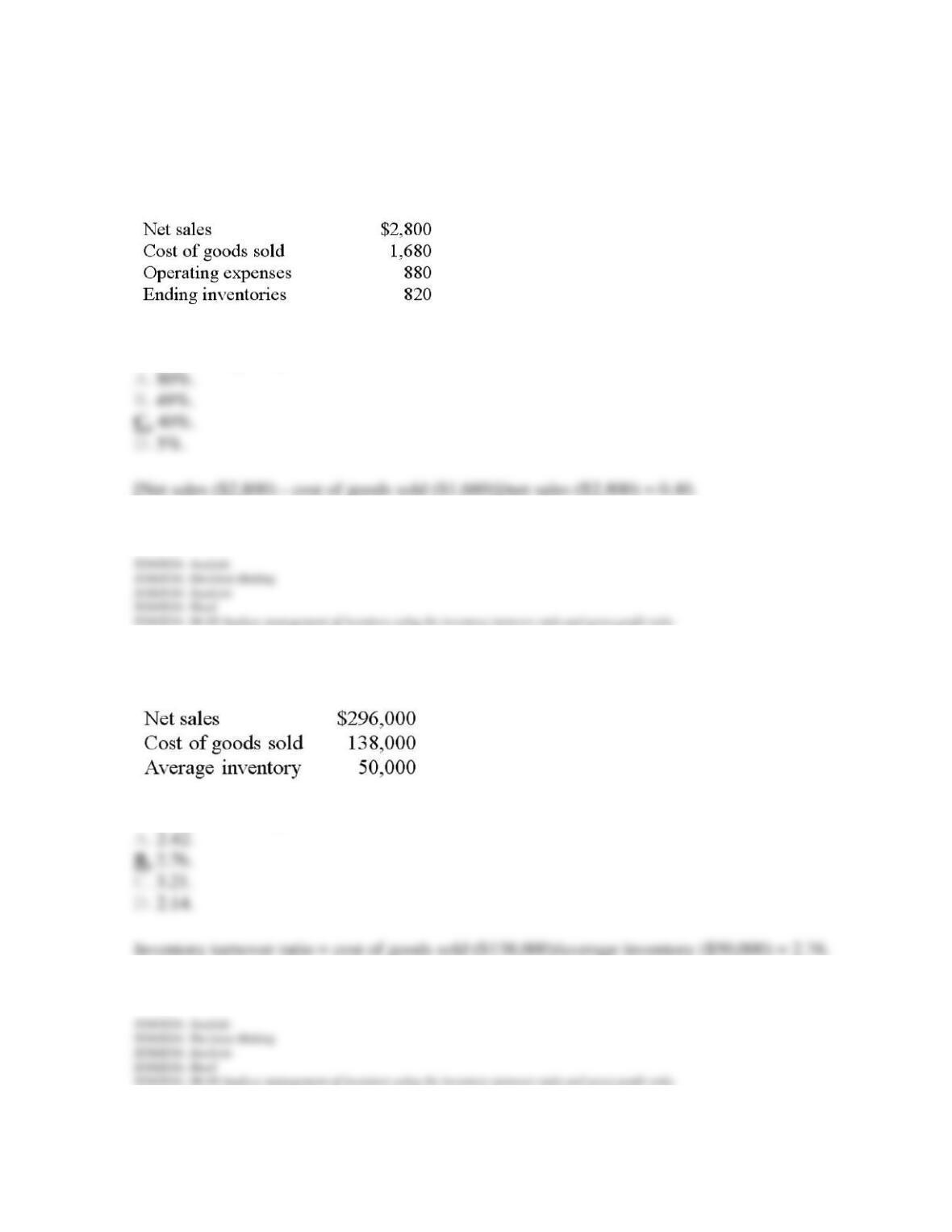
74. Nu Company reported the following data for its first year of operations:
What is Nu’s gross profit ratio?
75. Anthony Corporation reported the following amounts for the year:
Anthony’s inventory turnover ratio is:
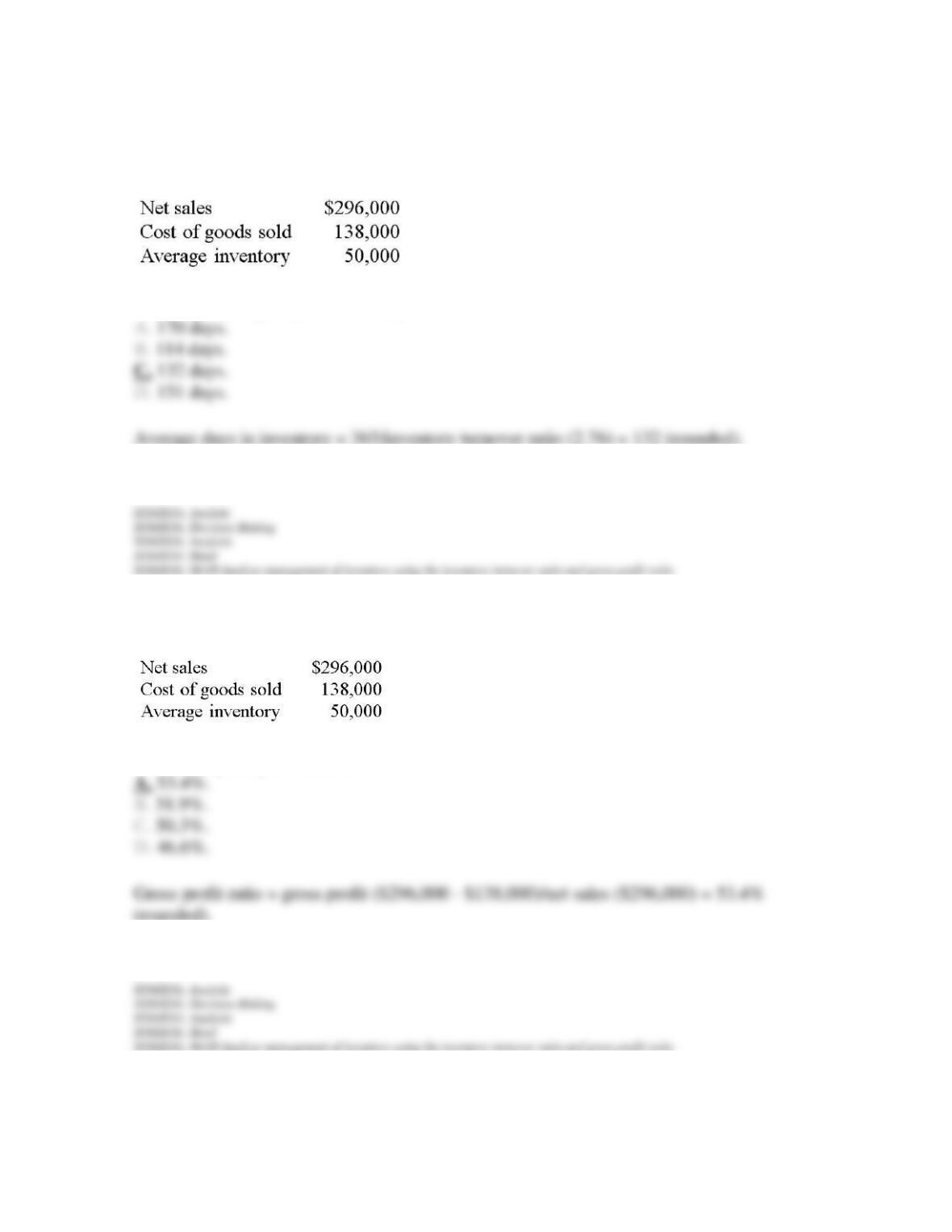
76. Anthony Corporation reported the following amounts for the year:
Anthony’s average days in inventory is:
77. Anthony Corporation reported the following amounts for the year:
Anthony’s gross profit ratio is:
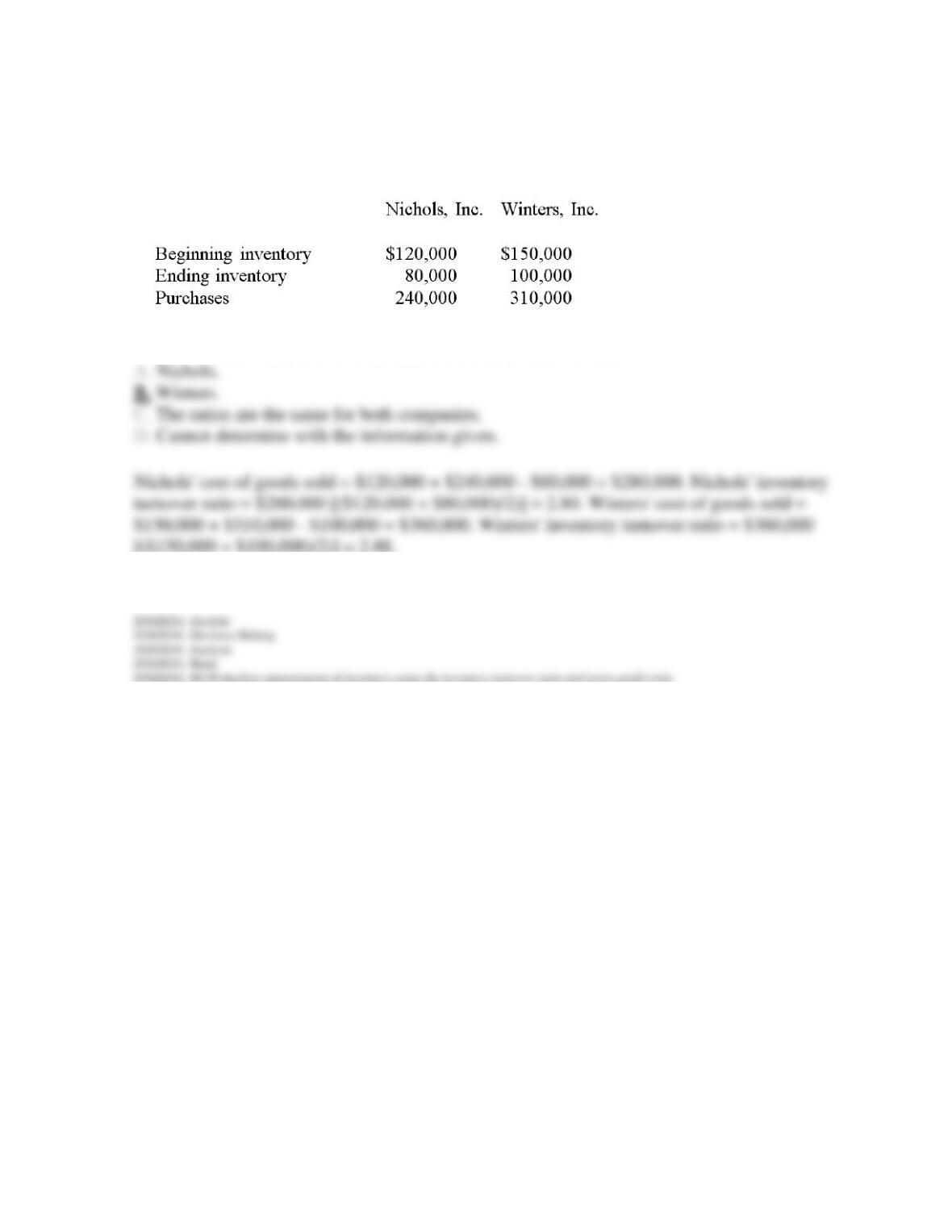
78. Consider the following inventory data for two companies:
Which of these companies had the higher inventory turnover ratio?
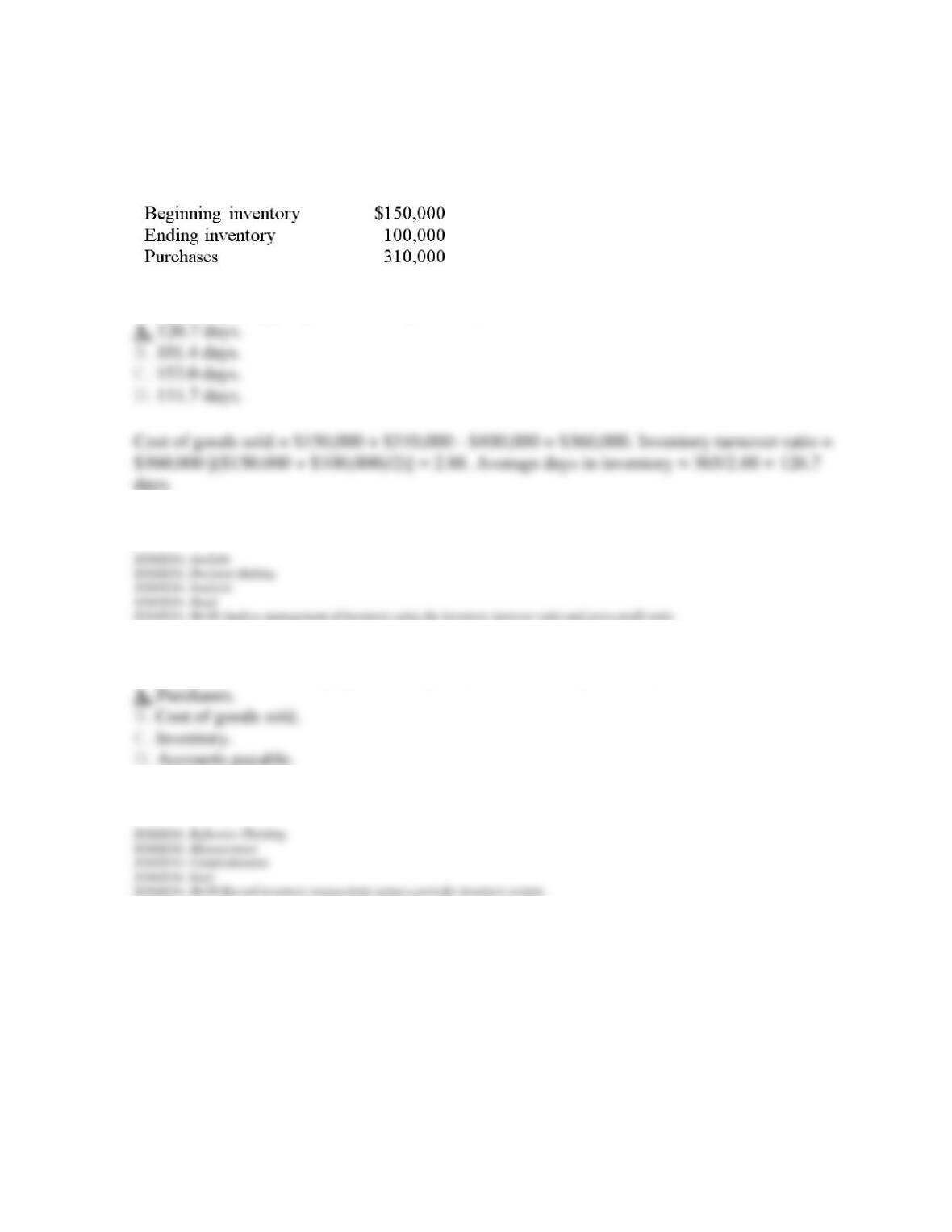
79. Consider the following inventory data:
What is the average days in inventory for the year?
80. In a periodic inventory system, the purchase of inventory is debited to:
81. Northwest Fur Co. started the year with $94,000 of merchandise inventory on hand.
During the year, $400,000 in merchandise was purchased on account with credit terms of
1/15, n/45. All discounts were taken. Northwest paid freight-in charges of $7,500.
Merchandise with an invoice amount of $5,000 was returned for credit. Cost of goods sold for
the year was $380,000. What is ending inventory?
82. The inventory method that will always produce the same amount for cost of goods sold in
a periodic inventory system as in a perpetual inventory system would be:
83. The primary difference between the periodic and perpetual inventory systems is:
84. Davis Hardware Company uses a periodic inventory system. How should Davis record the
85. In a periodic inventory system, at the time of a sale the cost of inventory sold is:
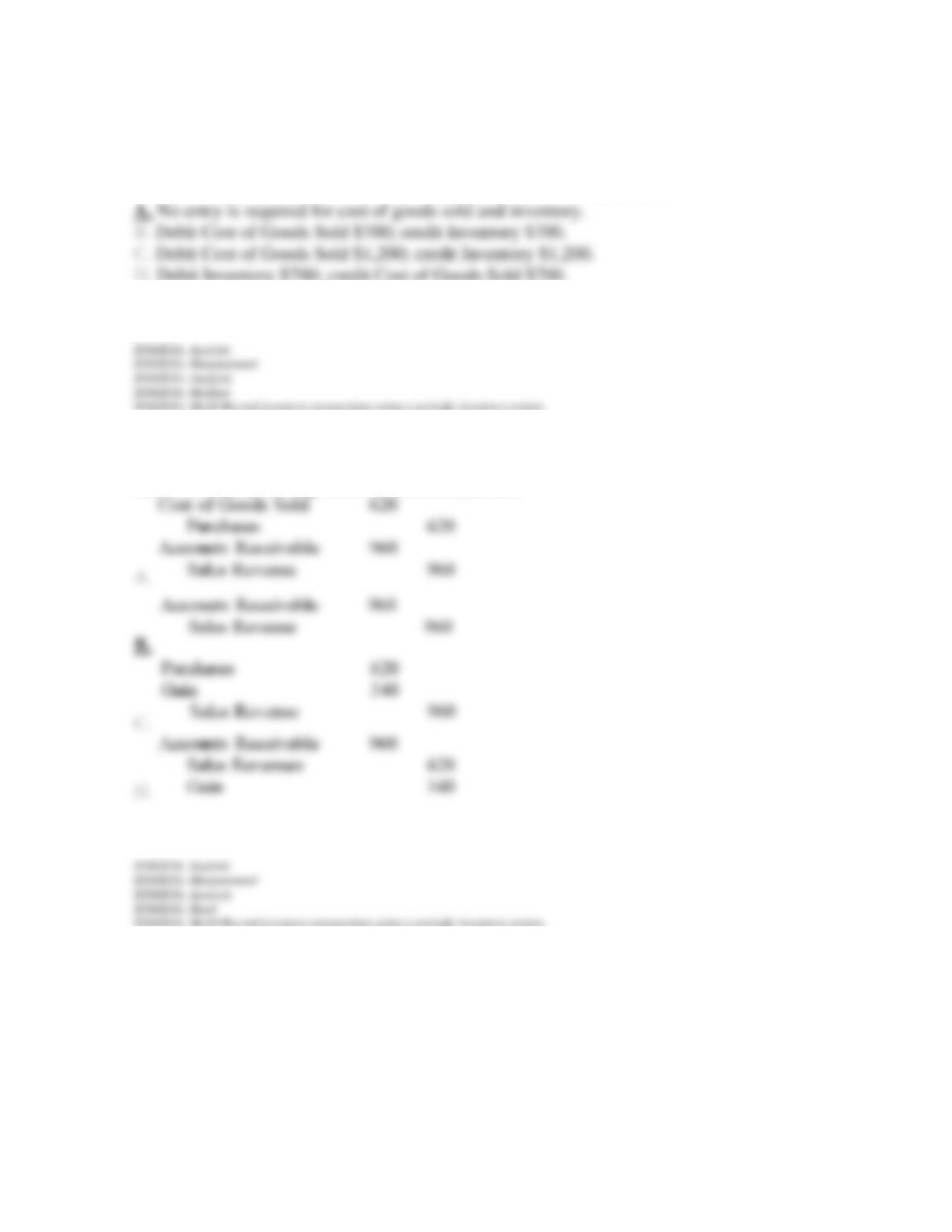
86. Good, Inc. sold inventory for $1,200 that was purchased for $700. Good records which of
the following when it sells inventory using a periodic inventory system?
87. Davis Hardware Company uses a periodic inventory system. How should Davis record the
sale of inventory costing $620 for $960 on account?
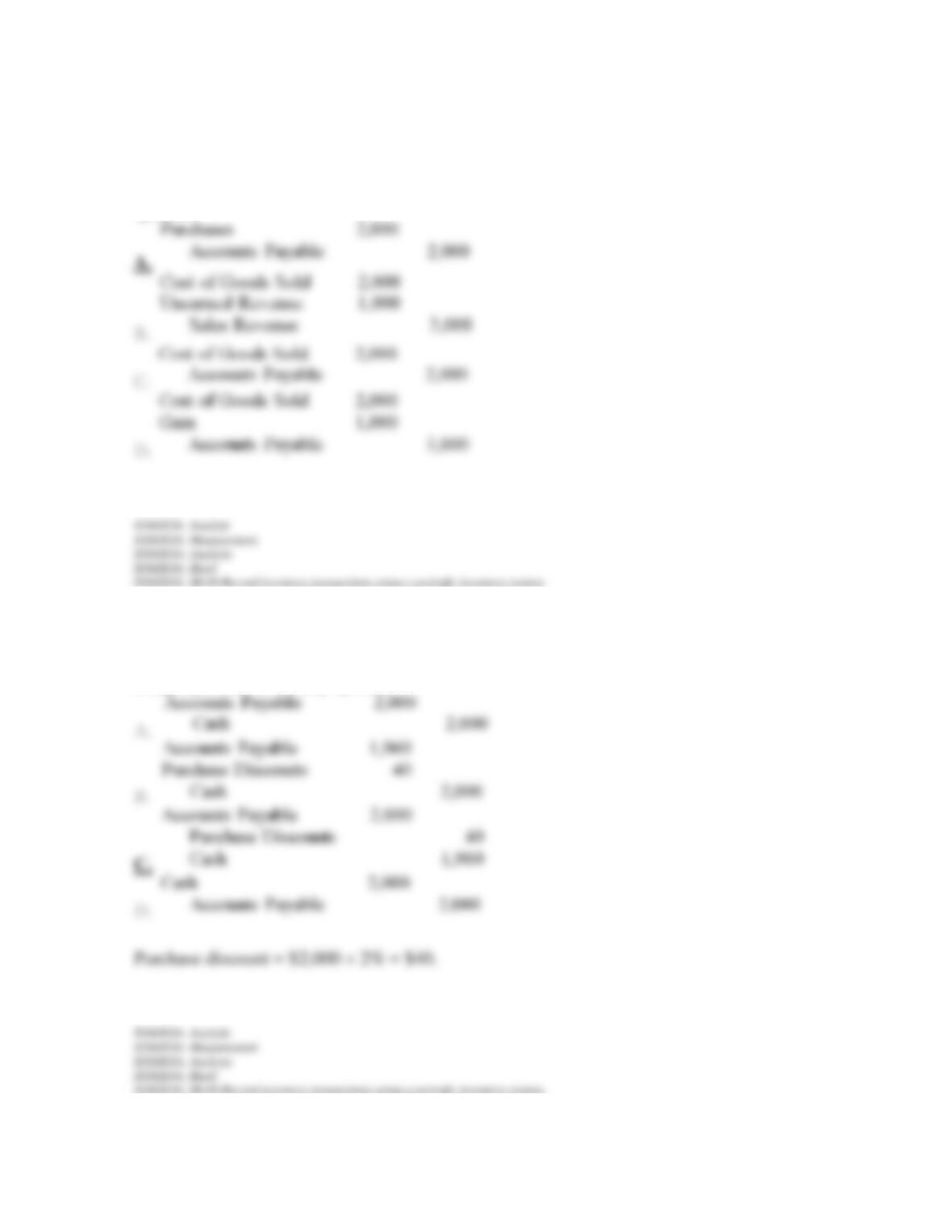
88. Ace Bonding Company purchased inventory on account. The inventory costs $2,000 and
is expected to sell for $3,000. How should Ace record the purchase using a periodic inventory
system?
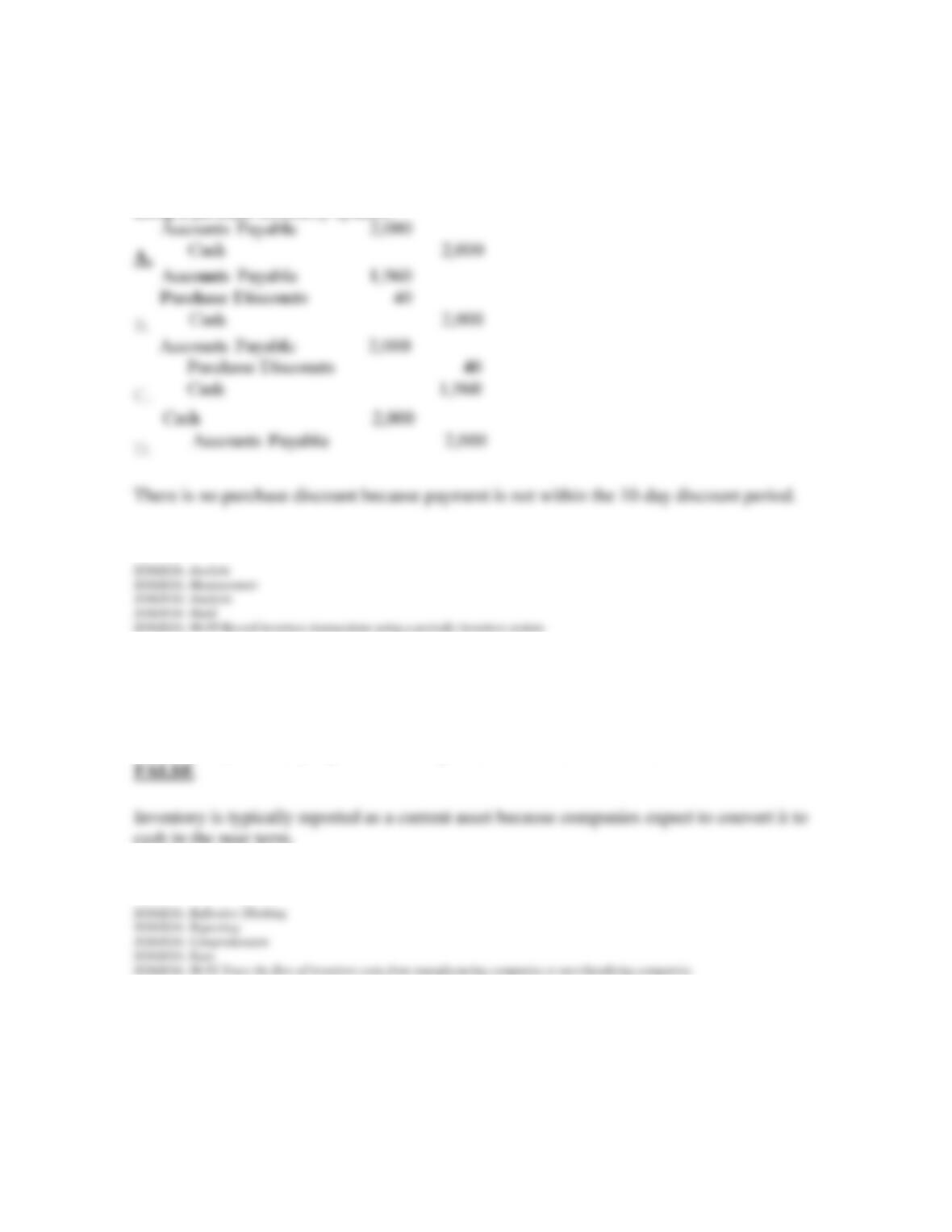
89. On May 1, Ace Bonding Company purchased inventory costing $2,000 on account with
terms 2/10, n/30. On May 8, Ace pays for this inventory and records which of the following
using a periodic inventory system?
90. On May 1, Ace Bonding Company purchased inventory costing $2,000 on account with
terms 2/10, n/30. On May 18, Ace pays for this inventory and records which of the following
91. Inventory is usually reported as a long-term asset in the balance sheet.
92. Cost of goods sold is an asset reported in the balance sheet and inventory is an expense
reported in the income statement.
93. Merchandising companies purchase inventories that are primarily in finished form for
resale to customers.
94. Overstating ending inventory in the current year causes net income in the current year to
be overstated.
95. Understating ending inventory in the current year causes cost of goods sold in the current
year to be understated.
96. Cost of goods sold is an expense reported in the income statement and represents the cost
of inventory sold during the period.
97. If a company has beginning inventory of $15,000, purchases during the year of $75,000,
and ending inventory of $20,000, cost of goods sold equals $70,000.
98. If a company has ending inventory of $25,000, purchases during the year of $95,000, and
beginning inventory of $30,000, cost of goods sold equals $90,000.
99. Companies are not allowed to report inventory costs by assuming which units of inventory
are sold and which units still remain on hand.
100. Using the first-in, first-out method (FIFO), the first units purchased are assumed to be
the first ones sold.
101. Using the weighted-average cost method, the average cost of inventory is calculated as
the average unit cost of inventory purchased during the year.
102. Companies are free to choose FIFO, LIFO, or weighted-average cost to report inventory
and cost of goods sold.
103. For most companies, actual physical flow of their inventory follows LIFO.
104. During periods of rising costs, FIFO generally results in a higher ending inventory
balance.
105. During periods of rising costs, FIFO generally results in a higher cost of goods sold.
106. During periods of rising costs, LIFO generally results in a higher cost of goods sold.
107. During periods of rising costs, LIFO generally results in a higher ending inventory
balance.