3) The inventory turnover ratio should be the same for all types of industries.
4) An inventory turnover of 3.65 means that, on average, items of inventory sat on a retailer’s shelves for
100 days before being sold.
5) A 30% gross profit percentage means that:
A) for each dollar of sales, the company has a cost of goods sold of seventy cents.
B) for each dollar of sales, the company has a gross profit of thirty cents.
C) for each dollar of sales, the company has a cost of goods sold of thirty cents.
D) A and B
6) The inventory turnover ratio:
A) is determined by dividing cost of goods sold by net sales.
B) shows how many times the company sold its average level of inventory.
C) should be high for a company that sells high-end merchandise.
D) will be lower for companies that have many low-priced items in their inventory.
7) The gross profit percentage is calculated as:
A) cost of goods sold divided by net sales revenue.
B) net sales revenue minus gross profit on sales.
C) net sales revenue minus cost of goods sold.
D) gross profit divided by net sales revenue.
8) Marian Company reported the following items for the month of July:
Sales revenue
$477,300
Cost of goods sold
$320,000
Beginning inventory
$67,400
Ending inventory
$73,200
Inventory turnover is: (Round your final answer to two decimal places.)
A) 2.24.
B) 4.37.
C) 4.55.
D) 4.75.
9) Maydak Company reported the following items for the month of July:
Sales revenue
$630,000
Cost of goods sold
$310,000
Beginning inventory
$67,400
Ending inventory
$81,200
The gross profit percentage is: (Round your final answer to the nearest percentage.)
A) 26%.
B) 49%.
C) 51%.
D) 23%.
10) Thomas Industries reported the following:
Net sales
$630,000
Cost of goods sold
$310,000
Operating expenses
$67,400
Tax rate
40%
The gross profit percentage is: (Round your final answer to the nearest percentage.)
A) 69%.
B) 18%.
C) 28%.
D) 31%.
11) Margaret Company reported the following information for the current year:
Net sales
$2,700,000
Purchases
$1,551,000
Beginning Inventory
$275,000
Ending Inventory
$145,000
Cost of Goods Sold
45% of sales
Industry Averages available are:
Inventory Turnover
5.29
Gross Profit Percentage
28%
How do the inventory turnover and gross profit percentage for Margaret Company compare to the
industry averages for the same ratios? (Round inventory turnover to two decimal places. Round gross
profit percentage to the nearest percent.)
A) Margaret Company has superior gross profit percentage and inventory turnover.
B) Margaret Company has superior gross profit percentage and inferior inventory turnover.
C) Margaret Company has inferior gross profit percentage and superior inventory turnover.
D) Margaret Company has inferior gross profit percentage and inventory turnover.
12) Scott Walker Company reported the following data for the past year:
Net sales
$440,000
Purchases
$220,000
Beginning Inventory
$150,000
Ending Inventory
$160,000
Cost of Goods Sold
$270,000
Industry Averages available are:
Inventory Turnover
5.00
Gross Profit Percentage
50%
How do the inventory turnover and gross profit percentage for Scott Walker Company compare to the
industry averages for the same ratios? (Round inventory turnover to two decimal places. Round gross
profit percentage to the nearest percent.)
A) Walker Company is superior on both measures.
B) Walker Company is inferior on both measures.
C) Walker Company is inferior on one measure and superior on the other measure.
D) There is not enough information.
13) For discount retailers such as Walmart, inventory turnover equals:
A) sales divided by average inventory.
B) cost of goods sold divided by average inventory.
C) sales discounts divided by average receivables.
D) sales divided by average receivables.
1) A company can use the cost-of-goods-sold model to determine how much inventory to purchase.
2) The cost-of–goods-sold model can be used to estimate ending inventory.
3) The gross profit method cannot be used for calculating inventory destroyed by a disaster, such as a
fire.
4) The cost-of–goods-sold model is:
A) beginning inventory, plus purchases, plus ending inventory equals cost of goods sold.
B) beginning inventory, less purchases, less ending inventory equals cost of goods sold.
C) beginning inventory, plus purchases, less ending inventory equals cost of goods sold.
D) beginning inventory, less purchases, plus ending inventory equals cost of goods sold.
5) Kennel Company reported the following:
Cost of goods sold (estimated for next period)
$300,000
Ending inventory (estimated for next period)
$95,000
Beginning inventory for the period
$60,000
Based on this information, the purchases for the next period should be:
A) $265,000.
B) $335,000.
C) $360,000.
D) $395,000.
6) Lolita Company has the following information:
Beginning Inventory
$140,000
Net Purchases
$360,000
Net Sales
$810,000
Gross Profit Percentage
40%
Lolita Company’s estimated ending inventory is: (Round your final answer to the nearest dollar.)
A) $14,000.
B) $176,000.
C) $486,000.
D) $500,000.
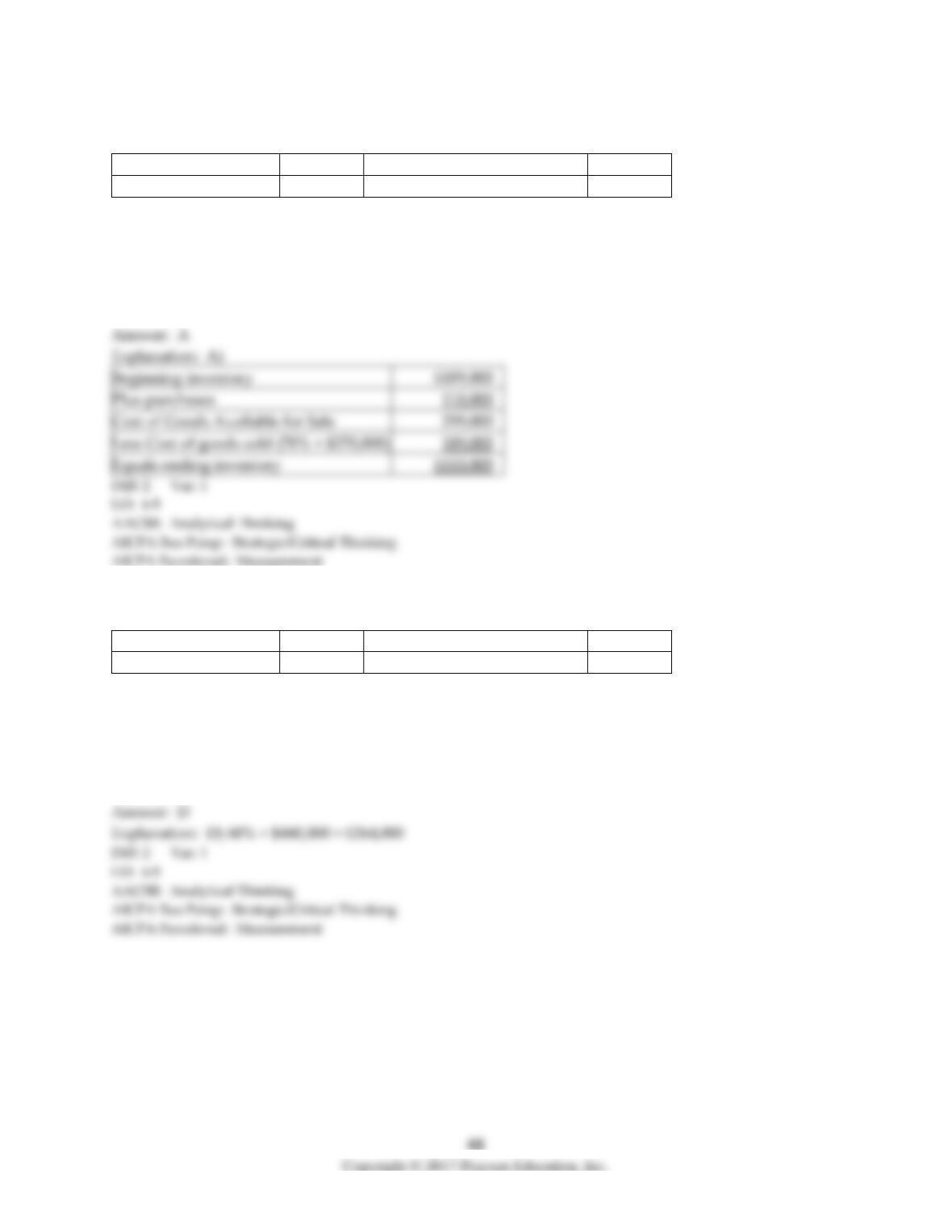
7) Blue Company has the following data for the year:
Beginning inventory
$189,000
Net purchases
$110,000
Net sales revenue
$270,000
Normal gross profit rate
30%
What is the estimated ending inventory? (Round your final answer to the nearest dollar.)
A) $110,000
B) $189,000
C) $218,000
D) $299,000
Beginning inventory
Plus purchases
Cost of Goods Available for Sale
Less Cost of goods sold (70% × $270,000)
Equals ending inventory
8) The following data are for Jessee’s Candy Store for January:
Beginning inventory
$205,000
Net sales revenue
$440,000
Net purchases
$585,000
Normal gross profit rate
40%
What is the company’s estimated cost of goods sold for the month?
A) $145,000
B) $176,000
C) $235,000
D) $264,000
9) The following data are for Steve’s Candy Store for January:
Beginning inventory
$191,000
Net sales revenue
$620,000
Net purchases
$480,000
Normal gross profit rate
30%
What is the company’s estimated ending inventory for the month?
A) $237,000
B) $186,000
C) $434,000
D) $485,000
Beginning inventory
$191,000
Plus Purchases
Cost of Goods available for sale
Less Cost of goods sold (70% × $620,000)
Equals ending inventory
$237,000
10) A fire destroyed the inventory of Barber Company. The following information is available:
Beginning Inventory
$50,000
Purchases
$170,000
Net Sales Revenue
$200,000
Gross Profit Percentage
30%
Prepare a schedule to compute the amount of inventory lost in the fire.
Beginning Inventory
Add: Purchases
$170,000
Cost of Goods Available for Sale
Less: Cost of Goods Sold = ($200,000 × 70%)
11) A fire destroyed the inventory and store of Schlichting Company. The following information is
available:
Beginning Inventory
$100,000
Purchases
$400,000
Net Sales Revenue
$600,000
Gross Profit Percentage
20%
Prepare a schedule to compute the amount of inventory lost in the fire.
Beginning Inventory
$100,000
Add: Purchases
$400,000
Cost of Goods Available for Sale
Less: Cost of Goods Sold = ($600,000 × 80%)
Ending Inventory
12) Barker Office Supply Store is budgeting for the fiscal year ending March 31, 2018. During the fiscal
year ended March 31, 2017, sales totaled $1,200,000 and cost of goods sold was $660,000. At March 31,
2017, inventory was $200,000. During the upcoming fiscal year, Barker estimates that cost of goods sold
will increase by 9% and that ending inventory will be $225,000.
Required: How much inventory should Barker purchase during the fiscal year ending March 31, 2018?
Show your well-labeled computations.
Estimated cost of goods sold ($660,000 × 1.09)
Estimated ending inventory
Cost of goods available as planned
Beginning inventory – March 31, 2017
Budgeted purchases
13) List three ways in which the gross profit method can be used by a retailer.
6 Learning Objective 6-6
1) Overstating ending inventory in the current year will understate the following year’s net income.
2) An error in ending inventory creates errors for two accounting periods.
3) If ending inventory for a year is overstated, then gross profit for that year will be overstated.
4) Beginning inventory and ending inventory have opposite effects on cost of goods sold.
5) An error in the ending inventory for the year ended December 31, 2017:
A) automatically creates errors in cost of goods sold in the 2017 and 2018 financial statements.
B) has no effect on the 2017 financial statements, but will create an error in the 2018 financial statements.
C) automatically creates errors in the ending inventory balance in the 2017 and 2018 financial
statements.
D) affects only the 2017 financial statements.
6) If ending inventory is overstated by $6,000, then:
A) stockholders’ equity is overstated by $6,000.
B) cost of goods sold is understated by $6,000.
C) gross profit is understated by $6,000.
D) A and B.
7) Ending inventory for the year ended December 31, 2017, is understated by $8,000. How will this affect
net income for 2017 and 2018?
A) Net income will be understated by $8,000 in 2017 and 2018.
B) Net income will be overstated by $8,000 in 2017 and 2018.
C) Net income will be understated by $8,000 in 2017 and overstated by $8,000 in 2018.
D) Net income will be overstated by $8,000 in 2017 and understated by $8,000 in 2018.
8) Ending inventory for the year ended December 31, 2017, is understated by $26,000. How will this
error affect net income for 2018?
A) Net income will be understated by $52,000.
B) Net income will be overstated by $52,000.
C) Net income will be understated by $26,000.
D) Net income will be overstated by $26,000.