Chapter 6 – Activity Analysis, Cost Behavior, and Cost Estimation
48. Which of the following is not an example of a committed fixed cost?
49. Committed fixed costs would include:
50. Amounts spent for charitable contributions are an example of a (n):
51. Which of the following would not typically be classified as a discretionary fixed cost?
52. Which of the following choices correctly classifies a committed fixed cost and a
discretionary fixed cost?
Committed
Discretionary
Promotion
Management salaries
Building depreciation
Charitable contributions
Management training
Property taxes
Equipment rentals
Equipment depreciation
Research and development
Advertising
53. Which type of fixed cost (1) tends to be more long-term in nature and (2) can be cut back
more easily in bad economic times without doing serious harm to organizational goals and
objectives?
Long Term in Nature
Can be Cut Back More Easily
In Bad Economic Times
Committed
Committed
Committed
Discretionary
Discretionary
Committed
Discretionary
Discretionary
Committed
No difference between
committed and discretionary
54. Which of the following techniques is not used to analyze cost behavior?
55. The high-low method and least-squares regression are used by accountants to:
56. Which of the following statements about the visual-fit method is (are) true?
I. The method results in the creation of a scatter diagram.
II. The method is not totally objective because of the manner in which the cost line is
determined.
III. The method is especially helpful in the determination of outliers.
57. The nonstatistical method of cost estimation that calls for the creation of a scatter diagram
is the:
58. Which of the following methods of cost estimation relies on only two data points?
Chapter 6 – Activity Analysis, Cost Behavior, and Cost Estimation
Use the following information to answer Questions 59-61.
Fulton and Sons, Inc. presently leases a copy machine under an agreement that calls for a
fixed fee each month and a charge for each copy made. Fulton made 7,000 copies and paid a
total of $360 in March; in May, the firm paid $280 for 5,000 copies. The company uses the
high-low method to analyze costs.
59. Fulton’s variable cost per copy is:
60. Fulton’s monthly fixed fee is:
61. How much would Fulton pay if it made 5,500 copies?
Use the following information to answer Questions 62-64.
Barkoff Enterprises, which uses the high-low method to analyze cost behavior, has
determined that machine hours best explain the company’s utilities cost. The company’s
relevant range of activity varies from a low of 600 machine hours to a high of 1,100 machine
hours, with the following data being available for the first six months of the year:
Month
Utilities
Machine Hours
January
$8,700
800
February
8,360
720
March
8,950
810
April
9,360
920
May
9,625
950
June
9,150
900
62. The variable utilities cost per machine hour for Barkoff is:
63. The fixed utilities cost per month for Barkoff is:
64. Using the high-low method, the utilities cost for Barkoff associated with 980 machine
hours would be:
65. On the basis of this information, the variable cost per machine hour for Swan was:
66. On the basis of this information, the fixed cost for Swan was:
67. On the basis of this information, what were total maintenance costs when Swan
experienced 23,000 machine hours?
68. Tallequah, Inc. uses the high-low method to analyze cost behavior. The company
observed that at 20,000 machine hours of activity, total maintenance costs averaged $10.50
per hour. When activity jumped to 24,000 machine hours, which was still within the relevant
range, the average total cost per machine hour was $9.75. On the basis of this information, the
company’s fixed maintenance costs were:
69. The following data relate to the Torrence Company for May and August of the current
year:
May
August
Maintenance hours
25,000
29,000
Maintenance cost
$1,175,000
$1,247,000
May and August were the lowest and highest activity levels, and Torrence uses the high-low
method to analyze cost behavior. Which of the following statements is true?
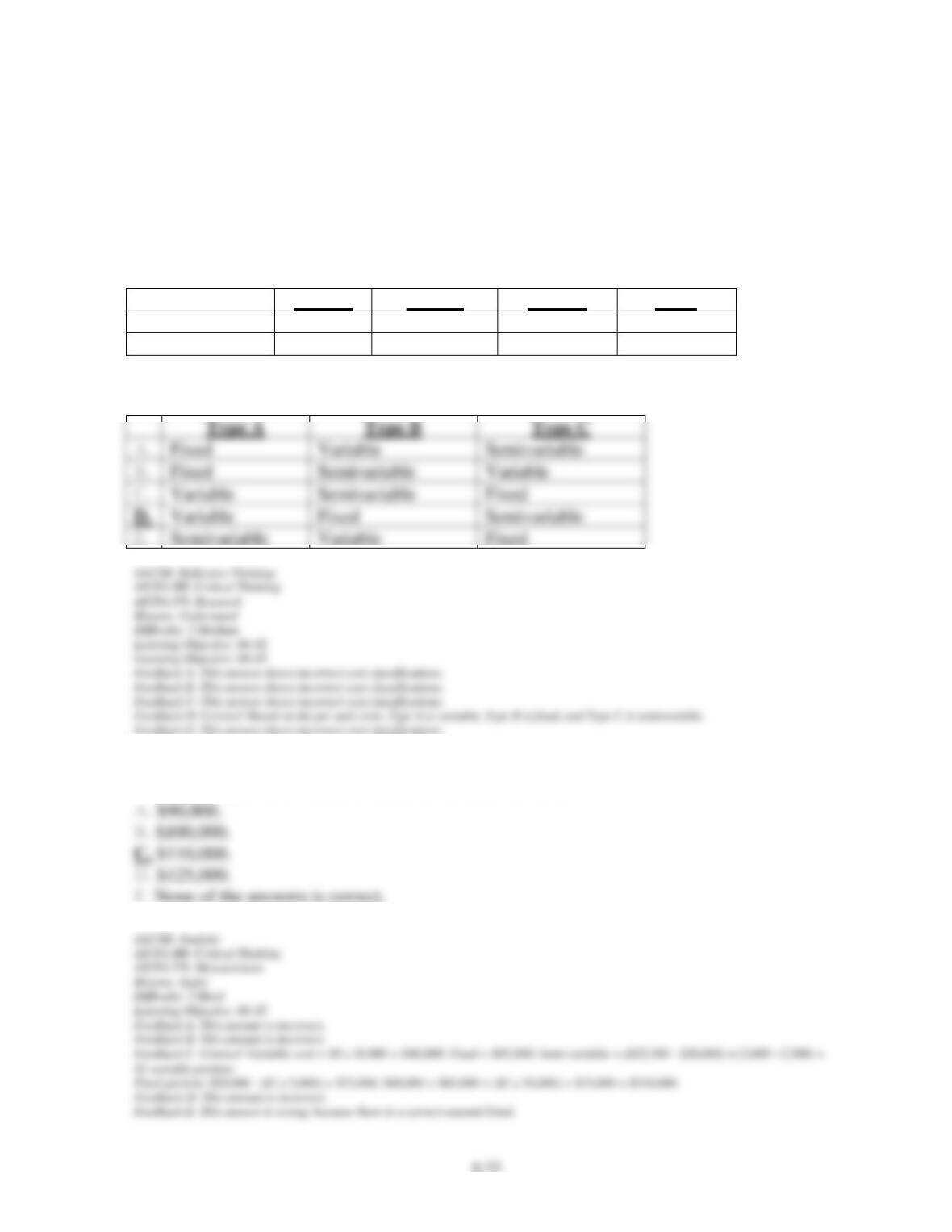
70. Data below relate to the Torrence Company for May and August of the current year:
May
August
Maintenance hours
25,000
29,000
Maintenance cost
$1,175,000
$1,247,000
May and August were the lowest and highest activity levels, and Torrence uses the high-
71. The following data relate to the Torrence Company for May and August:
May
August
Maintenance hours
25,000
29,000
Maintenance cost
$1,175,000
$1,247,000
May and August were the lowest and highest activity levels, and Torrence uses the high-low
method to analyze cost behavior. If maintenance hours are estimated to be 26,000 hours in
October, which of the following statements is true?
72. The following data relate to the Torrence Company for May and August:
May
August
Maintenance hours
25,000
29,000
Maintenance cost
$1,175,000
$1,247,000
May and August were the lowest and highest activity levels, and Torrence uses the high-low
method to analyze cost behavior. If maintenance hours are estimated to be 26,000 hours in
October, which of the following statements is true?
Chapter 6 – Activity Analysis, Cost Behavior, and Cost Estimation
Use the following information to answer Questions 73-75.
Shum Manufacturing, which uses the high-low method, makes a product called Kwan. The
company incurs three different cost types (A, B, and C) and has a relevant range of operation
between 2,500 units and 10,000 units per month. Per-unit costs at two different activity levels
for each cost type are presented below.
Type A
Type B
Type C
Total
5,000 units
$4
$9
$4
$17
7,500 units
4
6
3
13
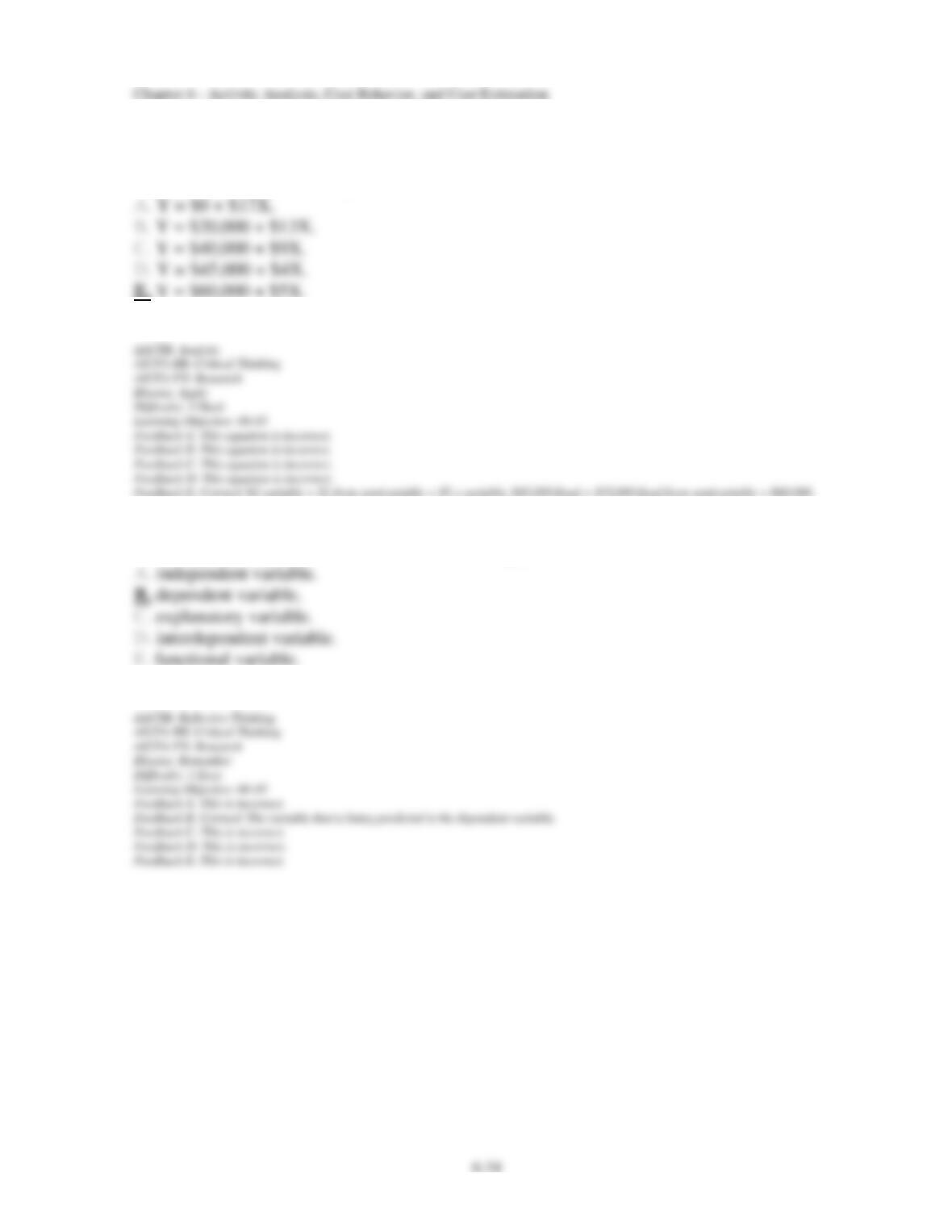
73. The cost types shown above are identified by behavior as:
Fixed
Variable
Semivariable
Fixed
Semivariable
Variable
Variable
Semivariable
Fixed
Variable
Fixed
Semivariable
Semivariable
Variable
Fixed
74. If Shum produces 10,000 units, the total cost would be:
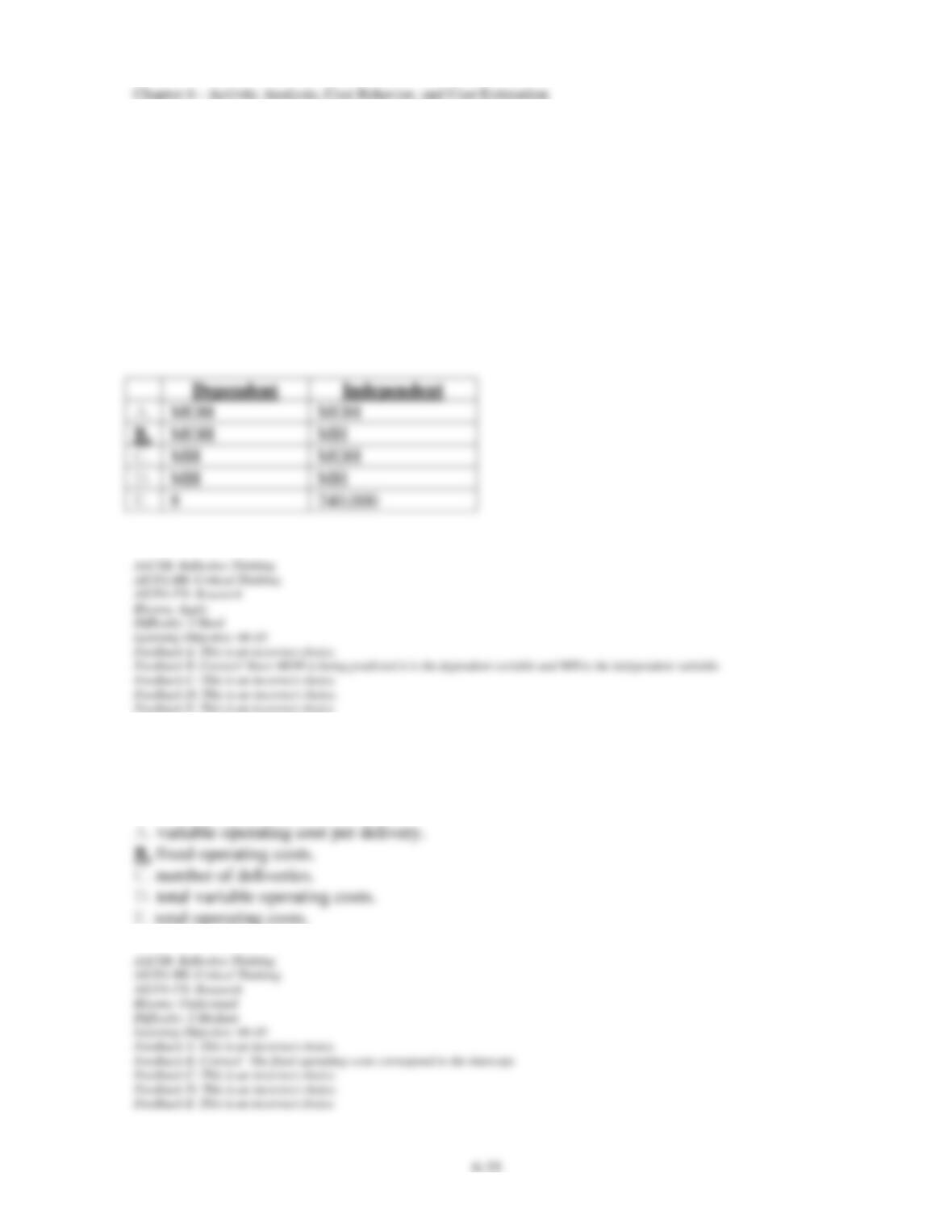
75. The cost formula that expresses the behavior of Shum’s total cost is:
76. In regression analysis, the variable that is being predicted is known as the:
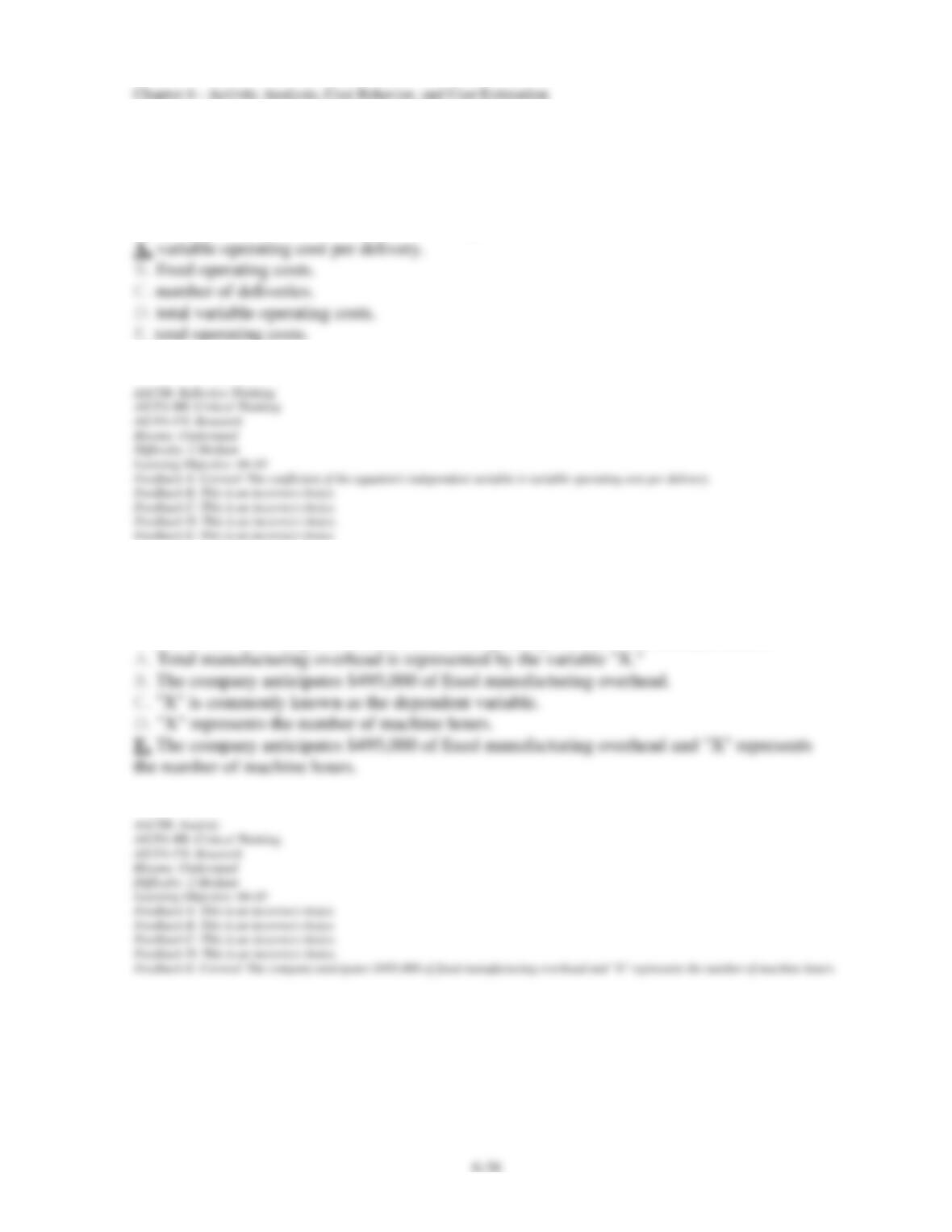
77. Almed Products has determined that the number of machine hours worked (MH) drives
the amount of manufacturing overhead incurred (MOH). On the basis of this relationship, a
staff analyst has constructed the following regression equation:
MOH = 240,000 + 8MH
Which of the choices correctly depicts the nature of Almed’s variables?
78. Focus, Inc. operates a small package delivery service in the Atlanta suburbs. If the
company uses a regression equation to forecast total operating costs, the equation’s intercept
would correspond to the:
79. Rushmont, Inc. operates a small package delivery service in the Nashville suburbs. If the
company uses a regression equation to forecast total operating costs, the coefficient of the
equation’s independent variable would correspond to the:
80. Corrine Corporation, which uses least-squares regression analysis, has derived the
following regression equation for estimates of manufacturing overhead: Y = 495,000 + 5.65X.
Which of the following statements is true if the primary cost driver is machine hours?
81. Blaster, Inc. recently conducted a least-squares regression analysis to predict selling
expenses. The company has constructed the following regression equation: Y = 329,000 +
7.80X. Which of the following statements is false if the primary cost driver is number of units
sold?
82. Trey, Inc. is studying marketing cost and sales volume, and has generated the following
information by use of a scatter diagram and a least-squares regression analysis:
Scatter Diagram
Regression Analysis
Variable cost per unit sold
$6.50
$6.80
Total monthly fixed cost
$45,000
$42,500
Trey is now preparing an estimate for monthly sales of 18,000 units. On the basis of the data
presented, compute the most accurate sales forecast possible.
83. Bogata Enterprises has determined that three variables play a key role in determining
company revenues. To arrive at an objective forecast of revenues for the next accounting
period, Bogata should use:
84. Which of the following tools is not associated with cost estimation?
85. A staff assistant at Warrington Corporation recently determined that the first five units
completed in a new manufacturing process took 500 hours to complete, or an average of 100
hours per unit. The assistant also found that when the cumulative output produced doubles,
the average labor time declines by 20%. On the basis of this information, how many total
hours would Warrington use if it produces a cumulative amount of 40 units?
86. Which of the following is not an issue in the collection of data for cost estimation?