21) A company has a beginning inventory of $50,000 and purchases during the year of $110,000 The
beginning inventory consisted of 1000 units and 7000 units were purchased during the year. The
company has 5000 units left at year-end. Under average-cost, what is Cost of Goods Sold? (Round any
intermediary calculations to two decimal places and your final answer to the nearest dollar.)
A) $140,000
B) $60,000
C) $110,000
D) $160,000
22) A company has a beginning inventory of $60,000 and purchases during the year of $160,000. The
beginning inventory consisted of 2000 units and 8000 units were purchased during the year. 4080 units
remain in ending inventory. The cost of the ending inventory using the average-cost method will be:
(Round any intermediary calculations to two decimal places and your final answer to the nearest
dollar.)
A) $130,240.
B) $220,000.
C) $89,760.
D) $309,760.
23) Given the following data, calculate the cost of ending inventory using the average cost method.
(Round any intermediary and final answers to two decimal places.)
Date
Item
Unit
1/1
Beginning inventory
30 units at $10 per
unit
3/5
Purchase of inventory
40 units at $20 per unit
5/30
Purchase of inventory
15 units at $22 per unit
12/31
Ending inventory
40 units
A) $693.20
B) $672.94
C) $800.00
D) $330.00
30 units × $10 =
40 units × $20 =
110
$1430 ÷ 110 = $13.00; $13.00 × 40 = $520
24) Given the following data, calculate the cost of goods sold using the average-cost method.
Round average cost per unit calculations to two decimal places. Round final answer to the nearest
dollar.
Date
Item
Unit
1/1
Beginning inventory
30 units at $30 per unit
5/10
Purchase of inventory
20 units at $20 per unit
10/9
Purchase of inventory
20 units at $12 per unit
12/31
Ending inventory
28 units
A) $1276
B) $924
C) $1540
D) $2310
30 units × $30 =
20 units × $20 =
70
$1540 ÷ 70 = $22.00 per unit
(70 – 28) × $22.00 = $924
25) Tomasino’s inventory records show the following data at January 31:
Beginning inventory Jan. 1
100 units at $9 per unit
Jan. 10 purchase
300 units at $12 per unit
Jan. 22 purchase
130 units at $13 per unit
At January 31, 230 units are still on hand. What is the cost of the ending inventory at January 31 if
Tomasino uses the FIFO method?
A) $2070
B) $2200
C) $2890
D) $2460
26) Thelen’s inventory records show the following data at January 31:
Beginning inventory Jan. 1
120 units at $6 per unit
Jan. 10 purchase
320 units at $11 per unit
Jan. 22 purchase
110 units at $12 per unit
At January 31, 240 units are still on hand. What is the cost of the ending inventory at January 31 if
Thelen uses the LIFO method?
A) $1440
B) $2040
C) $2880
D) $2160
27) Given the following data, what is cost of goods sold as determined by the FIFO method?
Sales
280 units
Beginning inventory
250 units at $6 per unit
Purchases
128 units at $11 per unit
A) $1680
B) $1830
C) $2320
D) $3080
28) Summertime had the following data for the month of March:
Beginning inventory March 1
316 units at $16 per unit
March 19 purchase
204 units at $25 per unit
March 27 purchase
198 units at $27 per unit
On March 31, 320 units are still on hand. Determine the cost of goods sold for March if Summertime
uses the FIFO method.
A) $11,488
B) $8640
C) $7106
D) $8546
Beginning inventory + Purchases = units available
316 + 204 + 198 = 718
718 units – 320 units on hand = 398 units sold
29) The following data was extracted from the records of Today Company:
Sales revenue
200 units at $55 per unit
Beginning inventory
80 units at $17 per unit
Purchases
200 units at $21 per unit
What is the gross profit using the LIFO method?
A) $6800
B) $9640
C) $4200
D) $11,000
Sales
200 units × $55 =
COGS
200 units × $21 =
200 × $34 =
30) Given the following data, calculate cost of goods sold using the FIFO costing method.
Date
Item
Unit
1/1
Beginning inventory
29 units at $8 per unit
2/25
Purchase of inventory
19 units at $12 per unit
5/20
Purchase of inventory
25 units at $12 per unit
8/15
Purchase of inventory
12 units at $14 per unit
10/17
Purchase of inventory
9 units at $15 per unit
12/31
Ending inventory
22 units
A) $748
B) $976
C) $915
D) $1215
29 units × $8 =
$232
19 units × $12 =
$228
24 units × $12 =
$288
72
$748
31) Given the following data, calculate the cost of goods sold using the LIFO costing method.
Date
Item
Unit
1/1
Beginning inventory
5 units at $22 per unit
3/18
Purchase of inventory
11 units at $24 per unit
6/20
Purchase of inventory
9 units at $27 per unit
9/27
Purchase of inventory
28 units at $28 per unit
11/27
Purchase of inventory
28 units at $29 per unit
12/31
Ending inventory
30 units
A) $2068
B) $1461
C) $1456
D) $1122
28 units × $29 =
$812
23 units × $28 =
$644
$1456
32) Which statement is FALSE?
A) LIFO is not allowed in several countries outside the United States.
B) IFRS does not permit the use of LIFO.
C) FIFO and average cost are allowed in Australia and the United Kingdom.
D) If LIFO is no longer allowed to be used in the United States, the tax burden on many companies will
be lower.
33) If inventory costs are decreasing over time, the income taxes paid using FIFO will ________ the
income taxes paid using LIFO.
A) exceed
B) equal
C) be less than
D) none of the above
34) Gross profit will be the:
A) highest if LIFO is used and inventory costs are decreasing.
B) lowest if LIFO is used and inventory costs are increasing.
C) highest if FIFO is used and inventory costs are increasing.
D) all of the above.
35) Which inventory costing method provides the most realistic measure of net income?
A) FIFO
B) LIFO
C) average cost
D) specific identification
36) Which inventory costing method provides the most current, up-to-date cost of inventory on the
balance sheet?
A) FIFO
B) LIFO
C) average cost
D) specific identification
37) When inventory costs are falling, which inventory costing method minimizes the taxes paid?
A) FIFO
B) LIFO
C) average cost
D) specific identification
38) Which of the following is not an issue in keeping track of perpetual inventories under LIFO and
weighted-average-cost methods?
A) The LIFO cost-flow assumption does not follow the logical flow of goods.
B) Many companies keep track of perpetual inventories in quantities only during the year, making year–
end adjusting entries to apply either LIFO or weighted-average-cost to both ending inventory and cost
of goods sold.
C) When costs are changing, it is physically impossible to apply LIFO unit costs to units purchased and
sold, as the transactions are happening, using a perpetual inventory accounting system.
D) All of the above statements are issues in keeping track of perpetual inventories under LIFO and
weighted-average-cost methods.
39) The following data was obtained from the records of Ivanovich Artists, Inc., for the current year.
Sales during the year were 400 units.
Jan. 1
Beginning Inventory
100 units at $10
February 1
Purchase
200 units at $12
April 1
Purchase
100 units at $14
July 1
Purchase
60 units at $16
Required:
1. Calculate the cost of the ending inventory using:
a. FIFO.
b. LIFO.
c. Average cost. Round final answers to the nearest dollar.
2. Calculate the cost of goods sold by:
a. FIFO.
b. LIFO.
c. Average cost. Round final answers to the nearest dollar.
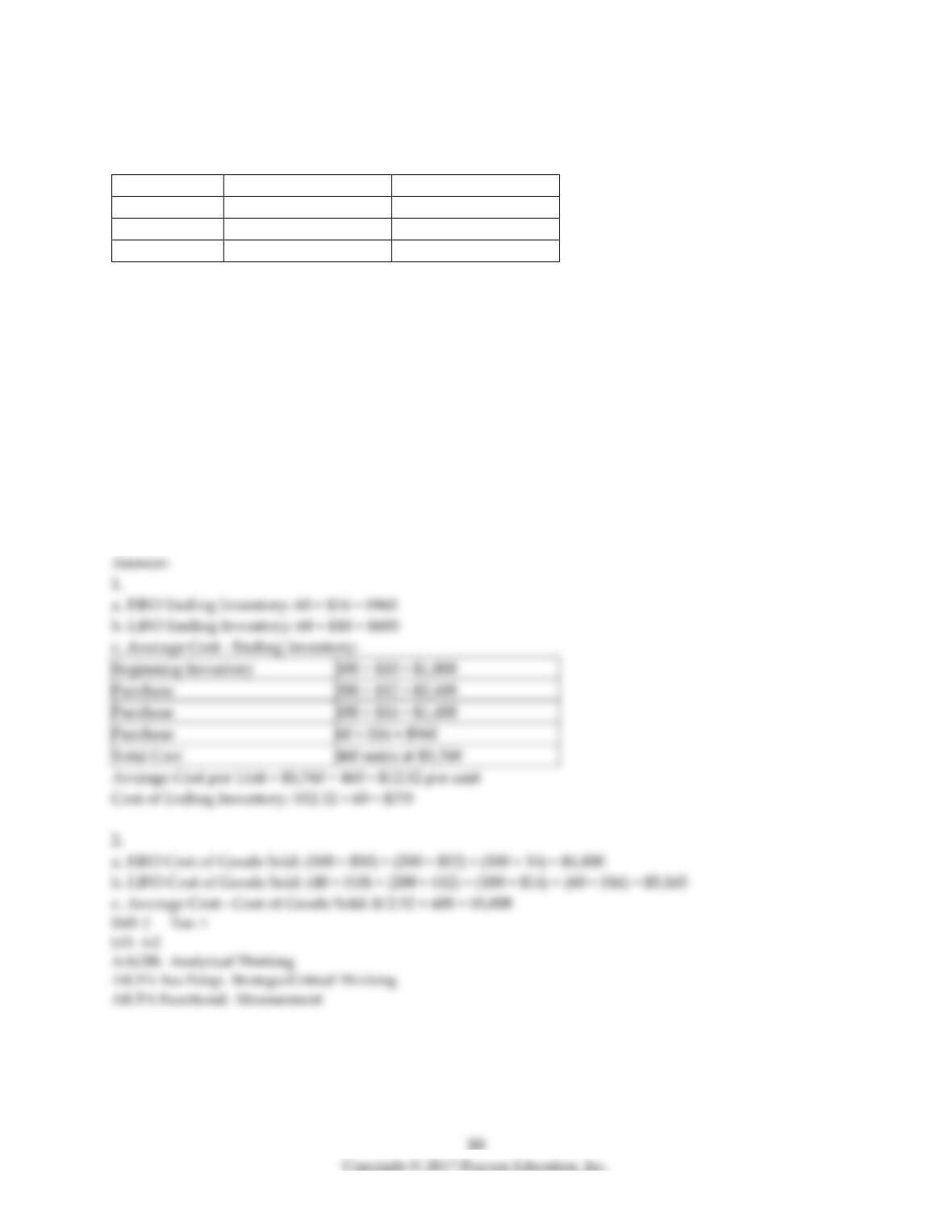
Beginning Inventory
100 × $10 = $1,000
Purchase
200 × $12 = $2,400
Purchase
100 × $14 = $1,400
Purchase
Total Cost
460 units at $5,760
40) The following data was obtained from the records of Brankovich Tool and Die, Inc., for the current
year:
Jan. 1
Beginning Inventory
110 units at $10
February 1
Purchase
200 units at $12
April 1
Purchase
100 units at $14
July 1
Purchase
80 units at $16
The company sold 200 units during the year. Sales for the year are $70,000; operating expenses are
$20,000; and the tax rate is 40%.
Required:
Using the multistep format, prepare the income statement using:
1. FIFO
2. LIFO
3. Average cost (Round all calculations to two decimal places.)
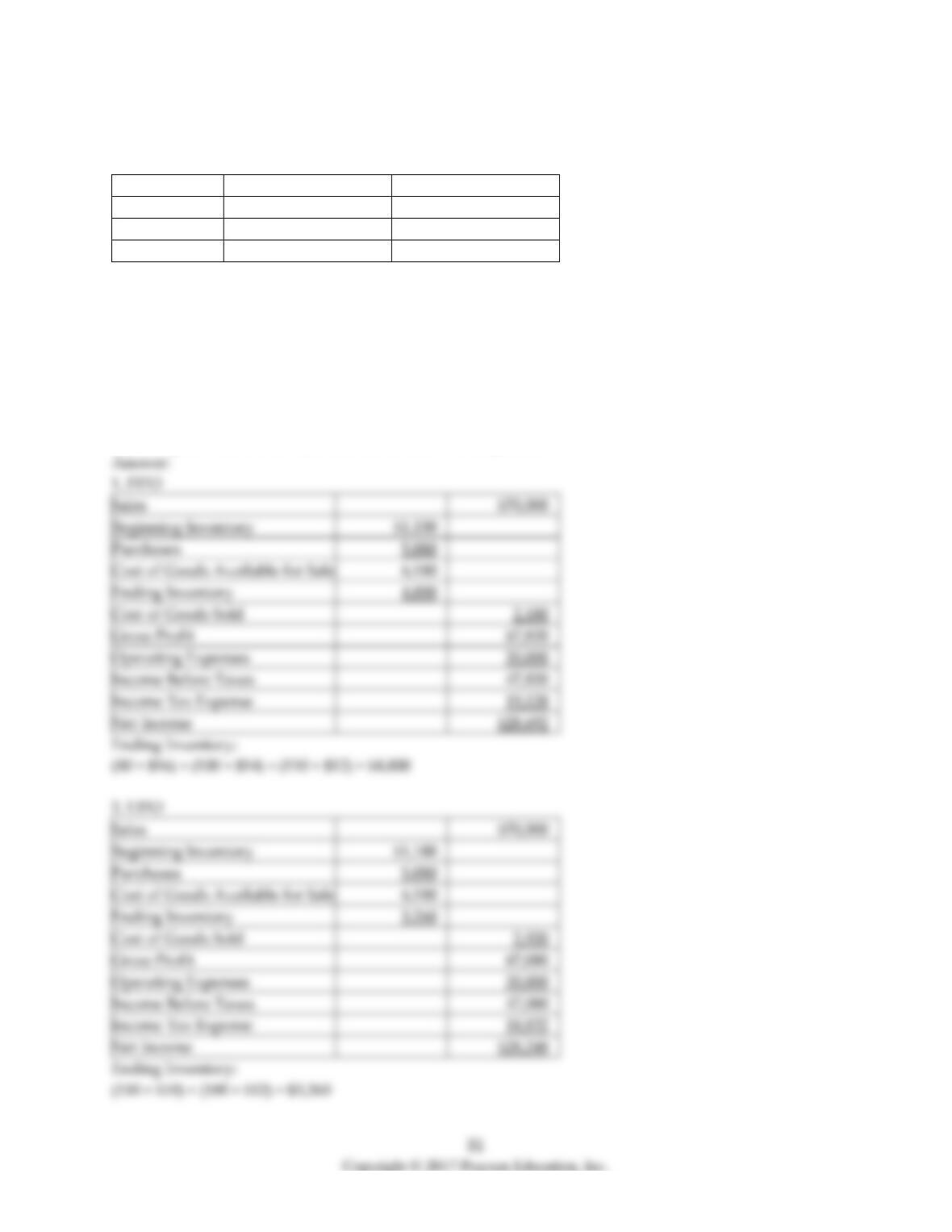
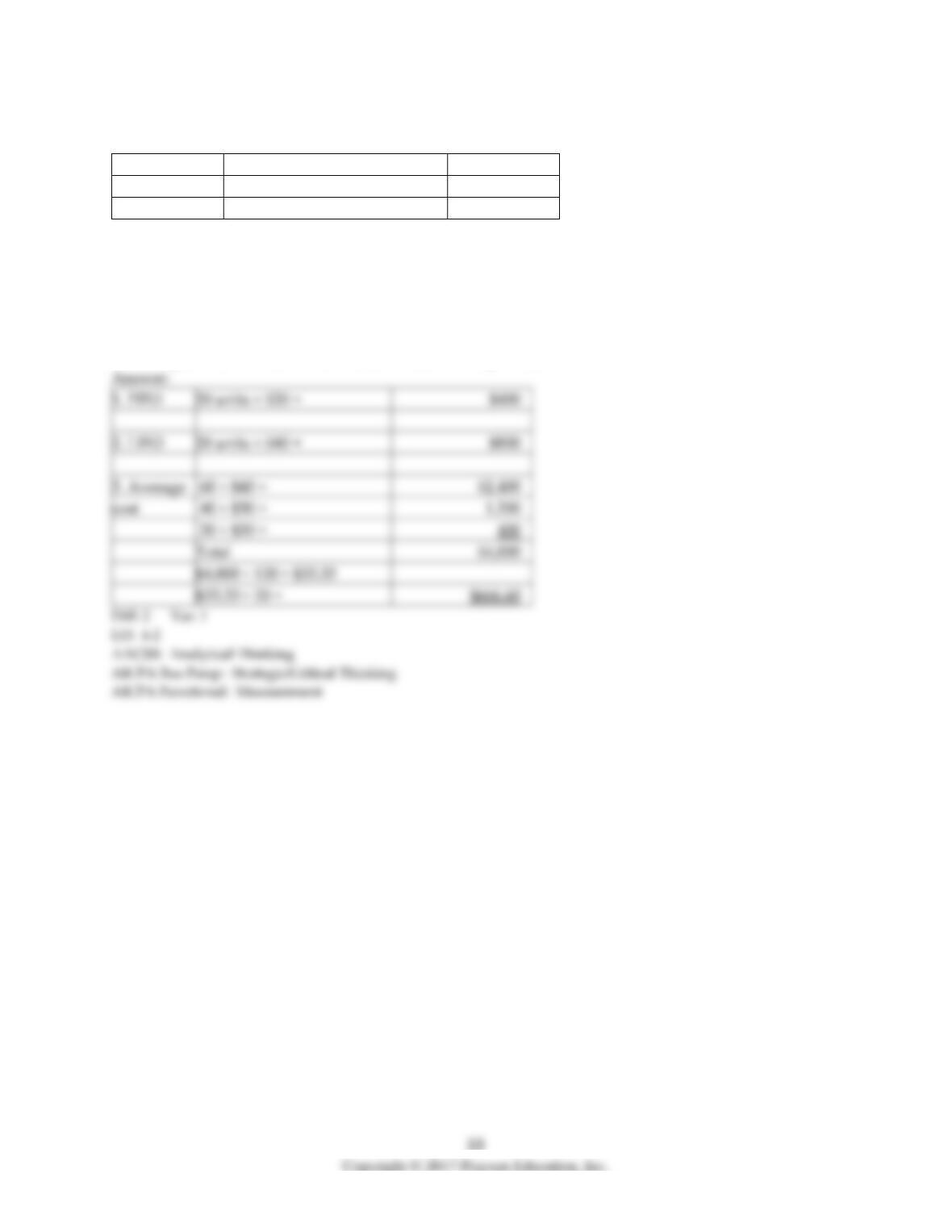
Sales
Beginning Inventory
Purchases
Cost of Goods Available for Sale
Ending Inventory
Cost of Goods Sold
Gross Profit
Operating Expenses
Income Before Taxes
Income Tax Expense
Net Income
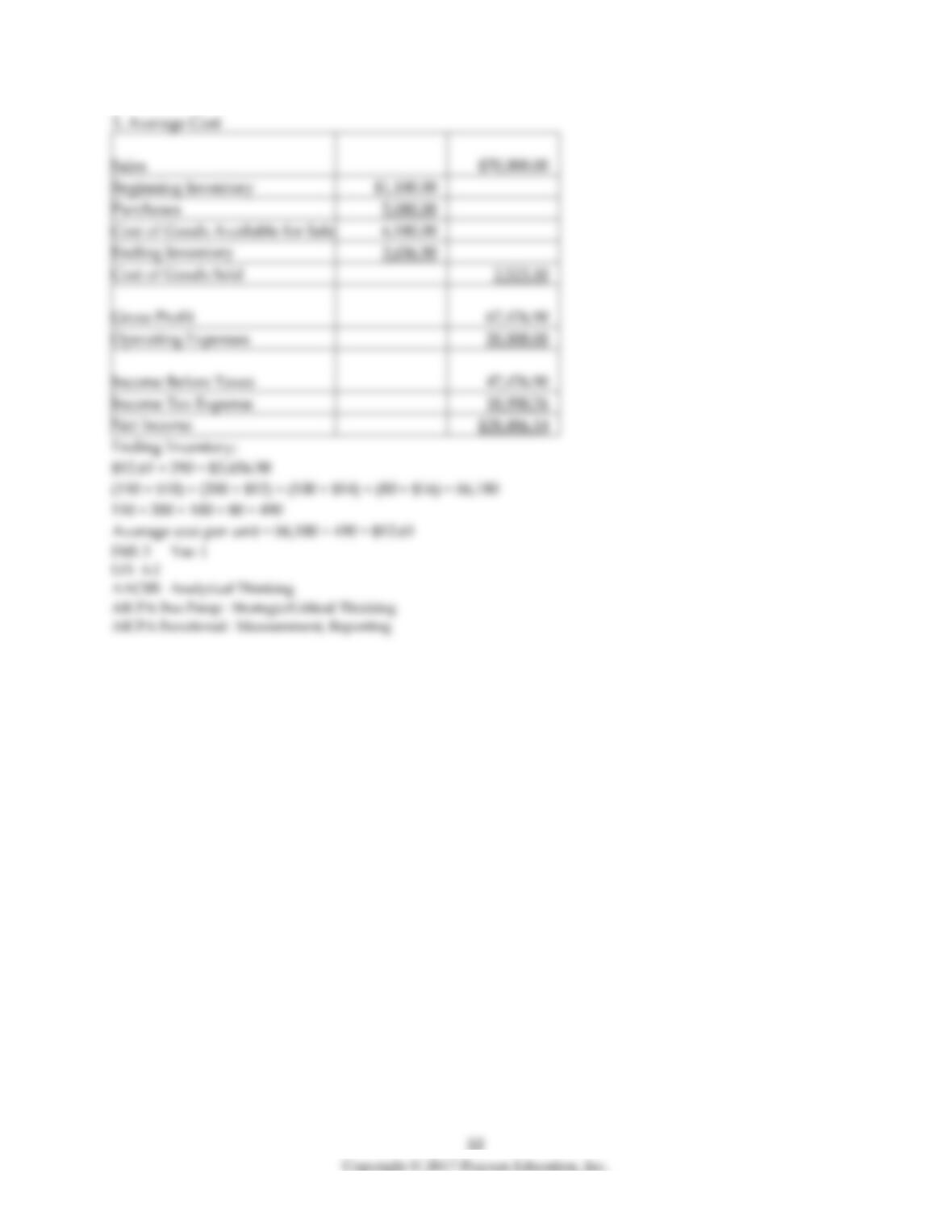
Sales
Beginning Inventory
Purchases
Cost of Goods Available for Sale
Ending Inventory
Cost of Goods Sold
Gross Profit
Operating Expenses
Income Before Taxes
Income Tax Expense
Net Income
41) The units of inventory available for sale during the month of June were as follows:
June 1
Beginning Inventory
60 units at $40
June 15
Purchase
40 units at $30
June 22
Purchase
20 units at $20
There are 20 units of inventory at June 30.
Required: Determine the ending inventory using:
1. FIFO
2. LIFO
3. Average cost (Round all calculations to two decimal places.)
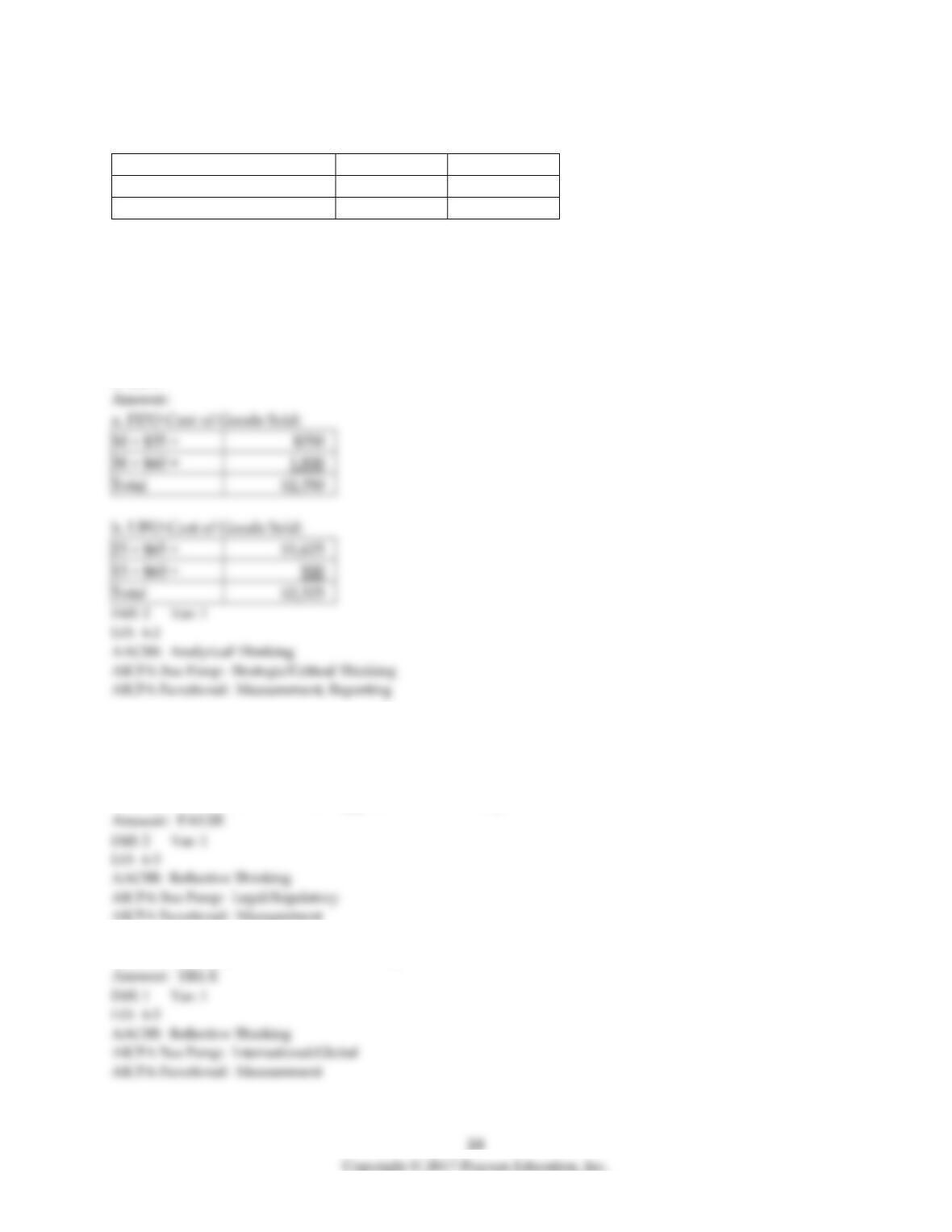
1. FIFO
20 units × $20 =
2. LIFO
20 units × $40 =
3. Average
60 × $40 =
cost
40 × $30 =
20 × $20 =
Total
$4,000 ÷ 120 = $33.33
42) Carboni Company had the following data available for the current month:
Beginning Inventory
10 units
$55 per unit
Purchase #1
30 units
$60 per unit
Purchase #2
25 units
$65 per unit
Assume 40 units were sold during the month. Sales Revenue for the month is $7,000 and operating
expenses are $2,200. The income tax rate is 30%.
Required:
Compute cost of goods sold using:
a. FIFO
b. LIFO
10 × $55 =
30 × $60 =
Total
25 × $65 =
15 × $60 =
Total
3 Learning Objective 6-3
1) When applying the lower-of-cost-or–market rule to inventory valuation in the United States, market
value generally refers to the selling price of the inventory.
2) IFRS defines market value for inventory as net realizable value.
3) The disclosure principle holds that a company’s financial statements should report enough
information for outsiders to make informed decisions about the company.
4) By having knowledge of the company’s inventory method, as well as having clear, complete
disclosures in the financial statements, bankers are guaranteed that the company will repay its loans.
5) The lower-of-cost-or–market rule is based on the principles of relevance and representational
faithfulness.
6) Under U.S. GAAP, the application of the lower–of-cost-or-market rule to inventories is optional.
7) If IFRS is adopted in the United States, inventory write-downs may become more common than they
are now, due to the fact that selling prices are usually greater than replacement cost.
8) A company uses LIFO in one year, then switches to FIFO and then to average-cost. This is a violation
of the:
A) disclosure principle
B) historical cost principle.
C) consistency principle.
D) conservatism principle.
9) Under U.S. GAAP, inventories are reported on the balance sheet at:
A) historical cost only.
B) current replacement cost only.
C) net realizable value.
D) lower-of-cost-or-market.
10) Following IFRS, the lower–of-cost-or–market rule requires a company to report inventories at the
lower of:
A) historical cost or current sales price.
B) historical cost or net realizable value.
C) current replacement cost or historical cost.
D) FIFO cost or LIFO cost.
11) When applying the lower–of-cost-or-market rule to inventories, market value generally refers to
________ under U.S. GAAP and ________ under IFRS.
A) current replacement cost; historical cost
B) historical cost; net realizable value
C) historical cost; current replacement cost
D) current replacement cost; net realizable value
12) Which of the following is a CORRECT statement about the lower–of-cost-or market rule?
A) Under U.S. GAAP, once inventory has been written down to market value, the write-downs can be
reversed in future periods.
B) Under U.S. GAAP, the lower–of-cost-or-market rule is optional.
C) Currently, the lower–of-cost-or-market rules are the same for both U.S. GAAP and IFRS.
D) Under IFRS, some lower–of-cost-or-market write-downs may be reversed.
13) Perfect Catering Company’s ending inventory was $109,700 at historical cost and $111,500 at current
replacement cost. Before consideration of the lower–of-cost-or-market rule, the company’s cost of goods
sold was $65,000. Following U.S. GAAP, which of the following statements reflect the correct
application of the lower-of–cost-or-market rule?
A) The Ending Inventory balance will be $109,700, and Cost of Goods Sold will be $65,000.
B) The Ending Inventory balance will be $111,500, and Cost of Goods Sold will be $65,000.
C) The Ending Inventory balance will be $111,500, and Cost of Goods Sold will be $66,800.
D) The Ending Inventory balance will be $111,500, and Cost of Goods Sold will be $63,200.
14) Mariah Company has inventory at the end of the year with a historical cost of $95,000. Mariah
Company uses the perpetual inventory system. Under the LCM rule, the current replacement cost is
$75,600. Under U.S. GAAP, the journal entry to record the write-down to LCM will:
A) debit Cost of Goods Sold for $19,400 and credit Inventory for $19,400.
B) debit Cost of Goods Sold for $19,400 and credit Purchases for $19,400.
C) debit Inventory for $19,400 and credit Cost of Goods Sold for $19,400.
D) debit Purchases for $19,400 and credit Cost of Goods Sold for $19,400.
15) The historical cost of Jahn Company’s ending inventory was less than the current replacement cost.
Following U.S. GAAP, which journal entry is required?
A) debit Cost of Goods Sold and credit Sales
B) debit Inventory and credit Cost of Goods Sold
C) debit Cost of Goods Sold and credit Inventory
D) No journal entry is needed.
16) Uptown Department Store uses the perpetual inventory system and has ending inventory with a
historical cost of $620,000. The current replacement cost of the inventory is $598,000. The net realizable
value is $670,000. Before any adjustments at the end of the period, the cost of goods sold account has a
balance of $920,000. Which journal entry is required under U.S. GAAP?
A) debit Cost of Goods Sold for $50,000 and credit Inventory for $50,000
B) debit Inventory for $50,000 and credit Cost of Goods Sold for $50,000
C) debit Cost of Goods Sold for $22,000 and credit Inventory for $22,000
D) debit Inventory for $22,000 and credit Cost of Goods Sold for $22,000
17) The Madyson Dress Shop uses the perpetual inventory system and has ending inventory with a
historical cost of $620,000. The current replacement cost of the inventory is $608,000. The net realizable
value is $640,000. Before any adjustments at the end of the period, the cost of goods sold account has a
balance of $880,000. What journal entry is required under IFRS?
A) No journal entry is required.
B) debit Cost of Goods Sold $20,000 and credit Inventory $20,000
C) debit Inventory $20,000 and credit Cost of Goods Sold $20,000
D) debit Cost of Goods Sold $12,000 and credit Inventory $12,000
18) The lower-of-cost-or–market rule for inventory is based on the accounting principle(s) of:
A) relevance.
B) representational faithfulness.
C) disclosure.
D) A and B.
19) It is the end of the year and Katerinos Company is applying the lower–of-cost-or-market (LCM) rule
to inventory. The company uses the perpetual inventory system. Katerinos has provided the following
information before any year-end adjustments:
Cost of Goods Sold
$500,000
Ending Inventory(Historical Cost)
$120,000
Ending Inventory(Current Replacement Cost)
$105,000
Ending Inventory(Net Realizable Value)
$115,000
Required: Prepare the required journal entry at year-end:
1. Following U.S. GAAP.
2. Following IFRS.
Cost of Goods Sold
20) Why does U.S. GAAP require companies to apply the lower-of-cost-or-market rule to inventories?
21) How does the disclosure principle help financial statements users compare the financial statements
of retailers, with regard to inventories?
4 Learning Objective 6-4
1) For most firms, the gross profit percentage changes significantly from year to year.
2) The gross profit percentage equals net sales divided by gross profit.