Name:
Class:
Date:
chapter 6
c. $675
d. $600
82. Jonas Company’s inventory has the following values:
Cost $1,000
Estimated selling price 1,500
Selling expenses 600
Under the lower-of-cost-or-market method, Jonas Company’s inventory will be valued at ____.
a. $500
b. $900
c. $1,500
d. $1,000
83. ABC Inc. provided the following data for the year end:
Cost of goods sold $4,680,000
Inventory at the beginning of the year 678,000
Inventory at the end of the year 570,000
What is ABC Inc.’s days’ sale in inventory? (Assume 360 days in a year)
a. 95 days
b. 13 days
c. 60 days
d. 48 days
84. If net sales is $550,000, beginning inventory is $110,000, and ending inventory is $125,000, how much would be the
accounts receivables turnover?
a. 4.4
b. 5.0
c. 4.7
d. 4.0
85. The inventory costing method that considers the ending inventory to be composed of units of the merchandise
acquired earliest is called ____.
a. first-in, first-out
b. highest-in, first-out
c. lowest-in, first-out
d. last-in, first-out
Name:
Class:
Date:
chapter 6
86. The analysis of receivables method of costing inventory is based on the assumption that ____.
a. the uncollectible accounts can be estimated as a percentage of credit sales
b. the bad debt expense is recorded by estimating uncollectible accounts at the end of the accounting period
c. the bad debt expense is recorded only when an account is determined to be worthless
d. the longer an account receivable is outstanding, the less likely that it will be collected
87. What type of account is Allowance for Doubtful Accounts?
a. Contra asset account
b. Asset account
c. Liability account
d. Expense account
88. If the cost of an item of inventory is $70, the current replacement cost is $65, and the sales price is $85, the amount
included in inventory according to the lower-of-cost-or-market method is ____.
a. $65.
b. $70.
c. $85.
d. $160.
89. A written promise to pay a sum of money on demand or at a definite time is called a(n) ____.
a. letter of credit
b. deferred note
c. credit memorandum
d. promissory note
90. If sales is $1,000,000, cost of merchandise sold is $750,000, and average inventory is $220,000, how much would be
inventory turnover?
a. 1.1
b. 3.4
c. 1.3
d. 4.5
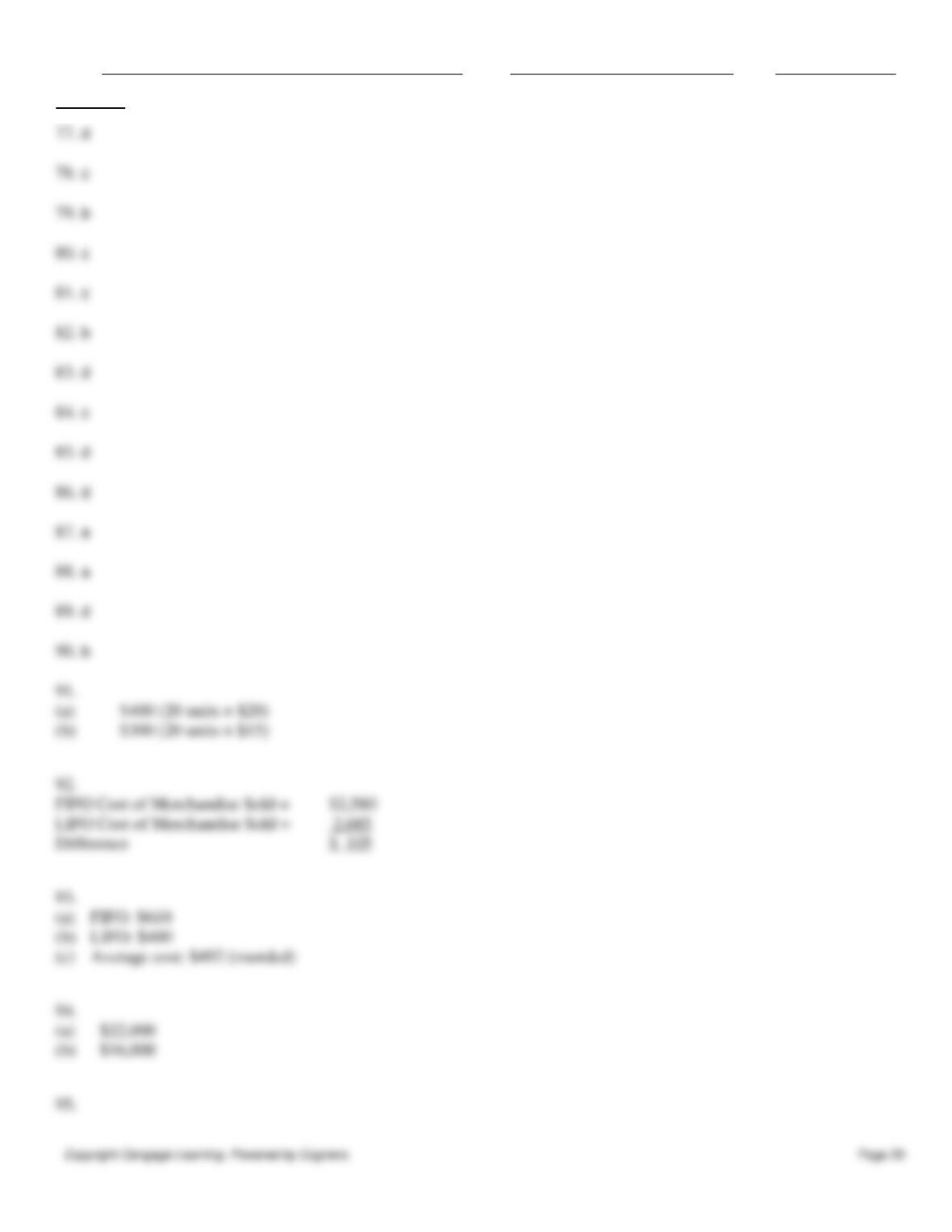
91. Joy Co.’s recorded inventory information for the month of August is as follows:
Beginning Inventory 22 units at $15 each
First Purchase 25 units at $18 each
Second Purchase 21 units at $20 each
Sales 48 units
Determine the total cost of ending inventory according to (a) FIFO method and (b) LIFO method.
92. The units of Product YY2 available for sale during the year were as follows:
Apr 1 Inventory 16 units at $30 each
Jun 16 Purchase 30 units at $33 each
Name:
Class:
Date:
chapter 6
Sep 28 Purchase 45 units at $37 each
There are 15 units of the product in the physical inventory at March 31. The periodic inventory system is used. Determine
the difference in gross profit between the LIFO and FIFO inventory cost systems.
93. The following units are available for sale during the year:
January 1 Beginning Inventory 10 units at $18 each
April 3 Purchase 30 units at $20 each
August 31 Purchase 28 units at $25 each
September 29 Purchase 17 units at $30 each
December 31 Ending Inventory 21 units
Determine ending inventory cost by (a) FIFO method, (b) LIFO method, and (c) average cost method.
94. Determine the amount to be added to Allowance for Doubtful Accounts in each of the following cases:
(a) Balance of $3,000 in the allowance account just prior to adjustment. Analysis of accounts receivable indicates
doubtful accounts of $25,000.
(b) Balance of $500 in the allowance account just prior to adjustment. Uncollectibles are estimated at 2% of sales,
which totaled $800,000 for the year.
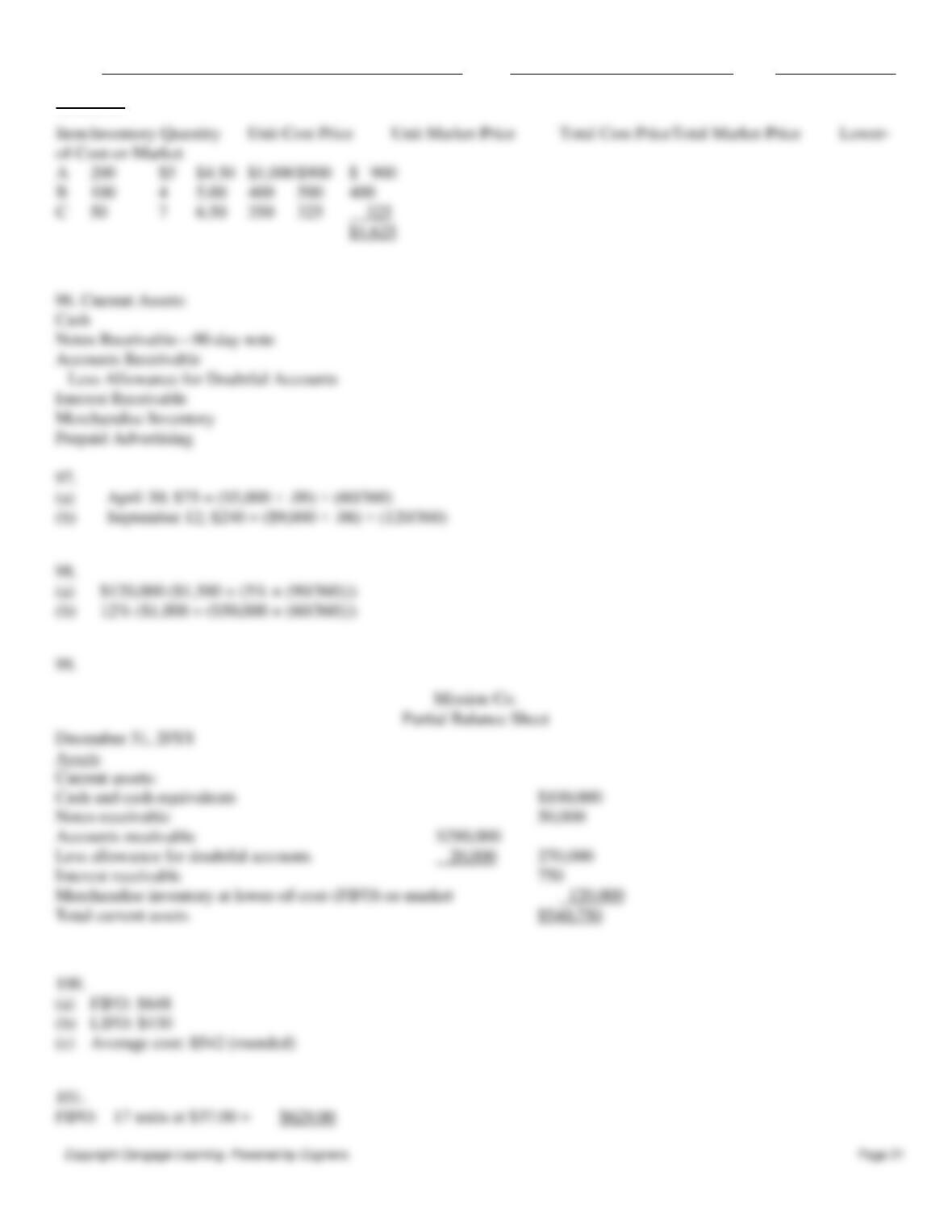
95. Using the lower-of-cost-or-market method of inventory valuation, what should the total inventory value be for the
following items:
Item Inventory Quantity Unit Cost Price Unit Market Price Total Cost Price Total Market Price
A 200 $5 $4.50 $1,000 $900
B 100 4 5.00 400 500
C 50 7 6.50 350 325
96. Prepare the Current Assets section of a balance sheet using some or all of the following accounts:
Cash
Property, Plant, and Equipment
Accounts Receivable
Notes Receivable—90-day note
Merchandise Inventory
Allowance for Doubtful Accounts
Interest Receivable
Prepaid Advertising
Sales Returns and Allowances
97. Determine the due date and amount of interest due at maturity on the following notes (Assume 360 days in a year):
Origination Date Face
Amount Term
of Note Interest
Rate Maturity
Date Interest
Amount
(a) March 1 $5,000 60 days 9% _______ _______
(b) May 15 $9,000 120 days 8% _______ _______
Name:
Class:
Date:
chapter 6
98.
(a) If the interest on a note is $1,500, the interest rate is 5%, and the time is 90 days, what is the principal? (Assume
360 days in a year)
(b) If the principal of a note is $50,000, the interest is $1,000, and the time is 60 days, what is the interest rate?
(Assume 360 days in a year)
99. On the basis of the following data related to current assets for Mission Co. at December 20Y8, prepare a partial
balance sheet in good form.
Cash and cash equivalents $100,000
Notes receivable 50,000
Accounts receivable 290,000
Allowance for doubtful accounts 20,000
Interest receivable 750
Merchandise inventory at lower-of-cost-(first-in, first-out method) or-market 120,000
100.
September 5 Purchase 65 units at $6 each
September 13 Purchase 55 units at $8 each
September 29 Purchase 44 units at $10 each
September 30 Ending Inventory 70 units
Determine ending inventory cost by (a) FIFO method, (b) LIFO method, and (c) average cost method.
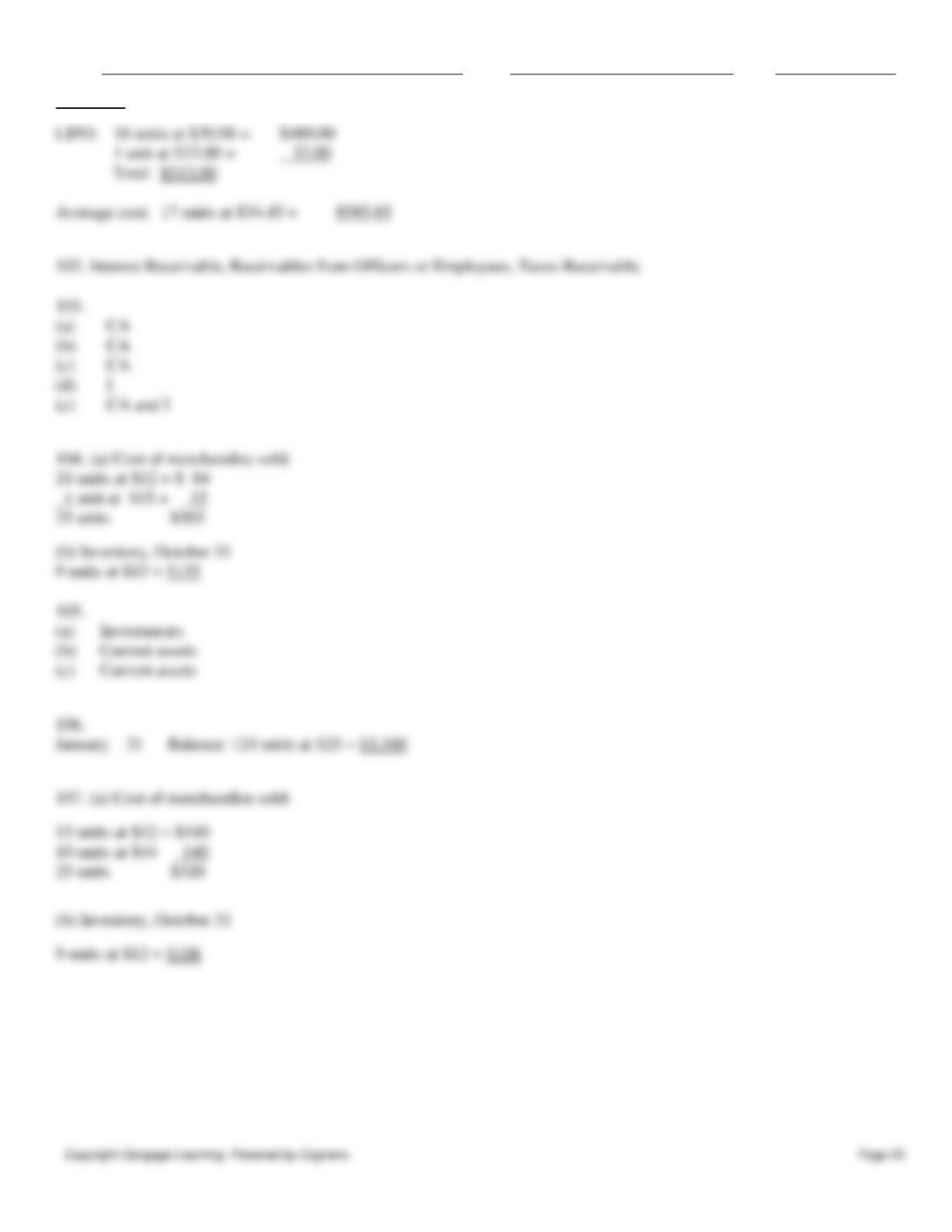
101. The units of Product YY2 available for sale during the year were as follows:
Apr. 1 Inventory 16 units at $30 each
Jun. 16 Purchase 30 units at $33 each
Sep. 28 Purchase 45 units at $37 each
There are 17 units of the product in the physical ending inventory at March 31. The periodic inventory system is used.
Determine the ending inventory cost by (a) FIFO, (b) LIFO, and (c) average cost methods.
102. Other than accounts receivable and notes receivable, name other receivables that might be included on the balance
sheet.
103. Classify the following as either Current Assets (CA), Investments (I), or both (CA and I).
(a) Trade Receivables
(b) Note Receivable due in 30 days
(c) Interest Receivable on note due in 30 days
(d) Note Receivable due in 2 years
(e) Five-year Note Receivable due in a series of equal annual payments
104. Beginning inventory, purchases, and sales for Product XCX are as follows:
Oct. 1 Beginning Inventory 24 units at $12 each
Oct. 17 Purchase 10 units at $15 each
Oct. 30 Sale 25 units
Name:
Class:
Date:
chapter 6
Assuming a periodic inventory system and the first-in, first-out method, determine (a) the cost of the merchandise sold
and (b) the inventory on October 31.
105. Indicate the section of the balance sheet (current assets, fixed assets, investments, current liabilities, long-term
liabilities, stockholders’ equity) in which each of the following is reported:
(a) Note receivable due in 3 years
(b) Note receivable due in 90 days
(c) Allowance for doubtful accounts
106. Jade Inc. recorded the following information pertaining to its inventory for the month of January:
1 Inventory 80 units at $20 each
18 Purchase 150 units at $25 each
Sales 106 units
The business uses the first-in, first-out inventory costing method. Determine the cost of the inventory on hand at the end
of January.
107. Beginning inventory, purchases, and sales for Product XCX are as follows:
Oct. 1 Beginning Inventory 24 units at $12 each
Oct. 17 Purchase 10 units at $14 each
Oct. 30 Sale 52 units
Assuming a periodic inventory system and the last-in, first-out method, determine (a) the cost of the merchandise sold for
the October 30 sale and (b) the inventory on October 31.
Name:
Class:
Date:
chapter 6
Answer Key
Name:
Class:
Date:
chapter 6
Name:
Class:
Date:
chapter 6
Name:
Class:
Date:
chapter 6
Name:
Class:
Date:
chapter 6
Name:
Class:
Date:
chapter 6