6.3-22When the LIFO method is used and there is no LIFO liquidation, the cost of goods sold is assumed to
consist of:
A) units with the lowest per unit cost.
B) units with the highest per unit cost.
C) oldest units.
D) most recently purchased units.
63-23 When inventory prices are increasing, the FIFO costing method will generally yield a cost of goods sold
that is:
A) higher than cost of goods sold under the LIFO method.
B) lower than cost of goods sold under the LIFO method.
C) equal to the gross profit under the LIFO method.
D) equal to cost of goods sold under the LIFO method.
6.3-24 The inventory costing method by which the first costs into inventory are the first costs out to cost of goods
sold is the:
A) average-cost method.
B) FIFO method.
C) LIFO method.
D) specific-identification method.
6.3-25 When inventory prices are falling, the LIFO costing method will generally result in a:
A) lower gross profit than under FIFO.
B) higher gross profit than under FIFO.
C) lower inventory value than under FIFO.
D) lower owners’ equity balance than under FIFO.
6.3-26 When using the average-cost method to determine the cost of inventory, the average cost per unit is
calculated as the cost of goods:
A) in ending inventory, divided by the number of units in ending inventory.
B) sold, divided by the number of units sold.
C) cost of goods available for sale, divided by the number of units available for sale.
D) sold, divided by the average number of units in inventory.
6.3-27 The use of the FIFO method generally increases taxable income:
A) when prices are constant.
B) when prices are declining.
C) when prices are increasing.
D) under all circumstances.
6.3-28 Which inventory method gives the most realistic net income?
A) FIFO, because it uses cost in the order in which they were incurred
B) LIFO, because it includes the most recent costs in cost of goods sold
C) Average-cost, because it averages old and recent costs
D) The answer depends on whether prices are rising or falling.
6.3-29 If prices are rising and a company is using LIFO, large purchases of inventory near the end of the year
will:
A) increase income taxes paid.
B) decrease income taxes paid.
C) not change the value of ending inventory.
D) do none of the above.
6.3-30 All of the following are reasons for choosing the FIFO versus the LIFO costing method EXCEPT that:
A) FIFO reports the most up-to-date inventory values on the balance sheet.
B) FIFO generally results in higher net income in period of rising prices.
C) FIFO uses more current costs in calculating the value of ending inventory.
D) FIFO results in lower income taxes.
6.3-31 When inventory costs are increasing with no LIFO liquidation:
A) FIFO cost of goods sold will be higher than LIFO cost of goods sold.
B) FIFO ending inventory will be lower than LIFO ending inventory.
C) FIFO cost of goods sold will be lower than LIFO cost of goods sold.
D) FIFO and LIFO will result in the same cost of goods sold and ending inventory.
6.3-32 When LIFO is used and inventory quantities fall below the level of the previous period, the situation is
called a:
A) LIFO adjustment.
B) LIFO failure.
C) LIFO liquidation.
D) LIFO materiality.
6.3-33 Ace Company began the current accounting period with 9,000 units of inventory purchased for $100 per
unit. Ace sells its units at $300 per unit. Ace would experience a LIFO liquidation if:
A) the sales price falls below $300 per unit.
B) the purchase price falls below $100 per unit.
C) the level of ending inventory falls below 9,000 units.
D) any of the above scenarios happened.
6.3-34 Harmon Fraiser Industries had beginning inventory of 20,000 candles and an ending inventory of 15,000
candles. Harmon originally paid $1.80 each when it purchased the candles. The current replacement cost
of the candles is $2.20 each. Each candle retails for $3.00. Harmon uses the LIFO method to account for
its inventory. How did the LIFO liquidation affect the company’s taxable income?
A) Taxable income increased because of the liquidation.
B) Taxable income decreased because of the liquidation.
C) Taxable income remained the same despite the liquidation.
D) You cannot determine taxable income from the given data.
6.3-35 The comparability principle:
A) does not enable investors to compare a company’s financial statements from one period to the next.
B) does not permit a company to change its accounting methods.
C) states that business should change its accounting methods and procedures from period to period.
D) none of the above.
6.3-36 The accounting principle that states that a business should use the same accounting methods and
procedures from period to period is the:
A) comparability principle.
B) historical cost principle.
C) disclosure principle.
D) conservatism principle.
6.3-37 A company uses LIFO in one year, then switches to FIFO and then to average-cost. This is a violation of
the:
A) disclosure principle
B) historical cost principle.
C) comparability principle.
D) conservatism principle.
6.3-38 The accounting principle that allows an analyst to analyze a company’s performance for multiple periods
is:
A) relevance principle.
B) accounting conservatism principle.
C) comparability principle.
D) going concern principle.
6.3-39 Which of the following is a violation of the comparability principle?
A) the business adopting a new accounting policy as a result of reporting standards changes.
B) the business changed its inventory from LIFO to average cost last year and to FIFO this year.
C) the business changed its PPE useful life estimate from 20 years to 15 years to reflect rapid wear and
tear of equipment.
D) the business changed its estimate of uncollectible receivables at the end of the year.
6.3-40 The lower-of-cost-or-NRV rule is based on accounting:
A) disclosure.
B) materiality.
C) conservatism.
D) revenue.
6.3-41 The lower-of-cost-or- net-realisable-value rule requires a company to report inventories at the lesser of:
A) historical cost or estimated sales price less cost of sale.
B) historical cost or current replacement cost.
C) current replacement cost or sales invoice price.
D) FIFO cost or LIFO cost.
6.3-42 When applying the lower-of-cost-or- net-realisable-value rule, net-realisable-value value generally refers
to:
A) FIFO cost using the periodic method.
B) LIFO cost using the periodic method.
C) estimated sales price of the inventory less cost of sale.
D) current replacement cost.
6.3-43 Wonkie Company’s ending inventory (at cost) was $75,000. The inventory was expected to be sold at
$80,000 with cost of sale of $15,000. How will this affect the reported ending inventory and cost of
goods sold?
A) It will increase both ending inventory and cost of goods sold by $10,000.
B) It will decrease ending inventory by $10,000 and increase cost of goods sold by $10,000.
C) It will increase ending inventory by $10,000 and have no effect on cost of goods sold.
D) It will have no effect on either ending inventory or cost of goods sold.
6.3-44 Pat and Company’s ending inventory (at cost) was $87,500. The company would be able to sell the
inventory at $100,000, net of cost of sale. Before consideration of the lower-of-cost-or-NRV rule, the
company’s cost of goods sold was $60,000. Which of the following statements reflect the correct
application of the lower-of-cost-or-NRV rule?
A) The Ending Inventory balance will be $100,000, and Cost of Goods Sold will be $72,500.
B) The Ending Inventory balance will be $87,500, and Cost of Goods Sold will be $60,000.
C) The Ending Inventory balance will be $87,500, and Cost of Goods Sold will be $72,500.
D) The Ending Inventory balance will be $100,000, and Cost of Goods Sold will be $72,500.
6.3-45 If year-end inventory is reduced from cost to a lower net-realisable-value, which of the following
accurately depicts the results?
A) The capital account balance is increased and beginning inventory of the next period is reduced by the
same amount.
B) Cost of goods sold is reduced and beginning inventory of the next period is reduced by the same
amount.
C) Year-end inventory is reduced and cost of goods sold is reduced by the same amount.
D) Cost of goods sold is increased and ending inventory is decreased by the same amount.
6.3-46 The purchasing manager for East Coast Hoggs is attempting to determine how much inventory to
purchase for the upcoming month. The following information has been collected:
Current inventory
$ 32,000
Budgeted cost of goods sold
$80,000
The manager wishes to end the month with ending inventory of $25,000. How much inventory must the
company purchase?
A) $85,000
B) $82,000
C) $73,000
D) $67,000
6.3-47 A company has cost of goods available for sale of $32,000, consisting of 8,000 units. The average cost
per unit to be used to value the ending inventory:
A) is $40.
B) is $4.
C) is $8.
D) cannot be determined from the data.
6.3-48 Given the following data, what is the value of the cost of goods sold as determined by the FIFO method?
Sales revenue
300 units at $15 per unit
Purchases
240 units at $10 per unit
Beginning inventory
120 units at $9 per unit
A) $2,880
B) $2,912
C) $2,940
D) $4,500
6.3-49 Given the following data, what is the value of the ending inventory as determined by the FIFO method?
Sales revenue
300 units at $15 per unit
Purchases
240 units at $10 per unit
Beginning inventory
120 units at $9 per unit
A) $2,880
B) $600
C) $540
D) $2,820
6.3-50 Given the following data, what is the value of the gross profit as determined by the LIFO method?
Sales revenue
300 units at $15 per unit
Purchases
240 units at $10 per unit
Beginning inventory
120 units at $9 per unit
A) $2,880
B) $600
C) $540
D) $1,560
CGS=
240 units @ 10=
2,400
60 units @ 9=
540
300
2,940
GP= Sales – CGS
GP= 4500-2940=
1,560
6.3-51 Given the following data, what is the value of the ending inventory as determined by the LIFO method?
Sales revenue
300 units at $15 per unit
Purchases
240 units at $10 per unit
Beginning inventory
120 units at $9 per unit
A) $2,880
B) $2,940
C) $540
D) $600
EI units=
120+240-300=
60
60 units @ 9=
540
6.3-52 The following data was extracted from the records of Winsam Company:
Winsam’s most recent income statement showed cost of goods sold of $8,800. Which method was used
for valuing inventory?
A) FIFO
B) LIFO
C) Average-cost
D) Specific identification
400 units @ 20=
8,000
50 units @ 16=
800
LIFO
8,800
Sales revenue
450 units @ $35 per unit
Purchases
400 units @ $20 per unit
Beginning inventory
100 units @ $16 per unit
6.3-53 The following data was extracted from the records of Winsam Company:
Winsam’s most recent balance sheet showed ending inventory of $800. Which method was used for
valuing inventory?
A) FIFO
B) LIFO
C) Average-cost
D) Specific identification
EI units = BI+P-CGS
100+400-450 =
50 units
800 EI/50 units =
16 per unit
16 is BI therefore LIFO
Sales revenue
450 units @ $35 per unit
Purchases
400 units @ $20 per unit
Beginning inventory
100 units @ $16 per unit
6.3-54 The following data was extracted from the records of Winsam Company:
What is the gross profit using the FIFO method?
A) $7,150
B) $6,950
C) $8,800
D) $8,600
CGS=
100 units @ 16=
1,600
350 units @ 20=
7,000
450
8,600
GP= Sales – CGS
GP= 15,750-8,600=
7,150
Sales revenue
450 units @ $35 per unit
Purchases
400 units @ $20 per unit
Beginning inventory
100 units @ $16 per unit
6.3-55 The following data was collected from the accounting records of Ambrose, Inc., which currently uses the
FIFO method of valuing inventory.
Sales revenue
200 units at $25 per unit
Purchases
180 units at $15 per unit
Beginning inventory
60 units @ $12 per unit
What would have been the difference in Ambrose’s ending inventory under the LIFO costing method?
A) Ending inventory would have been $120 higher.
B) Ending inventory would have been $120 lower.
C) Ending inventory is the same under both methods.
D) The difference cannot be determined using this information.
EI units
180+60-200=40
FIFO
40 units @ 15=
600
LIFO
40 units @12=
480
Difference
120
6.3-56 Given the following data, calculate the cost of ending inventory using the FIFO costing method.
Date
Item
Unit
1/1
Beginning inventory
30 units at $10 per unit
2/25
Purchase of inventory
15 units at $12 per unit
5/20
Purchase of inventory
25 units at $13 per unit
8/15
Purchase of inventory
20 units at $14 per unit
10/17
Purchase of inventory
25 units at $15 per unit
12/31
Ending inventory
65 units
A) $915
B) $740
C) $720
D) $545
6.3-57 Given the following data, calculate the cost of ending inventory using the LIFO costing method.
Date
Item
Unit
1/1
Beginning inventory
30 units at $10 per unit
2/25
Purchase of inventory
15 units at $12 per unit
5/20
Purchase of inventory
25 units at $13 per unit
8/15
Purchase of inventory
20 units at $14 per unit
10/17
Purchase of inventory
25 units at $15 per unit
12/31
Ending inventory
65 units
A) $915
B) $740
C) $720
D) $545
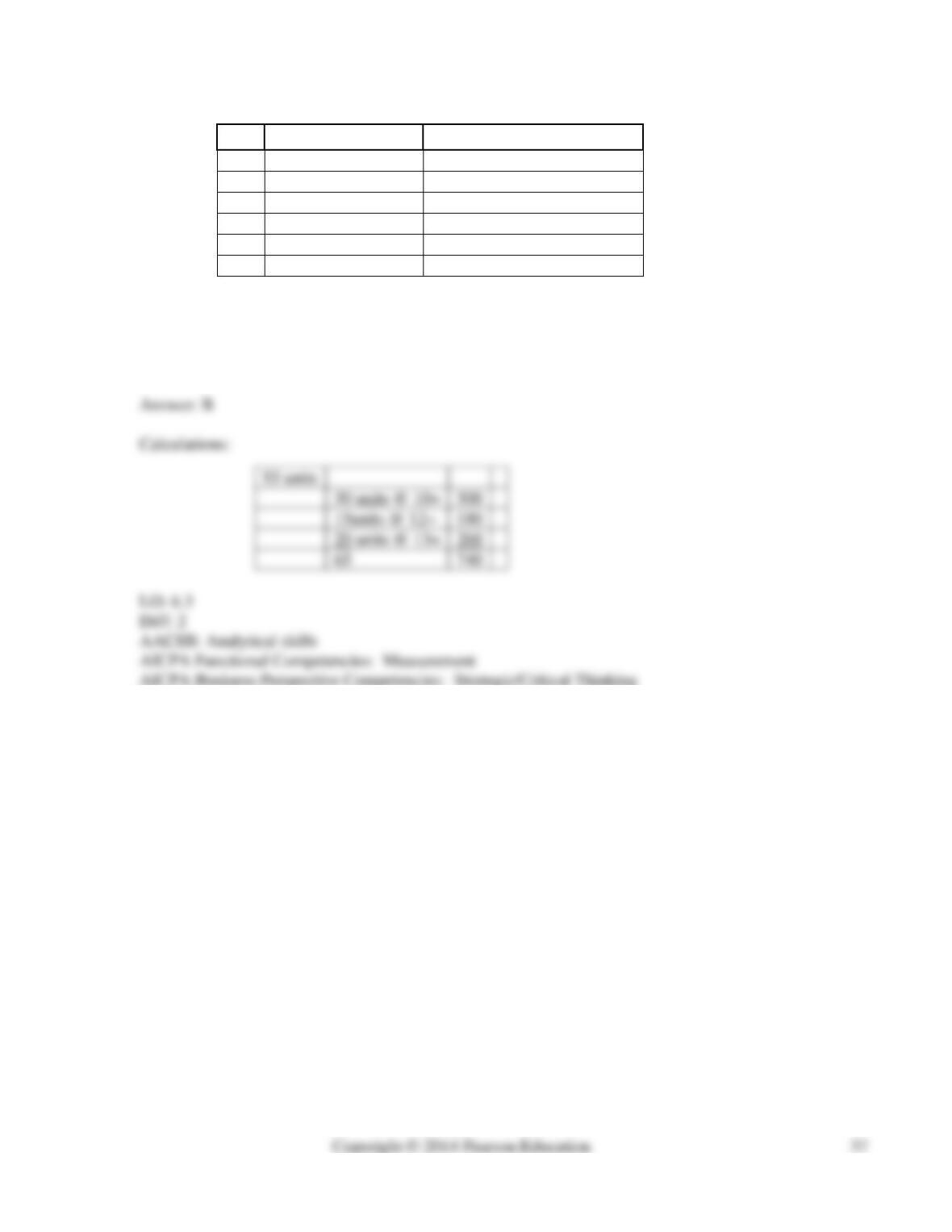
30 units @ 10=
300
20 units @ 13=
260
6.3-58 Given the following data, calculate the gross profit using the average-cost method, if the selling price
was $20 per unit.
Date
Item
Unit
1/1
Beginning inventory
40 units at $12 per unit
3/5
Purchase of inventory
18 units at $14 per unit
5/30
Purchase of inventory
24 units at $18 per unit
12/31
Ending inventory
20 units
A) $851.71
B) $634.78
C) $359.60
D) $283.90
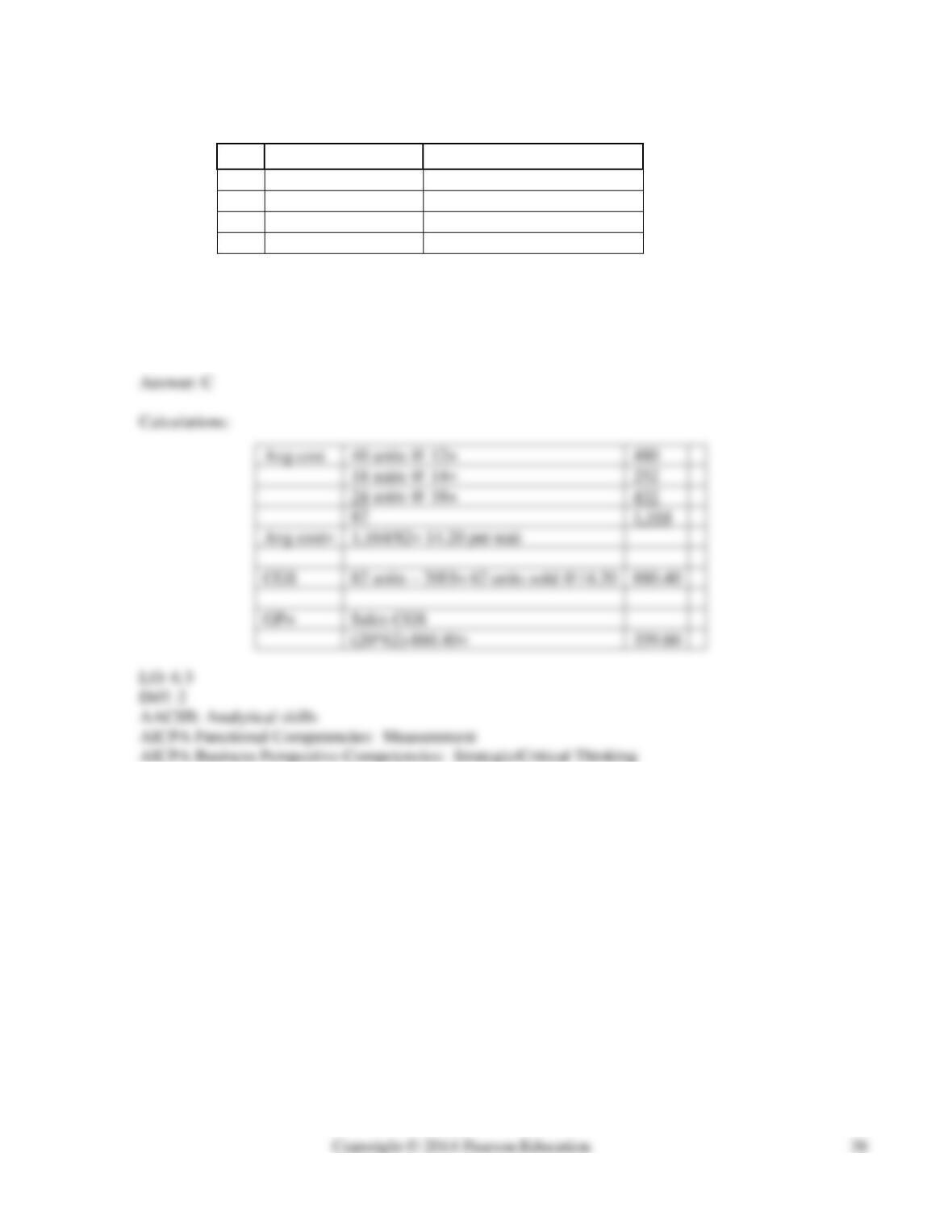
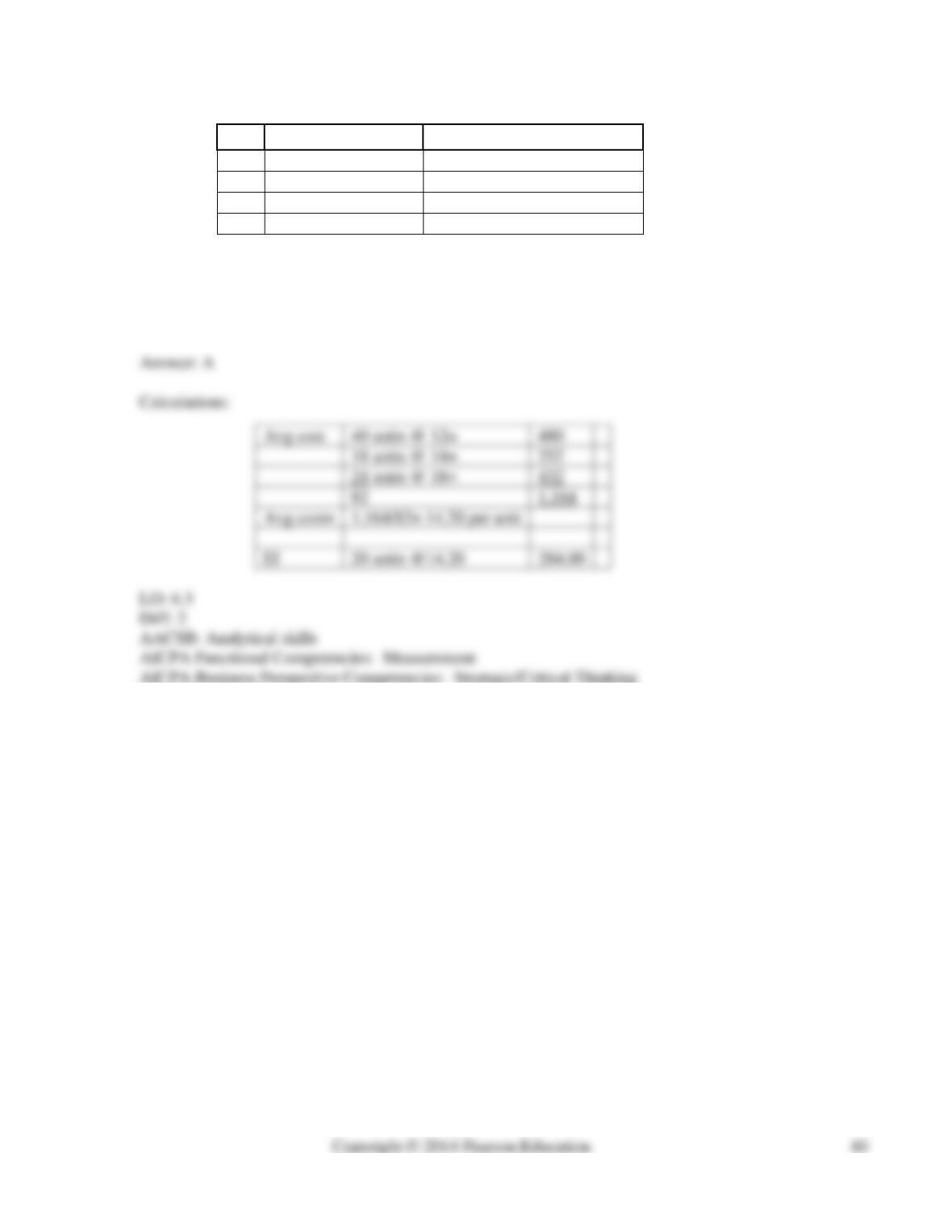
Avg cost
40 units @ 12=
480
24 units @ 18=
432
Avg cost=
1,164/82= 14.20 per unit
82 units – 20EI= 62 units sold @14.20
880.40
(20*62)-880.40=
359.60
6.3-59 Given the following data, calculate the dollar amount of goods available for sale of using the average-
cost method.
Date
Item
Unit
1/1
Beginning inventory
40 units at $12 per unit
3/5
Purchase of inventory
18 units at $14 per unit
5/30
Purchase of inventory
24 units at $18 per unit
12/31
Ending inventory
20 units
A) $ 283.90
B) $ 851.71
C) $1,164.00
D) $1,419.12
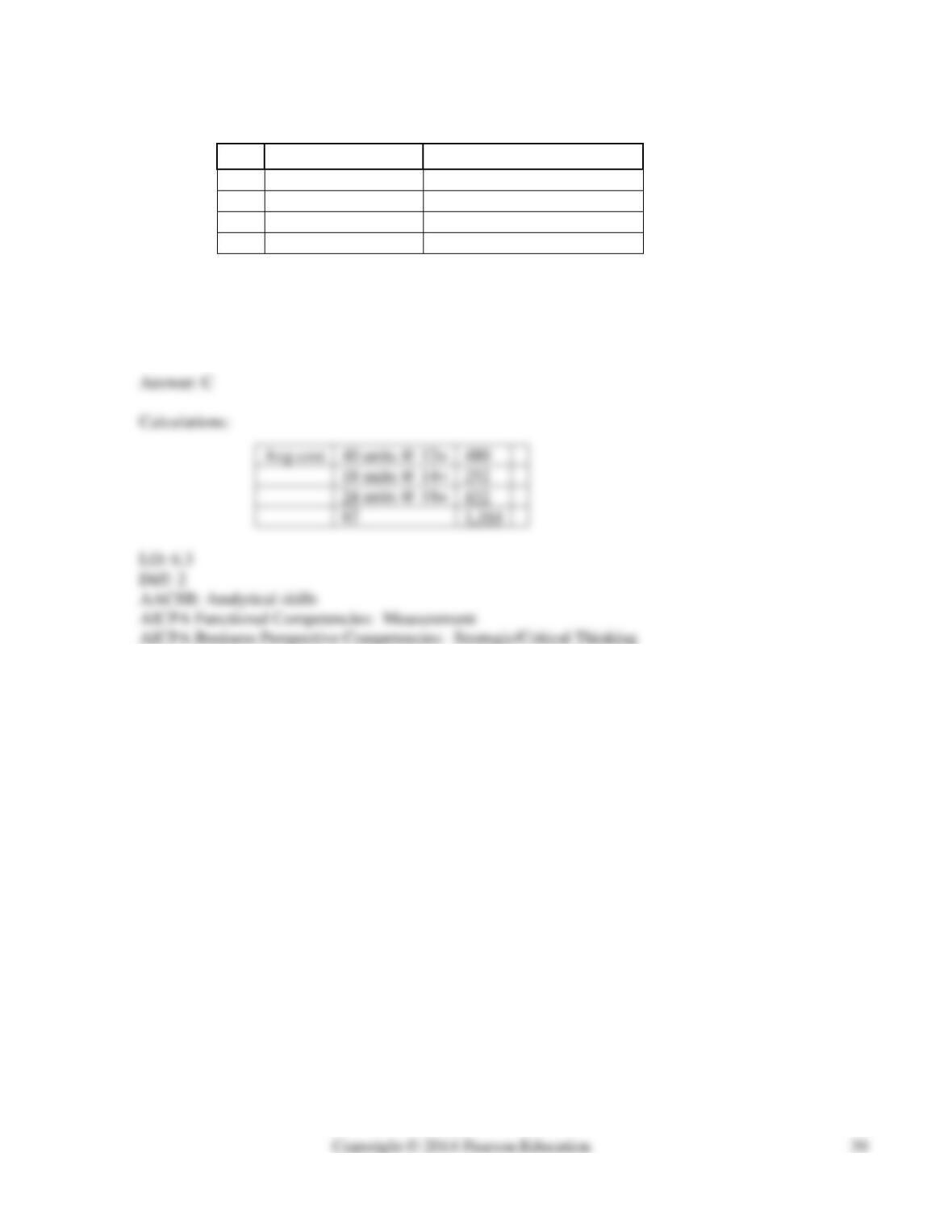
Avg cost
40 units @ 12=
480
24 units @ 18=
432
6.3-60 Given the following data, calculate the value of ending inventory using the average-cost method.
Date
Item
Unit
1/1
Beginning inventory
40 units at $12 per unit
3/5
Purchase of inventory
18 units at $14 per unit
5/30
Purchase of inventory
24 units at $18 per unit
12/31
Ending inventory
20 units
A) $ 284.00
B) $ 851.71
C) $1,164.00
D) $1,419.12