Accounting, 9e (Horngren)
Chapter 6 Merchandising Inventory
Learning Objective 6-1
1) The consistency principle states that a business should use the same accounting methods from period to period.
2) The lower–of-cost-or-market rule demonstrates accounting conservatism in action.
3) A company reports that it uses the FIFO method of inventory costing. This is an example of the disclosure
principle.
4) A company should NOT change the inventory costing method each period in order to maximize net income. This
is an example of the disclosure principle.
5) A company changes its inventory costing method each period in order to maximize net income. This is a
violation of the consistency principle.
6) A company is uncertain whether a complex transaction should be recorded as an asset or an expense. Under the
conservatism principle, they should choose to treat it as an asset.
7) A company is uncertain whether a complex transaction should be recorded as gain or loss. Under the
conservatism principle, they should choose to treat it a loss.
8) A company is uncertain whether a complex transaction should result in an asset being recorded at $100,000 or at
$150,000. Under the conservatism principle, they should choose to show it at the lower amount.
9) The consistency principle states that businesses should use the same accounting methods from period to period.
10) The materiality concept requires that a company should report enough information for outsiders to make wise
decisions about the company.
11) A company discovers that its Cost of goods sold is understated by an insignificant amount. They do NOT need
to correct the error because of the conservatism principle.
12) A company discovers that its Cost of goods sold is understated by an insignificant amount. They do not need to
correct the error because of the materiality concept.
13) Which of the following states that the business should use the same accounting methods from period to period?
A) Materiality concept
B) Consistency principle
C) Accounting conservatism
D) Disclosure principle
14) Which of the following states that a company must perform strictly proper accounting ONLY for items that are
significant to the business’s financial statements?
A) Accounting conservatism
B) Materiality concept
C) Disclosure principle
D) Consistency principle
15) A company decides to ignore a very small error in their inventory balance. This is an example of which of the
following principles?
A) Accounting conservatism
B) Materiality concept
C) Disclosure principle
D) Consistency principle
16) Changing from the LIFO (Last-In, First-Out) to specific-identification method of valuing inventory ignores the:
A) principle of conservatism.
B) principle of consistency.
C) principle of disclosure.
D) concept of materiality.
17) Which of the following states that a business must report enough information for outsiders to make
knowledgeable decisions about the company?
A) Accounting conservatism
B) Materiality concept
C) Disclosure principle
D) Consistency principle
18) Which of the following requires that financial statements should report the LEAST favorable figures?
A) Accounting conservatism
B) Materiality concept
C) Disclosure principle
D) Consistency principle
19) Which of the following principles are reflected in the lower-of-cost-or-market rule?
A) Accounting conservatism
B) Materiality concept
C) Disclosure principle
D) Consistency principle
20) The accounting principle that states that we should never anticipate gains is which of the following?
A) Accounting conservatism
B) Materiality concept
C) Disclosure principle
D) Consistency principle
21) Which of the following concepts states that a company must perform strictly proper accounting ONLY for
significant items?
A) Accounting conservatism
B) Materiality concept
C) Disclosure principle
D) Consistency principle
Learning Objective 6-2
1) Ending inventory equals the number of units on hand multiplied by the unit cost.
2) Ending inventory equals the cost of goods available for sale less beginning inventory.
3) Under Last-In, First-Out, the Cost of goods sold is based on the oldest purchases.
4) The various costing methods are necessary because the cost per unit of acquiring new inventory fluctuates
frequently.
5) When a company uses FIFO, the Cost of goods sold correlates to the most recently purchased goods, and the
ending inventory correlates to the oldest goods in stock.
6) When a company uses LIFO, the Cost of goods sold correlates to the most recently purchased goods, and the
ending inventory correlates to the oldest goods in stock.
7) The specific-unit-cost method of inventory costing is recommended when a business deals in unique and high–
priced inventory items.
8) Which of the following inventory costing methods is based on the actual cost of each particular unit of inventory?
A) Specific-unit-cost
B) Average-cost
C) Last-In, First-Out
D) First-In, First-Out
9) Under which of the following inventory costing methods is the Cost of goods sold based on the cost of the oldest
purchases?
A) Specific-unit-cost
B) Average-cost
C) Last-In, First-Out
D) First-In, First-Out
10) Under which of the following inventory costing methods is ending inventory based on the cost of the oldest
purchases?
A) Specific-unit-cost
B) Average-cost
C) Last-In, First-Out
D) First-In, First-Out
11) Under which of the following inventory costing methods is ending inventory based on the cost of the most
recent purchases?
A) Specific-unit-cost
B) Average-cost
C) Last-In, First-Out
D) First-In, First-Out
12) A new average cost is calculated after each purchase when a business is using which of the following methods?
A) Specific-unit-cost
B) Average-cost
C) Last-In, First-Out
D) First-In, First-Out
Learning Objective 6-3
1) A company purchased 100 units for $20 each on January 31. It purchased 100 units for $30 on February 28. It
sold 150 units for $45 each from March 1 through December 31. If the company uses the First-In, First-Out
inventory costing method, what is the amount of ending inventory on December 31?
A) $1,500
B) $1,250
C) $1,000
D) $2,250
2) A company purchased 100 units for $20 each on January 31. It purchased 100 units for $30 on February 28. It
sold 150 units for $45 each from March 1 through December 31. If the company uses the average-cost inventory
costing method, what is the amount of ending inventory on December 31?
A) $1,000
B) $1,250
C) $2,250
D) $1,500
3) A company purchased 100 units for $20 each on January 31. It purchased 100 units for $30 on February 28. It
sold 150 units for $45 each from March 1 through December 31. If the company uses the Last-In, First-Out
inventory costing method, what is the amount of ending inventory on December 31?
A) $1,500
B) $1,250
C) $1,000
D) $2,250
4) A company purchased 100 units for $20 each on January 31. It purchased 100 units for $30 on February 28. It
sold 150 units for $45 each from March 1 through December 31. If the company uses the First-In, First-Out
inventory costing method, what is the amount of Cost of goods sold on the December 31 income statement?
A) $6,750
B) $4,000
C) $3,500
D) $3,750
5) A company purchased 100 units for $20 each on January 31. It purchased 100 units for $30 on February 28. It
sold 150 units for $45 each from March 1 through December 31. If the company uses the average cost inventory
costing method, what is the amount of Cost of goods sold on the December 31 income statement?
A) $6,750
B) $3,750
C) $4,000
D) $3,500
6) A company purchased 100 units for $20 each on January 31. It purchased 100 units for $30 on February 28. It
sold 150 units for $45 each from March 1 through December 31. If the company uses the Last-In, First-Out
inventory costing method, what is the amount of Cost of goods sold on the December 31 income statement?
A) $4,000
B) $3,750
C) $6,750
D) $3,500
7) Samson Company had the following balances and transactions during 2013.
Beginning inventory
10 units at $70
March 10
Sold 8 units
June 10
Purchased 20 units at $80
October 30
Sold 15 units
What would the company’s Inventory amount be on the December 31, 2013 balance sheet if the perpetual First-In,
First-Out costing method is used? (Answers are rounded to the nearest dollar.)
A) $490
B) $540
C) $560
D) $554
8) Samson Company had the following balances and transactions during 2013.
Beginning inventory
10 units at $70
March 10
Sold 8 units
June 10
Purchased 20 units at $80
October 30
Sold 15 units
What would the company’s Cost of goods sold be on the December 31, 2013 income statement if the perpetual First–
In, First-Out costing method is used? (Answers are rounded to the nearest dollar.)
A) $1,760
B) $1,610
C) $1,740
D) $1,840
9) Samson Company had the following balances and transactions during 2013.
Beginning inventory
10 units at $70
March 10
Sold 8 units
June 10
Purchased 20 units at $80
October 30
Sold 15 units
What would the company’s Inventory amount be on the December 31, 2013 balance sheet if the perpetual Last-In,
First-Out costing method is used? (Answers are rounded to the nearest dollar.)
A) $490
B) $554
C) $560
D) $540
10) Samson Company had the following balances and transactions during 2013.
Beginning inventory
10 units at $70
March 10
Sold 8 units
June 10
Purchased 20 units at $80
October 30
Sold 15 units
What would the company’s Cost of goods sold be on the December 31, 2013 income statement if the perpetual Last–
In, First-Out costing method is used? (Answers are rounded to the nearest dollar.)
A) $1,760
B) $1,810
C) $1,690
D) $1,540
11) Samson Company had the following balances and transactions during 2013.
Beginning inventory
10 units at $70
March 10
Sold 8 units
June 10
Purchased 20 units at $80
October 30
Sold 15 units
What would the company’s Inventory amount be on the December 31, 2013 balance sheet if the perpetual average–
costing method is used? (Answers are rounded to the nearest dollar.)
A) $537
B) $554
C) $490
D) $560
12) Samson Company had the following balances and transactions during 2013.
Beginning inventory
10 units at $70
March 10
Sold 8 units
June 10
Purchased 20 units at $80
October 30
Sold 15 units
What would the company’s Cost of goods sold be on the December 31, 2013 income statement if the perpetual
average-costing method is used? (Answers are rounded to the nearest dollar.)
A) $1,590
B) $1,840
C) $1,746
D) $1,652
13) Metro Computer Company had the following balances and transactions during 2014.
Beginning inventory
100 units at $75
March 10
Sold 50 units
June 10
Purchased 200 units at $80
October 30
Sold 150 units
What would the company’s Inventory amount be on the December 31, 2014 balance sheet if the perpetual Last-In,
First-Out costing method is used? (Answers are rounded to the nearest dollar.)
A) $7,500
B) $8,000
C) $7,750
D) $7,300
14) Metro Computer Company had the following balances and transactions during 2014.
Beginning inventory
100 units at $75
March 10
Sold 50 units
June 10
Purchased 200 units at $80
October 30
Sold 150 units
What would the Cost of goods sold be as reported on the income statement at December 31, 2014 if the perpetual
Last-In, First-Out costing method is used? (Answers are rounded to the nearest dollar.)
A) $15,750
B) $12,000
C) $3,750
D) $15,000
15) Metro Computer Company had the following balances and transactions during 2014.
Beginning inventory
100 units at $75
March 10
Sold 50 units
June 10
Purchased 200 units at $80
October 30
Sold 150 units
What would the Cost of goods sold be as reported on the income statement at December 31, 2014 if the perpetual
First-In, First-Out costing method is used? (Answers are rounded to the nearest dollar.)
A) $15,000
B) $12,000
C) $16,000
D) $15,500
16) Metro Computer Company had the following balances and transactions during 2014.
Beginning inventory
100 units at $75
March 10
Sold 50 units
June 10
Purchased 200 units at $80
October 30
Sold 150 units
What would the Inventory amount be as reported on the balance sheet at December 31, 2014 if the perpetual First–
In, First-Out costing method is used? (Answers are rounded to the nearest dollar.)
A) $7,000
B) $8,600
C) $8,000
D) $7,750
17) Metro Computer Company had the following balances and transactions during 2014.
Beginning inventory
100 units at $75
March 10
Sold 50 units
June 10
Purchased 200 units at $80
October 30
Sold 150 units
What would the Inventory amount be as reported on the balance sheet at December 31, 2014 if the perpetual
average-costing method is used? (Answers are rounded to the nearest dollar.)
A) $7,900
B) $8,600
C) $8,000
D) $7,750
18) Metro Computer Company had the following balances and transactions during 2014.
Beginning inventory
100 units at $75
March 10
Sold 50 units
June 10
Purchased 200 units at $80
October 30
Sold 150 units
What would the Cost of goods sold be as reported on the income statement at December 31, 2014 if the perpetual
average-costing method is used? (Answers are rounded to the nearest dollar.)
A) $13,900
B) $14,600
C) $15,600
D) $17,750
19) Martin Sales had a Beginning inventory balance of $120 made up of 10 units purchased for $12.00 per unit.
Early in the month, they purchased 16 units at $10.00 per unit. Later that month, they sold 15 units. Martin uses a
perpetual inventory system, and applies FIFO. How much is the Cost of goods sold for the month?
A) $170
B) $150
C) $180
D) $165
20) Martin Sales had a Beginning inventory balance of $120 made up of 10 units purchased for $12.00 per unit.
Early in the month, they purchased 16 units at $10.00 per unit. Later that month, they sold 15 units. Martin uses a
perpetual inventory system, and applies FIFO. How much is the Ending inventory balance?
A) $116
B) $130
C) $132
D) $110
21) Martin Sales had a Beginning inventory balance of $120 made up of 10 units purchased for $12.00 per unit.
Early in the month, they purchased 16 units at $10.00 per unit. Later that month, they sold 15 units. Martin uses a
perpetual inventory system, and applies LIFO. How much is the Ending inventory balance?
A) $116
B) $130
C) $132
D) $110
22) Martin Sales had a Beginning inventory balance of $120 made up of 10 units purchased for $12.00 per unit.
Early in the month, they purchased 16 units at $10.00 per unit. Later that month, they sold 15 units. Martin uses a
perpetual inventory system, and applies LIFO. How much is Cost of goods sold for the month?
A) $180
B) $170
C) $150
D) $110
23) Martin Sales had a Beginning inventory balance of $120 made up of 10 units purchased for $12.00 per unit.
Early in the month, they purchased 16 units at $10.00 per unit. Later that month, they sold 15 units. Martin uses a
perpetual inventory system, and applies the average-costing method. How much is Cost of goods sold for the
month?
(When calculating average cost, please round to the nearest cent. When calculating Cost of goods sold and Ending
inventory, please round to the nearest whole dollar.)
A) $162
B) $170
C) $158
D) $168
24) Martin Sales had a Beginning inventory balance of $120 made up of 10 units purchased for $12.00 per unit.
Early in the month, they purchased 16 units at $10.00 per unit. Later that month, they sold 15 units. Martin uses a
perpetual inventory system, and applies the average-costing method. How much is the Ending inventory balance?
(When calculating average cost, please round to the nearest cent. When calculating Cost of goods sold and Ending
inventory, please round to the nearest whole dollar.)
A) $122
B) $126
C) $118
D) $109
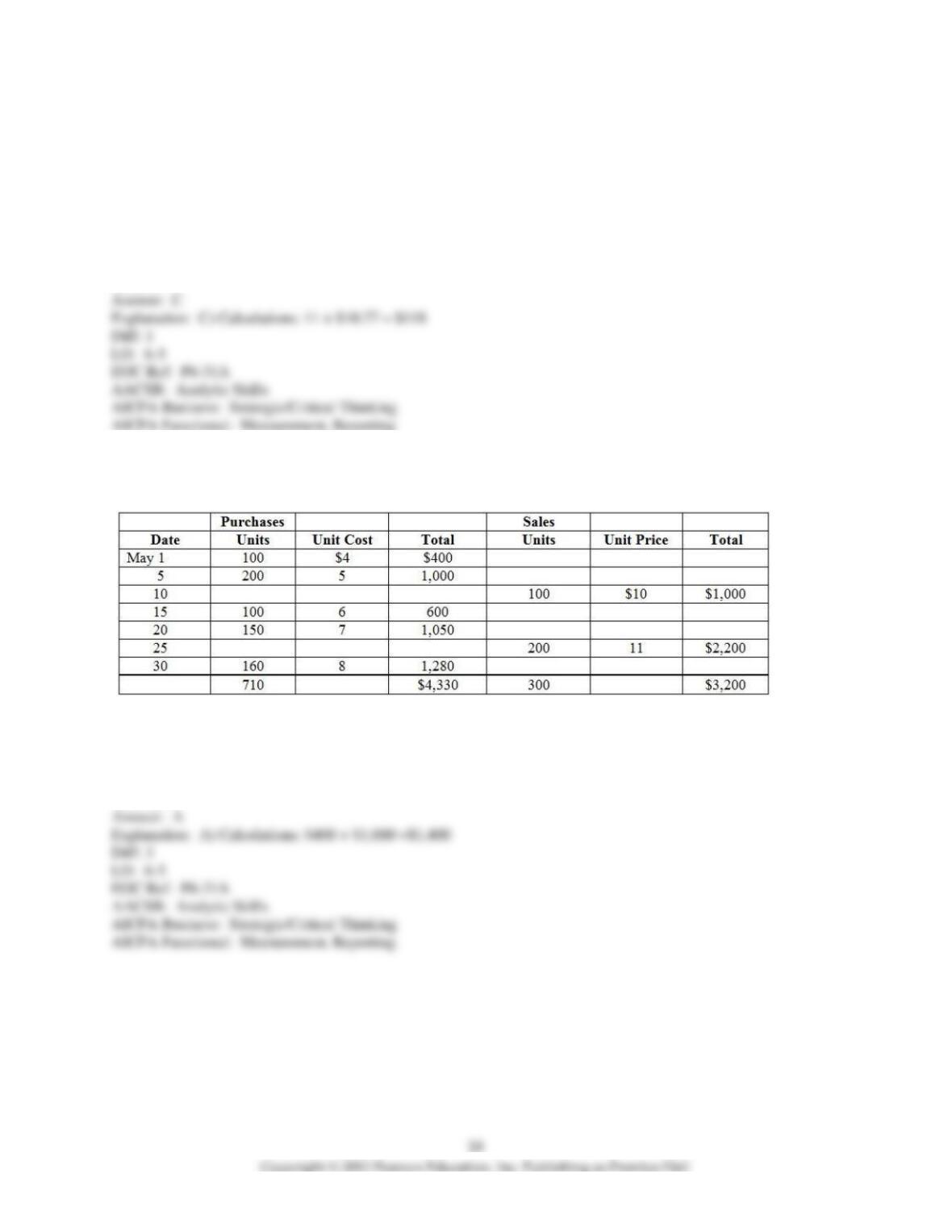
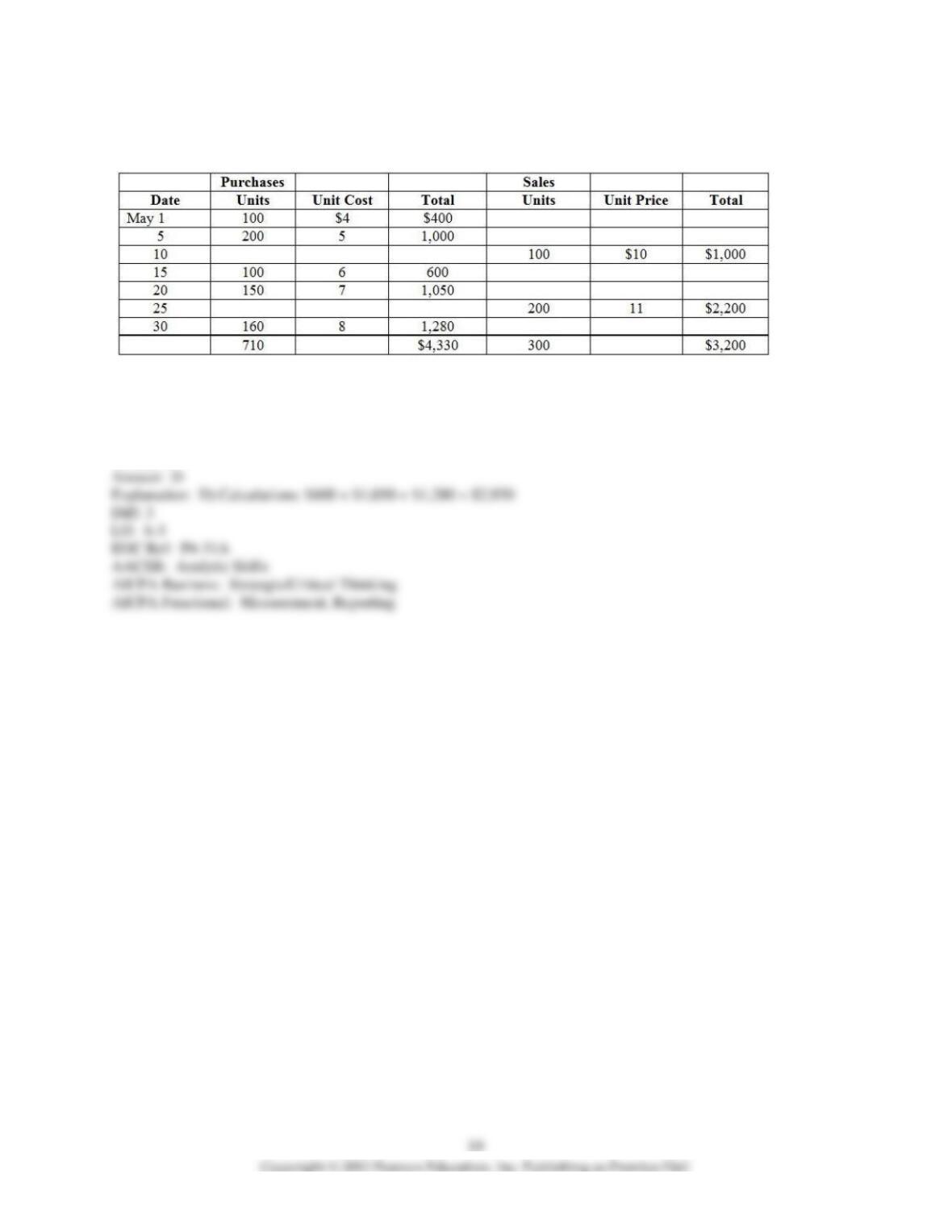
25) Santa Fe Tile Company had the following inventory purchases and sales during the month of May. The
company uses the periodic inventory method.
If Santa Fe uses FIFO costing, how much was the Cost of goods sold for the month?
A) $1,400
B) $1,520
C) $1,380
D) $1,850
26) Santa Fe Tile Company had the following inventory purchases and sales during the month of May. The
company uses the periodic inventory method.
If Santa Fe uses FIFO costing, how much was the Ending inventory balance?
A) $2.980
B) $3,120
C) $2,200
D) $2,930
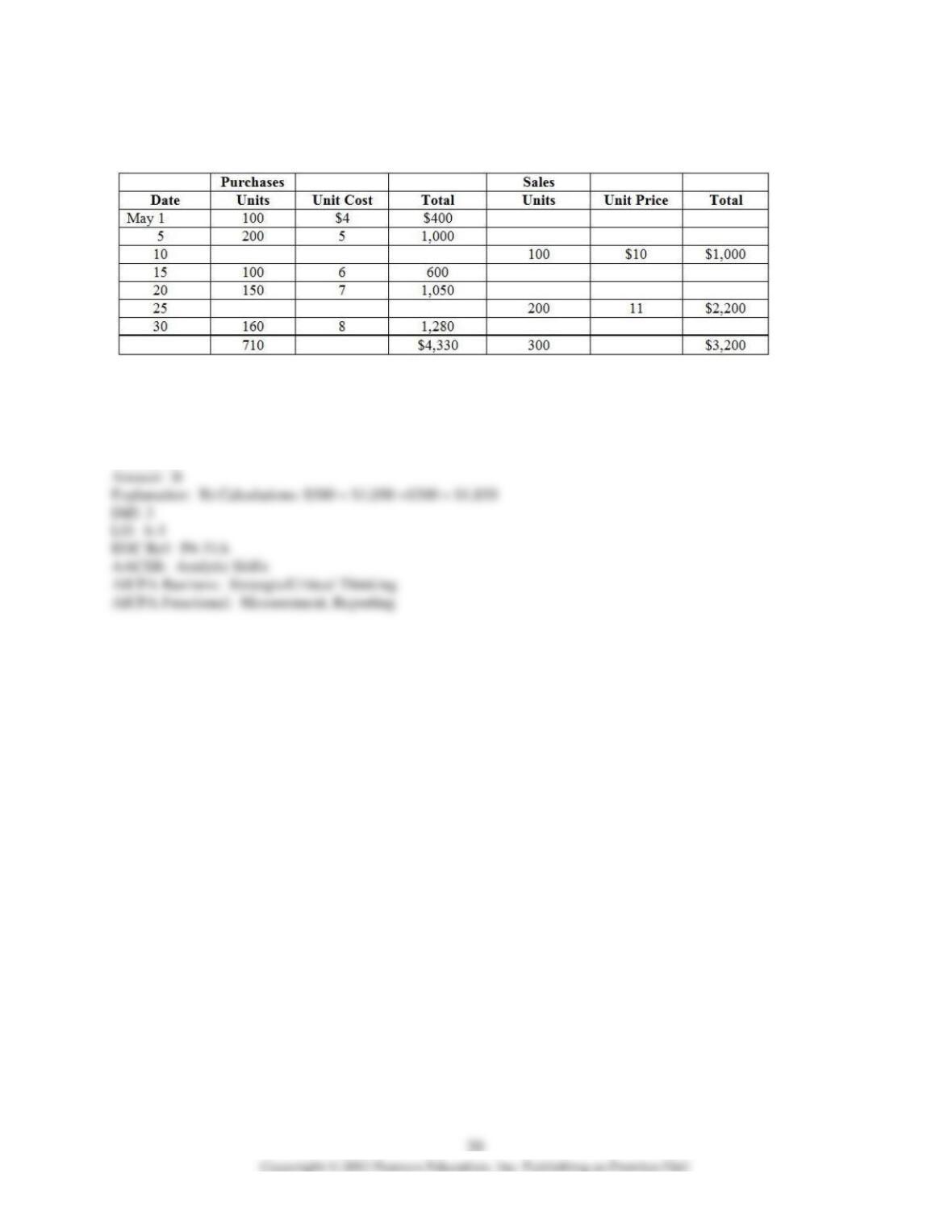
27) Santa Fe Tile Company had the following inventory purchases and sales during the month of May. The
company uses the periodic inventory method.
If Santa Fe uses LIFO costing, how much was the Cost of goods sold for the month?
A) $1,400
B) $1,850
C) $1,380
D) $1,640