1. The term “product” often refers to an organization’s output and includes both tangible
items (e.g., chair, desk, etc.) and intangible items (e.g., services provided).
2. Individual product costs are relevant for managerial decision-making but irrelevant for
preparing the financial statements.
3. One of the most common decisions facing managers is determining the price at which to
sell one of their products or to provide their services.
4. It is important that cost management systems are designed using the cost-benefit
principle so that the costs of gathering additional information are balanced against the benefits of
that information.
5. In general, indirect costs are
allocated
, while direct costs are
assigned
.
6. Cost management systems should be designed to report the same costs to each decision–
maker.
7. The only purpose of cost information is to determine the individual product cost on a per
unit basis in order to value inventory.
8. “Beginning Balance (BB) plus Transfers Out (TO) equals Ending Balance (EB) plus
Transfers In (TI)”.
9. The Transfers In (TI) costs in the basic cost flow model of a manufacturing firm are direct
materials, direct labor, and manufacturing overhead.
10. The basic cost flow model applies only to physical units and not to costs.
11. If the Beginning Balance (BB) equals the Ending Balance (EB), then the Transfers In (TI)
equal the Transfers Out (TO).
12. The predetermined overhead rate is calculated by dividing the prior period’s overhead cost
by the prior period’s allocation base (i.e., activity level).
13. Overestimating a period’s allocation base will understate the predetermined overhead
rate.
14. Regression analysis can be used to estimate the strength of the relationship between a
cost and potential allocation bases for that cost.
15. The two-stage cost allocation process allocates costs to multiple cost pools and then to
individual cost objects using different allocation bases.
16. If a company has three cost pools, it should have three
different
cost allocation bases.
17. The selection of an appropriate cost allocation base is more important for single-stage
cost allocation systems than for two-stage cost allocation systems.
18. Hospitals are more likely to use a process costing system than a job order costing
system.
19. Process costing systems do not separate and record direct material and direct labor costs
for each individual unit of product.
20. Operation costing is a hybrid system used in manufacturing goods that have some
common characteristics and some individual characteristics.

21. Which of the following statements is (are) true regarding product costing?
(A) Individual product costs are relevant for managerial decision–making but irrelevant for
preparing the financial statements.
(B) A common decision facing managers is determining the price at which to sell their products or
provide their services.

22. Which of the following statements is (are) false regarding cost allocations and product
costing?
(A) It is easier to determine the individual product cost for a manufacturer than it is for a
wholesaler.
(B) In general, indirect costs are assigned, while direct costs are allocated.
23. The Cost Flow Diagram for product costing includes all of the following costs except:
24. Which of the following statements does not reflect one of the fundamental themes
underlying the design of cost systems for managerial purposes?
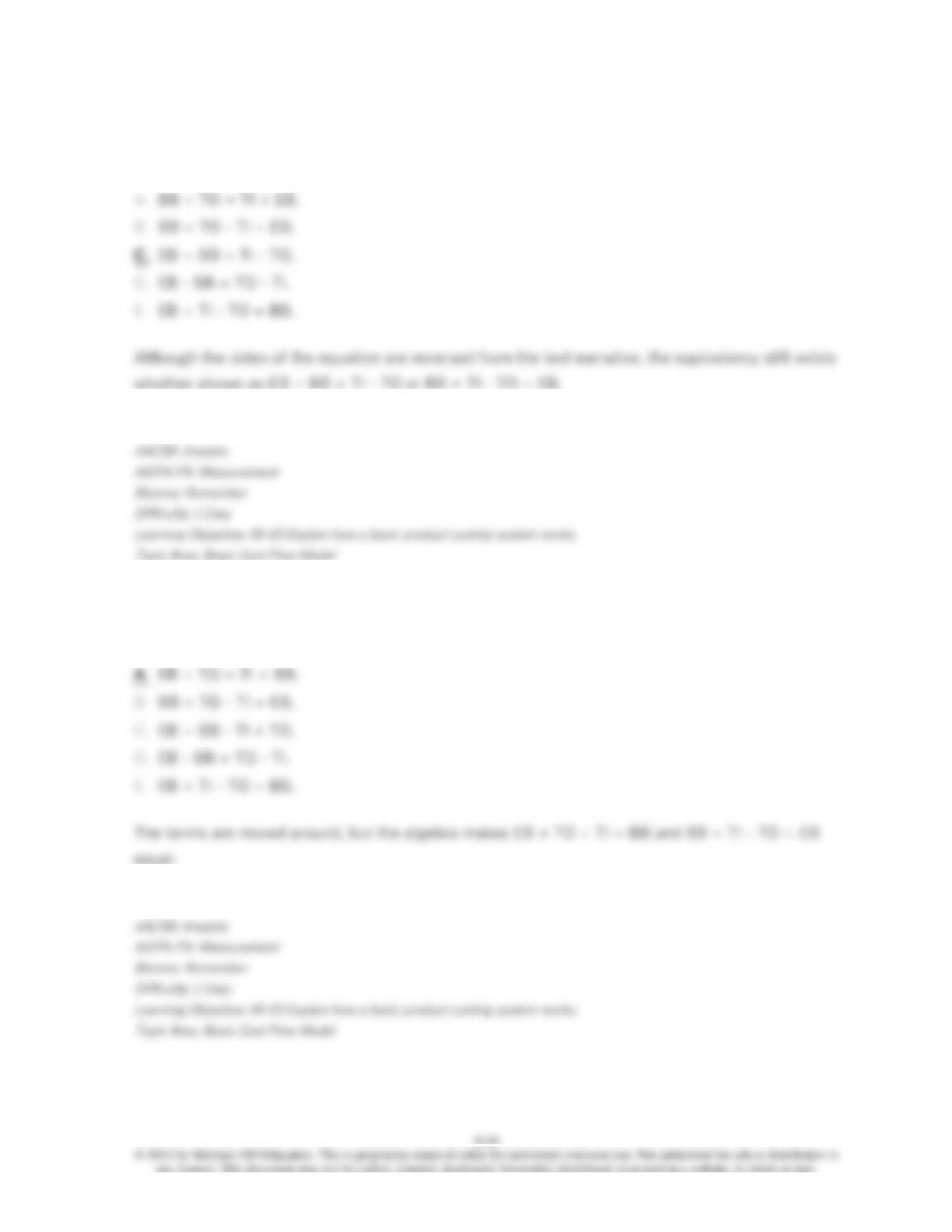
25. The basic cost flow model is:
26. The basic cost flow model is:
27. The basic cost flow model is:
28. The basic cost flow model is:
29. When a manufacturing company has a highly automated manufacturing plant producing
many different products, what is probably the most appropriate basis of applying overhead costs
to work-in-process?
30. Beal Company uses direct labor cost as a basis for computing its predetermined overhead
rate. In computing the predetermined overhead rate for 2012, the company misclassified a portion
of direct labor cost as indirect labor. The effect of this misclassification will be to:
31. In a labor intensive company in which more overhead is used by the more highly skilled
and paid employees, which activity base would be most appropriate for applying overhead to
production?
32. A company is considering the use of a single-stage cost allocation process. Under what
conditions would this choice be justified?
33. Which of the following statements regarding the two-stage cost allocation process is (are)
false?
(A) If a company has three cost pools, then it should also have three
different
cost allocation
bases.
(B) The selection of an appropriate cost allocation base is more important for single-stage cost
allocation systems than for two-stage cost allocation systems.
34. Cost pools are:
35. A system that provides information about the costs of processes, products, and services
used and produced by an organization is a:
36. The process of first allocating costs to intermediate cost pools and then to the individual
cost objects using different allocation bases is a(n):
37. A system that mass-produces a single, homogenous output in a continuous process is
a(n):
38. A hybrid costing system that is often used when manufacturing goods that have some
common characteristics plus some individual characteristics is called: