Financial Accounting, 11e (Harrison/Horngren/Thomas)
Chapter 6 Inventory & Cost of Goods Sold
1 Learning Objective 6-1
1) Cost of Goods Sold is an operating expense on the income statement.
2) Inventory is reported on the balance sheet at the selling price of the inventory still on hand.
3) Service entities report cost of goods sold on the income statement.
4) A company will include goods out on consignment in its ending inventory.
5) To document approval of purchase returns, management issues a credit memorandum meaning that
accounts payable are reduced for the amount of the return.
6) In a perpetual inventory system, a business maintains a running record of the number of units
bought, sold and on hand for each inventory item.
7) Since a perpetual inventory system continuously updates the inventory account, a physical inventory
count is not necessary to prove the inventory records.
8) A purchase discount decreases the cost of the inventory.
9) Freight in is accounted for as a delivery expense.
10) The cost of inventory shifts from asset to expense when the seller fulfills its contract with the
customer, delivers the goods to the buyer and recognizes revenue.
11) The financial statements of a merchandising company will show:
A) the same accounts as the financial statements of a service company.
B) gross profit after operating expenses on the income statement.
C) inventory as a current asset on the balance sheet.
D) cost of goods sold as a contra revenue account on the income statement.
12) The cost of the inventory that a business has sold to customers is called:
A) inventory.
B) cost of goods sold.
C) purchases.
D) gross profit.
13) The cost of inventory that is still on hand is called:
A) cost of goods sold, an expense that appears on the balance sheet.
B) inventory, a long-term asset that appears on the balance sheet.
C) inventory, a current asset that appears on the balance sheet.
D) purchases, a current asset that appears on the balance sheet.
14) Another term for gross profit is:
A) gross income.
B) gross sales.
C) gross margin.
D) gross operating income.
15) Two accounts that appear on the financial statements of a merchandising company but are not
needed by a service company are:
A) cost of goods sold and depreciation.
B) cost of goods sold and net income.
C) cost of goods sold and inventory.
D) inventory and depreciation.
16) Sales revenue is based on the ________ of the inventory, while cost of goods sold is based on the
________ of the inventory.
A) cost; sale price
B) cost; fair market value
C) sale price; retail price
D) sale price; cost
17) Which is the CORRECT order for items to appear on the income statement?
A) sales revenue, operating expenses, gross profit, net income
B) sales revenue, gross profit, net income, operating expenses
C) sales revenue, gross profit, cost of goods sold, operating expenses
D) sales revenue, cost of goods sold, gross profit, operating expenses
18) A periodic inventory system:
A) is used for inexpensive goods.
B) is not expensive to maintain.
C) does not keep a running record of inventory on hand.
D) is all of the above.
19) The inventory system that uses computer software to keep a running record of inventory on hand is
the:
A) cost of goods sold inventory system.
B) periodic inventory system.
C) perpetual inventory system.
D) hybrid inventory system.
20) Roadway Company purchases inventory from Fedway Company with the shipping terms FOB
destination. This means that:
A) Roadway Company owns the goods while they are in transit.
B) Legal title passes to Roadway Company when the goods leave Fedway’s shipping dock.
C) Fedway Company will pay the freight on this transaction.
D) Roadway Company will include the goods in their inventory as soon as they leave Fedway’s
shipping dock.
21) Under a perpetual inventory system, when a sale is made, the seller needs to prepare:
A) no journal entry.
B) one journal entry only.
C) two journal entries.
D) three journal entries.
22) How do purchase returns and allowances and purchase discounts affect gross purchases?
A) Both are added to purchases.
B) Both are subtracted from purchases.
C) Purchase returns and allowances are added to purchases; purchase discounts are subtracted from
purchases.
D) Purchase returns and allowances are subtracted from purchases; purchase discounts are added to
purchases.
23) Which of the following is NOT used to determine the cost of net purchases?
A) freight-out
B) freight-in
C) purchase returns
D) purchase discounts
24) When inventory is shipped from the seller to the buyer with shipping terms of FOB destination:
A) title passes from the seller to the buyer when the goods leave the seller’s shipping dock.
B) the goods will be included in the inventory of the buyer while in transit.
C) the seller has title to the goods while they are in transit.
D) the buyer will pay the transportation costs associated with the purchase.
25) Company A has inventory out on consignment and held for sale by Company B. Which company
will include the goods in their inventory?
A) Company A
B) Company B
C) either Company A or Company B
D) cannot be determined from the facts
26) Using a perpetual inventory system, which journal entry(ies) is(are) prepared when two units of
merchandise are sold on account?
A) debit Accounts Receivable and credit Sales Revenue only
B) debit Cash and credit Sales Revenue; debit Cost of Goods Sold and credit Inventory
C) debit Accounts Receivable and credit Sales Revenue; debit Cost of Goods Sold and credit Inventory
D) debit Accounts Receivable and credit Sales Revenue; debit Inventory and credit Cost of Goods Sold
27) A company purchased inventory for $700 per unit. The company later sold one unit of the inventory
for cash of $2400. Under the perpetual inventory system, which accounts will be debited to record the
sale?
A) Cash, $2400; Inventory, $700
B) Cash, $2400; Cost of Goods Sold, $700
C) Cash, $2400; Cost of Goods Sold, $1700
D) Cash, $2400; Inventory, $1700
28) Under a perpetual inventory system, the journal entry to record the purchase of inventory on
account will include a:
A) debit to Inventory and a credit to Cash
B) debit to Inventory and a credit to Accounts Payable
C) debit to Accounts Payable and a credit to Inventory
D) debit to Purchases and a credit to Accounts Payable
29) The selling price of a television is $1600 and the cost to the retailer is $225. What is the retailer’s gross
profit from the sale of the television?
A) $0
B) $1375
C) $225
D) $1600
30) Boston Company sells twenty items for $1100 per unit, and has a cost of goods sold percentage of
60%. The gross profit to be reported for selling 20 items is:
A) $440.
B) $8800.
C) $13,200.
D) $22,000.
31) Sanfran Company purchased inventory for $110,000. In addition they had purchase returns of $5000
and paid freight-in of $10,000. Sanfran Company’s net cost of purchases would be:
A) $95,000.
B) $105,000.
C) $115,000.
D) $125,000.
32) Grogan Company purchases inventory on account with a cost of $1300 and a retail price of $2600.
Grogan Company uses the perpetual inventory method. What journal entry is required on the date of
purchase?
A) debit Purchases for $1300 and credit Accounts Payable for $1300
B) debit Purchases for $2600 and credit Cash for $2600
C) debit Inventory for $1300 and credit Accounts Payable for $1300
D) debit Accounts Receivable for $2600 and credit Purchases for $2600
33) On June 1, Nicholson Company purchased inventory on account with a cost of $1300. Credit terms
were 2/10, net 30. On June 2, Nicholson Company returned 40 percent of the inventory. Nicholson
Company uses the perpetual inventory system. What journal entry did Nicholson Company prepare on
June 2?
A) debit Purchase Returns for $1300 and credit Accounts Payable for $1300
B) debit Cash for $1300 and credit Accounts Payable for $1300
C) debit Purchase Returns for $520 and credit Accounts Payable for $520
D) debit Accounts Payable for $520 and credit Inventory for $520
34) On July 1, Corrao Company purchased $1600 of inventory on account with credit terms of 2/10, net
30. Corrao Company uses the perpetual inventory system. On July 5, Corrao Company paid the amount
due. What journal entry did they prepare on July 5?
A) debit Accounts Receivable for $1600 and credit Cash for $1600
B) debit Accounts Payable for $1600, credit Inventory for $32 and credit Cash for $1568
C) debit Purchase Discount for $32, debit Accounts Payable for $1536 and credit Cash for $1568
D) debit Accounts Payable for $1568 and credit Cash for $1568
35) On August 1, Savage Company purchased $2200 of inventory on account with credit terms of 4/10,
net 30. Savage Company uses the perpetual inventory system. On August 15, Savage Company paid the
amount due. What journal entry did they prepare on August 15?
A) debit Inventory for $2200 and credit Accounts Payable for $2200
B) debit Accounts Payable for $2200, credit Purchase Discounts for $88 and credit Cash for $2112
C) debit Accounts Payable for $2200 and credit Cash for $2200
D) debit Accounts Payable for $2112 and credit Cash for $2112
36) On May 1, Santelle Company purchased $700 of inventory on account with credit terms of 2/10, net
30. Santelle uses the perpetual inventory system. On May 2, the seller gave Santelle a $100 allowance
due to a product defect. What journal entry did Santelle Company prepare on May 2?
A) debit Accounts Payable for $100 and credit Purchase Returns and Allowances for $100
B) debit Accounts Payable for $100 and credit Purchase Discounts for $100
C) debit Cash for $100 and credit Accounts Payable for $100
D) debit Accounts Payable for $100 and credit Inventory for $100
37) To determine the cost of goods sold, to report on the income statement, multiply the number of units
of inventory:
A) sold times the retail price per unit.
B) sold times the cost per unit.
C) purchased times the retail price per unit.
D) purchased times the cost per unit.
38) Which statement is TRUE?
A) Most businesses use the periodic inventory system.
B) The excess of sales revenue over cost of goods sold is called gross profit because operating expenses
have not yet been subtracted.
C) Most companies use the specific identification method.
D) Most companies in the United States follow International Financial Reporting Standards.
39) On June 1, Neighbor Company purchased inventory on account with a cost of $5000. The credit
terms were 2/10, net 30. On June 2, Neighbor returned 60 percent of the inventory. Neighbor uses the
perpetual inventory system. On June 8, Neighbor paid for the inventory. What journal entry did
Neighbor Company prepare on June 8?
A) debit Purchase Discount for $40, debit Cash for $1960 and credit Accounts Payable for $2000
B) debit Accounts Payable for $3000 and credit Cash for $3000
C) debit Accounts Payable for $2000 credit Purchase Discount for $40 and credit Cash for $1960
D) debit Accounts Payable for $2000, credit Inventory for $40 and credit Cash for $1960

12
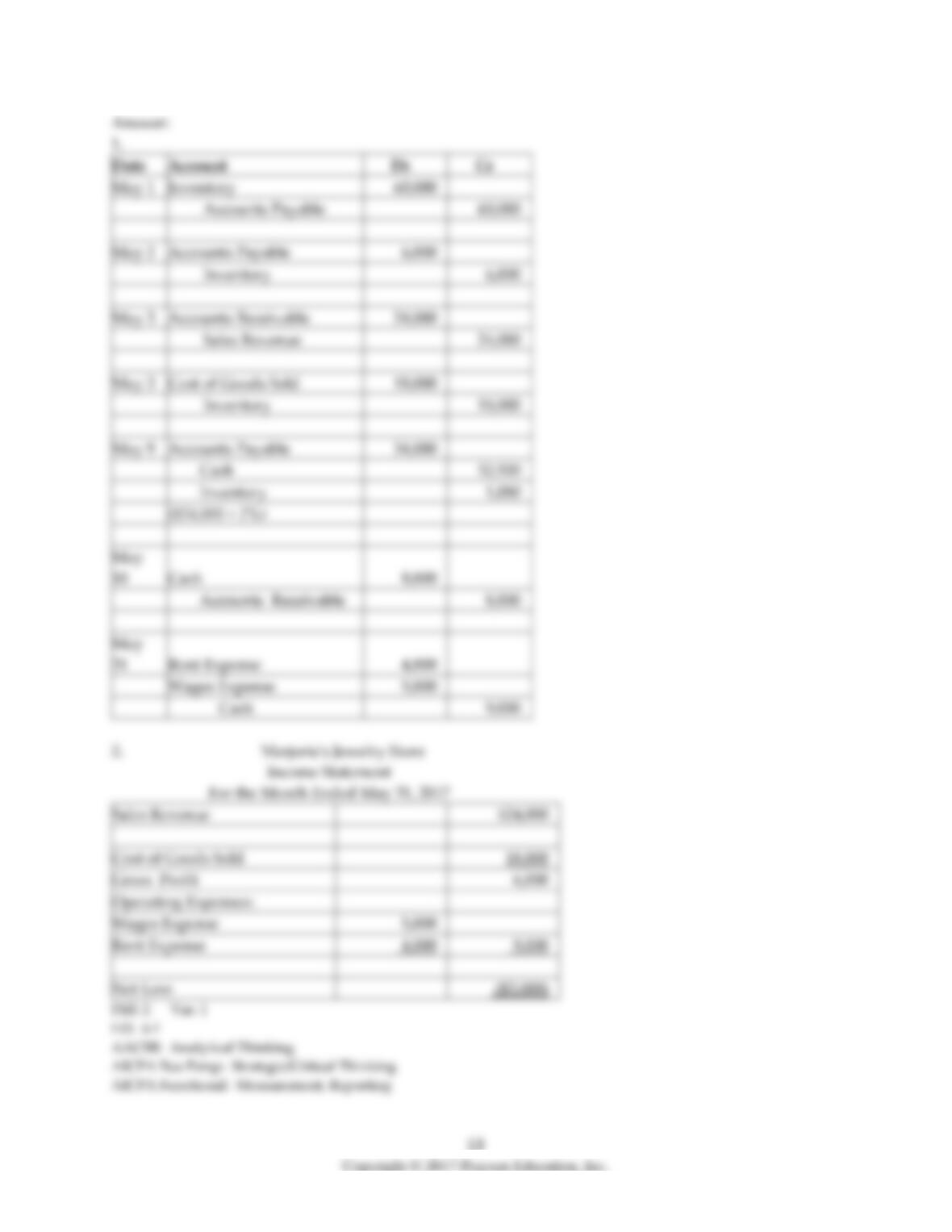
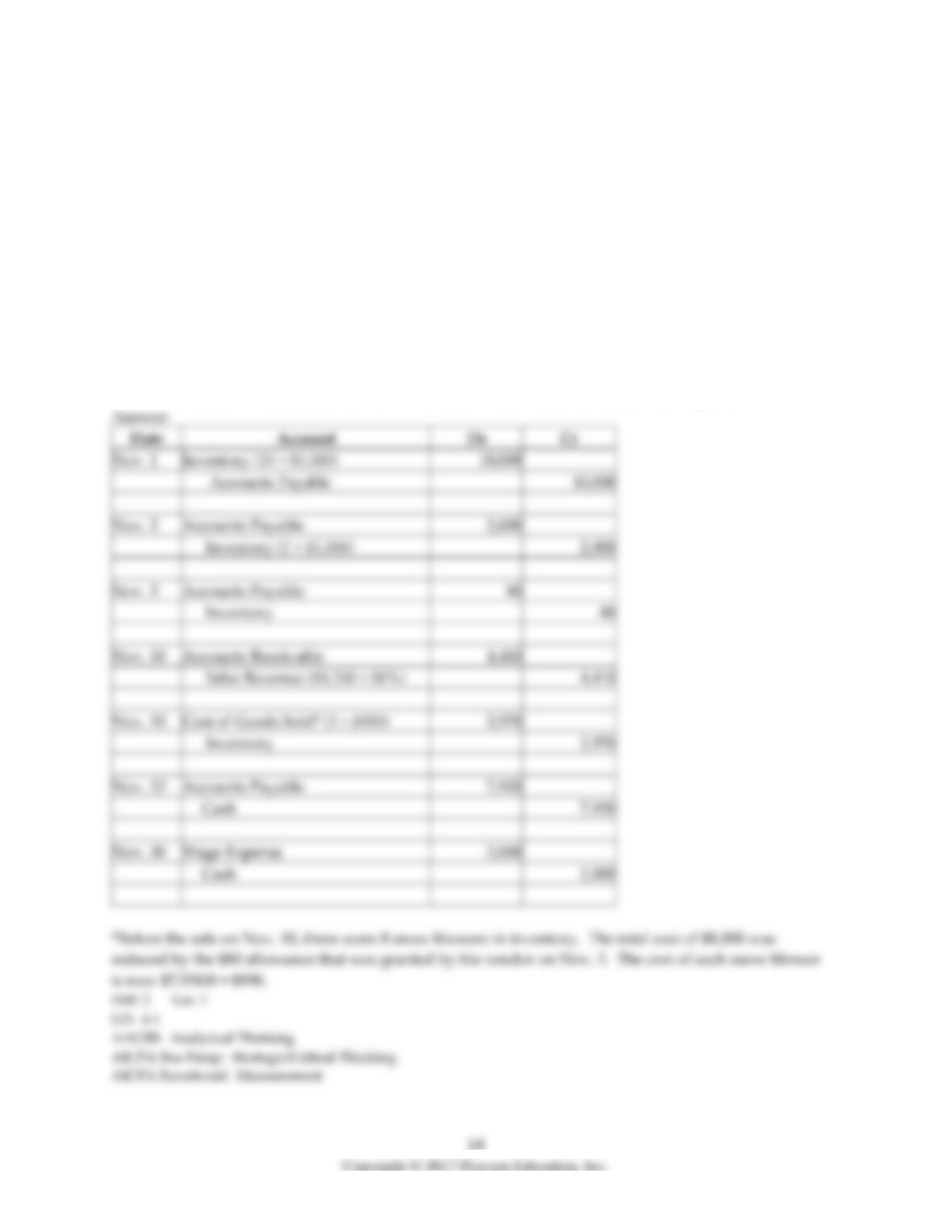
40) In 2017, the following transactions occurred for Marjorie’s Jewelry Store:
A. On May 1, the business purchased 10 rings on account at $6,000 each. Credit terms were 2/10, net/30.
B. On May 2, the business returned one ring because of a defect.
C. On May 3, three of the rings were sold on account at $8,000 each, to one customer. Credit terms were
n/30. No sales returns were expected.
D. On May 9, the accounts payable was paid in full.
E. On May 10, the customer paid for one ring sold on May 3.
F. On May 31, the business paid rent of $4,000 for the month of May and wages of $5,000.
Required:
1. Journalize the above transactions for Marjorie’s Jewelry Store. The store uses the perpetual inventory
system. Explanations are not required.
2. Prepare the income statement for the month ending May 31, 2017. Use the multistep format and
ignore taxes.
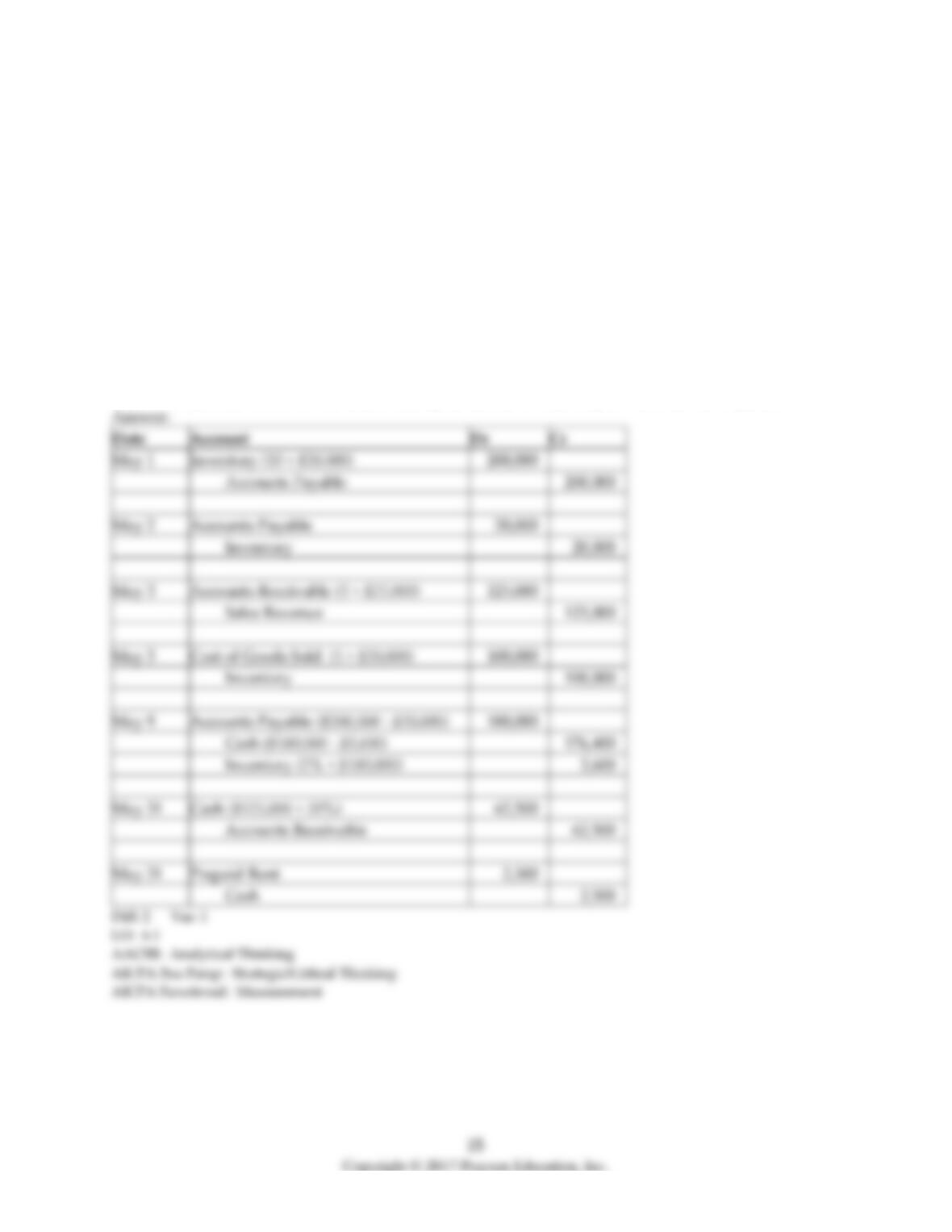
41) Steve’s Hardware Store uses the perpetual inventory system. The business incurred the following
transactions:
A. On November 1, 10 snow blowers were purchased on account at $1,000 each. Credit terms were 2/10,
net 30.
B. On November 2, the business returned two snow blowers due to damage incurred in shipping.
C. On November 3, the supplier granted Steve’s Hardware an allowance of $80 because one of the snow
blowers was missing an attachment.
D. On November 10, the business sold three of the snow blowers on account at $1,500 each. The credit
terms were 2/10, net 30. No sales returns are expected.
E. On November 12, the business paid for the snow blowers.
F. On November 30, business paid wages of $2,000.
Required:
Journalize the above transactions for Steve’s Hardware Store. Explanations are not required.
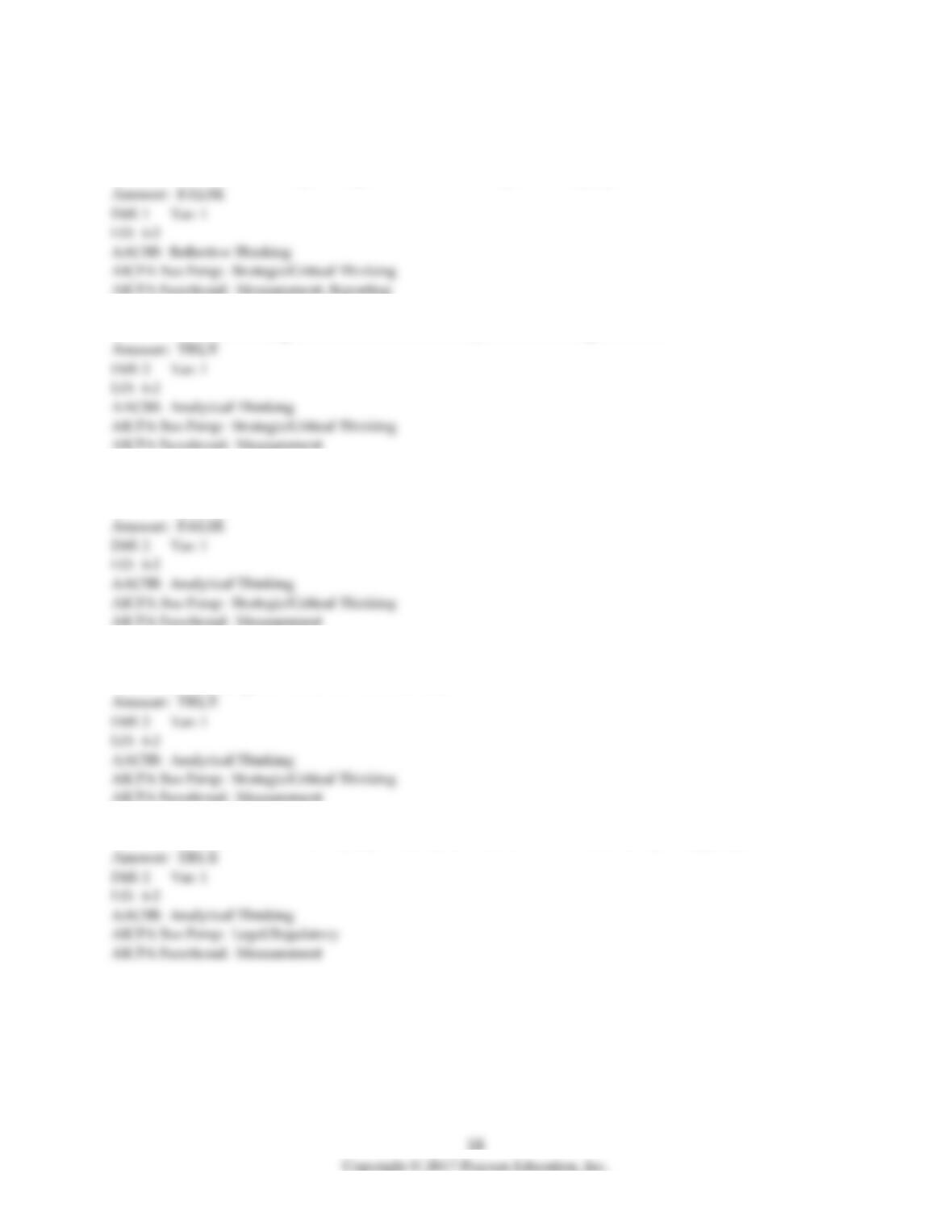
42) An auto dealer uses a perpetual inventory system. The dealer incurred the following transactions
during the month of May:
1. On May 1, the dealer purchased 10 vehicles on account at $20,000 each, with credit terms of 2/10, net
30.
2. On May 2, the dealer returned one vehicle due to a product defect.
3. On May 3, the dealer sold 5 vehicles for $25,000 each on account. The credit terms are n/30. No sales
returns are expected.
4. On May 9, the dealer paid for the vehicles purchased less the return on May 2.
5. On May 31, the dealer collected one-half of the amount due from the May 3 sale.
6. On May 31, the dealer paid the rent for the next month of $2,500.
Required:
Prepare the journal entries for the dealer during the month of May. Explanations are not required.
2 Learning Objective 6-2
1) The choice of an inventory costing method does not impact a company’s balance sheet.
2) The LIFO method assigns the most recent inventory cost to cost of goods sold.
3) The average cost per unit is calculated as the cost of goods available for sale divided by the number of
units sold.
4) The inventory cost under the average cost per unit method will generally fall in between the
inventory cost using the LIFO and FIFO methods.
5) If a company uses LIFO for tax purposes, they must use LIFO for financial reporting purposes.
6) When inventory costs are rising, a company using the LIFO costing method will generally pay less
taxes than if the company had been using the FIFO method.
7) When inventory costs are rising, FIFO allows managers to manipulate net income by timing the
purchases of inventory.
8) All of the following costs would be included in the cost of inventory EXCEPT for:
A) insurance while in transit from seller.
B) costs to get inventory ready for sale.
C) taxes paid on the purchase price.
D) sales commission paid to salesperson when the inventory is sold.
9) ABC Furniture Unlimited sells antique furniture. ABC will most likely use the ________ method to
cost its ending inventory.
A) First-in, first-out
B) Last-in, first-out
C) Specific-unit-cost
D) Average
10) The inventory method used by a company affects:
A) net income on the income statement.
B) the income taxes to be paid.
C) the ending inventory on the balance sheet.
D) all of the above.
11) To determine the cost of ending inventory using the LIFO method:
A) the latest purchase costs are used.
B) the specific unit cost of the inventory is used.
C) the average cost of the inventory is used.
D) the beginning inventory and earliest purchase costs are used.
12) Under the average-cost inventory method, to determine the average cost per unit:
A) the cost of beginning inventory is divided by the number of units available.
B) the cost of beginning inventory plus the cost of purchases is divided by the number of units sold.
C) the cost of purchases for the period are divided by the number of units available.
D) the cost of beginning inventory plus the cost of purchases is divided by the number of units
available.
13) When inventory costs are increasing, the FIFO costing method will generally yield a cost of goods
sold that is:
A) higher than cost of goods sold under the LIFO method.
B) lower than cost of goods sold under the LIFO method.
C) equal to the gross profit under the LIFO method.
D) equal to cost of goods sold under the LIFO method.
14) Under the ________ method, ending inventory is based on the costs of the most recent purchases.
A) average-cost
B) FIFO
C) LIFO
D) specific-identification
15) When inventory costs are decreasing, the LIFO costing method will generally result in:
A) a higher gross profit than under FIFO.
B) a lower gross profit than under FIFO.
C) a lower inventory value than under FIFO.
D) the same inventory value as FIFO.
16) When comparing the results of LIFO and FIFO when inventory costs are decreasing:
A) cost of goods sold will be lower using FIFO.
B) ending inventory will be higher using FIFO.
C) cost of goods sold will be higher using LIFO.
D) ending inventory will be higher using LIFO.
17) The use of the FIFO method generally increases taxable income:
A) when inventory costs are constant.
B) when inventory costs are declining.
C) when inventory costs are increasing.
D) under all circumstances.
18) If inventory costs are rising and a company is using LIFO, large purchases of inventory near the end
of the year will:
A) increase income taxes paid.
B) decrease income taxes paid.
C) not change the amount of income taxes paid.
D) cannot be determined.
19) When comparing the FIFO and LIFO inventory methods:
A) LIFO reports inventory at net realizable value.
B) LIFO reports the most up–to-date inventory cost on the balance sheet.
C) FIFO results in the most realistic net income figure.
D) FIFO matches old inventory costs against revenue.
20) A LIFO liquidation occurs when ________ fall(s) below the ending inventory quantities in the
previous period.
A) beginning inventory quantities
B) ending inventory quantities
C) beginning inventory costs
D) ending inventory retail value