Financial Accounting: IFRS, 11e, GE
Harrison/Horngren/Thomas/Tietz/Suwardy
Test Item File
Chapter 6: Inventory and Merchandising Operations
6.1-1 The merchandise inventory is reported as an asset until it is sold.
6.1-2 Inventory is presented on the balance sheet at the selling price of the item.
6.1-3 In a merchandising business, gross profit is the sum of sales revenue and the cost of goods sold.
6.1-4 Only freight-out costs associated with merchandise inventory are included in cost of goods sold.
6.1-5 The cost of the inventory is the net amount of the purchases.
6.1-6 Purchase returns and allowances and purchase discounts reduce the cost of goods sold.
6.1-7 A purchase return is a decrease in the cost of purchases because the purchaser returned goods to the
supplier.
6.1-8 In a perpetual inventory system, businesses maintain a continuous record for each inventory item.
6.1-9 As a perpetual inventory system continuously updates the inventory account, a physical inventory count
is not necessary to prove the inventory records.
6.1-10 The number of inventory units on hand during the year may be determined from the accounting records
under a perpetual inventory system; therefore, using this method, it is never necessary to count inventory
at the end of the year.
6.1-11 When a sale is made under the perpetual inventory system, there is no entry to cost of goods sold.
6.1-12 Under the perpetual inventory system, inventory shifts from an asset to an expense when the seller
delivers the goods to the buyer.
6.1-13 To record the cost of inventory sold under a perpetual inventory, a debit to Cost of Goods Sold and a
credit to Inventory is required.
6.1-14 The largest expense on the income statement for most merchandising companies is:
A) administrative expenses.
B) selling expenses.
C) cost of goods sold.
D) other expenses.
6.1-15 In a merchandising company’s income statement, which of the following would NOT be included in the
Cost of Goods Sold calculation?
A) Shipping costs from the manufacturer to the merchandiser
B) Sales commissions
C) Returns of inventory purchases
D) Sales taxes on inventory purchases, as shown on the invoices
6.1-16 The cost of the inventory that the business has sold to customers is called:
A) Inventory.
B) Cost of Goods Sold.
C) Purchases.
D) Gross Profit.
6.1-17 The cost of inventory that is still on hand and has NOT been sold to customers is called:
A) cost of goods sold, and it appears on the balance sheet.
B) inventory, a current asset that appears on the income statement.
C) inventory, a current asset that appears on the balance sheet.
D) cost of goods sold, and it appears on the income statement.
6.1-18 In a merchandising business, gross profit is equal to sales revenue minus:
A) cost of goods sold, operating expenses and prepaid expenses combined.
B) cost of goods sold and operating expenses combined.
C) cost of goods sold only.
D) cost of goods sold and sales commissions combined.
6.1-19 Two accounts that would appear on the financial statements of a merchandising company that are not
needed by a service company are:
A) cost of goods sold and depreciation.
B) cost of goods sold and net income.
C) cost of goods sold and inventory.
D) inventory and depreciation.
6.1-20 Sales revenue is based on the _________ price of the inventory, while cost of goods sold is based on the
__________ of the inventory.
A) cost, sales
B) cost, cost
C) sales, sales
D) sales, cost
6.1-21 On the income statement, after a company computes gross profit, it subtracts:
A) cost of goods sold.
B) inventory.
C) operating expenses.
D) all of the above.
6.2-1The two main types of inventory accounting systems are:
A) cost of goods sold and gross profit.
B) perpetual and periodic.
C) perpetual and continuous.
D) none of the above.
6.2-2 A periodic inventory system:
A) is used for inexpensive goods.
B) is not expensive to maintain.
C) does not keep a running record of inventory on hand.
D) is all of the above.
6.2-3 The inventory system that uses computer software to keep a running record of inventory on hand is the:
A) cost of goods sold inventory system.
B) periodic inventory system.
C) perpetual inventory system.
D) hybrid inventory system.
6.2-4 The inventory system that does not keep a running record of all goods bought, sold, and on hand and—
therefore—must take a physical count of the inventory on hand to determine the ending inventory is:
A) the cost of goods sold inventory system.
B) the periodic inventory system.
C) the perpetual inventory system.
D) all of the above.
6.2-5 A perpetual inventory system offers which of the following advantages?
A) Inventory balances have to be counted to be accurate.
B) This system is used for inexpensive goods.
C) This system is more expensive than a periodic system.
D) This system helps to determine if there is a sufficient supply of inventory on hand to fill customer
orders, just by reviewing the inventory records.
6.2-6 Under a perpetual inventory system, when a sale is made:
A) the company makes a journal entry to record the sale only.
B) the company makes a journal entry to record only the cost of goods sold.
C) the company makes a journal entry to record the sale and the cost of goods sold.
D) no journal entry needs to be made.
6.2-7 How do purchase returns and allowances and purchase discounts affect net purchases?
A) Both are added to purchases.
B) Both are subtracted from purchases.
C) Purchase returns and allowances are added to purchases; purchase discounts are subtracted from
purchases.
D) Purchase returns and allowances are subtracted from purchases; purchase discounts are added to
purchases.
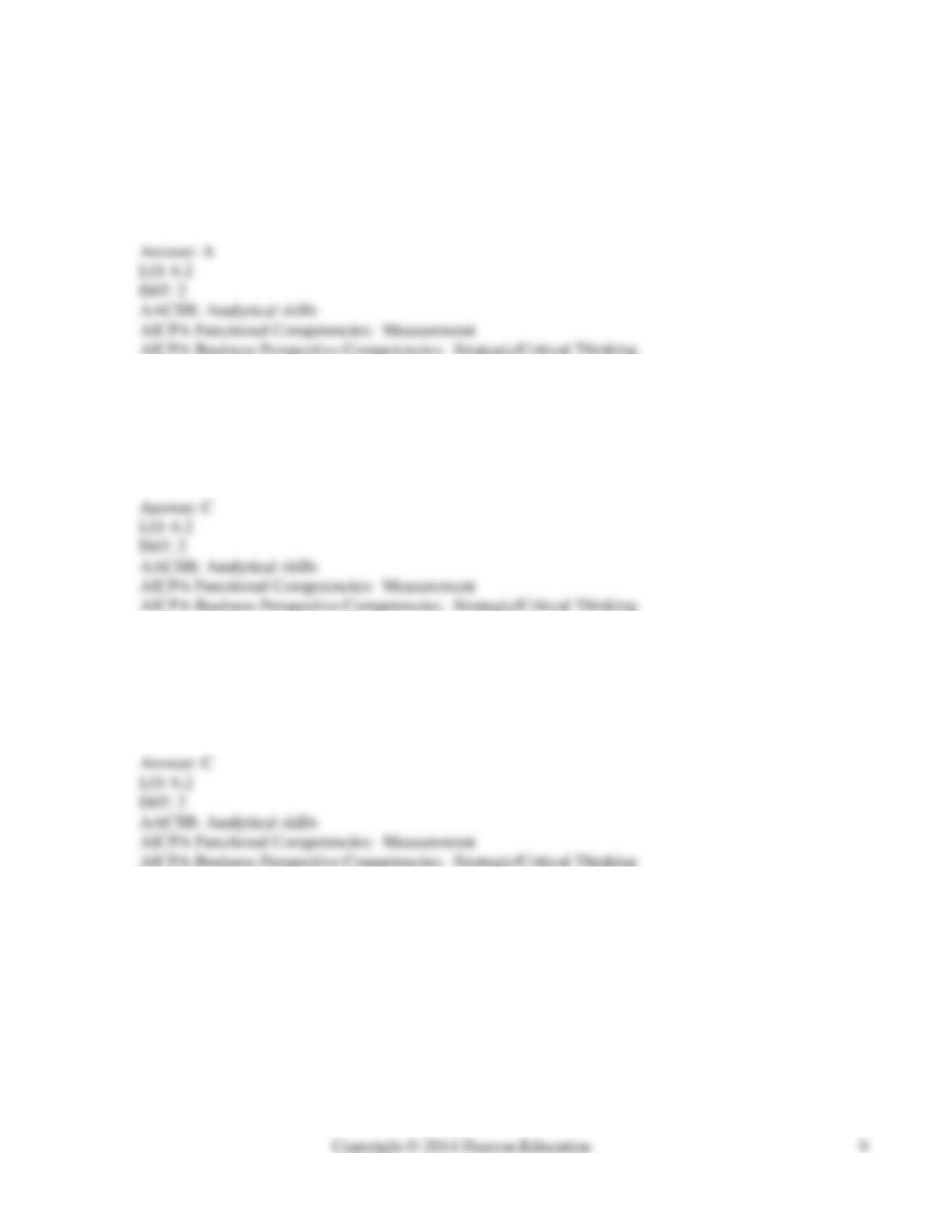
6.2-8 Exter Co. receives terms of 2/10, n/30 on all invoices from Garn Industries. On January 15, 2011, Exter
purchased items from Garn for $4,200, excluding taxes and shipping costs. What amount would Exter
use as the purchase discount if the invoice was paid on January 28, 2011?
A) $ 0
B) $ 84
C) $4,116
D) $4,200
6.2-9 What is the formula used to calculate net purchases?
A) Purchases less Purchase Returns and Allowances plus Purchase Discounts less freight–in
B) Purchases plus Purchase Returns and Allowances less Purchase Discounts plus freight–in
C) Purchases less Purchase Returns and Allowances less Purchase Discounts plus freight-in
D) Beginning Inventory less Purchases
6.2-10 Unlike the periodic inventory system, the perpetual inventory system:
A) does not require a physical count of the ending inventory.
B) includes only the inventory purchased for cash.
C) provides a continuous record of inventory on hand.
D) is not required by GAAP.
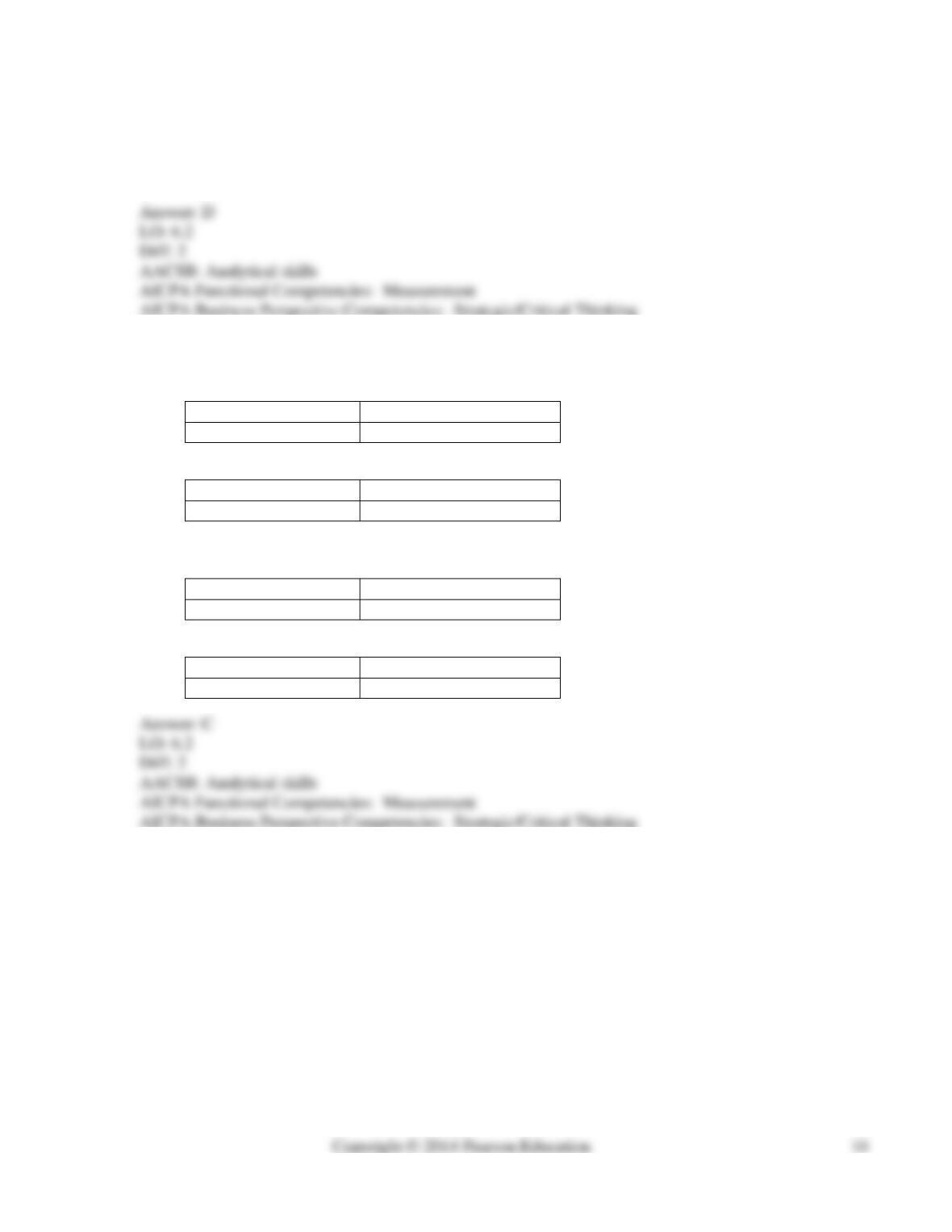
6.2-11 A company using a perpetual inventory system will use which of the following accounts?
A) Cost of Goods Purchases
B) Inventory Returns
C) Purchases
D) Inventory
6.2-12Using a perpetual inventory system, which of the following entries would record the cost of merchandise
sold on credit?
A)
B)
C)
D)
Sales Discounts
Accounts Payable
Cost of Goods Sold
Purchase Discounts
Cost of Goods Sold
Inventory
Inventory
Cost of Goods Sold
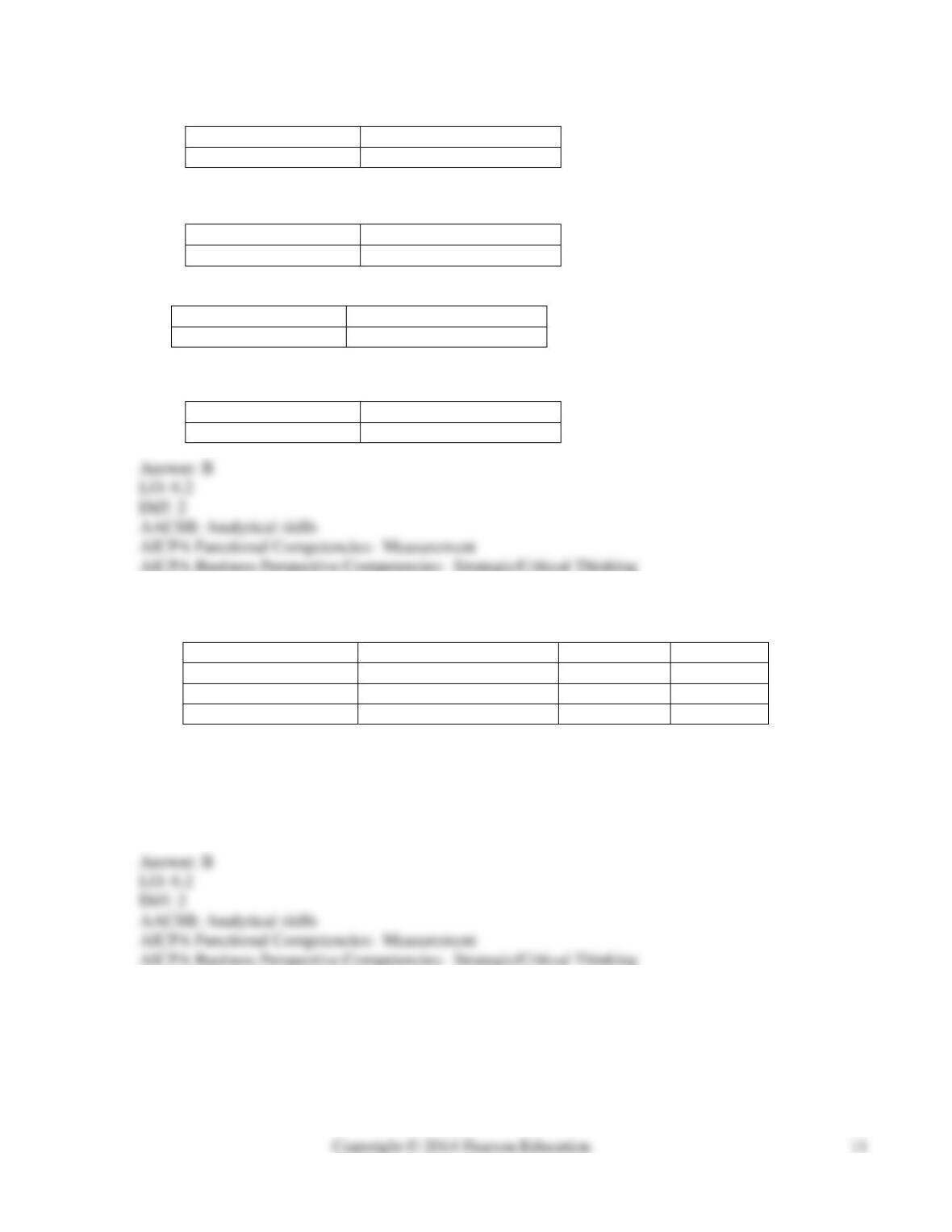
6.2-13 Under a perpetual inventory system, which of the following entries would record the purchase of
merchandise on credit?
A)
B)
C)
D)
6.2-14On July 16, 2011, Martson and Co. made the following journal entry:
Martson and Co. is using the _________ Inventory system.
A) Periodic
B) Perpetual
C) FIFO
D) LIFO
Purchases
Accounts Payable
Inventory
Accounts Payable
Purchases
Cost of Goods Sold
Sales
Accounts Receivable
Accounts Receivable
25,000
Sales Revenue
25,000
Cost of Goods Sold
10,000
Inventory
10,000
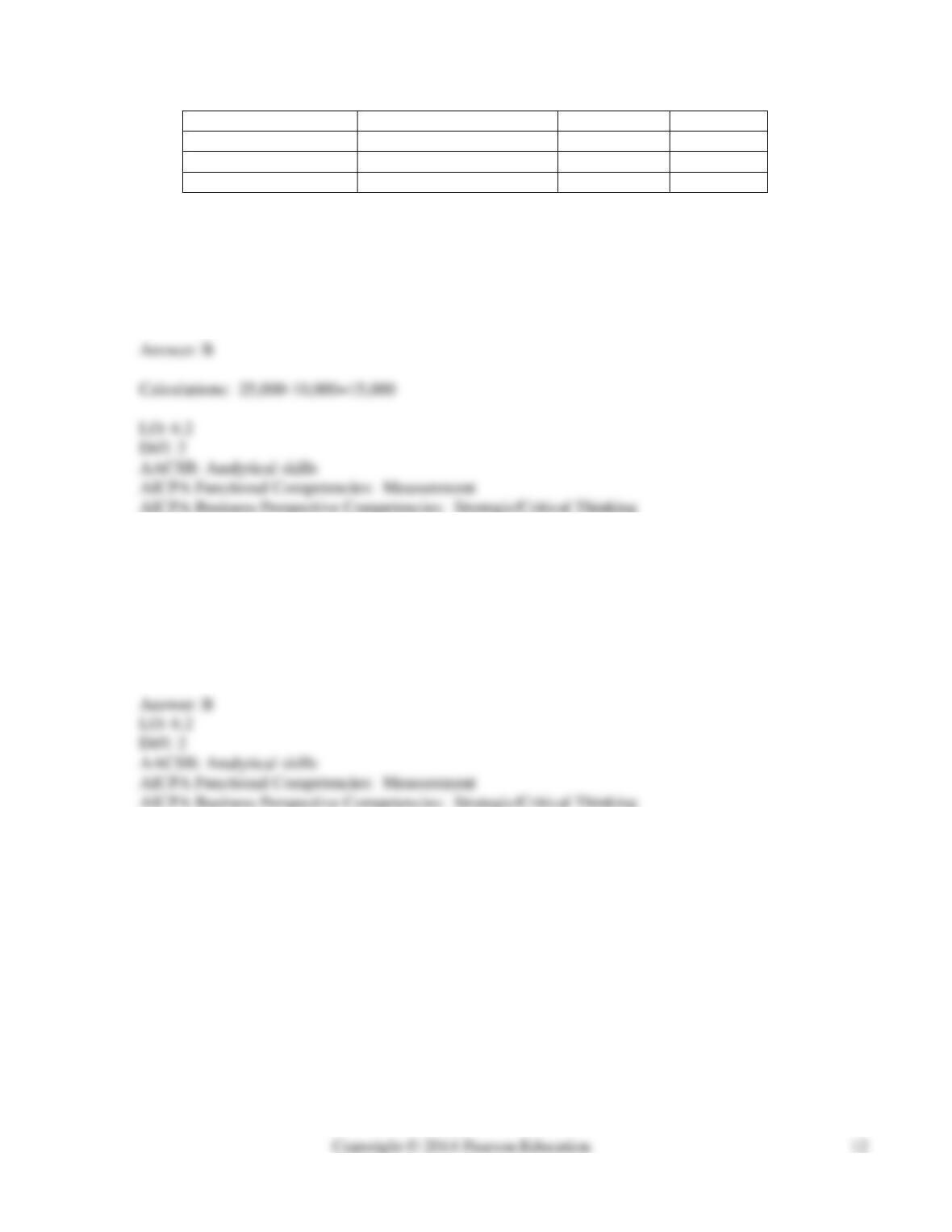
6.2-15 On July 16, 2011, Martson and Co. made the following journal entry:
What is the Gross Profit from this sale?
A) $10,000
B) $15,000
C) $25,000
D) $ 0
6.2-16 A company purchased inventory for $800 per unit. The inventory was marked up to sell for $1,000 per
unit. The entries to record the sale for cash and the cost of a unit of inventory would include debits to
which of the following accounts?
A) Sales, $1,000; Inventory, $800
B) Cash, $1,000; Cost of Goods Sold, $800
C) Cash, $800; Cost of Goods Sold, $1,000
D) Sales, $800; Inventory, $800
Accounts Receivable
25,000
Sales Revenue
25,000
Cost of Goods Sold
10,000
Inventory
10,000
6.2-17BMX Co. sells item XJ15 for $1,000 per unit, and has a cost of goods sold percentage of 80%. The gross
profit to be found for selling 20 items:
A) is $20,000.
B) is $16,000.
C) is $ 4,000.
D) cannot be calculated with a cost of goods sold percentage greater than 50%.
6.2-18A company purchased merchandise inventory on credit for $600 per unit, and later sold the inventory for
$800 per unit. The journal entry to record the purchase of inventory included a debit to:
A) Accounts Receivable.
B) Inventory.
C) Accounts Payable.
D) Cost of Goods Sold.
6.2-19Which of the following is added to the purchase price of the inventory to determine net purchases?
A) Freight-out
B) Freight-in
C) Purchase returns
D) Purchase discounts
6.2-20 Which of the following are subtracted from the purchase price of the inventory to determine net
purchases?
A) Freight-out and freight-in
B) Purchase returns, purchase allowances and freight-in
C) Purchase returns, purchase allowances, and purchase discounts
D) None of the above
6.2-21Net sales is computed as:
A) sales revenue less freight-out.
B) sales revenue less sales returns and allowances plus sales discounts.
C) sales less cost of goods sold.
D) sales revenue less sales returns and allowances less sales discounts.
6.2-22 Bonz, Inc. is using a perpetual inventory system with a December 31 year end date. The balance in this
company’s inventory account as of September 30 would be equal to:
A) beginning inventory as of January 01.
B) beginning inventory as of January 01 plus all purchases from the beginning of the year through
September 30, less all items sold from the beginning of the year through September 30.
C) beginning inventory as of January 01 plus all purchases from the beginning of the year through
September 30.
D) all purchases from the beginning of the year through September 30.
6.2-23A company purchased 400 units at $75 per unit. The company sold 385 units. What is the cost of goods
sold and ending inventory?
A)
B)
C)
D)
.
6.3-1 The choice of an inventory costing method has no significant impact on the company’s income statement
and balance sheet.
Cost of Goods Sold
Ending Inventory
$10,000
$ 9,625
Cost of Goods Sold
Ending Inventory
$40,000
$28,875
Cost of Goods Sold
Ending Inventory
$28,875
$ 1,125
Cost of Goods Sold
Ending Inventory
$28,875
$10,000
6.3-2 The specific unit cost method is preferred by accountants because it is easy to use and fairly accurate.
6.3-3 The FIFO method assigns the most recent inventory cost to expense.
6.3-4 The ending inventory using the LIFO costing method reports the oldest inventory costs.
6.3-5 The weighted-average cost per unit is calculated as the cost of goods sold divided by the number of units
actually sold.
6.3-6 The inventory cost under the average cost per unit method will generally fall in between the inventory
costs using the LIFO and FIFO methods.
6.3-7 In a period of increasing prices, LIFO generally results in a lower tax liability.
6.3-8 When prices are rising, a company using the FIFO costing method will generally pay less taxes than if the
company had been using the LIFO method.
6.3-9 A LIFO liquidation occurs when the inventory prices fall below prices of the previous period.
6.3-10 Companies may choose to determine the cost of goods sold using the lower-of-cost-or-net-realisable-
value rule.
6.3-11 When applying the lower-of-cost-or– net-realisable-value rules to beginning inventory valuation, market
value generally refers to the cost at which the company can sell a unit of inventory.
6.3-12 Using the lower-of-cost-or- net-realisable-value rule to value ending inventory complies with the ongoing
principles of accounting.
6.3-13 Adjusting entries for inventory are required under the perpetual inventory system.
6.3-14 Under the disclosure principle, the inventory accounting method must be disclosed.
6.3-15 The cost of inventory is the:
A) purchase price.
B) sum of all the costs incurred to bring the inventory to its intended use.
C) sum of all the costs incurred to bring the inventory to its intended use, plus any discounts and
allowances.
D) sum of all the costs incurred to bring the inventory to its intended use, less any discounts and
allowances.
6.3-16 The cost of inventory includes the:
A) purchase price, advertising costs and sales commissions.
B) purchases price, freight-in and sales taxes paid on the purchase.
C) purchase price, advertising costs and insurance while in transit.
D) purchase price, delivery costs and sales commissions.
6.3-17 A company whose inventory consists of very unique items would probably use which inventory method?
A) First-in, first-out
B) Last-in, first-out
C) Specific-unit-cost
D) Weighted-average of only the unique items
6.3-18 The inventory cost method based on the particular cost of certain units of inventory is the:
A) first-in, first-out method.
B) last-in, first-out method.
C) specific-unit-cost method.
D) weighted-average method.
6.3-19 The choice of an inventory costing method will affect:
A) the ending inventory.
B) the cost of goods sold.
C) the ending inventory and cost of goods sold.
D) none of the above.
6.3-20 Deciding on which inventory method a company should use affects:
A) the profits to be reported.
B) the income taxes to be paid.
C) the values of ratios reported from the balance sheet.
D) all of the above.
6.3-21 When the FIFO method is used, ending inventory is assumed to consist of the:
A) units with the lowest per unit cost.
B) units with the highest per unit cost.
C) oldest units.
D) most recently purchased units.