79) Which of the following would not be included on an income statement?
A) Accumulated depreciation.
B) Insurance expense.
C) Cost of goods sold.
D) Discontinued operations.
80) Which of the following is true?
A) Income from operations would increase other income.
B) Income before income taxes would be shown as a component of operating income on the
income statement.
C) Gains and losses on the sales of investments are included in nonoperating income (loss).
D) Income tax expense is shown as part of operating expenses.
81) Farrell Company has rent expense, wages expense, and utilities expense. Where will the
company present these expenses on the income statement?
A) As a component of net sales.
B) As a component of gross profit.
C) After income from operations.
D) Prior to income from operations.
82) Which of the following statements regarding international financial reporting standards
(IFRS) is false?
A) Common stock is titled as share capital.
B) Property, plant, and equipment can be reported on the balance sheet at either fair value or
historical cost.
C) The last-in first-out (LIFO) inventory method is permitted.
D) Development costs are capitalized.
83) Which of the following statements does not accurately describe the effect of the sale of
inventory at a profit on the financial statements?
A) Income from operations and current assets both increase.
B) Operating income and gross profit both increase.
C) Net income and earnings per share both increase.
D) Current assets do not change and stockholders’ equity increases.
84) Which of the following statements regarding international financial reporting standards
(IFRS) is false?
A) Research and development costs are expensed.
B) Paid-in capital is titled share premium.
C) Cash payments for interest are reported on the cash flow statement as either an operating or
financing cash flow.
D) Reversal of inventory write-downs is required.
85) Which of the following would not be included within the operating activities section of a
cash flow statement?
A) Cash received from customers.
B) Cash paid for insurance.
C) Cash paid for interest expense.
D) Cash paid to acquire a patent.
86) Which of the following would be reported in the supplemental cash flows disclosure section
of the statement of cash flows?
A) Sales on account which have not yet been collected.
B) Net income.
C) Cash paid for income taxes.
D) Depreciation expense.
87) Which of the following statements is correct?
A) Accumulated depreciation is the amount of depreciation on the income statement.
B) Current liabilities are debts expected to be paid within one year.
C) Current assets are resources of a company that might include cash and copyrights.
D) Patents, goodwill, and deferred revenues are classified as intangible assets on the balance
sheet.
88) Which of the following statements is false?
A) Gross profit percentage is calculated as gross profit divided by net sales.
B) Gross profit percentage should only be viewed for each reporting company and is not useful
in comparing different companies in the same industry.
C) Gross profit is calculated as net sales less cost of sales.
D) A higher gross profit might be strategic in order to afford high research and development
costs.
89) On January 1, 2019, Gucci Brothers Inc. had a $500,000 credit balance in retained earnings
and $600,000 balance in common stock. During 2019, the company earned net income of
$100,000, declared a dividend of $15,000, and issued additional stock for $25,000. What is total
stockholders’ equity on December 31, 2019?
A) $1,100,000.
B) $1,210,000.
C) $1,225,000.
D) $1,240,000.
90) Which of the following transactions results in a decrease in the return on assets ratio?
A) Increasing the sales price of the products sold.
B) An increase in the net profit margin ratio.
C) Purchasing land by signing a long-term note payable.
D) Collecting cash from an account receivable.
91) Which of the following results in an increase in the return on assets ratio?
A) A decrease in the total asset turnover ratio.
B) An increase in the net profit margin ratio.
C) Purchasing a building by signing a long-term mortgage payable.
D) Using cash to purchase land.
92) Marino Company has provided the following information:
Net sales, $480,000
Net income, $24,000
Average total assets, $200,000
What is Marino’s net profit margin?
A) 75%
B) 12%
C) 42%
D) 5%
93) Marino Company has provided the following information:
Net sales, $480,000
Net income, $24,000
Average total assets, $200,000
What is Marino’s total asset turnover?
A) 12.0
B) 8.33
C) 0.42
D) 2.4
94) Marino Company has provided the following information:
Net sales, $480,000
Net income, $24,000
Average total assets, $200,000
What is Marino’s return on assets?
A) 240%
B) 12%
C) 5%
D) 42%
95) Harley Company has provided the following selected financial information.
2018
2019
Total assets
$
3,200,000
$
3,600,000
Net sales
$
7,200,000
$
9,000,000
Net income
$
640,000
$
450,000
What is Harley’s 2019 total asset turnover (rounded)?
A) 2.38
B) 2.25
C) 0.132
D) 2.65
96) Harley Company has provided the following selected financial information.
2018
2019
Total assets
$
3,200,000
$
3,600,000
Net sales
$
7,200,000
$
9,000,000
Net income
$
640,000
$
450,000
What is Harley’s 2019 net profit margin (rounded)?
A) 5.0%
B) 6.1%
C) 6.7%
D) 13.2%
97) Harley Company has provided the following selected financial information.
2018
2019
Total assets
$
3,200,000
$
3,600,000
Net sales
$
7,200,000
$
9,000,000
Net income
$
640,000
$
450,000
What is Harley’s 2019 return on assets (rounded)?
A) 12.5%
B) 13.2%
C) 16.0%
D) 25.0%
98) Which of the following transactions will decrease both the return on assets ratio and the total
asset turnover ratio?
A) Purchasing land by signing a note payable.
B) Accruing interest expense at year-end.
C) Accruing interest revenue at year-end.
D) Collecting cash from an account receivable.
99) Which of the following does not increase the net profit margin ratio?
A) Increasing sales volume.
B) Increasing sales price.
C) Reducing inventory kept on hand.
D) Decreasing operating expenses.
100) Which of the following statements is true?
A) A decrease in net income decreases both the net profit margin ratio and the total asset
turnover ratio.
B) An increase in average total assets results in a decrease in both the total asset turnover ratio
and the net profit margin ratio.
C) A decrease in average total assets results in an increase in the total asset turnover ratio and a
decrease in the net profit margin ratio.
D) An increase in net income increases both the net profit margin ratio and the return on assets
ratio.
101) Which of the following would most likely increase the net profit margin ratio?
A) An increase in the unit selling price.
B) A decrease in the overall sales volume.
C) An increase in operating expenses.
D) An increase in cost of goods sold.
102) Which of the following statements is correct?
A) Income from operations increases when common stock is sold for more than par value.
B) The accrual of research and development costs does not affect the net profit margin ratio.
C) The payment of an accrued liability decreases total asset turnover.
D) The declaration and payment of a cash dividend increases the return on assets ratio.
103) Which of the following statements correctly describes the effect of accruing interest
revenue at year-end?
A) Income from operations increases.
B) The net profit margin ratio does not change.
C) The total asset turnover ratio increases.
D) The return on assets ratio is affected.
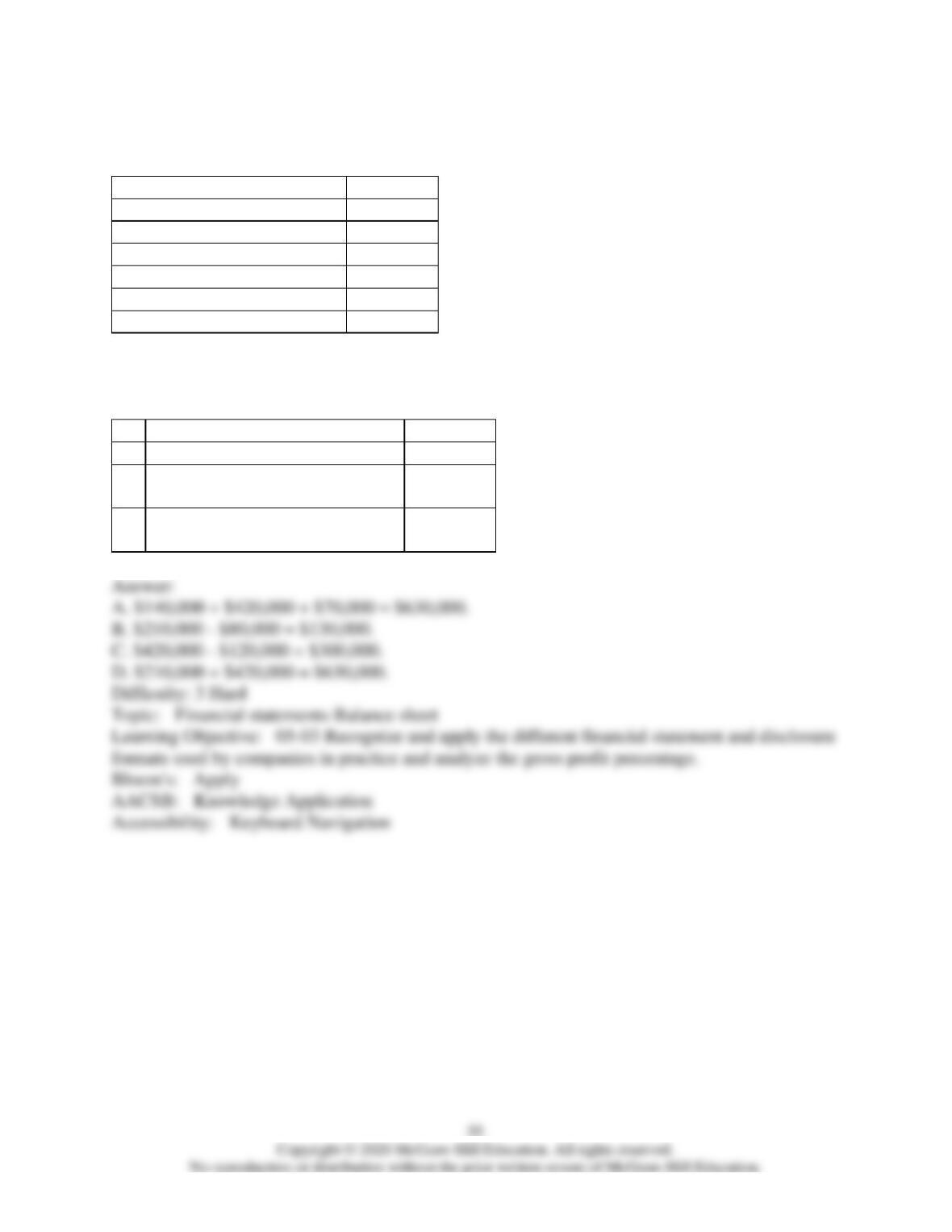
104) The balance sheet for Glenwood Corporation at December 31, 2019 showed the following
subtotals:
Current assets
$140,000
Current liabilities
80,000
Buildings and equipment
420,000
Total stockholders’ equity
420,000
Retained earnings
120,000
Total liabilities
210,000
Other long-term assets
70,000
Required:
Based on the above data, calculate the following amounts:
A.
Total assets
_______
B.
Long-term liabilities
_______
C.
Common stock and Additional
paid-in capital
_______
D.
Total liabilities and stockholders’
equity
_______
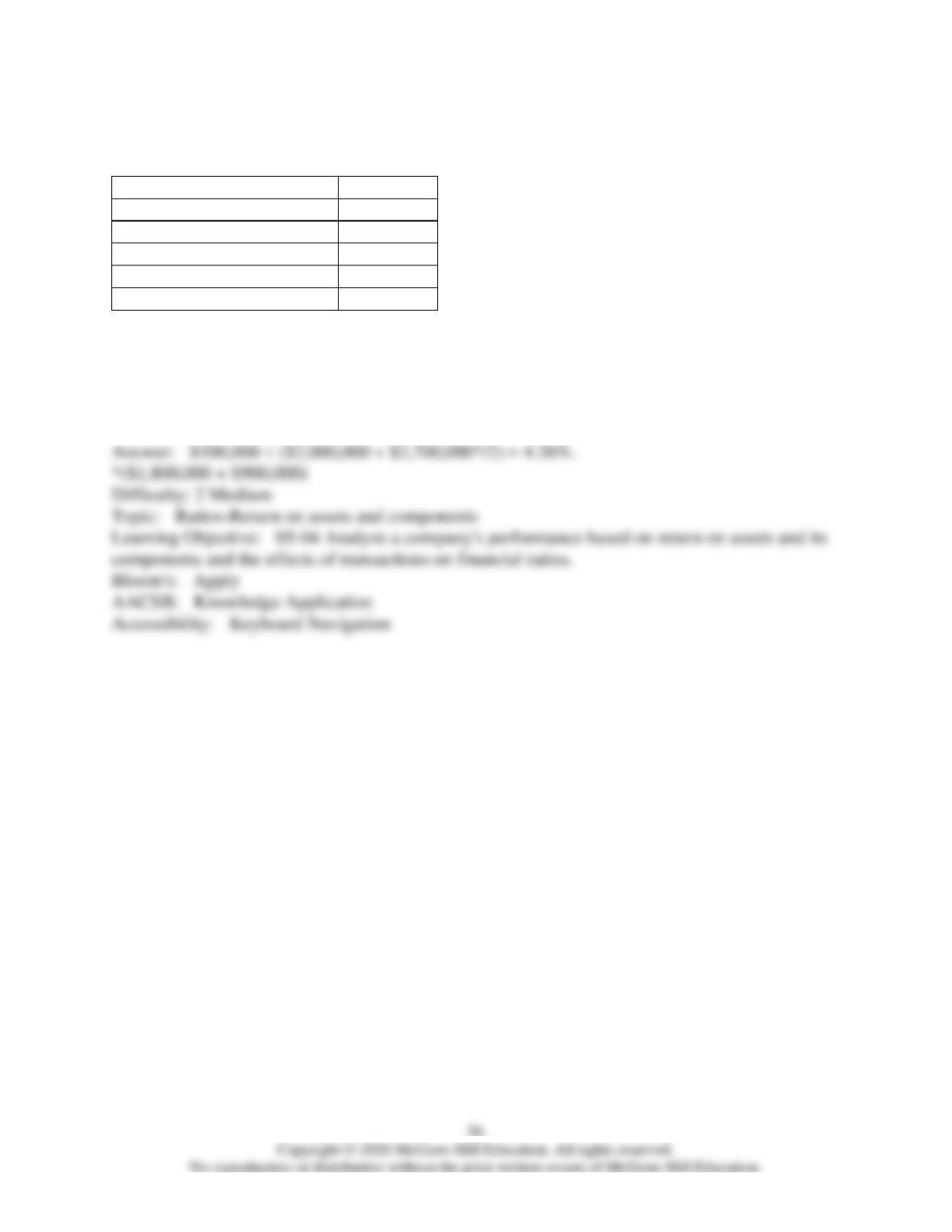
105) Ridgetop Corporation reported the following amounts on its balance sheet at December 31,
2019:
Total current assets
$1,800,000
Total long-term assets
900,000
Total current liabilities
1,300,000
Total long-term liabilities
500,000
Total stockholders’ equity
900,000
Net income
100,000
On January 1, 2019, total assets were $2,000,000, total liabilities were $1,200,000 and total
stockholders’ equity was $800,000.
Calculate Ridgetop’s return on assets.