159) Which of the following is not true about contract assets?
A) Contract assets are recorded when payment depends on something other than the passage of
time.
B) Contract assets are recognized when the seller has a conditional right to receive payment.
C) Contract assets are recognized when the seller has been paid in advance for at least partially
fulfilling its performance obligations.
D) Contract assets are not the same as accounts receivable.
160) Which of the following is not true about contract liabilities?
A) Contract liabilities are only recognized when the seller has a conditional right to receive
payment.
B) Contract liabilities might be called deferred revenue.
C) Contract liabilities are recognized when the seller has been paid in advance of satisfying its
performance obligations.
D) Contract liabilities may be shown on a separate line of the balance sheet.
161) Gupta Industries received a $300,000 prepayment from Packard Associates for the sale of
new equipment. Gupta will bill Packard an additional $100,000 upon delivery of the equipment.
Upon receipt of the $300,000 prepayment, how much should Gupta recognize for a contract
asset, a contract liability, and accounts receivable?
A) Contract asset: $0; contract liability: $300,000, accounts receivable, $0.
B) Contract asset: $300,000; contract liability: $0, accounts receivable, $0.
C) Contract asset: $0; contract liability: $300,000, accounts receivable, $100,000.
D) Contract asset: $300,000; contract liability: $0, accounts receivable, $100,000.
162) Which of the following is not something that revenue recognition disclosures typically
should help investors to understand?
A) Timing of revenue and cash flows
B) Outstanding performance obligations
C) Significant judgments used to estimate transaction prices
D) Significant fluctuations in long-term debt necessary to increase revenue in the future
163) Which of the following is not true about revenue recognition with respect to long-term
construction contracts?
A) Long-term construction contracts often are viewed as having a single performance obligation,
because goods or services fail the “separately identifiable” criterion.
B) Long-term construction contracts often satisfy the criteria for recognizing revenue over time.
C) Long-term construction contracts require accounting for construction in progress as well as
billings to customers.
D) Long-term construction contracts typically include multiple performance obligations because
of all the different types of goods or services included for each project.
164) Which of the following is least likely to be a reason why a long-term construction contract
would qualify for revenue recognition over time?
A) The customer consumes the benefit of the seller’s work as it is performed.
B) The customer controls the asset as it is created.
C) The seller is creating an asset that has no alternative use to the seller, and the seller has the
legal right to receive payment for progress to date.
D) The seller is constructing an addition to property that is owned by the customer.
165) Which of the following is true about accounting for contract assets (CIP in excess of
billings) in each balance sheet prior to completion of long-term construction contracts?
A) Contract assets are likely to be larger if revenue is recognized over time than if revenue is
recognized at a point in time.
B) Contract assets are likely to be smaller if revenue is recognized over time than if revenue is
recognized at a point in time.
C) Contract assets are likely to be the same size regardless of whether revenue is recognized over
time or at a point in time.
D) There is no way to tell how revenue recognition timing will affect the size of contract assets
without more information.
166) Which of the following is not true about accounting for long-term construction contracts?
A) Long-term construction contracts could show a contract asset or contract liability, depending
on the relation between construction in progress and billings.
B) Billings on contracts in progress is a contra account to accounts receivable.
C) Gross profit is debited to construction in progress.
D) When a customer is billed for payment due, billings on contracts in progress is credited at the
same time accounts receivable is debited.
167) A rationale for recognizing revenue over the life of a contract rather than at a single point in
time is that:
A) Results are more conservative.
B) It provides a better measure of periodic accomplishment.
C) It is a better match with legal ownership.
D) It results in a lower income tax.
168) Revenue on a long-term contract should not be recognized according to the proportion of
the performance obligation that has been completed if:
A) Completion rates are certain.
B) Profits are low.
C) Projects are more than five years to completion.
D) The arrangement does not qualify for revenue recognition over time.
169) With respect to delaying revenue recognition until completion of a long-term contract, it is
the case that:
A) Estimated losses on the overall contract are recognized before the contract is completed.
B) Expenses are recognized each period, but revenue is only recognized when the contract is
completed.
C) Use of this approach is not permitted under generally accepted accounting principles.
D) Neither gains nor losses are recognized until the contract is completed.
170) When accounting for revenue over time for a long-term contract, the percentage of
completion used to recognize revenue in the first year usually is determined by measuring:
A) Costs incurred in the first year, divided by estimated remaining costs to complete the project.
B) Costs incurred in the first year, divided by estimated total costs for the completed project.
C) Costs incurred in the first year, divided by estimated gross profit.
D) Costs incurred in the first year, divided by estimated total costs to be incurred in the
remaining years of the project.
171) Arizona Desert Homes (ADH) constructed a new subdivision during 2017 and 2018 under
contract with Cactus Development Co. Relevant data are summarized below:
Contract amount
$
3,000,000
Cost:
2017
1,200,000
2018
600,000
Gross profit:
2017
800,000
2018
400,000
Contract billings:
2017
1,500,000
2018
1,500,000
ADH recognizes revenue over time with respect to these contracts.
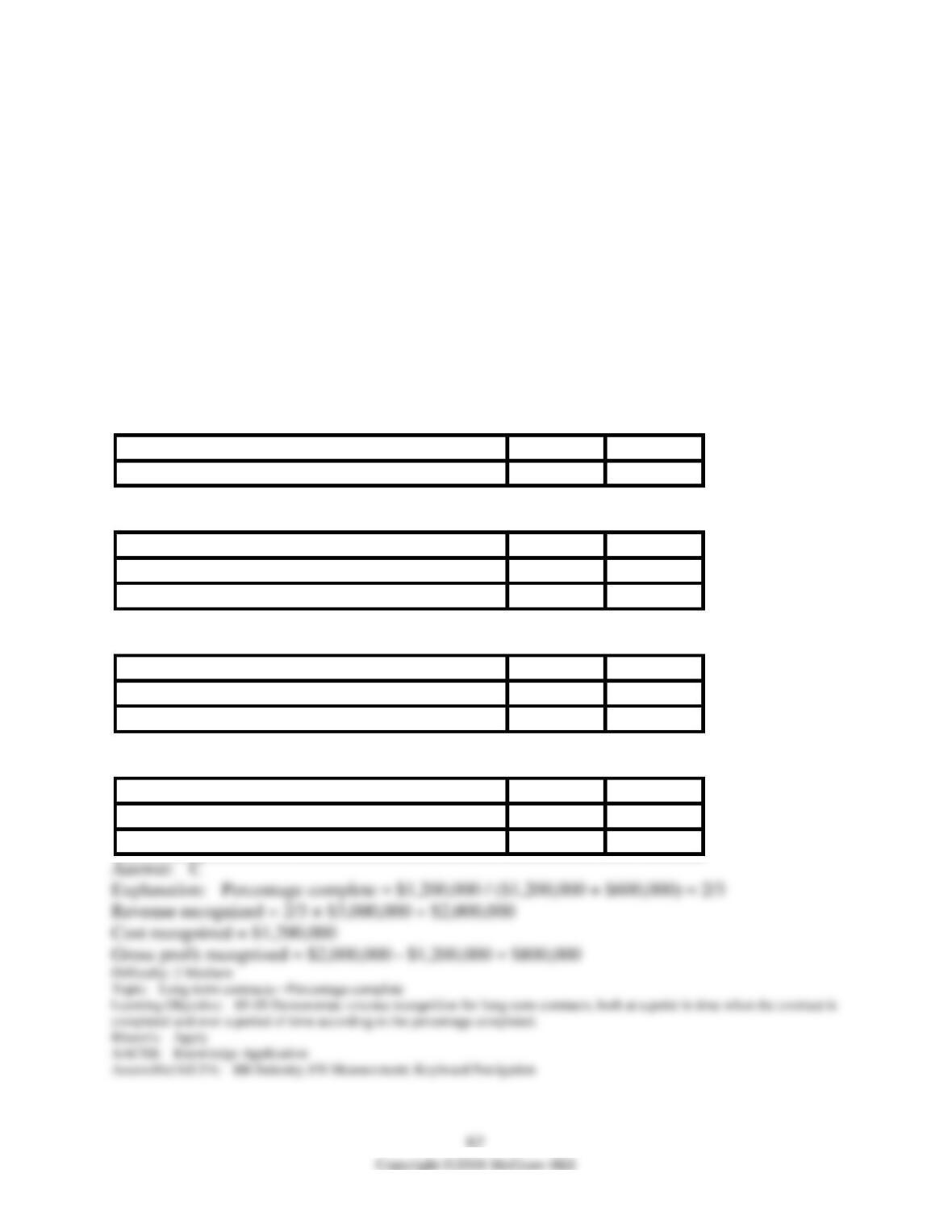
What would be the journal entry made in 2017 to record revenue?
A)
Accounts receivable
1,500,000
Revenue from long-term contracts
1,500,000
B)
Accounts receivable
2,300,000
Gross profit
800,000
Revenue from long-term contracts
1,500,000
C)
Construction in progress
800,000
Cost of construction
1,200,000
Revenue from long-term contracts
2,000,000
D)
Accounts receivable
1,500,000
Billings in excess of cost
300,000
Revenue for long-term contracts
1,800,000
172) Arizona Desert Homes (ADH) constructed a new subdivision during 2017 and 2018 under
contract with Cactus Development Co. Relevant data are summarized below:
Contract amount
$
3,000,000
Cost:
2017
1,200,000
2018
600,000
Gross profit:
2017
800,000
2018
400,000
Contract billings:
2017
1,500,000
2018
1,500,000
ADH recognizes revenue over time with respect to these contracts.
In its December 31, 2017, balance sheet, ADH would report:
A) The contract asset, cost and profits in excess of billings, of $500,000.
B) The contract liability, billings in excess of cost, of $300,000.
C) The contract asset, contract amount in excess of billings, of $1,500,000.
D) The contract asset, deferred profit, of $400,000.
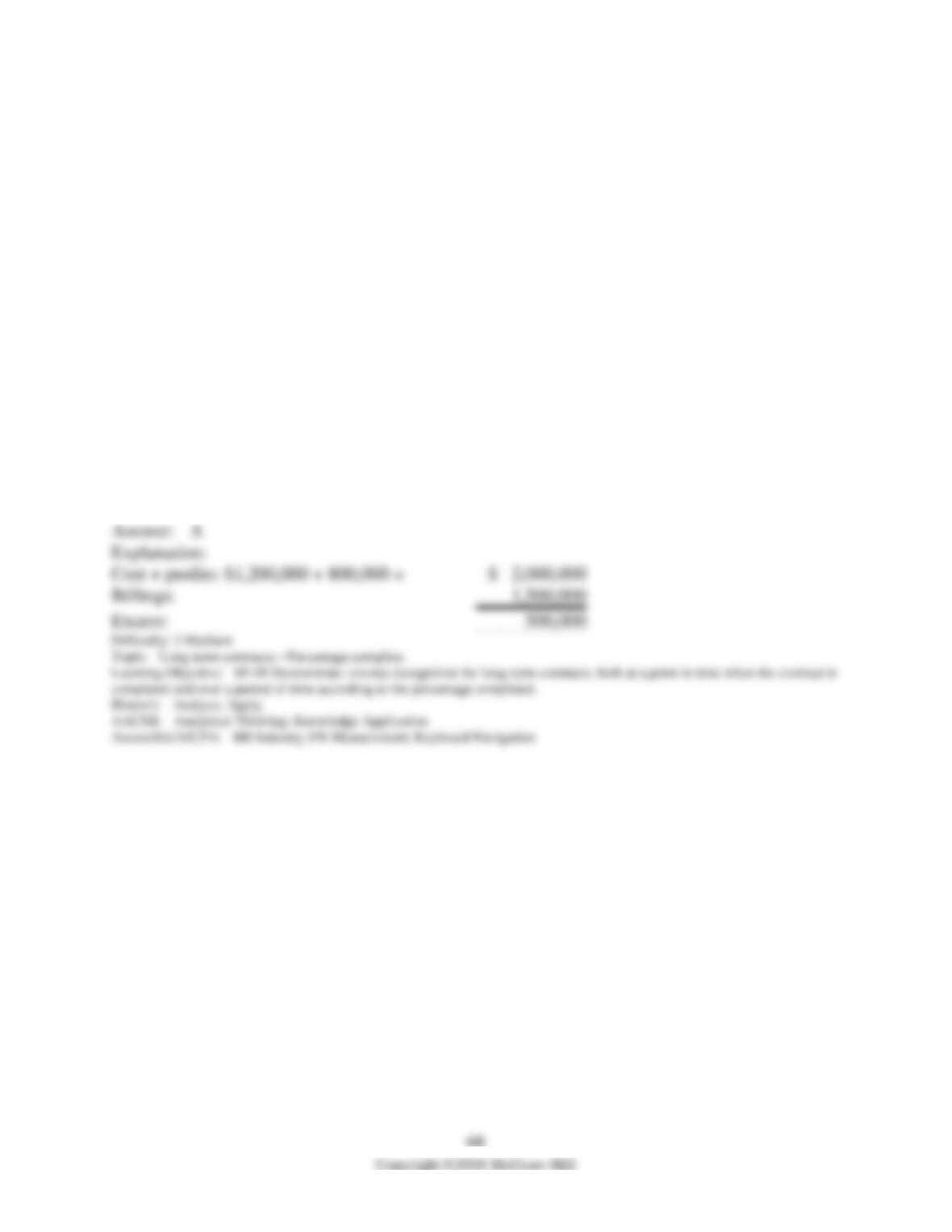
Cost + profits: $1,200,000 + 800,000 =
$
2,000,000
Billings:
1,500,000
Excess:
69
173) Arizona Desert Homes (ADH) constructed a new subdivision during 2017 and 2018 under
contract with Cactus Development Co. Relevant data are summarized below:
Contract amount
$
3,000,000
Cost:
2017
1,200,000
2018
600,000
Gross profit:
2017
800,000
2018
400,000
Contract billings:
2017
1,500,000
2018
1,500,000
ADH recognizes revenue over time with respect to these contracts.
For 2018, what is the journal entry to record revenue?
A)
Accounts receivable
1,500,000
Revenue from long-term contracts
1,500,000
B)
Construction in progress
400,000
Cost of construction
600,000
Revenue from long-term contracts
1,000,000
C)
Cost of construction
2,000,000
Gross profit
1,000,000
Revenue from long-term contracts
3,000,000
D)
Accounts receivable
1,500,000
Cost of construction
600,000
Gross profit
600,000
Deferred revenue
300,000
174) Arizona Desert Homes (ADH) constructed a new subdivision during 2017 and 2018 under
contract with Cactus Development Co. Relevant data are summarized below:
Contract amount
$
3,000,000
Cost:
2017
1,200,000
2018
600,000
Gross profit:
2017
800,000
2018
400,000
Contract billings:
2017
1,500,000
2018
1,500,000
ADH recognizes revenue upon completion of the contract.
For 2017, what is the journal entry to record revenue?
A)
Accounts receivable
1,500,000
Revenue from long-term contracts
1,500,000
B)
Accounts receivable
2,300,000
Gross profit
800,000
Revenue from long-term contracts
1,500,000
C)
Construction in progress
800,000
Cost of construction
1,200,000
Revenue from long-term contracts
2,000,000
D) No entry.
175) Arizona Desert Homes (ADH) constructed a new subdivision during 2017 and 2018 under
contract with Cactus Development Co. Relevant data are summarized below:
Contract amount
$
3,000,000
Cost:
2017
1,200,000
2018
600,000
Gross profit:
2017
800,000
2018
400,000
Contract billings:
2017
1,500,000
2018
1,500,000
ADH recognizes revenue upon completion of the contract.
In its December 31, 2017, balance sheet, ADH would report:
A) The contract asset, cost and profits in excess of billings, of $500,000.
B) The contract liability, billings in excess of cost, of $300,000.
C) The contract asset, contract amount in excess of billings, of $1,500,000.
D) The contract asset, deferred profit, of $400,000.
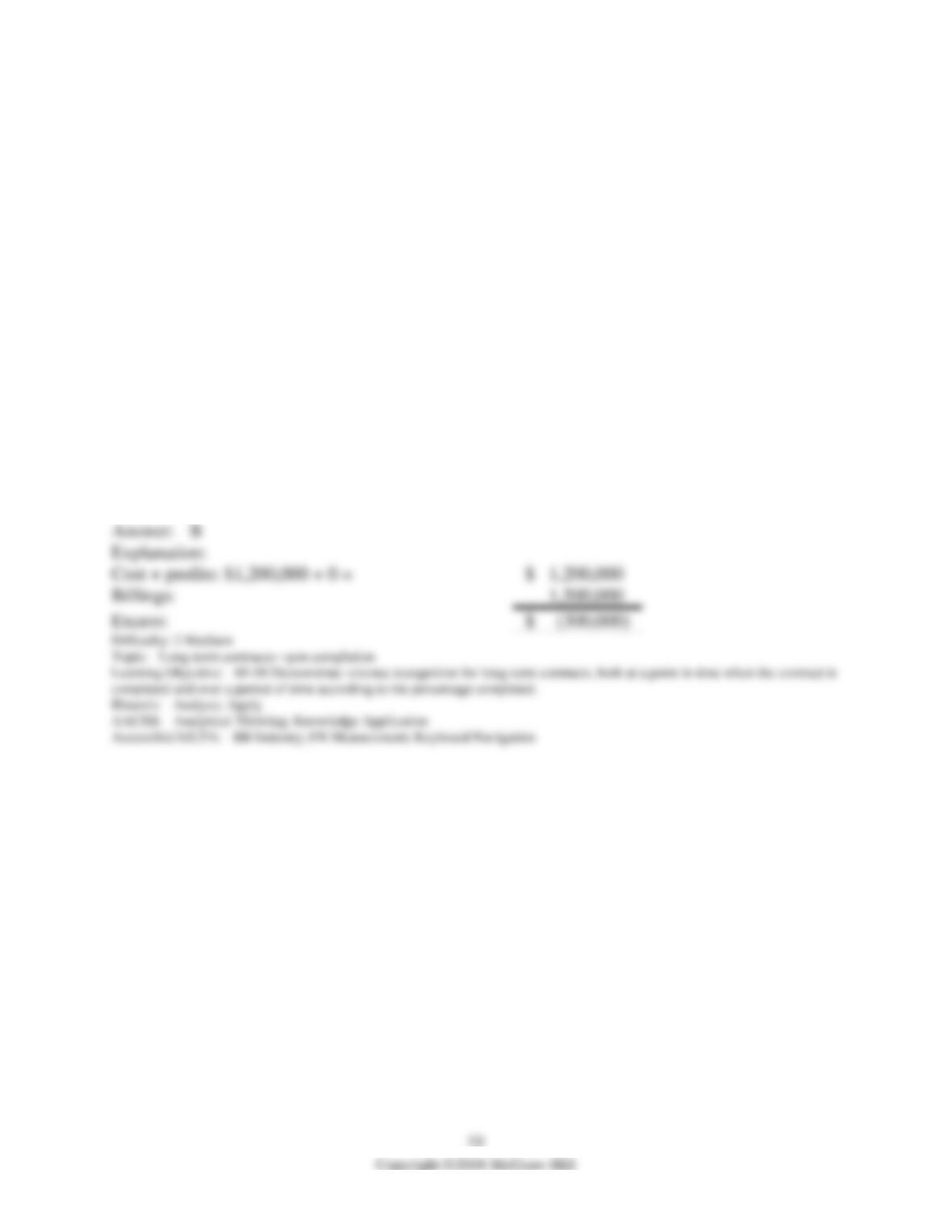
Cost + profits: $1,200,000 + 0 =
$
1,200,000
Billings:
1,500,000
Excess:
$
)
176) Arizona Desert Homes (ADH) constructed a new subdivision during 2017 and 2018 under
contract with Cactus Development Co. Relevant data are summarized below:
Contract amount
$
3,000,000
Cost:
2017
1,200,000
2018
600,000
Gross profit:
2017
800,000
2018
400,000
Contract billings:
2017
1,500,000
2018
1,500,000
ADH recognizes revenue upon completion of the contract.
What is the journal entry in 2018 to record revenue?
A)
Accounts receivable
1,500,000
Revenue from long-term contracts
1,500,000
B)
Construction in progress
400,000
Cost of construction
600,000
Revenue from long-term contracts
1,000,000
C)
Cost of construction
2,000,000
Gross profit
1,000,000
Revenue from long-term contracts
3,000,000
D)
Construction in progress
1,200,000
Cost of construction
1,800,000
Revenue from long-term contracts
3,000,000
177) JRE2 Inc. entered into a contract to install a pipeline for a fixed price of $2,200,000. JRE2
recognizes revenue upon contract completion.
Cost incurred
Estimated Cost to
Complete
2017
$
250,000
$
1,550,000
2018
1,600,000
500,000
2019
450,000
0
In 2017, JRE2 would report (rounded to the nearest thousand) gross profit (loss) of:
A) $0.
B) $(100,000).
C) $56,000.
D) $73,000.
178) JRE2 Inc. entered into a contract to install a pipeline for a fixed price of $2,200,000. JRE2
recognizes revenue upon contract completion.
Cost incurred
Estimated Cost to
Complete
2017
$
250,000
$
1,550,000
2018
1,600,000
500,000
2019
450,000
0
In 2018, JRE2 would report gross profit (loss) of:
A) $(223,000).
B) $(150,000).
C) $(206,000).
D) $0.
179) JRE2 Inc. entered into a contract to install a pipeline for a fixed price of $2,200,000. JRE2
recognizes revenue upon contract completion.
Cost incurred
Estimated Cost to
Complete
2017
$
250,000
$
1,550,000
2018
1,600,000
500,000
2019
450,000
0
In 2019, JRE2 would report gross profit (loss) of:
A) $(100,000).
B) $50,000.
C) $123,000.
D) $2,000.
In 2019:
$2,200,000 – ($250,000 + 1,600,000 + 450,000) = $(100,000)
$(100,000) – (150,000) = $50,000
180) Indiana Co. began a construction project in 2018 with a contract price of $150 million to be
received when the project is completed in 2020. During 2018, Indiana incurred $36 million of
costs and estimates an additional $84 million of costs to complete the project. Indiana recognizes
revenue over time and for this project recognizes revenue over time according to the percentage
of the project that has been completed.
Indiana:
A) Recognized no gross profit or loss on the project in 2018.
B) Recognized $6 million loss on the project in 2018.
C) Recognized $9 million gross profit on the project in 2018.
D) Recognized $36 million loss on the project in 2018.
181) Indiana Co. began a construction project in 2018 with a contract price of $150 million to be
received when the project is completed in 2020. During 2018, Indiana incurred $36 million of
costs and estimates an additional $84 million of costs to complete the project. Indiana recognizes
revenue over time and for this project recognizes revenue over time according to the percentage
of the project that has been completed.
In 2019, Indiana incurred additional costs of $58.5 million and estimated an additional $40.5
million in costs to complete the project. Indiana:
A) Recognized $15 million gross profit on the project in 2019.
B) Recognized $13.5 million gross profit on the project in 2019.
C) Recognized $6 million gross profit on the project in 2019.
D) Recognized $1.5 million gross profit on the project in 2019.
182) Indiana Co. began a construction project in 2018 with a contract price of $150 million to be
received when the project is completed in 2020. During 2018, Indiana incurred $36 million of
costs and estimates an additional $84 million of costs to complete the project. Indiana recognizes
revenue over time and for this project recognizes revenue over time according to the percentage
of the project that has been completed.
Suppose that, in 2019, Indiana incurred additional costs of $63.75 million and estimated an
additional $42.75 million in costs to complete the project. Indiana:
A) Recognized $3.75 million loss on the project in 2019.
B) Recognized $5.25 million gross profit on the project in 2019.
C) Recognized $7.5 million gross profit on the project in 2019.
D) Recognized $1.5 million loss on the project in 2019.
183) In 2018, Cupid Construction Co. (CCC) began work on a two-year fixed price contract
project. CCC recognizes revenue over time according to percentage of completion for this
contract, and provides the following information (dollars in millions):
Accounts receivable, 12/31/2018 (from construction progress billings)
$
37.5
Actual construction costs incurred in 2018
$
135
Cash collected on project during 2018
$
105
Construction in progress, 12/31/2018
$
207
Estimated percentage of completion during 2018
60
%
What is the amount of gross profit on the project recognized by CCC during 2018?
A) $160 million.
B) $72 million.
C) $48 million.
D) Cannot be determined from the given information.
184) In 2018, Cupid Construction Co. (CCC) began work on a two-year fixed price contract
project. CCC recognizes revenue over time according to percentage of completion for this
contract, and provides the following information (dollars in millions):
Accounts receivable, 12/31/2018 (from construction progress billings)
$
37.5
Actual construction costs incurred in 2018
$
135
Cash collected on project during 2018
$
105
Construction in progress, 12/31/2018
$
207
Estimated percentage of completion during 2018
60
%
What are CCC’s estimated remaining construction costs on the project at the end of 2018?
A) $90 million.
B) $135 million.
C) $225 million.
D) $0.
185) In 2018, Cupid Construction Co. (CCC) began work on a two-year fixed price contract
project. CCC recognizes revenue over time according to percentage of completion for this
contract, and provides the following information (dollars in millions):
Accounts receivable, 12/31/2018 (from construction progress billings)
$
37.5
Actual construction costs incurred in 2018
$
135
Cash collected on project during 2018
$
105
Construction in progress, 12/31/2018
$
207
Estimated percentage of completion during 2018
60
%
What is the fixed contract price for CCC’s project?
A) $120 million.
B) $225 million.
C) $345 million.
D) $349.5 million.
186) In 2018, Cupid Construction Co. (CCC) began work on a two-year fixed price contract
project. CCC recognizes revenue over time according to percentage of completion for this
contract, and provides the following information (dollars in millions):
Accounts receivable, 12/31/2018 (from construction progress billings)
$
37.5
Actual construction costs incurred in 2018
$
135
Cash collected on project during 2018
$
105
Construction in progress, 12/31/2018
$
207
Estimated percentage of completion during 2018
60
%
What were the construction billings by CCC during 2018?
A) $142.5 million.
B) $67.5 million.
C) $37.5 million.
D) Cannot be determined from the given information.