46. (Journal entries – tax revenue accounting – year-end adjustments)
Prepare entries to record the following transactions and events related to Colfax
County’s tax revenues for the year beginning January 1, 2013:
a. To raise property tax revenue of $800,000, the County bills its property
owners a total of $802,000, providing $2,000 for uncollectible and
refundable taxes.
b. During the year, taxpayers pay a total of $750,000 in property taxes.
c. E. Bloodworth declares bankruptcy, owing the County $2,000 in property
taxes. The County writes off the unpaid amount as uncollectible.
d. The state collects sales taxes on behalf of Colfax County. It sends the
County $150,000 for sales taxes collected during the year.
e. At year-end, the County declares all unpaid property taxes to be delinquent.
f. To prepare financial statements for the year, the County comptroller makes
the following determinations regarding tax revenues:
(1) She estimates that Colfax will receive $20,000 in delinquent 2013
property taxes before the end of February, 2014. The other
delinquent taxes will trickle in later in 2014.
(2) She learns that the state will remit $10,000 to Colfax in January
2014 for sales taxes collected by merchants in December 2013.
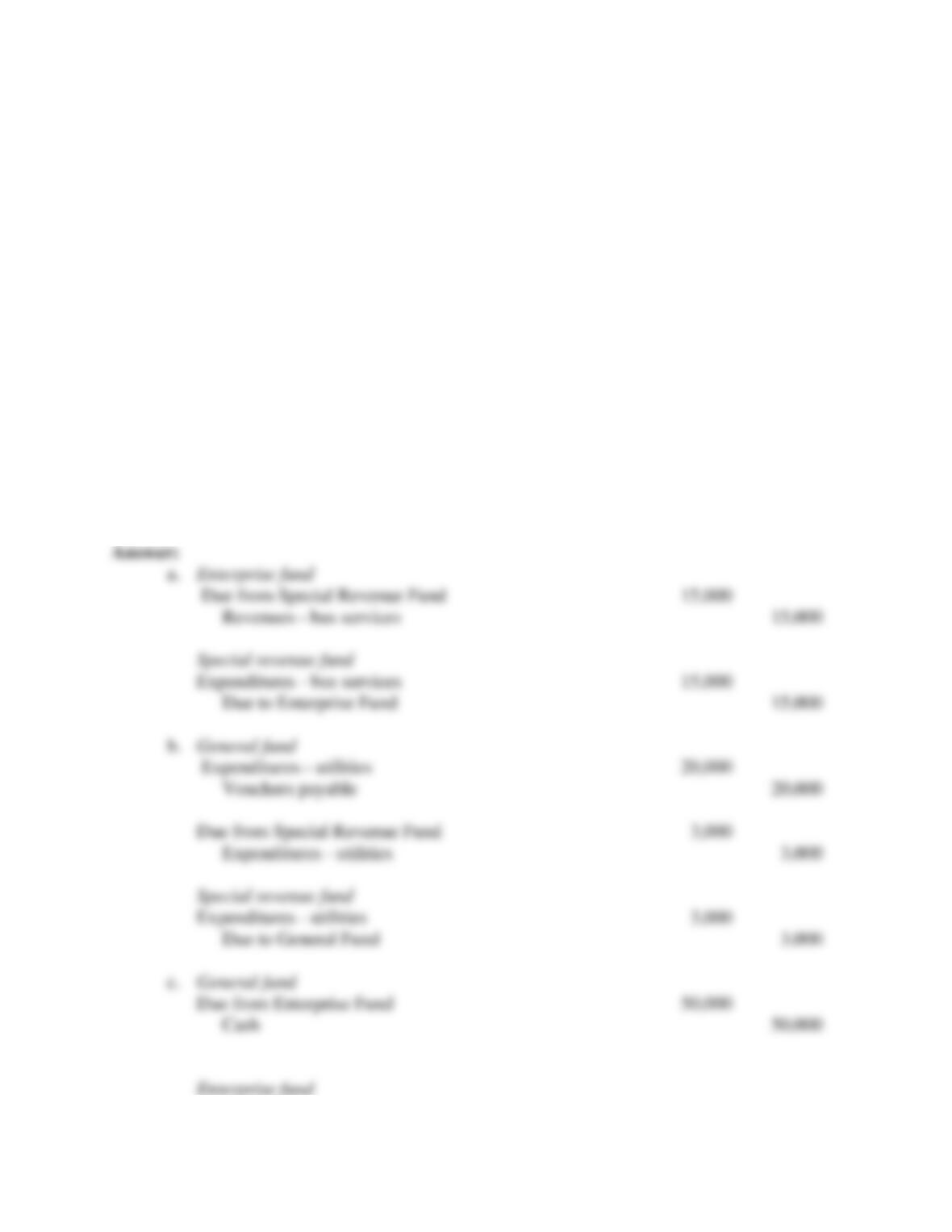
47. (Journal entries – interfund transactions)
Theodore County uses a General Fund, a Special Revenue Fund, and an Enterprise
Fund. The Special Revenue Fund is financed by a grant from the state to provide
care for the elderly. The Enterprise Fund provides bus service both to the public
and to government agencies. Prepare entries to record these transactions. Indentify
the funds involved in each case.
a. The Enterprise Fund bills the Special Revenue Fund $15,000 for bus
service provided to the elderly.
b. The General Fund receives an electricity bill for $20,000 and prepares a
voucher to pay the bill. The General Fund then bills the Special Revenue
Fund for $3,000, representing the portion of the electricity bill applicable to
the senior citizens building.
c. The Enterprise Fund is short of cash to pay its bills. The General Fund
lends the Enterprise Fund $50,000 in cash, which will be repaid before the
end of the year.
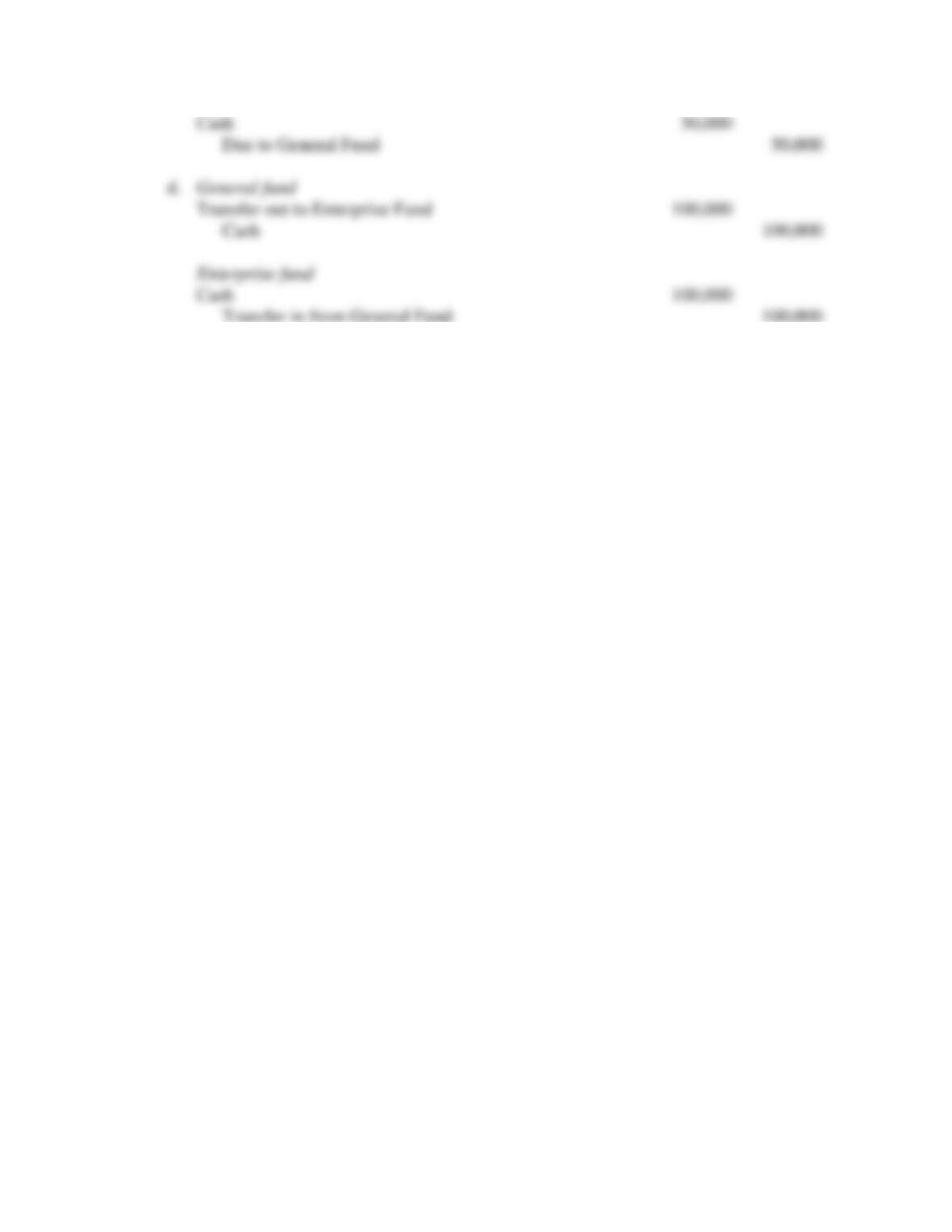
d. The General Fund pays cash of $100,000 to the Enterprise Fund as a
subsidy to help meet the operating costs of the Enterprise Fund.
48. (Property tax revenue recognition)
In its General Fund balance sheet at December 31, 2013, Marathon City reported
Property taxes receivable of $40,000, deferred property tax revenues of $15,000,
and an allowance for uncollectible taxes of $0. At the start of the year 2014,
Marathon City made the following journal entry to record its property tax levy:
Property taxes receivable 950,000
Allowance for refunds and uncollectible taxes 10,000
Revenues – property taxes 940,000
During the year 2014, the city collected all the property taxes receivable
outstanding at December 31, 2013. It also collected $920,000 of the receivables
recognized at the beginning of 2014, and wrote off $6,000 of receivables against
the allowance account. On December 31, 2014, the Marathon City finance director
made the following determinations regarding the property taxes outstanding at that
date:
a. All outstanding property taxes would be collected, so there was no need for
the allowance for uncollectible property taxes.
b. The City would collect about $15,000 of the outstanding property taxes
receivable during the first 60 days of 2015 and the remainder during the
latter part of 2015.
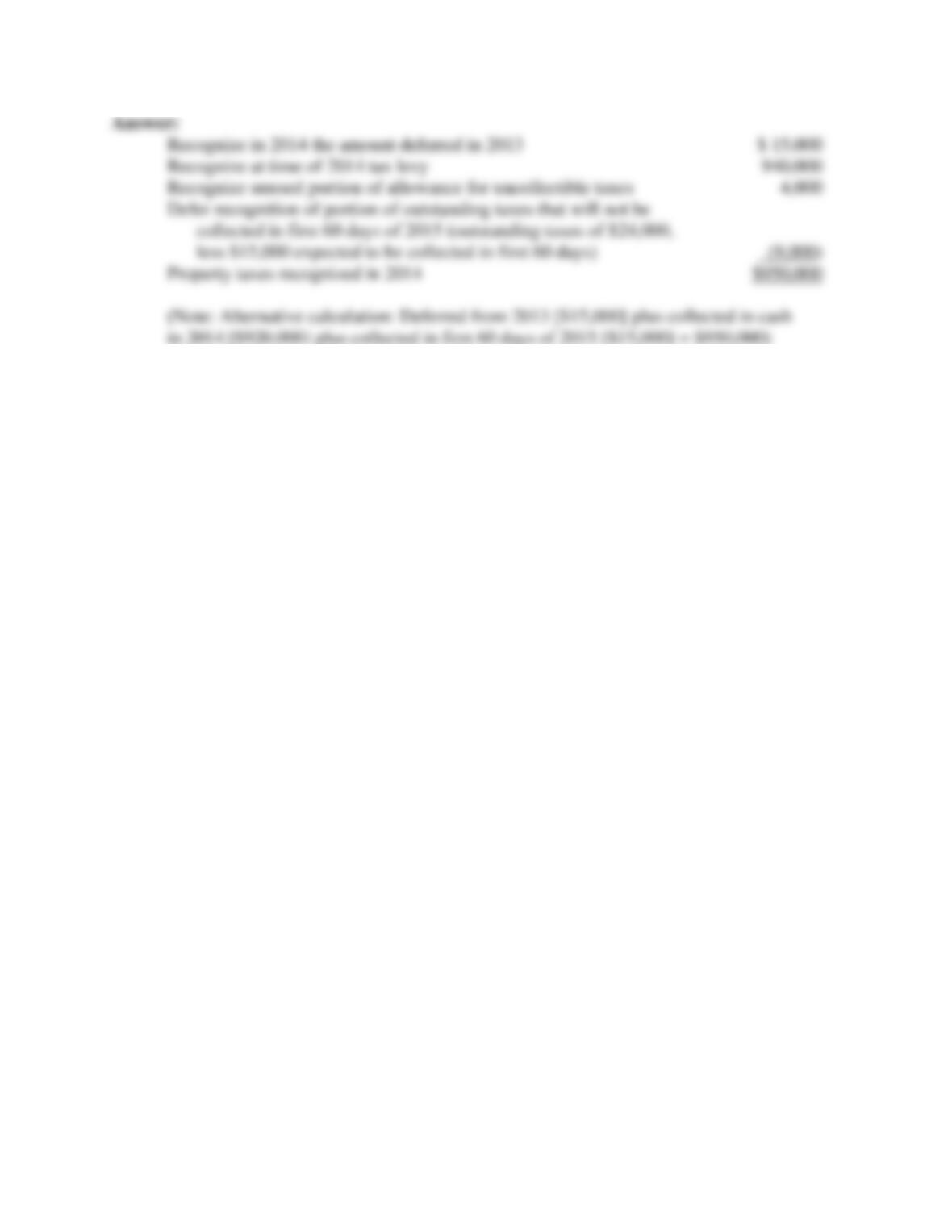
Required: Calculate how much property tax revenues Marathon City
should recognize in 2014.
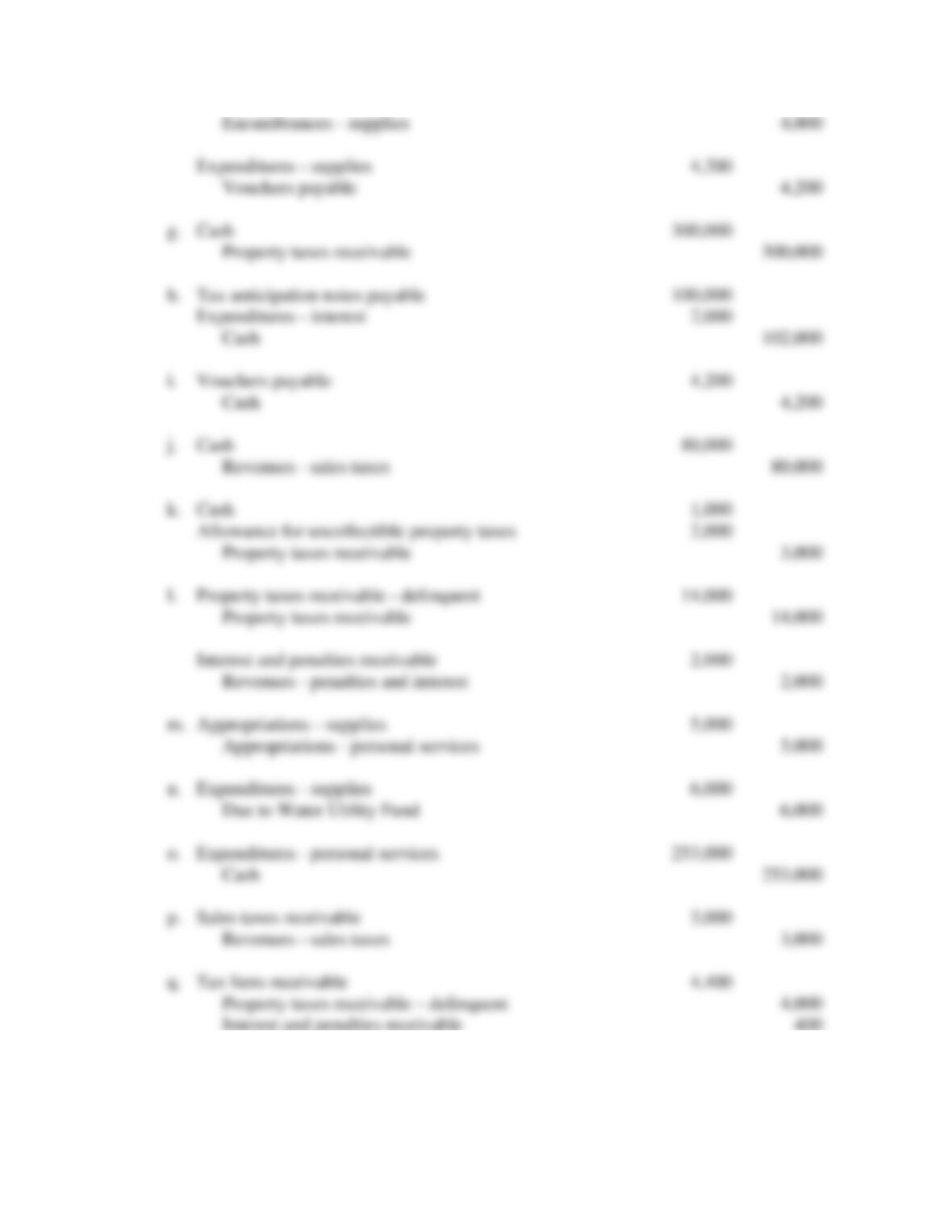
49. (Journal entries – comprehensive problem)
The Town of Elderville accounts for its revenues and day-to-day operating
expenditures in its General Fund. The Town uses encumbrance accounting to keep
budgetary control over the appropriation for “other expenditures.” Prepare journal
entries to record these transactions in the General Fund for the calendar year 2013.
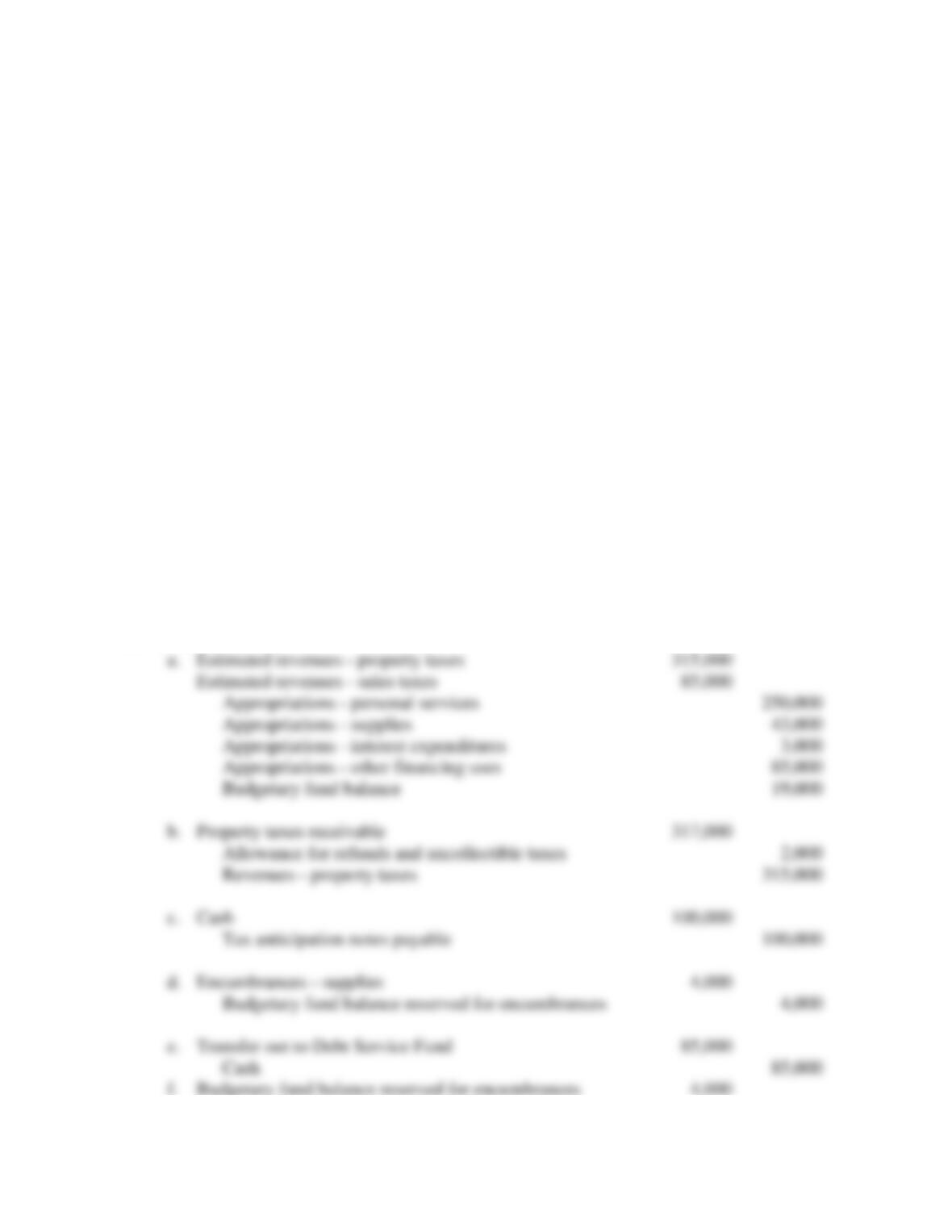
a. The following budget is adopted at the beginning of the year:
Estimated revenues:
Property taxes $315,000
Sales taxes 85,000
Appropriations:
Personal services 250,000
Supplies 43,000
Interest expenditures 3,000
Other financing uses 85,000
b. To raise the required $315,000 in property taxes, property owners are billed
for a total of $317,000. This will allow $2,000 for estimated uncollectible
property taxes and refunds.
c. To provide cash at the start of the year, the Town borrows $100,000 on a
tax anticipation note. The note will be repaid in six months with interest at
4% per annum.
d. The Town sends a purchase order for $4,000 to a vendor for supplies.
e. The General Fund pays $85,000 to the Debt Service Fund (DSF) to enable
the DSF to pay interest and principal on Town debt.
f. The vendor in d., above, delivers the supplies ordered by the Town, and
bills the Town for $4,200. The Town accepts delivery and prepares a
voucher for the full amount of the bill.
g. Property owners pay property taxes in the amount of $300,000.
h. The Town repays the $100,000 borrowed in c., above, together with interest
for six months.
i. The voucher in f., above, is paid.
j. The Town receives $80,000 for sales taxes collected by the state on behalf
of the Town.
k. S. Sparrow, a long-time resident, is unable to pay his $3,000 property tax
bill in full. He pays $1,000, and the Town writes off the remaining $2,000
as uncollectible.
l. The Town declares all remaining unpaid property taxes to be delinquent.
It also notifies delinquent property owners that they owe penalties of
$2,000 on the delinquent taxes.
m. The Town Council approves a budgetary interchange of $5,000 from the
supplies appropriation to the personal services appropriation to meet
unforeseen overtime costs.
n. The General Fund receives a bill from the Water Utility Fund for $6,000.
(Note: Charge this to supplies expenditures. No encumbrance is
necessary.)
o. The Town pays personal services in the amount of $253,000.
p. The Town is notified by the state that it collected an additional $3,000 in
December 2013 sales taxes that it will remit to the Town on January 20,
2014.
q. The Town files a tax lien against one of the delinquent taxpayers (in l.
above). The taxpayer is past due on $4,000 of property taxes and owes
penalties and interest of $400 on delinquent taxes.
r. The city sold the property (in q.) at auction for $6,000. The auctioneer
charged $300 for his services, which has not yet been paid.
Answer (Problem 49)

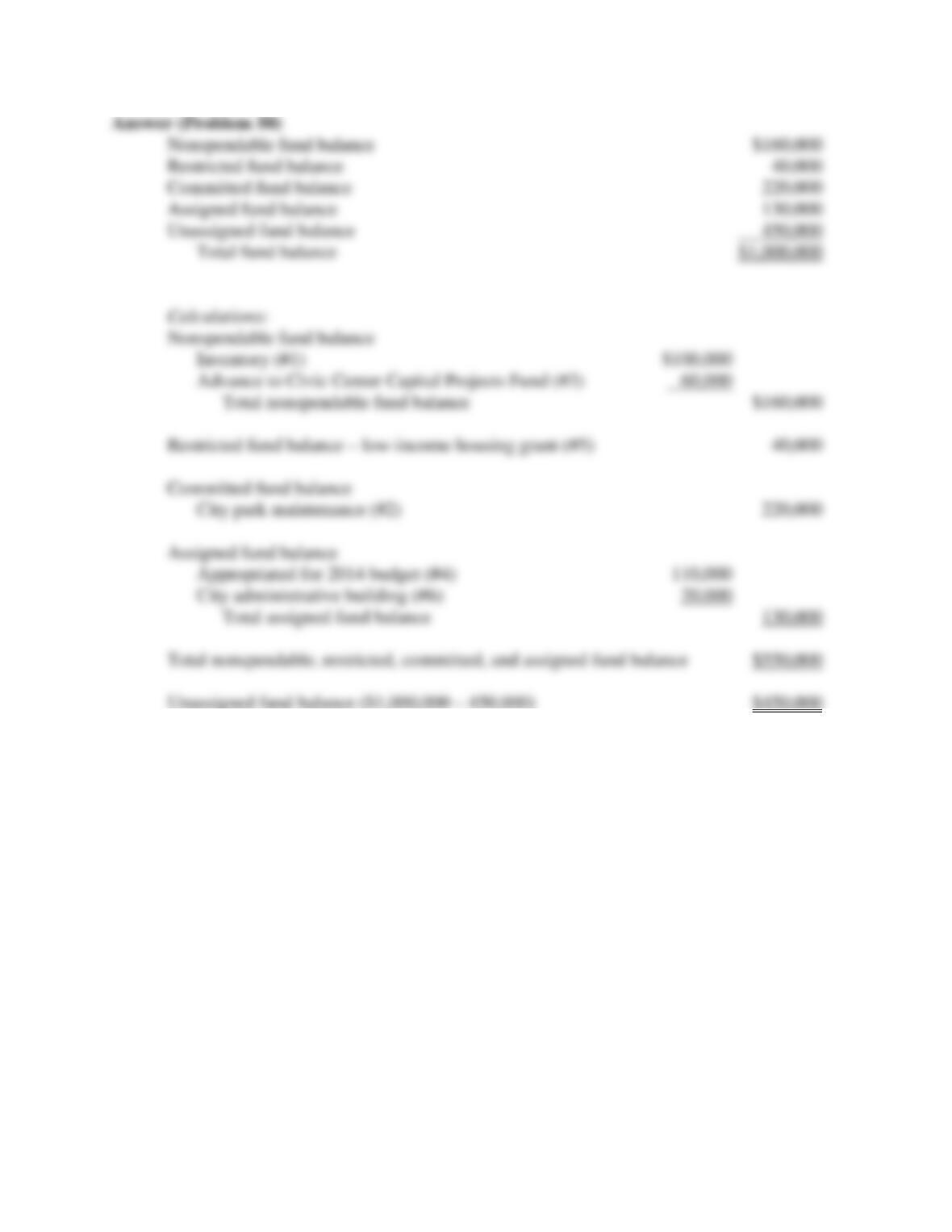
50. (Classification of fund balance)
The General Fund of the City of Davis Fort has a total fund balance of $1,000,000
as of its fiscal year-end, December 31, 2013. Please review the following
additional information regarding General Fund activities and determine how much
fund balance should be classified as nonspendable, restricted, committed,
assigned, and unassigned. Show the calculations necessary for making the fund
balance determinations.
1. The balance sheet of the City of Davis Fort showed $100,000 of inventory on
December 31, 2013.
2. The highest level of decision making authority for the city (the city council)
passed an ordinance that any royalty payments received from oil production
on city property must be used for city park maintenance. At year-end, the city
had not spent $220,000 of the oil royalty proceeds that it had received.
3. The General Fund made a long-term loan of $60,000 to the Civic Center
Capital Projects Fund during 2013. None had been repaid by December 31,
2013, and none is expected to be repaid until 2016.
4. The city council of the City of Davis Fort approves its 2014 budget in
December, 2013. It appropriates $110,000 of the December 31, 2013 fund
balance to eliminate an anticipated budget deficit in the 2014 budget. The
anticipated budget deficit is the result of expected 2014 expenditures
exceeding expected 2014 revenues.
5. The General Fund receives a federal grant that must be used to provide low-
income housing subsidies. The grant had no time restrictions. At year-end,
the General Fund had unspent resources of $40,000.
6. The city council authorized the city’s finance director to set aside a portion of
General Fund balance for future repairs to the city’s administrative building.
During 2013, the finance director set aside $20,000; none of which had been
spent at year-end.
51. (Treatment of inventory—purchases method)
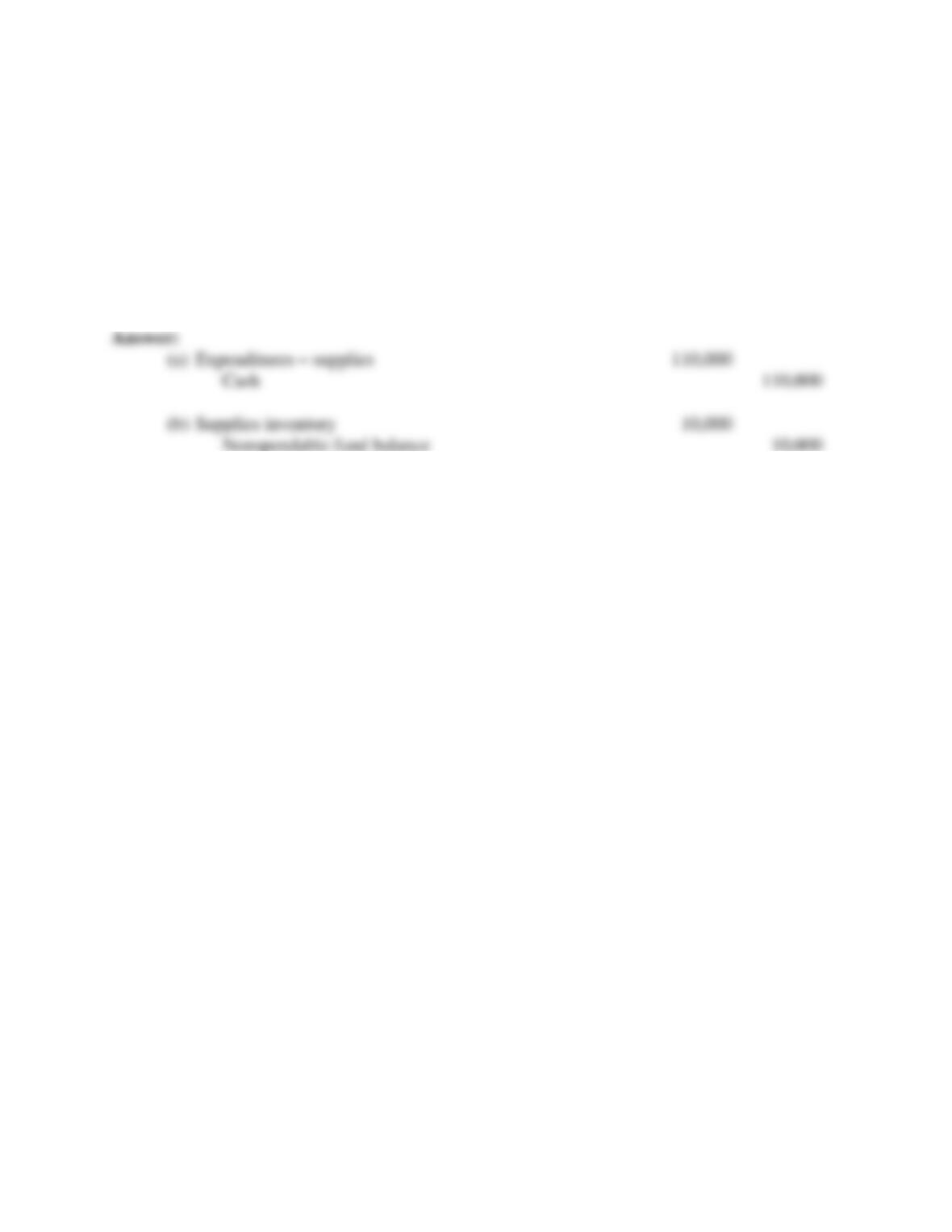
The General Fund of the City of Mineral Wells shows $40,000 in supplies
inventory on January 1, 2013. During the year 2013, General Fund cash is used to
purchase $110,000 of supplies. On December 31, 2013, the city conducts an
inventory count and finds $50,000 of supplies inventory remains. Using the
purchases method of accounting for inventory, prepare the journal entries
necessary to record (a) the purchase of the inventory and (b) to make the year-end
adjustment to inventory.

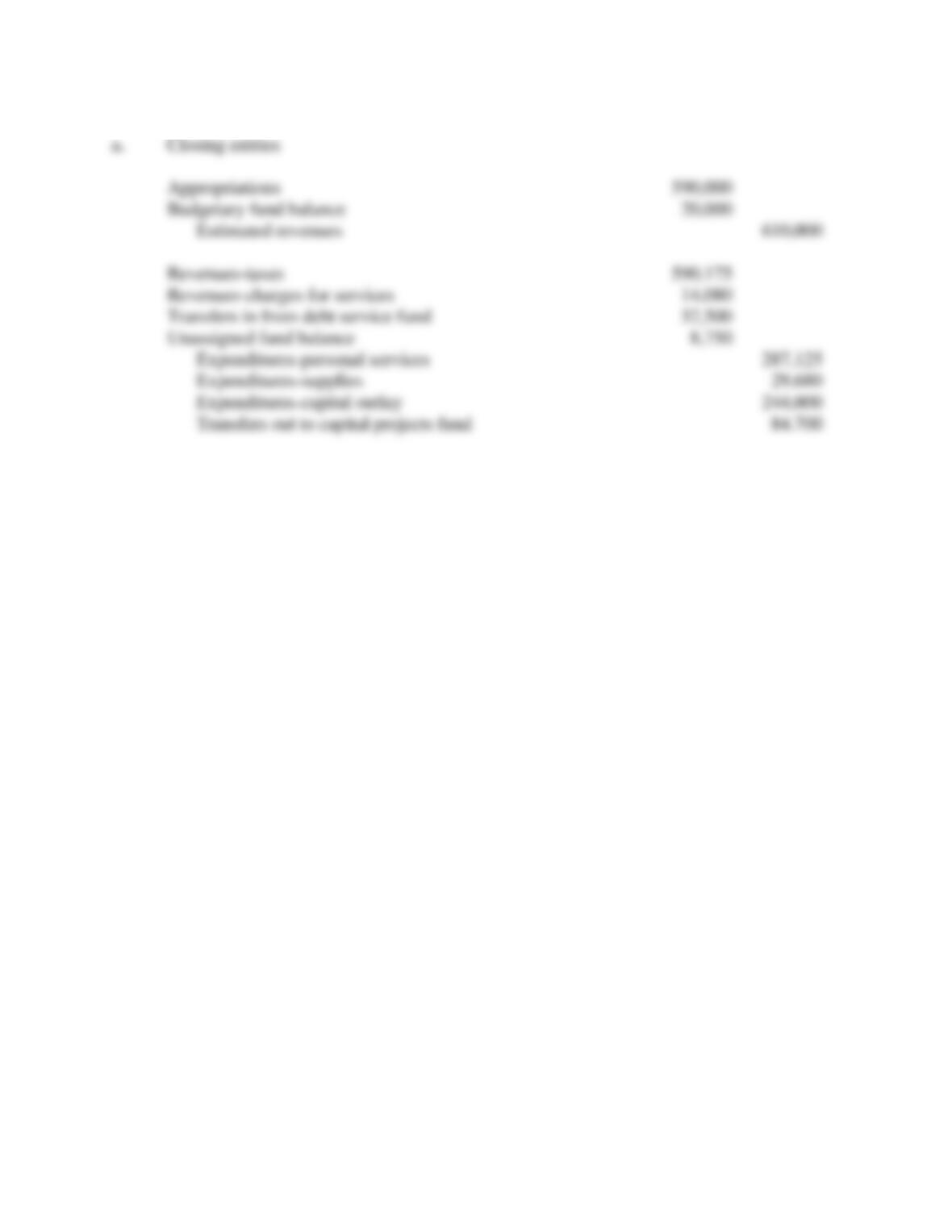
52. (Preparing closing entries and financial statements from a trial balance.)
Presented below is the adjusted trial balance for the General Fund of the Town of
Tranquil Bay at December 31, 2013, the end of the fiscal year. Based on this
information, prepare, in good form:
a. closing entries
b. the statement of revenues, expenditures, and changes in fund balance for the year
c. the balance sheet at December 31, 2013.
Town of Tranquil Bay
General Fund
Adjusted Trial Balance
December 31, 2013
Cash
19,750
Taxes receivable, net
137,000
Investments
65,000
Due from other funds
68,000
Vouchers payable
38,750
Due to other funds
142,750
Unassigned fund balance
117,000
Estimated revenues
610,000
Appropriations
590,000
Budgetary fund balance
20,000
Revenues-taxes
590,175
Revenues-charges for services
14,080
Expenditures-personal services
287,125
Expenditures-supplies
29,680
Expenditures-capital outlay
244,000
Transfer in from debt service fund
32,500
Transfers out to capital projects fund
84,700
0
$1,545,255
$1,545,255
Answer (Problem 52)