Balance Sheet and Statement of Cash Flows
5 – 39
Solution 5-116
Ex. 5-117—Statement of cash flows.
For each event listed below, select the appropriate category which describes the effect of the
event on a statement of cash flows:
a. Cash provided/used by operating activities.
b. Cash provided/used by investing activities.
c. Cash provided/used by financing activities.
d. Not a cash flow.
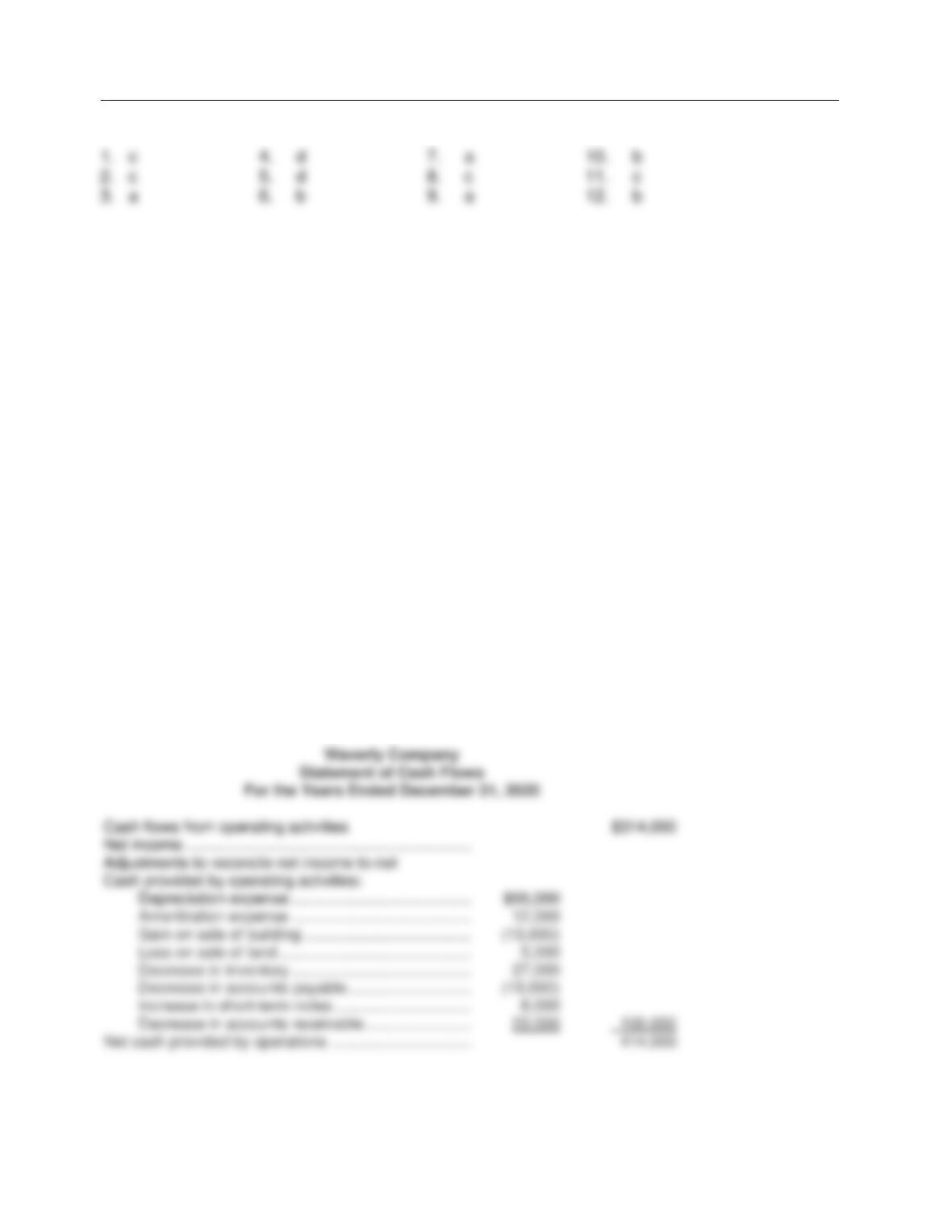
____ 1. Payment on long-term debt
____ 2. Issuance of bonds at a premium
____ 3. Collection of accounts receivable
____ 4. Cash dividends declared
____ 5. Issuance of stock to acquire land
____ 6. Sale of available-for-sale securities (long-term)
____ 7. Payment of employees’ wages
____ 8. Issuance of common stock for cash
____ 9. Payment of income taxes payable
____ 10. Purchase of equipment
____ 11. Purchase of treasury stock (common)
____ 12. Sale of real estate held as a long-term investment
Test Bank for Intermediate Accounting, Seventeenth Edition
5 – 40
Solution 5-117
Ex. 5-118—Statement of cash flows.
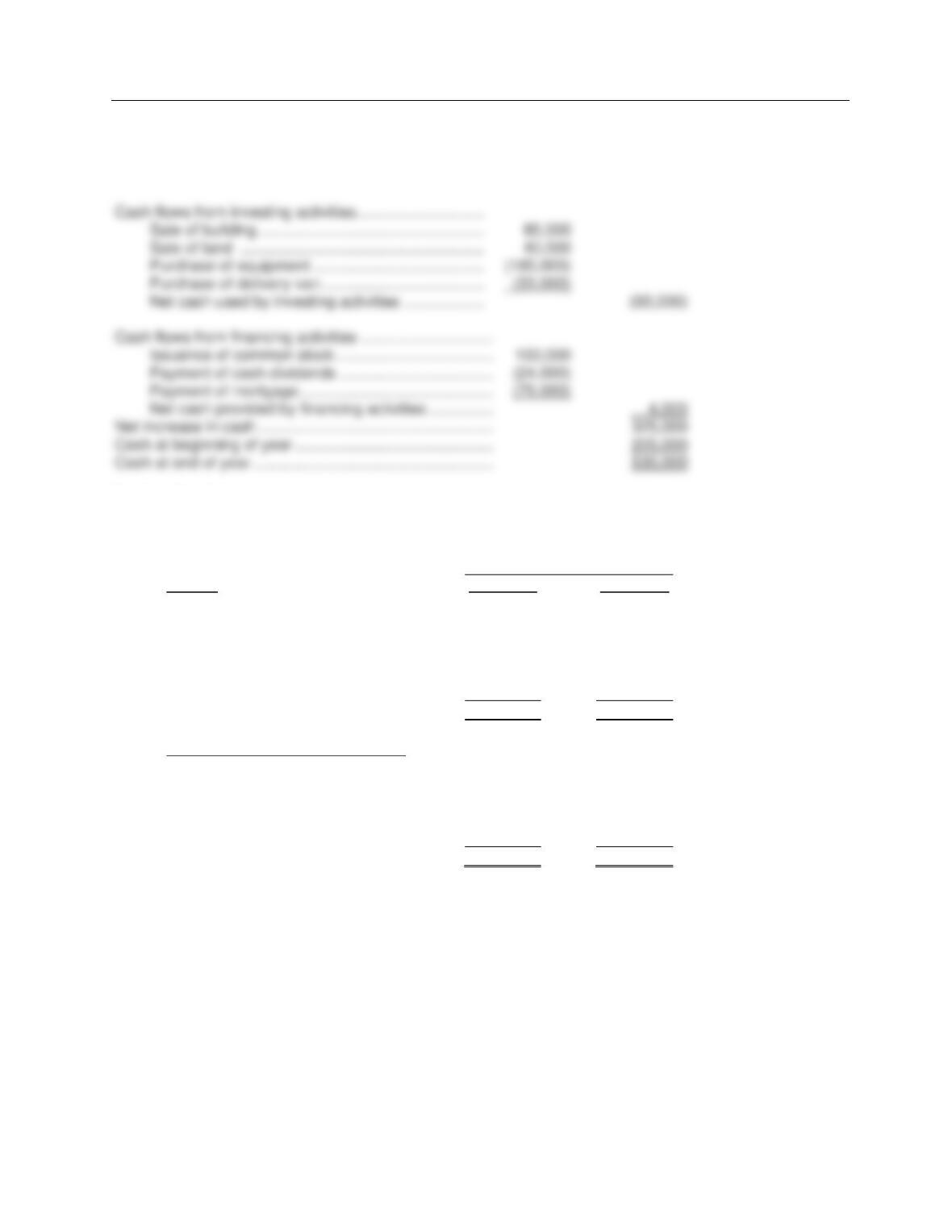
(L.O. 5) The information shown below is taken from the accounts of Waverly Corporation for the
year ended December 31, 2020
Net income
$314,000
Amortization of patent
12,000
Proceeds from issuance of common stock
103,000
Decrease in inventory
27,000
Sale of building at a $15,000 gain
85,000
Decrease in accounts payable
15,000
Purchase of equipment
185,000
Payment of cash dividends
24,000
Depreciation expense
55,000
Decrease in accounts receivable
23,000
Payment of mortgage
75,000
Increase in short-term notes payable
8,000
Sale of land at a $5,000 loss
40,000
Purchase of delivery van
33,000
Cash at beginning of year
205,000
Instructions
Prepare a statement of cash flows for Robinson Corporation for the year ended December 31,
2020.
Solution 5-118
Balance Sheet and Statement of Cash Flows
5 – 41
Solution 5-118 (cont.)
Ex. 5-119—Statement of cash flows.
A comparative balance sheet for Talkington Corporation is presented below.
December 31
Assets
2020
2019
Cash
$ 68,000
$ 22,000
Accounts receivable
82,000
66,000
Inventory
170,000
189,000
Land
71,000
110,000
Equipment
280,000
200,000
Accumulated depreciation–equipment
(74,000)
(42,000)
Total
$597,000
$545,000
Liabilities and Stockholders’ Equity
Accounts payable
$ 34,000
$ 47,000
Bonds payable
150,000
200,000
Common stock ($1 par)
164,000
164,000
Retained earnings
249,000
134,000
Total
$597,000
$545,000
Additional information:
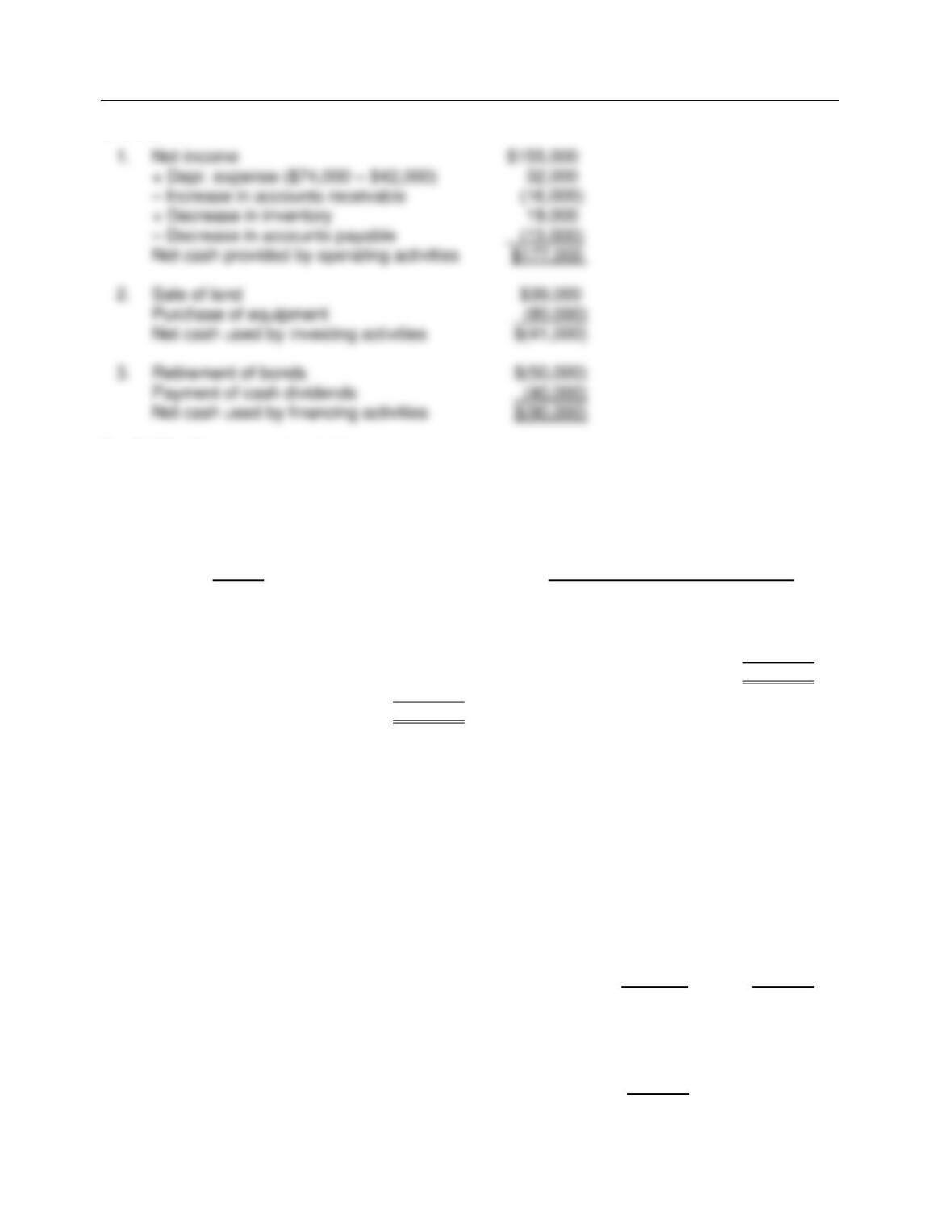
1. Net income for 2020 was $155,000; there were no gains or losses.
2. Cash dividends of $40,000 were declared and paid.
3. Bonds payable of $50,000 were retired.
Instructions:
Compute each of the following:
1. Net cash provided by operating activities
2. Net cash provided (used) by investing activities
3. Net cash provided (used) by financing activities
(185,000)
103,000
(24,000)
(75,000)
Test Bank for Intermediate Accounting, Seventeenth Edition
5 – 42
Solution 5-119
Ex. 5-120—Statement of cash flows ratios.
Financial statements for Hilton Company are presented below:
Hilton Company
Balance Sheet
December 31, 2020
Assets Liabilities & Stockholders’ Equity
Cash $ 40,000 Accounts payable $ 20,000
Accounts receivable 35,000 Bonds payable 50,000
Buildings and equipment 150,000 Common stock 65,000
Accumulated depreciation— Retained earnings 60,000
buildings and equipment (50,000) $195,000
Patents 20,000
$195,000
Hilton Company
Statement of Cash Flows
For the Year Ended December 31, 2020
Cash flows from operating activities
Net income $50,000
Adjustments to reconcile net income to net cash
provided by operating activities:
Increase in accounts receivable $(16,000)
Increase in accounts payable 8,000
Depreciation—buildings and equipment 15,000
Gain on sale of equipment (6,000)
Amortization of patents 2,000 3,000
Net cash provided by operating activities 53,000
Cash flows from investing activities
Sale of equipment 12,000
Purchase of land (25,000)
Purchase of buildings and equipment (48,000)
Net cash used by investing activities (61,000)
Balance Sheet and Statement of Cash Flows
5 – 43
Ex. 5-120 (cont.)
Cash flows from financing activities
Payment of cash dividend (15,000)
Sale of bonds 30,000
Net cash provided by financing activities 15,000
Net increase in cash 7,000
Cash, January 1, 2020 33,000
Cash, December 31, 2020 $40,000
At the beginning of 2020, Accounts Payable amounted to $12,000 and Bonds Payable was
$20,000.
Instructions
Calculate the following for Hilton Company:
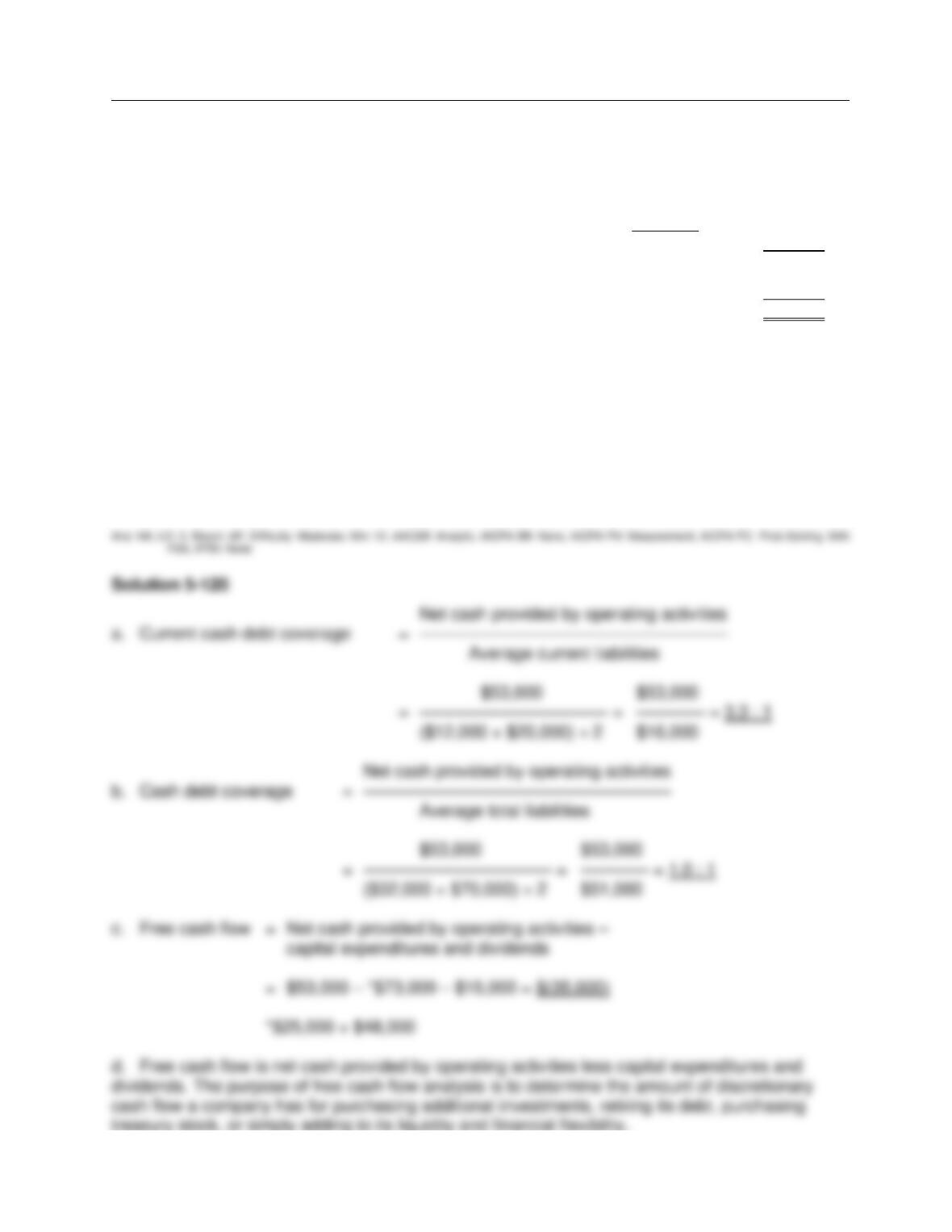
a. Current cash debt coverage
b. Cash debt coverage
c. Free cash flow
d. Explain the purpose of free cash flow analysis.

Test Bank for Intermediate Accounting, Seventeenth Edition
5 – 44
PROBLEMS
Pr. 5-121—Balance sheet format.
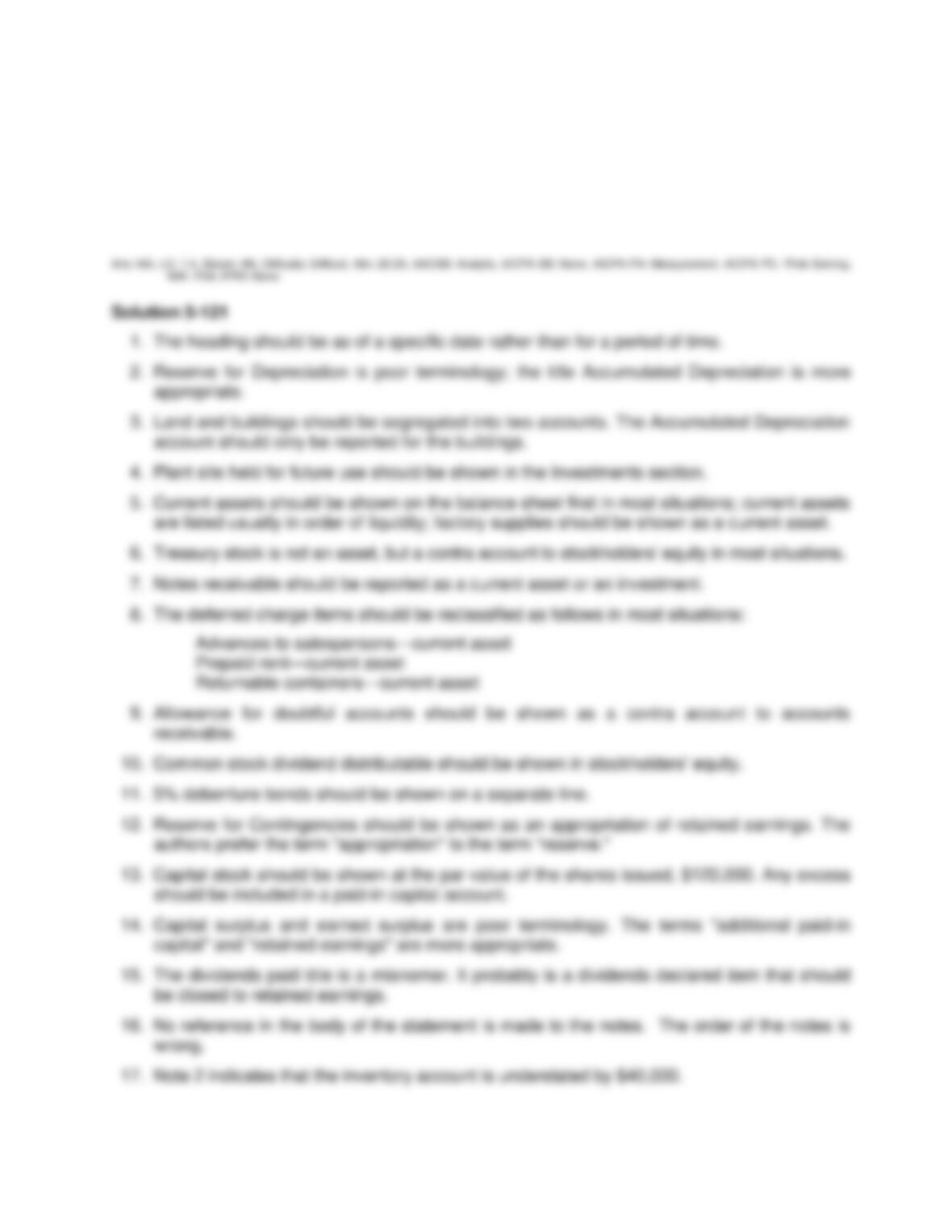
The following balance sheet has been submitted to you by an inexperienced bookkeeper. List
your suggestions for improvements in the format of the balance sheet. Consider both terminology
deficiencies as well as classification inaccuracies.
Jasper Industries, Inc.
Balance Sheet
For the Period Ended 12/31/20
Assets
Fixed Assets—Tangible
Equipment $110,000
Less: reserve for depreciation (40,000) $ 70,000
Factory supplies 22,000
Land and buildings 400,000
Less: reserve for depreciation (150,000) 250,000
Plant site held for future use 90,000 $ 432,000
Current Assets
Accounts receivable 175,000
Cash 80,000
Inventory 220,000
Treasury stock (at cost) 20,000 495,000
Fixed Assets—Intangible
Goodwill 80,000
Notes receivable 40,000
Patents 26,000 146,000
Deferred Charges
Advances to salespersons 60,000
Prepaid rent 27,000
Returnable containers 75,000 162,000
TOTAL ASSETS $1,235,000
Liabilities
Current Liabilities
Accounts payable $140,000
Allowance for doubtful accounts 8,000
Common stock dividend distributable 35,000
Income tax payable 42,000
Sales tax payable 17,000 $ 242,000
Long-term Liabilities, 5% debenture bonds, due 2023 500,000
Reserve for contingencies 150,000 650,000
TOTAL LIABILITIES 892,000
Equity
Capital stock, $10 par value, issued 12,000 shares with
60 shares held as treasury stock $150,000
Capital surplus 90,000
Dividends paid (20,000)
Earned surplus 123,000
TOTAL EQUITY 343,000
TOTAL LIABILITIES AND EQUITY $1,235,000
Balance Sheet and Statement of Cash Flows
5 – 45
Note 1. The reserve for contingencies has been created by charges to earned surplus and has
been established to provide a cushion for future uncertainties.
Note 2. The inventory account includes only items physically present at the main plant and
warehouse. Items located at the company’s branch sales office amounting to $40,000
are excluded since the company has consistently followed this procedure for many
years.
Test Bank for Intermediate Accounting, Seventeenth Edition
5 – 46
Pr. 5-122—Balance sheet presentation.
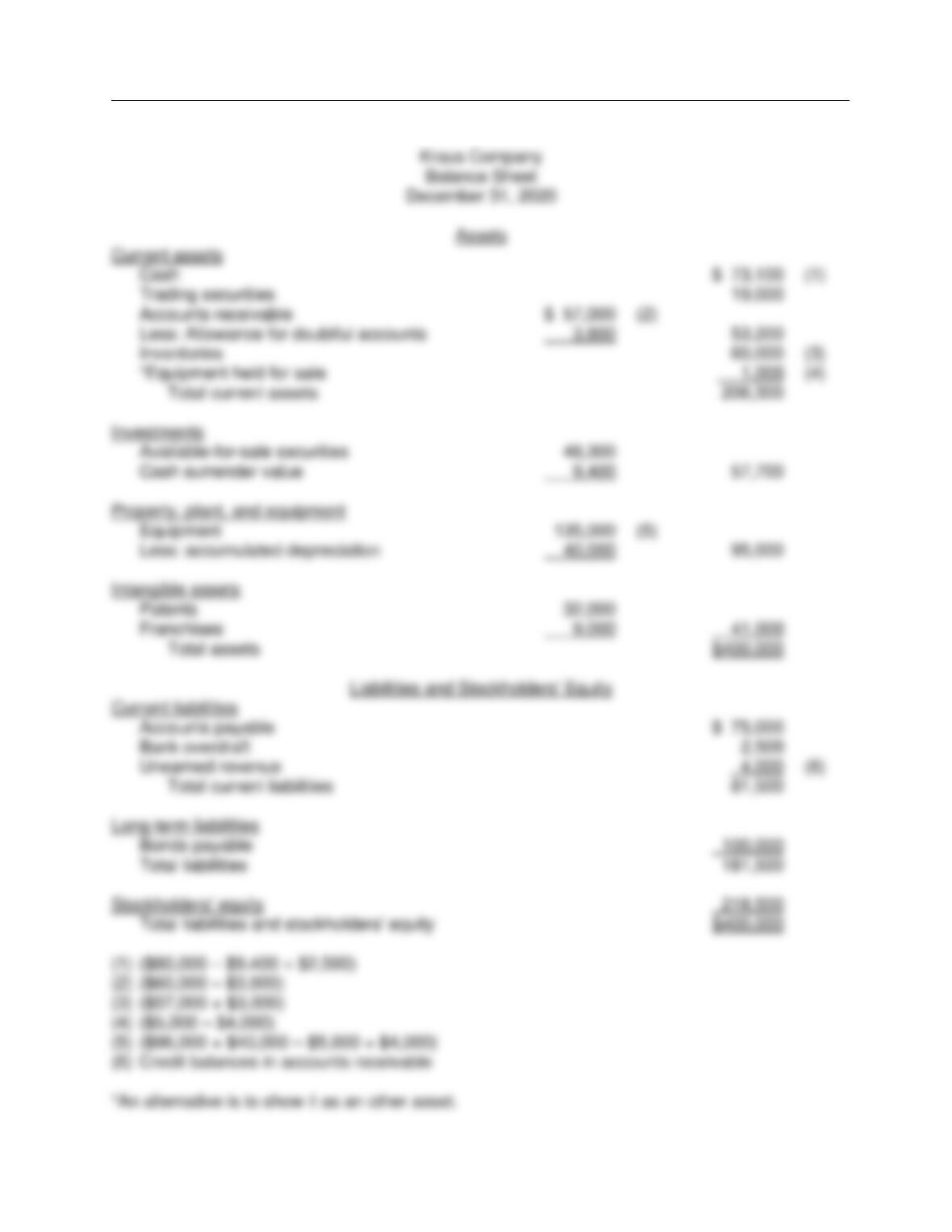
The following balance sheet was prepared by the bookkeeper for Kraus Company as of
December 31, 2020.
Kraus Company
Balance Sheet
as of December 31, 2020
Cash $ 80,000 Accounts payable $ 75,000
Accounts receivable (net) 52,200 Bonds payable 100,000
Inventory 57,000 Stockholders’ equity 218,500
Investments 76,300
Equipment (net) 96,000
Patents 32,000
$393,500 $393,500
The following additional information is provided:
1. Cash includes the cash surrender value of a life insurance policy $9,400, and a bank
overdraft of $2,500 has been deducted.
2. The net accounts receivable balance includes:
(a) accounts receivable—debit balances $60,000;
(b) accounts receivable—credit balances $4,000;
(c) allowance for doubtful accounts $3,800.
3. Inventory does not include goods costing $3,000 shipped out on consignment. Receivables of
$3,000 were recorded on these goods.
4. Investments include investments in common stock, trading $19,000 and available-for-sale
$48,300, and franchises $9,000.
5. Equipment costing $5,000 with accumulated depreciation $4,000 is no longer used and is
held for sale. Accumulated depreciation on the other equipment is $40,000.
Instructions
Prepare a balance sheet in good form (stockholders’ equity details can be omitted.)
Balance Sheet and Statement of Cash Flows
5 – 47
Solution 5-122
Test Bank for Intermediate Accounting, Seventeenth Edition
5 – 48
Pr. 5-123—Balance sheet presentation.
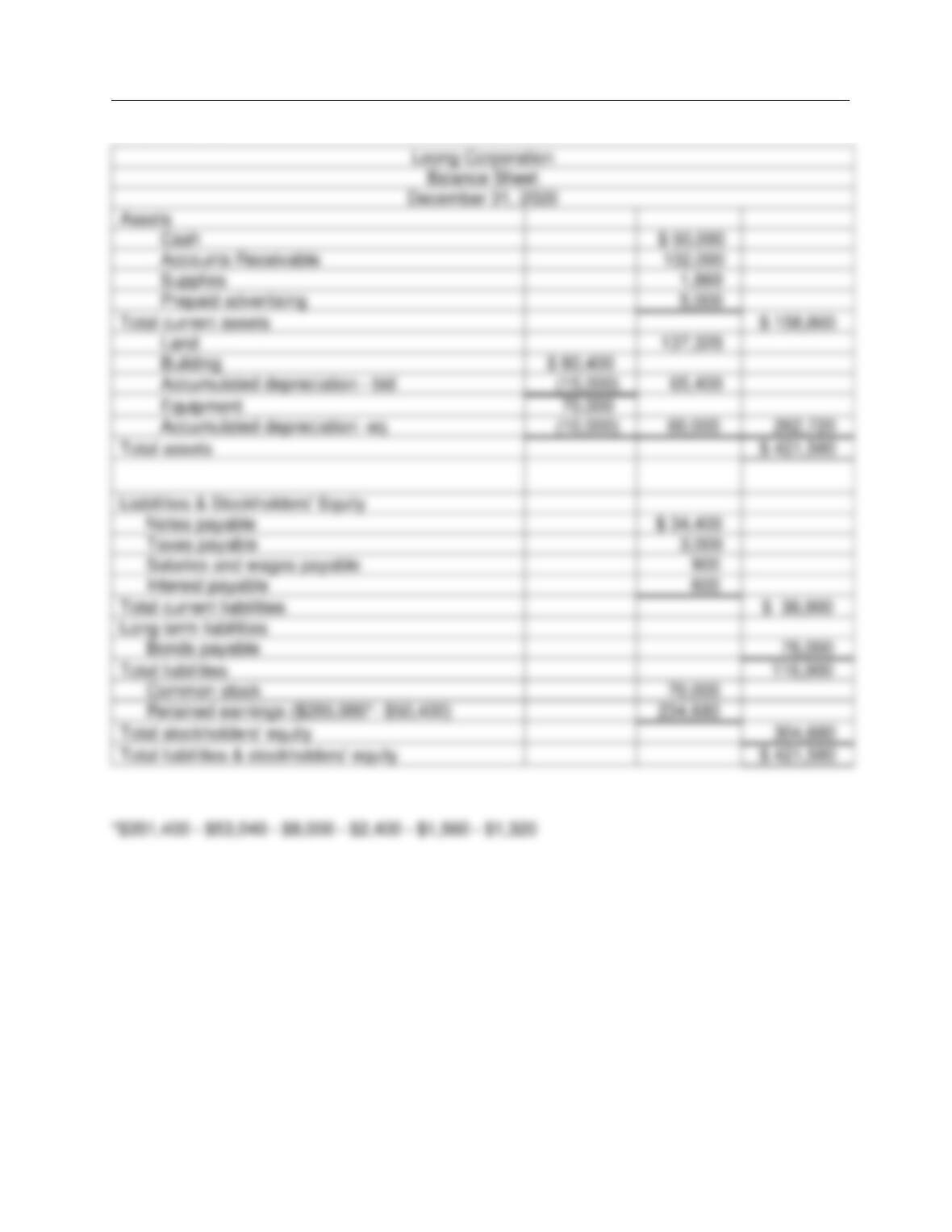
Given the following account information for Leong Corporation, prepare a balance sheet in report
form for the company as of December 31, 2020. All accounts have normal balances.
Equipment 70,000
Interest Expense 2,400
Interest Payable 600
Retained Earnings ?
Dividends 50,400
Land 137,320
Accounts Receivable 102,000
Bonds Payable 78,000
Notes Payable (due in 6 months) 34,400
Common Stock 70,000
Accumulated Depreciation – Equip. 10,000
Prepaid Advertising 5,000
Service Revenue 351,400
Buildings 80,400
Supplies 1,860
Income Taxes Payable 3,000
Utilities Expense 1,320
Advertising Expense 1,560
Salaries and Wages Expense 53,040
Salaries and Wages Payable 900
Accumulated Depr. – Bld. 15,000
Cash 50,000
Depreciation Expense 8,000
Balance Sheet and Statement of Cash Flows
5 – 49
Solution 5-123

Test Bank for Intermediate Accounting, Seventeenth Edition
5 – 50
Pr. 5-124—Statement of cash flows preparation.
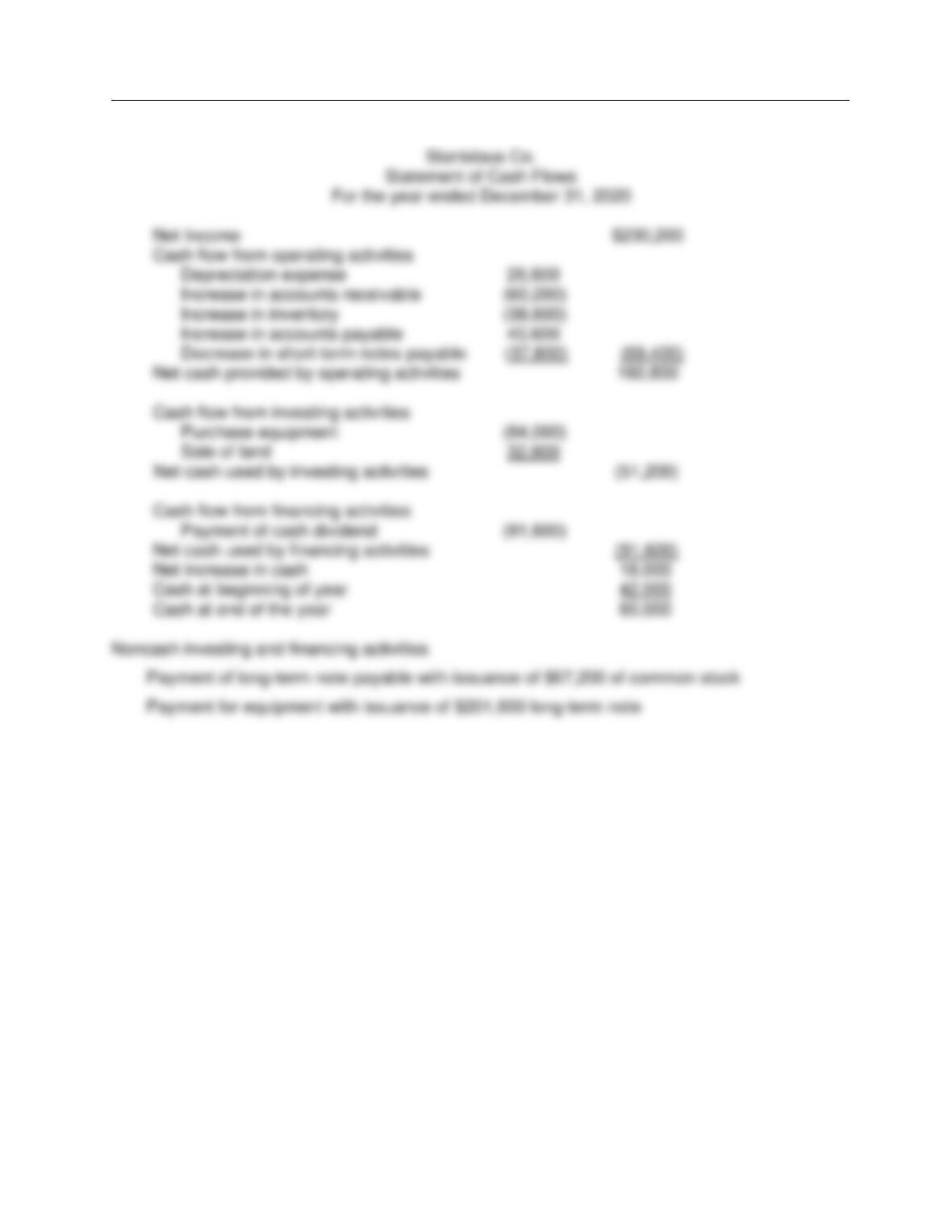
Selected financial statement information and additional data for Stanislaus Co. is presented
below. Prepare a statement of cash flows for the year ending December 31, 2020.
December 31
2019 2020
Cash ………………………………………………. $42,000 $60,000
Accounts receivable (net) ………………….. 84,000 144,200
Inventory …………………………………………. 168,000 206,600
Land ……………………………………………….. 58,800 26,000
Equipment ………………………………………. 504,000 789,600
TOTAL …………………………………. $856,800 $1,226,400
Accumulated depreciation …………………. $84,000 $110,600
Accounts payable …………………………….. 50,400 91,000
Notes payable – short-term ………………… 67,200 29,400
Notes payable – long-term …………………. 168,000 302,400
Common stock …………………………………. 420,000 487,200
Retained earnings ……………………………. 67,200 205,800
TOTAL …………………………………. $856,800 $1,226,400
Additional data for 2020:
1. Net income was $230,200.
2. Depreciation was $26,600.
3. Land was sold at its original cost.
4. Dividends of $91,600 were paid.
5. Equipment was purchased for $84,000 cash.
6. A long-term note for $201,600 was used to pay for an equipment purchase.
7. Common stock was issued to pay a $67,200 long-term note payable.
Balance Sheet and Statement of Cash Flows
5 – 51
Solution 5-124

Test Bank for Intermediate Accounting, Seventeenth Edition
5 – 52
Pr. 5-125—Statement of cash flows preparation.
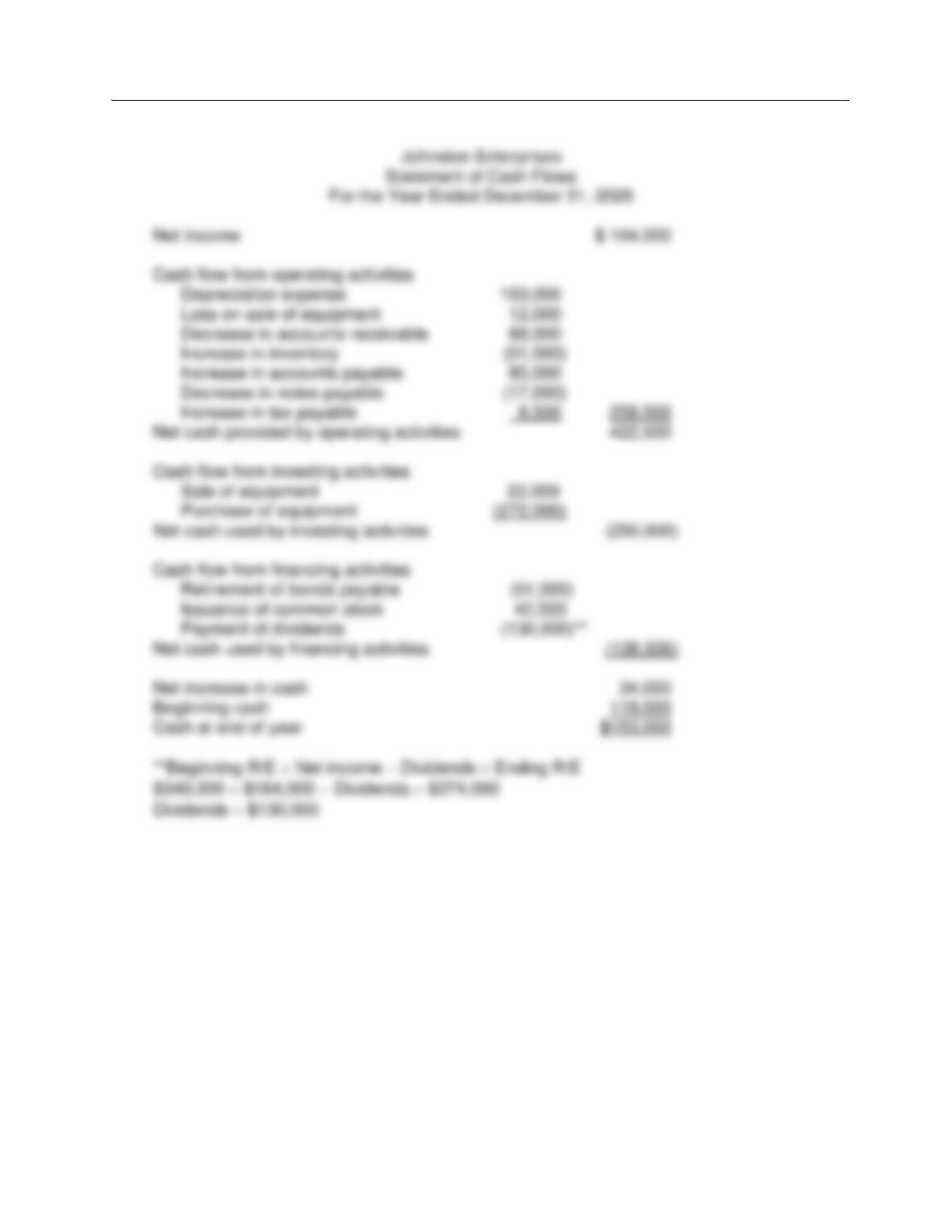
Selected financial statement information and additional data for Johnston Enterprises is
presented below. Prepare a statement of cash flows for the year ending December 31, 2020.
Johnston Enterprises
Balance Sheet and Income Statement Data
December 31, December 31,
2020 2019___
Current Assets:
Cash $153,000 $119,000
Accounts Receivable 238,000 306,000
Inventory 391,000 340,000
Total Current Assets 782,000 765,000
Property, Plant, and Equipment 1,241,000 1,122,000
Less: Accumulated Depreciation (476,000) (442,000)
Total Assets $1,547,000 $1,445,000
Current Liabilities:
Accounts Payable $187,000 $102,000
Notes Payable 51,000 68,000
Income Taxes Payable 85,000 76,500
Total Current Liabilities 323,000 246,500
Bonds Payable 340,000 391,000
Total Liabilities 663,000 637,500
Stockholders’ Equity:
Common Stock 510,000 467,500
Retained Earnings 374,000 340,000
Total Stockholders’ Equity 884,000 807,500
Total Liabilities & Stockholders’ Equity $1,547,000 $1,445,000
Sales Revenue 1,615,000 $1,513,000
Less Cost of Goods Sold 751,000 731,000
Gross Profit 864,000 782,000
Expenses:
Depreciation Expense 153,000 136,000
Salaries and Wages Expense 391,000 357,000
Interest Expense 34,000 34,000
Loss on Sale of Equipment 12,000 0
Income Before Taxes 274,000 255,000
Less Income Tax Expense 110,000 102,000
Net Income $164,000 $153,000
Additional Information:
During the year, Johnston sold equipment with an original cost of $153,000 and accumulated
depreciation of $119,000 and purchased new equipment for $272,000.
Ans: NA, LO: 3, Bloom: AP, Difficulty: Difficult, Min: 15–20, AACSB: Analytic, AICPA BB: None, AICPA FN: Measurement, AICPA PC: Prob Solving, IMA:
Reporting, IFRS: None
Balance Sheet and Statement of Cash Flows
5 – 53
Solution 5-125
Test Bank for Intermediate Accounting, Seventeenth Edition
5 – 54
IFRS QUESTIONS
True/False:
1. Although the presentation formats for the balance sheet and statement of cash flows are
similar under IFRS and U.S. GAAP, IFRS requires far more extensive disclosure.
2. One significant difference between a balance sheet prepared using IFRS rather than U.S.
GAAP is that long-term tangible assets may be reported at fair value rather than historical
cost.
3. Both IFRS and U.S. GAAP require that specific items be reported on the balance sheet.
4. Both IFRS and U.S. GAAP require current assets to be listed first on the balance sheet.
Answers to True/False:
Multiple Choice Questions:
5. Which of the following statements about IFRS and U.S. GAAP accounting and reporting
requirements for the balance sheet is not correct?
a. The presentation formats required by IFRS and U.S. GAAP for the balance sheet are
similar.
b. One difference between the reporting requirements under IFRS and those of
U.S. GAAP balance sheet is that an IFRS balance sheet may list long-term assets first.
c. Both IFRS and U.S. GAAP require that property, plant and equipment be reported at
historical cost on the balance sheet.
d. Both IFRS and U.S. GAAP require that comparative information be reported.
Use the following information to answer the next two questions.
Franco Company uses IFRS and owns property, plant and equipment with a historical cost of
5,000,000 euros. At December 31, 2019, the company reported a valuation reserve of
8,565,000 euros. At December 31, 2020, the property, plant and equipment was appraised at
5,525,000 euros.
Balance Sheet and Statement of Cash Flows
5 – 55
6. The property, plant and equipment will be reported on the December 31, 2020 statement of
financial position at
a. 5,000,000 euros.
b. 5,525,000 euros.
c. 8,565,000 euros.
d. 9,090,000 euros.
7. The valuation reserve at December 31, 2020 will be reported at
a. 8,040,000 euros on the Statement of Stockholders’ Equity.
b. 8,565,000 euros in the Assets section of the Statement of Financial Position
c. 9,090,000 euros in the equity section of the Statement of Financial Position.
d. 525,000 euros on the Income Statement.
8. Similarities between IFRS and U.S. GAAP requirements for balance sheet presentation
include all of the following except:
a. Both require that changes to the valuation reserve be disclosed in the notes to the
financial statements.
b. Both require disclosure of significant accounting policies.
c. Both require the preparation of financial statements annually.
d. Both generally require the use of the current/ non-current classification for both assets and
liabilities.
9. Under IFRS, current assets are listed in:
a. the order of liquidity.
b. the reverse order of liquidity.
c. the ascending order of their balances.
d. the descending order of their balances.
10. Under IFRS, which of the following current assets will be listed last in a statement of financial
position?
a. Inventory
b. Accounts Receivable
c. Short-term Investments Cash
d. Cash
Answers to Multiple Choice:
Test Bank for Intermediate Accounting, Seventeenth Edition
5 – 56
IFRS Short Answer:
11. Briefly describe some of the similarities and differences between GAAP and IFRS with
respect to statement of financial position reporting.
Among the similarities between IFRS and GAAP related to statement of financial position
presentation are as follows:
• IAS 1 specifies minimum note disclosures. These must include information about
(1) accounting policies followed, (2) judgments that management has made in the
process of applying the entity’s accounting policies, and (3) the key assumptions
and estimation uncertainty that could result in a material adjustment to the carrying
amounts of assets and liabilities within the next financial year.
• Comparative prior-period information must be presented and financial statements
must be prepared annually.
• Current/non-current classification for assets and liabilities is normally required. In
general, post-financial statement events are not considered in classifying items as
current or non-current.
Differences include (1) IFRS statements may report property, plant, and equipment first in
the statement of financial position. Some companies report the sub-total “net assets”,
which equals total assets minus total liabilities. (2) While the use of the term “reserve” is
discouraged in U.S. GAAP, there is no such prohibition in IFRS.
12. Briefly describe the convergence efforts related to financial statement presentation.
The IASB and the FASB are working on a project to converge their standards related to
financial statement presentation. A key feature of the proposed framework is that each of the
statements will be organized, in the same format, to separate an entity’s financing activities
from its operating and other investing activities and, further, to separate financing activities into
transactions with owners and creditors. Thus, the same classifications used in the statement of
financial position would also be used in the statement of comprehensive income and the
statement of cash flows.