
89. The following income statement information for 2010 and 2011 was obtained from the accounting records
of the Upperton Company.
2010
2011
Sales
$200,000
$150,000
Beginning inventory
(a)
________
(e)
________
Purchases (net)
40,000
50,000
Ending inventory
25,000
5,000
Cost of goods sold
(b)
________
60,000
Gross profit
65,000
(f)
________
Operating expenses
(c)
________
(g)
________
Income before income taxes
(d)
________
40,000
Income tax expense (30%)
14,100
(h)
________
Net income (loss)
32,900
(i)
________
Required:
Fill in the blanks for the missing data.
90. The information for the Rush Company is presented below:
Cost of goods sold
$30,000
Purchase returns and allowances
1,500
Sales returns and allowances
3,750
Gross profit
25,000
Selling expenses
9,000
Net income
10,750
Transportation-in
1,250
Purchases
35,000
Ending inventory
8,790
120,000
135,000
18,000
47,000
15,000
90,000
50,000
12,000
28,000
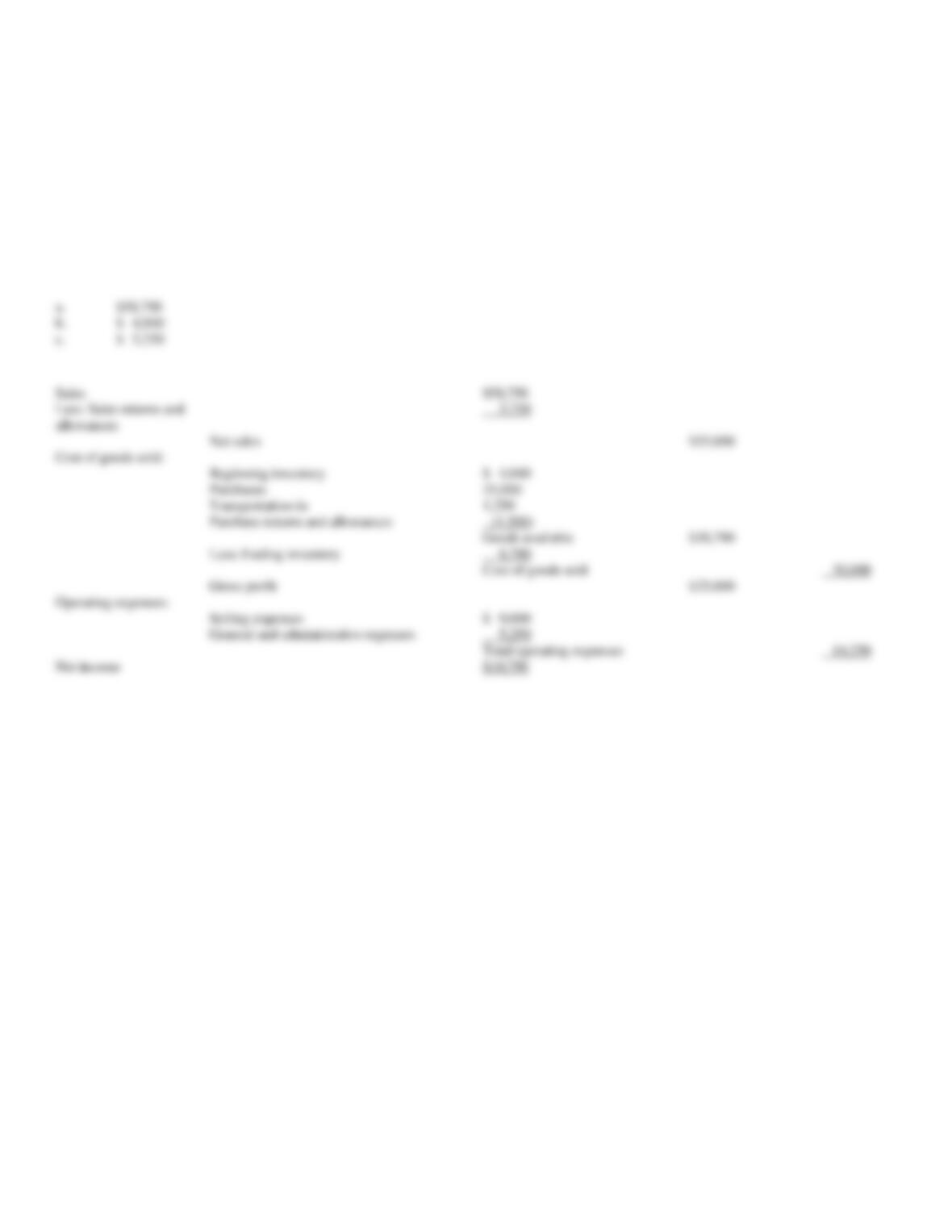
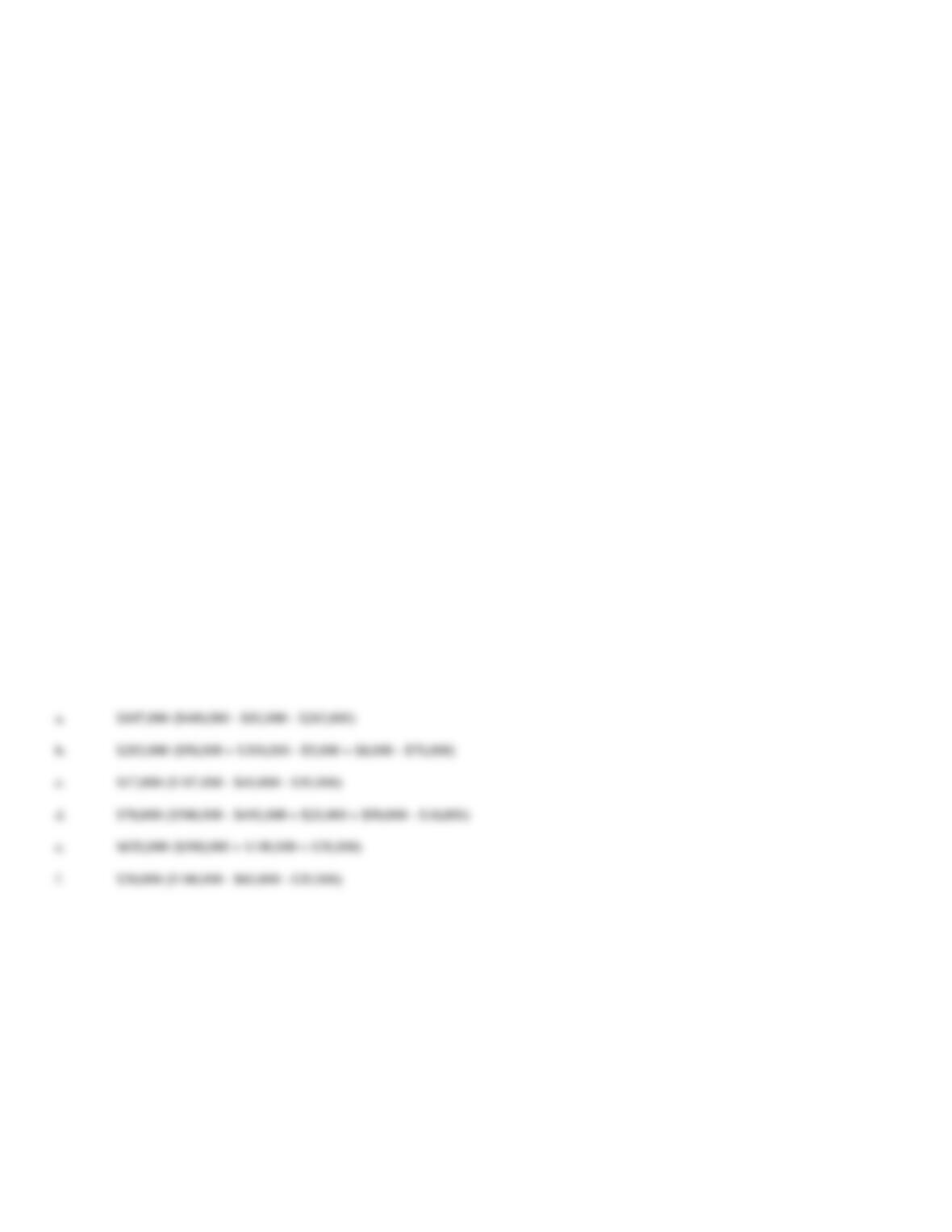
Required:
Compute the following (ignore income taxes):
a.
Sales
b.
Beginning inventory
c.
General and administrative expenses
a.
$58,750
$ 4,040
c.
$ 5,250
Sales
$58,750
Net sales
$55,000
Cost of goods sold:
Beginning inventory
$ 4,040
Purchases
35,000
1,250
Purchase returns and allowances
(1,500)
Goods available
$38,790
Less: Ending inventory
8,790
Cost of goods sold
Gross profit
$25,000
Operating expenses:
Selling expenses
$ 9,000
General and administrative expenses
5,250
Total operating expenses
Net income
$10,750
91. The income statement information for 2010 and 2011 of the Kappy Company (a sole proprietorship) is as
follows:
2010
2011
Beginning inventory
$ 50,000
(d)
________
Sales
400,000
(e)
________
Purchases
300,000
$490,000
Purchases returns and allowances
5,000
20,000
Ending inventory
70,000
50,000
Sales returns and allowances
10,000
20,000
Gross profit
(a)
________
100,000
Cost of goods sold
(b)
________
500,000
Selling expenses
40,000
60,000
Transportation-in
8,000
10,000
General and administrative expenses
50,000
(f)
________
Net income
(c)
________
20,000
Required:
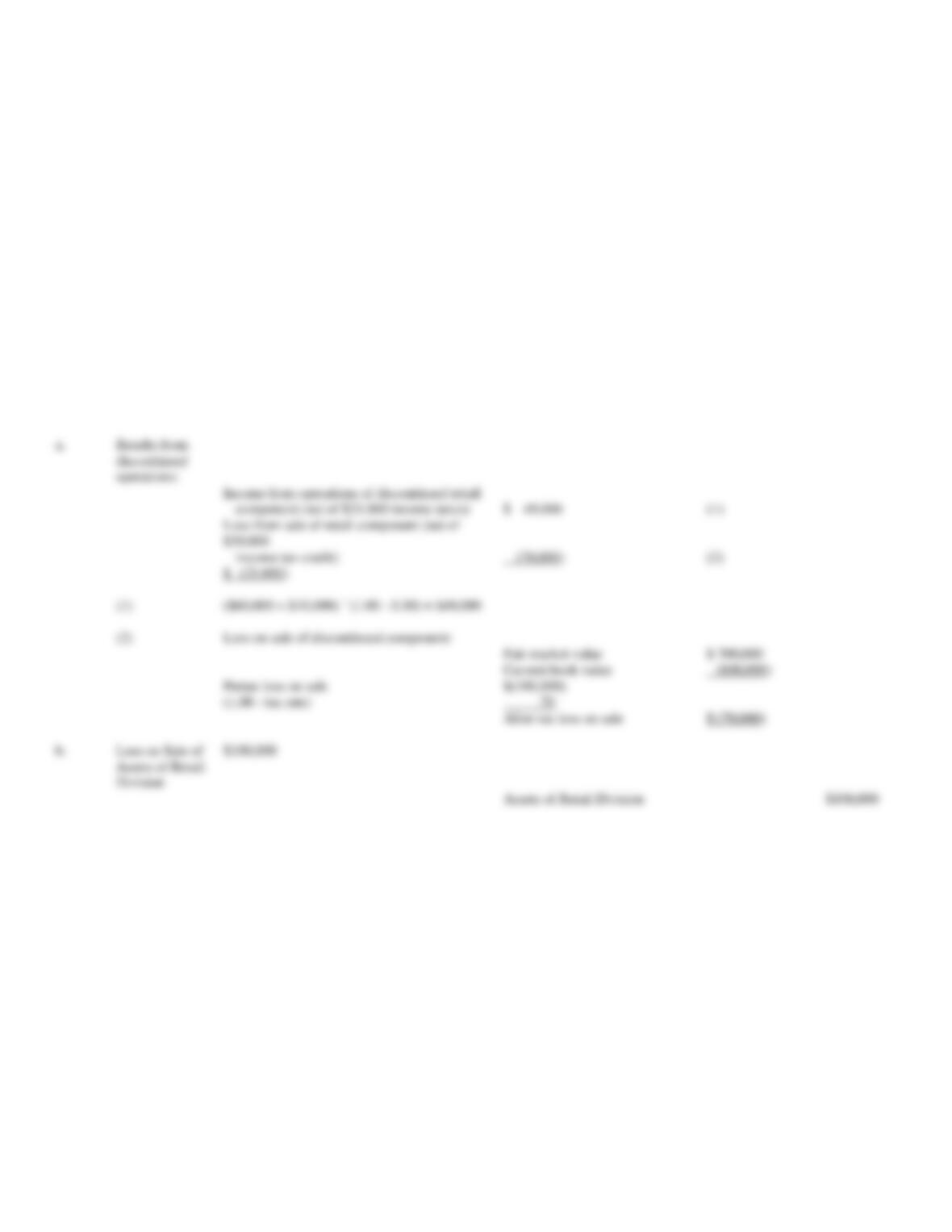
Fill in the blanks for the missing data. All the necessary information is listed.
$107,000 ($400,000 – $10,000 – $283,000)
$283,000 ($50,000 + $300,000 – $5,000 + $8,000 – $70,000)
$17,000 ($107,000 – $40,000 – $50,000)
$70,000 ($500,000 – $490,000 + $20,000 + $50,000 – $10,000)
$620,000 ($500,000 + $100,000 + $20,000)
$20,000 ($100,000 – $60,000 – $20,000)
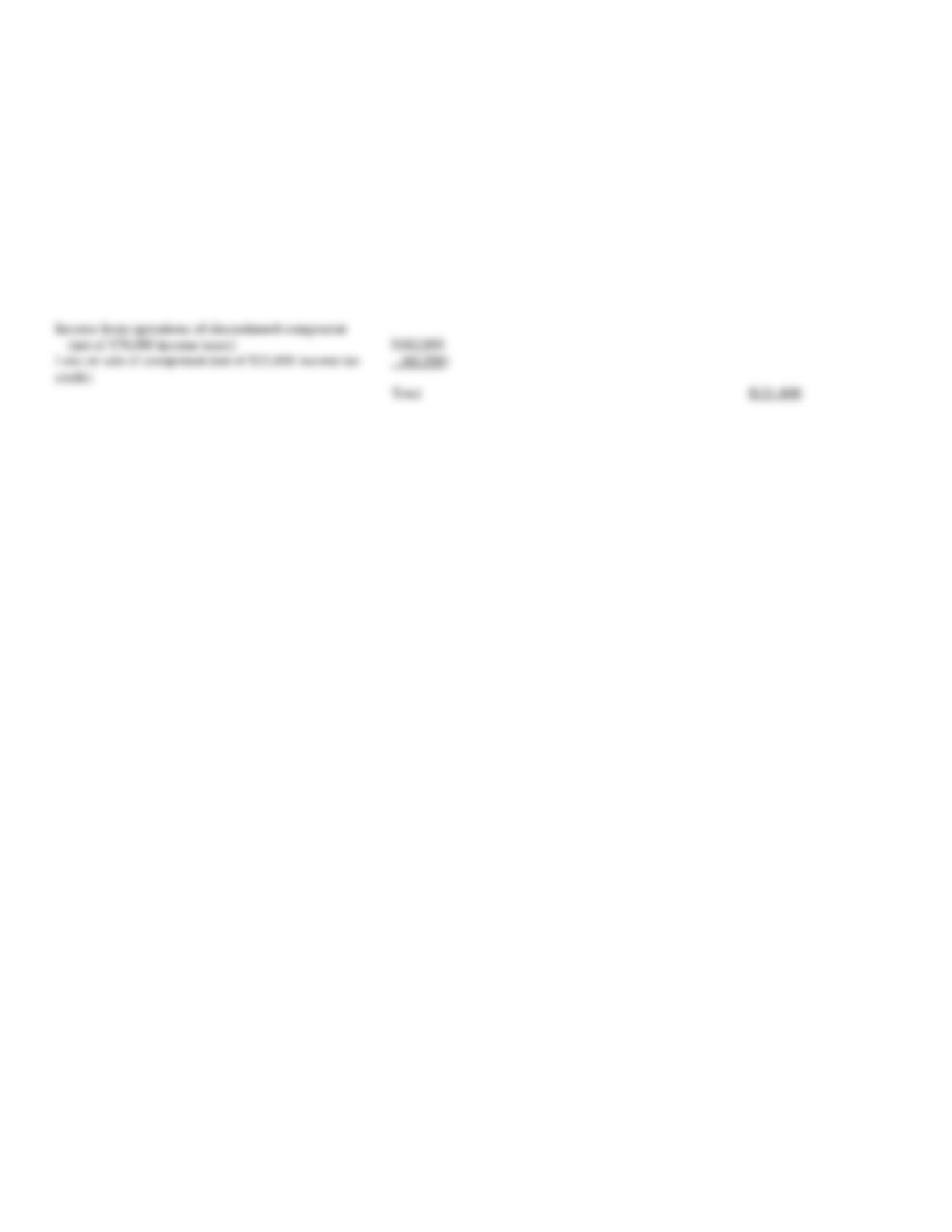
92. On October 1, 2010, Corsicana Corporation finalized its plans to discontinue operations of its retail
component. The plan calls for the sale of the retail operations to another company for $700,000 (current fair
value) on April l, 2011. The current book value of the assets is $800,000. For the first nine months of 2010, the
component incurred a pretax operating income of $60,000. During the last quarter of 2010, the pretax income
was $10,000, while the expected pretax income for the first quarter in 2011 is expected to be $20,000.
Corsicana is subject to a 30% income tax rate.
Required:
a.
Prepare the results from discontinued operations section of Corsicana’s income statement for 2010, using good format. Show all
computations.
b.
Prepare the journal entry to record the pretax loss on the held-for-sale assets of Corsicana’s retail component.
component (net of $21,000 income taxes)
$ 49,000
(1)
Loss from sale of retail component (net of
$30,000
$ (21,000)
(2)
Loss on sale of discontinued component:
After-tax loss on sale
$ (70,000)
93. On May 1, 2010, Wharton Company decided to dispose of its foreign sales operations (considered a major
class of customer). The component was sold on November 24, 2010, for $800,000 resulting in an $86,000 loss
on the sale. The foreign sales operations recorded a $260,000 operating profit in 2010 up to the date of sale.
Wharton Company is subject to a 30% income tax rate.
Required:
Prepare the results from discontinued operations section of Wharton Company’s income statement for 2010.
Results from discontinued operations:
94. Information from the accounts of the Nichols Company is shown below:
Sales (net)
$9,000,000
Purchases (net)
5,000,000
Operating expenses
1,100,000
Gain on sale of equipment
100,000
Extraordinary loss from earthquake (pretax)
400,000
Gain on sale of component
1,000,000
Operating loss from disposed component
200,000
Merchandise inventory, 12/31/10
1,900,000
Income from operations of discontinued component
(net of $78,000 income taxes)
$182,000
Total
$121,800
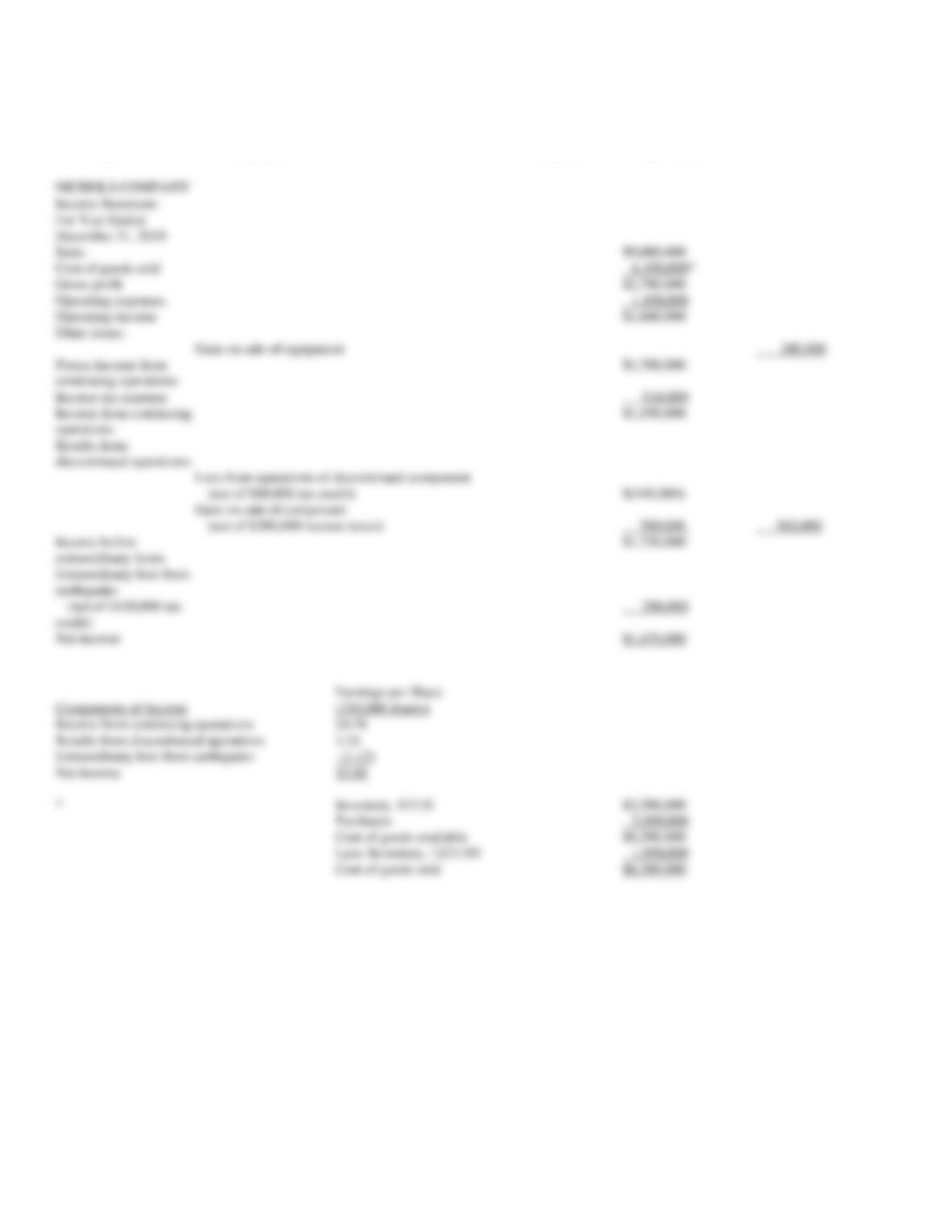
The merchandise inventory on January 1, 2010, was $3,200,000. There were 250,000 shares of common stock outstanding during the entire year.
Required:
Assuming a 30% income tax rate, prepare a 2010 income statement for the Nichols Company. Use a multiple-step format.
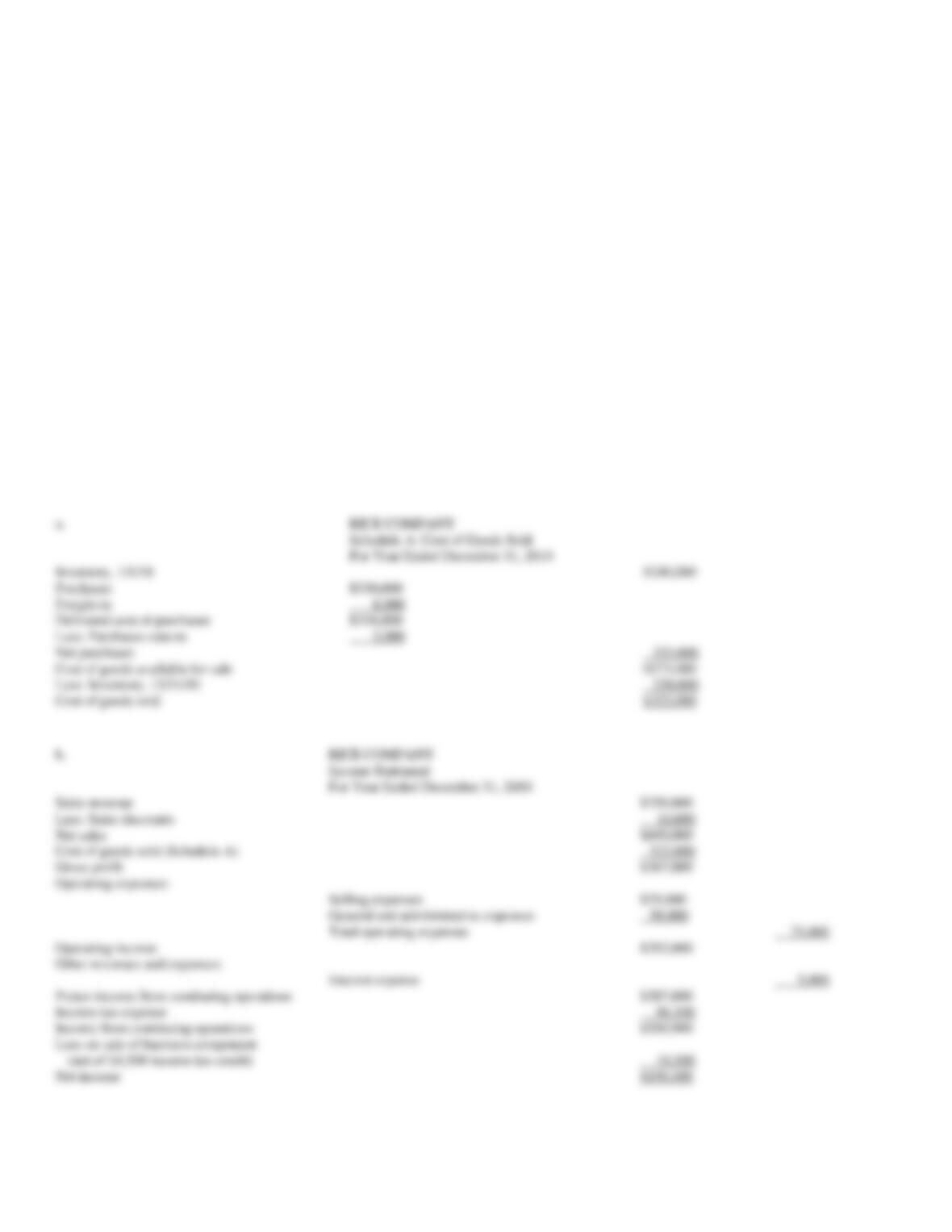
95. The information below is taken from the December 31, 2010 adjusted trial balance of the Rice Company:
Inventory, 1/1/10
$240,000
Sales
700,000
Selling expenses
25,000
General and administrative expenses
50,000
Interest expense
5,000
Purchases
330,000
Purchases returns
5,000
Sales discounts
10,000
Freight-in
8,000
Loss on sale of a major component of the business (pretax)
15,000
The inventory on December 31 was $250,000. The income tax rate is 30%. There were 25,000 shares of common stock outstanding throughout the
year.
Required:
a.
Prepare a schedule of the cost of goods sold.
b.
Prepare a 2010 income statement for the Rice Company, using a multiple-step format (disregard earnings per share).
c.
Prepare a 2010 income statement for the Rice Company, using a single-step format (disregard earnings per share).
Inventory, 1/1/10
$240,000
Purchases
$330,000
Freight-in
8,000
Delivered cost of purchases
$338,000
Less: Purchases returns
5,000
Net purchases
333,000
Cost of goods available for sale
$573,000
Less: Inventory, 12/31/10
250,000
Cost of goods sold
$323,000
Sales revenue
$700,000
Less: Sales discounts
10,000
Net sales
$690,000
Cost of goods sold (Schedule A)
323,000
Gross profit
$367,000
Operating expenses:
Selling expenses
$25,000
General and administrative expenses
50,000
Total operating expenses
75,000
Operating income
$292,000
Other revenues and expenses:
Interest expense
5,000
Pretax income from continuing operations
$287,000
Income tax expense
86,100
Income from continuing operations
$200,900
Loss on sale of business component
(net of $4,500 income tax credit)
10,500
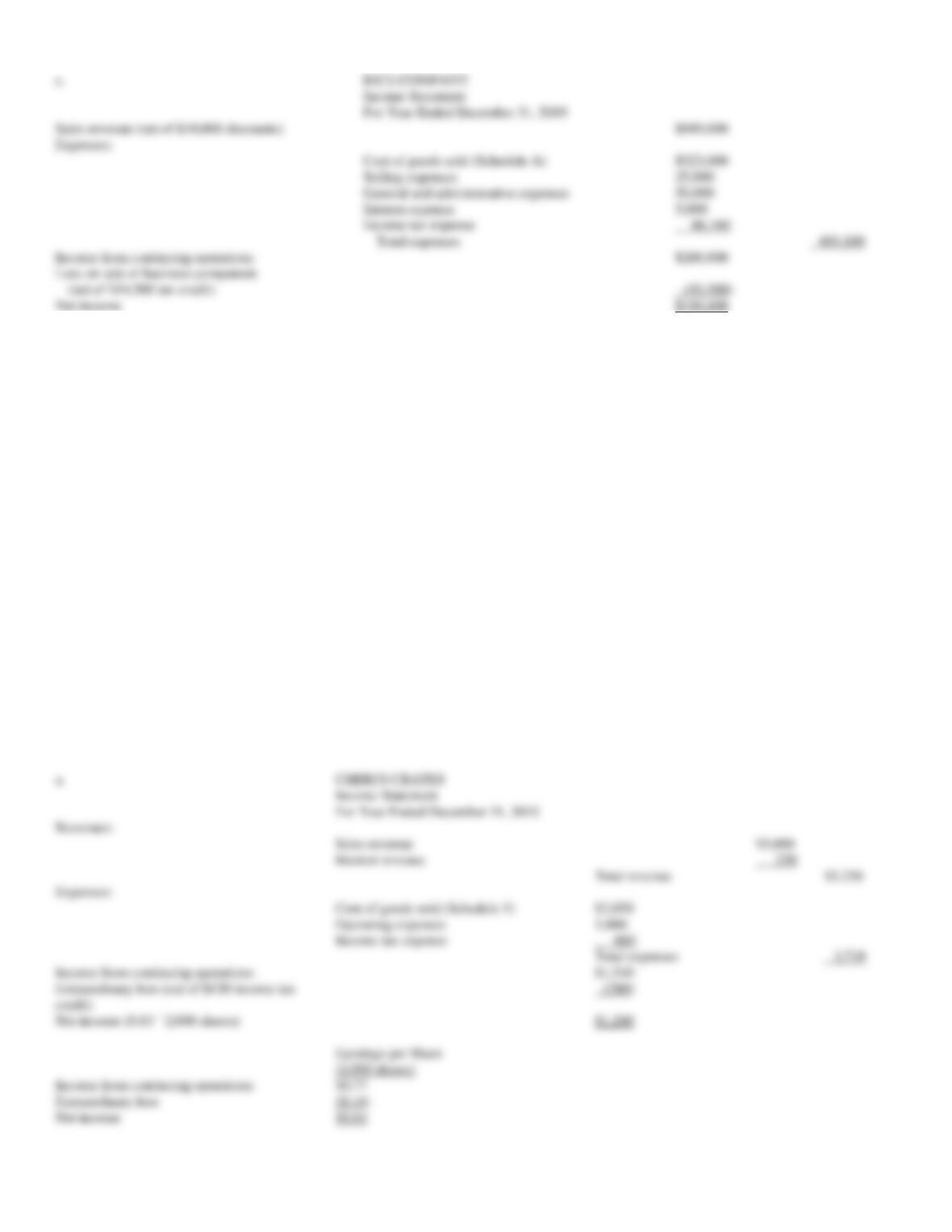
96. Below are selected accounts taken from the adjusted trial balance of Cheri’s Crates on December 31, 2010:
Operating expenses
$1,000
Sales revenue
5,000
Finished goods inventory, Jan. 1, 2010
1,600
Purchases
1,200
Interest revenue
250
Extraordinary loss (pre-tax)
400
Finished goods inventory, Dec. 31, 2010
750
Income tax expense
660
Cheri’s Crates has 2,000 shares of common stock outstanding and net income per share for 2010 was $0.63. The income tax rate is 30%.
Required:
a.
Prepare a single-step income statement.
b.
Prepare a multiple-step income statement.
Revenues:
Sales revenue
$5,000
Interest revenue
250
Total revenue
$5,250
Expenses:
Cost of goods sold (Schedule 1)
$2,050
Operating expenses
1,000
Income tax expense
660
Total expenses
3,710
Income from continuing operations
$1,540
Net income ($.63 ´ 2,000 shares)
$1,260
Earnings per Share
Net income
$0.63
Sales revenue (net of $10,000 discounts)
$690,000
Expenses:
Cost of goods sold (Schedule A)
$323,000
Selling expenses
25,000
General and administrative expenses
50,000
Interest expense
5,000
Income tax expense
86,100
Total expenses
489,100
Income from continuing operations
$200,900
Loss on sale of business component
(net of $14,500 tax credit)
(10,500)
Net income
$190,400
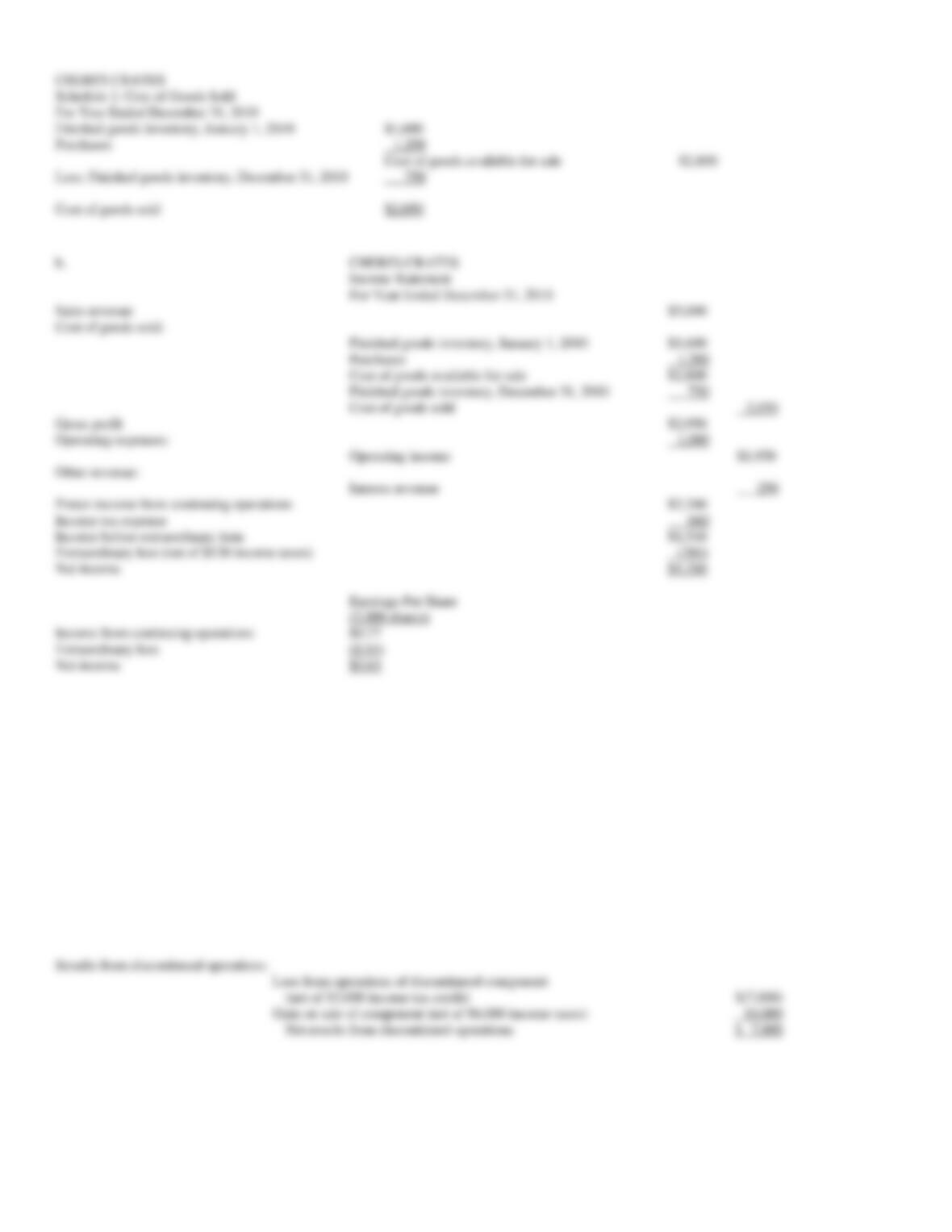
97. Tate Corporation sold Division X (a business component). It was determined that the pretax loss from the
operations of Division X during the year totaled $10,000 and that a pretax gain of $20,000 was realized on the
sale of the division. The tax rate is 30%.
Required:
In good form, prepare the appropriate section of the income statement.
98. Barlow, Inc., reported income from continuing operations (before taxes) of $30,000. In addition, there was a
$5,000 loss from an unusual and infrequent flood. Taxes of $7,500 (30%) were paid.
Required:
Prepare the bottom portion of the income statement.
99. The following accounts are taken from the accounting records of the Nemo Company at December 31,
2010, after adjustments:
Sales
$250,000
Sales salaries expense
14,000
Administrative salaries expense
15,000
Depreciation expense: equipment
8,000
Purchases
160,000
Sales returns
1,000
Purchases returns
2,000
Freight-in
10,000
Inventory, 1/1/10
80,000
Retained earnings, 1/1/10
60,000
In addition, the following information is available:
·
In December, an accountant for the company discovered that depreciation in the amount of $5,000 (pretax) on a major piece of
equipment had not been recorded in 2008. The amount is considered material.
·
The inventory on December 31, 2010, was $75,000.
·
Ten thousand shares of common stock were outstanding during the entire year. Nemo paid dividends of $1.00 per share.
·
At the end of October, Nemo sold its unprofitable restaurant component. From January through October, the component had incurred an
operating loss (pretax) of $14,000. The sale was made at a loss (pretax) of $8,000.
·
In November, the company sold the only land it ever owned for a gain of $10,000.
·
The applicable tax rate is 30%.
Pretax income from continuing operations
$30,000
Income tax expense
9,000
Income from continuing operations
$21,000
Extraordinary item:
Flood loss (net of $1,500 income tax credit)
(3,500)
Net income
$17,500
Required:
Prepare a 2010 multiple-step income statement for the Nemo Company.
100. Accounting information might be separately reported in any of the following components of the income
statement or statement of retained earnings and their supporting schedules and footnotes:
a.
income from continuing operations or supporting schedules
b.
extraordinary gains or losses
c.
footnote disclosure
d.
statement of retained earnings
e.
results from discontinued operations
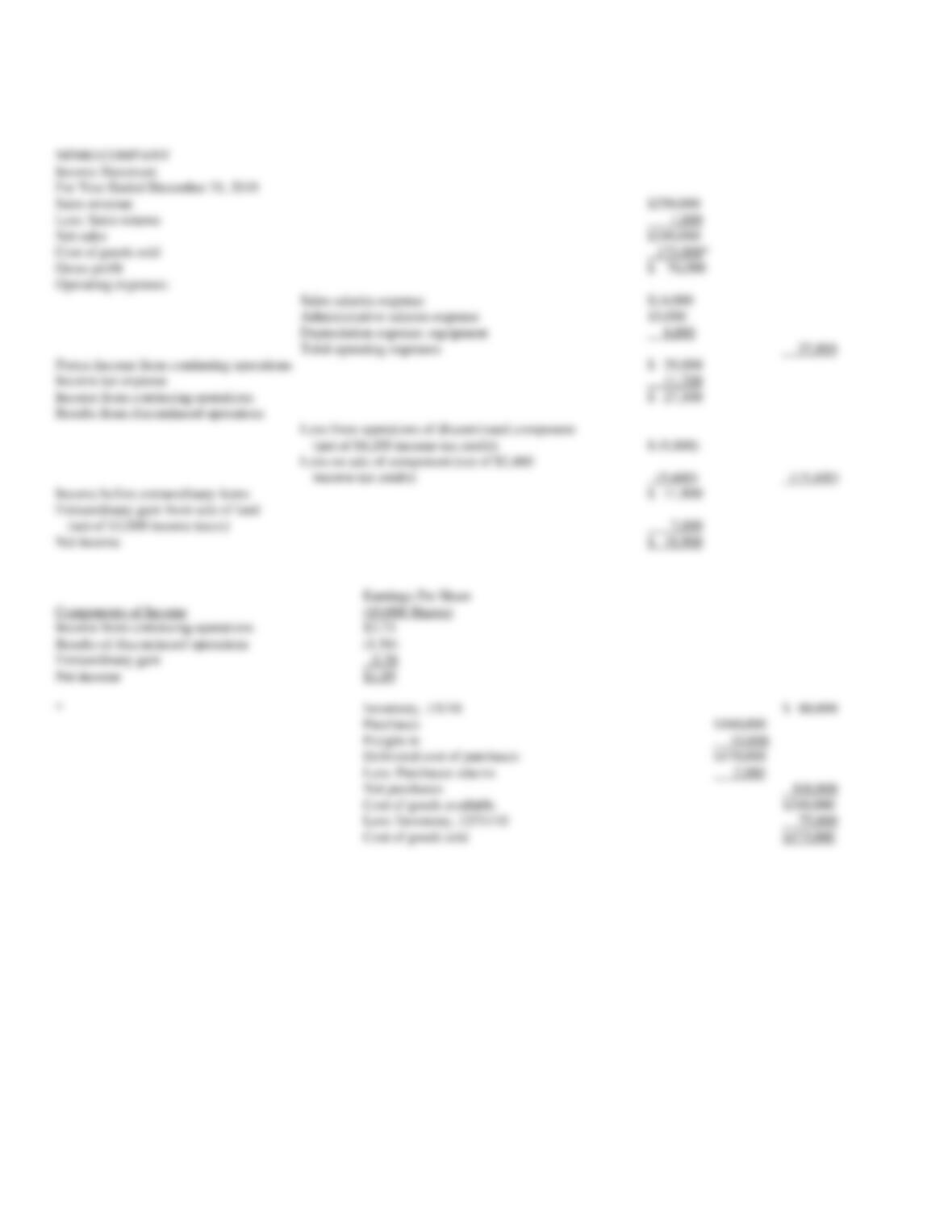
Sales revenue
$250,000
Less: Sales returns
1,000
Net sales
$249,000
Cost of goods sold
173,000*
Gross profit
$ 76,000
Operating expenses:
Sales salaries expense
$14,000
Administrative salaries expense
15,000
Depreciation expense: equipment
8,000
Total operating expenses
37,000
Pretax income from continuing operations
$ 39,000
Income tax expense
11,700
Income from continuing operations
$ 27,300
Results from discontinued operations
Loss from operations of discontinued component
(net of $4,200 income tax credit)
$ (9,800)
Loss on sale of component (net of $2,400
income tax credit)
(5,600)
(15,400)
Income before extraordinary items
$ 11,900
Extraordinary gain from sale of land
(net of $3,000 income taxes)
7,000
Net income
$ 18,900
Earnings Per Share
Components of Income
(10,000 Shares)
Income from continuing operations
Extraordinary gain
0.70
Net income
$1.89
*
Inventory, 1/1/10
$ 80,000
Purchases
$160,000
10,000
Delivered cost of purchases
$170,000
Less: Purchases returns
2,000
Net purchases
168,000
Cost of goods available
$248,000
Less: Inventory, 12/31/10
75,000
Cost of goods sold
$173,000

Several items of accounting information are listed below.
____
1.
Earthquake damage to the only silo owned by a company in Kansas, when the damage caused a material loss to the
company
____
2.
Material effect of changing the estimated useful lives for a group of depreciable assets from 20 years to 12 years
____
3.
Loss on sale by a highly diversified company of one of its four manufacturing plants
____
4.
Dividends to shareholders declared by the corporation during the year
____
5.
Operating loss of the current period of a component sold late in the year
____
6.
Total amount of cash paid to employees during the year
____
7.
Total selling expenses incurred by a producer of farm equipment during the year
____
8.
Impact of a change in the method of valuing inventory from the first-in, first-out method (FIFO) to the average cost method
Required:
By placing the letters (a-e) in the space provided above, identify where the information would be most appropriately reported. If the information
would not appear in any of the above components, place an (X) in the space. Items may be reported in more than one location.
101. Below is a list of financial statement components with a corresponding letter code.
a.
Sales revenue (net)
b.
Cost of goods sold
c.
Selling expenses
d.
General and administrative expenses
e.
Other revenue and expenses
f.
Results from discontinued operations
g.
Extraordinary items
h.
Prior period adjustments
i.
Additions to retained earnings (other than h)
j.
Deductions from retained earnings (other than h)
k.
Footnotes to financial statements
l.
Ending balance sheet
1.
b, c
5.
e
2.
a, c
6.
X
3.
a
7.
a
4.
d
8.
a, d