a.
decrease to Sales.
b.
increase to Sales.
c.
decrease to Sales Returns and Allowances.
d.
increase to Sales Returns and Allowances.
36. Under the perpetual inventory system, the entry to record a purchase return would include a credit to
which account?
a.
Merchandise Inventory
b.
Purchases Returns and Allowances
c.
Accounts Receivable
d.
Cash
37. Under the perpetual inventory system, in addition to making the entry to record a sales return, a
company would
a.
increase Merchandise Inventory and decrease Cost of Goods Sold.
b.
increase Cost of Goods Sold and decrease Purchases.
c.
increase Cost of Goods Sold and decrease Merchandise Inventory.
d.
make no additional entry until the end of the period.
38. Bryan Company purchased merchandise worth $1,800 on credit, terms n/30. What is the required
journal entry to record the transaction under the perpetual inventory system?
a.
Accounts Receivable 1,800
Purchases 1,800
b.
Purchases 1,800
Merchandise Inventory 1,800
c.
Merchandise Inventory 1,800
Accounts Payable 1,800
d.
Accounts Payable 1,800
Merchandise Inventory 1,800
39. Bryan Company purchased merchandize worth $1,800 on credit, terms n/30 and returned merchandise
worth $200 the next day. What is the required journal entry to record the merchandise returns under
the perpetual inventory system?
a.
Accounts Payable 200
Purchases Returns and Allowances 200
b.
Accounts Payable 200
Merchandise Inventory 200
c.
Merchandise Inventory 200
Purchases Returns and Allowances 200
d.
Purchases Returns and Allowances 200
Merchandise Inventory 200
40. Feathertouch Company sold merchandise worth $800 on credit, terms n/15. The cost of the
merchandise sold was $550. What is the required journal entry to record the transaction under the
perpetual inventory system?
a.
Accounts Receivable 800
Sales 800
Cost of Goods Sold 550
Merchandise Inventory 550
b.
Sales 800
Accounts Receivable 800
Merchandise Inventory 550
Cost of Goods Sold 550
c.
Accounts Receivable 800
Merchandise Inventory 800
Cost of Goods Sold 550
Merchandise Inventory 550
d.
Merchandise Inventory 800
Sales 800
Cost of Goods Sold 550
Merchandise Inventory 550
41. Feathertouch Company sold merchandise worth $800 on credit, terms n/15 and the next day the
customer returned merchandise worth $50, which cost $30 for Feathertouch company. What is the
required journal entry to record the merchandise returns under the perpetual inventory system?
a.
Accounts Receivable 50
Sales Returns and Allowances 50
Cost of Goods Sold 30
Merchandise Inventory 30
b.
Sales Returns and Allowances 50
Accounts Receivable 50
Merchandise Inventory 30
Cost of Goods Sold 30
c.
Accounts Receivable 50
Merchandise Inventory 50
Cost of Goods Sold 30
Sales 30
d.
Merchandise Inventory 50
Sales 50
Sales 30
Cost of Goods Sold 30
42. The amount of goods available for sale during the year depends on the amounts of
a.
beginning merchandise inventory, net cost of purchases, and ending merchandise
inventory.
b.
beginning merchandise inventory and cost of goods sold.
c.
beginning merchandise inventory, cost of goods sold, and ending merchandise inventory.
d.
beginning merchandise inventory and net cost of purchases.
43. Which of the following is not considered in computing net cost of purchases?
a.
Freight-out expenses
b.
Purchases
c.
Freight paid on purchased goods
d.
Purchases returns and allowances
44. Which of the following is necessary for computing cost of goods sold but not necessary for computing
goods available for sale?
a.
Freight-in
b.
Purchases
c.
Ending merchandise inventory
d.
Beginning merchandise inventory
45. The entry to record a purchase of $12,000 in merchandise assuming terms of 2/10, n/30 and a periodic
inventory system would include a(n)
a.
increase to Accounts Payable for $12,000.
b.
increase to Purchases Discounts for $240.
c.
decrease to Purchases for $12,000.
d.
decrease to Accounts Payable for $11,760.
46. Assuming that net cost of purchases was $116,000 during the year and that ending merchandise
inventory was $2,000 less than the beginning merchandise inventory of $25,000, how much was cost
of goods sold?
a.
$139,000
b.
$143,000
c.
$118,000
d.
$93,000
47. Use this information to answer the following question.
Account Name
Debit
Credit
Sales
303,000
Sales Returns and Allowances
10,000
Purchases
68,000
Purchases Returns and Allowances
8,000
Freight-In
12,000
Selling Expenses
30,000
General and Administrative Expenses
110,000
In addition, beginning merchandise inventory was $22,000 and ending merchandise inventory was
$14,000.
Net sales for the period were
a.
$303,000.
b.
$273,000.
c.
$293,000.
d.
$213,000.
48. Use this information to answer the following question.
Account Name
Debit
Credit
Sales
600,000
Sales Returns and Allowances
20,000
Purchases
106,000
Purchases Returns and Allowances
16,000
Freight-In
24,000
Selling Expenses
60,000
General and Administrative Expenses
220,000
In addition, beginning merchandise inventory was $44,000 and ending merchandise inventory was
$28,000.
Net cost of purchases for the period were
a.
$154,000.
b.
$90,000.
c.
$114,000.
d.
$138,000.
49. Use this information to answer the following question.
Account Name
Debit
Credit
Sales
300,000
Sales Returns and Allowances
10,000
Purchases
62,000
Purchases Returns and Allowances
8,000
Freight-In
12,000
Selling Expenses
30,000
General and Administrative Expenses
110,000
In addition, beginning merchandise inventory was $22,000 and ending merchandise inventory was
$14,000.
Cost of goods sold for the period was
a.
$74,000.
b.
$62,000.
c.
$88,000.
d.
$58,000.
50. Use this information to answer the following question.
The selected accounts and balances for Pawnee Market appear as follows:
Advertising Expense
$ 28,000
Common Stock
200,000
Dividends
42,000
Freight-In
14,000
Freight-Out Expense
20,000
Interest Income
48,000
Merchandise Inventory (Jan. 1)
140,000
Merchandise Inventory (Dec. 31)
112,000
Purchases
120,000
Purchases Returns and Allowances
8,000
Rent Expense
18,000
Retained Earnings
80,000
Sales
300,000
Sales Returns and Allowances
38,000
Wages Expense
64,000
The amount of net sales on the income statement would be
a.
$338,000.
b.
$288,000.
c.
$262,000.
d.
$274,000.
51. Use this information to answer the following question.
The selected accounts and balances for Pawnee Market appear as follows:
Advertising Expense
$ 28,000
Common Stock
200,000
Dividends
42,000
Freight-In
14,000
Freight-Out Expense
20,000
Interest Income
48,000
Merchandise Inventory (Jan. 1)
116,000
Merchandise Inventory (Dec. 31)
112,000
Purchases
120,000
Purchases Returns and Allowances
8,000
Rent Expense
18,000
Retained Earnings
80,000
Sales
300,000
Sales Returns and Allowances
38,000
Wages Expense
64,000
Goods available for sale would appear on the income statement as
a.
$228,000.
b.
$122,000.
c.
$242,000.
d.
$102,000.
52. Use this information to answer the following question.
The selected accounts and balances for Pawnee Market appear as follows:
Advertising Expense
$ 28,000
Common Stock
200,000
Dividends
42,000
Freight-In
14,000
Freight-Out Expense
20,000
Interest Income
48,000
Merchandise Inventory (Jan. 1)
140,000
Merchandise Inventory (Dec. 31)
112,000
Purchases
120,000
Purchases Returns and Allowances
8,000
Rent Expense
18,000
Retained Earnings
80,000
Sales
302,000
Sales Returns and Allowances
38,000
Wages Expense
64,000
Gross margin from sales would be
a.
$124,000.
b.
$110,000.
c.
$148,000.
d.
$136,000.
53. Chancellor Company purchased merchandise worth $900 on credit, terms n/30. What is the required
journal entry to record the transaction under the periodic inventory system?
a.
Accounts Receivable 900
Purchases 900
b.
Purchases 900
Accounts Payable 900
c.
Merchandise Inventory 900
Accounts Payable 900
d.
Accounts Payable 900
Merchandise Inventory 900
54. Chancellor Company purchased merchandise worth $900 on credit, terms n/30 and returned
merchandise worth $100 on next day. What is the required journal entry to record the merchandise
returns under the periodic inventory system?
a.
Accounts Payable 100
Purchases Returns and Allowances 100
b.
Accounts Payable 100
Merchandise Inventory 100
c.
Merchandise Inventory 100
Purchases Returns and Allowances 100
d.
Purchases Returns and Allowances 100
Merchandise Inventory 100
55. Rogers Company sold merchandise worth $1,600 on credit, terms n/15. The merchandise sold had cost
$1,100. What is the required journal entry to record the transaction and to transfer the cost of
merchandise inventory to cost of goods sold under the periodic inventory system?
a.
Accounts Receivables 1,600
Sales 1,600
No entry for transfer to cost of goods sold.
b.
Sales 1,600
Accounts Receivables 1,600
Merchandise Inventory 1,100
Cost of Goods Sold 1,100
c.
Accounts Receivables 1,600
Merchandise Inventory 1,600
Cost of Goods Sold 1,100
Merchandize Inventory 1,100
d.
Merchandise Inventory 1,600
Sales 1,600
No entry for transfer to cost of goods sold.
56. On June 3, Win-Tel Company sold merchandise worth $800 on credit, terms 2/10, n/30. The
merchandise sold had cost $550. The customer paid the amount on June 10.
What is the required journal entry to record the payment received under the periodic inventory system?
a.
Accounts Receivable 784
Sales Discounts 16
Cash 800
b.
Accounts Receivable 800
Sales Discounts 16
Cash 784
c.
Cash 784
Sales Discounts 16
Accounts Receivable 800
d.
Cash 800
Sales Discounts 16
Accounts Receivable 816
57. On June 3, Win-Tel Company sold merchandise worth $800 on credit, terms 2/10, n/30. The
merchandise sold had cost $550. The customer paid the amount on June 15.
What is the required journal entry to record the payment received under the periodic inventory system?
a.
Accounts Receivable 784
Sales Discounts 16
Cash 800
b.
Accounts Receivable 800
Cash 800
c.
Cash 784
Sales Discounts 16
Accounts Receivable 800
d.
Cash 800
Accounts Receivable 800
58. On May 13, Wagoner Company purchased merchandize worth $2,400 on credit, terms 2/10, n/30. The
amount was paid on May 20. What is the required journal entry to record the payment under the
periodic inventory system?
a.
Accounts Payable 2,352
Purchases Discounts 48
Cash 2,400
b.
Accounts Payable 2,400
Purchases Discounts 48
Cash 2,352
c.
Cash 2,352
Purchases Discounts 48
Accounts Payable 2,400
d.
Cash 2,400
Purchases Discounts 48
Accounts Payable 2,448
59. On May 13, Maryland Company purchased merchandise worth $2,400 on credit, terms 2/10, n/30. The
amount was paid on May 25. What is the required journal entry to record the payment under the
periodic inventory system?
a.
Accounts Payable 2,352
Purchases Discounts 48
Cash 2,400
b.
Accounts Payable 2,400
Purchases Discounts 48
Cash 2,352
c.
Cash 2,400
Accounts Payable 2,400
d.
Accounts Payable 2,400
Cash 2,400
60. Assume a company uses the periodic inventory system and has a beginning merchandise inventory
balance of $5,000, purchases of $75,000, and sales of $125,000. The company closes its records once a
year on December 31. In the accounting records, the merchandise inventory account would be
expected to have a balance on December 31 prior to adjusting and closing entries that was
a.
indeterminate.
b.
less than $5,000.
c.
more than $5,000.
d.
equal to $5,000.
61. Use this information to answer the following question.
Account Name
Debit
Credit
Sales
638,000
Sales Returns and Allowances
20,000
Purchases
136,000
Purchases Returns and Allowances
16,000
Freight-In
24,000
Selling Expenses
60,000
General and Administrative Expenses
220,000
In addition, beginning merchandise inventory was $44,000 and ending merchandise inventory was
$28,000.
Income before income taxes for the period was
a.
$398,000.
b.
$238,000.
c.
$178,000.
d.
$458,000.
62. Use this information to answer the following question.
Account Name
Debit
Credit
Sales
600,000
Sales Returns and Allowances
20,000
Purchases
136,000
Purchases Returns and Allowances
16,000
Freight-In
24,000
Selling Expenses
60,000
General and Administrative Expenses
220,000
In addition, beginning merchandise inventory was $44,000 and ending merchandise inventory was
$28,000.
If beginning and ending merchandise inventories were ignored in computing net income, then net
income would be
a.
understated by $44,000.
b.
overstated by $16,000.
c.
understated by $28,000.
d.
understated by $16,000.
63. Which of the following is not a primary concern of internal control?
a.
Efficiency of company operations
b.
Fairness of financial statements
c.
Accuracy of accounting records
d.
Safeguarding assets
64. All of the following are examples of internal control activities except
a.
rotation of key personnel.
b.
company picnics for all employees.
c.
authorization of certain transactions
d.
well-designed documents
65. A traditional definition of internal control specifically includes all of the following features except
a.
adherence to prescribed managerial policies.
b.
promotion of operational efficiency.
c.
reliability of accounting data.
d.
maintenance of a clean and safe workplace.
66. Each of the following is a feature of internal control except
a.
physical controls that limit access to assets.
b.
recording of all transactions.
c.
periodic independent verification.
d.
television commercials to enhance marketability.
67. Each of the following is a feature of internal control except
a.
limited access to assets.
b.
periodic independent verification.
c.
management compensation packages.
d.
authorization of transactions.
68. The bonding of employees is an example of which feature of a good system of internal control?
a.
Authorization of transactions
b.
Well-designed documents
c.
Sound personnel policies
d.
Periodic independent verification
69. A very small company would have the most difficulty in implementing which of the following internal
control activities?
a.
Separation of duties
b.
Well-designed documents
c.
Limited access to assets
d.
Recording of all transactions
70. Internal control is weakened by all of the following except
a.
collusion.
b.
separation of duties.
c.
effects of changing conditions.
d.
human error.
71. In a small business, because it is often cost-prohibitive to hire extra employees, the lack of certain
separations of duties can best be overcome by
a.
hiring only honest employees.
b.
bonding the employees.
c.
holding one person responsible for a given set of transactions.
d.
getting the owner actively involved.
72. Which of the following attributes of internal control would be violated if the accounting clerk wrote
checks to pay accounts payable?
a.
Adequate design of documents
b.
Sound personnel procedures
c.
Periodic independent verification
d.
Separation of duties
73. Which of the following would not be found in a good system of internal control?
a.
Establishing a system of checks and balances
b.
Having one person handle all the responsibilities of a department
c.
Establishing an internal audit staff
d.
Requiring all employees to take earned vacations
74. A consequence of a separation of duties is that
a.
operations become extremely inefficient because of constant training of employees.
b.
theft by employees becomes impossible.
c.
more employees will need to be bonded.
d.
theft is possible only when several employees are involved.
75. Which of the following is not an internal control activity for cash?
a.
Surprise audits of cash on hand should be made occasionally.
b.
All cash receipts should be recorded promptly.
c.
The number of persons who have access to cash should be limited.
d.
Most transactions should be in cash to reduce recordkeeping.
76. Which of the following documents is sent to the vendor (seller) of goods?
a.
Check authorization
b.
Purchase order
c.
Bank statement
d.
Invoice
77. In a purchase system, the most appropriate department to control goods upon arrival into the company
is the
a.
receiving department.
b.
treasury department.
c.
accounting department.
d.
requesting department.
78. The document prepared by a department requesting the company to buy something is called a(n)
a.
check.
b.
purchase requisition.
c.
check authorization.
d.
purchase order.
79. A remittance advice is attached to a(n)
a.
check.
b.
invoice.
c.
purchase requisition.
d.
check authorization.
80. Which of the following sets of documents are in the correct sequence?
a.
Purchase order, check, receiving report
b.
Receiving report, Purchase requisition, purchase order
c.
Purchase order, purchase requisition, receiving report
d.
Purchase requisition, purchase order, invoice
81. All of the following are the goals of internal controls over merchandising transactions except
a.
To keep credit losses at a minimum
b.
To retain enough cash to take advantage of cash discounts
c.
To keep the appropriate amount of inventory on hand
d.
To decide on the quality of materials to be purchased
82. Which of the following is not an internal control activity for cash?
a.
Limit the number of employees who have access to cash.
b.
Recordkeeping and physical custody of cash should be performed by the same person.
c.
Record and deposit all cash receipts promptly.
d.
Banking facilities should be used as much as possible.
83. When payment is received by mail, a detailed list of such receipts would not be retained by the
a.
person who opens the mail.
b.
accounting department.
c.
receiving department.
d.
cashier.
84. A purchase order is sent from a company’s
a.
accounting department to the supplier.
b.
treasurer to the supplier.
c.
supplier to its accounting department.
d.
purchasing department to the supplier.
85. Before a check authorization is issued, the following documents must be in agreement, except for the
a.
invoice.
b.
remittance advice.
c.
purchase order.
d.
receiving report.
86. Which of the following documents is prepared by a company’s accounting department?
a.
Receiving report
b.
Check authorization
c.
Purchase order
d.
Purchase requisition
87. When a company makes payment for goods or services, the check is prepared by the company’s
a.
requesting department.
b.
treasurer.
c.
accounting department.
d.
receiving department.
88. Which of the following documents would not originate with the purchasing company?
a.
Purchase order
b.
Check authorization
c.
Purchase requisition
d.
Invoice
89. Which of the following documents would be sent to the treasurer?
a.
Invoice
b.
Purchase order
c.
Check authorization
d.
Bank statement
90. Which of the following is an appropriate internal control activity for cash?
a.
The amount of cash on hand should be kept to a maximum.
b.
All payments should be made with currency, not checks.
c.
Banking facilities should be used as little as possible.
d.
Recordkeeping and custodianship over cash should be performed by separate individuals.
91. Which of the following is not a goal of a system of internal control over merchandising transactions?
a.
Prevent the theft of cash and inventory.
b.
Keep enough cash on hand to take advantage of purchase discounts.
c.
Keep the maximum amount of inventory on hand at all times.
d.
Keep credit losses as low as possible.
92. Which of the following documents would be prepared (by a buyer of goods) after the others?
a.
Check authorization
b.
Check
c.
Purchase requisition
d.
Invoice
93. Which of the following documents remains within the originating company in a purchase transaction?
a.
Purchase order
b.
Receiving report
c.
Check
d.
Invoice
SHORT ANSWER
1. For a company that takes an average of 40 days to sell inventory, takes an average of 90 days to collect
for its sales, and has payment terms of 60 days on its purchases, what is the financing period? Show
calculations.
2. Under a perpetual inventory system, is it necessary to take a physical inventory at the end of the
period? Why or why not?
3. Beaver Company bought merchandise from Caddo Company. Following are the terms of sale for the
merchandise.
·
The list price of the merchandise is $34,000.
·
Caddo Company offered Beaver Company a trade discount of 20%.
·
The merchandise was sold at FOB shipping point and the cost of shipping was $1,200.
·
Caddo Company also offered Beaver Company a sales discount of 2/10, n/30. The sales
discount does not apply to the shipping costs.
What is the net cost of the merchandise to Beaver Company, assuming it was paid for within 10 days
of purchase?
4. Garvin Company bought equipment from Haskell Company. Following are the terms of sale for the
equipment.
·
The list price of the equipment is $75,000.
·
Haskell Company offered Garvin Company a trade discount of 30%.
·
The merchandise was sold at FOB destination and the cost of shipping was $500.
·
Haskell Company also offered Garvin Company a sales discount of 1/10, n/30. The sales
discount does not apply to the shipping costs.
What is the net cost of the equipment to Haskell Company, assuming it was paid for within 10 days of
purchase?
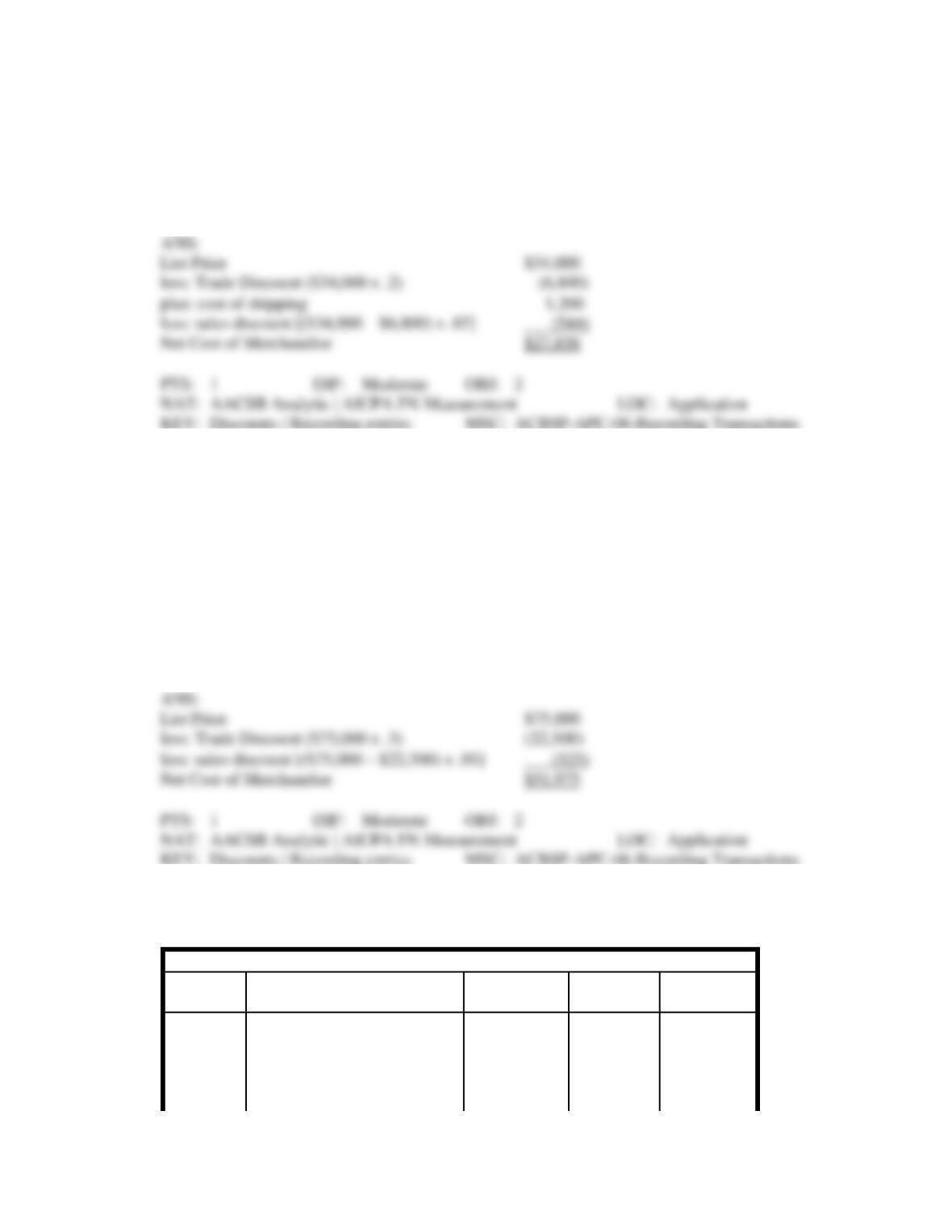
List Price
$75,000
less: sales discount [($75,000 – $22,500) x .01]
(525)
Net Cost of Merchandise
$51,975
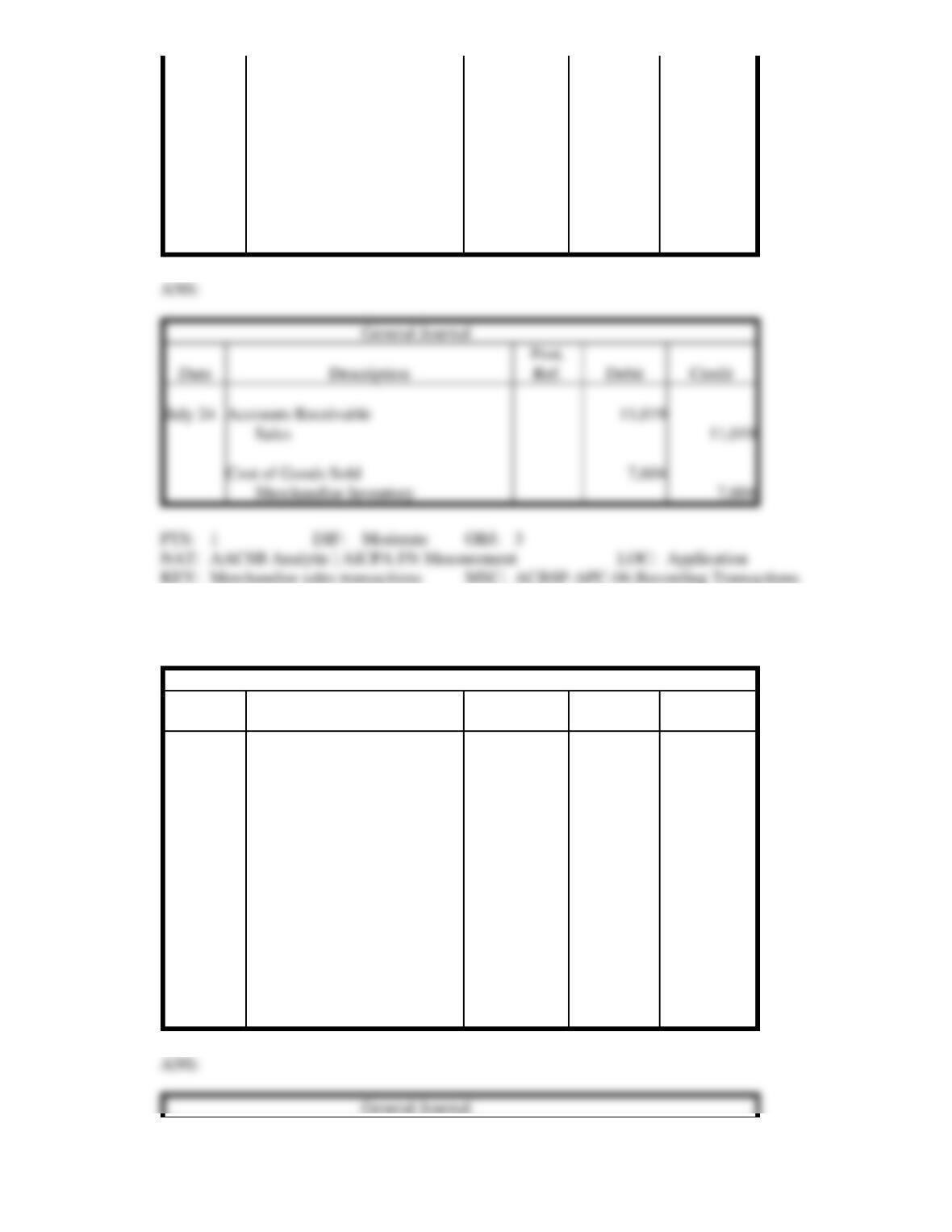
5. Assume that on July 24, Bond Company had a sale totaling $11,019 with a related cost of goods sold
of $7,604. Record this transaction in journal form assuming the perpetual inventory system was in use.
General Journal
Page 1
Date
Description
Post.
Ref.
Debit
Credit
List Price
$34,000
plus: cost of shipping
1,200
less: sales discount [($34,000 – $6,800) x .02]
(544)
Net Cost of Merchandise
$27,856
6. Assume that on March 13, Cimarron Company made a purchase totaling $13,000. Record this
transaction in journal form assuming the perpetual inventory system was in use (omit explanations).
General Journal
Page 1
Date
Description
Post.
Ref.
Debit
Credit
July 24
Accounts Receivable
Sales
Cost of Goods Sold
Merchandise Inventory
7,604