67) Buffalo Company reported a December 31 ending inventory balance of $412,000. The
following additional information is also available:
• The ending inventory balance of $412,000 did not include goods costing $48,000 that
were purchased by Buffalo on December 28 and shipped FOB destination on that
date. Buffalo did not receive the goods until January 2 of the following year.
• The ending inventory balance of $412,000 included damaged goods at their original
cost of $38,000. The net realizable value of the damaged goods was $10,000.
Based on this information, the correct balance for ending inventory on December 31 is:
A) $374,000
B) $384,000
C) $460,000
D) $422,000
E) $438,000
68) Costs included in the Merchandise Inventory account can include all of the following except:
A) Invoice price minus any discount.
B) Transportation-in.
C) Storage.
D) Insurance.
E) Damaged inventory that cannot be sold.
69) Internal controls that should be applied when a business takes a physical count of inventory
should include all of the following except:
A) Prenumbered inventory tickets.
B) A manager confirms that all inventories are ticketed only once.
C) Counters confirm the validity of inventory existence, amounts, and quality.
D) Second counts by a different counter.
E) Counters of inventory should be those who are responsible for the inventory.
70) Physical counts of inventory:
A) Are not necessary under the perpetual system.
B) Are necessary to adjust the Inventory account to the actual inventory available.
C) Must be taken at least once a month.
D) Requires the use of hand-held portable computers.
E) Are not necessary under the cost-to benefit constraint.
71) During a period of steadily rising costs, the inventory valuation method that yields the
highest reported net income is:
A) Specific identification method.
B) Average cost method.
C) Weighted-average method.
D) FIFO method.
E) LIFO method.
72) The inventory valuation method that tends to smooth out erratic changes in costs is:
A) FIFO.
B) Weighted average.
C) LIFO.
D) Specific identification.
E) WIFO.
73) The inventory valuation method that has the advantages of assigning an amount to inventory
on the balance sheet that approximates its current cost, and also mimics the actual flow of goods
for most businesses is:
A) FIFO.
B) Weighted average.
C) LIFO.
D) Specific identification.
E) Lower of cost or market.
74) The inventory valuation method that results in the lowest taxable income in a period of
inflation is:
A) LIFO method.
B) FIFO method.
C) Weighted-average cost method.
D) Specific identification method.
E) Gross profit method.
75) The LIFO conformity rule:
A) Requires when LIFO is used for tax reporting, it is also used for financial reporting.
B) Requires a company to use one method of inventory valuation exclusively.
C) Requires that all companies in the same industry use the same accounting methods of
inventory valuation.
D) Is also called the taxation principle.
E) Is only applicable to the automotive industry.
76) The selected inventory costing method impacts:
A) Gross profit and ending inventory.
B) Sales.
C) The physical flow of goods.
D) Amount of inventory on hand.
E) The shipping terms to the buyer.
77) Companies can and often do use different costing methods for financial reporting and tax
reporting. An exception to this is the:
A) Full disclosure principle.
B) Consistency concept.
C) FIFO inventory valuation method.
D) LIFO conformity rule.
E) Matching principle.
78) Which of the following inventory costing methods will always result in the same values for
ending inventory and cost of goods sold regardless of whether a perpetual or periodic inventory
system is used?
A) FIFO and LIFO
B) LIFO and weighted-average cost
C) Specific identification and FIFO
D) FIFO and weighted-average cost
E) LIFO and specific identification
79) If a period-end inventory amount is reported in error, it can cause a misstatement in all of the
following except:
A) Cost of goods sold.
B) Gross profit.
C) Net sales.
D) Current assets.
E) Net income.
80) An error in ending inventory causes an error in the next period’s:
A) Sales.
B) Beginning inventory.
C) Accounts payable.
D) Accounts receivable.
E) Shipping costs.
81) The understatement of the ending inventory balance causes:
A) Cost of goods sold to be overstated and net income to be understated.
B) Cost of goods sold to be overstated and net income to be overstated.
C) Cost of goods sold to be understated and net income to be understated.
D) Cost of goods sold to be understated and net income to be overstated.
E) Cost of goods sold to be overstated and net income to be correct.
82) The understatement of the beginning inventory balance causes:
A) Cost of goods sold to be understated and net income to be understated.
B) Cost of goods sold to be understated and net income to be overstated.
C) Cost of goods sold to be overstated and net income to be overstated.
D) Cost of goods sold to be overstated and net income to be understated.
E) Cost of goods sold to be overstated and net income to be correct.
83) Lucia Company reported cost of goods sold for Year 1 and Year 2 as follows:
Year 1
Year 2
Beginning inventory
$
120,000
$
130,000
Cost of goods purchased
250,000
275,000
Cost of goods available for sale
370,000
405,000
Ending inventory
130,000
135,000
Cost of goods sold
$
240,000
$
270,000
Lucia Company made two errors: 1) ending inventory at the end of Year 1 was understated by
$15,000 and 2) ending inventory at the end of Year 2 was overstated by $6,000. Given this
information, the correct cost of goods sold figure for Year 2 would be:
A) $291,000
B) $276,000
C) $264,000
D) $285,000
E) $249,000
84) Hull Company reported the following income statement information for the current year:
Sales
$
410,000
Cost of goods sold:
Beginning inventory
$
132,000
Cost of goods purchased
273,000
Cost of goods available for sale
405,000
Ending inventory
144,000
Cost of goods sold
261,000
Gross profit
$
149,000
The beginning inventory balance is correct. However, the ending inventory figure was overstated
by $20,000. Given this information, the correct gross profit would be:
A) $149,000.
B) $169,000.
C) $129,000.
D) $142,000.
E) $112,000.
85) An understatement of ending inventory will cause:
A) An overstatement of assets and equity on the balance sheet.
B) An understatement of assets and equity on the balance sheet.
C) An overstatement of assets and an understatement of equity on the balance sheet.
D) An understatement of assets and an overstatement of equity on the balance sheet.
E) No effect on the balance sheet.
86) The inventory turnover ratio:
A) Is used to analyze collectability.
B) Is used to measure solvency.
C) Reveals how many times a company sells its merchandise inventory during a period.
D) Reveals how many days a company can sell inventory if no new merchandise is purchased.
E) Calculation depends on the company’s inventory valuation method.
87) Days’ sales in inventory:
A) Shows the buffer against out-of-stock inventory.
B) Focuses on average inventory rather than ending inventory.
C) Is used to measure solvency.
D) Is calculated by dividing cost of goods sold by ending inventory.
E) Is a substitute for the acid-test ratio.
88) The inventory turnover ratio is calculated as:
A) Cost of goods sold divided by average merchandise inventory.
B) Sales divided by cost of goods sold.
C) Ending inventory divided by cost of goods sold.
D) Cost of goods sold divided by ending inventory.
E) Cost of goods sold divided by ending inventory times 365.
89) Days’ sales in inventory is calculated as:
A) Ending inventory divided by cost of goods sold.
B) Cost of goods sold divided by ending inventory.
C) Ending inventory divided by cost of goods sold times 365.
D) Cost of goods sold divided by ending inventory times 365.
E) Ending inventory times cost of goods sold.
90) Giorgio had cost of goods sold of $9,421 million, ending inventory of $2,089 million, and
average inventory of $1,965 million. Its inventory turnover equals:
A) 0.21.
B) 4.51.
C) 4.79.
D) 76.1 days.
E) 80.9 days.
91) Perfection Company had cost of goods sold of $853,000, ending inventory of $70,500, and
average inventory of $71,600. Its inventory turnover equals:
A) 11.9.
B) 1.0.
C) 6.0.
D) 30.6.
E) 14.0.
92) Beckenworth had cost of goods sold of $9,421 million, ending inventory of $2,089 million,
and average inventory of $1,965 million. Its days’ sales in inventory equals: (Use 365 days a
year.)
A) 0.21.
B) 4.51.
C) 4.79.
D) 76.1 days.
E) 80.9 days.
93) Ulrich had cost of goods sold of $6.7 million, ending inventory of $2.2 million, and average
inventory of $1.9 million. Its days’ sales in inventory equals (round your final answer to the
nearest whole number):
A) 120.
B) 104.
C) 60.
D) 35.
E) 180.
94) Acceptable methods of assigning specific costs to inventory and cost of goods sold include
all of the following except:
A) LIFO method.
B) FIFO method.
C) Specific identification method.
D) Weighted average method.
E) Retail method.
95) Decisions management must make in accounting for inventory cost include all of the
following except:
A) Costing method.
B) Perpetual or periodic inventory system.
C) Customer demand for inventory.
D) Damage or obsolescence
E) Items included in inventory and their costs.
96) The inventory valuation method that identifies each item in ending inventory with a specific
purchase and invoice is the:
A) Weighted average inventory method.
B) First-in, first-out method.
C) Last-in, first-out method.
D) Specific identification method.
E) Retail inventory method.
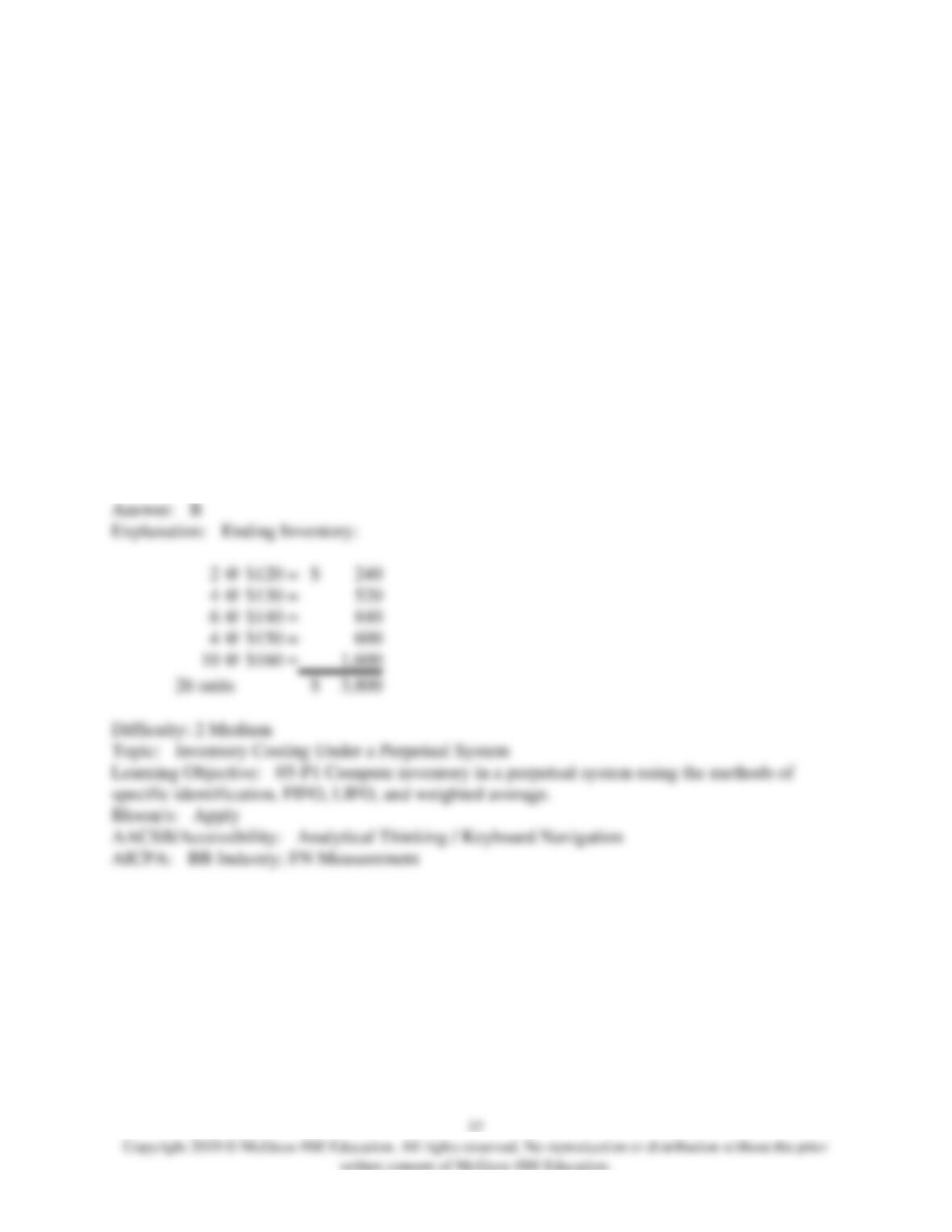
97) A company had the following purchases during its first year of operations:
Purchases
January:
10 units at $120
February:
20 units at $130
May:
15 units at $140
September:
12 units at $150
November:
10 units at $160
On December 31, there were 26 units remaining in ending inventory. These 26 units consisted of
2 from January, 4 from February, 6 from May, 4 from September, and 10 from November. Using
the specific identification method, what is the cost of the ending inventory?
A) $3,500.
B) $3,800.
C) $3,960.
D) $3,280.
E) $3,640.
98) A company had the following purchases and sales during its first year of operations:
Purchases
Sales
January:
10 units at $120
6 units
February:
20 units at $125
5 units
May:
15 units at $130
9 units
September:
12 units at $135
8 units
November:
10 units at $140
13 units
On December 31, there were 26 units remaining in ending inventory. Using the perpetual FIFO
inventory costing method, what is the cost of the ending inventory? (Assume all sales were made
on the last day of the month.)
A) $3,405.
B) $3,200.
C) $3,365.
D) $3,540.
E) $3,270.
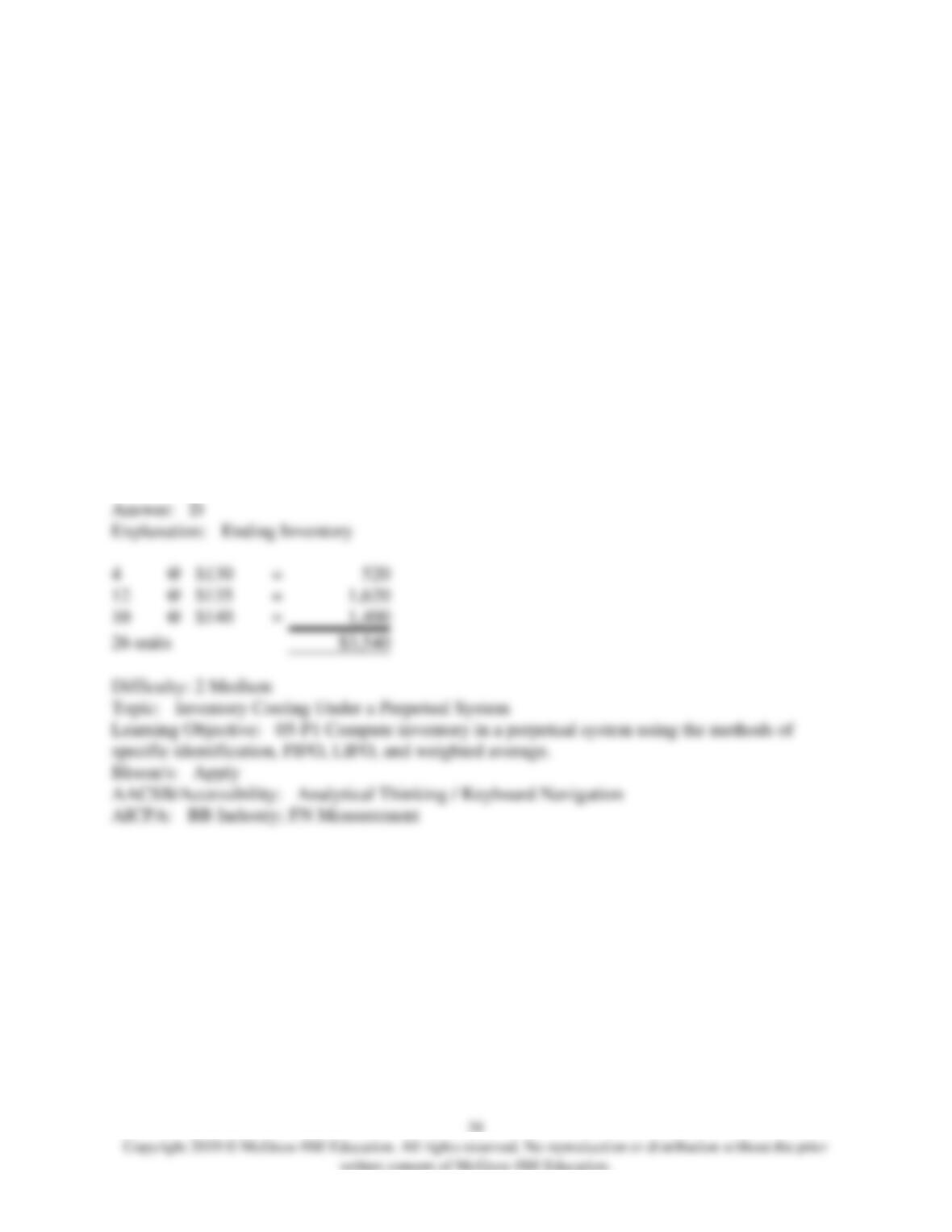
4
@
$130
12
@
$135
10
@
$140
26 units
99) A company had the following purchases and sales during its first year of operations:
Purchases
Sales
January:
10 units at $120
6 units
February:
20 units at $125
5 units
May:
15 units at $130
9 units
September:
12 units at $135
8 units
November:
10 units at $140
13 units
On December 31, there were 26 units remaining in ending inventory. Using the periodic FIFO
inventory costing method, what is the cost of the ending inventory? (Assume all sales were made
on the last day of the month.)
A) $3,405.
B) $3,200.
C) $3,445.
D) $3,540.
E) $3,270.
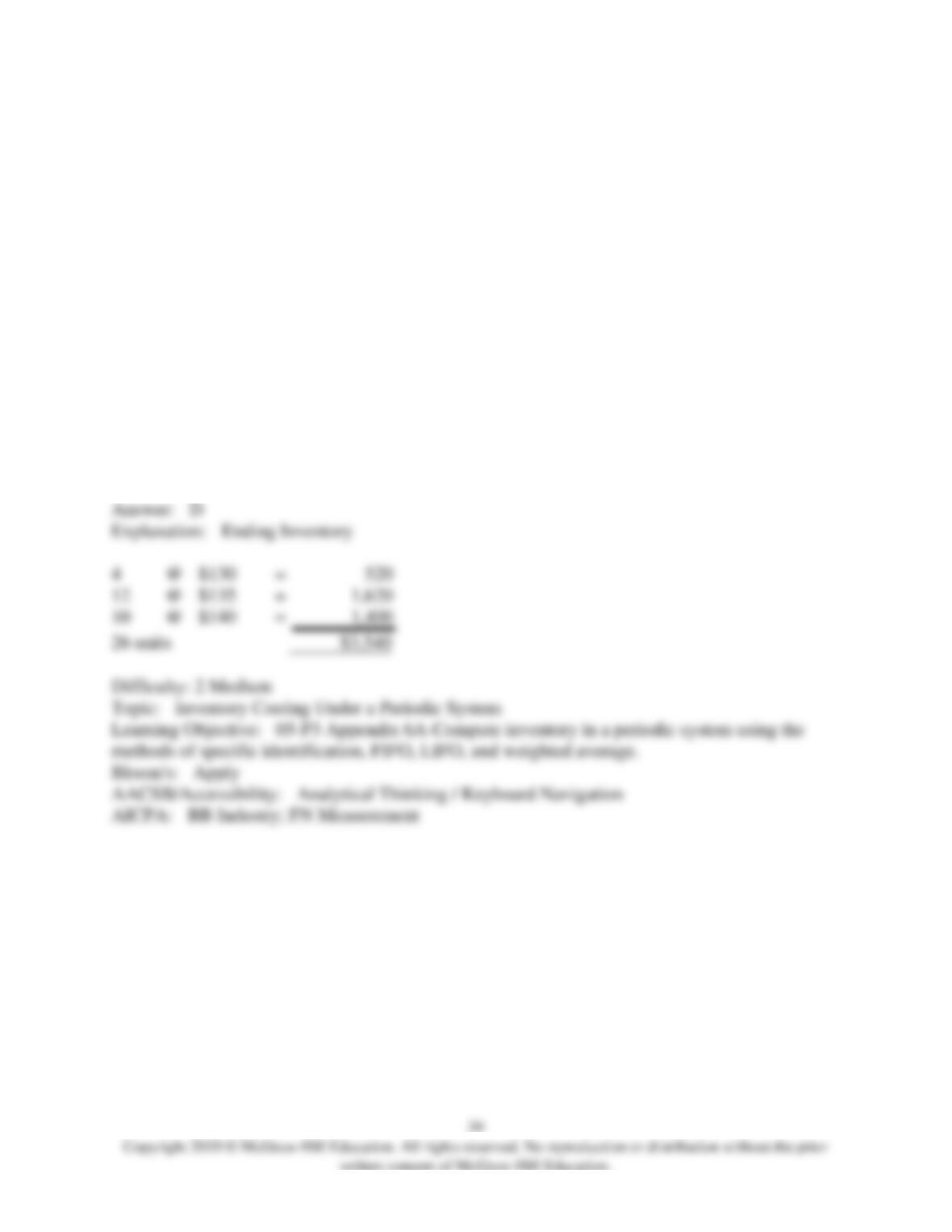
4
@
$130
12
@
$135
10
@
$140
26 units
100) A company had the following purchases and sales during its first year of operations:
Purchases
Sales
January:
10 units at $120
6 units
February:
20 units at $125
5 units
May:
15 units at $130
9 units
September:
12 units at $135
8 units
November:
10 units at $140
13 units
On December 31, there were 26 units remaining in ending inventory. Using the perpetual LIFO
inventory costing method, what is the cost of the ending inventory? (Assume all sales were made
on the last day of the month.)
A) $3,405.
B) $3,270.
C) $3,200.
D) $3,364.
E) $5,400.
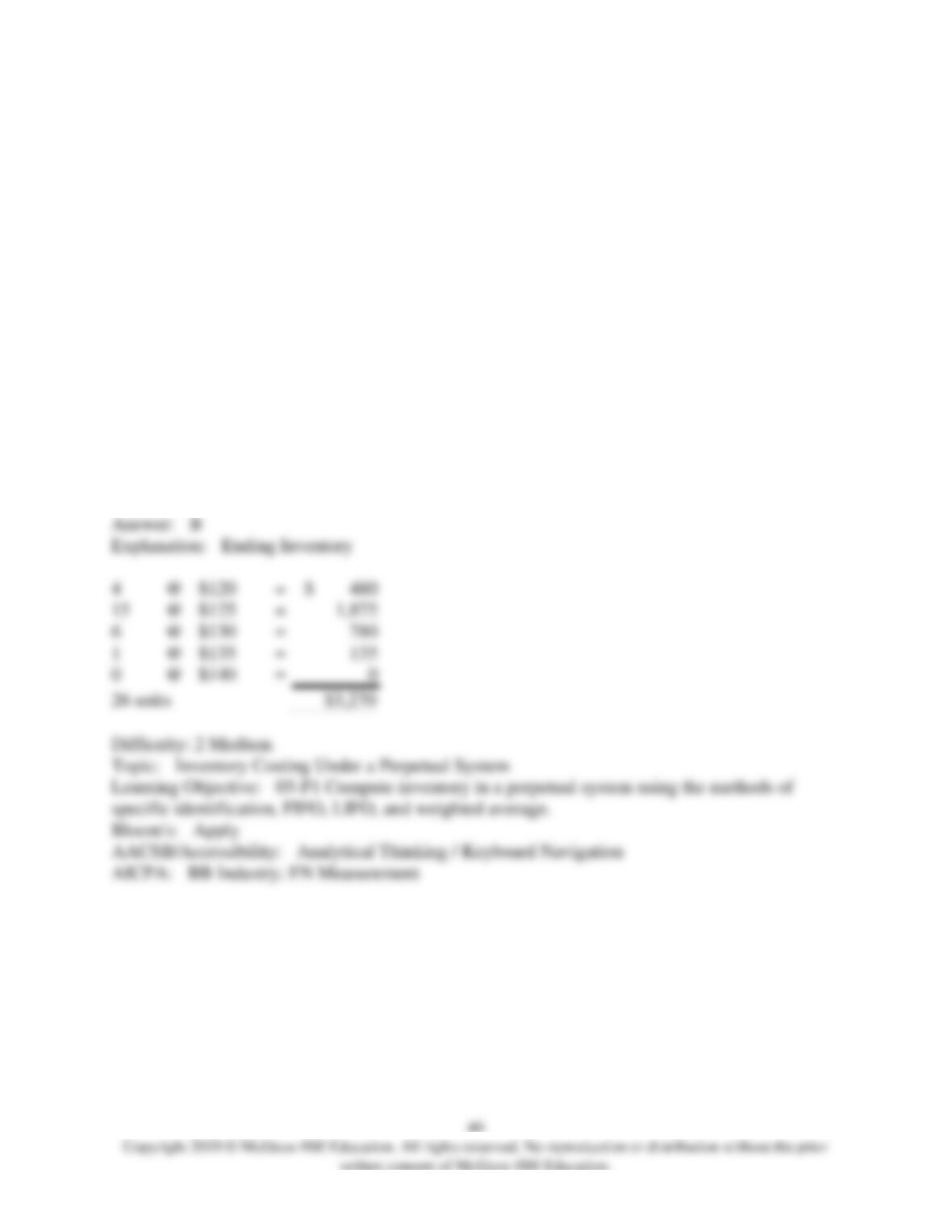
4
@
$120
15
@
$125
6
@
$130
1
@
$135
0
@
$140
26 units