86.
Refer to the information above. After closing the accounts, Retained Earnings at December
31 equals:
87.
Refer to the information above. The total debits in the After-Closing Trial Balance will
equal:
88.
Which account will appear on an After-Closing Trial Balance?
89.
Which account will
not
appear on an After-Closing Trial Balance?
90.
Which account appears on the After-Closing Trial Balance?
91.
Return on equity measures:
92.
Return on equity is calculated by:
93.
If current assets are $90,000 and current liabilities are $70,000, the current ratio will be:
94.
If current assets are $110,000 and current liabilities are $50,000, working capital will be:
95.
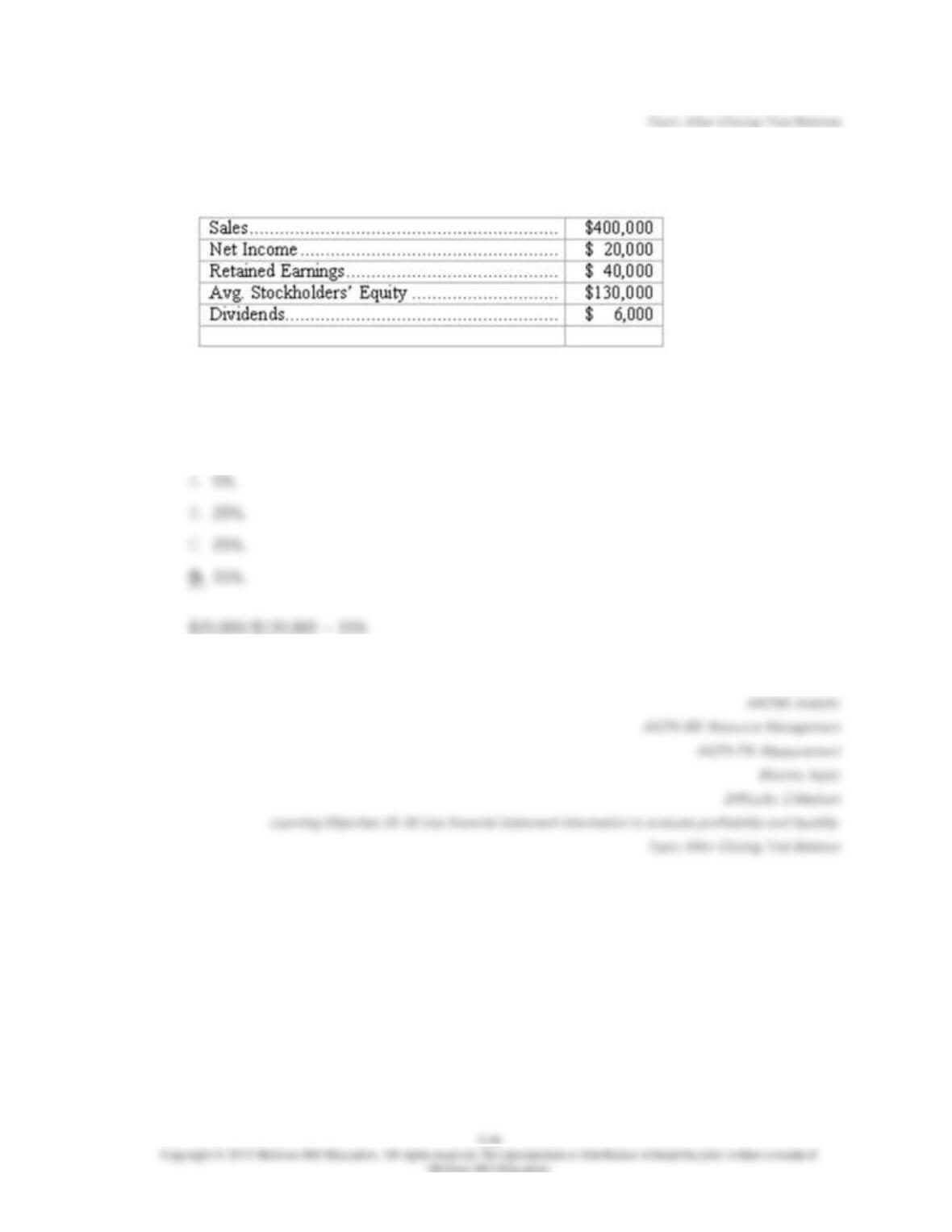
The following information is available:
What is the return on equity? (round to the nearest number)
96.
If current assets are $180,000 and current liabilities are $130,000, the current ratio will be:
97.
If current assets are $180,000 and current liabilities are $130,000, working capital will be:
98.
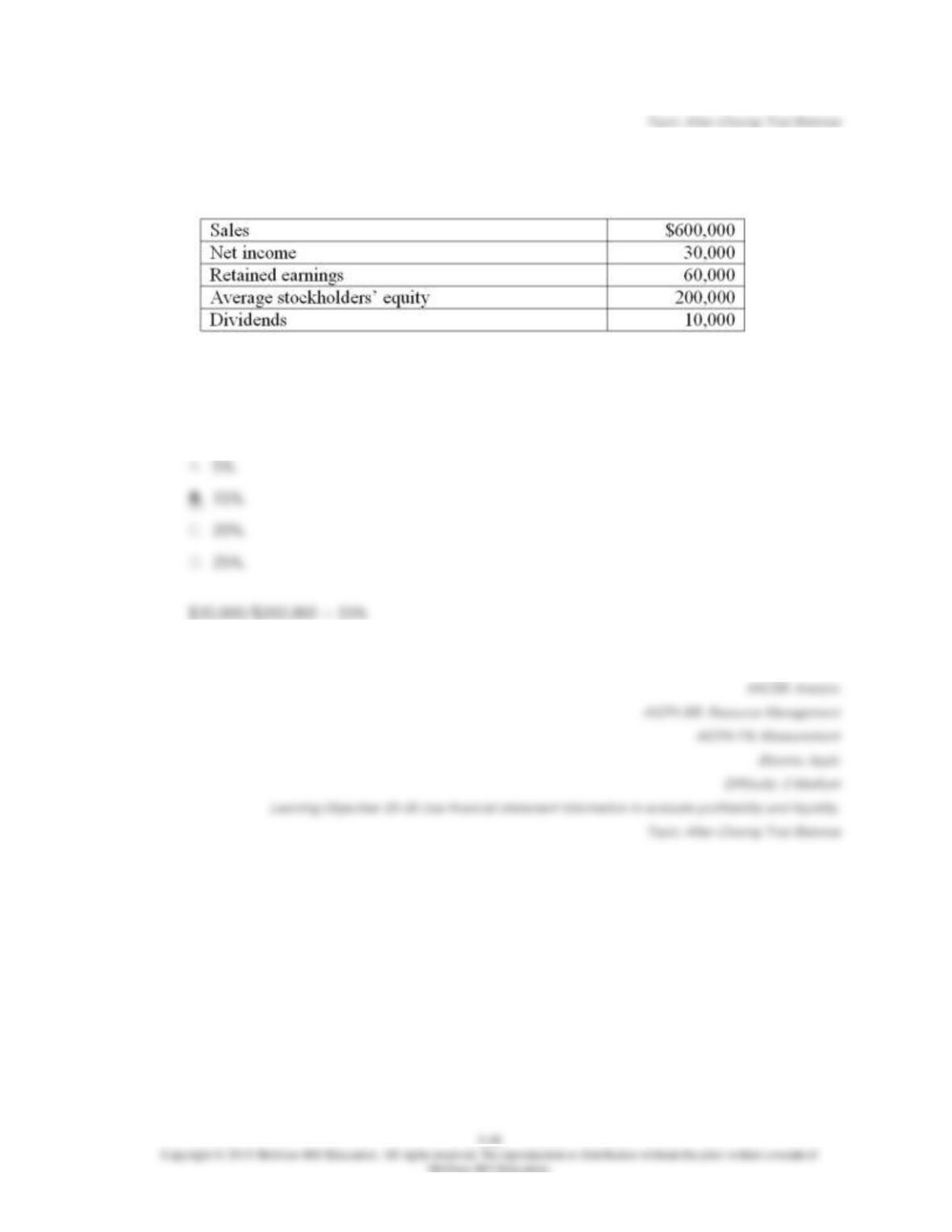
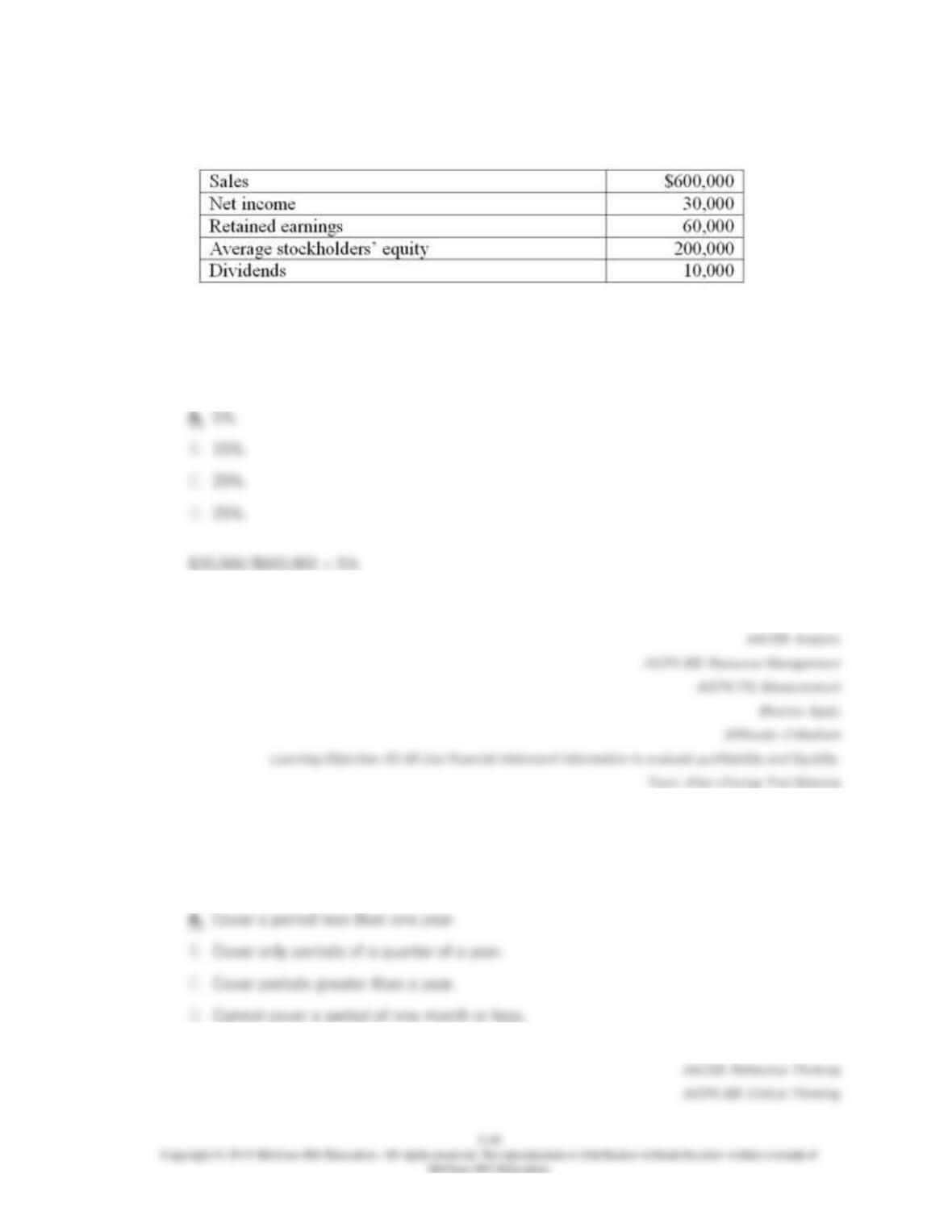
The following information is available:
What is the return on equity? (round to the nearest number)
99.
The following information is available:
What is the net income percentage? (round to the nearest number)
100.
Interim financial statements:
101.
Preparation of interim financial statements:
102.
If monthly financial statements are desired by management:
103.
The section of the annual report titled “Management Discussion and Analysis” is:
104.
A worksheet consists of all of the following
except
:
105.
When a worksheet is prepared, which account would
not
be entered into the income
statement columns?
106.
The worksheet:
107.
Which of the following amounts appears in both the Income Statement debit column and
the Balance Sheet credit column of a worksheet?
108.
A worksheet should be viewed as:
109.
The amount of net income (or loss) will appear on the debit side of the Income Statement
columns in a worksheet if:
110.
Which of the following is true regarding a worksheet prepared at year-end?
111.
When a worksheet is used:
112.
Only two adjustments appear in the adjustments column of a worksheet for Wycliff
Publications: one to record $800 depreciation of office equipment and the other to record
the use of $560 of office supplies. If the Trial Balance column totals are $15,380, what are
the totals of the Adjusted Trial Balance columns?
113.
The December 31, 2014 worksheet for Fran’s Fine Dining showed the following amounts
related to the Supplies Expense account:
(a). In the Trial Balance debit column: $745
(b). In the Adjustments debit column: $125
(c). In the Adjusted Trial Balance debit column: $870
What is the proper balance in the Supplies Expense account on January 1, 2015, after all
closing entries for 2014 have been posted, but before any 2015 transactions are
recorded?
114.
Only two adjustments appear in the adjustments column of a worksheet for Winona Mfg:
one to record $8,000 depreciation of factory equipment, and the other to record the use of
$1,500 of prepaid insurance. If the Trial Balance column totals are $145,380, what are the
totals of the Adjusted Trial Balance columns?
5-59
115.
The December 31, 2014 worksheet for Albertville Grill showed the following amounts
related to the Depreciation Expense account:
(a). In the Trial Balance debit column: $1,745
(b). In the Adjustments debit column: $1,125
(c). In the Adjusted Trial Balance debit column: $1,870
What is the proper balance in the Depreciation Expense account on January 1, 2015, after
all closing entries for 2014 have been posted, but before any 2015 transactions are
recorded?
Essay Questions

5-60
116.
Accounting terminology
Listed below are eight technical accounting terms emphasized in this chapter:
In the space provided for each statement, indicate the accounting term described.
______ a. The generally accepted accounting principle of providing with financial
statements any information that users need to interpret those statements properly.
______ b. A trial balance prepared after all closing entries have been posted. This trial
balance consists only of accounts for assets, liabilities, and owners’ equity.
______ c. Journal entries made at the end of the period for the purpose of closing
temporary accounts (revenue, expense, and dividend accounts) and transferring balances
to the Retained Earnings account.
______ d. Computer software used for recording transactions, maintaining journals and
ledgers, and preparing financial statements. Also includes spreadsheet capabilities for
showing the effects of proposed adjusting entries or transactions on the financial
statements without actually recording these entries in the accounting records.
______ e. The summary account in the ledger to which revenue and expense accounts are
closed at the end of the period. The balance (credit balance for a net income, debit
balance for a net loss) is transferred to the Retained Earnings account.
______ f. Financial statements prepared for periods of less than one year (includes
monthly and quarterly statements).
______ g. Supplemental disclosures that accompany financial statements. They provide
users with various types of information considered necessary for the proper interpretation
of the statements.
______ h. A multicolumn schedule showing the relationships among the current account
balances (a trial balance), proposed or actual adjusting entries or transactions, and the
financial statements that would result if these adjusting entries or transactions were
recorded. Used both at the end of the accounting period as an aid to preparing financial
statements and for planning purposes.