81
153) All of the following statements related to goods on consignment are true except:
A) Goods on consignment are goods provided by the owner, call the consignor.
B) A consignee sells goods for the owner.
C) The consignor continues to own the consigned goods.
D) The consignee reports the goods in its inventory until sold.
E) The consignor reports the goods in its inventory until sold.
154) When costs to purchase inventory regularly decline, which method of inventory costing will
yield the lowest gross profit and income?
A) FIFO.
B) LIFO.
C) Weighted average.
D) Specific identification.
E) Gross margin.
82
155) When costs to purchase inventory regularly decline, which method of inventory costing will
yield the lowest cost of goods sold?
A) FIFO.
B) LIFO.
C) Weighted average.
D) Specific identification.
E) Gross margin.
156) All of the following statements regarding the financial statement impact of inventory
costing are true except.
A) When purchase prices are changing, the methods to assign inventory costs result in different
amounts for cost of goods sold.
B) Inventory on the balance sheet approximates current cost when FIFO is used.
C) The weighted average method smooths out erratic changes in costs.
D) Selected costing method does not impact net income.
E) Cost of goods sold on the income statement approximates current cost when LIFO is used.
83
157) Sandoval needs to determine its year-end inventory. The warehouse contains 20,000 units,
of which 3,000 were damaged by flood and are not sellable. Another 2,000 units were purchased
from Markor Company, FOB shipping point, and are currently in transit. The company also
consigns goods and has 4,000 units at a consignee’s location. How many units should Sandoval
include in its year-end inventory?
A) 29,000
B) 21,000
C) 23,000
D) 19,000
E) 26,000
158) Salmone Company reported the following purchases and sales of its only product. Salmone
uses a perpetual inventory system. Determine the cost assigned to the ending inventory using
FIFO.
Date
Activities
Units Acquired at Cost
Units Sold at Retail
May 1
Beginning Inventory
150 units @ $10.00
5
Purchase
220 units @ $12.00
10
Sales
140 units @ $20.00
15
Purchase
100 units @ $13.00
24
Sales
90 units @ $21.00
A) $2,980
B) $2,460
C) $2,850
D) $2,590
E) $2,860
84
159) Salmone Company reported the following purchases and sales of its only product. Salmone
uses a perpetual inventory system. Determine the cost assigned to cost of goods sold using FIFO.
Date
Activities
Units Acquired at Cost
Units Sold at Retail
May 1
Beginning Inventory
150 units @ $10.00
5
Purchase
220 units @ $12.00
10
Sales
140 units @ $20.00
15
Purchase
100 units @ $13.00
24
Sales
90 units @ $21.00
A) $2,980
B) $2,460
C) $2,850
D) $2,590
E) $5,440
85
160) Salmone Company reported the following purchases and sales of its only product. Salmone
uses a perpetual inventory system. Determine the cost assigned to ending inventory using LIFO.
Date
Activities
Units Acquired at Cost
Units Sold at Retail
May 1
Beginning Inventory
150 units @ $10.00
5
Purchase
220 units @ $12.00
10
Sales
140 units @ $20.00
15
Purchase
100 units @ $13.00
24
Sales
90 units @ $21.00
A) $5,440
B) $2,460
C) $2,590
D) $2,980
E) $2,860
86
161) Salmone Company reported the following purchases and sales for its only product. Salmone
uses a perpetual inventory system. Determine the cost assigned to cost of goods sold using
LIFO.
Date
Activities
Units Acquired at Cost
Units Sold at Retail
May 1
Beginning Inventory
150 units @ $10.00
5
Purchase
220 units @ $12.00
10
Sales
140 units @ $20.00
15
Purchase
100 units @ $13.00
24
Sales
90 units @ $21.00
A) $2,860
B) $2,460
C) $2,590
D) $2,850
E) $2,980
87
162) Salmone Company reported the following purchases and sales of its only product. Salmone
uses a periodic inventory system. Determine the cost assigned to the ending inventory using
FIFO.
Date
Activities
Units Acquired at Cost
Units Sold at Retail
May 1
Beginning Inventory
150 units @ $10.00
5
Purchase
220 units @ $12.00
10
Sales
140 units @ $20.00
15
Purchase
100 units @ $13.00
24
Sales
90 units @ $21.00
A) $2,980
B) $5,440
C) $2,460
D) $2,850
E) $2,590
88
163) Salmone Company reported the following purchases and sales of its only product. Salmone
uses a periodic inventory system. Determine the cost assigned to cost of goods sold using FIFO.
Date
Activities
Units Acquired at Cost
Units Sold at Retail
May 1
Beginning Inventory
150 units @ $10.00
5
Purchase
220 units @ $12.00
10
Sales
140 units @ $20.00
15
Purchase
100 units @ $13.00
24
Sales
90 units @ $21.00
A) $2,460
B) $2,860
C) $2,980
D) $2,850
E) $2,590
89
164) Salmone Company reported the following purchases and sales of its only product. Salmone
uses a periodic inventory system. Determine the cost assigned to ending inventory using LIFO.
Date
Activities
Units Acquired at Cost
Units Sold at Retail
May 1
Beginning Inventory
150 units @ $10.00
5
Purchase
220 units @ $12.00
10
Sales
140 units @ $20.00
15
Purchase
100 units @ $13.00
24
Sales
90 units @ $21.00
A) $2,260
B) $3,180
C) $2,580
D) $3,580
E) $2,100
90
165) Salmone Company reported the following purchases and sales for its only product. Salmone
uses a periodic inventory system. Determine the cost assigned to cost of goods sold using LIFO.
Date
Activities
Units Acquired at Cost
Units Sold at Retail
May 1
Beginning Inventory
150 units @ $10.00
5
Purchase
220 units @ $12.00
10
Sales
140 units @ $20.00
15
Purchase
100 units @ $13.00
24
Sales
90 units @ $21.00
A) $2,590
B) $2,850
C) $2,580
D) $2,860
E) $2,460
91
166) On September 1 of the current year, Scots Company experienced a flood that destroyed the
company’s entire inventory. Because the company had not completed its month end reporting for
August, it must estimate the amount of inventory lost using the gross profit method. At the
beginning of August, the company reported beginning inventory of $215,450. Inventory
purchased during August was $192,530. Sales for the month of August were $542,500.
Assuming the company’s typical gross profit ratio is 40%, estimate the amount of inventory
destroyed in the flood.
A) $87,480
B) $134,520
C) $109,980
D) $82,480
E) $81,480
167) Use the following information for Shafer Company to compute inventory turnover for year
2.
Year 2
Year 1
Net sales
$
647,500
$
582,000
Cost of goods sold
389,500
360,840
Ending inventory
76,700
79,380
A) 9.98
B) 5.08
C) 4.99
D) 8.30
E) 8.44
168) Use the following information for Davis Company to compute inventory turnover for Year
2.
Year 2
Year 1
Cost of goods sold
279,500
291,800
Ending inventory
47,700
49,350
A) 5.86
B) 5.76
C) 5.67
D) 11.77
E) 5.89
94
169) Use the following information for Ephron Company to compute days’ sales in inventory for
Year 2.
Year 2
Year 1
Net sales
$
547,500
$
572,000
Cost of goods sold
348,500
370,840
Ending inventory
75,700
81,400
A) 52.4
B) 82.3
C) 50.5
D) 76.8
E) 79.3
95
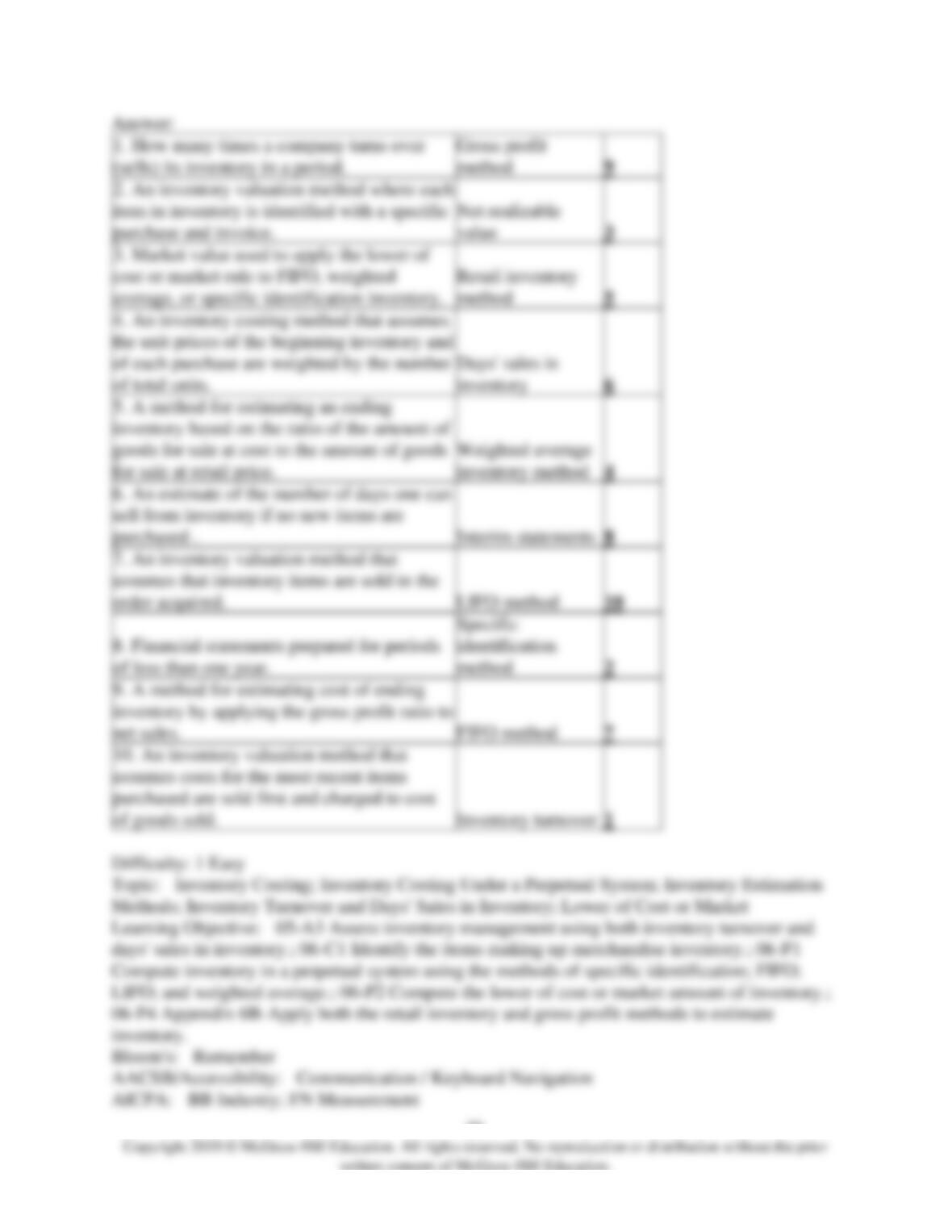
170) Match the following terms with the appropriate definition.
1. How many times a company turns over
(sells) its inventory in a period.
Gross profit
method
2. An inventory valuation method where each
item in inventory is identified with a specific
purchase and invoice.
Net realizable
value
3. Market value used to apply the lower of
cost or market rule to FIFO, weighted
average, or specific identification inventory.
Retail inventory
method
4. An inventory costing method that assumes
the unit prices of the beginning inventory and
of each purchase are weighted by the number
of total units.
Days’ sales in
inventory
5. A method for estimating an ending
inventory based on the ratio of the amount of
goods for sale at cost to the amount of goods
for sale at retail price.
Weighted average
inventory method
6. An estimate of the number of days one can
sell from inventory if no new items are
purchased .
Interim statements
7. An inventory valuation method that
assumes that inventory items are sold in the
order acquired.
LIFO method
8. Financial statements prepared for periods
of less than one year.
Specific
identification
method
9. A method for estimating cost of ending
inventory by applying the gross profit ratio to
net sales.
FIFO method
10. An inventory valuation method that
assumes costs for the most recent items
purchased are sold first and charged to cost
of goods sold.
Inventory turnover
96
97
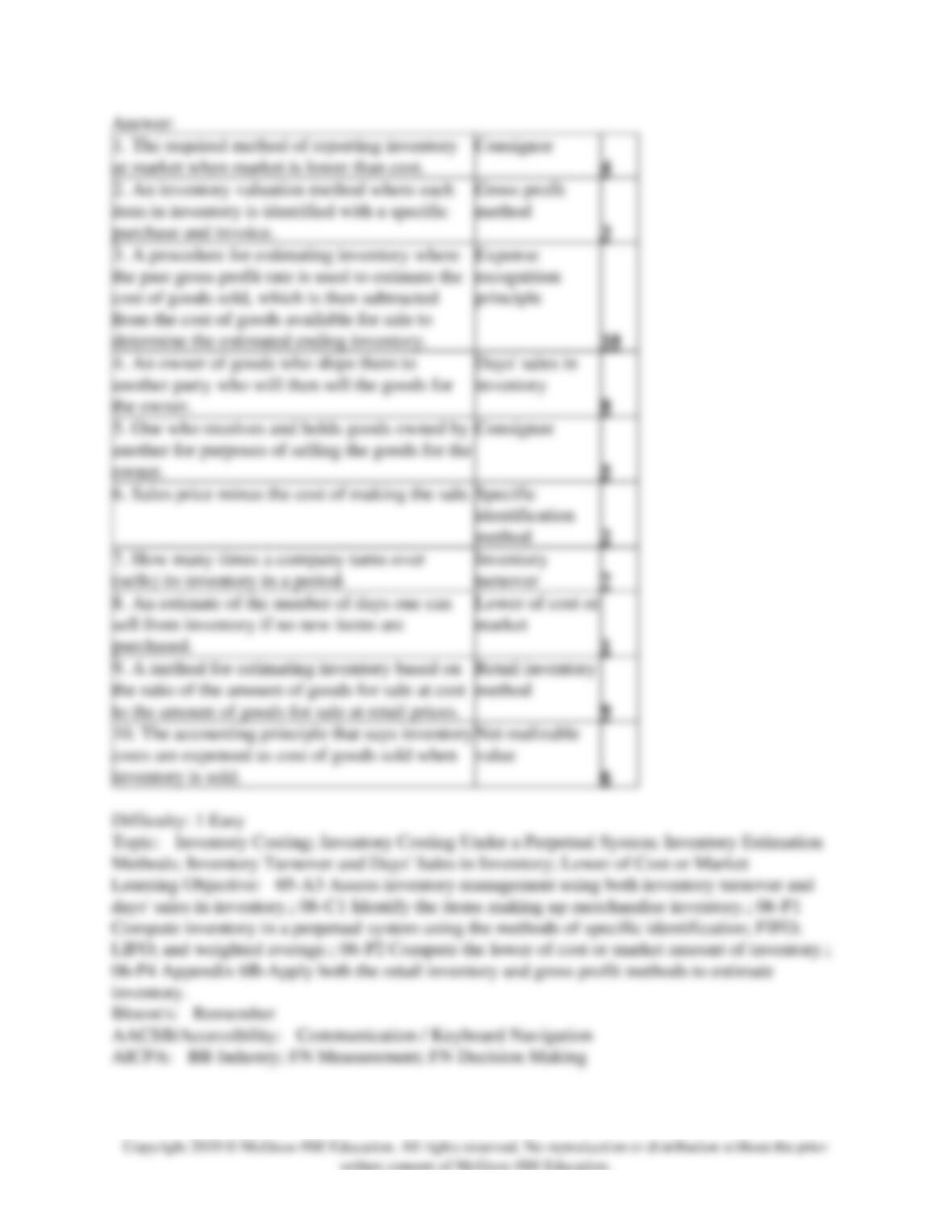
171) Match the following terms with the appropriate definition.
1. The required method of reporting inventory at
market when market is lower than cost.
Consignor
2. An inventory valuation method where each item
in inventory is identified with a specific purchase
and invoice.
Gross profit
method
3. A procedure for estimating inventory where the
past gross profit rate is used to estimate the cost of
goods sold, which is then subtracted from the cost
of goods available for sale to determine the
estimated ending inventory.
Expense
recognition
principle
4. An owner of goods who ships them to another
party who will then sell the goods for the owner.
Days’ sales in
inventory
5. One who receives and holds goods owned by
another for purposes of selling the goods for the
owner.
Consignee
6. Sales price minus the cost of making the sale.
Specific
identification
method
7. How many times a company turns over (sells) its
inventory in a period.
Inventory
turnover
8. An estimate of the number of days one can sell
from inventory if no new items are purchased.
Lower of cost or
market
9. A method for estimating inventory based on the
ratio of the amount of goods for sale at cost to the
amount of goods for sale at retail prices.
Retail inventory
method
10. The accounting principle that says inventory
costs are expensed as cost of goods sold when
inventory is sold.
Net realizable
value
98
99
172) Match the inventory costing method from the list below that is being described in each
situation in letters a-e. In all cases, assume a period of rising prices.
FIFO
First in, first out
LIFO
Last in, first out
WA
Weighted average
SI
Specific identification
_________ a. The method that is used if each inventory item can be matched with a specific
purchase and invoice.
_________ b. The method that will cause the company to have the lowest income taxes.
_________ c. The method that will cause the company to have the lowest cost of goods sold.
_________ d. The method that will assign a value to inventory that approximates current cost.
_________ e. The method that will tend to smooth out erratic changes in costs.
173) Identify the items that are included in merchandise inventory. (In your answer address the
special situations of goods in transit, consigned goods, and damaged goods.)
100
174) What specific costs and deductions are used to determine the final cost of merchandise
inventory? Identify all costs including the incidental costs.
175) Describe the internal controls that must be applied when taking a physical count of
inventory.
176) Explain the effects of inventory valuation methods on the cost of ending inventory, income,
and income taxes.