
–
Chapter 5: The Governmental Fund Accounting Cycle
General and Special Revenue Funds (Continued)
Multiple Choice
1. The measurement focus used by governmental fund measures:
a. capital resources
b. spendable resources
c. spendable resources and capital resources
d. economic resources
2. A government would refer to its property tax calendar to determine whether
property taxes receivable at any given time are
a. collectible in part or in full
b. delinquent or current
c. sufficient to finance planned expenditures
d. larger or smaller than those of the prior year
3. At the time a government levies the property tax, an allowance for uncollectible
property taxes is established so that
a. probable delinquent taxpayers can be identified individually
b. property tax revenues can be reported at a net collectible amount
c. an expenditure for bad debts is recorded in the accounts
d. property tax revenues will exceed the total amount of the levy
4. A municipality uses the allowance method to record uncollectible property taxes.
If it decides to write off an account as uncollectible, it should:
a. debit bad debts expenditures; credit allowance for uncollectible property
taxes
b. debit allowance for uncollectible property taxes; credit property taxes
receivable
c. debit allowance for uncollectible property taxes; credit property tax revenues
d. debit property tax revenues; credit property taxes receivable
5. If a taxpayer fails to pay his property taxes on time and the city decides to

foreclose the property, what accounting entry should the city make?
a. write off the property tax receivable as uncollectible
b. reduce property tax revenues by the amount of the receivable
c. reclassify the property tax receivable account to a delinquent receivable account
d. reclassify the property tax receivable account to a tax lien receivable account
6. A city levies property taxes of $1,050,000, but believes that it will not be able to
collect $50,000 of those taxes. What entry should it make when the taxes are
levied?
a. Property taxes receivable 1,050,000
Allowance for uncollectible taxes 50,000
Revenues – property taxes 1,000,000
b. Revenues – property taxes 50,000
Allowance for uncollectible taxes 50,000
c. Property taxes receivable 1,000,000
Revenues – property taxes 1,000,000
d. Allowance for uncollectible taxes 50,000
Revenues – property taxes 50,000
e. No entry is required because cash has not yet been received.
7. A property owner receives a property tax bill for $4,000 and appeals the
assessment. Before he pays the bill, the city reduces his property tax to $3,000. If
the city had previously established an allowance for property tax refunds, what
entry should it make to record the reduction?
a. Revenues – property taxes 3,000
Property taxes receivable 3,000
b. Revenues – property taxes 1,000
Property taxes receivable 1,000
c. Allowance for property tax refunds 1,000
Property taxes receivable 1,000
d. Tax liens receivable 1,000
Property taxes receivable 1,000
8. A city uses the allowance method to provide for uncollectible property taxes. At the
start of the year, the city established an allowance of $100,000 for uncollectible
taxes. During the year, it wrote off $80,000 as uncollectible. At year-end, the city
still has some uncollected taxes, but believes it will need an allowance of only
$15,000 to cover any receivables that it may need to write off as uncollectible.
What adjusting entry should it make?
a. Revenues – property taxes 5,000

Allowance for uncollectible property taxes 5,000
b. Revenues – property taxes 15,000
Allowance for uncollectible property taxes 15,000
c. Allowance for uncollectible property taxes 15,000
Property taxes receivable 15,000
d. Allowance for uncollectible property taxes 5,000
Revenues – property taxes 5,000
9. At the beginning of the year 2013, a town recorded General Fund property tax
receivables of $600,000. By year-end (December 31), taxpayers had paid a total
$575,000. Based on previous experience, the town expected to collect the $25,000
of delinquent taxes as follows: $10,000 in January and February of 2014 and
$15,000 between March and August of 2014. How much should the town report as
property tax revenue in its General Fund statements for the year 2013?
a. $585,000
b. $600,000
c. $590,000
d. $575,000
10. On January 1, 2013, a city recorded General Fund property tax revenues of
$750,000, but made no provision for uncollectible receivables or tax refunds.
During the year, it collected property taxes of $720,000, wrote off $4,000 as
uncollectible, and made tax refunds of $3,000. At year-end, the city finance director
concluded that $10,000 of the delinquent taxes would be collected in January and
February of 2014, $12,000 would be collected later in 2014, and $1,000 would need
to be written off as uncollectible. How much should the city report as property tax
revenue in its General Fund financial statements for the year 2013?
a. $720,000
b. $730,000
c. $742,000
d. $713,000
11. Which of the following best describes the general principle for recognizing
property tax revenues in the General Fund?
a. They should be recognized in the current period to the extent that cash is
collected
b. They should be recognized for the entire amount levied for the current
period, regardless of when they are collected in cash
c. They should be recognized in the current period, less appropriate
allowances for uncollectible accounts, tax refunds, and discounts

d. They should be recognized in the current period to the extent collected and
also if collected early in the following year
12. When making its year-end entries, the city’s accountant determines that $20,000 of
the city’s remaining current property taxes receivable would not be collected within
the first sixty days of the next fiscal year, but would be collectible later in that year.
At year-end, the city should report a $20,000 credit to:
a. revenues – property taxes
b. property taxes receivable – delinquent
c. deferred revenues – property taxes
d. allowance for uncollectible taxes
13. Which of the following is the most likely reason that deferred revenue is reported
on the General Fund balance sheet?
a. qualifying expenditures have been incurred in conjunction with a federal
grant
b. there are property taxes receivable at year end that probably will not be
collected for at least 60 days after the end of the accounting period
c. there are property taxes receivable at year end that will probably be
collected within 60 days after the end of the accounting period
d. the government owes refunds to property owners who have successfully
appealed their property tax assessments

14. When reporting on the General Fund in the fund financial statements, what is the
general principle regarding the accrual of sales taxes collected by merchants but not
yet remitted to the taxing government?
a. sales taxes should be recognized only if received by the state by year end
b. sales taxes should be recognized when the merchant makes the sale
provided taxes are received early enough in the following year to finance
expenditures of the period covered by the statements
c. sales taxes should be accrued provided they are received within 15 days
after the end of the accounting period
d. sales taxes should be accrued based on an estimate of amounts received by
merchants but not yet remitted to the state, regardless of when the taxes are
remitted
15. Which of the following is not considered to be a “derived” tax revenue based on
GASB standards?
a. sales taxes
b. property taxes
c. income taxes
d. all of the above are derived tax revenues
16. A state provides a city with a grant of $500,000 for a special “meals for the
homeless” program. The city will receive payment from the state within 30 days of
incurring eligible expenditures for homeless people. When should the city
recognize revenues under this grant?
a. when it receives the cash payments from the state
b. at the end of the grant, when all expenditures have been incurred
c. when it sends bills to the state
d. when it incurs expenditures under the grant
17. When counties receive cash advances under grants from the state, what account
should they credit?
a. grants receivable
b. revenues – grants
c. advance on state grants
d. grant expenditures
18. A school district receives a grant from the federal government to reimburse the

district for the salaries of teachers in an “English as a Second Language” program.
The grant has no time requirements. The school district has paid the teachers and
expects to receive payment from the federal government within 30 days of year-
end. Which of the following journal entries would be needed for the school district?
a. debit cash and credit intergovernmental revenues – grants
b. debit deferred revenues – grants and credit intergovernmental revenues –
grants
c. debit due from federal government and credit intergovernmental revenues –
grants
d. debit due from federal government and credit deferred revenues – grants
19. A state government receives a grant from the federal government that it disburses to
local governments within the state. To meet federal grant requirements, the state
government monitors the local governments to make sure that they comply with
federal grant requirements. When the state government disburses the grant monies
to the local governments, it should debit:
a. due to local governments
b. deferred revenues – grants
c. expenditures – federal grant
d. no entry is required
20. A state government receives a grant from the federal government that it disburses to
local governments within the state. The state government disburses the cash
received from the federal government to the local government, but the state
government has no other administrative responsibilities regarding the grant. The
state government should report the grant in:
a. an agency fund
b. a special revenue fund
c. internal service fund
d. the general fund
21. Which of the following liabilities normally would not be reported in governmental funds?
a. accrued salaries payable

b. bonds payable
c. vouchers payable
d. all of the above are commonly reported in governmental funds
e. none of the above are commonly reported in governmental funds
22. Governmental fund liabilities are:
a. claims against current financial resources
b. obligations not currently payable
c. both a and b
d. none of the above
23. The attorneys for the City of Hensley believe that a lawsuit filed against the city
will be settled late in the next fiscal year. The attorneys believe that it is probable
that the city will have to pay the claimants $30,000 to settle the lawsuit, but it is
possible that it could be settled for as little as $15,000 or as much as $40,000. How
much should the city accrue as a liability in the General Fund for its current fiscal
year?
a. $0
b. $15,000
c. $30,000
d. $40,000
24. A town’s garbage trucks accidentally sideswiped two parked automobiles in the
year ended December 31, 2013. One case was settled for $3,000, and the town
expects to pay it in January 2014. In the other case, the claimant originally
demanded $15,000. The town attorney thinks they can settle the claim for $10,000,
but it probably will take two years to settle the case. What amount should the town
report as a claims liability on the General Fund’s December 31, 2013 balance sheet?
a. $0
b. $3,000
c. $13,000
d. $18,000
25. The General Fund lends cash at the beginning of the year to an Enterprise Fund,
expecting to be repaid before the end of the year. What account should be debited
in the General Fund?

a. transfer out to enterprise fund
b. due from enterprise fund
c. other financing uses – enterprise fund
d. expenditures – enterprise fund loans
26. A General Fund receives an invoice from the Electric Utility Fund (an Enterprise
Fund) for electricity provided by the Utility Fund. When it receives the invoice,
what account should be debited in the General Fund?
a. due from electric utility fund
b. transfer in from electric utility fund
c. expenditures – utility services
d. due to electric utility fund
27. The General Fund of a city pays all utility bills received from private companies for
services provided to city agencies. It then bills other funds for their shares of the
bills. On May 10, the General Fund pays an electric bill for $230,000. It then sends
a bill to the Library Special Revenue Fund for $4,000, representing the library’s
share of the bill. Which account should the General Fund credit when it sends the
bill to the Library Special Revenue Fund?
a. expenditures – utilities
b. due from library special revenue fund
c. transfer out to library special revenue fund
d. due to library special revenue fund
28. The city council decides to close the Library Special Revenue fund and send its
remaining resources ($45,000 cash) to the General Fund. What account should the
Library Special Revenue Fund debit when it sends the cash to the General Fund?
a advance to general fund
b. transfer out to general fund
c. due from general fund
d. expenditures – fund closeout
29. The General Fund provides a recurring annual subsidy to the Mass Transit
Enterprise Fund to keep bus fares at a reasonable level. How should the General
Fund report the subsidy in its financial statements?
a as an expenditure

b. as a long-term advance
c. as a transfer out
d. as a reimbursement
30. Which of the following interfund transactions will be reported as a separate line
item in the operating statement of a General Fund?
a. short-term interfund loan received
b. transfer out to a debt service fund
c. reimbursement received from a special revenue fund
d. long-term interfund loan received
31. In the statement of revenues, expenditures, and changes in fund balances, a transfer
received by the Debt Service Fund from the General Fund should be reported by
the Debt Service Fund as a:
a. transfer in, in the other financing sources/uses section
b. negative expenditure, in the expenditure section
c. direct addition to equity, in the fund balance section
d. reimbursement, in the revenue section
32. A city paid $40,000 for police cars with the expectation that they would have a
useful life of four years. After three years, the city sold the cars for $3,000. How
should the city account for the sale in the General Fund?
a. debit cash for $3,000, debit accumulated depreciation for $30,000, debit
loss on sale of general fixed assets for $7,000, and credit equipment for
$40,000.
b. debit cash for $3,000 and credit other financing source—sale of capital
assets for $3,000.
c. debit cash for $3,000, debit loss on sale of general fixed assets for $37,000,
and credit equipment for $40,000.
d. debit cash for $3,000, debit other financing uses for $37,000, and credit
equipment for $40,000.
33. A city uses the purchases method of accounting for supplies in the General Fund.
At year-end, the amount of supplies on hand is material and the city wants to report
the inventory in its balance sheet. How should the General Fund record the
inventory?
a. debit supplies inventory and credit expenditures—supplies used

b. debit supplies inventory and credit vouchers payable—supplies
c. debit supplies inventory and credit unassigned fund balance
d. debit supplies inventory and credit nonspendable fund balance
34. Which of the following describes the proper accounting procedure for supplies in
the General Fund?
a. Supplies may be accounted for as expenditures either when purchased or
when consumed. In either case, material amounts of inventory are shown on
the balance sheet
b. Supplies must be accounted for as expenditures when purchased. Therefore,
inventories are not shown on the balance sheet
c. Supplies must be initially recorded as assets, and then charged off as
expenditures as the supplies are consumed
d. Supplies may be accounted for as expenditures either when purchased or
when consumed. If the purchases method is used, inventories are not shown
on the balance sheet.
35. A county has $3,650,000 of outstanding encumbrances related to unassigned
resources at year-end, December 31, 2013. It expects to accept delivery on all
orders in 2014. How should the county handle the outstanding encumbrances in its
General Fund balance sheet at December 31, 2013?
a. it should report encumbrances as if they were expenditures and liabilities of
the year 2013
b. it should close the open encumbrances and show them as part of unassigned
fund balance
c. it should close the open encumbrances and show them as part of assigned
fund balance
d. it should close the open encumbrances and make no adjustments to fund
balance
36. Which of the following best describes an assignment of fund balance?
a. it is a government’s intent to spend resources for specific purposes
b. it is another term for a budgetary fund balance reserved for encumbrances
c. it is constrained as a result of a formal action by a government’s legislative
body
d. it is a legal segregation of fund balance, and must be used for the purpose

assigned
37. The City of Maysville’s General Fund balance sheet for its December 31, 2013 year
end shows inventory of $28,000 and prepaid rent of $10,000. The city also had
$60,000 of outstanding encumbrances related to unassigned resources in its General
Fund at year-end. In December 2013, a grantor provided the City with $42,000 that
must be used to pay musicians who perform in the city’s series of summer concerts
in the park during 2014. How much should the city report as assigned fund balance
in its General Fund on December 31, 2013?
a. $28,000
b. $38,000
c. $42,000
d. $60,000
e. $98,000
38. The City of Maysville’s General Fund balance sheet for its December 31, 2013 year
end shows inventory of $28,000 and prepaid rent of $10,000. The city also had
$60,000 of outstanding encumbrances in its General Fund at year-end. In December
2013, a grantor provided the City with $42,000 that must be used to pay musicians
who perform in the city’s series of summer concerts in the park during 2014. How
much should the city report as nonspendable fund balance in its General Fund on
December 31, 2013?
a. $10,000
b. $28,000
c. $38,000
d. $42,000
e. $60,000
39. The City of Maysville’s General Fund balance sheet for its December 31, 2013 year
end shows inventory of $28,000 and prepaid rent of $10,000. The city also had
$60,000 of outstanding encumbrances in its General Fund at year-end. In December
2013, a grantor provided the City with $42,000 that must be used to buy musical
instruments for the city’s youth orchestra. No instruments had been purchased at
year-end. How much should the city report as restricted fund balance in its General
Fund on December 31, 2013?

a. $28,000
b. $38,000
c. $42,000
d. $60,000
e. $102,000
40. The highest level of decision-making authority for the City of Palo Pinto passes an
ordinance that states that all royalty payments received from oil or gas production
on city property must be used for street maintenance or improvements. As of the
end of its current fiscal year, the city has $1,250,000 of unspent royalty payments.
These amounts should be reported as part of:
a. nonspendable fund balance
b. restricted fund balance
c. committed fund balance
d. assigned fund balance
e. unassigned fund balance
41. A city has only one special revenue fund. All the fund balance classifications that it
reports have positive balances. Which of the following fund balance classifications
would not be reported by the city?
a. unassigned fund balance
b. assigned fund balance
c. committed fund balance
d. restricted fund balance
42. For the general fund, the residual fund balance classification is:
a. unassigned fund balance
b. assigned fund balance
c. committed fund balance
d. restricted fund balance
43. The city’s governing body gives the city’s finance director the authority to set aside
“excess” amounts in the General Fund to provide funds to build a new fire station.
The finance director sets aside $200,000 for that purpose during the current fiscal
year. This should be reported as part of:
a. unassigned fund balance
b. assigned fund balance
c. committed fund balance

d. restricted fund balance
e. nonspendable fund balance
44. The city council appropriates a portion of the government’s current year-end fund
balance to eliminate an anticipated budget deficit in next year’s budget. Projected
expenditures are anticipated to be greater than expected revenues next year. The
appropriated portion of the current year’s fund balance should be reported as:
a. unassigned fund balance
b. assigned fund balance
c. committed fund balance
d. restricted fund balance
e. nonspendable fund balance
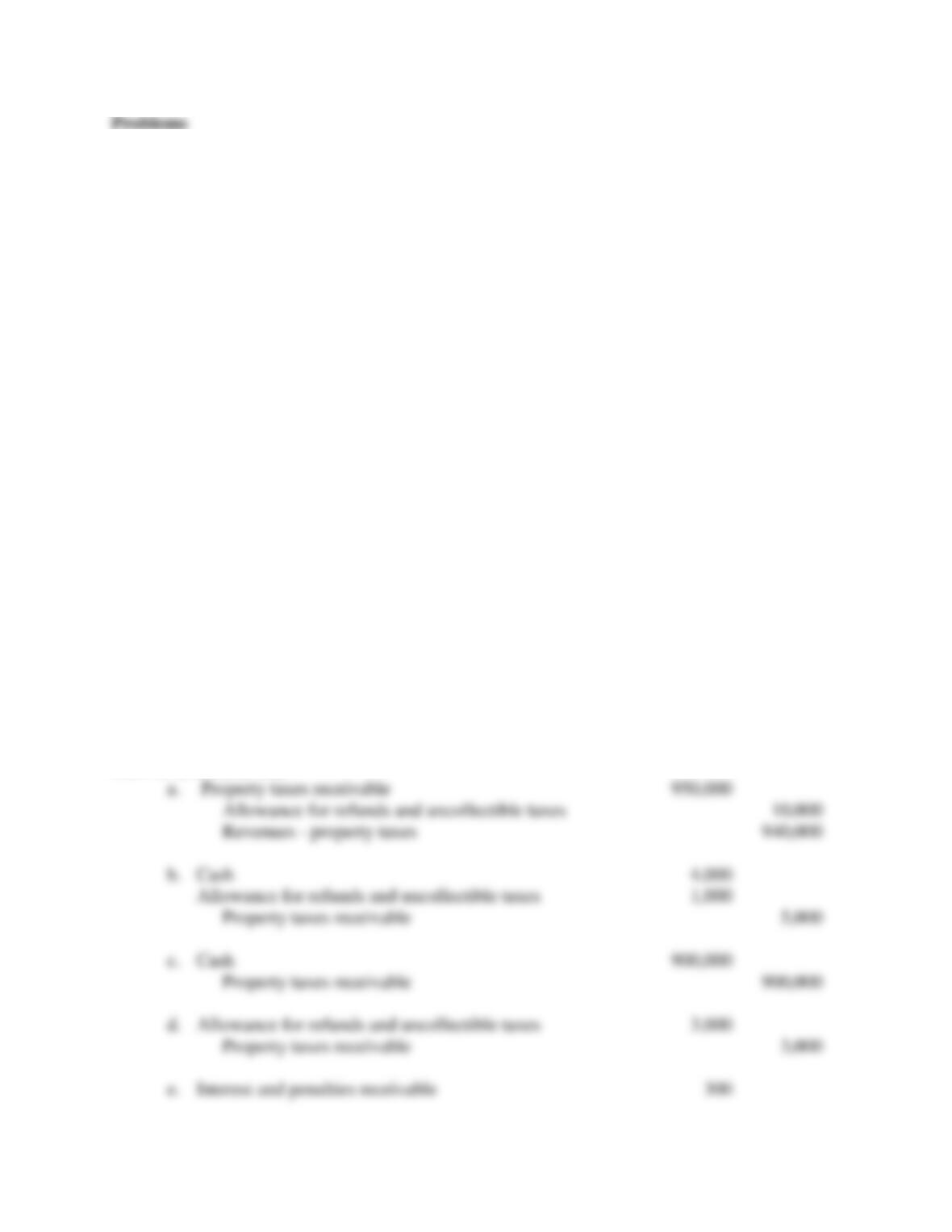
45. (Journal entries – property tax accounting)
Prepare entries to record the following transactions and events related to
Dominguez County’s property taxes for the year beginning January 1, 2013:
a. To raise property tax revenues of $940,000, the County sends bills to
property owners totaling $950,000. This will provide $10,000 for
uncollectible taxes and refunds. The County makes no provision for
possible tax refunds.
b. Shortly after receiving his $5,000 tax bill, Harold appeals his assessment.
His tax bill is reduced by $1,000. He then pays the remaining $4,000 that is
due.
c. Dominguez County receives $900,000 in cash from taxpayers (other than
Harold) who make timely payment on their taxes.
d. Brown’s home is destroyed by fire. He declares bankruptcy and the County
writes off his $3,000 tax bill as uncollectible.
e. C. Blacke and D. Wight, who received bills totaling $8,000, are unable to
pay on time. The County bills them $300 for interest. They subsequently
pay the taxes plus interest. (Do not make an adjustment for delinquent taxes
receivable for C. Blacke and D. Wight as this entry is only made at year-
end.)
f. At year-end, the County declares all unpaid property taxes to be delinquent.
Interest and penalties amounting to $1,500 is assessed against the
delinquent taxpayers and is considered available.
g. The County decides to increase its allowance for uncollectible taxes by
$1,000.
Answer (Problem 45):