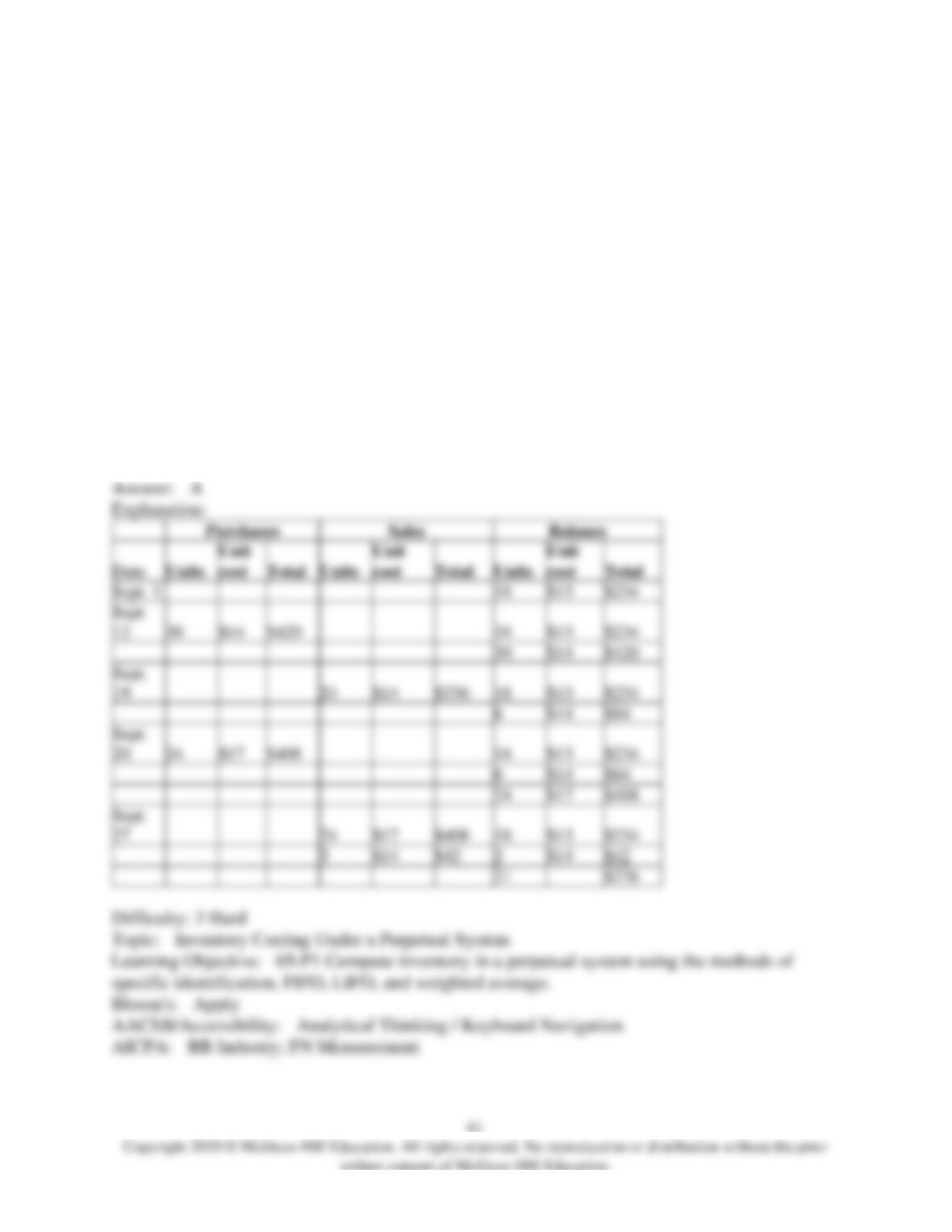
124) A company sells garden hoses and uses the perpetual inventory system to account for its
merchandise. The beginning balance of the inventory and its transactions during September were
as follows:
September 1: Beginning balance of 18 units at $13 each
September 12: Purchased 30 units at $14 each
September 19: Sold 24 units at $30 selling price each
September 20: Purchased 24 units at $17 each
September 27: Sold 27 units at $30 selling price each
If the ending inventory is reported at $276, what inventory method was used?
A) LIFO method.
B) FIFO method.
C) Weighted average method.
D) Specific identification method.
E) Retail inventory method.
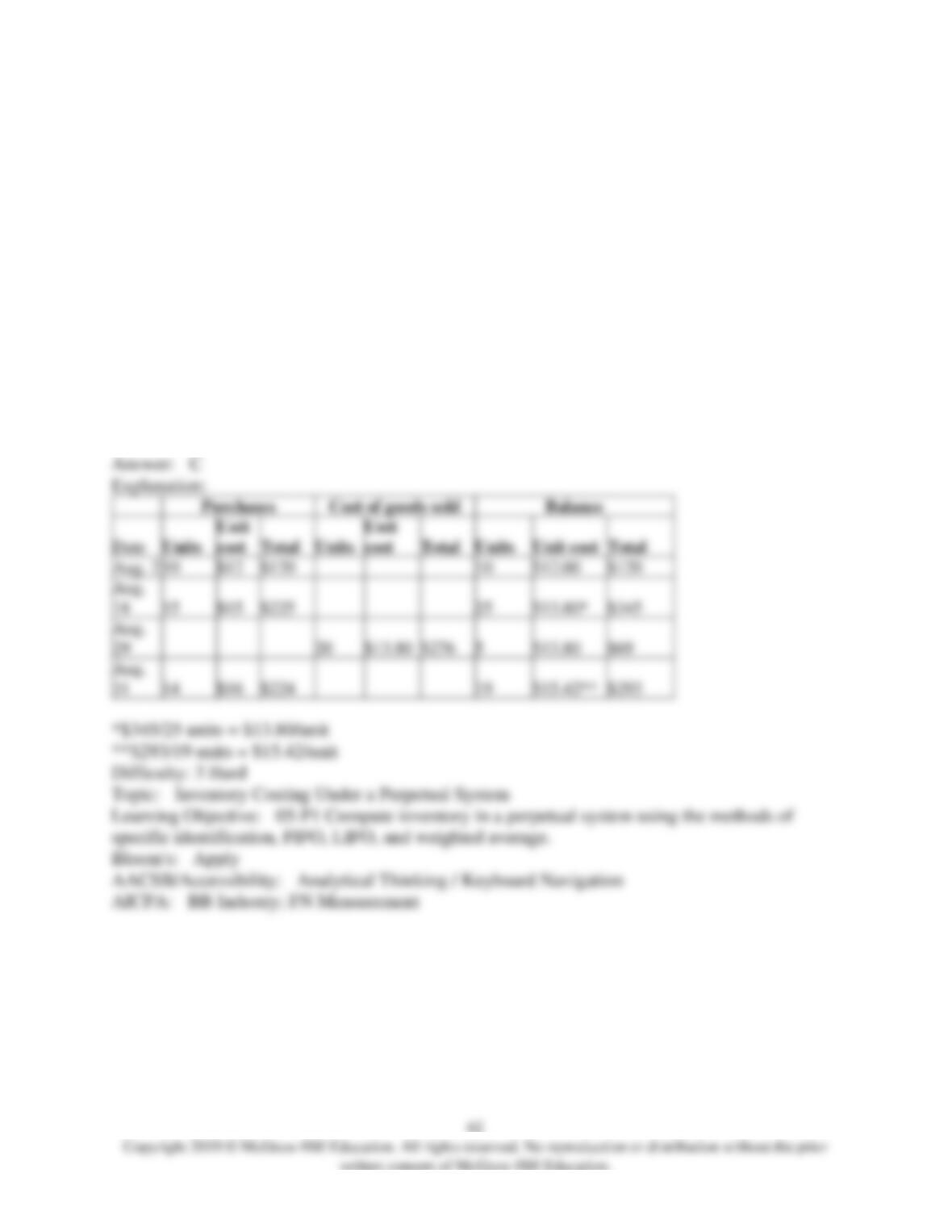
125) Jammer Company uses a weighted average perpetual inventory system and reports the
following:
August 2
Purchase
10 units at $12 per unit.
August 18
Purchase
15 units at $15 per unit.
August 29
Sale
20 units.
August 31
Purchase
14 units at $16 per unit.
What is the per-unit value of ending inventory on August 31?
A) $12.00
B) $13.80
C) $15.42
D) $16.00
E) $17.74
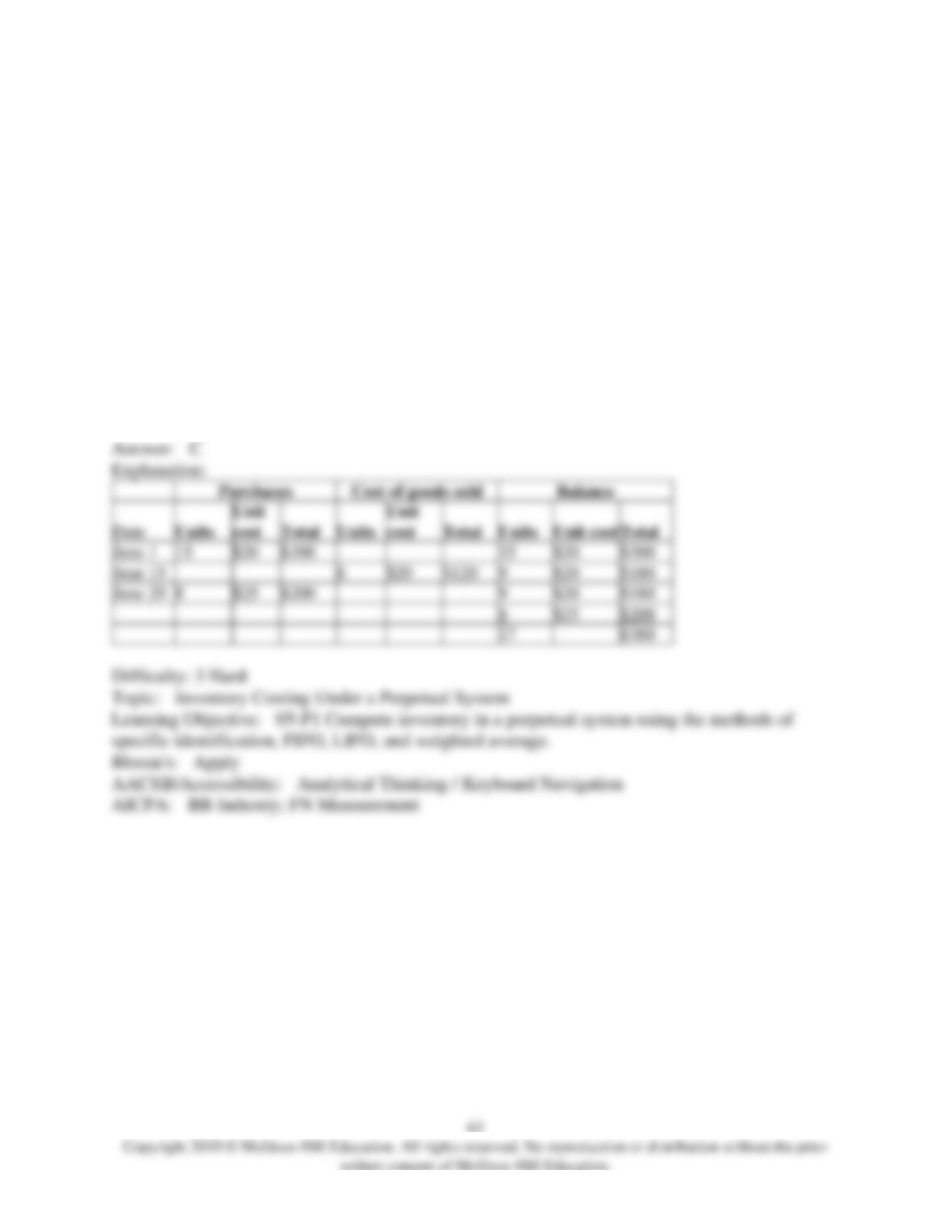
126) Given the following information, determine the cost of the inventory at June 30 using the
LIFO perpetual inventory method.
June 1
Beginning inventory
15 units at $20 each
June 15
Sale of 6 units for $50 each
June 29
Purchase
8 units at $25 each
The cost of the ending inventory is:
A) $200
B) $220
C) $380
D) $275
E) $300
127) In applying the lower of cost or market method to LIFO inventory valuation, market is
defined as:
A) Historical cost.
B) Current replacement cost.
C) Current sales price.
D) FIFO.
E) LIFO.
128) Raleigh Co. has the following products in its ending inventory. Compute the lower of cost
or market total for inventory applied separately to each product.
Product
Quantity
Cost per unit
Market per unit
Jelly
150
$
2.00
2.15
Jam
370
$
2.65
2.50
Marmalade
260
$
3.10
3.05
A) $2,040.50.
B) $2,086.50.
C) $2,018.00.
D) $2,109.00.
E) $2,053.50.
129) Generally accepted accounting principles require that the inventory of a company be
reported at:
A) Market value.
B) Historical cost.
C) Lower of cost or market.
D) Replacement cost.
E) Retail value.
130) Lower of cost or market:
A) Is applied to each individual item, major categories of items, or the whole inventory.
B) Is only applicable to companies using FIFO.
C) Records only an increase in inventory value.
D) Is only applicable to companies using LIFO.
E) Reports all inventory items at full cost.
131) A company’s normal selling price for its product is $20 per unit. However, due to market
competition, the selling price has fallen to $15 per unit. This company’s current FIFO inventory
consists of 200 units purchased at $16 per unit. Net realizable value has fallen to $13 per unit.
Calculate the value of this company’s inventory at the lower of cost or market.
A) $2,550.
B) $2,600.
C) $2,700.
D) $3,000.
E) $3,200.
132) A company normally sells its product for $20 per unit. However, the selling price has fallen
to $15 per unit. This company’s current FIFO inventory consists of 200 units purchased at $16
per unit. Net realizable value has now fallen to $13 per unit. What is the amount of the lower
cost of market adjustment the company must make as a result of this decline in value?
A) $1,000.
B) $1,400.
C) $400.
D) $600.
E) $800.
133) A company’s current LIFO inventory consists of 5,000 units purchased at $6 per unit.
Replacement cost has now fallen to $5 per unit. What is the entry the company must record to
adjust inventory to market?
A) Debit Merchandise Inventory $25,000; credit Cost of Goods Sold $25,000.
B) Debit Cost of Goods Sold $30,000; credit Merchandise Inventory $30,000.
C) Debit Cost of Goods Sold $5,000; credit Merchandise Inventory $5,000.
D) Debit Loss on Inventory $5,000; credit Cost of Goods Sold $5,000.
E) Debit Merchandise Inventory $30,000; credit Cost of Goods Sold $25,000.
134) A company has the following per unit original costs and market values for its inventory.
Lower of cost or market is applied to individual items.
Part A: 50 units with a cost of $5, and replacement cost of $4.50
Part B: 75 units with a cost of $6, and replacement cost of $6.50
Part C: 160 units with a cost of $3, and replacement cost of $2.50
Under the lower of cost or market method, the total value of this company’s ending inventory is:
A) $1,180.00.
B) $1,075.00.
C) $1,112.50.
D) $1,217.50.
E) $1,137.50.
135) A company has beginning inventory of 10 units at a cost of $10 each on February 1. On
February 3, it purchases 20 units at $12 each. 12 units are sold on February 5. Using the FIFO
periodic inventory method, what is the cost of the 12 units that are sold?
A) $120
B) $124
C) $128
D) $130
E) $140
136) A company has beginning inventory of 15 units at a cost of $12 each on October 1. On
October 5, it purchases 10 units at $13 per unit. On October 12 it purchases 20 units at $14 per
unit. On October 15, it sells 30 units. Using the FIFO periodic inventory method, what is the
value of the inventory at October 15 after the sale?
A) $140
B) $160
C) $210
D) $380
E) $590
137) A company had beginning inventory of 10 units at a cost of $20 each on March 1. On
March 2, it purchased 10 units at $22 each. On March 6 it purchased 6 units at $25 each. On
March 8, it sold 22 units for $54 each. Using the FIFO perpetual inventory method, what was the
cost of the 22 units sold?
A) $470
B) $490
C) $450
D) $570
E) $520
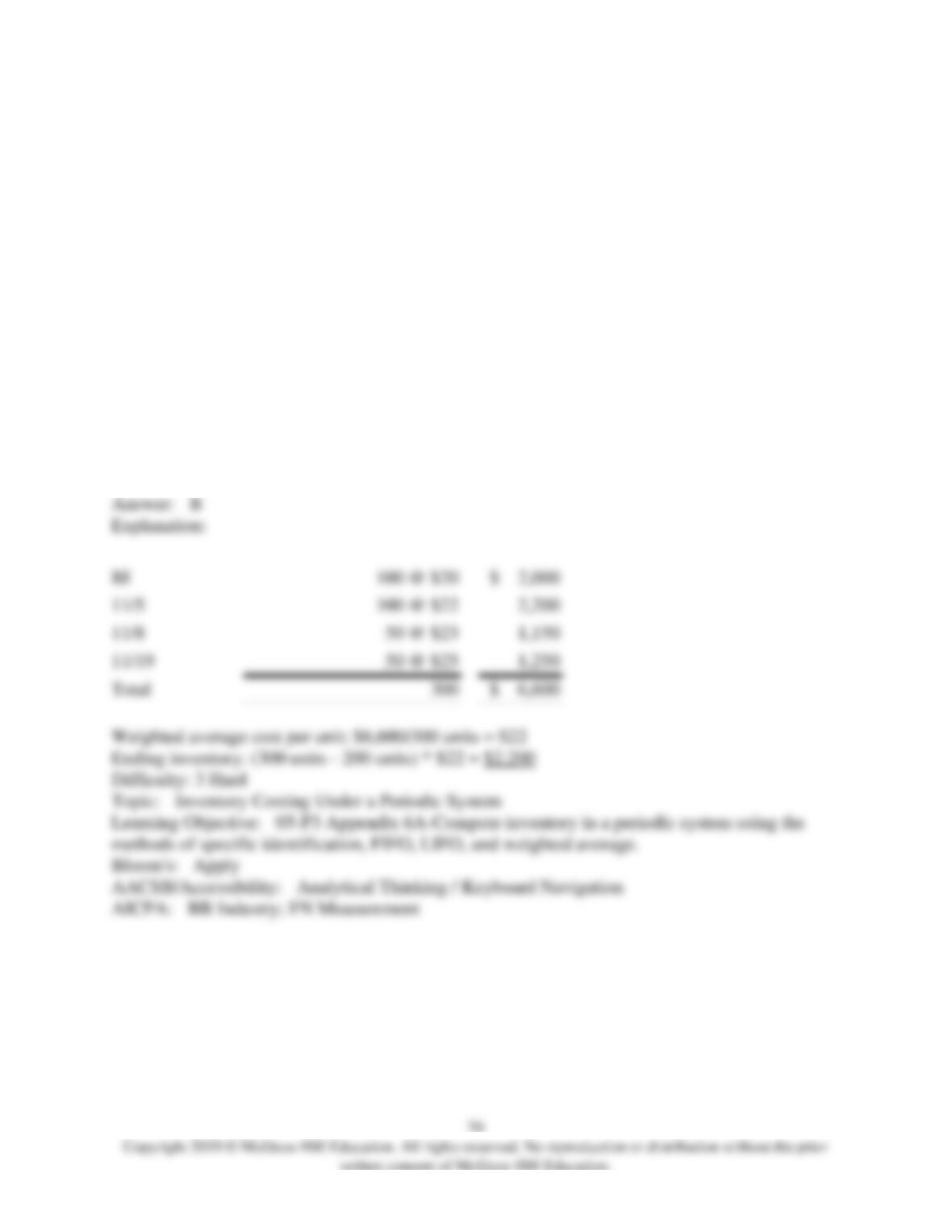
138) A company uses the periodic inventory system and had the following activity during the
current monthly period.
November 1:
Beginning inventory
100 units @ $20
November 5:
Purchased
100 units @ $22
November 8:
Purchased
50 units @ $23
November 16:
Sold
200 units @ $45
November 19:
Purchased
50 units @ $25
Using the weighted-average inventory method, the company’s ending inventory would be:
A) $2,000
B) $2,200
C) $2,250
D) $2,400
E) $4,400
11/5
11/8
11/19
Total
139) Health Defense sells first aid kits and uses the periodic inventory system to account for its
merchandise. The beginning balance of the inventory and its transactions during January were as
follows:
January 1: Beginning balance of 18 units at $13 each
January 12: Purchased 30 units at $14 each
January 19: Sold 24 units at a selling price of $30 each
January 20: Purchased 24 units at $17 each
January 27: Sold 27 units at a selling price of $30 each
If the ending inventory is reported at $357, what inventory method was used?
A) LIFO.
B) FIFO.
C) Weighted average.
D) Specific identification.
E) Retail inventory method.
140) A flood destroyed a company’s warehouse contents on September 12. The following
information was the only information that was salvaged:
• Inventory, beginning: $28,000
• Purchases for the period: $17,000
• Sales for the period: $55,000
• Sales returns for the period: $700
The company’s average gross profit ratio is 35%. What is the estimated cost of the lost inventory
using the gross profit method?
A) $9,705.
B) $25,995.
C) $29,250.
D) $44,000.
E) $45,000.
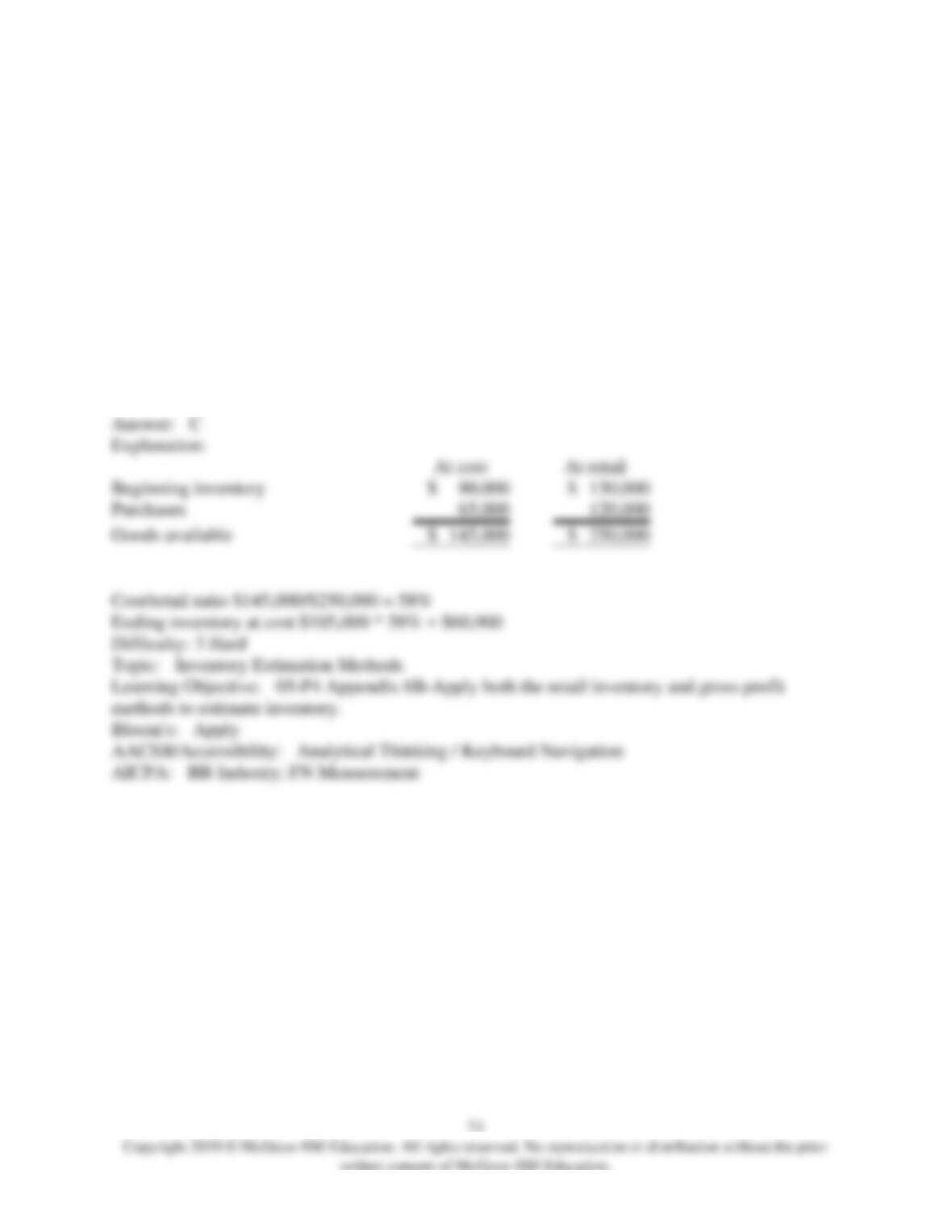
141) A company reports the following information regarding its inventory.
Beginning inventory: cost is $80,000; retail is $130,000
Net purchases: cost is $65,000; retail is $120,000
Sales at retail: $145,000
The year-end inventory shows $105,000 worth of merchandise available at retail prices. What is
the cost of the ending inventory calculated using the retail inventory method?
A) $135,000.
B) $73,125.
C) $60,900.
D) $72,900.
E) $105,000.
142) On March 31 a company needed to estimate its ending inventory to prepare its first quarter
financial statements. The following information is available:
Beginning inventory, January 1: $4,000
Net sales: $80,000
Net purchases: $78,000
The company’s gross margin ratio is 25%. Using the gross profit method, the cost of goods sold
would be:
A) $60,000.
B) $20,000.
C) $58,500.
D) $63,000.
E) $19,500.
143) On March 31 a company needed to estimate its ending inventory to prepare its first quarter
financial statements. The following information is available:
Beginning inventory, January 1: $4,000
Net sales: $80,000
Net purchases: $78,000
The company’s gross margin ratio is 25%. Using the gross profit method, the estimated ending
inventory value would be:
A) $82,000.
B) $60,000.
C) $20,000.
D) $22,000.
E) $19,500.
144) Big Box Store has operated with a 30% average gross profit ratio for a number of years. It
had $100,000 in sales during the second quarter of this year. If it began the quarter with $18,000
of inventory at cost and purchased $72,000 of inventory during the quarter, its estimated ending
inventory by the gross profit method is:
A) $30,000.
B) $21,000.
C) $20,000.
D) $18,000.
E) $27,000.
145) On January 31, a company needed to estimate its ending inventory to prepare its monthly
financial statements. The following information is currently available:
Inventory as of January 1: $120,500
Net sales for January: $400,000
Net purchases for January: $270,500
This company typically achieves a gross profit ratio of 15%. Ending Inventory under the gross
profit method would be:
A) $102,425.
B) $10,425.
C) $9,000.
D) $51,000.
E) $51,425.
146) Interim financial statements:
A) Are required by the Congress.
B) Are necessary to achieve full disclosure about a business’s operations.
C) Are statements prepared for periods of less than one year.
D) Require the use of the perpetual method for inventories.
E) Cannot be prepared if the company follows the conservatism principle.
147) Jefferson Company has sales of $300,000 and cost of goods available for sale of $270,000.
If the gross profit ratio is typically 30%, the estimated cost of the ending inventory under the
gross profit method would be:
A) $60,000
B) $180,000
C) $30,000
D) $90,000
E) $120,000
148) Oxford Packing Company reported net sales in November of the current year of
$1,000,000. At the beginning of November, the company reported beginning inventory of
$368,000. Cost of goods purchased during November amounted to $217,500. The company
reported ending inventory at the end of November of $226,750.
The company’s gross profit rate for November of the current year was:
A) 35.9%
B) 18.8%
C) 81.2%
D) 64.1%
E) 58.6%
149) On April 24 of the current year, The Memphis Pecan Company experienced a tornado that
destroyed the company’s entire inventory. At the beginning of April, the company reported
beginning inventory of $226,750. Inventory purchased during April (until the date of the
tornado) was $197,800. Sales for the month of April through April 24 were $642,500. Assuming
the company’s typical gross profit ratio is 50%, estimate the amount of inventory destroyed in the
tornado.
A) $212,275
B) $103,300
C) $217,950
D) $321,250
E) $157,788
150) Avanti purchases inventory from overseas and incurs the following costs: the merchandise
cost is $50,000, credit terms 2/10, n/30 that apply only to the $50,000; FOB shipping point
freight charges are $1,500; insurance during transit is $500; and import duties are $1,000. Avanti
paid within the discount period and incurred additional costs of $1,200 for advertising and
$5,000 for sales commissions. Compute the cost that should be assigned to the inventory.
A) $50,000
B) $53,000
C) $52,000
D) $51,500
E) $53,200
151) Hasham purchases inventory from overseas and incurs the following costs: the merchandise
cost is $80,000, credit terms 1/10, n/30, applicable only to the $80,000; FOB shipping point
freight charges are $2,500; insurance during transit is $300; and import duties are $1,500.
Hasham paid within the discount period. Compute the cost that should be assigned to the
inventory.
A) $83,500
B) $79,200
C) $81,700
D) $84,300
E) $81,000
152) A company decides which inventory amounts to record to cost of goods sold and which
amounts remain in ending inventory:
A) Through application of the cost-benefit constraint.
B) By selecting one of four possible inventory costing methods.
C) By selecting the cost principle.
D) Through application of the conservation constraint principle.
E) Is the lower of cost or market principle.